For those of you who are not familiar with it, T”U BiShvat is the fifteenth of the month of Sh’vat. (I’d spell it out for you in Hebrew, but I’ve discovered that when I post things all the Hebrew gets reversed!) The letters Tet Vav in Hebrew spell T”U, and are equal to the number fifteen. Originally this day was set to mark the time when you could first harvest your fruit trees. The Mishna, Tractate Rosh HaShanah, sets four new years. The first of Nisan (later in the spring) is “new year for kings and festivals”. The first of Elul (fall) is the “new year for the tithe of cattle”. The first of Tishrei (right after Elul) is the “new year for years” — Rosh HaShanah. And the fifteenth of Shvat is the “new year for trees”. The Talmud sets Tu BiShvat as the cut-off date in the Hebrew calendar for calculating the age of a fruit-bearing tree. Fruit that ripens on a three-year-old tree before Tu BiShvat is forbidden to eat, while fruit ripening on or after Tu BiShvat of the tree’s third year is permitted. (These rules are still followed in Orthodox Judaism.)
Per Wikipedia, “In the Middle Ages, Tu BiShvat was celebrated with a feast of fruits in keeping with the Mishnaic description of the holiday as a “New Year.” In the 16th century, the kabbalist Rabbi Yitzchak Luria of Safed and his disciples instituted a Tu BiShvat seder in which the fruits and trees of the Land of Israel were given symbolic meaning. The main idea was that eating ten specific fruits and drinking four cups of wine in a specific order while reciting the appropriate blessings would bring human beings, and the world, closer to spiritual perfection.”
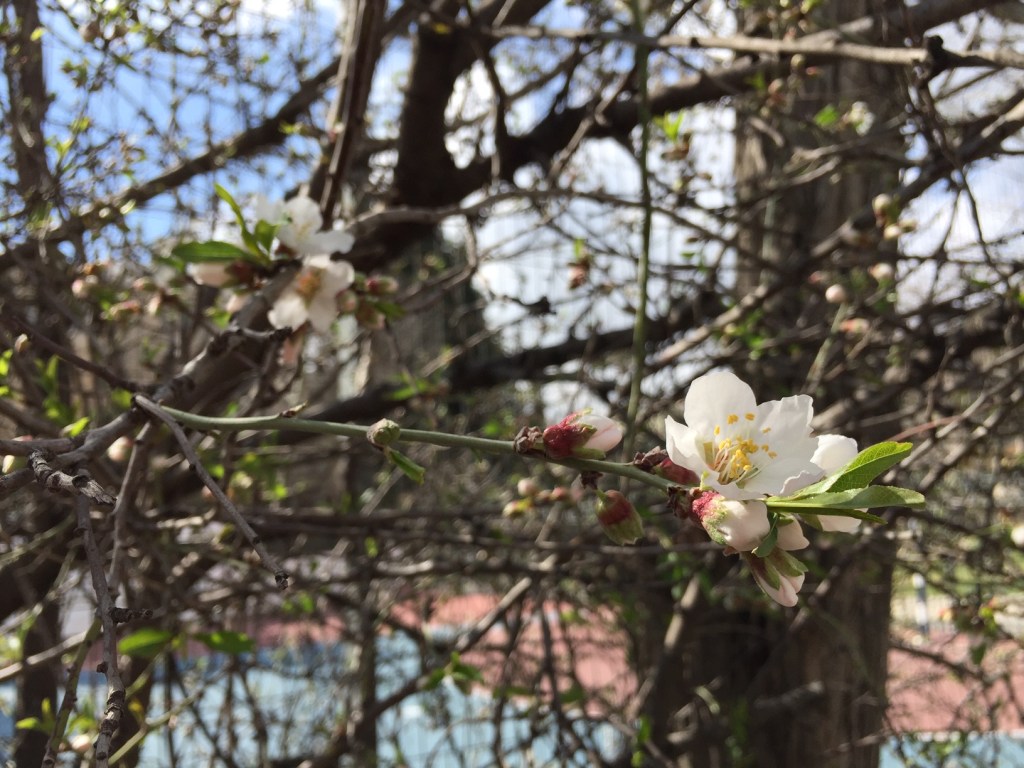
One of the delights of living in Israel is living on a Jewish calendar. A month before T”U BiShvat, around the time when you might first see Valentine’s paraphernalia appears in the U.S., the supermarkets here put up a big display of dried fruits and nuts toward the front of their stores. This once minor holiday has become significant for many, both as a day of tree planting and environmentalism and as an opportunity to celebrate T”U BiShvat seders as the Kabbalists once did. Also, around this time the almond blossoms open (they were only a few days after T”U BiShvat this year). In Vermont, we usually have several feet of snow at T”U BiShvat, and it always seems silly to sing “The almond trees are blooming”. Here, the holidays fit the seasons. (Still, I also think fondly of our T”U BiShvat seders at home in Brattleboro, where we dip our challah in maple syrup as my friend Beth from Maine taught me, and recommit ourselves to trying to save our embattled environment.)
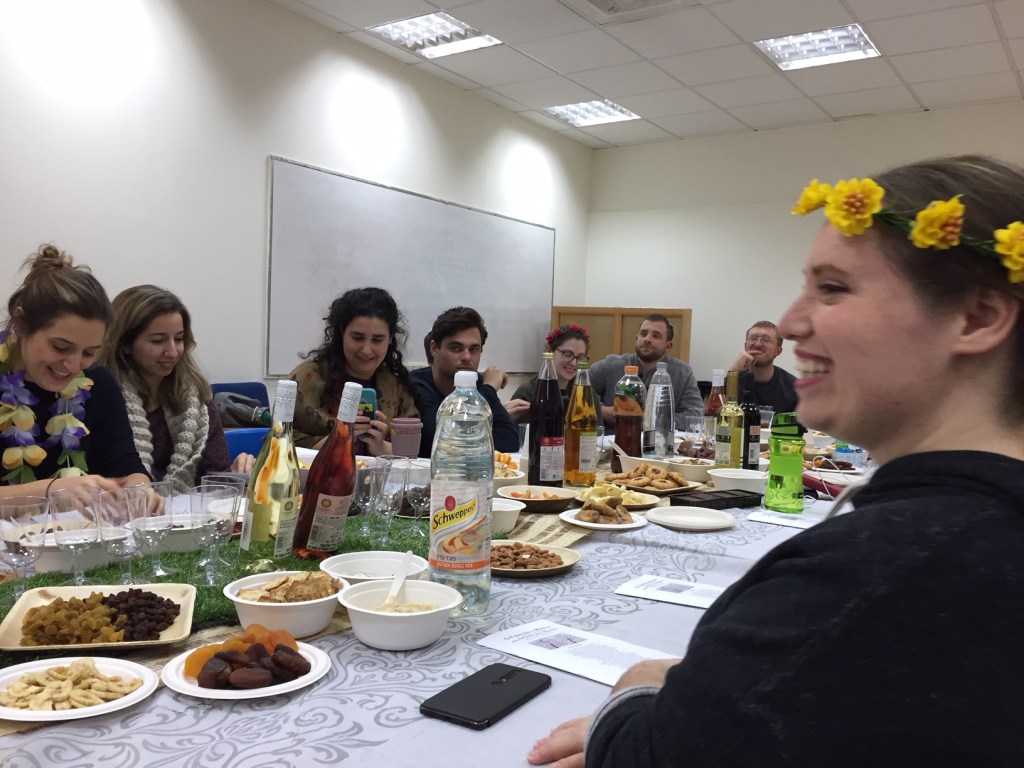
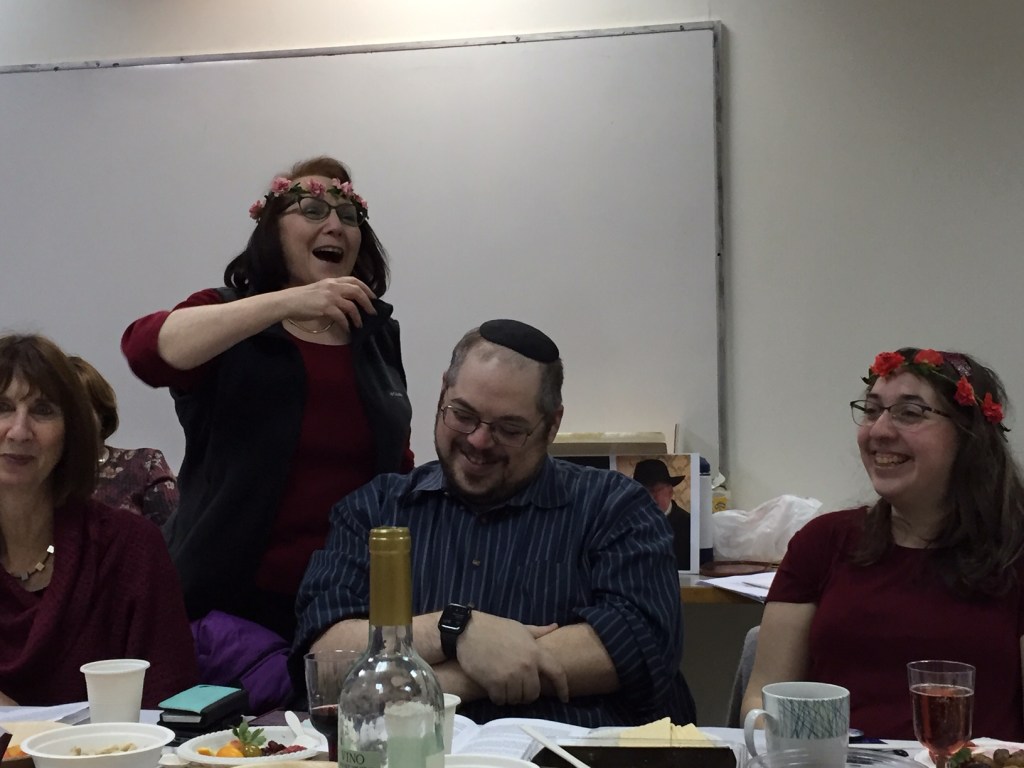
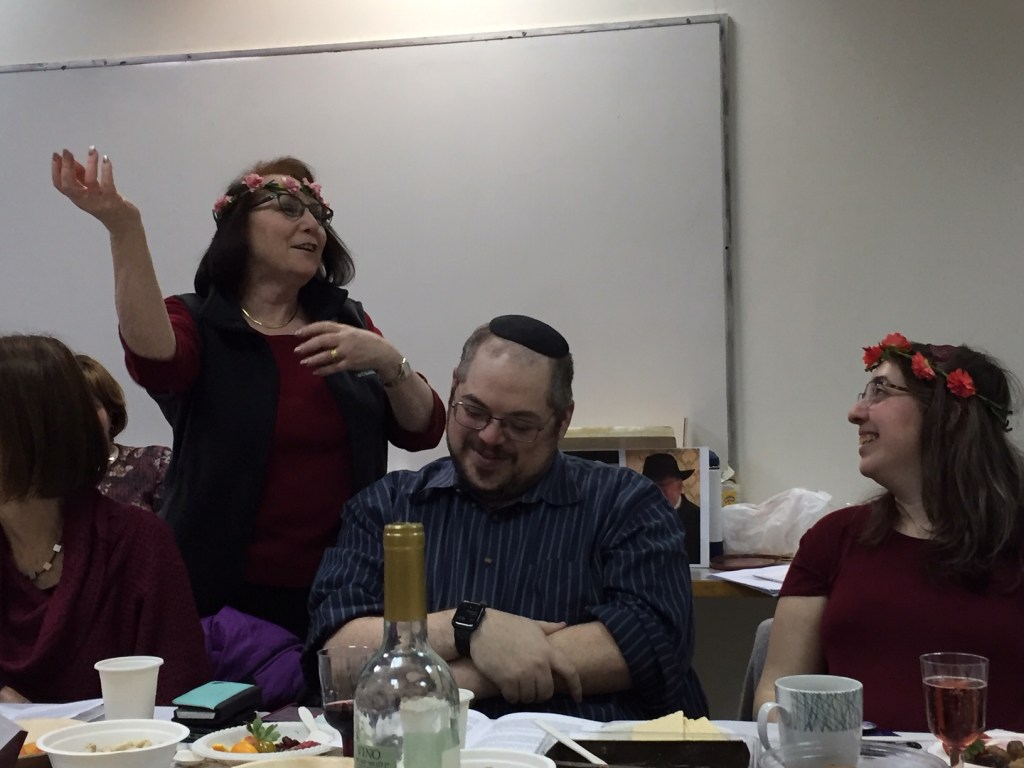
My friend Sara Laya, who is a student at Pardes and a ten-year resident of Israel, decided to commemorate her father’s yahrtzeit with a T”U BiShvat seder. She held the seder at pardes, and invited all the students, but also invited other friends and all the branches of her family, both from the U.S. and Israel.
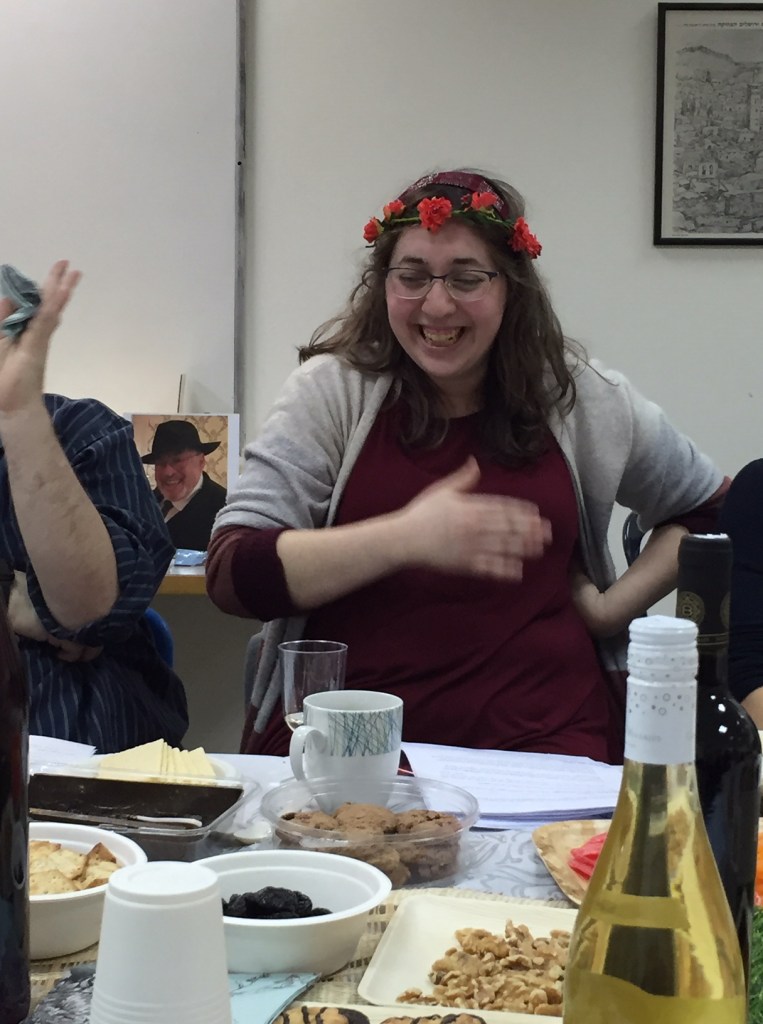
The photo in the background is his father, Aaron BenTzion ben Chaim-Meyer Halevi, zichrono livracha (may his memory be a blessing). Same smile!
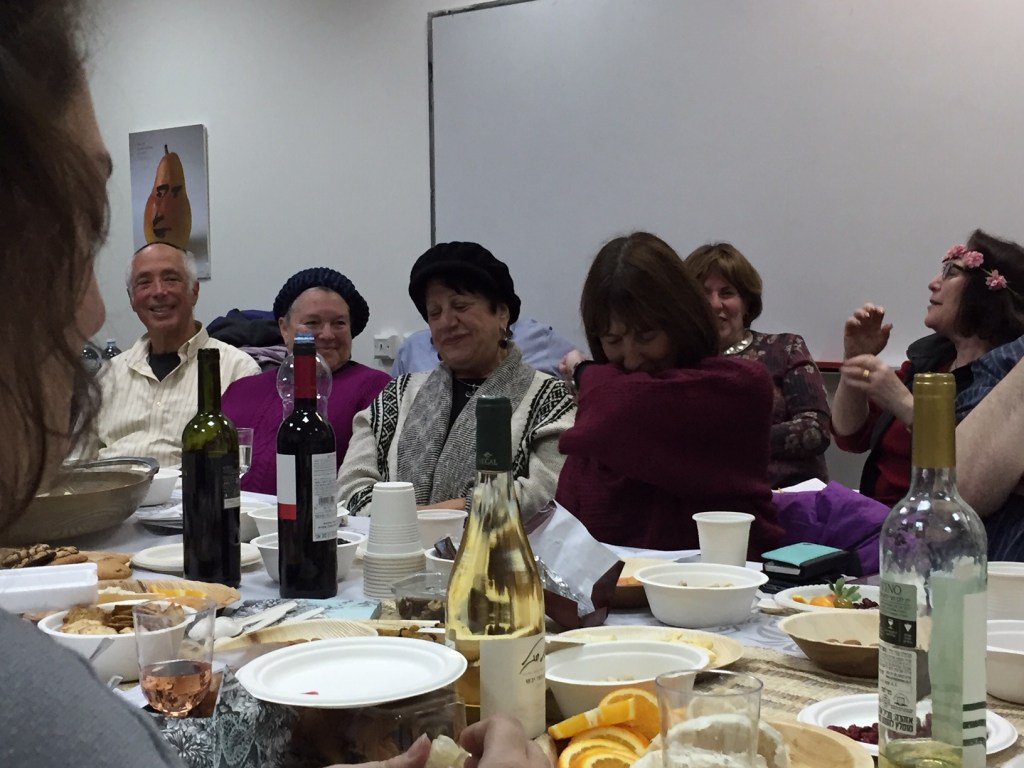
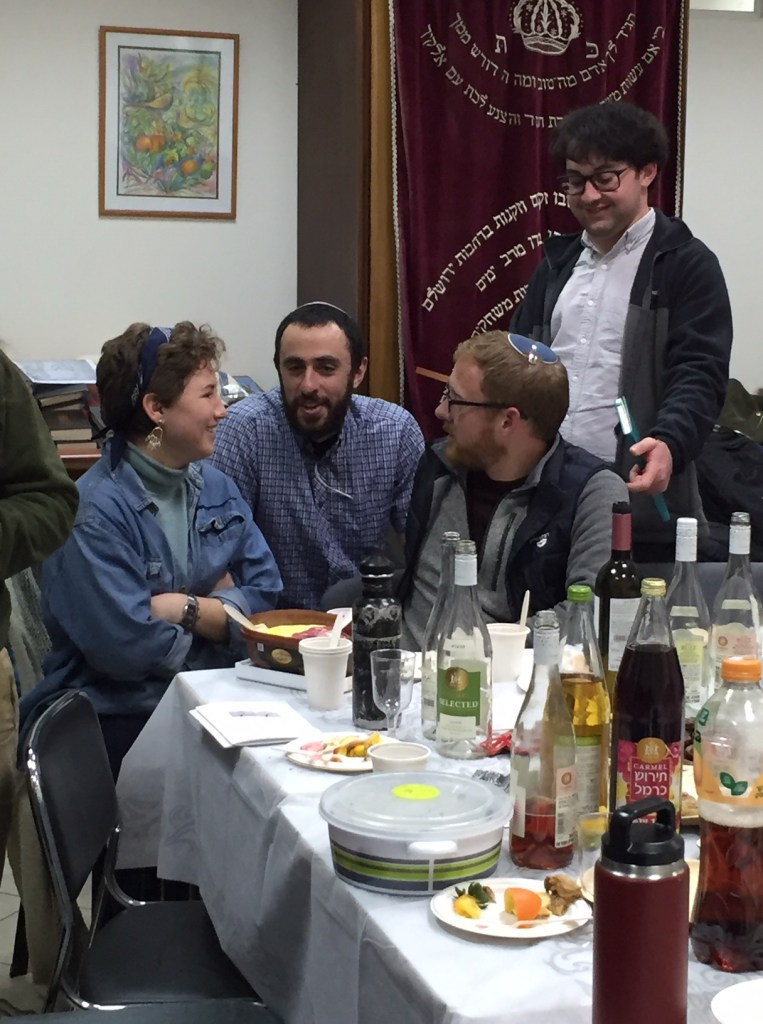
I know Sara Laya worried about how the more frum (observant) members of her family would mingle with the loosey-goosey crowd at Pardes. But her whole family showed up, and while they sat together and we sat together, it somehow all worked. Sara Laya had designed and printed a nice little haggadah for her seder. We drank the traditional four cups of wine or juice — white for winter, white with a drop of red for spring, half white half red for summer, and red for fall. We ate the seven species associated with Eretz Yisrael — wheat, barley, figs, dates, olives, grapes, and pomegranates. We also ate a “shehekhianu fruit” — a fruit that was new to us for the season, over which we could say the shehekhianu blessing for new or seasonally returning things. And we partook of the fruits that symbolize the four worlds of kabbalistic thinking — the world of action, the world of formation, the world of creation, and the world of essence. The table was well loaded with dried fruits, fresh fruits, and baked goods, as well as ice cream, cake, and other tasty things. We said blessings, sang songs, and read selections from the Talmud and from other sources that Sara Laya had compiled. Several people offered memories of Sara Laya’s father, and others told more general stories and thoughts about the holiday and the fruits associated with it. Our Marxist journalist classmate Isaac recounted a story about Walter Benjamin and some figs that I’m fairly sure puzzled us all, especially the Orthodox crowd — but he also told us an interesting fact about the fig trees if Tel Aviv. They are an Asian variety that orginally had no pollinators in Israel–tehy were planted with the thought that if they had no fruit they wouldnt mess up the sidewalks – -but at some point the pollinating wasps found a way here, and now in the season there are figs on every tree in Tel Aviv.
I was touched by Sara Laya’s gift to all of us in memory of her father. It was delightful way to spend a cold rainy Jerusalem night. Here are a few more pictures from this lovely event.


 Nine months in Israel
your stories – blogs-have so much resonance for me of your life and time in israel i love all the photos and especially of plants — we hardly ever associate israel with such many blooming flowers – so for me it has been a delightful discovery to see those lovely plants and understand that the desert does bloom-after all people have lived in the desert for millennia i also feel i know your friendsand the joy of being in israel –albeiet temporarily –is palpable through your blogs and how novel and liberating it must feel to just follow the jewish calendar and be in a place where friday night and saturday becomes something other than daily life – celebrated in different ways by different israelis but yet part of the culture and heritage of the nation
i also experienced the wonder of the seder table
thank you kate
selma
On Mon, Feb 24, 2020 at 8:53 AM Nine months in Israel wrote:
> cantorkate posted: ” For those of you who are not familiar with it, T”U > BiShvat is the fifteenth of the month of Sh’vat. (I’d spell it out for you > in Hebrew, but I’ve discovered that when I post things all the Hebrew gets > reversed!) The letters Tet Vav in Hebrew spell T”” >
LikeLike
Dear Selma, I’m glad you a enjoying my blog. Yes, the desert does bloom — but Jerusalem ,especially this very rainy winter, is not a desert! It is very green and damp here right now! And I’m told that out in the desert and in the field of the Galilee there are whole fields of wildflowers right now. In the south that have what they call “Darom Adom” — “Red South” — right now, where the hillsides become red with poppies and anemones. Of course, this is also near Gaza so maybe not the safest place to visit just now…Yes, I”m having a good experience here- — but also, I look forward to coming home to my beloved Vermont and BAJC!
LikeLike