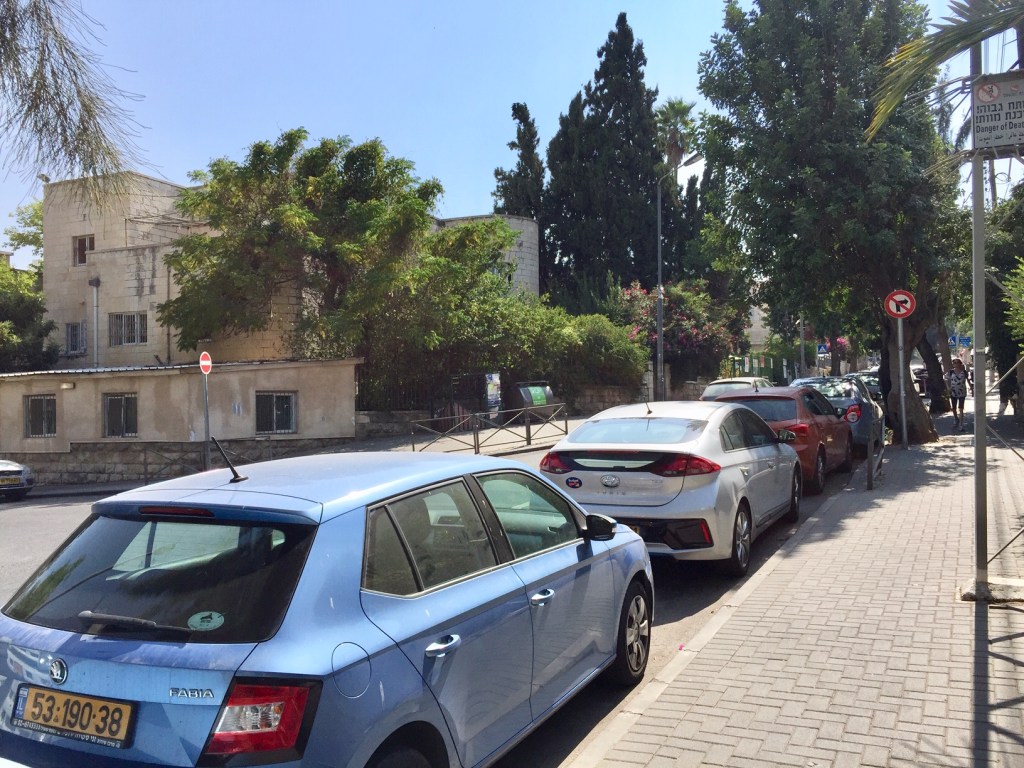
I had promised that I would tell you the story of my neighborhood, Katamon (officially called Gonen –but no one uses that name). However, as I read over the Wikipedia entry, I decided I would let you refer to that yourselves, if you are so inclined. https://en.wikipedia.org/wiki/
Suffice it say that like much of this beautiful, contested country, my neighborhood has had a complex and sometimes violent history. As I sit here on my patio watching the half moon set and the night time clouds gather overhead, it’s hard to imagine that this peaceful place was so recently the site of conflict. It’s a very gentrified neighborhood now, full of French and Americans (I can hear both languages, as well as Hebrew, drifting down from the upstairs balconies of this six or seven floor apartment building.) New apartment blocks are going up everywhere. There are plenty of little shops, offices of doctors and acupuncturists and yoga practitioners and lawyers, batei kafe (cafes), a hospital, small supermarkets, and more, within easy walking distance.
It’s also a religious neighborhood — Modern Orthodox and also Haredi (“Ultra-Orthodox”). Up the hill a little is an area known as “the minyan factory”, where at any time of the day you can easily find ten guys if you need to say kaddish. There are several nearby synagogues, including the large new Sephardi synagogue next door. Early in the morning I hear the sound of men’s voices raised in slichot (penitential pre-Rosh HaShanah song), followed by the merry sound of children’s voices. (Mostly merry – -there is one child who clearly is not adapting to his new school!) When I leave for school at eight in the morning, I meet parents in cars, on bikes, on foot, on scooters, bringing their small children to the gan (kindergarten).
But I see plenty of secular folk as well. Almost exclusively white. No Ethiopian Jews to speak of, and no Arabs except working construction or in the shops. Middle class looking people, walking dogs, wheeling children in strollers, hurrying off to classes or to work, sitting in the cafe run by Chabad (the Orthodox Jewish outreach group known for its “mitzvah mobiles”).
Every place has history, of course. When I am at home in Brattleboro, I don’t think much about how I am living in a place where my ancestors displaced the Abenaki Indians (I am being a bit euphemistic with the word “displaced”). And here, it is difficult to say to whom any area or piece of land belongs. It’s possible to say, “The Jew were here first” — possible, and not wrong. And yet, if the Abenakis were to suddenly multiply and reclaim Brattleboro, imagine the violence and the anguish…


Dear Kate
Thanks for adding me to your list of receivers. I am really enjoying these peeks into your new life.
Love, Celia
>
LikeLike
THanks, Celia — feel free to share it with people who might be intersted.
LikeLike