It had to happen eventually. I’ve been here a little more than two weeks, managing everything more or less, walking to school even with a cold, improvising and bumbling along, feeling like an idiot, often being treated like an idiot (on the street and sometimes in class), socializing with lots of new people and sometimes feeling I was putting my foot in my mouth, and fulfilling my role as the baalat habayit (or if you prefer the Yiddish, balabuste) of my apartment by cleaning and shopping and preparing for Shabbat, not to mention the endless walking here and there (I haven’t been on a bus yet!)…Yesterday, I gave up. I took a real Shabbat — a Rest — by staying home.I attended a lovely Shabbat dinner Friday night, but on Saturday I did not even unlock my apartment door. I napped. I read a book in English. Eventually I studied a little Hebrew — just a little. I had long conversations via Skype with a friend and a relative. And today…today I woke up refreshed and ready to begin the whole process again.
So what have I been up to since I last wrote? Trying to understand the convoluted and compact text of the first sugiya (section) of the seventh perek (chapter) of Yoma — the book of Mishna and Gemara that deals with Yom HaKippurim, or Yom Kippur. According to the Society for the Interpretation of Talmud, “The sugya is the basic unit of organization in Talmudic literature, more so than the ‘page’ (Hebrew daf), which is merely an external trapping. Someone studying Talmud should be directed to understanding the material at the level of the sugya, with careful attention paid to its internal structure, its major sections, and the nature of its component parts, with the words of the earliest generations of sages(Tanna’im) considered in their own right, the words and reported actions of the later sages (Amora’im) too considered in their own right, and finally the words of the anonymous editorial voice of the Talmud considered as such.” Thus, I and my classmates in Leah’s class have been excavating this sugiya, a process which took us down several rabbit holes and around Robin Hood’s barn, after which we arrived right back where we started from (not in Philadelphia…)
In Rahel’s class we’ve also been digging into Mishna — the foundational texts collected and edited by R. Yehuda haNasi, upon which all of the rest of Talmud bases itself (at least in part). And in Nechama’s class we’ve been sifting through some of what Rabbanit Nechama refers to as the “Top Twenty Greatest Hits of the Talmud”, starting at the very beginning of everything with the famous section on “When do we say the nighttime Shema?”, through which we learned a lot about life after the destruction of the Temple, and a very startling section of Berakhot , 17 b, 19b-20a, in which the question of how to be compassionate to mourners leads oddly into a thicket of bad behavior by some rabbis who surely(according to the laws of Judaism) ought to have known better.
I take two Bible classes as well. In one we’ve been shoveling our way through the Book of Joshua — with most of the shoveling being done by the teacher in lecture form, even though he admitted to me that he personally hates sitting through lecture classes. (Me too!!) In the other, our archeological explorations of text have been conducted in Hebrew, as we have heard about and also discussed the Torah portion of the week in the very tongue it’s written in (more or less). Oh, and there’s an evening class called “Unpacking the Sages” – I cannot even tell you what we may uncover there, as the first class was spent on the teacher explaining to us, with good deal of obscure terminology and reference to many academic theories, why he does not believe in obscure terminology or academic theories…
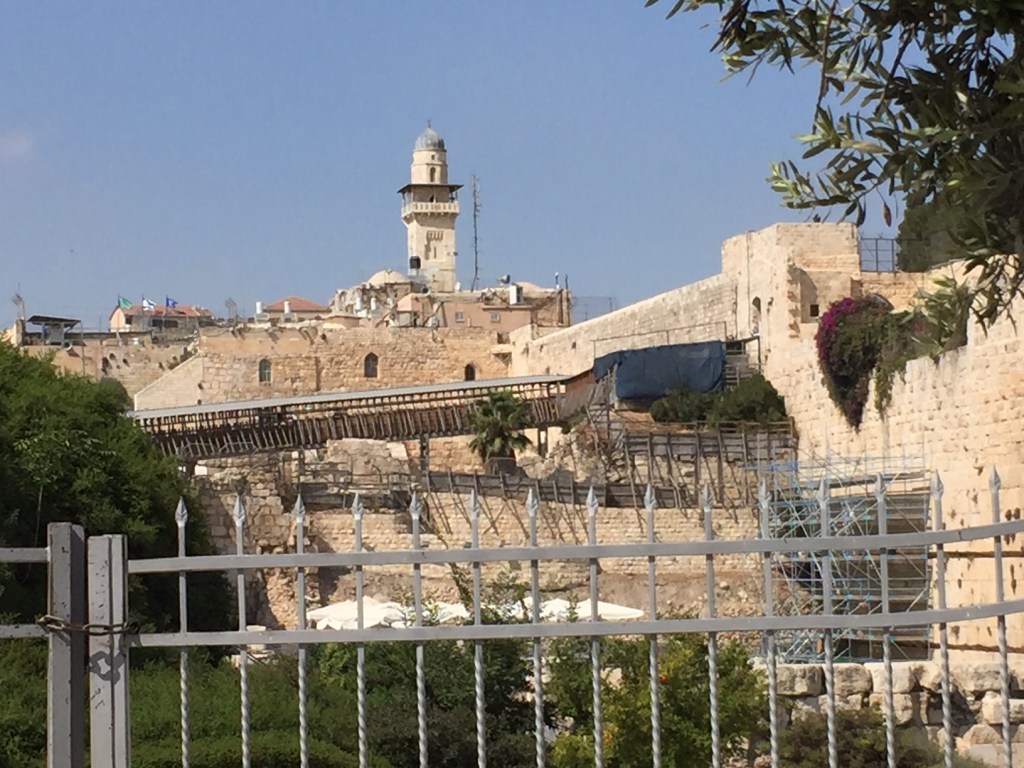
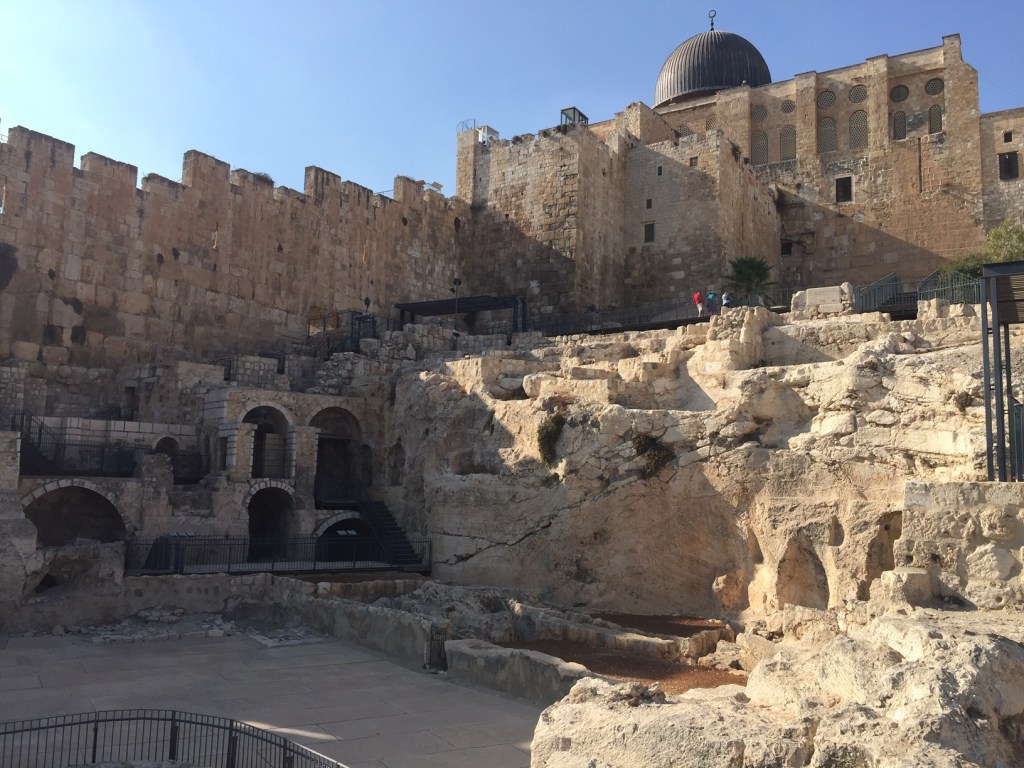
Why am I using an archeological motif? Two reasons: one, I took a tiyyul with a guide and few classmates to the Southern Excavations — the area South of the Temple Mount (Har HaBayit, the Mountain of the House). I have loads of pics — that will be another posting I think. Two, I’ve been musing not only on the textual digging we’ve been doing at school ,but also the mind-body-soul digging that I seems to be inevitably engaging in during this whole strange process. Before I left Vermont, I had spent a good deal of my summer reflecting on and revisiting my past — not just my life with my husband, but also my life before I knew him, when I was growing up in Marlboro, attending Marlboro College, and just generally maturing as a human being. When I arrived here I set all that aside for a time; I was overwhelmed by the stimuli of my new life. Some time last week I found my past catching up with me again. Now, my task seems to be to reclaim myself — my past, my experiences, my existing body of knowledge — and integrate it into the life I am living now.
My day of rest was a key to this process. To simply be, to go on strike in a sense, to forget my struggles with Hebrew, my struggles with Mishna and Gemara, my struggles with daily existence in a foreign land — this allowed me to remember that I am not an idiot, I am not generally tactless, I am on the whole a reasonably intelligent and sensitive human being. My life now is not only what I see on the surface — it rests on the layers of my past, and the past of people before me, my family, my teachers, my friends. As much as the Talmud is about generations of Tannaim and Amoraim, so too is any life — mine, for instance — about the generations that came before me, and about my own previous life experiences.
Tomorrow, I’ll tell you a little about the real excavations — at the Southern Wall.
 Nine months in Israel