As I write this, rockets are raining down on S’derot, N’tiv HaAsara, and the whole region proximate to Gaza, as far north as Tel Aviv. How ironic that I happened to put off until today the account of our final stop on the tiyyul in late October, to Netiv HaAsara and a wonderful woman there who is a peace activist. I hope you will all keep Israel and Gaza in your prayers these next few days, as it looks like a dicey time for all concerned. That being said, I can understand Israel’s choice to assassinate the leader of the Islamic Jihad, Bahaa Abu el-Ata. His group has been goign against agreements Israel has with Hamas and firing rockets and planning other attacks on Israeli civilians.
So — maybe it’s a good time to talk about peace here…
When we left Sderot we traveled a short way to the village of Netiv HaAsara. There we were welcomed very graciously into the home of a lovely older English-Israeli woman, Roni. When we had all gathered in her small living room amid the beautiful oil paintings done by her husband, Roni began by telling us the history of her village. It began as a settlement in the Northern Sinai, after Israel had annexed that territory as a buffer zone. It was a beautiful location, Roni said. Crops grew well, especially winter crops. They had a good relationship with their Palestinian and Gazan neighbors.
In 1979, to everyone’s astonishment, Anwar Sadat made peace with Israel. (Do you remember where you were when this happened? I heard it on the living room radio in my parents house — on Robert J. Lurtsema’s Morning Pro Musica. I was sixteen, a student at Marlboro College.) Israel left the Northern Sinai, and the settlers of Netiv HaAsara had to leave “our beautiful life in the Sinai”. The village was moved to the border with the very top of the Gaza strip, because they wanted to be as near to their previous home in Sinai as they could. There were 66 families. (There are now 230 families in Netiv HaAsara, with 20 more expected to move in soon.)
In Roni’s telling, the early years were good. Their relationship with their Gazan neighbors was friendly. Roni’s husband, an Egyptian-Israeli, worked at his specialty, which is agricultural development. But in the 1990s things went bad — it was the beginning of suicide bombings, tunnels, rockets, flaming kites… Now, when they hear the call of Tzeva Adom, Code Red, they have fifteen seconds to get to a shelter or safe room. Roni told us a story of how recently, in the stress of getting herself, her husband, and their adult daughter and her children into the safe room, Roni slammed her hand in the heavy metal door of the mamad, the safe room. Her daughter was so horrified at the sight that she fainted. EMTs were called, and while the red alert was still on, they were driven to the hospital. “Our community is very strong,”Roni said. “And we have lots of help. W have the Resilience Center. I have gone there. They help with PTSD. Of course, I think everyone is Israel has PTSD, really.”
“It’s wonderful when you only know one side of the story; you can be completely at home with yourself,” Roni said. She talked about how her husband, who had left Egypt with nothing but a suitcase because he was driven out, came to make his own peace with Egypt, finally returning there (with her) to live for five years to help the government with its agriculture. So, too he has come to know more about the Palestinian side of the story, and to work to help people within Gaza. She has friends in Gaza, with whom she communicates regularly by Skype. She sends packages — baby clothes, toys, and so on. “What does it matter how long the Palestian People has existed. They are here now, and they feel that this is their home, just a I feel that this is my home,”she said. “It is never going to be just one of us instead of the other. We’ve got to believe that the solution is there — and it is.”
She works with various organizations. One is the Gaza Youth Committee, which teaches young people to help clean Gaza rather than to storm the border in a futile (and life-threatening) attempt to cross. The help with olive picking at the Border, and work with a US program called “Stars of Hope”. (https://starsofhopeusa.org/) She also works with Lighthouse for Awareness of Gaza. This group meets at a nearby kibbutz once a week to learn about Gaza. She is also involved in something called “The Way to Recovery”. She introduces children from Israel and from Gaza to each other via Skype, and they send gifts to each other. There are two connected youth theater groups, one on each side ofthe border.
“If I want to be safe, I must give them a life,” she said. She noted that Gazans currently have at most six hours a day of electricity, and no clean drinking water whatsoever — even showering in their water is not really safe. You need three permits to leave Gaza — one from Hamas, one from the Palestinian Authority, and one from Israel. In other words, getting out is virtually impossible.
“Both sides are dreaming if they think one side can win,”she said. “There is a risk to open the border, but it’s a risk of hope. She said she is leaning now toward the idea of a one state solution. She doesn’t give up hope for peace some day.
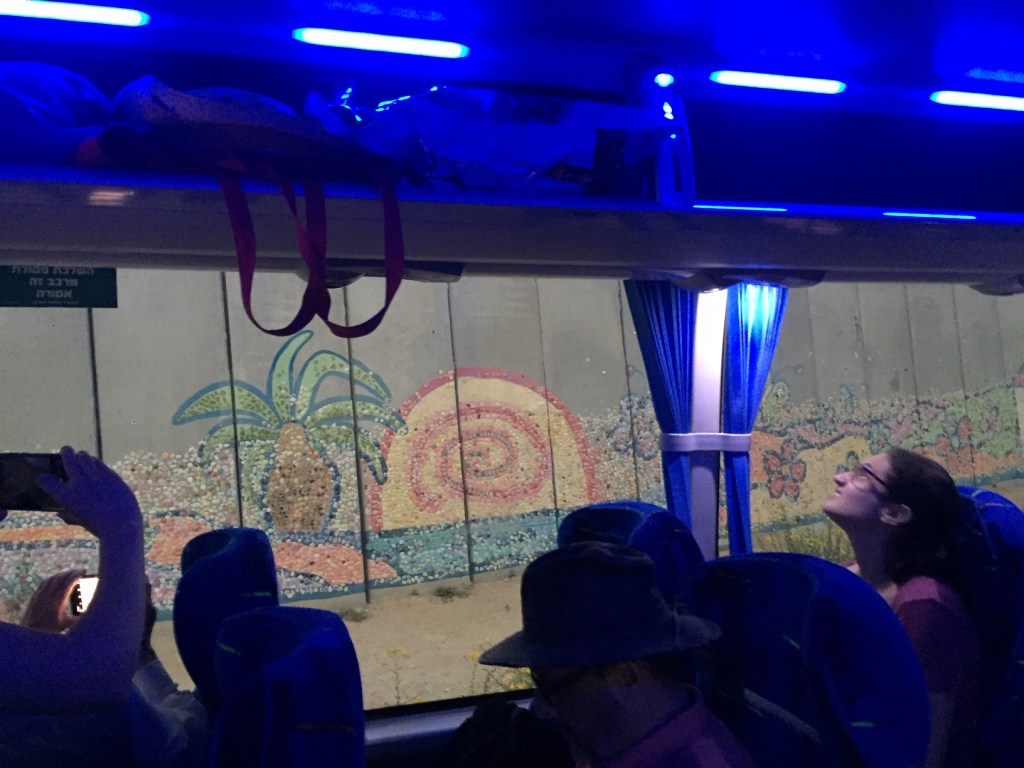
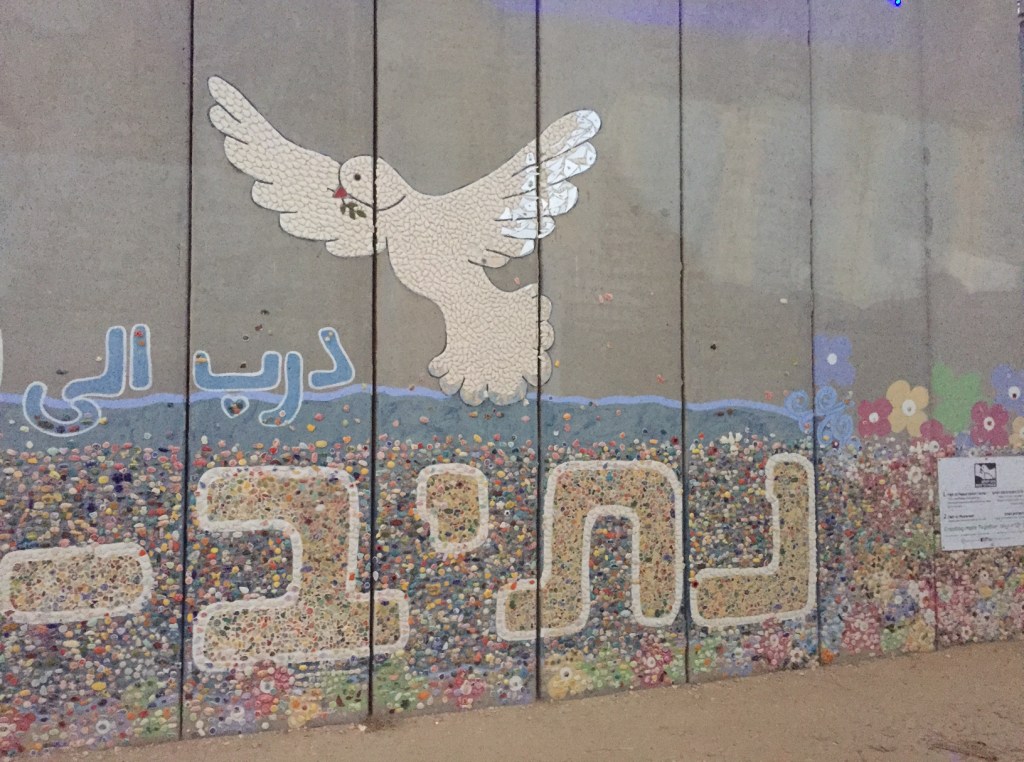
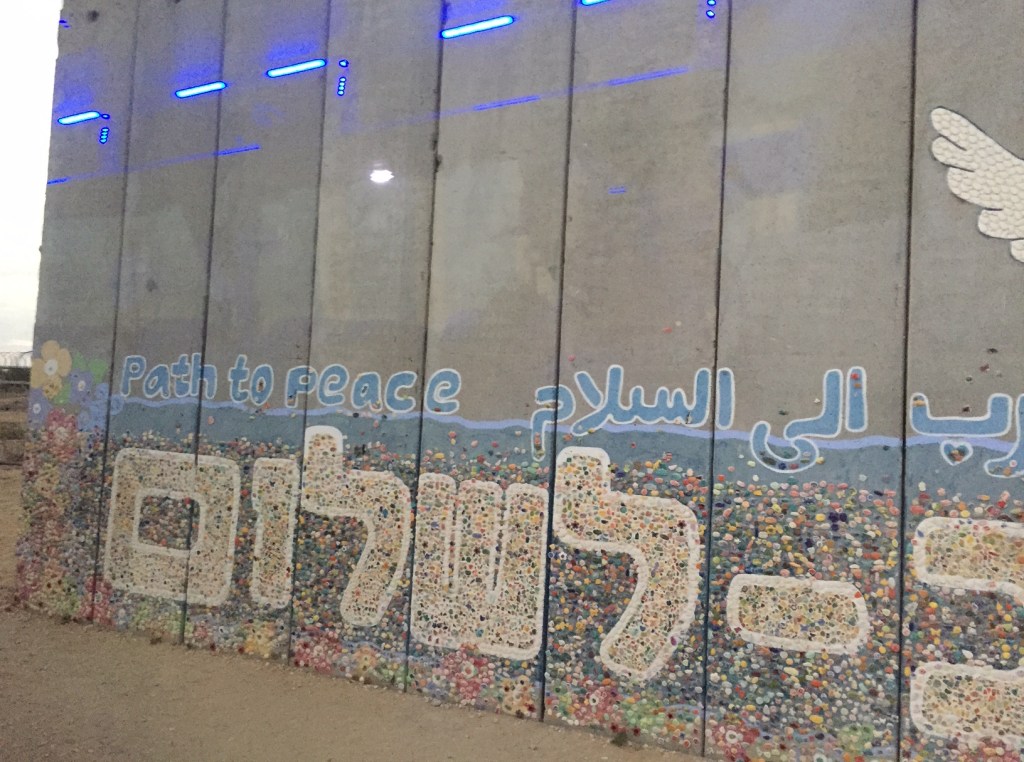
Afte she had spoke with us, she came on the bus with us to the nearby Peace Wall. Here are some photos. It’s an art project — you can read about it here: https://www.pathtopeacewall.com/ Keep praying, and maybe send some money to one of the projects mentioned above if you are so moved.
 Nine months in Israel