Between the Chanukah break and the Winter break between semesters, Pardes offers a week called the Winter Learning Intensive. The theme of the Intensive this year was “The Many Faces of Me: Exploring Identity in a Post-Modern World”. I had intended to blog during that week, but our whirlwind round of classes and events was indeed so intensive that I couldn’t find a minute to write. Herewith, a brief reflection.
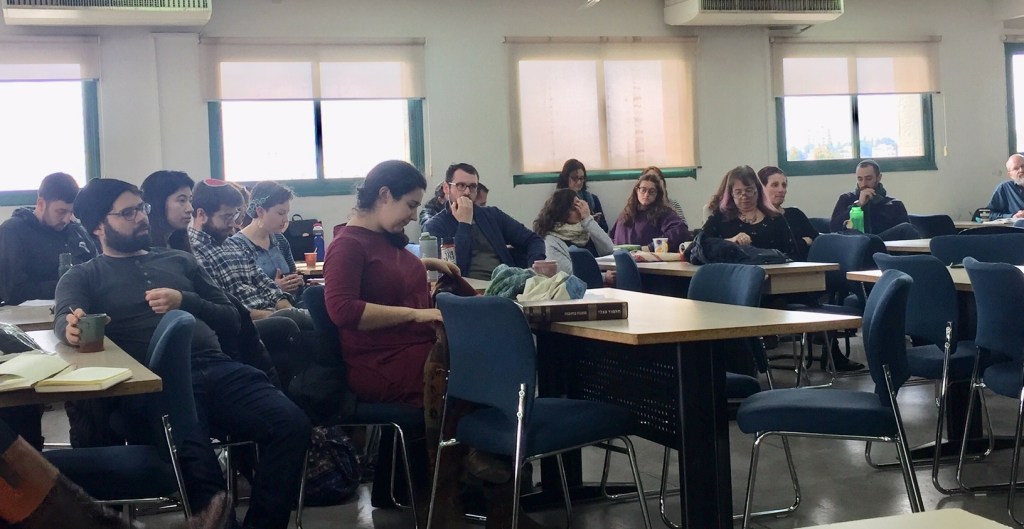
We began our week together in the Beit Midrash. The large room was very full, as a big contingent of new students had arrived just for the week: twice as many as in the picture above — every seat was filled. If you like vibrant Jewish learning, and are yearning to do it in Jerusalem, I highly recommend the Pardes Winter Intensive!
Our opening session was led by Rabbi Meesh Hammer-Kossoy. (For more about Meesh, see here: https://www.myjewishlearning.com/author/dr-meesh-hammer-kossoy/ ) She asked us to consider how our Jewish identities can be a bridge, rather than a wall, between ourselves and the world. What is identity and how is it formed? Is identity a problem or a solution? How do our collective and personal identities interweave? Meesh brought us radically different ideas from Kwame Anthony Appiah and Mark Moffett. Appiah believes that identity politics “set us against each other”, while Moffett believes it is dangerous not to form national identities, writing, “Cooperation and conflict are inseparable forms of sociation”. Ultimately, Meesh proposed that we see ourselves as both members of one universal identity — as human beings — and of multiple individual identities as well — as “children of our parents” as well as products of the choices we make in our lives. Her talk was an interesting way to set the tone for the week ahead.
My first class every morning as an in-depth look at the Book of Ruth with a teacher I had not worked with before, Tova Leah. She drew on a book by Yael Ziegler, Ruth: From Alienation to Monarchy, as well as traditional rabbinic sources. The class included an hour or more studying in chevruta (study pairs or trios) in the Beit Midrash. I enjoyed working with some of the new student, many of whom were closer to my own age than the average year student at Pardes. We did a close reading of Ruth in English and in Hebrew, using wonderful source sheets that Tova Leah had compiled for us. I look forward to bringing all the ideas from this class back to my teaching of the Book of Ruth at Shavuot in years to come.
In the later mornings and in the afternoons we had electives and sometimes whole-group activities. I took “Sexual Identity and Intersectionality” with Nechama, “The Search for Authenticity” with Yiscah, “Daughters of Egypt, Daughters of Tzelophechad: Women Leading from Personal to National Identity” with Judy Klitsner, “The Death and Rebirth of Rav: A Tale of Rabbinic Hazing” with Gila, and “Reclaiming our imperfect selves” with visiting teacher Miriam Stern.
Most electrifying of these were the class with Judy and the class with Gila. In one, I experienced the joy of studying Bible with an Orthodox feminist who is not afraid of either rabbinic or scholarly sources, and whose incisive mind brings new perspectives and exciting insights of familiar texts. (I am also reading Judy’s book, Subversive Sequels in the Bible — highly recommended!) In the other I discovered a completely different way of reading Talmud, from a modern literary criticism perspective. We read an astonishingly graphic story about the return of Rav (the leading figure of the Babylonian amora’im or writers of the Gemara ) to Babylon from Eretz Yisrael, and his “welcome” by his Babylonian counterpart Shmu’el. Gila suggested that the story is an example of what 20th century Russian philosopher and literary critic Mikhail Bakhtin called “grotesque realism”, in which “lower”, bodily things serve as metaphors for higher things. I’ll just say, this story, like many in the Talmud, seems to be fascinated with intestinal distress!
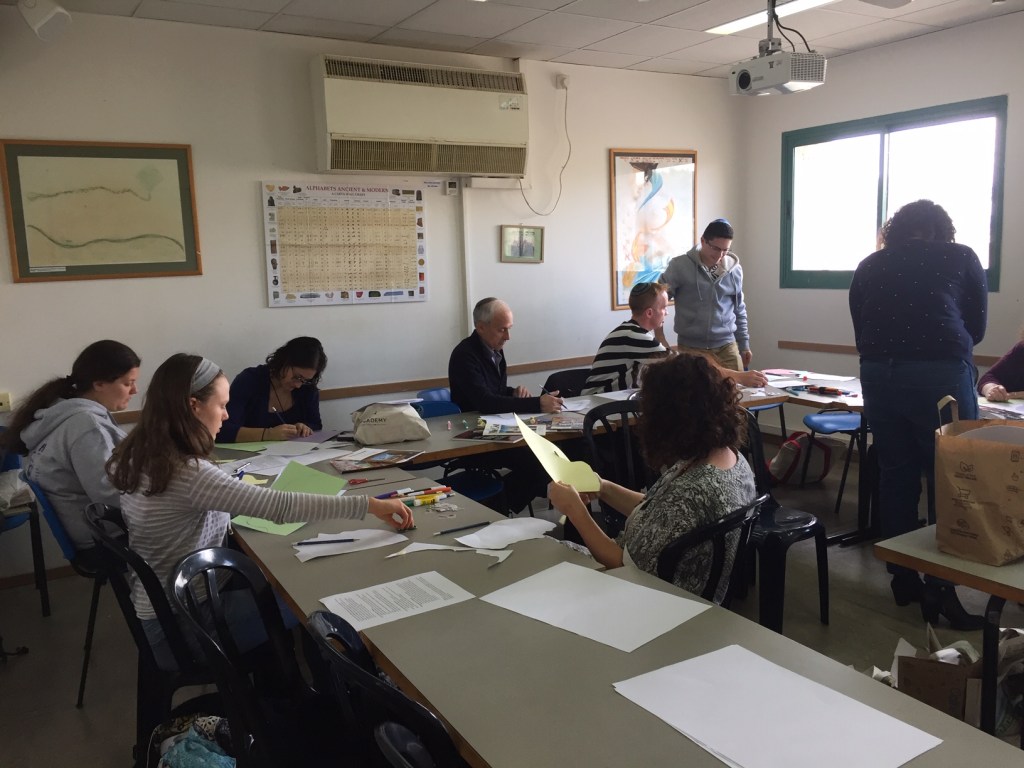
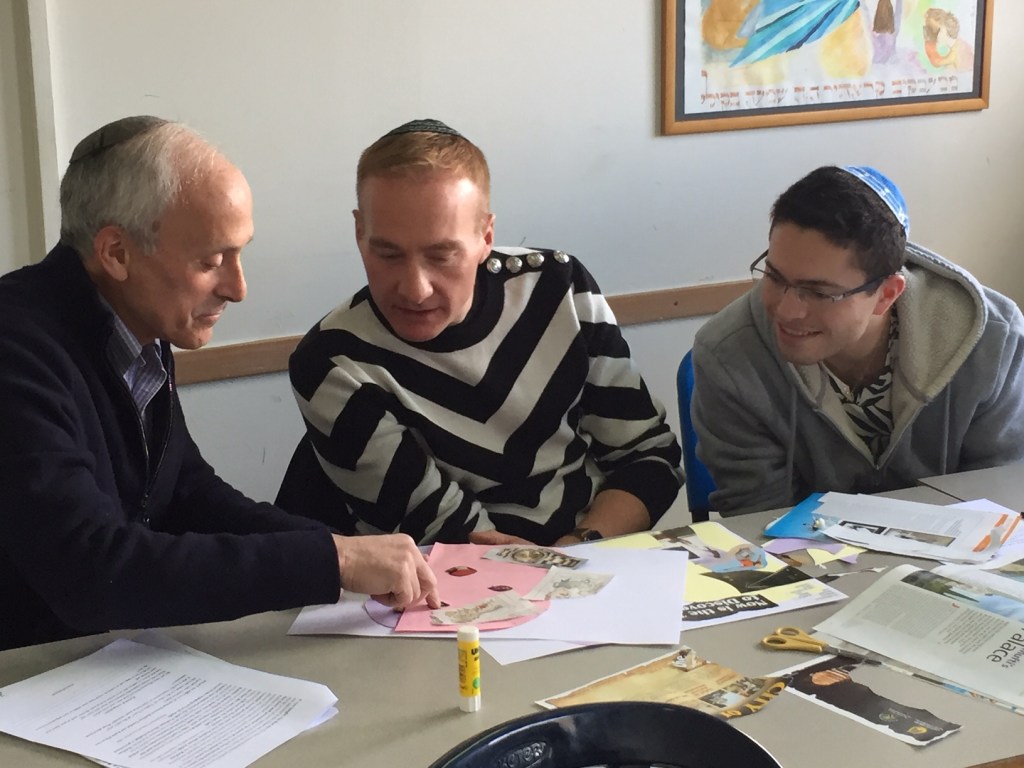
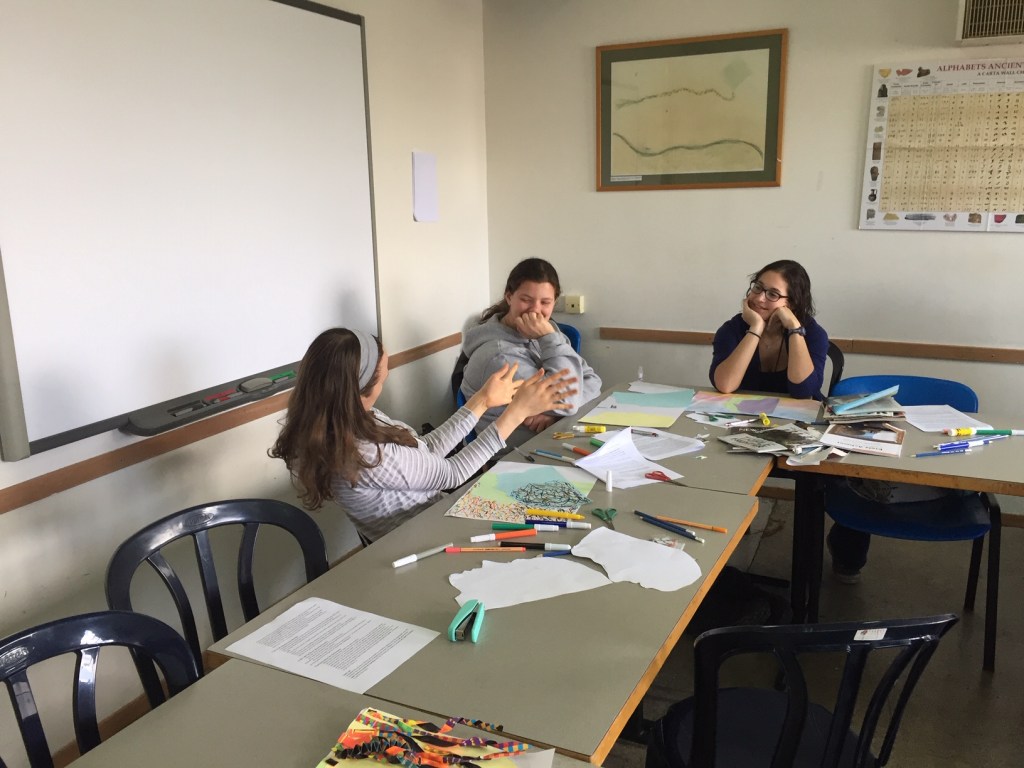
Mid-week, I had the pleasure of being a teacher as well as a student. Regular students were invited to offer our own short classes. I taught on the topic of my Masters Thesis — applying the Alexander Technique to Jewish prayer. My brief workshop was well-attended, and I think some people took away new ideas about how to be conscious of their full “psycho-physical beings” while davenning. I also was one of several who facilitated a fun art workshop in which participants created two cut paper silhouettes of themselves and decorated them according to their perception of their inner and outer selves. I was only able to attend one of the other student taught classes, a presentation by a classmate who has worked for several international relief organizations. She provided a fascinating look at three Bible stories that involve the clash of cultures and the status of refugees, while giving us some insights into her own work.
The week concluded with a faculty panel on “Commitment, compromise, sacrifice: Living a Jewish Identity”, which sadly provided no deeper insights, and the usual Thursday community lunch. Then it was time to say goodbye to our new friends, and also to those students who were only with us for the Fall semester. I will miss some good friends very much — Anne Gaelle, a rabbinical student and former journalist from France who was one of my chevrutot; Golda, also from France, a student with a dry wit; and Eitan, a lovely young person from San Francisco whose gentle presence greatly enriched my life at Pardes.
But I was already preparing for my vacation, the arrival of my husband’s daughter Deborah, and a trip to Jordan…see my next post!
 Nine months in Israel