Beyond our studies of Tanakh and Talmud, Pardes is endeavoring to give its students a taste of the complexities of Israeli life, the political conundrums and the conflicting points of view. They have a difficult task — one I know some of my fellow students would say they are not completing adequately. But then — that Pardes students disagree is a given, and indeed an essential part of the Pardes education.
At the end of the fall holidays a group of us went on a twelve hour trip south to the Negev. This was billed as a tiyyul to the periferia — the periphery, meaning the parts of Israel that distant from the Mercaz, the Center. Israel is, as our teacher Meesh reminded us, “A dinky country”, and yet the perception of the vast majority of its citizens who live in the Center (Tel Aviv and its environs) is that places like Beer Sheva, Tzfat, and even Jerusalem are somehow curiously far away. The government, too, often fails to remember the importance of these “peripheral” communities. If you live in Southern Vermont, you may be reminded of the way that the power brokers in Burlington and Montpelier forget those of us down in the “banana belt”. In New York, the folks upstate are ignored by the urban majority. In the tiny yet populous nation of Israel, where seventy percent of the inhabitants live “between Gadera and Hadera” (https://www.google.com/maps/dir/Gedera/Hadera/@32.1260642,33.774801,8.05z/data=!4m14!4m13!1m5!1m1!1s0x1502b96580af56d3:0x890891e383854631!2m2!1d34.7770192!2d31.8123014!1m5!1m1!1s0x151d124252d125bb:0x3abe13857b8fe43d!2m2!1d34.9196518!2d32.4340458!3e0), any community more than say 45 minutes north or south of Tel Aviv is simply not worth worrying about. If you add in a dimension of ethnic prejudice and historical conflict, some communities, such as those of the Bedouin, are in a very difficult position
Our bus drove for about an hour and a half over through rocky hillsides and then through gentle farm country, at last arriving in the beginnings of the desert. We came to the Bedouin community of Lakiya, which is slightly north of Beer Sheva. There are two Lakiyas — the recognized one and the unrecognized one. Shortly after the establishment of the State of Israel in 1948, the new government, headed by European Jews, decided (of course without consulting the Bedouin) that it would be great improvement for Bedouin life if Bedouins ceased to be semi-nomadic and settled in nice sensible European-style towns. Seven towns were created, of which Lakiya (the recognized part) is one.
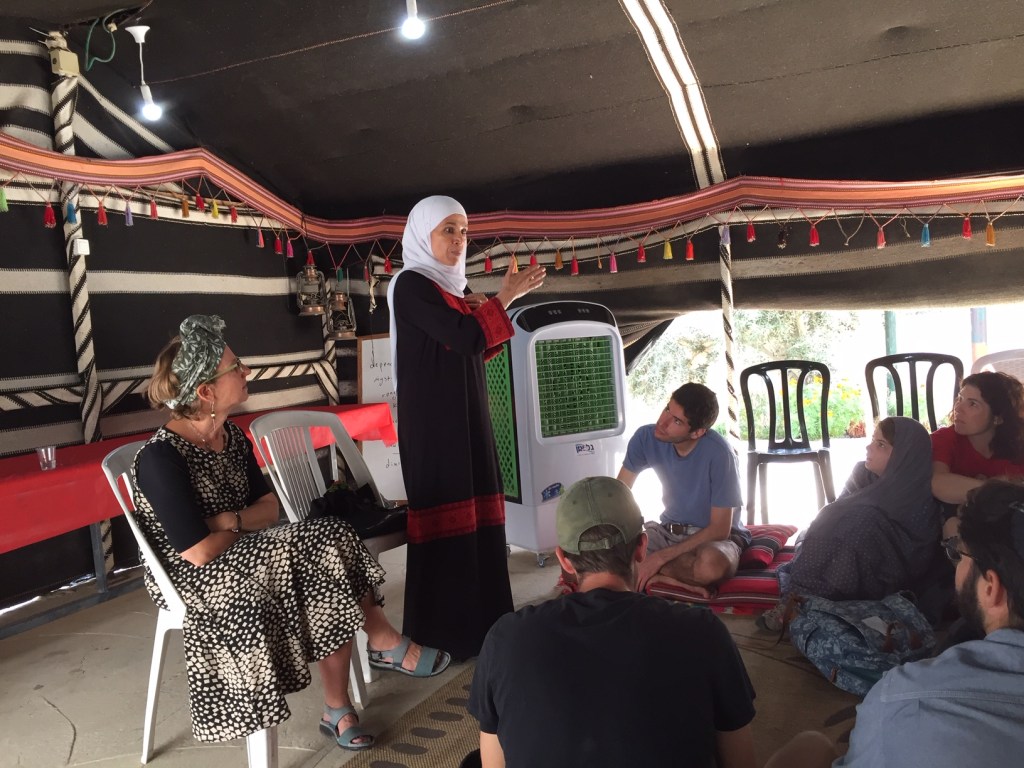
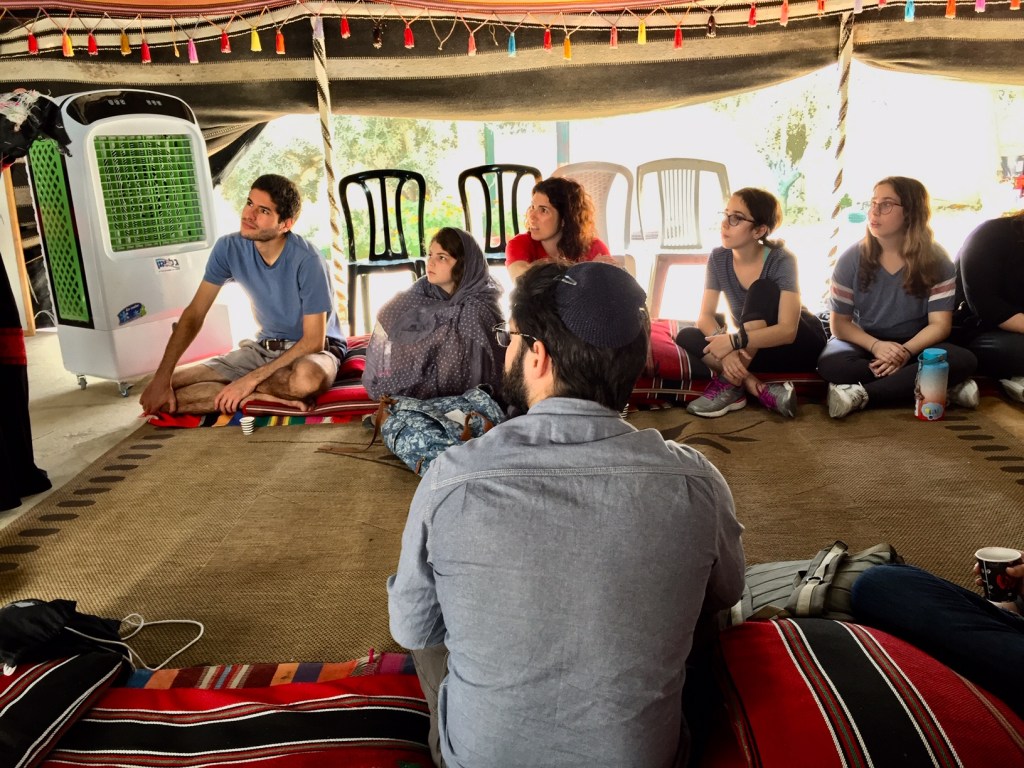
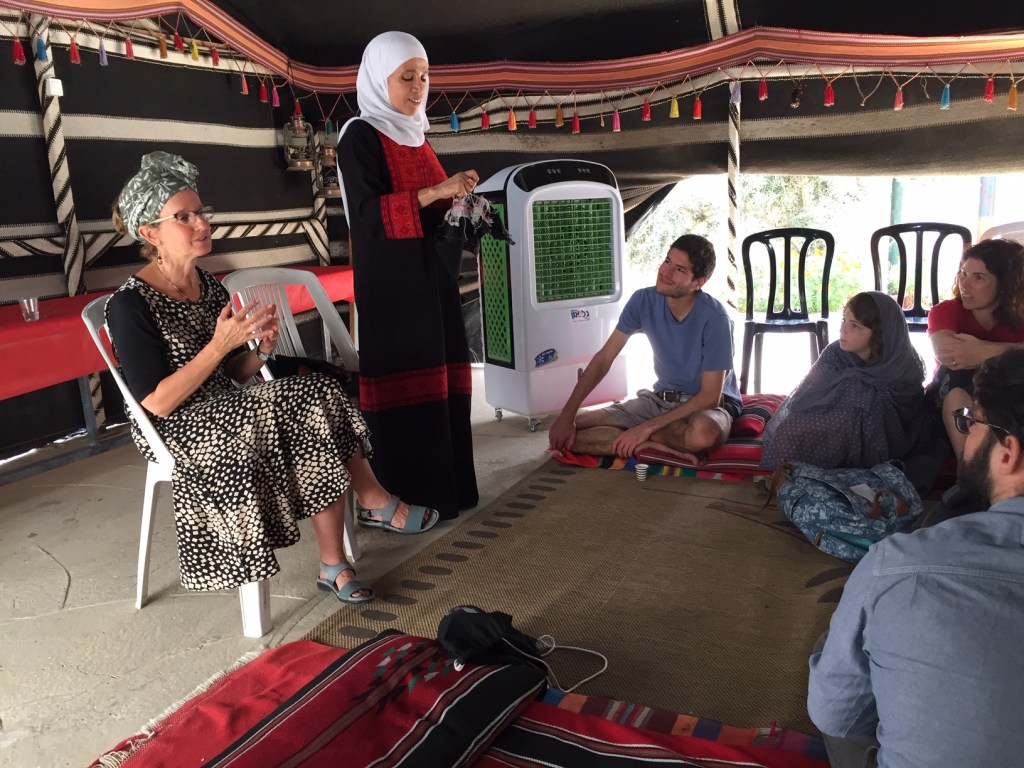
We first visited an organization called Desert Embroidery, in the recognized town of Lakiya. We passed a couple of beautiful and imposing mosques, and many homes and shops, as well as a health center and a community center, before arriving at the building and the large traditional goat-hair tent that house this remarkable organization. We sat under the tent — some in chairs and others on traditional cushions — and were served little cups of thick coffee, and then later of sweet tea. Meesh translated as one of the founders of Desert Embroidery, Khadra Elsaneh, spoke to us about how her project began, all that it now does, and the importance of its work. When I am directly quoting her I will use quotation marks.
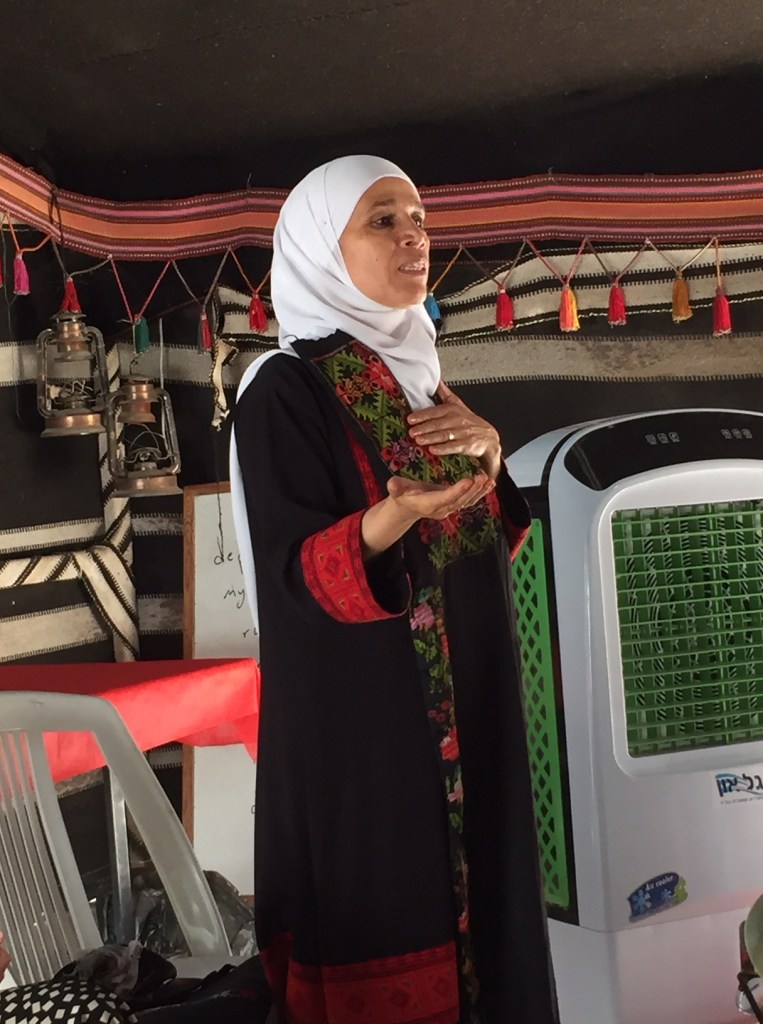
“Embroidery is the art of the Bedouin women. I embroider my love, my anger at my tribe that doesn’t allow me to go out — women embroider their emotional state. […] If we start with the embroidery, we have to make changes through the embroidery.” In the old days, the women did the cooking and shared in the agricultural work. The tent was dived, with men living on one side and women and children on the other. Women had many children; if the first wife did not produce enough children, the man would get a second, third, and so on. So — very Biblical. Women cooked pita three times a day, brought water from the well. When they went to the well, the men would watch form a distance. They could tell by what colors a woman’s embroidery was, whether was was married. The background color is always black. With red: married; with green or purple: unmarried; with blue: a widow.
Dr. Elsaneh and her sister (who is a professor at McGill University) saw how the loss of the semi-nomadic life had made things even more difficult for women than before. With the loss of the traditional way of life, women were more trapped. On the other hand, there was the possibility of education. In the non-recognized villages girls are not allowed to go to high school. In the recognized villages, girls do go to school — and some, like Dr. Elsaneh and her sister, go to University.
The women of Desert Embroidery have four projects. It started with the embroidery itself. In the beginning, women would pretend they were sick in order to go to the Health Center, where they would then have meetings about the embroidery project. Now, they don’t need to be as secretive –but there is still much resistance on the part of the male leaders – -so much so that the Desert Embroidery buildings were burned in 2006. Nonetheless, they rebuilt and they continue, making the beautiful embroidery which they sell, which pays for them to get education and hopefully go to college and beyond. When they come to be paid, they also attend a lecture on women’s health, helping them “to learn to speak up for themselves. Also, “To teach them not to marry their cousins”, because there is a very high incidence of children with special needs and birth defects because of the high rate of intermarriage, and the burden of caring for the children is on the women.
The second project is a mobile library. Like Brattleboro’s Bookmobile of old, it travels to five of the unrecognized villages, bringing books in Hebrew, Arabic, and English. Not school books, fun books. Books encourage literacy, literacy encourages women’s independence.
The third project is the Young Leadership program. This is a two year program for both boys and girls to learn about leadership. It especially encourages girls to think about going to college. It helps them with their language skills and to pick the right major. “There’s less [Arab on Arab — a significant concern of the Arab community right now] violence here in the south than in the north. Also, it’s changed — there used to be more girls kills [honor killings], now it’s more boys.”
The fourth project simply offers the use of their space for anyone in the Bedouin community who wants to learn languages.
After the speech from Dr. Elsaneh, who is not only beautiful but extremely compelling, we went into the little shop. I confess, I bought more than I perhaps should have. Many of you can be prepared to receive a gift from me of exquisite Bedouin embroidery. However, if you would like to make your own purchases, don’t miss the web site, which also wil give you much more information about the whole project and the amazing work they are doing: http://www.desert-embroidery.org/
Our chaperones had difficulty prying us loose from the embroidery shop, but we got back on the bus at last and bumped our way across town and up a little hill that overlooks both the recognized and the unrecognized villages of Lakiya. Here our guide were two young women from the Negev Coexistence Program. (https://www.dukium.org/), one Jewish, one Bedouin Arab. Later we were joined by an older Bedouin man who is also an activist. We stood in the “field” (dry ground) outside the house of the young Bedouin woman, whose family is well-to-do and owns the house. As we looked over the two towns — one looking more like the shanty-towns of Africa or Mexico — our Jewish guide attempted to fill in our sense of the history of what we ere seeing.
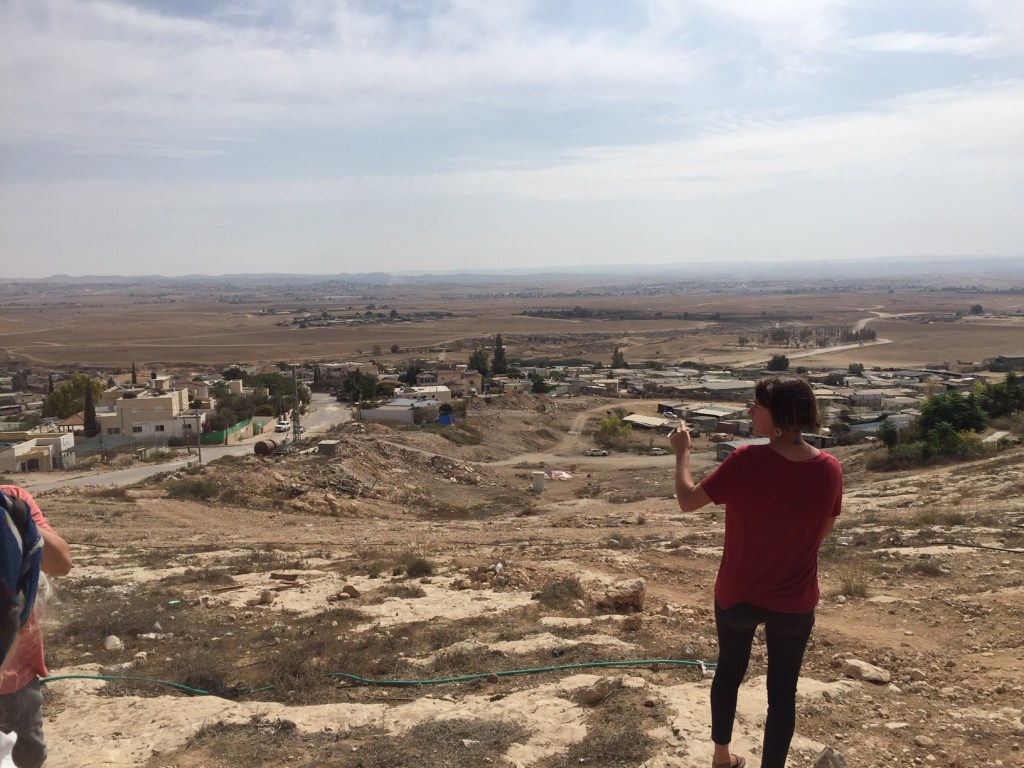
The Bedouin Arabs were semi-nomadic. They lived in tents, moving at certain times of year to follow the water. They knew whose land was whose, and will never — to this day — use land that they know belongs to another family. This is why there is unused land in the recognized town of Lakiya, even though there is a severe housing shortage. While the government of Israel portrays them as having been fully nomadic, with no ties to any part of the land, this is not actually correct. Of the 1 million people in the Negev, one third are Bedouin. “Before Israel”, claimed our guide, the population was 100 per cent Bedouin Arab. However, a little investigation shows that there was Jewish settlement of this area starting in the 1880’s. It is true that the southern part of the Negev was not part of the Biblical land of Israel.
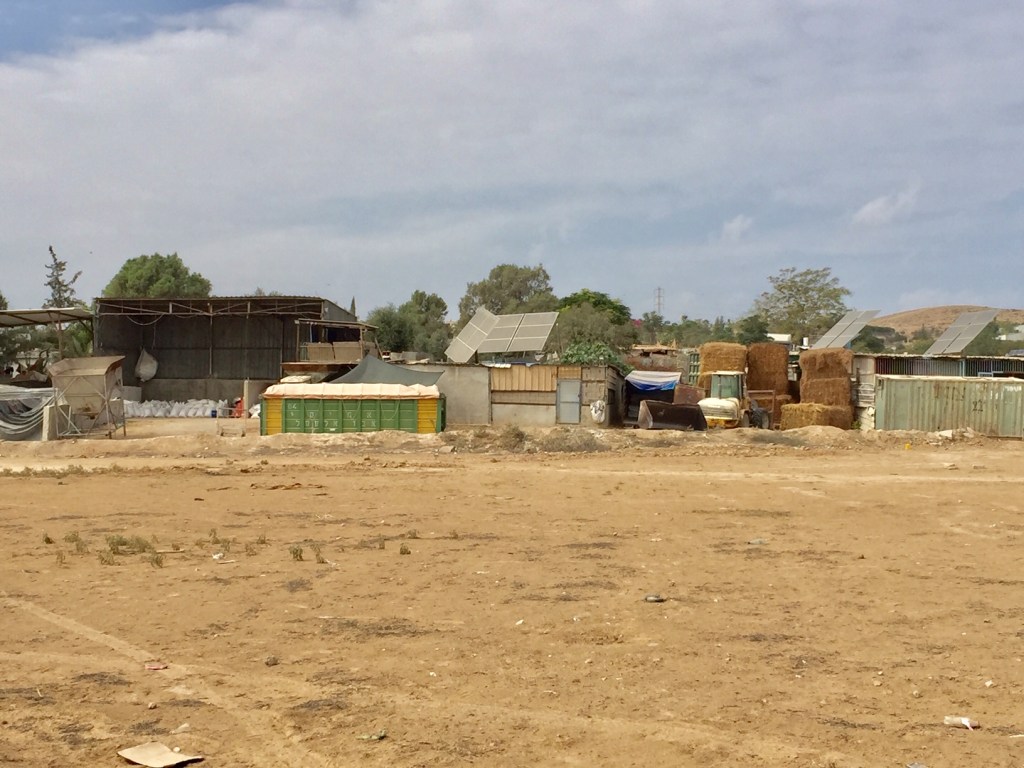
As of now, the Bedouin only have 2 % of their original lands. 76 % of women are unemployed. (But it’s worth noting that before Western influence, women wouldn’t have been “employed” in the sense we use this word now — and one reason they are not employed now is that their husbands would rather they weren’t) There is a high incidence of weapons and drugs in the Bedouin communities. Currently there are about 300,000 Bedouins living in the Negev. 150,000 are in state-recognized villages, 150,000 are in unrecognized villages. No Bedouin are living a semi-nomadic life any more, although they do continue to have camels and goats and to ado agriculture where they can. They are all — this is important — citizens of Israel. Their identity cards say the name of their tribe, emphasizing the Israeli government’s view that they are nomadic and have no land that is truly theirs.
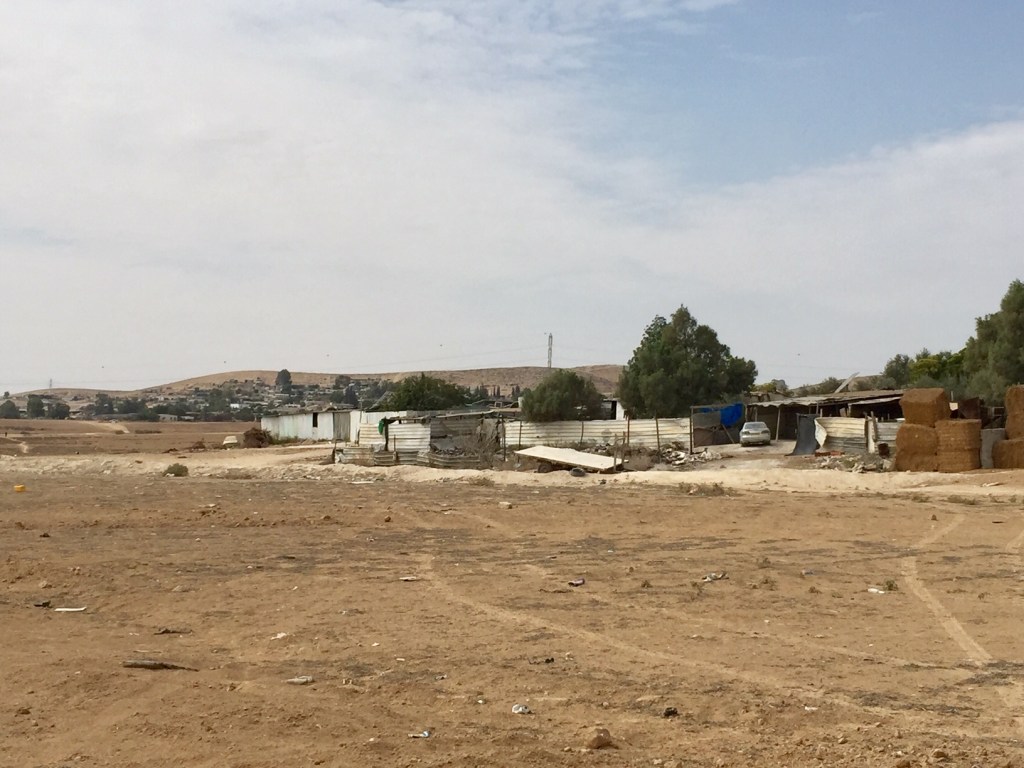
The government of Israel spends “Billions of dollars” on Bedouin development — but only in the recognized villages. Remember, these are the villages that the government told the Bedouin were where they could live, back at the start of the State of Israel. The unrecognized villages, which the government says have no right to exists, and which it therefor is regularly demolishing, have no infrastructure. The Bedouin who live in these villages are attempting to get them recognized. In this era when the population of Israel is burgeoning, and the (right wing) government wants to develop the Negev for its Jewish citizens, this recognition is not coming any time soon. Meanwhile, the lands around these villages are often understood by the government to be either army land (60 % of the Negev is a military zone), or nature preserves. One tactic used is that the Jewish National Fund plants those trees you and I may have sent money for, on land that the Bedouin are attempting to farm, and around the unrecognized villages, preventing them from spreading. Kids in the unrecognized villages do go to school, but there are no schools in the villages, so they are bused long distances over often dangerous roads — and in the winter when there are floods and mudslides, they often don’t go at all.
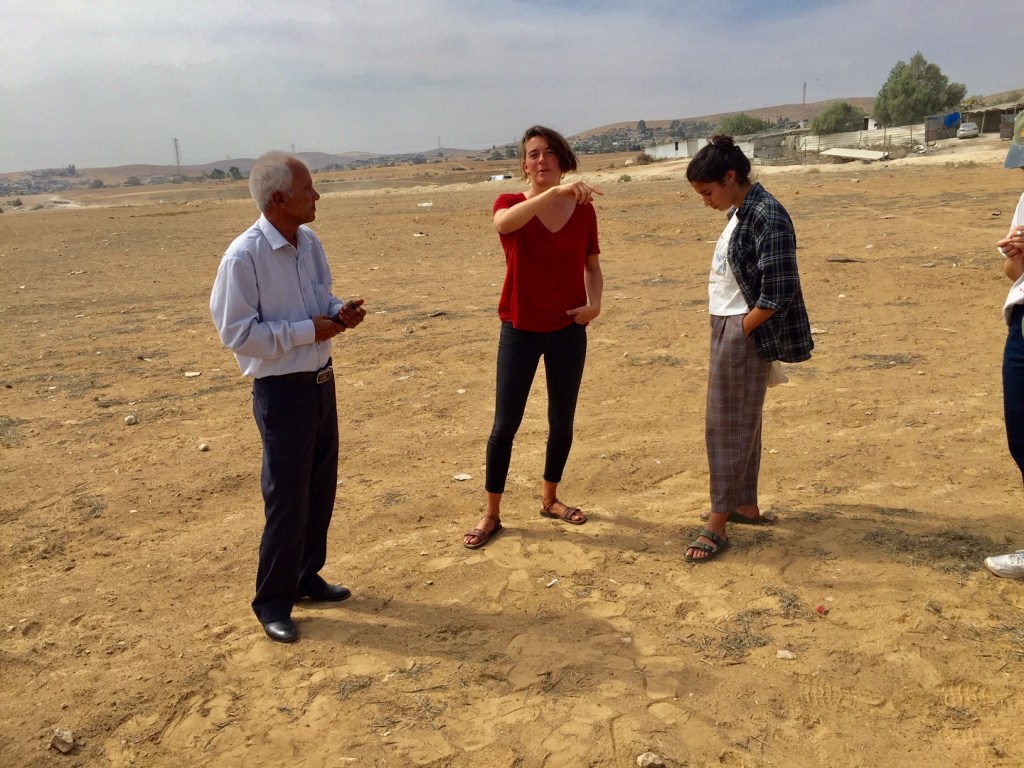
I found a lot of this presentation compelling. One certainly could not help but make comparisons to the treatment by the United States government of the native peoples. There is, or instance, a Bedouin Authority, a bureau of the government which seems to be similar to our Bureau of Indian Affairs, with about as much interest in the true needs of the Bedouin as the BIA has in the true needs of the Native Americans. That the Bedouin community was utterly mismanaged by the founders of the State of Israel seems clear — probably more out of European cluelessness and the view that “our Western way is the best way” than out of malice. Not that the results were any different. I believe those of us on the tiyyul approached with open hearts and minds. Many of us were put on guard, though, when the young Bedouin woman activist, who is wealthy and highly educated, not only identified herself as a “Palestinian” , but said that the Israeli government is “Fascist”. In her view, the State of Israel has no right to exist, although she generously grants us Jews the right to be Jewish as long as we don’t think we have the right to have a state here.
I wonder if the young are more radicalized around these issues, or simply less tactful (as the young often are)? It seems that the older man was simply advocating for the rights of his people to live where they have traditionally lived, and to have the services they deserve as Israeli citizens. I wondered if the misguided policies of the government over the years have alienated and radicalized the young. In the end, I was left with the feeling that the Bedouin have been poorly served. It would be interesting to see what a more left leaning government might do to try to change the situation.
For the second half of my report on our trip (a visit to Sderot and another town on the Gaza border) stay tuned!

