First last…

This morning at 6:05 am I completed the first of my “lasts” for this week — my last Talmudic Personalities class with Leah Rosenthal. Since I returned to the US I have gotten up faithfully at 4:40 am on Sunday and Thursday for Talmudic Personalities and on Monday and Wednesday for Talmudic Heroines with Gila Fine. Gila’s class will meet twice this week, but Leah’s class ended today, as on Thursday there are no classes because of Shavuot, the third of the pilgrimage holidays or regalim (besides Pesach and Sukkot).

My heart is very full, and my mind is flooded with memories of this year. I know I’ll be wanting to say lots more about my time at Pardes, as well as my time in Israel, and hopefully I’ll be able to motivate myself to do that in the coming weeks. I have a lot of photos still to share, as well — of the remainder of the tiyyul in February, of my last trip to the Botanic Garden, of the Hebron tiyyul back in the fall that I was so conflicted about that I never wrote it up…

Leah Rosenthal also taught my wonderful Intermediate Talmud class, which I had to give up when I returned to the States. At the beginning of the year I think Leah wasn’t too sure about my skills, and I was a bit worried about her as a teacher — she seemed a little stern. But I’ve come to feel that my classes with her, especially the Talmud class, were the classes that I was looking for when I came to Pardes. Leah taught me that I can sit down with a passage of Talmud, with my trusty Jastrow and Frank dictionaries and my Tanakh at my elbow, and translate what I am reading. I may not get it all right, but I’ll be able to unpack a lot of it. I can read the Rashi commentary — in that pesky special “Rashi script” that it’s printed in, where some letters don’t remotely resemble their counterparts in normal Hebrew print — and to a large extent understand what Rashi is trying to tell me. If I am lucky enough to have a great chevruta, as I did for much of the year in my friend Yarden, I can go even further in understanding.

The study of Talmud is a curious way to spend one’s time in this modern day, I suppose. When we started at Pardes they told us that we were unusual in choosing to take a year out of our lives to do this, and that we could look forward to returning to our communities as “the most knowledgeable Jew in the room” in many settings. I hope that studying Talmud will be a part of my life forever, that I will be able to find chevruta partners here, and that this year of reflection and learning will do what I planned: shake me out of my habits and propel me into a new chapter of my life.

Right now it feels as if we are all suspended in amber. Time seems to have little meaning. Nonetheless, this week I am reaching the conclusion of a milestone experience in my life, and readying myself for whatever may come. Look for more thoughts about this — the nine months is ending soon, but the blog will continue for a bit as I process my experiences. Thanks for traveling with me!

On Yom HaAtzma’ut, Looking Back

Some days it’s harder not to be in Israel right now. Last week, as Yom HaZikaron (Israel’s Memorial Day) segued into Yom HaAtzma’ut (Israel’s Independence Day), I felt some strong pangs. Even from my apartment I would have been able to feel the solemnity of Yom HaZikaron and the joyous celebration of Yom HaAtzma’ut differently than I felt it here, far across the ocean. At lunchtime I watched part of the live celebrations from David’s Tower that were taking place as Yom HaZikaron ended in Israel and Yom HaAzma’ut began. The group leading the musical Hallel and Ma’ariv (standing carefully six feet apart from each other and fenced off from any live viewers, if such there were) was excellent. The tunes carried me back to Israel, and I found tears in my eyes.

It’s a complicated country, but a special one — and essential, l’da’ati (in my opinion). Not for nothing do the Israelis observe Yom HaShoah (Holocaust Remembrance Day) a week after the last day of Passover and a week before Yom HaZikaron and Yom HaAtzma’ut. It’s hard to avoid seeing cycles of destruction and renewal in the history (and mythology) of the Jewish People. Here in the States a lot of people tend to see Israel only through the lens of the Israeli/Arab problem, but there’s a lot more to think about in the long arc of the Jewish story. Which is by no means to say that I applaud the way the Israeli government has handled the Palestinian Arab situation.

In any case, as I sit here missing my life in Jerusalem (even tucked up in my apartment), and as I consider the importance of the existence of a Jewish state, however conflicted it may be, it seems like a good time to return to my blog and post some more pictures from the last tiyyul I took with Pardes, back in — can it be? — early February, before the almond tress bloomed.

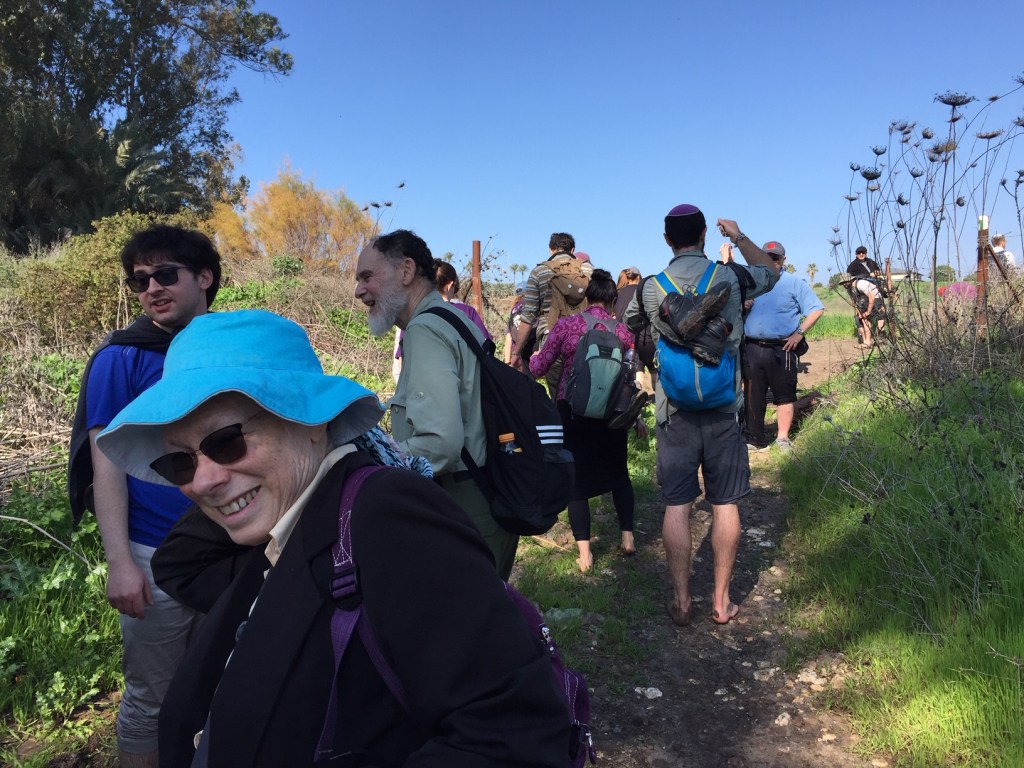
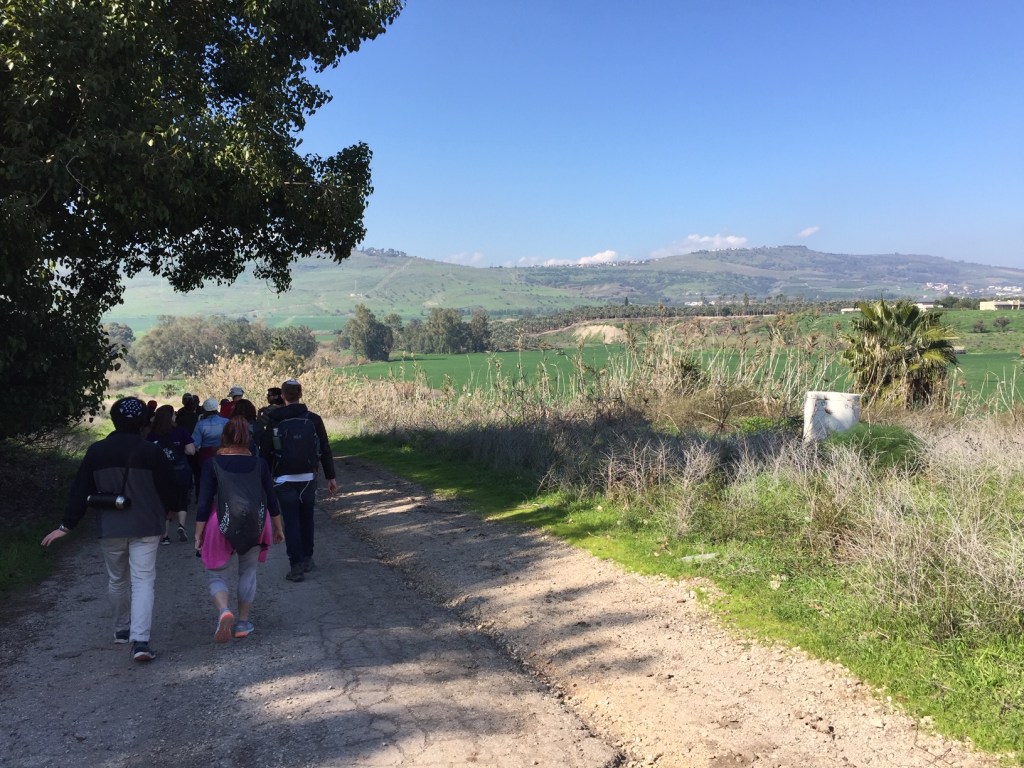
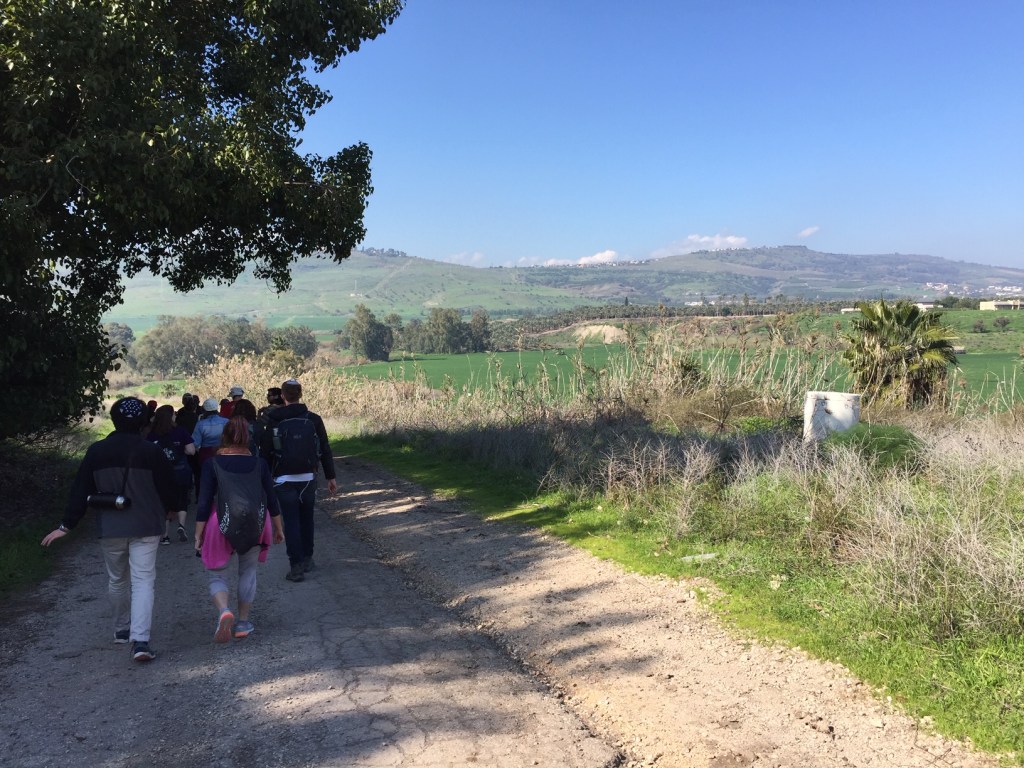
Way back on March 8 (about a month after the original trip) I posted about the beginning of our tiyyul, where we visited a disused bridge from Israel to Jordan. From there we drove north, and began a trip to reflect on the history of the kibbutzim. We disembarked from the bus and began our hike through the fields. In early February it was warm — about 70 degrees Fahrenheit. We all felt the relief of winter beginning to leave and spring to unfold (although there would be many more weeks of rainy cold weather before winter was altogether behind us). As I look a these pictures now, it seems strange that it was greener in Israel in January than it is here in Vermont at the end of April!

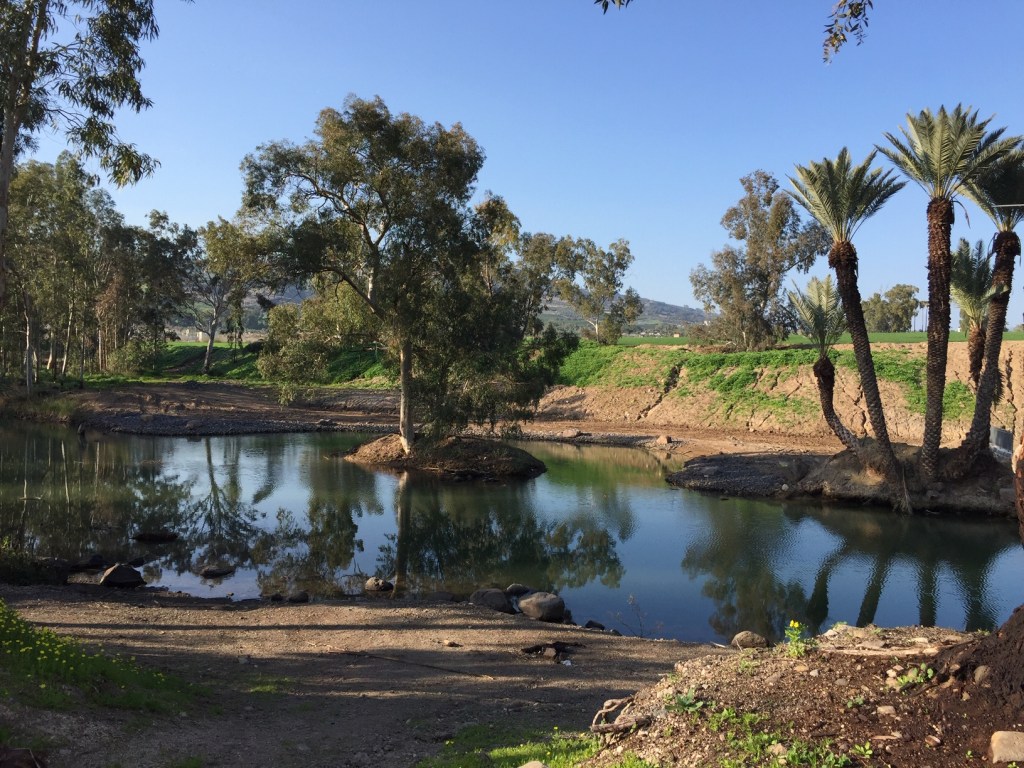
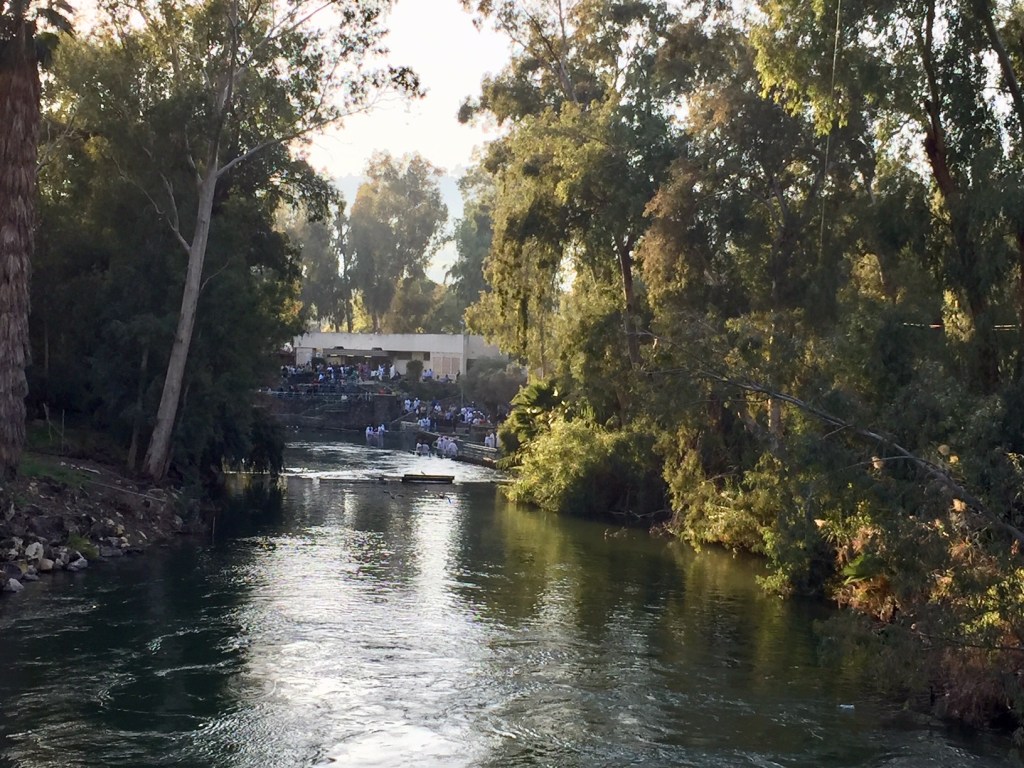
This is the Jordan River.
After a rainy winter, it was green everywhere!
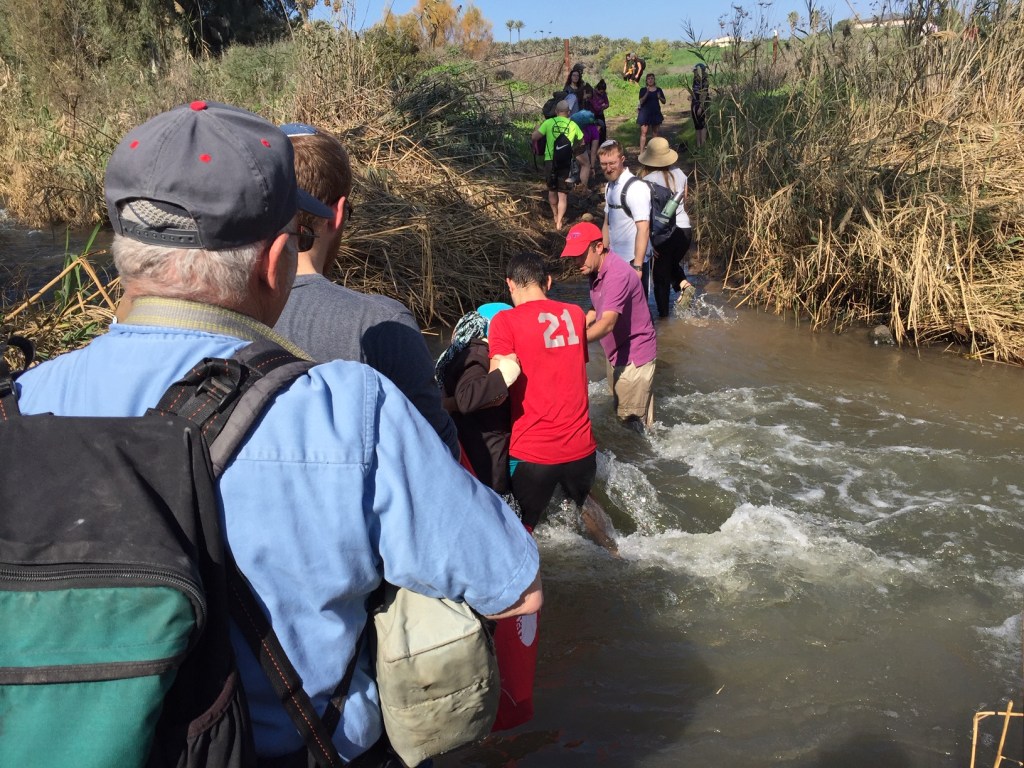
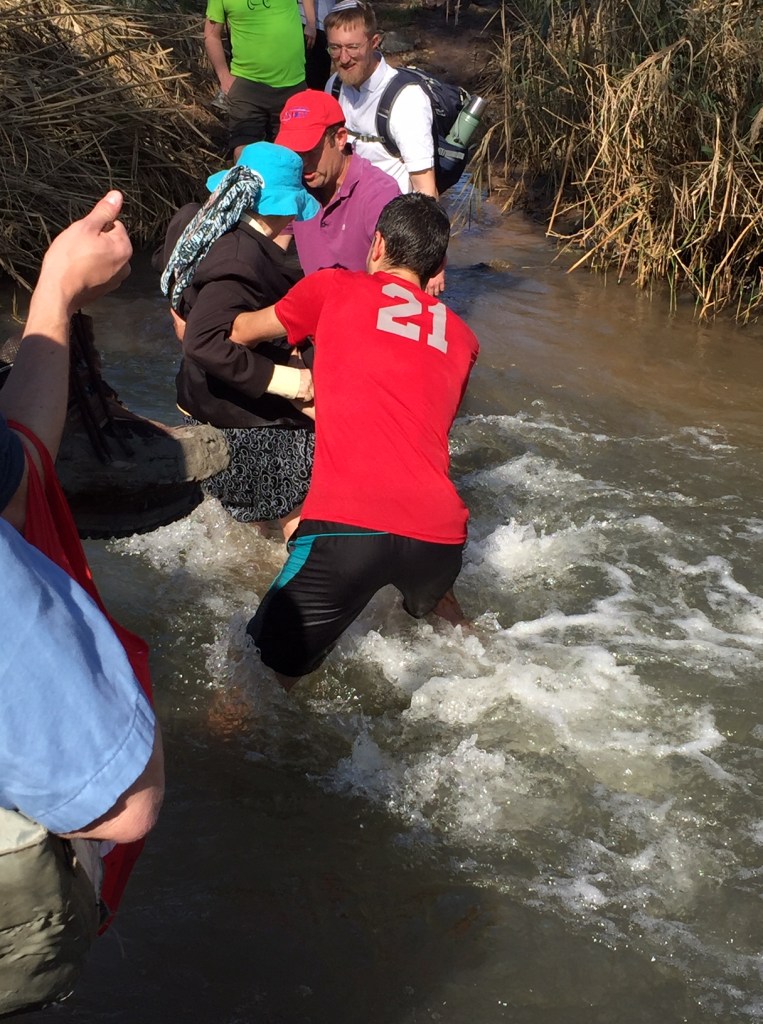
Fording the Jordan. Reminded me of the old spiritual, “Wade in the Water”! The channel was narrow but the current was quite strong, and in the middle the bottom dropped so that we were nearly up to our butts. Help from fellow hikers was welcome!
My 70-something friend Yehudit gets a hand from Jonathan, Caleb, and our tour leader, Jamie.
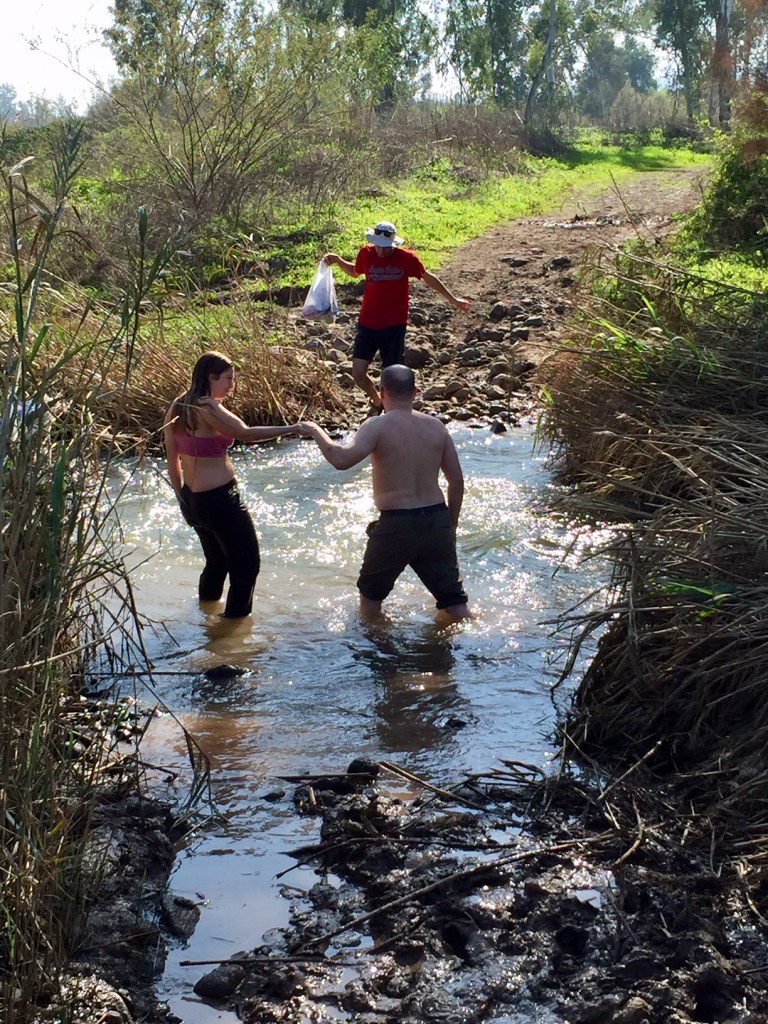
Some folks went swimming. As someone said, “That photo’s probably not going up on the Pardes web site!” Pardes serves, and is supported by, enough Orthodox folk who might be quite taken aback by such semi-naked inter-gender frolics. I’m not telling who these happy people are!
Safe (but wet!) on the other side. Yehudit, Alex, Tuvia, and all…
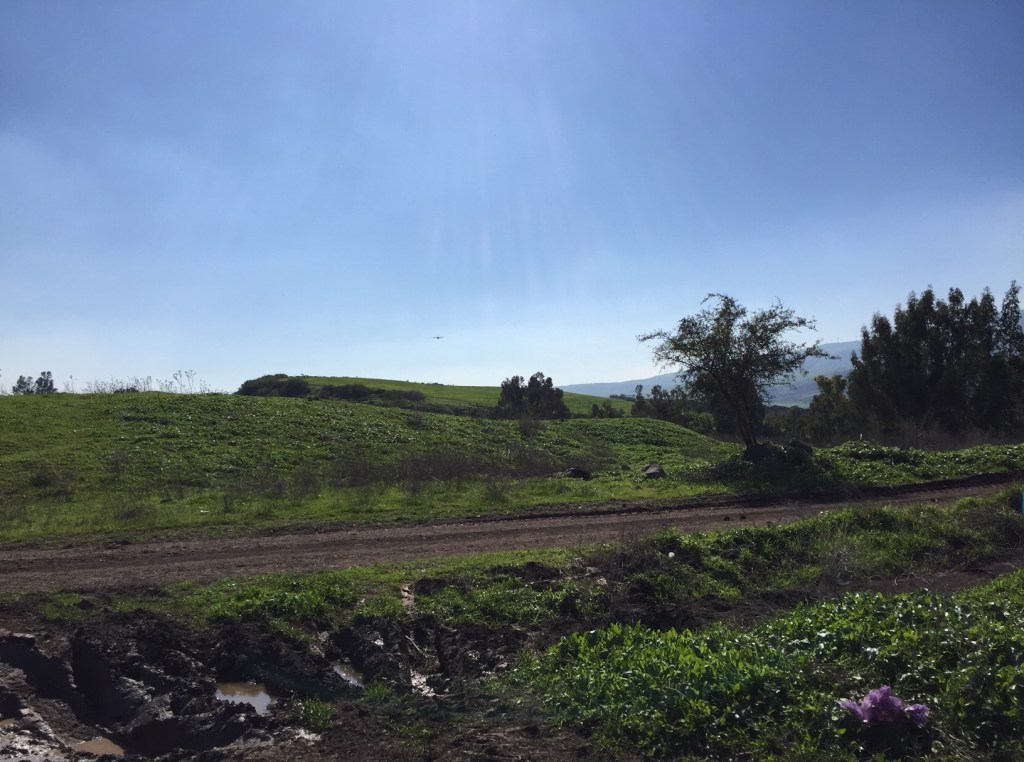
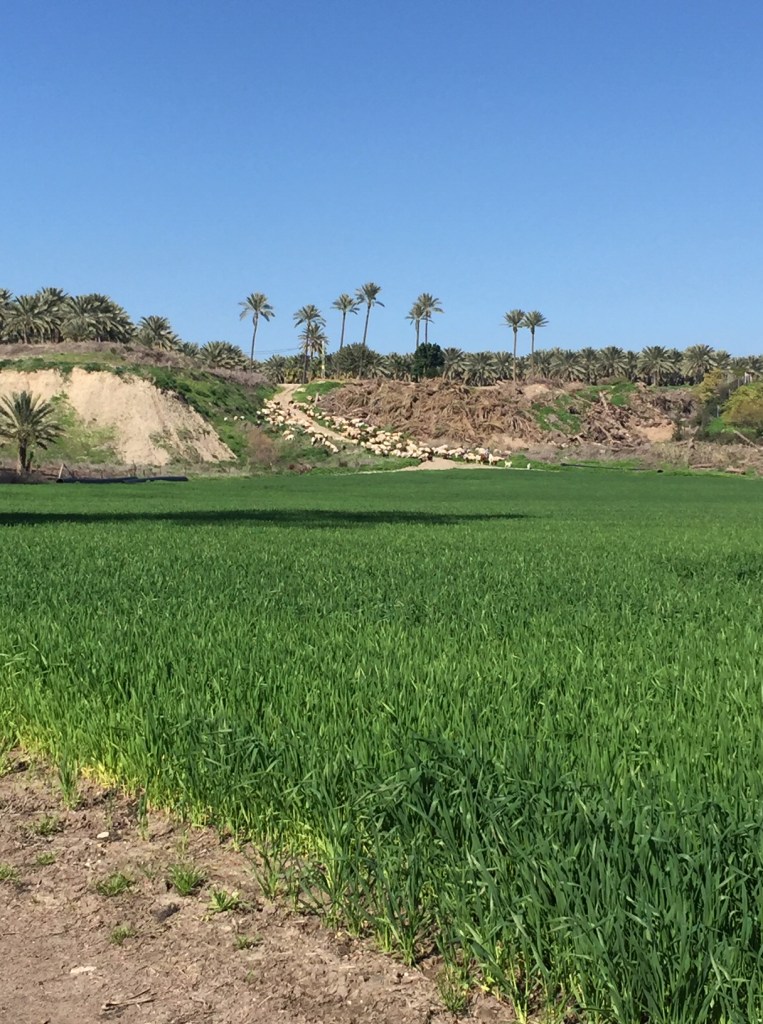
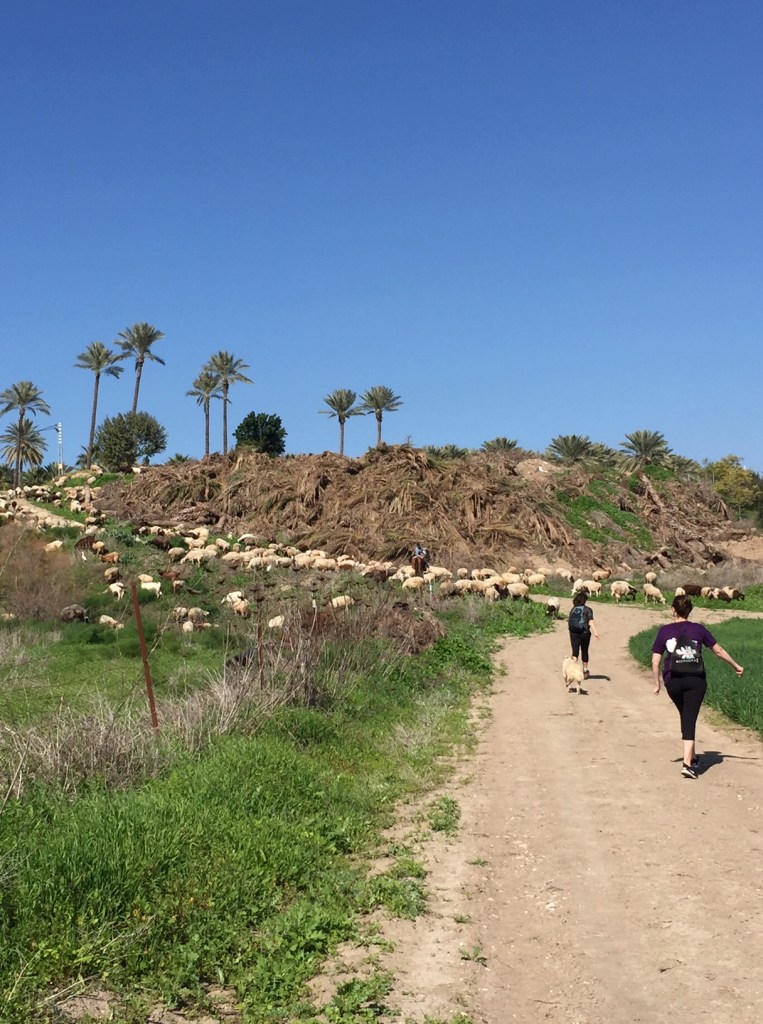
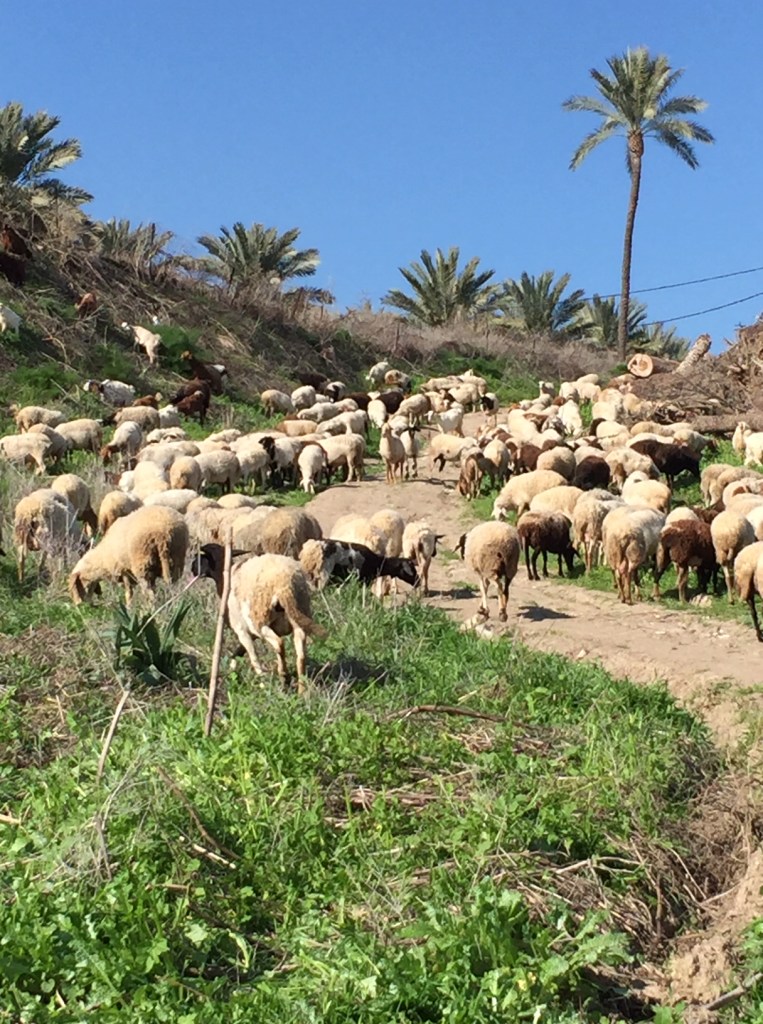
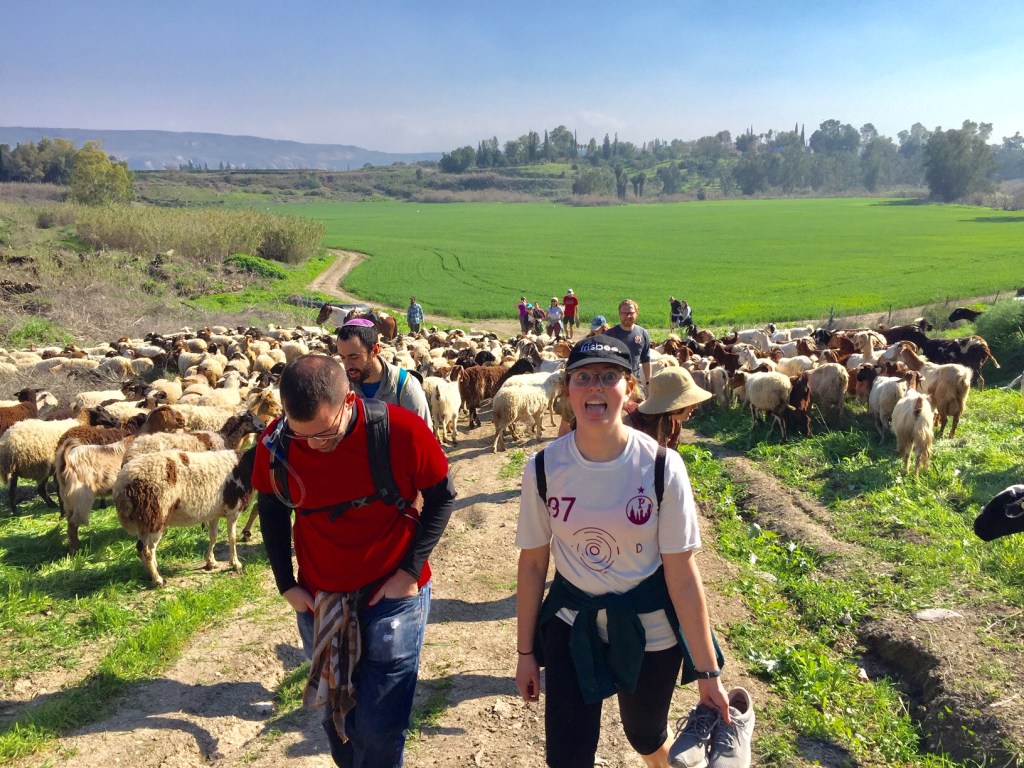
Yes, the sky is really that blue and the grass is really that green. What you see coming down the hillside below the palm trees is a big flock of shaggy sheep.
Can you hear the baa-ing?
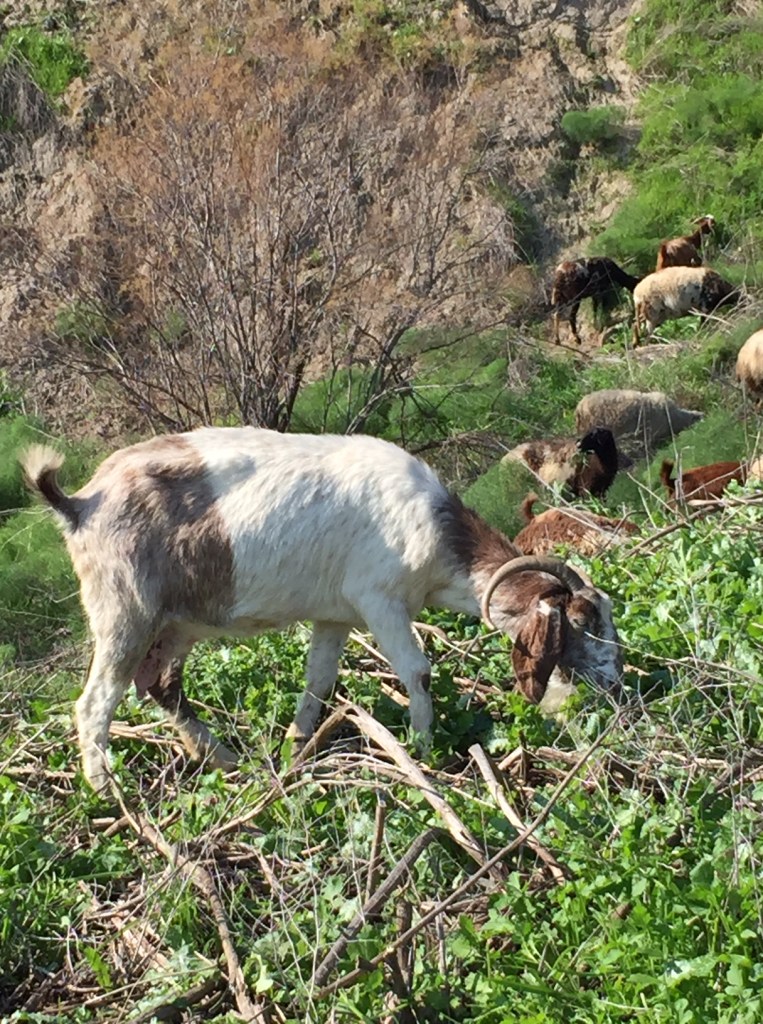
There were goats, too.
I turned back to capture the scene, and got this shot of Claire and Doug.
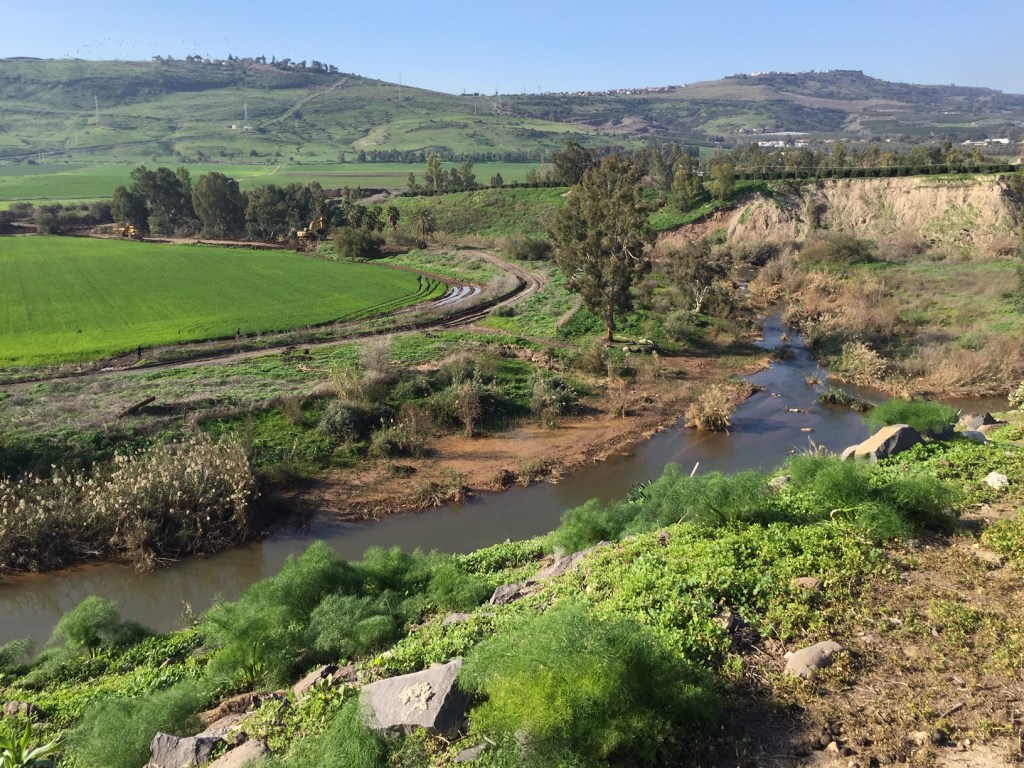
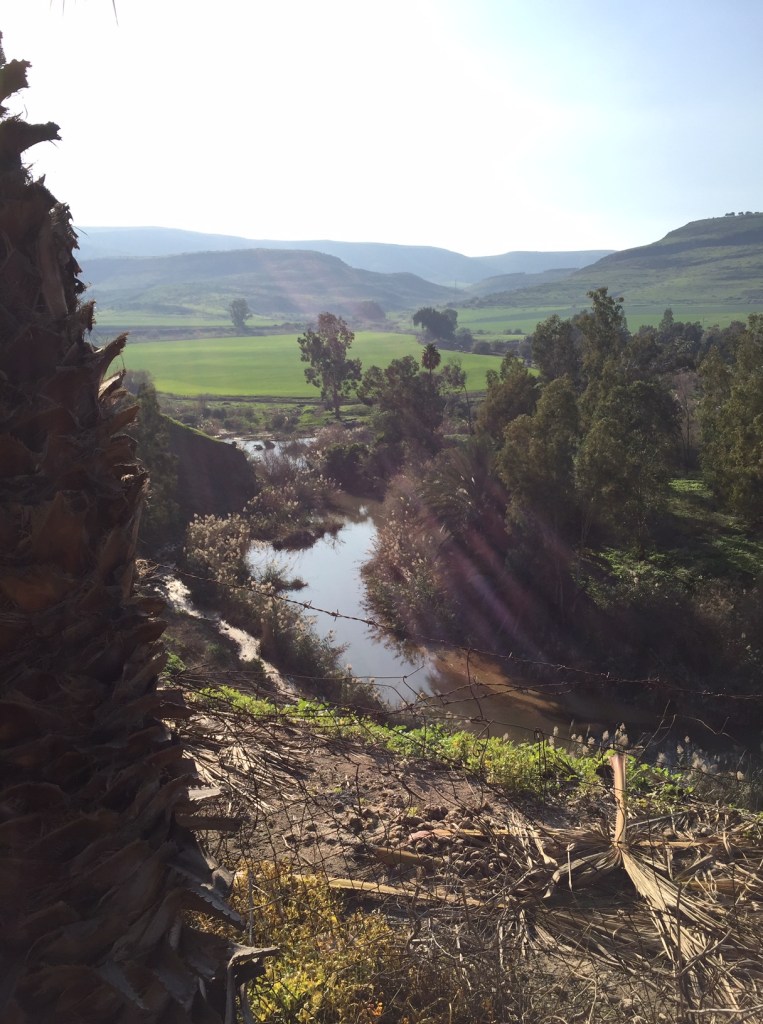
At the top of the hill we were looking down on the River Jordan. The green fluffy stuff in the foreground is wild fennel.
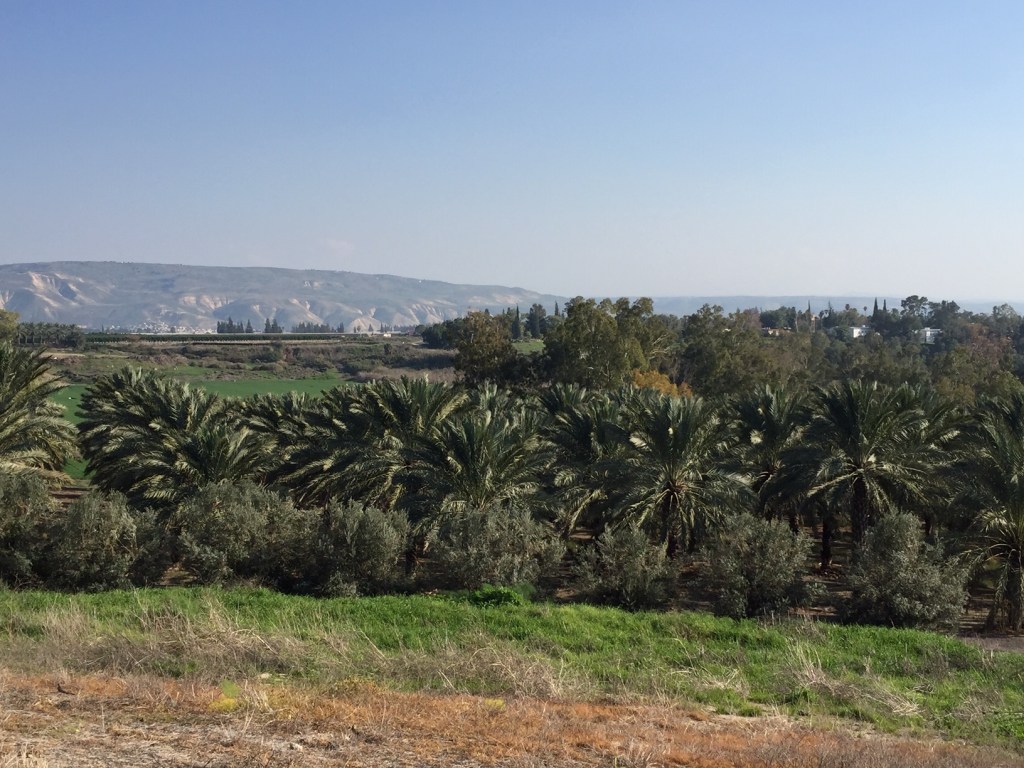
Looking the other direction, date palms and the distant hills of Jordan.
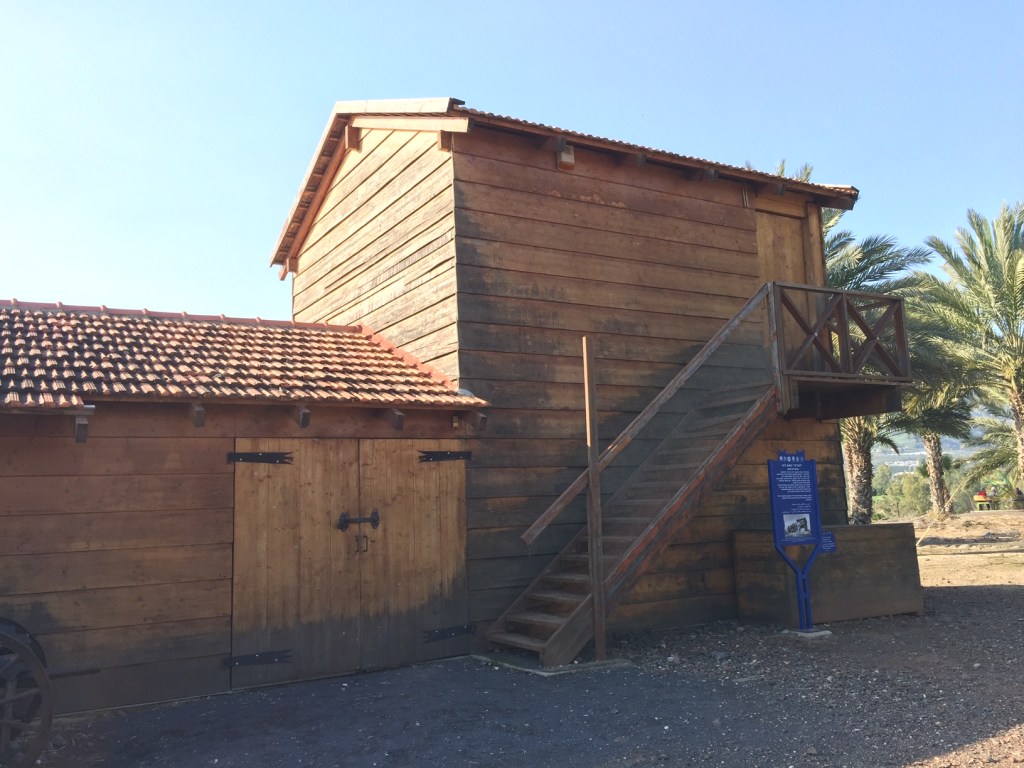
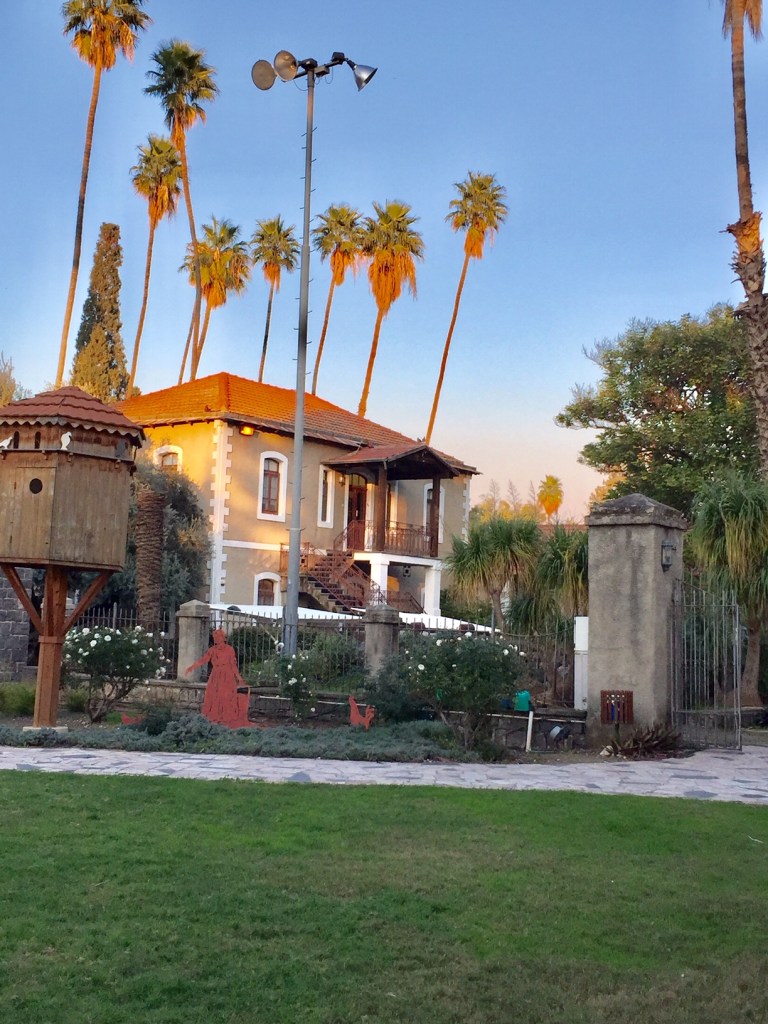
This is a recreation of the very first kibbutz, Degania Aleph. Degania means “cornflower” — it comes from the Hebrew word for grain, dagan, in the midst of which cornflowers often grow. (Hence also corn – flower.)
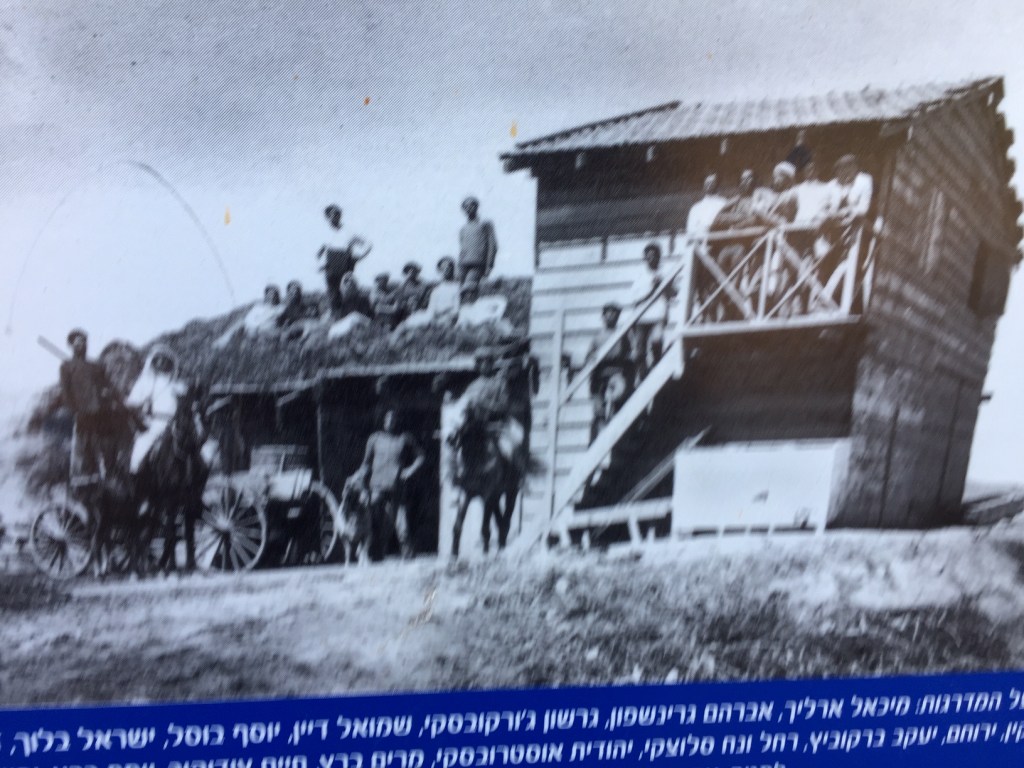
The sign by the building shows a photo of the original inhabitants of this very first kibbutz. The Hebrew writing is their names.

We ate our lunch in a pergola looking over the river, behind this building. Jamie recounted some of the history of the original kibbutz. You can read more about it here: http://degania.org.il/en/

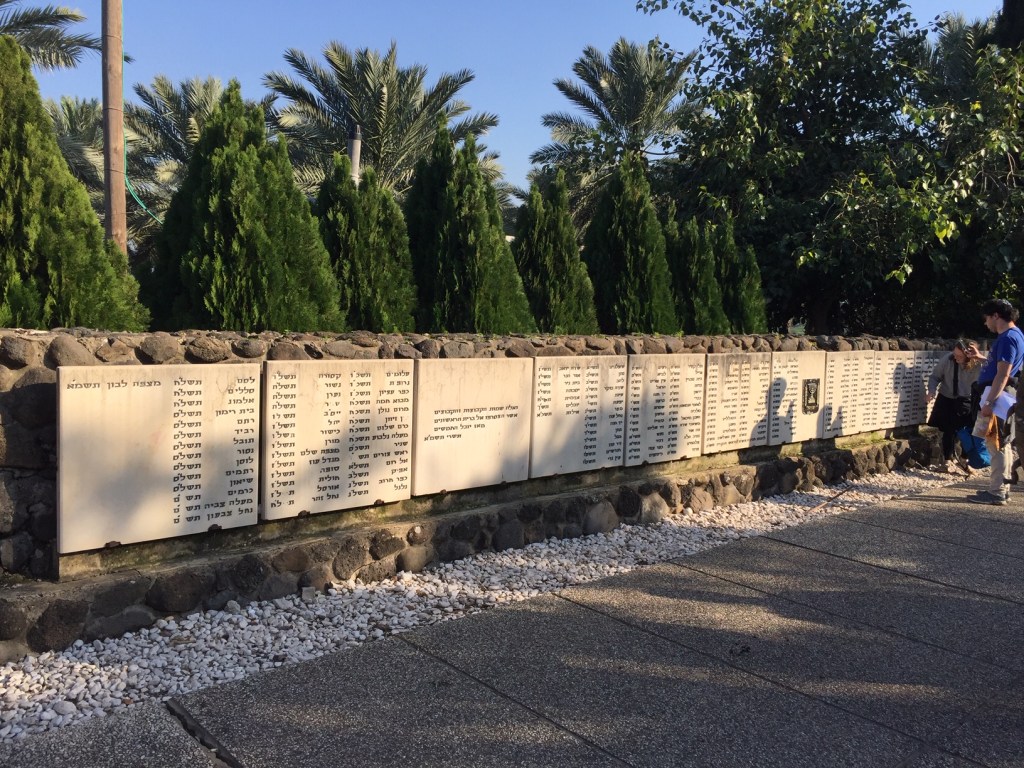
As we left the site we stopped to read this list of all the kibbutzim that were ever built in Israel. The kibbutz movement has largely faded away, as the socialist ideals of the early settlers have given way to capitalism. However, a you’ll see from my pictures from Day two of our tiyyul, there are some modern experiments with a kibbutz-like model. Of course many of the old kibbutzim also still exist, but they do not function on the communal model as they once did. Most of the residents work off site, and the kibbutzim support themselves by providing things like lodging and meals.
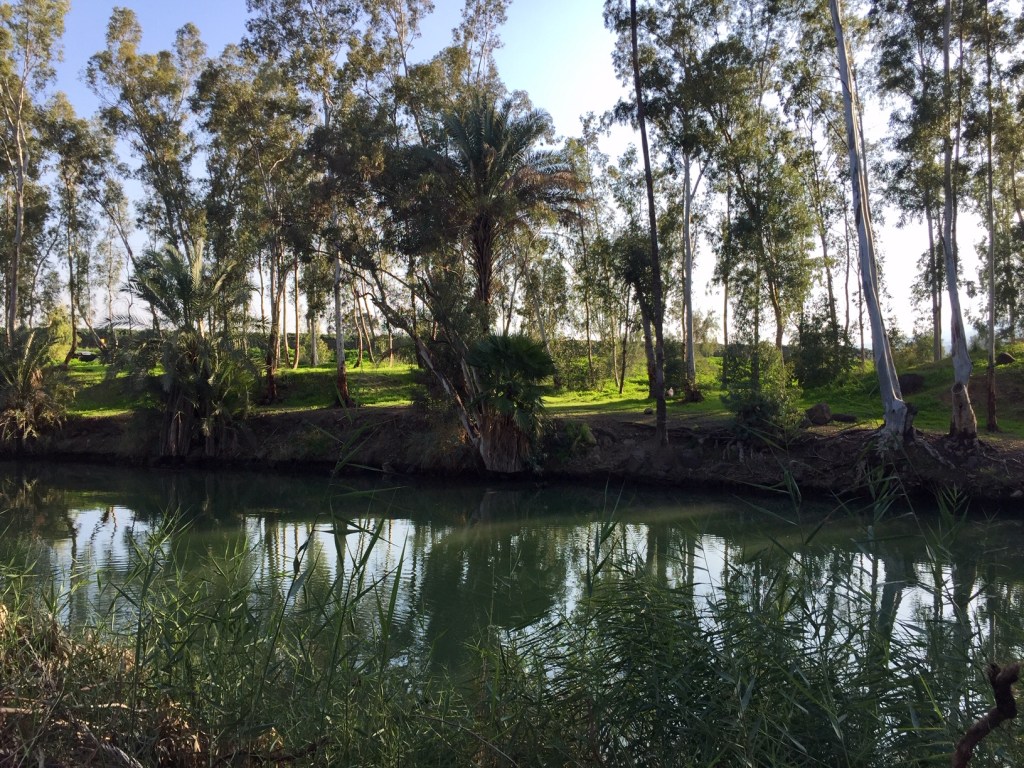
The land along the River Jordan is very tame — this is not wild country!
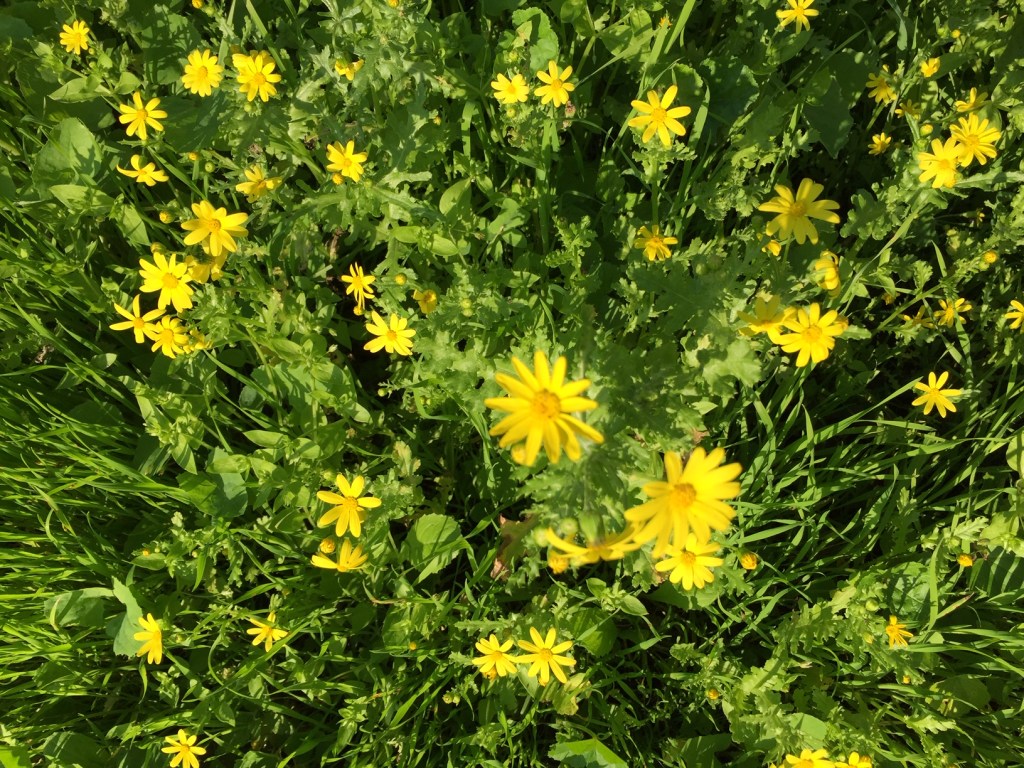
This is Spring Groundsel — Savyon Avivi in Hebrew.
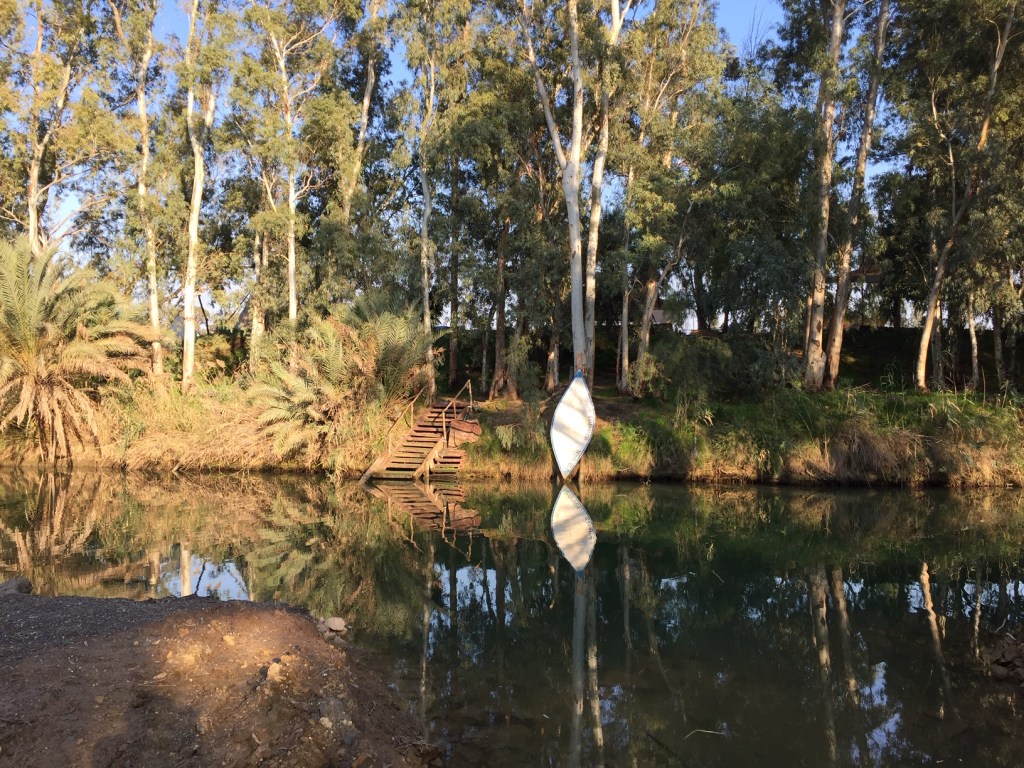
People go camping along here.
And canoeing.

We passed by a camp ground and came out onto the main road. To our right through the fence we could see what seemed to be a sort of spa. This is a kibbutz that has found a way to make money giving Christians a place to do baptisms in the River Jordan. The photo above looks back from the main road bridge over the river. Those white figures you see are folks in terry cloth robes who have either just been or are about to be dunked in the river. I confess, I was enormously amused by the excitement of my fellow students at this “exotic” sight! I know the Christians think the Jews are strange and fascinating — who knew it goes the other way as well?!

On the other side of the bridge is a dam that holds back the waters of the Kinneret — the “Sea of Galilee”, a large freshwater lake on the River Jordan. Jamie explained to us that this would almost certainly be the the year that the flood gates are opened and the waters are allowed to go downstream, much to the excitement of the kayaking community. They were expecting this to happen any day, but when in fact it did happen, on April 23, there were no kayakers and no one to see the release of the water, due to COVID-19. It remains exciting, as the Kinneret has not been full enough to let water out since 1993. With its many desalinization plants, Israel no longer worries as it once did about running out of water. Nonetheless, a full Kinneret is good news to Israel’s water supply and its agriculture.

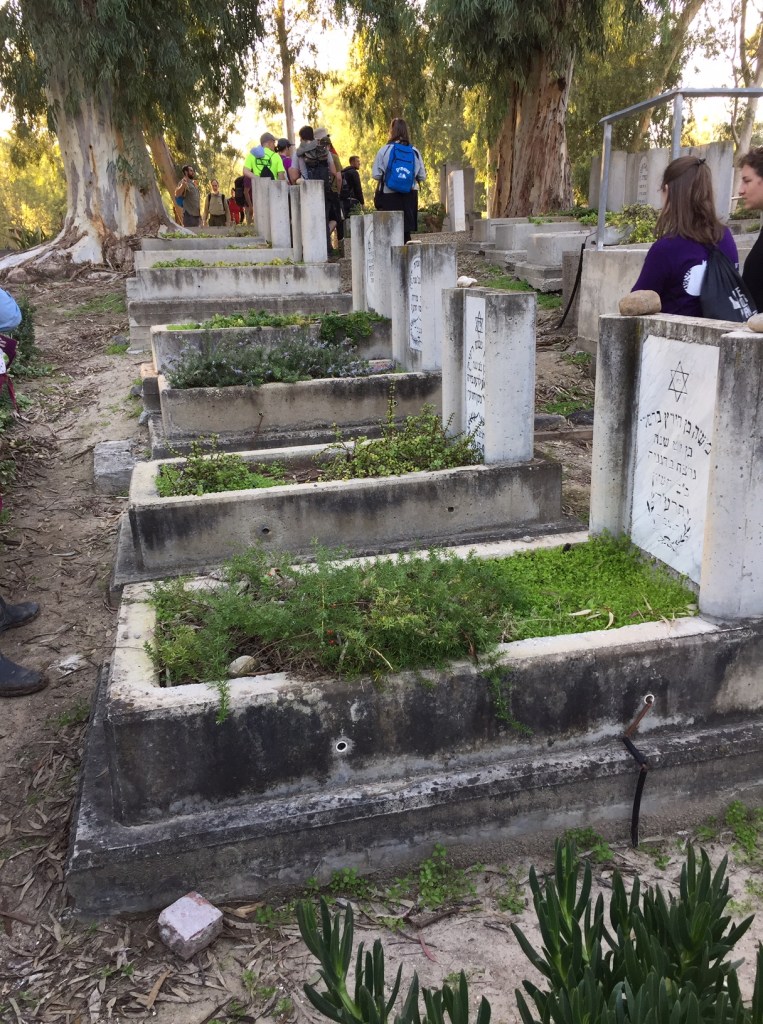
Next to the river stands a cemetery where many notable figures from Israeli history are buried.

I had never seen this style of grave before, with a flower-planting bed atop the grave.

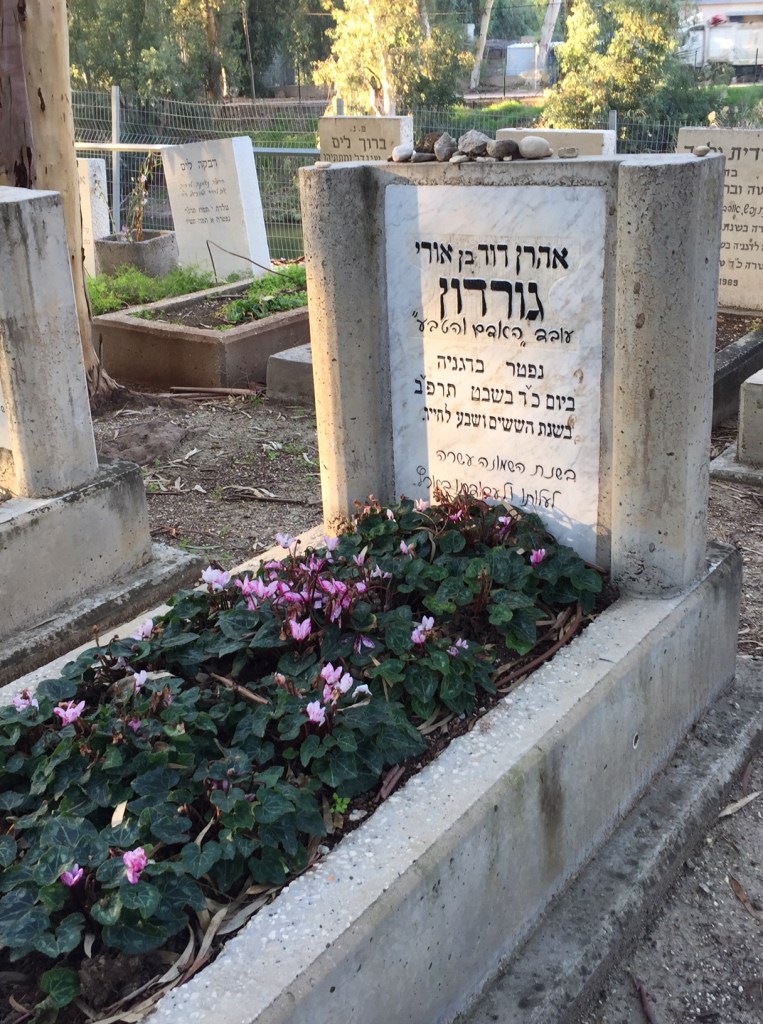
This is the grave of A.D. Gordon, (9 June 1856 – 22 February 1922). Wikpedia describes him much as our guide did, as “the spiritual force behind practical Zionism and Labor Zionism. He founded Hapoel Hatzair, a movement that set the tone for the Zionist movement for many years to come. Influenced by Leo Tolstoy and others, it is said that in effect he made a religion of labor.” Gordon “made aliyah to Ottoman Palestine in 1904, when he was 48, after being persuaded by his wife not to emigrate to America. His daughter Yael followed him in 1908 and his wife about a year later, but his son stayed behind to continue his religious studies… Four months after she arrived in the country, his wife became ill and died. Gordon lived in Petah Tikva and Rishon LeZion, moved to the Galilee in 1912, traveled the country taking manual jobs and engaging the youth, until finally settling in Kibbutz Degania n in 1919. He lived simply and supported himself as a hired agricultural hand, while writing his emerging philosophy at night. Gordon believed that all of Jewish suffering could be traced to the parasitic state of Jews in the Diaspora, who were unable to participate in creative labor. To remedy this, he sought to promote physical labor and agriculture as a means of uplifting Jews spiritually. […]he also believed that working the land was a sacred task, not only for the individual but for the entire Jewish people. Agriculture would unite the people with the land and justify its continued existence there. In his own words: “The Land of Israel is acquired through labor, not through fire and not through blood.””

Ever the visionary, he wrote, “As we now come to re-establish our path among the ways of living nations of the earth, we must make sure that we find the right path. We must create a new people, a human people whose attitude toward other peoples is informed with the sense of human brotherhood and whose attitude toward nature and all within it is inspired by noble urges of life-loving creativity. All the forces of our history, all the pain that has accumulated in our national soul, seem to impel us in that direction… we are engaged in a creative endeavor the like of which is itself not to be found in the whole history of mankind: the rebirth and rehabilitation of a people that has been uprooted and scattered to the winds…”

Like many of the early returnees to Eretz Yisrael, A. D. Gordon’s idealism included a belief that despite the hostilities that existed between Jews and Arabs, there could and should be peaceful settlement together. He wrote, “Our relations to the Arabs must rest on cosmic foundations. Our attitude toward them must be one of humanity, of moral courage which remains on the highest plane, even if the behavior of the other side is not all that is desired. Indeed their hostility is all the more a reason for our humanity.”

My friend Mimi listens with her characteristic skepticism to a hagiographic account of A.D. Gordon.

From the cemetery we walked on, close to the shores of the Kinneret, to the site where Kibbutz Degania Aleph moved after their first outpost was not successful.

This is the central space at the kibbutz, which is now a museum.
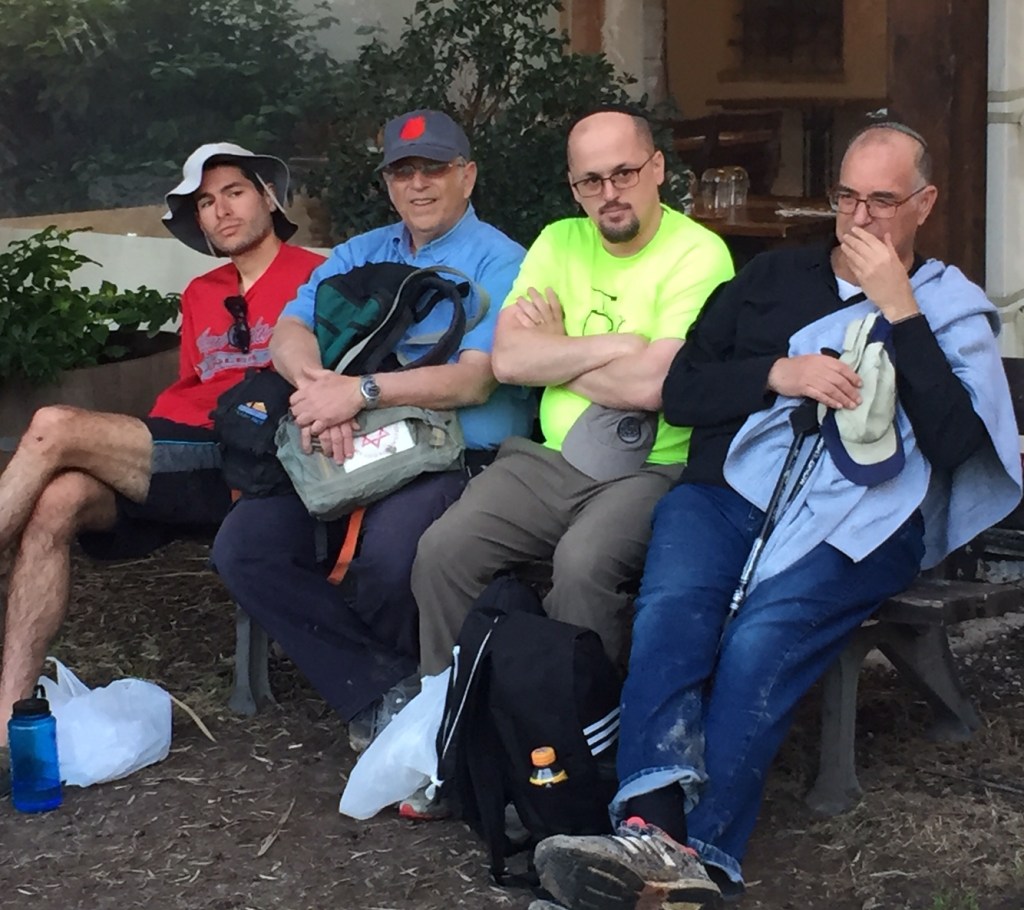
I love this photo of some of my fellow travelers: Jonathan, Rav Meir, Joe Brophy, and Manny. Rav Meir is retiring from being full-time faculty at the end of this school year — as we just learned last week. It will be a different place without him — he has brought his ardent Dati Le’umi (Religious Zionist) views and his personable and caring teaching style to Pardes for 43 years!
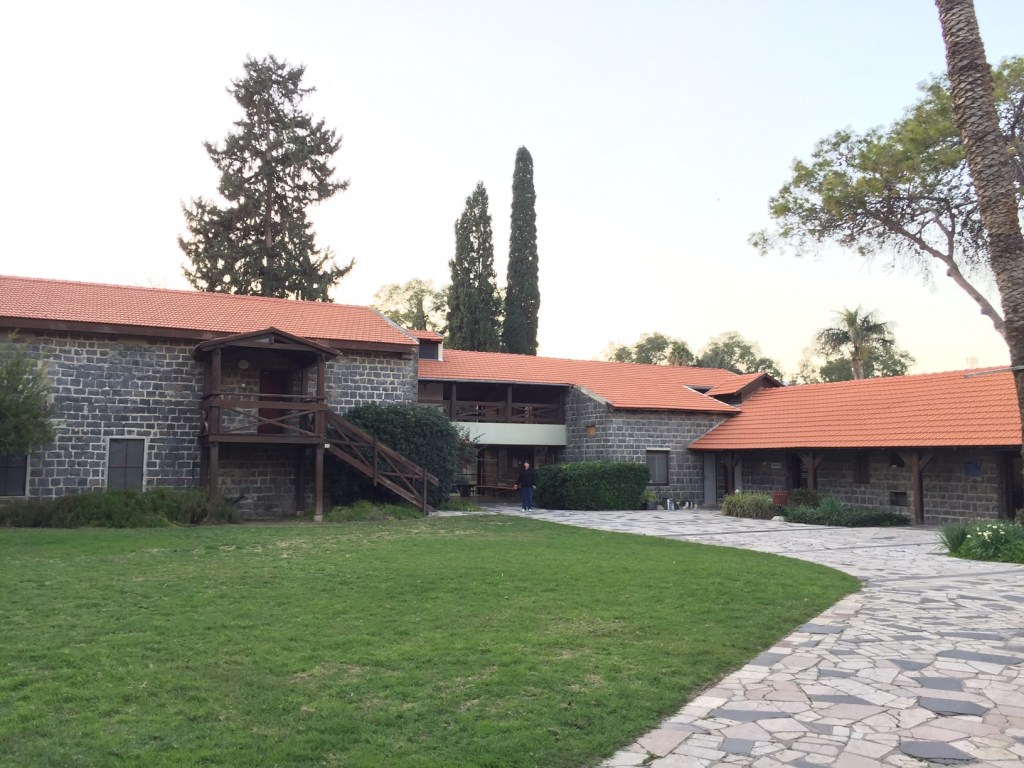
The old kibbutz buildings feel a bit severe.

From here we weary travelers re-boarded the bus and drove a short distance to another nearby kibbutz, Ashdot Yaakov, where we settled into our rooms for the night. Neither the food nor the lodging was outstanding, but we were tired and glad to rest and eat. Some of us gathered in the uninviting social hall for games, but soon most of us wandered off to bed. I’ll tell about the second day of the of the trip in my next post — soon, I hope!

Zissen Pesach — Sweet Passover

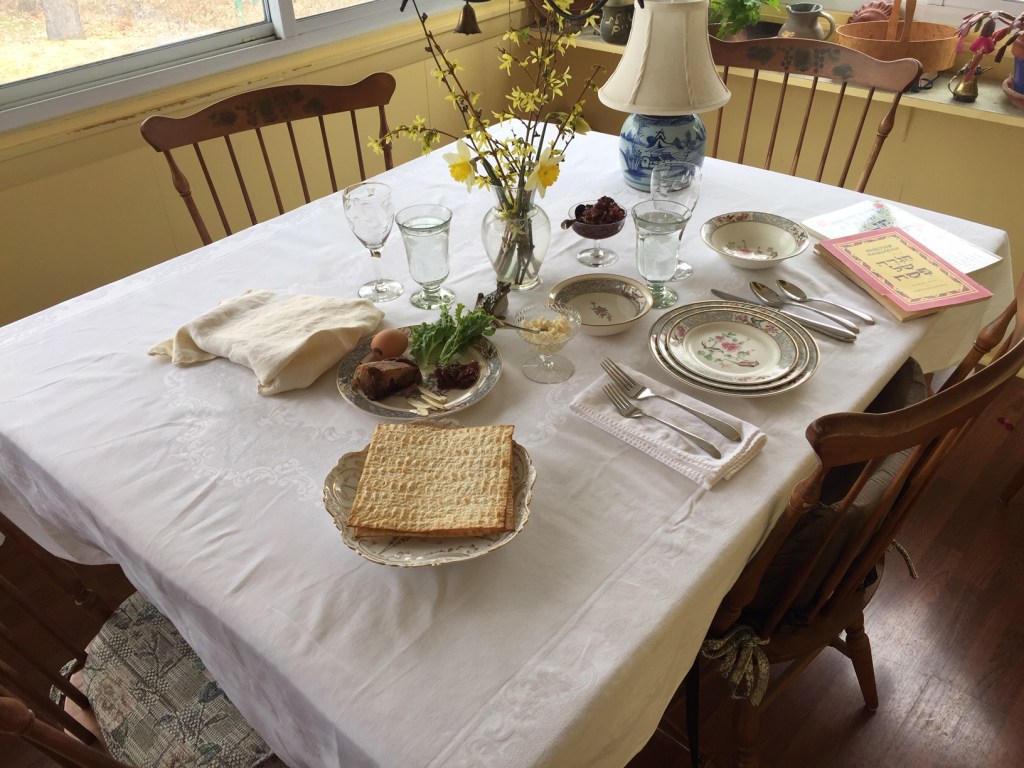
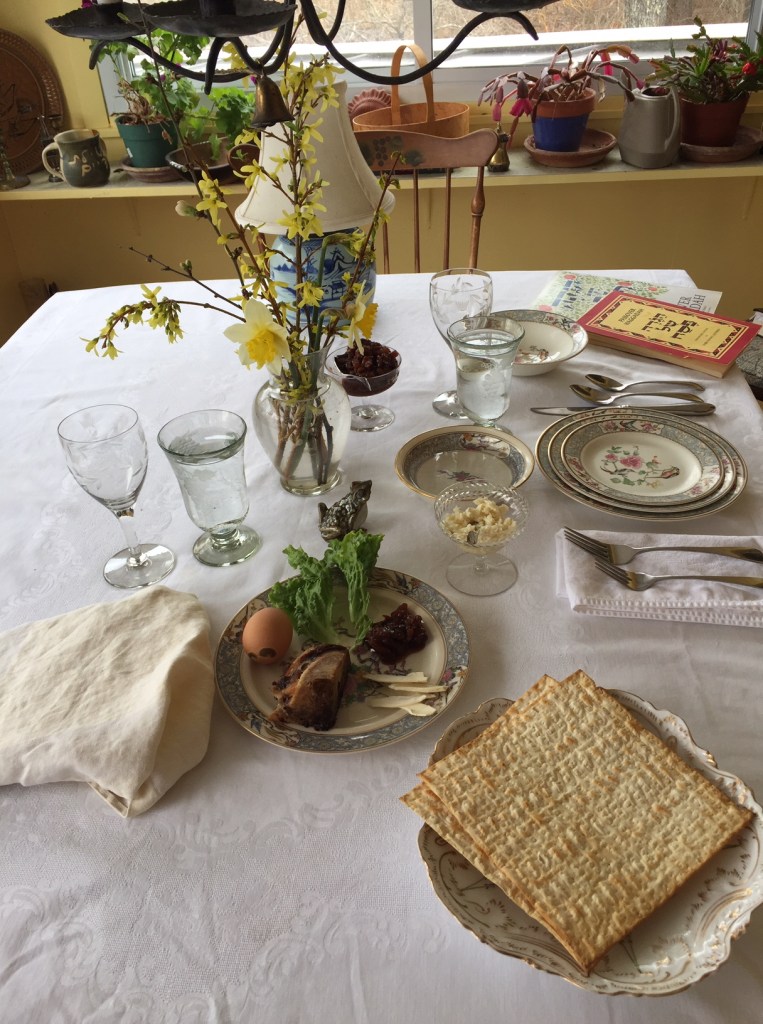
This is not Jerusalem! This white damask tablecloth has seen many holidays in my home, since the first Thanksgiving I had away from my parents’ house, at Bob’s and my apartment in Arlington, Massachusetts in 1989 or so.

I have written many blog posts in my mind since I’ve been home in Vermont. I think I’ve had a hard time starting to write again, knowing that I won’t be writing any more of this blog in Israel this time around. When I was in Israel I often felt that I had left half my heart in Vermont, and now that I am in Vermont I feel as though I’ve left half my heart in Israel!

I am not here…wish I was!

I’ll be lighting my candles in about an hour for the first night of Pesach. I told so many people last year that for me it would be truly, as we say at the end of the seder, “This year in Jerusalem” — or at least, in Tzfat with my family. Best not to count on our plans too much — you’d think I would already have learned that lesson in these past few years with their many surprises. I’ll be having my seder tonight alone the Divine. Hagai is in Jerusalem, where he proposed to sneak past the police who are enforcing the curfew and go to a friend’s house — I don’t know if he made it. Yochi and Yoni and Golan are with Yochi’s mom, Laurie, in Tzfat. Avishai and Libat and the kids are with Libat’s family, also in Tzfat. Ariel and Chris and little Liv, who had planned also to be in Israel, are in Florida, where Chris works as an ER doctor — please include him in your prayers! Gal also got stuck in Florida, so I imagine she’s with Ariel. Yoni and Shoshana presumably had a quiet seder in Mitzpeh Ramon, down in the desert.

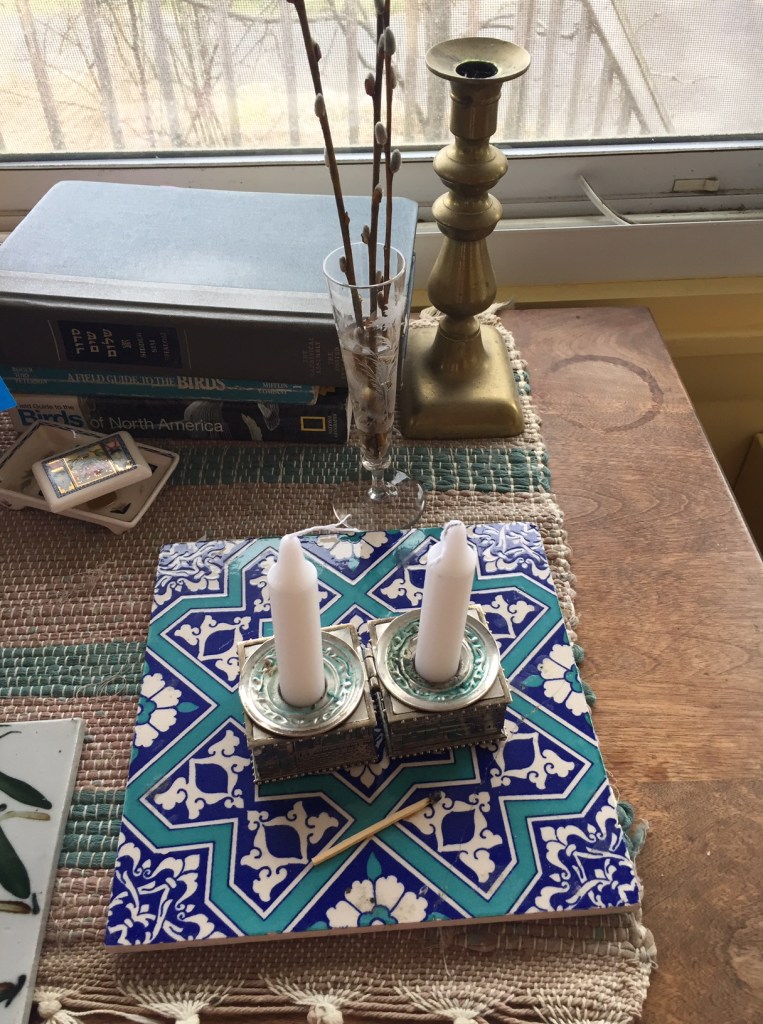
I’ll be lighting these soon.

Tomorrow night I’ll join some Pardes friends (who are in this country right now like me) for a Zoom seder — but tonight I”ll be engaging with the full text of the Haggadah for the first time, and signing all the songs, which I never get to do! I thought I’d share a few photos — and I promise that I will resume my Israel blog, sharing all the Israel photos I’ve not yet shared and reflecting on my time there, after these first nights of the holiday.

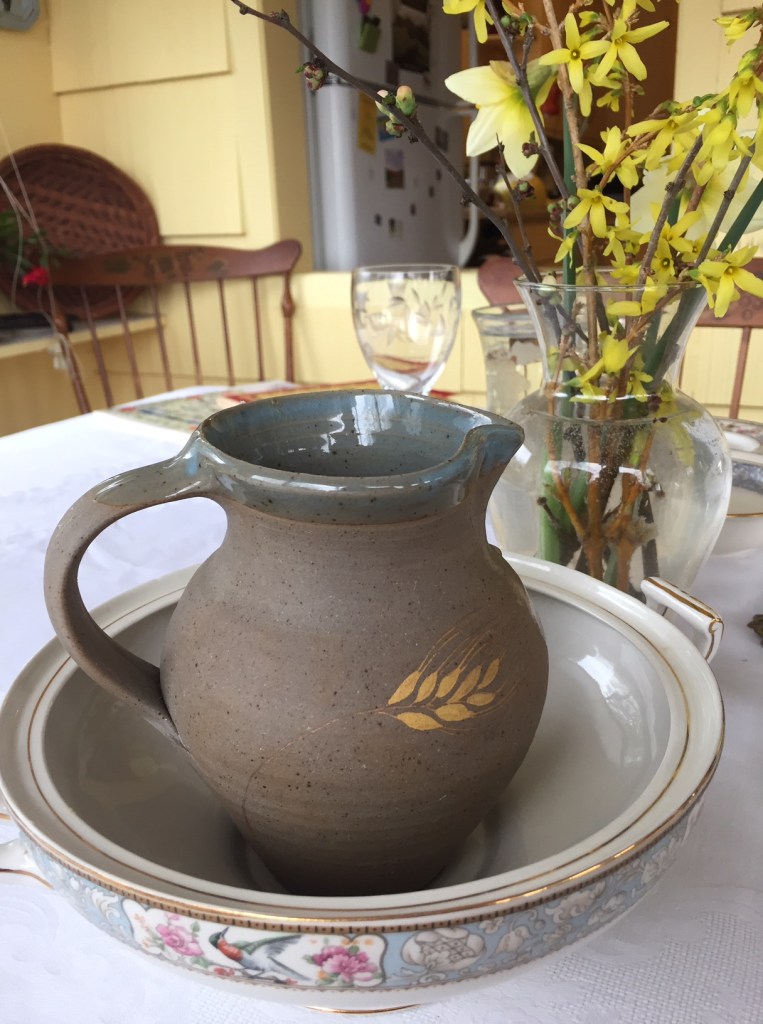
I’ll do my hand washing with this beautiful pitcher from Miranda Thomas. (Hand washing twice is ritually required, although there’ve been plenty of suggestions that if you are having a seder with other people that alcogel between every food is even better!)
The first daffodils came out for today! The forsythia I forced — I brought it in side when I got home two weeks ago. (Have I really been here already two weeks?!)
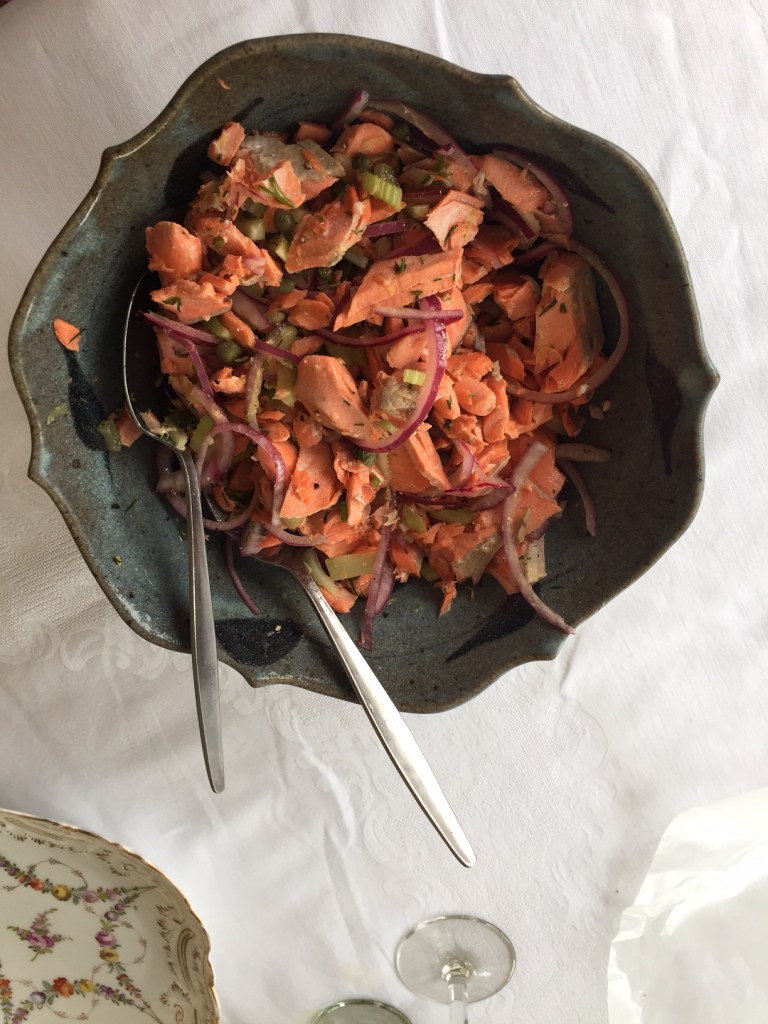
I don;t particularly care for gefilte fish — so I made a salmon salad.
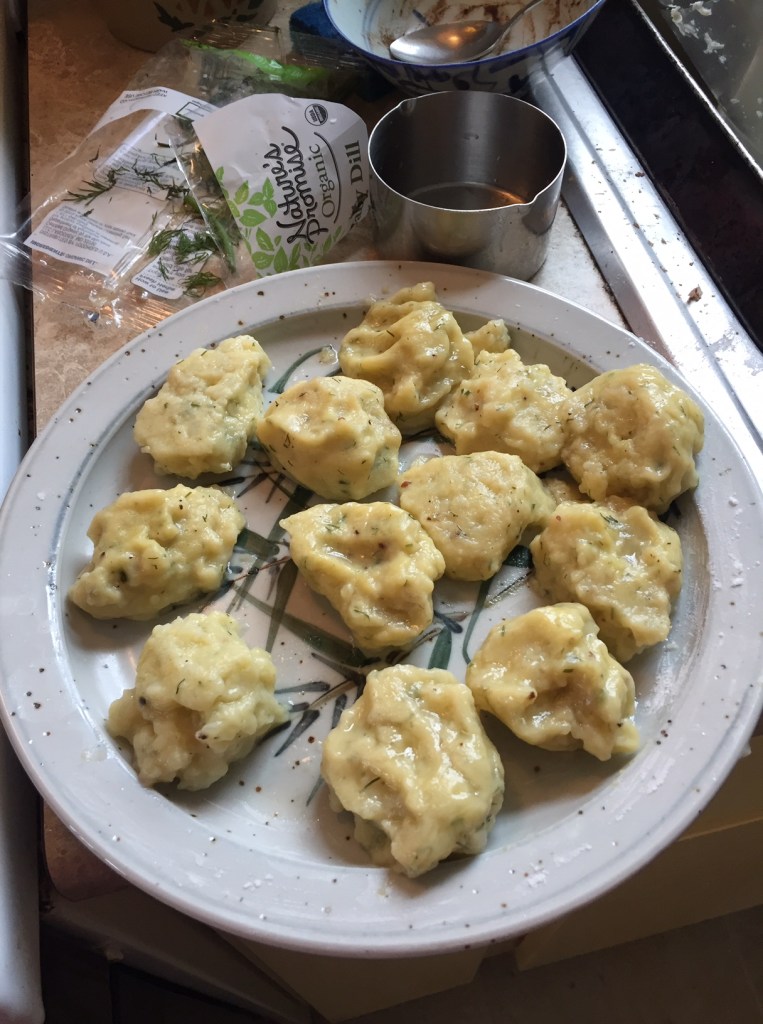
I made gluten free knaidlach with potatoes — they’ll go in chicken broth for a second course.
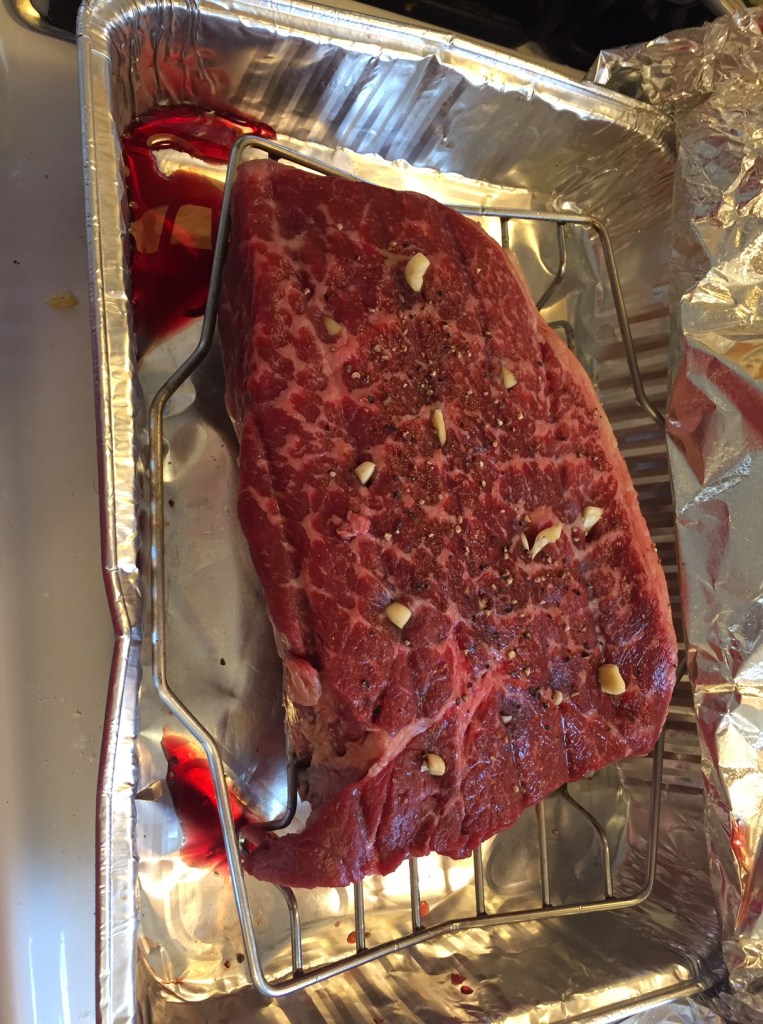
Local beef — in the oven right now with…
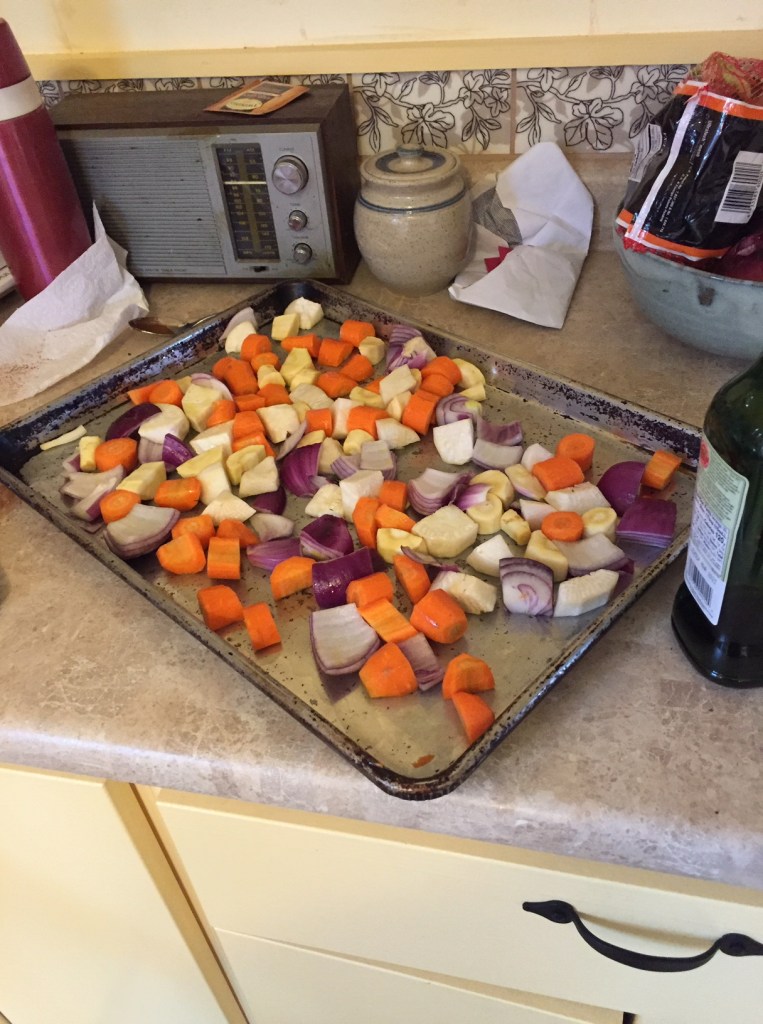
…these veggies plus some apple and pears, roasting.
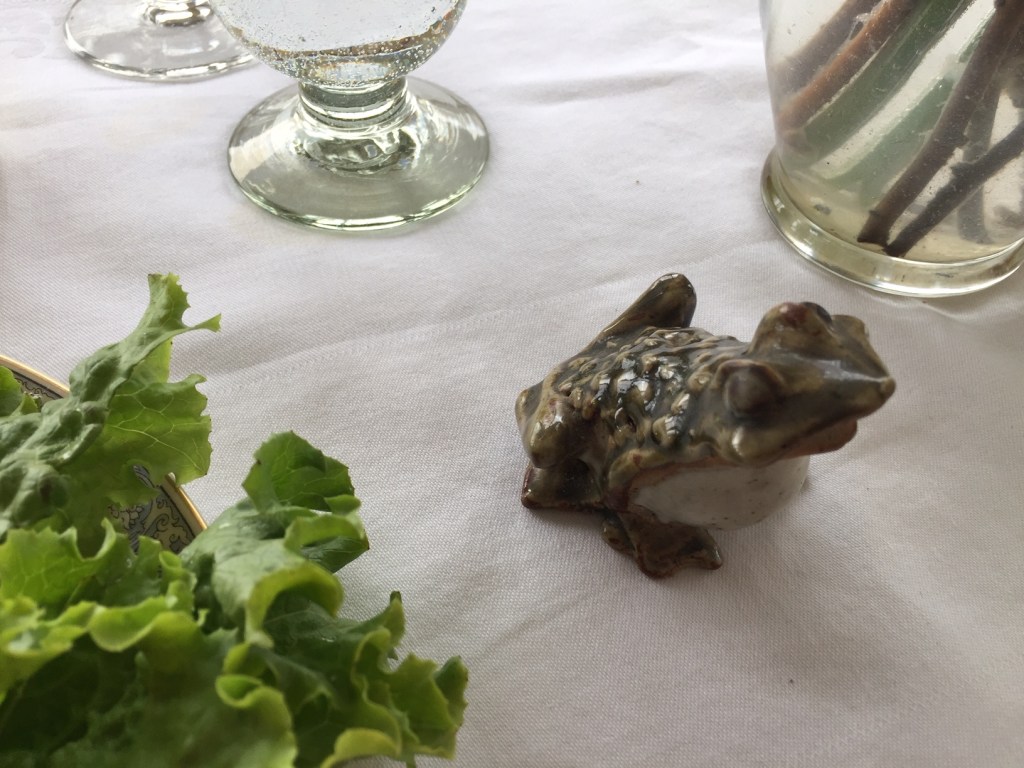
I’ll be accompanied by this frog made by my friend Elysse — for the plague of frogs.
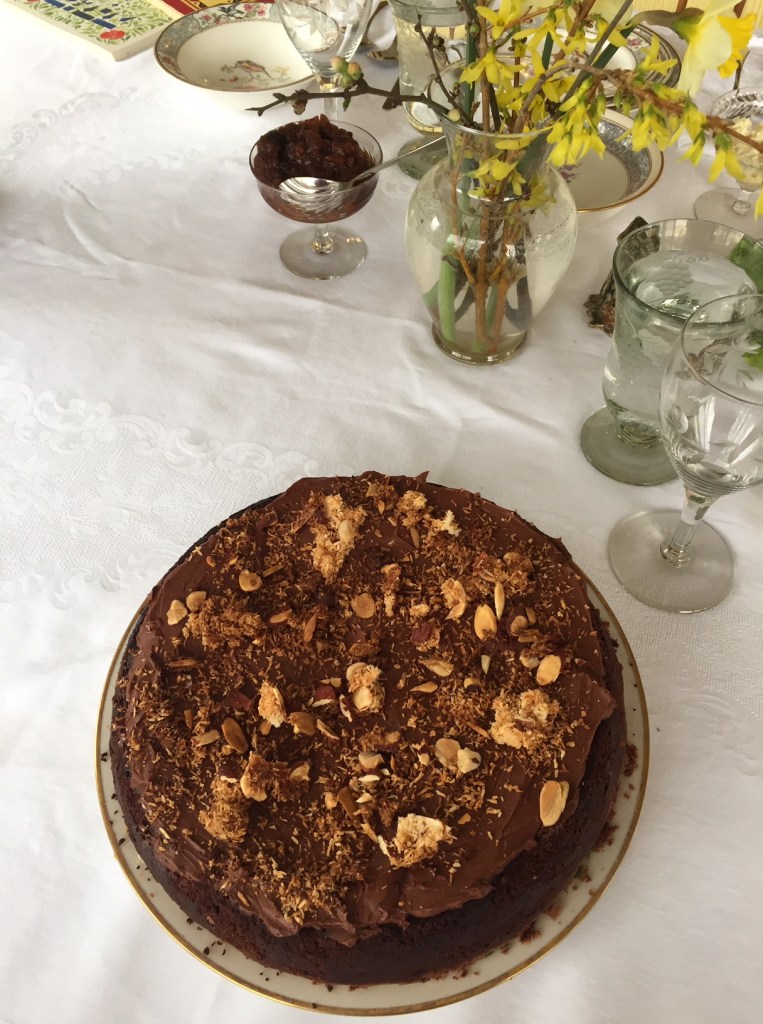
And I’ll be finishing up with this chocolate coconut almond torte.

I wish everyone a sweet Pesach, or a Happy Easter if that’s what you’re celebrating — or just plain happy spring! May we all see liberation soon — and in the meantime, thank God we are safe, healthy, and blessed with friends and family.

Quandaries

Dear friends,

I wrote the following post more than week ago — how much longer it seems! The problems I was wrestling with resolved themselves, and I decided, sadly, to return to the US. I have been home in Vermont since Wednesday night. I am voluntarily self-quarantining for two weeks just in case I picked up something on the trip — but so far I feel fine, although quite disoriented. I’ve been doing my best to get up at 4:30 am to make it to at least some of my classes that are online. It’s nice to be in my familiar home, and most of all, to be able to go outside and garden, walk, chat (from a reasonable distance ) with neighbors, etc. In the coming weeks I plan to continue the blog — I have many photos and thoughts that have as yet been unreported. Stay tuned, stay safe ,stay healthy — and for now, here is what I was thinking eleven days ago:

Cold and rain have settled over Jerusalem these past few days. It makes staying in “lock down” more bearable, in a way. Still, today I went for a brief walk to the park, just to breathe some fresh air. I wasn’t the only one out walking — I saw a few others, mostly small family groups. Everyone I passed looked worried and suspicious, and we all kept well away from each other. It was a far cry from the the usual Shabbat afternoon, when the streets would be full of people come or going from lunch with baskets and pans covered with aluminum foil, kids would be running around yelling, and you could hear loud song coming from many apartments. Today, silence. Still, even in this chilly dampness the spring flowers are blooming and the birds are hopping about.

Hagai and I were planning to go up to Tzfat to visit his mother for Shabbat. I had heard (incorrectly, as it turns out) that Yochi and Yoni and Golan were already up there, and (correctly, I believe) that Avishai and Libat and the kids were going up as well. Laurie, the mother of my grandkids, said Yochi and her family were planning to stay up there and that I was welcome to come as well — “for the duration”. I was wrestling with this generous offer and whether it made sense when I heard from Hagai that Bibi had announced a full lock down. Hagai thought it was wisest to remain in Jerusalem. At the last minute I invited him for Shabbat dinner. Only a minute before Shabbat came in I got a text from Yochi — it seems they also had decided it was best to remain place for now. She invited me to come to their place, but I had already nearly finished cooking dinner –and I wondered if it would be wise to share my germs with time, when I haven’t seen them for a few weeks.

I was invited to join an in person Shabbat lunch today — of six people, she thought — but on reflection I decided to turn that down as well. I miss seeing people “in the flesh”, and I know I will more and more as time goes on. Still, I am an introvert who is well-accustomed to keeping my self occupied, and I get plenty of study and conversation still, even though it is via the internet. I have no wish to catch this thing, nor to accidentally give it to someone else.

My struggle for now is this: do I stay here until June, and hope that I will be able to go home then? Or do I obey the recent instructions of the US State Department and go home now? Part of my decision hinges on whether my house is still occupied, or whether my tenants have gone home to their house in Massachusetts now that, presumably, the school their son attends has closed. I am quite sure that I am safer here than I would be traveling. My only worry is that if I cannot fly in June, I might be stranded here. My lease runs through July, and no doubt my landlady would be willing to renew it if necessary, but I am supposed to be back on the job as of July 1. It’s true that, as someone said to me, if there are no flights there will be no job — at least in person. But it would be better for me to be in the same time zone as my congregation, even if I am serving them virtually. And — I hate to think this — there might be funerals. Please God there won’t — that is my prayer!

Bringing new meaning to the word “Sabbatical”

There’s been a lovely prayer going around on the internet in which the author suggests that we view our time of quarantine as a kind of Shabbat. Lynn Ungar, a Unitarian Universalist minister, suggests gently,

What if you thought of it
as the Jews consider the Sabbath—
the most sacred of times?
Cease from travel.
Cease from buying and selling.
Give up, just for now,
on trying to make the world
different than it is.
Sing. Pray. Touch only those
to whom you commit your life.
Center down.

My cousins in New Mexico wrote, “It sounds like your sabbatical turned out a bit differently than you (or anyone else) expected.” True enough. And just as I was thinking, “Well, I’ve only got two and half months, I’d better hop to it and see everything I can,” I am now instructed to stay in my ground floor apartment with its limited view of some vines and the wall of the synagogue next door. Nonetheless, there is something to what Reverend Ungar suggests. My sabbatical just increased its rest component. The whole world is taking a kind of Sh’mita period. We read that pollution is greatly decreasing, even as the markets plummet. We all sit at home, meditating, praying, doing yoga, chatting with our friends online — in short, resting.

All of my classes have moved online, so I am not without occupation. I do miss my walks to and from school — and now they are advising that we not go out at all unless we have to (although I am intending to push that envelope if I can). The day before everything went on full lock-down my grandson took me for a lovely walk on the campus of Hebrew University, where we admired wildflowers and also cultivated gardens. The little wild red anemones, pink cyclamens, and some beautiful pink and white wild orchids that were new to me grow right on campus, in a rocky area they’ve left to itself. Down the hill, high tech companies have taken over some old dormitories and planted lavish terraced gardens around them. Plants from all over the world mingle there — forsythia and quince blooming next to bright orange Aloe flowers and other exotics. Sadly, I forgot my phone so I don’t have pictures…I do hope that, in spite of everything, I can take some walks around my immediate neighborhood at least. All the spring flowers are springing — although today the wintry weather swept back in and it’s only 45 degrees Fahrenheit with a stiff breeze and a cloudy sky.

I began my first day of home stay with my regular class on Torah. We’re reading the Book of Shemot — Exodus. On Monday we looked at the Ten “Commandments” (in Hebrew, something like the Ten Utterances). We compared the version in Shemot with the one in Devarim (Deuteronomy). The authors of the two versions have different ideas about why we should take Shabbat every week. In Shemot we are told to remember the Sabbath day in order to set it apart from the workday week. The reason given is that after doing the work of Creation God rested on the seventh day, and so we should emulate and honor God. “…you shall not do any work—you, your son or daughter, your male or female slave, or your cattle, or the stranger who is within your settlements. For in six days the LORD made heaven and earth and sea, and all that is in them, and He rested on the seventh day; therefore the LORD blessed the sabbath day and hallowed it.” (Shemot 20:9-10)

But in Devarim the author proposes a different reason:

“...you shall not do any work—you, your son or your daughter, your male or female slave, your ox or your ass, or any of your cattle, or the stranger in your settlements, so that your male and female slave may rest as you do. Remember that you were a slave in the land of Egypt and the LORD your God freed you from there with a mighty hand and an outstretched arm; therefore the LORD your God has commanded you to observe the sabbath day.” (Devarim 5:13-14 — emphasis mine)

In this current time of enforced rest we are surely more in tune with Shemot than with Devarim. The workers of world, especially those paid a pittance — the slaves of our day — would be glad to be working now, as without the work they are without sustenance. Those lucky ones among us who have some means of support, meanwhile, may find this a time to reconnect with God in some way we might have forgotten about. We may find ourselves, even, in tune with the medieval monk who wrote the text which Samuel Barber set to music as “Beloved that pilgrimage”:

Ah. To be all alone in a little cell to be alone, all alone. Beloved that pilgrimage… Alone I came into this world Alone I shall go from it.

We may not think of being alone as a part of the Jewish search for spiritual connection. To recite the most essential portions of our liturgy out loud we require a group of ten people. The Mourner’s Kaddish, the prayer we say for one who has died, in particular requires at least ten — at least nine people to surround the mourner and make her feel supported in her time of loss, some would say. The rest we take on Shabbat is actually in normal times a rest that involves a great deal of sociability — praying in groups, eating in groups, singing in groups, getting a bit merry with wine in groups…

And yet some of our own great sages and teachers also spoke of the spiritual value of solitude. The Chassids teach about hitbodedut — a kind of sacred seclusion. Rebbe Natan of Nemirov took the words of Rebbe Nachman of Breslov and made a poem which begins,

Master of the Universe, grant me the ability to be alone;
may it be my custom to go outdoors each day
among the trees and grass — among all growing things
and there may I be alone, and enter into hitbodedut prayer,
to talk with the One to whom I belong.

Though I am an introvert, I certainly did not intend to spend my sabbatical in hitbodedut! And fortunately, thanks to the caring community of Pardes, as well as the wonders of the computer, my time of enforced home stay is not lonely. Yet I am prepared to accept that there may be things I will learn from this experience that I could not have learned if I were carrying on my sabbatical as I did before, dashing around the country trying to see all the sights, or trudging back and forth to school, or even gathering with friends for Shabbat. Now, the learning will be of a different nature. Not what I expected, but important in its own way. I will bless this time, this time set part from any experience I’ve had before, this sabbatical from my sabbatical.
Early spring tiyyul Part 1: The Bridge

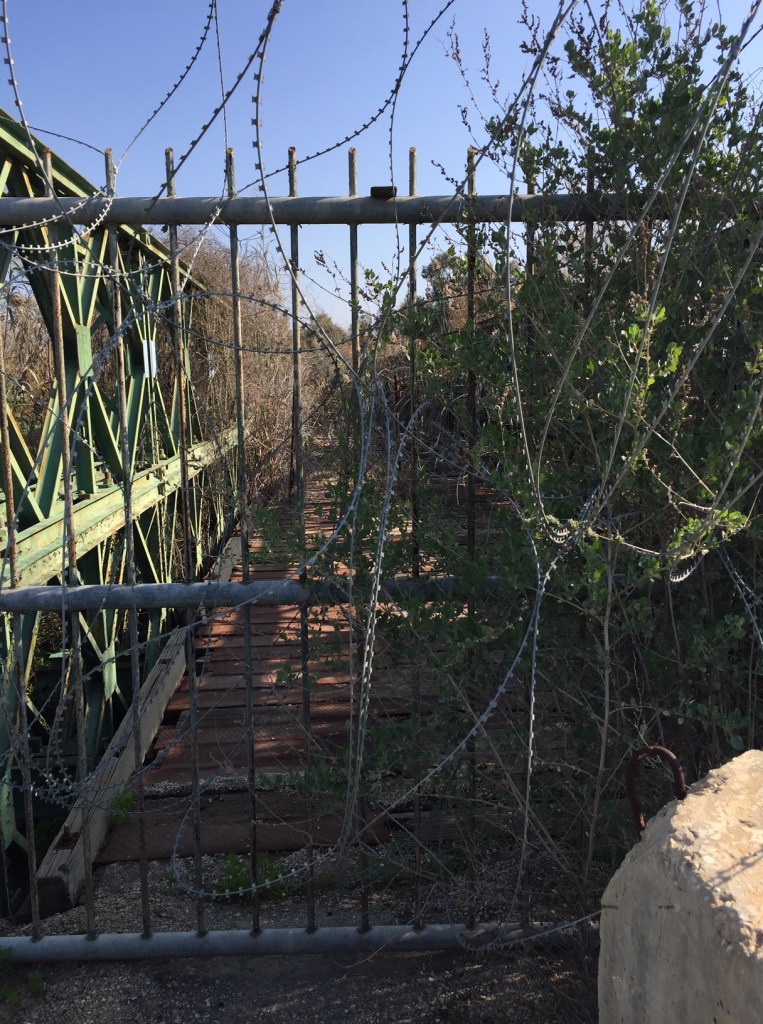
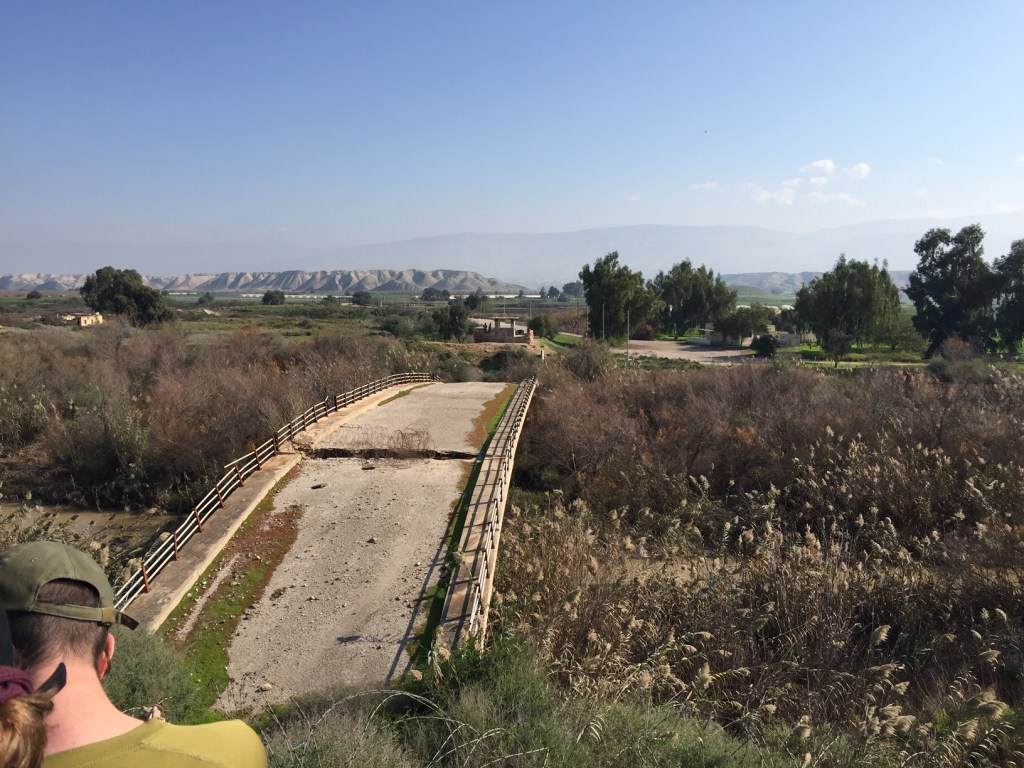
In early February, a few days after I had returned from a brief trip to snowy Kalamazoo, Michigan for my sister-in-law’s memorial service, I traveled with a group of Pardesnikim on a two day tiyyul to north central Israel. Although the stated intention of our trip was to trace the history of the kibbutz movement, our religious Zionist tour leader, moved by the recent announcement of the Trump “peace plan”, decided to take us first into the West Bank to the site of an old border crossing between Israel and Jordan. We drove down the hillside to within sight of Yam HaMelach (the Dead Sea), then proceeded northward and made our way into a closed military area which we had received permission to enter. There, we were accompanied by a bevy of soldiers to view the Damia Bridge, known in Israel as Gesher Adam (Adam Bridge — or perhaps, The People’s Bridge).

One of the old bridges, now closed.

Wiki can tell you what our tour guide told us: “After 1991 it was used only for goods transported by truck between Israel, the West Bank and Jordan until its closure for security reasons some time between 2002 and 2005 during the Second Intifada. As of 2014, the Israeli side is part of a closed military area.The site was used as a crossing between the west and east banks of the Jordan due to good access in both directions over the Far’a[2]/Tirzah Valley to the west and the Zarqa/Yabbok Valley to the east.

Still visible are ruins of several consecutive bridges:[3] the stone bridge built by the Mamluk sultan Baibars in the 13th century, blown up by Haganah forces during Operation Markolet (known as the Night of the bridges) on the night of 16–17 June 1946; a British bridge built soon after, and a Jordanian one from the 1950s, both destroyed by the Israeli army during the 6-Day War of 1967. Right after the war, in August 1967, Israeli Minister of Defense Moshe Dayan allowed the uncontrolled traffic of goods between the Palestinians and Jordan using the ford of Damiya, as a way of avoiding the economic collapse of the West Bank and for avoiding Palestinian discontent, since the Israeli markets were not open yet to Palestinian produce. This was an element of what became known as the “policy of the open bridges”.[4]

And another. On the far side of the bridge you can see the Jordanian military outpost. The trees are in Jordan.

I know that feelings about our visit to this bridge, and about the Trump plan, are varied among my fellow students. In general, the students at Pardes are more left-leaning than the faculty (many of whom live in what you or I mightcall “settlements” in what we refer to as the West Bank). But this is not true of all of us — and there are also gradations of left-ness, as well. I know that in this blog I’ve skirted the Israel/Palestine issue somewhat. I never did post my pictures and reflections on our tiyyul to Hebron back in the fall — it raised so many questions for me that I found it hard to know where to begin. I can only tell you that the way the conservative Zionists remember history seems always to be tinted with a rosy glow of nostalgia (“in the old days we got along so well with the Arabs”), and perhaps with a golden haze of military triumph as well. And yet, would it be better to have this bridge open to commercial traffic? I think yes. The question is, who should in charge of that traffic flow — Israel, or the Palestinian Authority? Jordan has little enthusiasm for either option. If the next government follows the Trump plan which would allow Israel to annex these contested lands, will this bridge reopen? Hard to say.

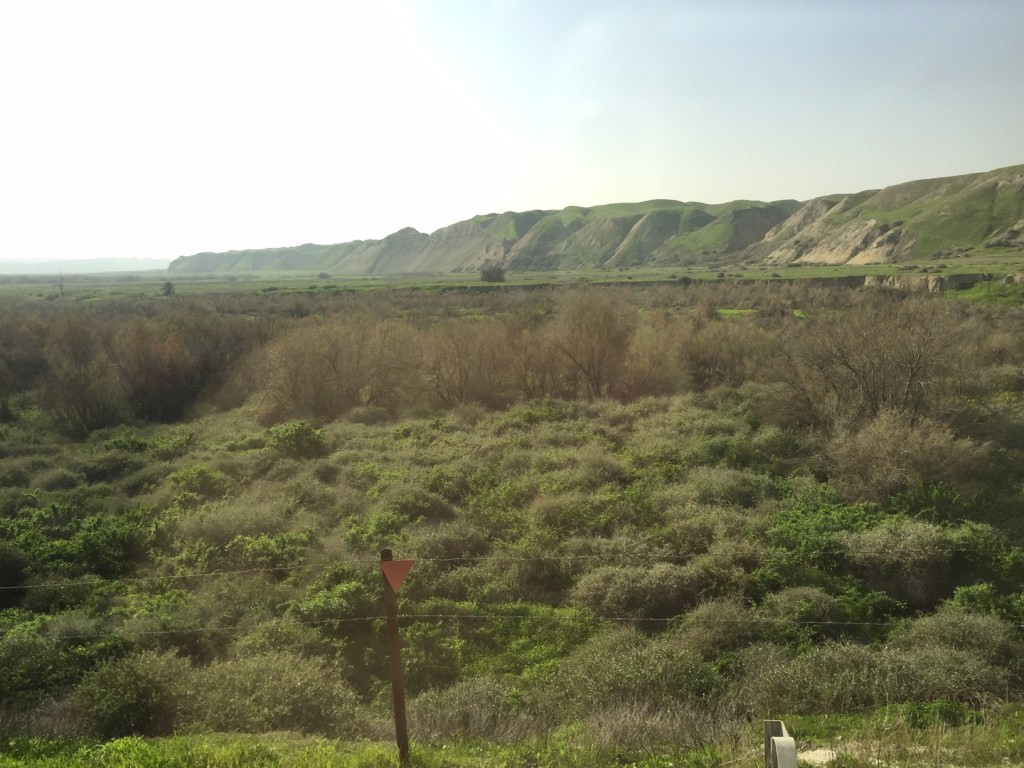
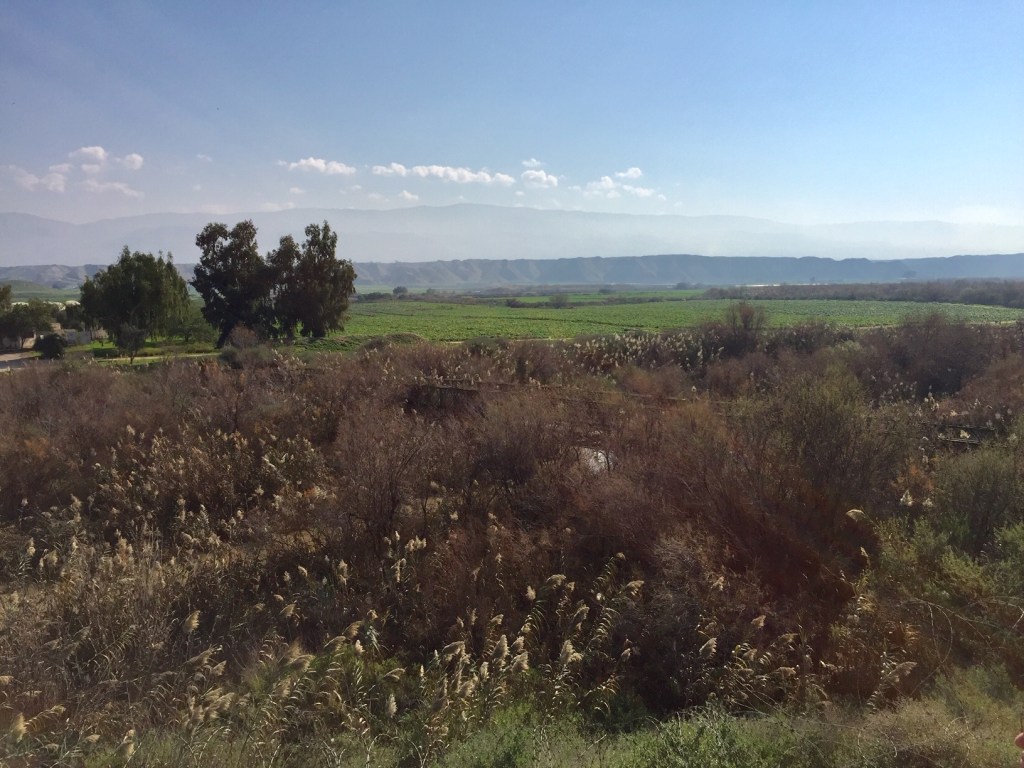
From the road down to the bridge, the swamp lands turning green from the winter rains give little clue of the conflicts that have been and continue to be fought over them.
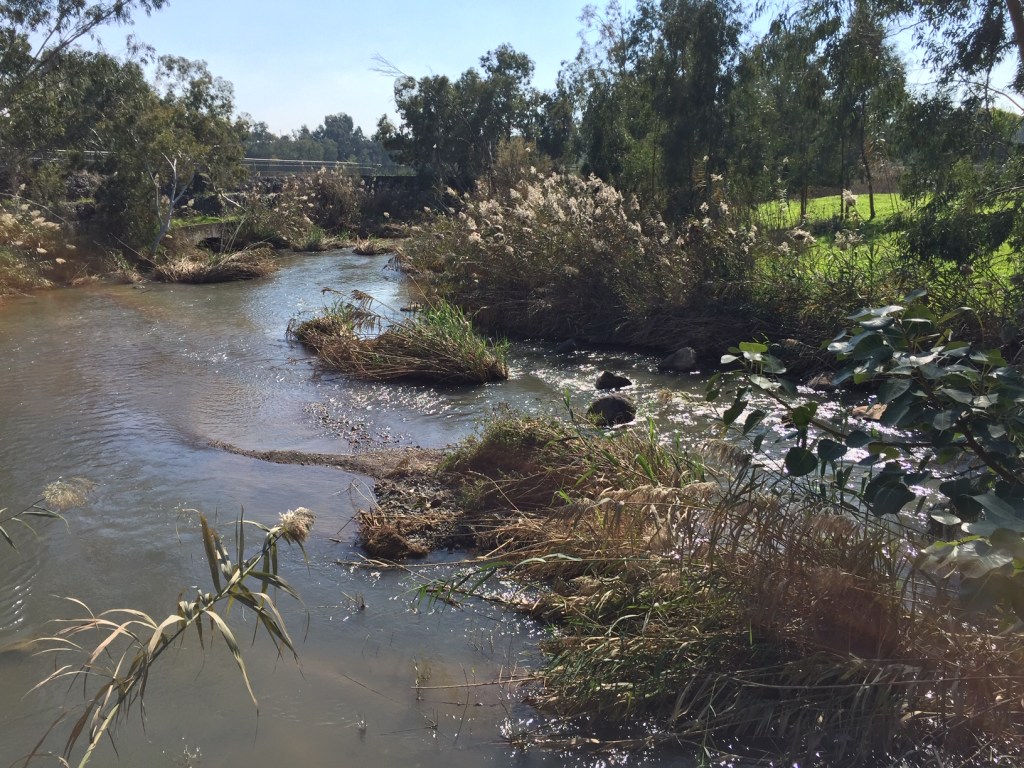
The little glimpse of water is the Jordan River. Most of it is siphoned off for agricultural use much further upstream, by Lebanon and Syria as well as Jordan and Israel. Those green farm fields are in Jordan.
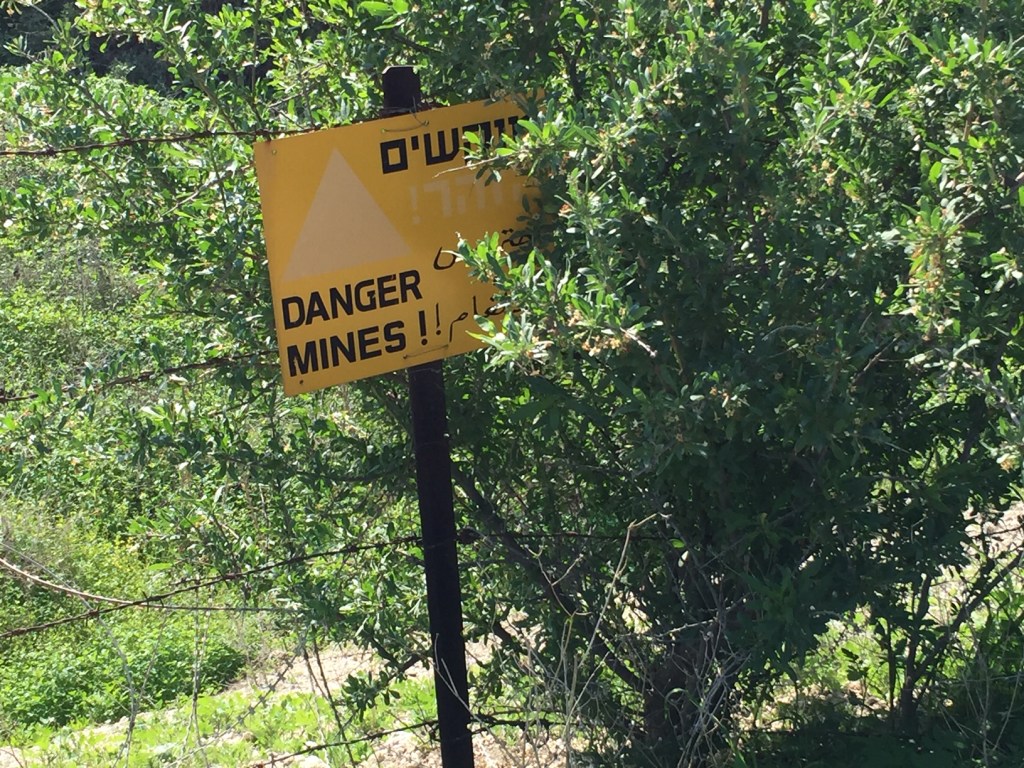
Best not to step off the path…

From the bridge we drove north. The weather was perfect, and everything was glowing green with the first flush of spring. We passed through farm fields, some farmed by Palestinians and some by Israelis. The fertility of this land, and its access to water, is part of what makes it desirable. You can see in this map from Peace Now https://peacenow.org.il/en/data-on-netanyahus-jordan-valley-annexation-map that where we were driving is exactly what Netanyahu (and others) proposes to annex, with full support of Trump’s government. One can make an argument — a strong one –that Israel is historically entitled to these lands. One can also make an argument that the Palestinians need a place to live, and that much of this land has been in their possession for centuries. I wish I could tell you that I think this is clear and uncomplicated…What I can say for sure is that the large majority of Israelis are center right, and do not support an organization like Peace Now.

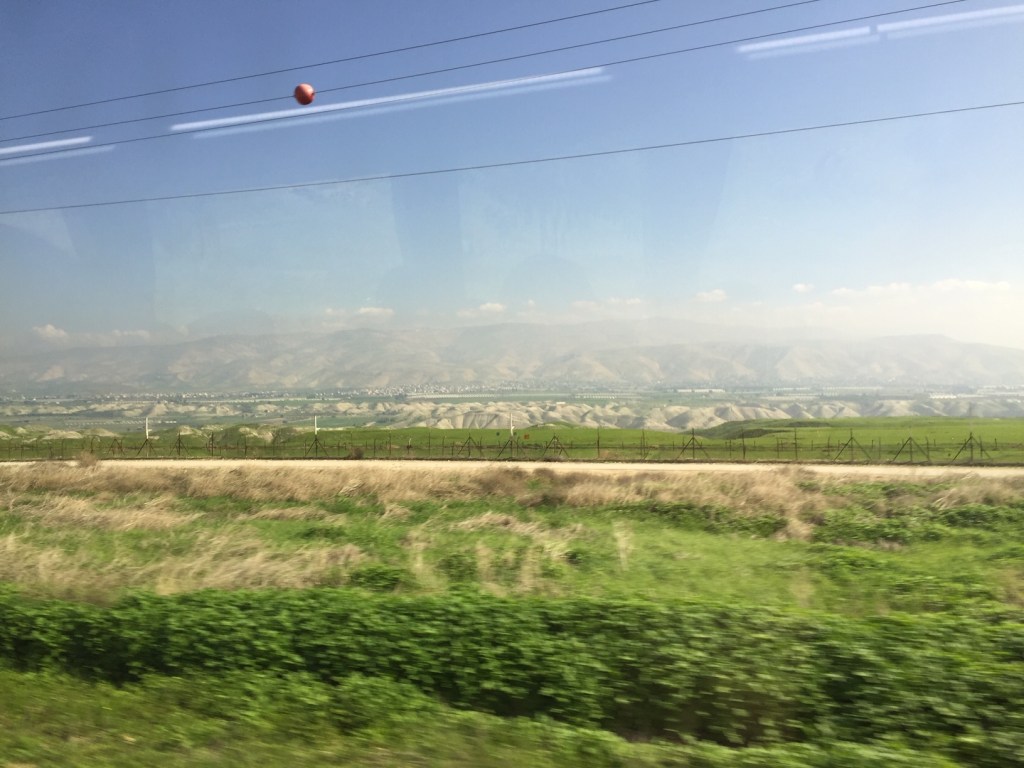
View from the bus as we drove north. Not sure exactly where Jordan begins — the mountain and the distant buildings are Jordanian for sure, and possibly the green behind the fence as well.

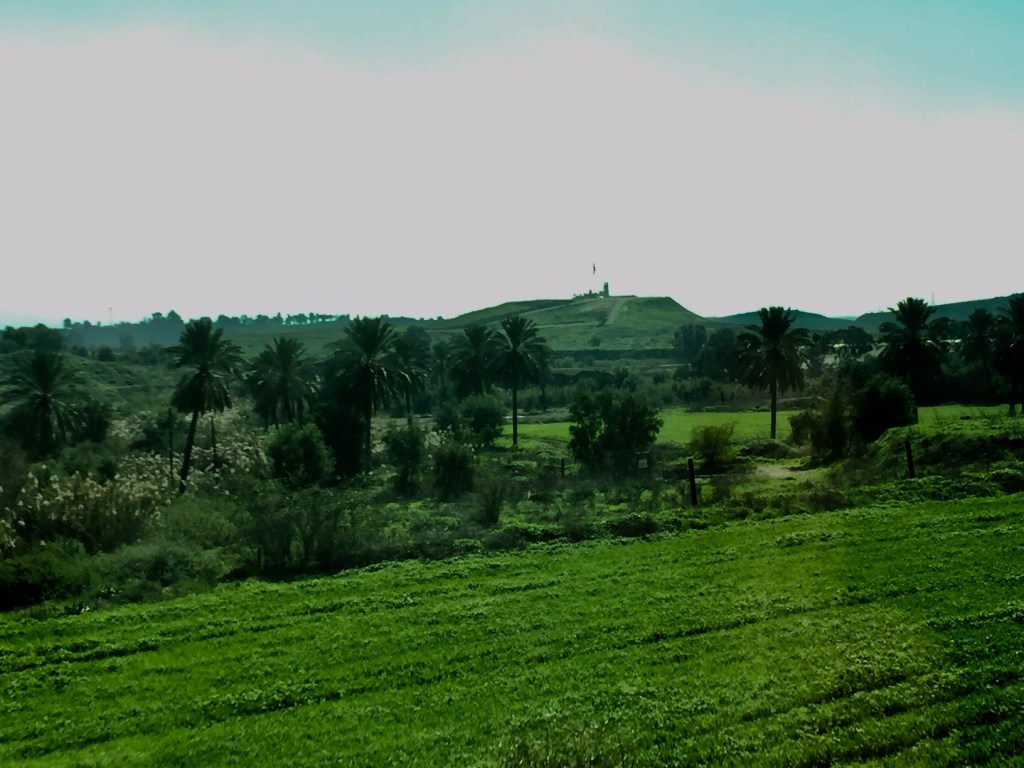
After we came through the checkpoint at the “Green Line”, we stopped at a small convenience store for a snack and a pee. Everything was peaceful, sunny, normal. Still, when we boarded the bus again, the last view before we disembarked and began our hike was another piece of contested ground — the area known to Israelis a the Island of Peace. The Jordanian flag is flying there now, for the first time since the early nineties. You can read more here: https://www.nytimes.com/2019/11/10/world/middleeast/jordan-israel-lease-land.html
The speck in the distance is a huge Jordanian flag, hoisted a few weeks ago when Jordan reclaimed this land.

Update in real time — Purim, COVID-19, and more

Dear friends,

I’m afraid my blogging lags well behind my actual experiences. And alas, my present experience is sitting at home with a bad upper respiratory infection. No, don’t panic — I’m quite sure it is my usual winter sinus mess, and NOT the new corona virus. But it caused me to miss a Shabbat dinner I would have loved to attend (at which the Dean was in attendance — a man who is difficult to get to know). And now, a day of classes as well — not to mention, the weather is delightful today, sunny and warm and full of bird song. I felt much less sad about staying in on Friday when the rain and the wind were whipping around outside and the sky was as dark at mid-day as it usually is at dusk. Just now, a Palestinian Sunbird (sort of like a giant iridescent hummingbird) was fluttering around in the sunlight on my patio. If it stays so nice, I will at least go sit outside for a bit in that gorgeous sun.

Here as everywhere there is a general panic about COVID-19. Normally a great deal of travel goes on between Israel and the rest of the world. Now, people are being placed in quarantine at a rapid rate, and many countries are off-limits for travel. One of Pardes’s staff members made the mistake of going to France to visit family and is now on lock-down for fourteen days. We receive daily updates about the best ways to prevent the spread of the virus — measures that we all no doubt should have been following even before the advent of this nasty virus, given that a place like Pardes is a veritable petri dish of germs. A couple days ago we got a notice from the government that an American tourist who was later diagnosed with COVID-19 had gone traipsing through Talpiot (the neighborhood where Pardes is located), visiting all the shops, cafes, and buses that we generally use. They provided us with a list of times, dates, and locations, and said if we’d been in any of these places at these times we should report to the government for testing and possible quarantine. As one of my classmates said, “Who the hell remembers what time or day we were in the mall or on the Hebron Road bus?”
Purim is almost upon us. With the fears about the virus, it seems like a bad time to be encouraging mass parties with excessive drinking. In Intermediate Talmud we’ve been reading Tractate Megillat Esther, which lays out the rules for Purim. As kids from the BAJC Hebrew School know, there are “One, two, three, four — four mitzvot for Purim.” (See here for the song: https://www.youtube.com/watch?v=5LhrjAksLlE I’m afraid it proves the sad truth that there are few if any really good songs for this holiday!). Tractate Megillah lays out the commandments: Read Megillat Esther (the scroll of Esther), give Mishloach manot (food gifts to friends), give matanot laEvyonim (gifts to the poor), and make a festive Purim meal. But there is also a commandment — not listed as one of the four, but spelled out in the gemara — “Rava said: A person is obligated to become intoxicated on Purim until he is so intoxicated that he does not know how to distinguish between “cursed is Haman” and “blessed is Mordecai”. (Megillah 7:b)

Our teacher Leah told us that her son, who goes to a frum yeshiva, was thinking about coming home for Purim in order to avoid the spectacle — as well as the possible dangers — of seeing his fellow-classmates and teachers taking this commandment literally. She said he was quite nervous about it. I don’t blame him. I was planning a Purim seudah (meal) at my house, but I wasn’t all that sorry to have to cancel it due to being sick — the possibility that my guests would be very drunk didn’t thrill me. As it is, I was recently at a Shabbat lunch where everyone except me was drunk, and it held no joy for me. All this will come as a surprise, perhaps, to members of my Brattleboro community who know how many years I lobbied for us to observe Purim as the adult holiday it really is, and to offer alcohol at our festivities (as we now do). But I have never seen anyone at the BAJC Purimpalooza drink to excess. Apparently Rambam (Maimonades) said that the instructions in Megillah 7:b simply mean to drink enough to be too sleepy to hear the difference between Haman and Mordechai. If I were to drash (interpret) a bit, I’d say that what it really means is that we should be so merry that we can forget for a brief time the real evils in the world.

Another thing we learn in Tractate Megillah is that Purim is observed on a different day in Jerusalem than anywhere else. Technically, it is observed on a different day — a day later than the rest of the world — in all walled cities, but the gemara makes the decision that it has to be walled cities that have been walled since the time of Joshua — and then also decides that this means Jerusalem. The walls around the Old City have actually only been extant since Suleiman the Magnificent built them in the sixteenth century, but the story goes that Jerusalem has been a walled city since Joshua took it — although there’s no archeological proof that Joshua even existed. There’s an argument to be made that the Talmud simply wants Jerusalem to be different because it is Jerusalem, and sets about proving its case any way it can. In any case, we’re a day later with our Purim festivities here, so one can, if on wishes, travel to Tel Aviv to participate in Purim there (sure to be raucous and transgressive!) and then come back up the hill for Purim here the next day.

So here I sit — on my patio now, in the sun, listening to a bulbul going through his elaborate vocal exercises, as well as to the exuberant voices of the children in the gan (daycare/kindergarten) next door. I’m hoping I recover speedily. I’ve been invited to do a vocal recital with the pianist roommate of a friend, and I need to be practicing our repertoire. Also, I’m supposed to chant part of the megillah Wednesday morning. I hope to be singing like that bulbul any day now. In the meantime, I’ll be writing the rest of those blog posts I’m so behind on… stay tuned!

T”U BiShvat with Sara Laya

For those of you who are not familiar with it, T”U BiShvat is the fifteenth of the month of Sh’vat. (I’d spell it out for you in Hebrew, but I’ve discovered that when I post things all the Hebrew gets reversed!) The letters Tet Vav in Hebrew spell T”U, and are equal to the number fifteen. Originally this day was set to mark the time when you could first harvest your fruit trees. The Mishna, Tractate Rosh HaShanah, sets four new years. The first of Nisan (later in the spring) is “new year for kings and festivals”. The first of Elul (fall) is the “new year for the tithe of cattle”. The first of Tishrei (right after Elul) is the “new year for years” — Rosh HaShanah. And the fifteenth of Shvat is the “new year for trees”. The Talmud sets Tu BiShvat as the cut-off date in the Hebrew calendar for calculating the age of a fruit-bearing tree. Fruit that ripens on a three-year-old tree before Tu BiShvat is forbidden to eat, while fruit ripening on or after Tu BiShvat of the tree’s third year is permitted. (These rules are still followed in Orthodox Judaism.)

Per Wikipedia, “In the Middle Ages, Tu BiShvat was celebrated with a feast of fruits in keeping with the Mishnaic description of the holiday as a “New Year.” In the 16th century, the kabbalist Rabbi Yitzchak Luria of Safed and his disciples instituted a Tu BiShvat seder in which the fruits and trees of the Land of Israel were given symbolic meaning. The main idea was that eating ten specific fruits and drinking four cups of wine in a specific order while reciting the appropriate blessings would bring human beings, and the world, closer to spiritual perfection.”

One of the delights of living in Israel is living on a Jewish calendar. A month before T”U BiShvat, around the time when you might first see Valentine’s paraphernalia appears in the U.S., the supermarkets here put up a big display of dried fruits and nuts toward the front of their stores. This once minor holiday has become significant for many, both as a day of tree planting and environmentalism and as an opportunity to celebrate T”U BiShvat seders as the Kabbalists once did. Also, around this time the almond blossoms open (they were only a few days after T”U BiShvat this year). In Vermont, we usually have several feet of snow at T”U BiShvat, and it always seems silly to sing “The almond trees are blooming”. Here, the holidays fit the seasons. (Still, I also think fondly of our T”U BiShvat seders at home in Brattleboro, where we dip our challah in maple syrup as my friend Beth from Maine taught me, and recommit ourselves to trying to save our embattled environment.)

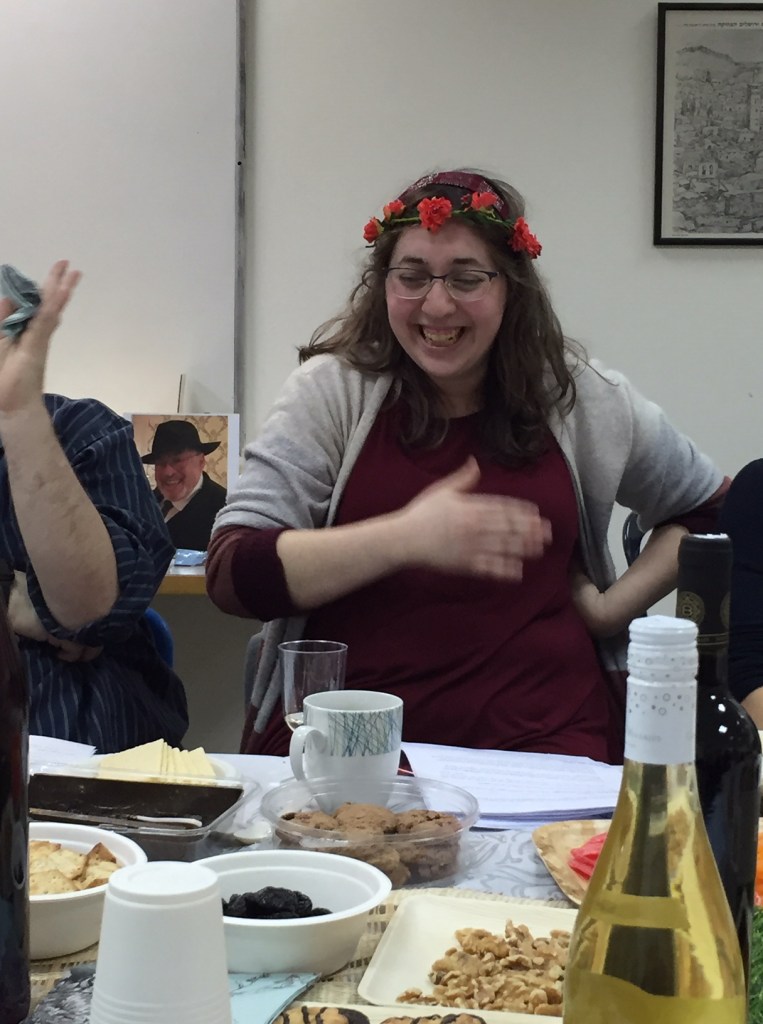
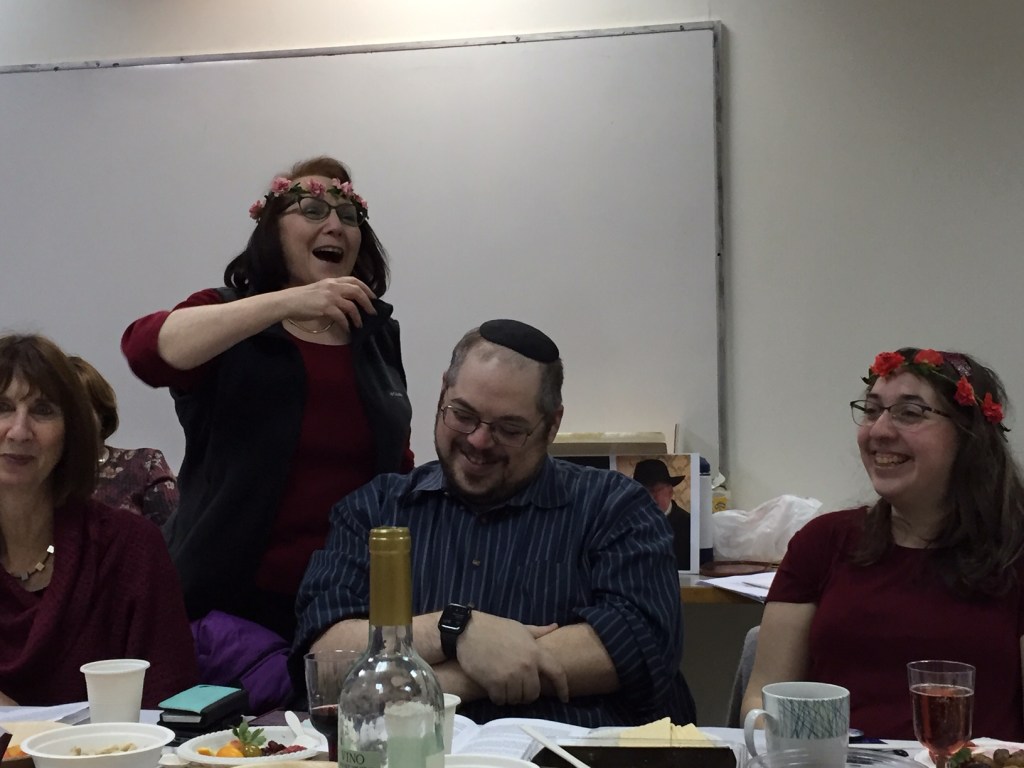
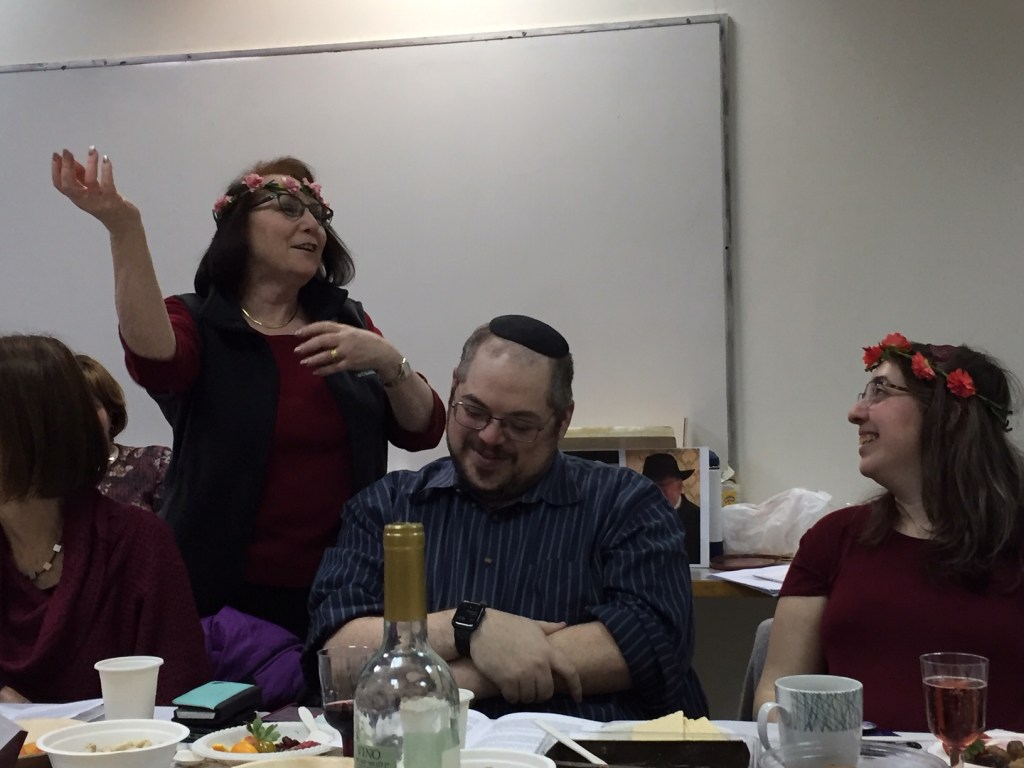
My friend Sara Laya, who is a student at Pardes and a ten-year resident of Israel, decided to commemorate her father’s yahrtzeit with a T”U BiShvat seder. She held the seder at pardes, and invited all the students, but also invited other friends and all the branches of her family, both from the U.S. and Israel.

This is Sara Laya. She is an extremely warm, kind person with a great sense of humor.
The photo in the background is his father, Aaron BenTzion ben Chaim-Meyer Halevi, zichrono livracha (may his memory be a blessing). Same smile!

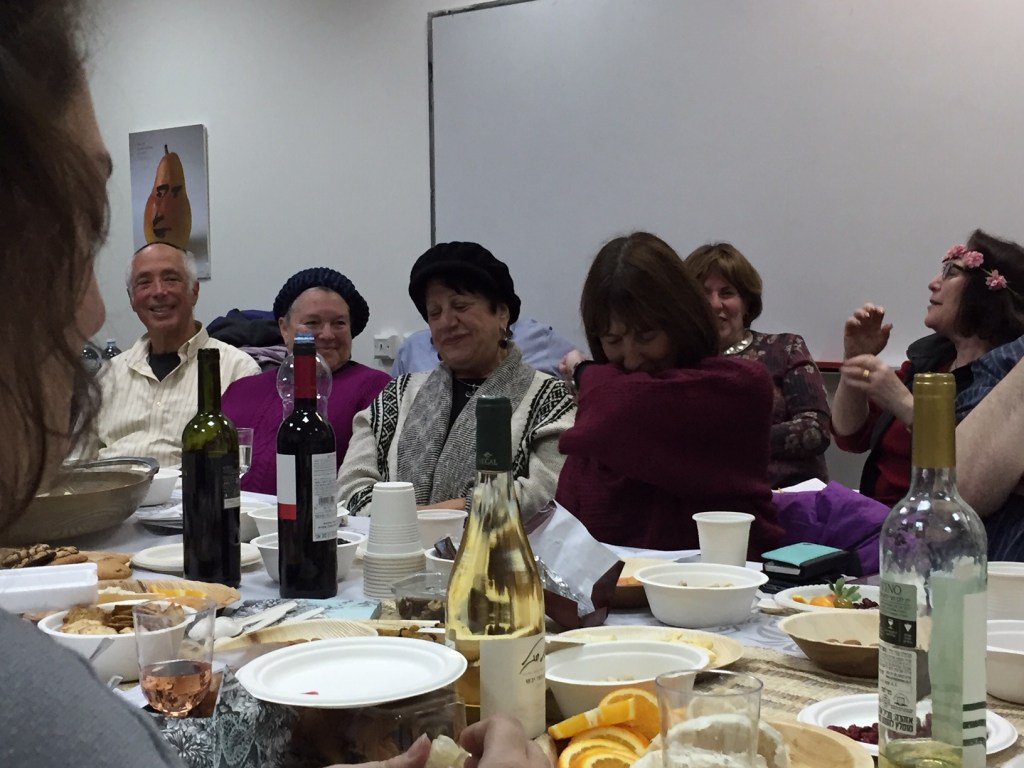
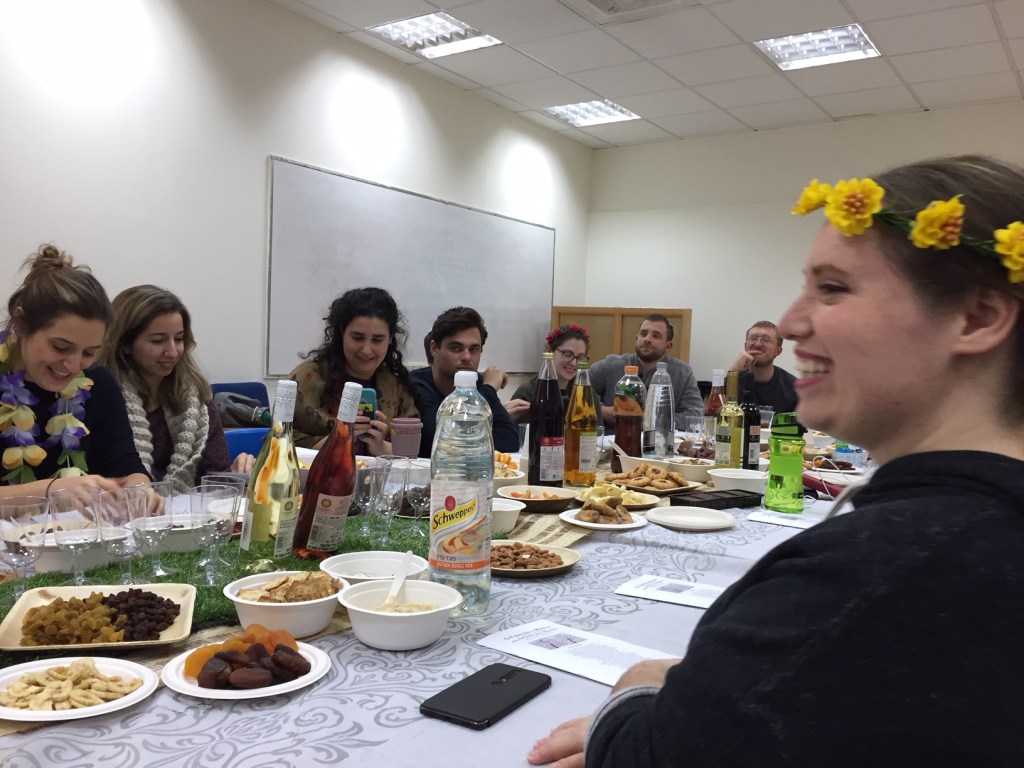
I know Sara Laya worried about how the more frum (observant) members of her family would mingle with the loosey-goosey crowd at Pardes. But her whole family showed up, and while they sat together and we sat together, it somehow all worked. Sara Laya had designed and printed a nice little haggadah for her seder. We drank the traditional four cups of wine or juice — white for winter, white with a drop of red for spring, half white half red for summer, and red for fall. We ate the seven species associated with Eretz Yisrael — wheat, barley, figs, dates, olives, grapes, and pomegranates. We also ate a “shehekhianu fruit” — a fruit that was new to us for the season, over which we could say the shehekhianu blessing for new or seasonally returning things. And we partook of the fruits that symbolize the four worlds of kabbalistic thinking — the world of action, the world of formation, the world of creation, and the world of essence. The table was well loaded with dried fruits, fresh fruits, and baked goods, as well as ice cream, cake, and other tasty things. We said blessings, sang songs, and read selections from the Talmud and from other sources that Sara Laya had compiled. Several people offered memories of Sara Laya’s father, and others told more general stories and thoughts about the holiday and the fruits associated with it. Our Marxist journalist classmate Isaac recounted a story about Walter Benjamin and some figs that I’m fairly sure puzzled us all, especially the Orthodox crowd — but he also told us an interesting fact about the fig trees if Tel Aviv. They are an Asian variety that orginally had no pollinators in Israel–tehy were planted with the thought that if they had no fruit they wouldnt mess up the sidewalks – -but at some point the pollinating wasps found a way here, and now in the season there are figs on every tree in Tel Aviv.

I was touched by Sara Laya’s gift to all of us in memory of her father. It was delightful way to spend a cold rainy Jerusalem night. Here are a few more pictures from this lovely event.

Most of Sara Laya’s family.
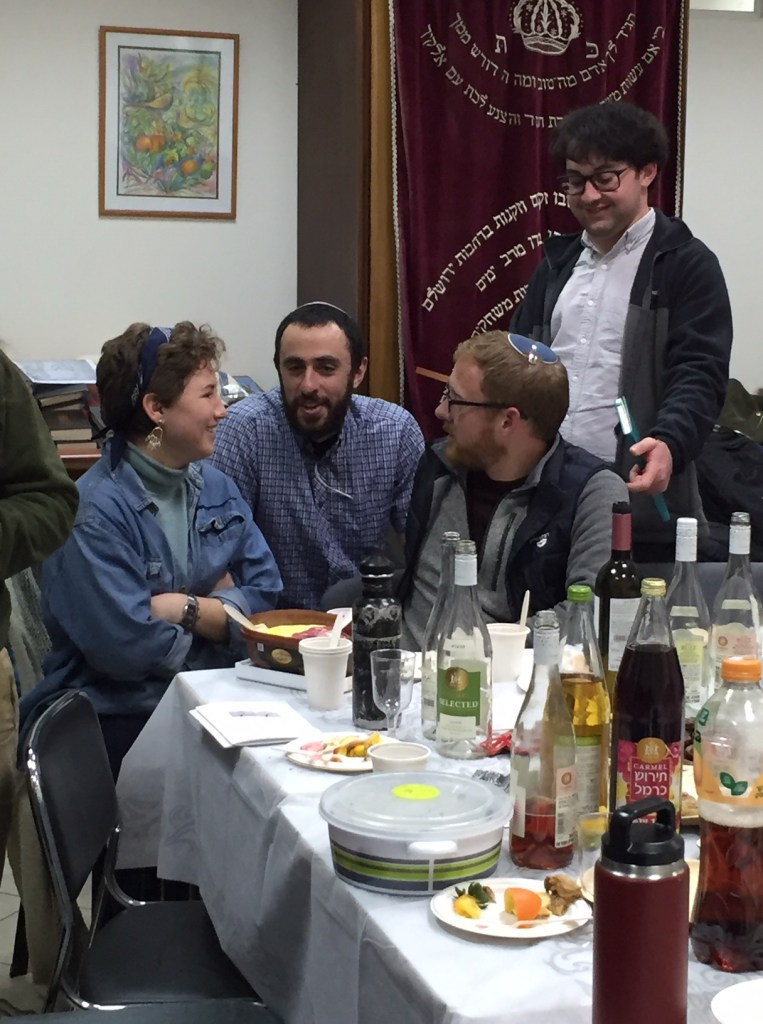
Some classmates — Liana, Joe Schiff, Brandon, and Max. The ark for the Torah is in back of them — we use this room for davenning.
A mixture of Pardesniks and other friends of Sara Laya’s.
Sara Laya’s mom, her brother, and herself. It’s not hard to see the family resemblance.

Winter/Spring — floods and flowers

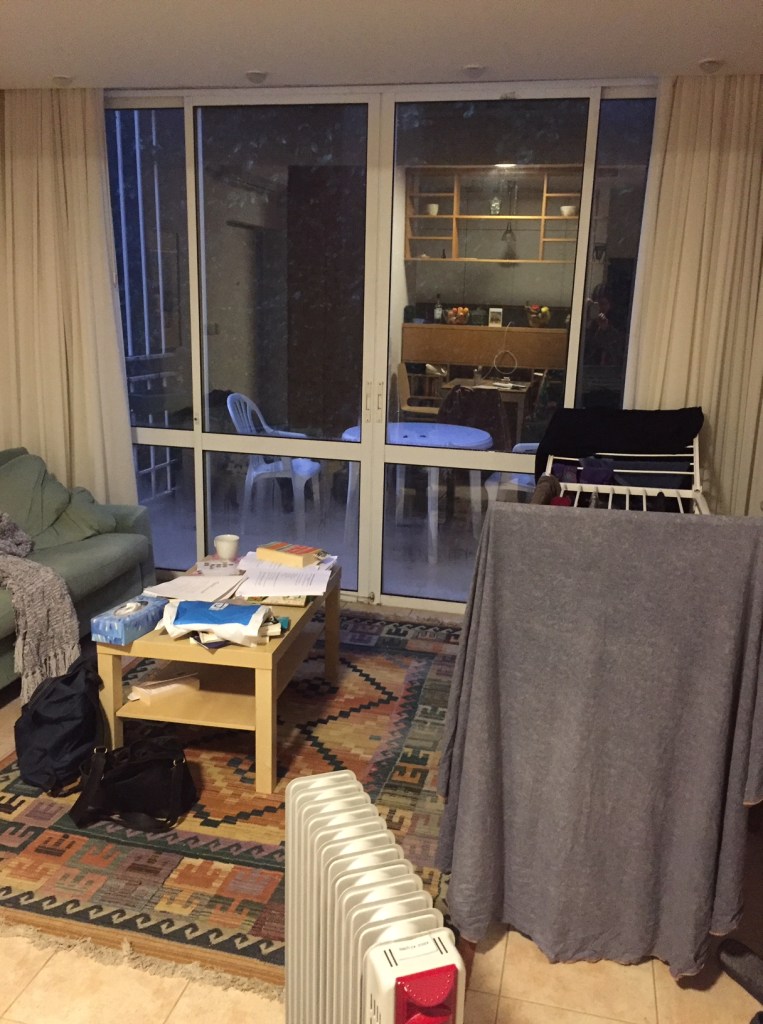
January 20th — an afternoon in my apartment. I like the reflection of my kitchen on the living room doors.

Winter is Jerusalem is much like winter in parts of California. It rains — this particular winter, a great deal. When it rains, it often also blows strong gusts. The temperatures descend into the 50s, the 40s. Twice we’ve gotten some small hail or large sleet. Some days, it seems best to stay indoors. The laundry also stays indoors, exhaling dampness that the space heaters and even the wall heating unit do little to allay. If you go away for a few days (as I did in mid-Janaury), mold takes hold on the walls in a distressing fashion, and has to be removed with bleach.

Mold on my bedroom wall. I thought the landlady should see pictures — she’s away in Australia for the winter.

Sometimes, of course, you have to go out, rain or no rain. The nearest bus to school or ulpan (Hebrew lessons) is a five minute to ten minute walk away. One evening I encountered this on my way to the bus stop. I don’t have rubber boots here, or rain pants. I arrived for ulpan quite damp! Fortunately, I had good chicken vegetable soup waiting at home.

About six inches deep.
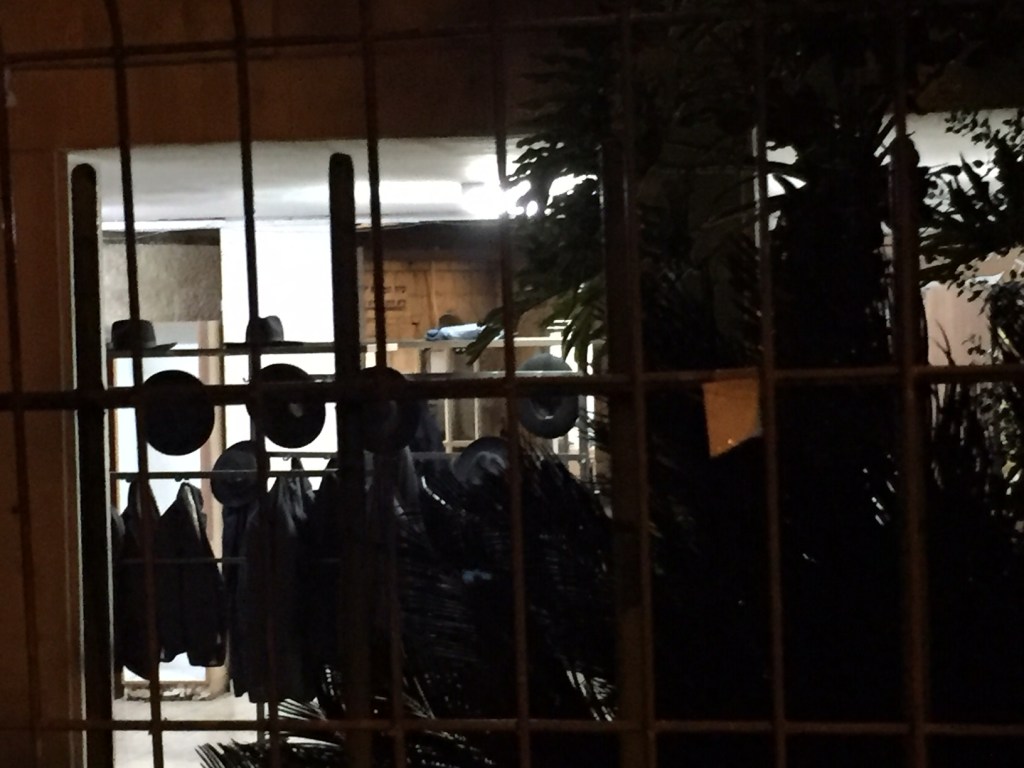
At the Ultra-Orthodox yeshiva down the street, black hats and coats are hung to dry on a wet night.

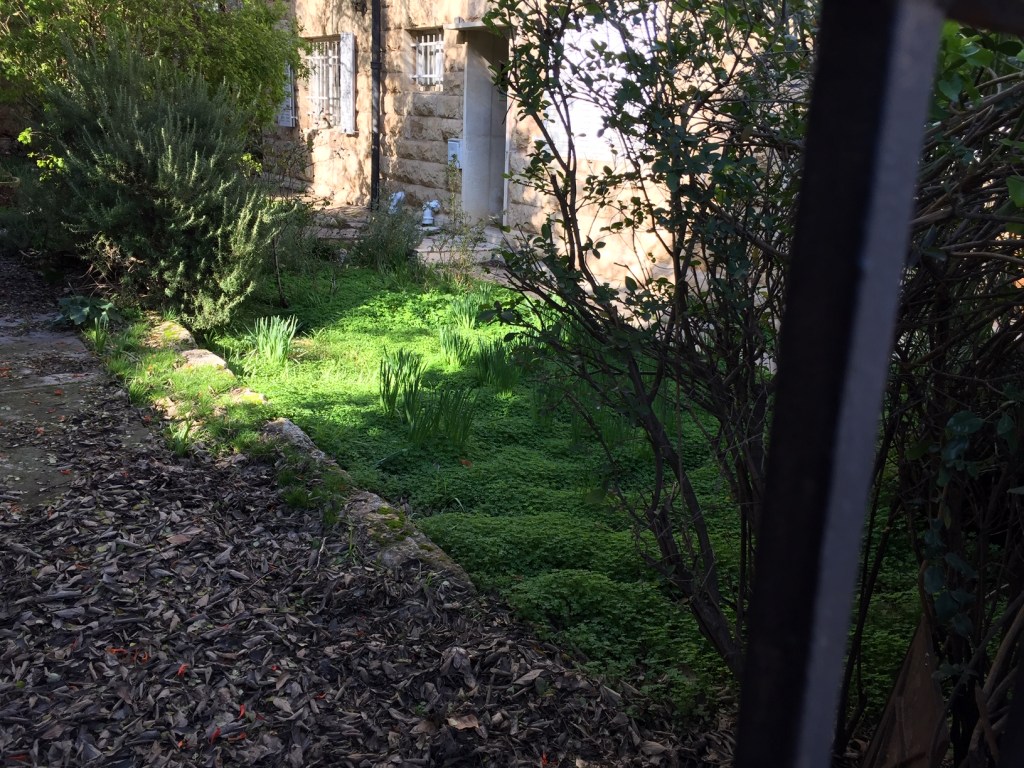
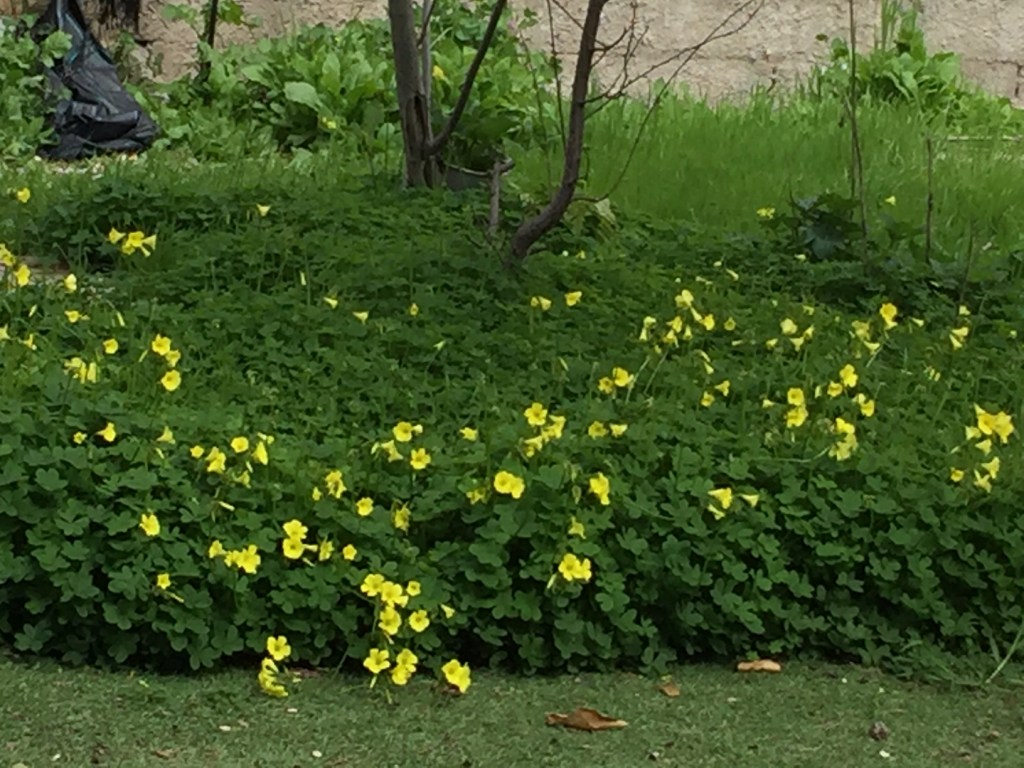
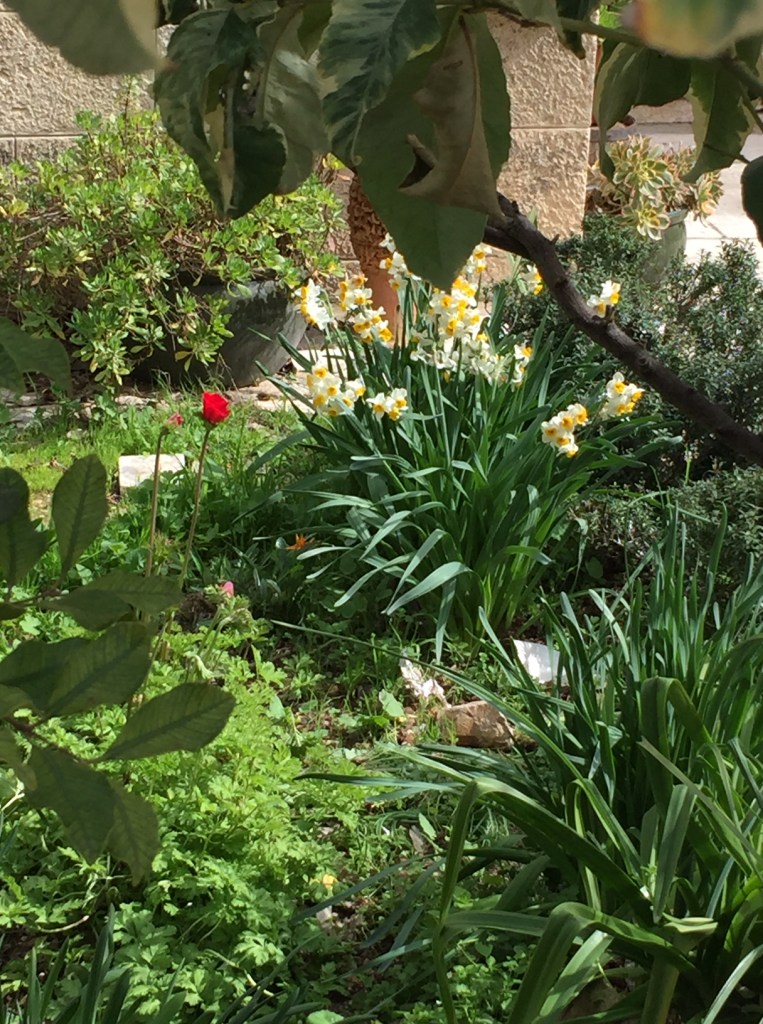
With all the rain, everything that was brown, dry, and seemingly empty of life sprouts with green. In every sidewalk and wall plants appear — first a few green shoots, then robust growth, then flowers. I’ve seen many herbs — lemon balm, horse mint, wild oregano — and of course, everywhere the huge bushes of rosemary are covered with blue blossoms. The bare, dusty yards of every apartment building and house have turned solid green with Jerusalem’s ubiquitous weed, oxalis. Now the green carpet is sending up tall blossom stalks, and lemon yellow flowers are gaily popping out. Meanwhile, people who have flower gardens are seeing the first cultivated spring bulbs — anemones and narcissus and cyclamen.

The leaves of narcissus emerge from a carpet of oxalis.
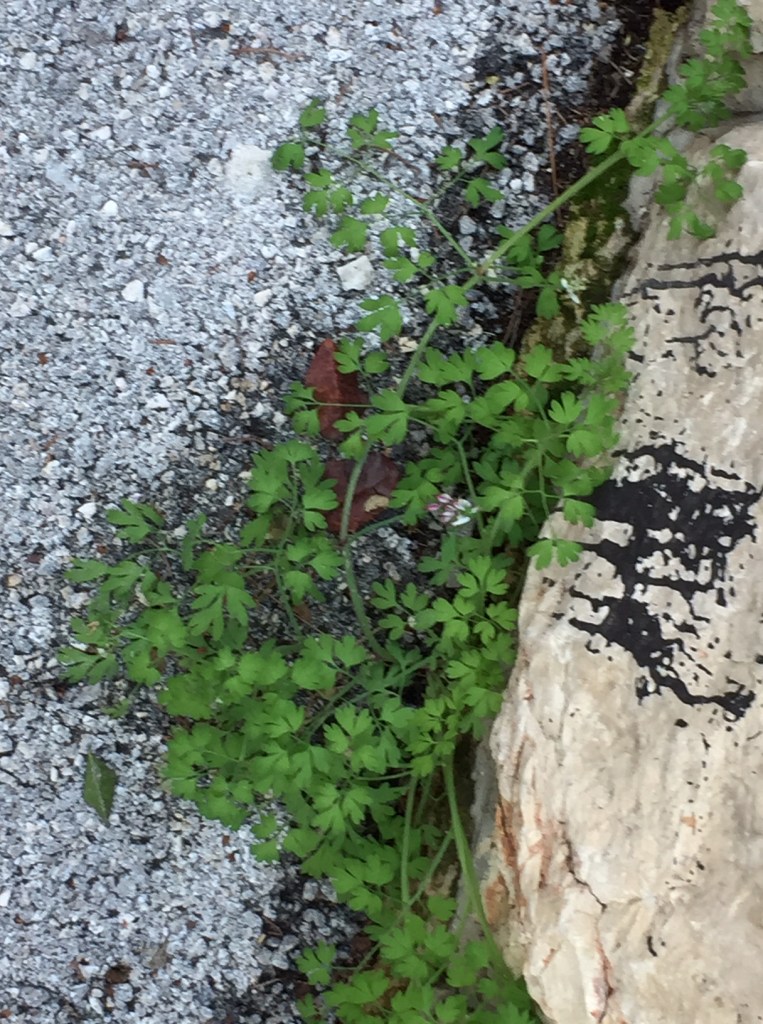
This is ceratocapnos palaestinus — growing in the sidewalk down the street from my place.
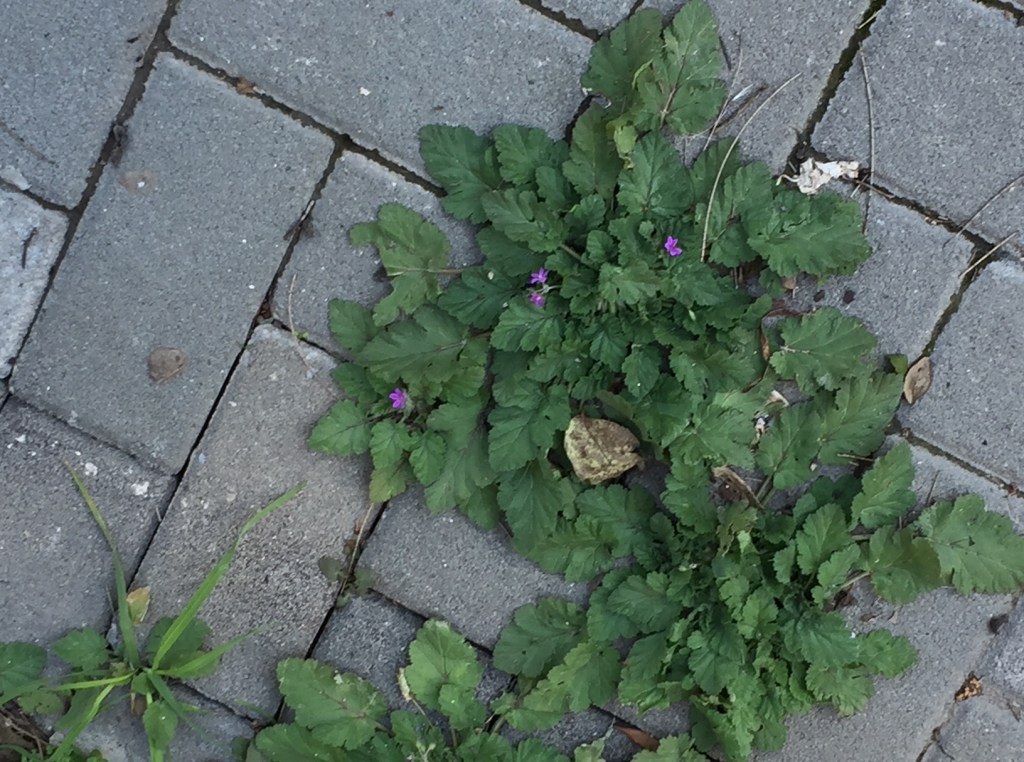
This is one of Israel’s numerous plants in the geranium family. Best guess: Mallow Storksbill. Also possibly Round-leaved geranium. Growing happily in the sidewalk near my house.
Lush grass growing in the gutters at Katamon Books.
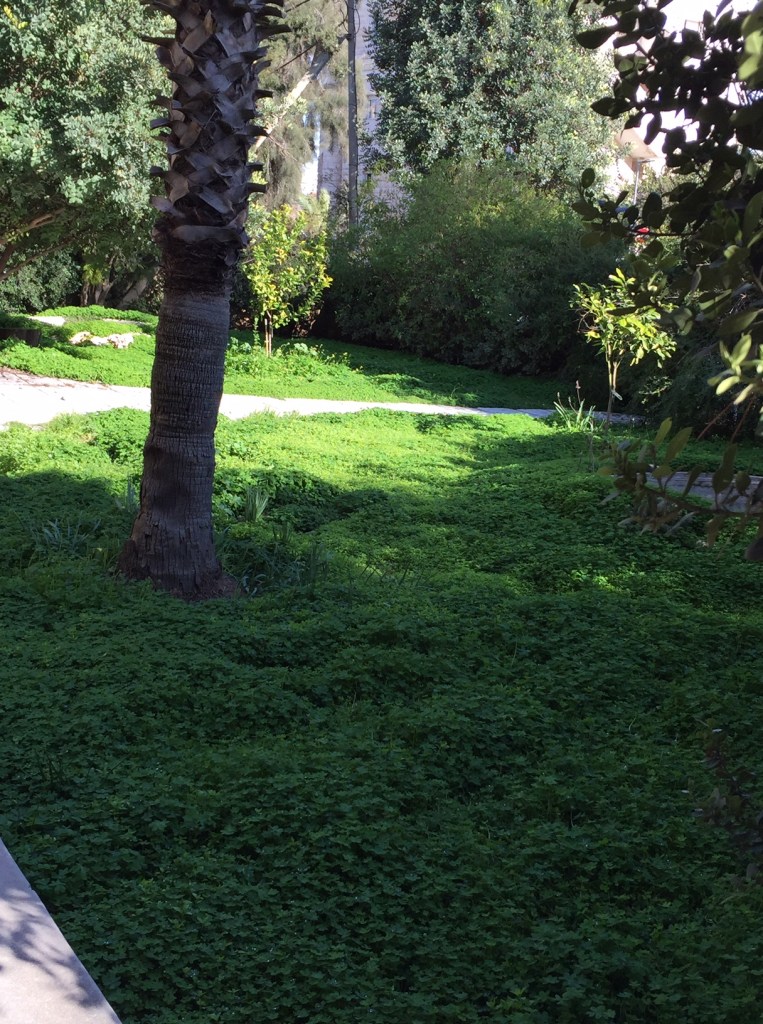
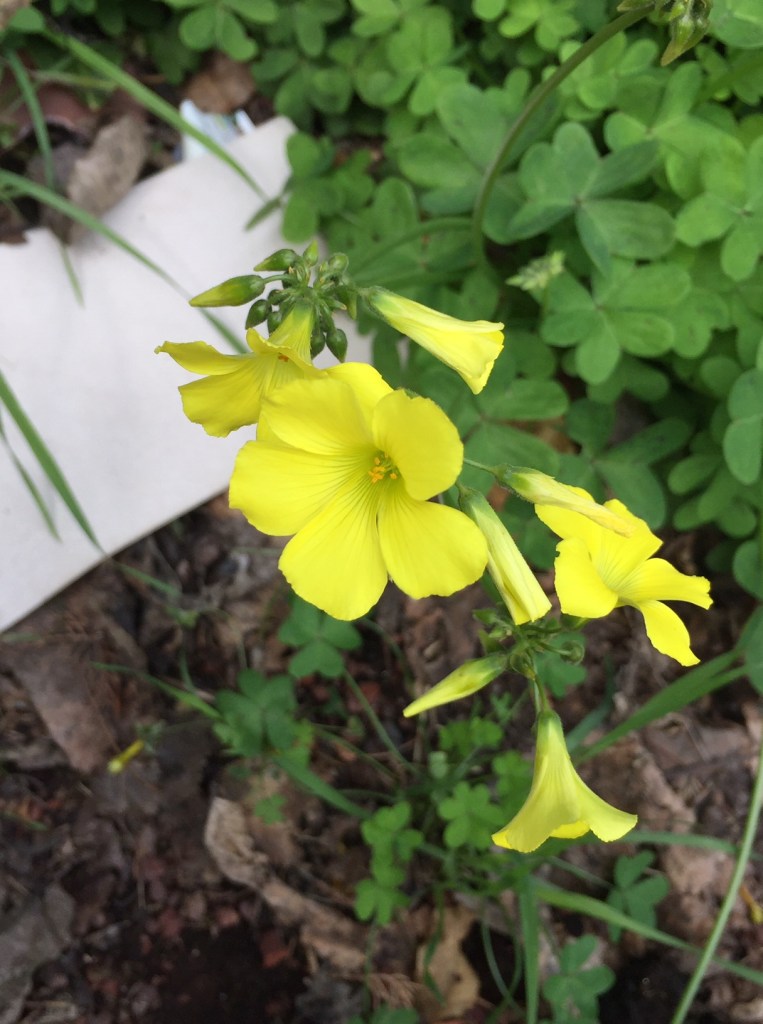
The “lawn” of Jerusalem: a carpet of Oxalis pescaprae (literally “goat-foot” oxalis) or Nodding Wood Sorrel. In Hebrew this plant is called Chamtzitz natui ) — natui means inclined, and the word chamtzitz — wood sorrel — comes from chamutz, sour (vinegar is also called chamutz), which is related to a word we all know from Pesach (Passover) chametz, meaning leavening or leavened bread.
A few weeks later — in bloom.
Close-up — larger than life. Each flower is about the size of a two shekel coin — or a nickel.
Narcissus and anemone

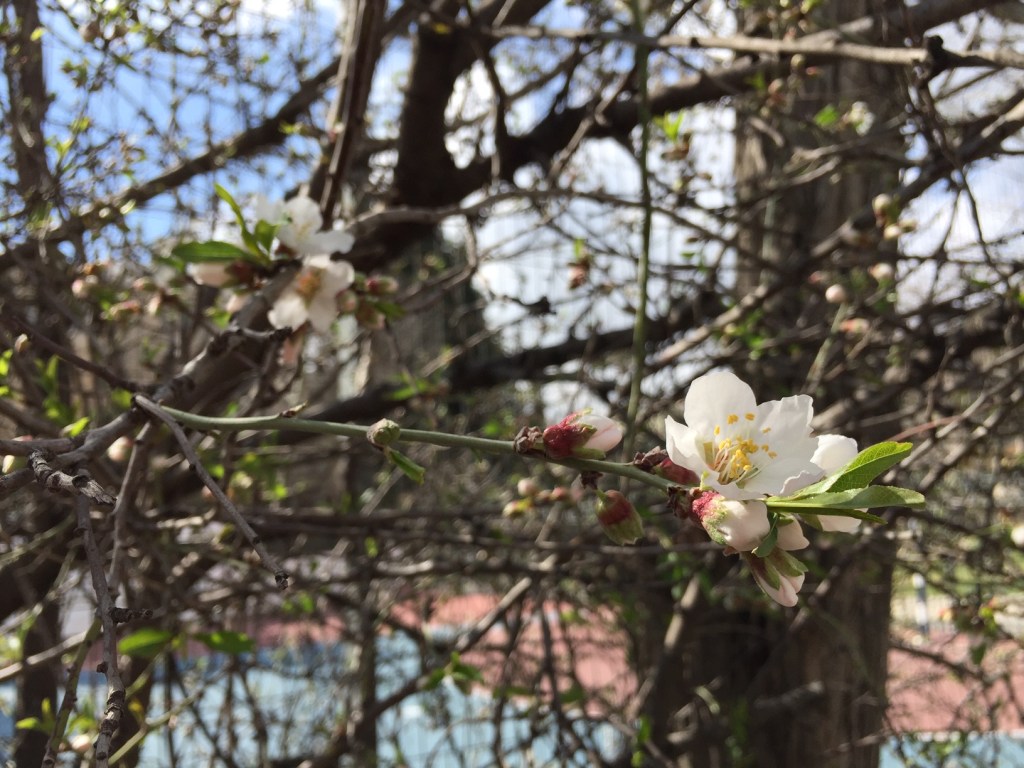
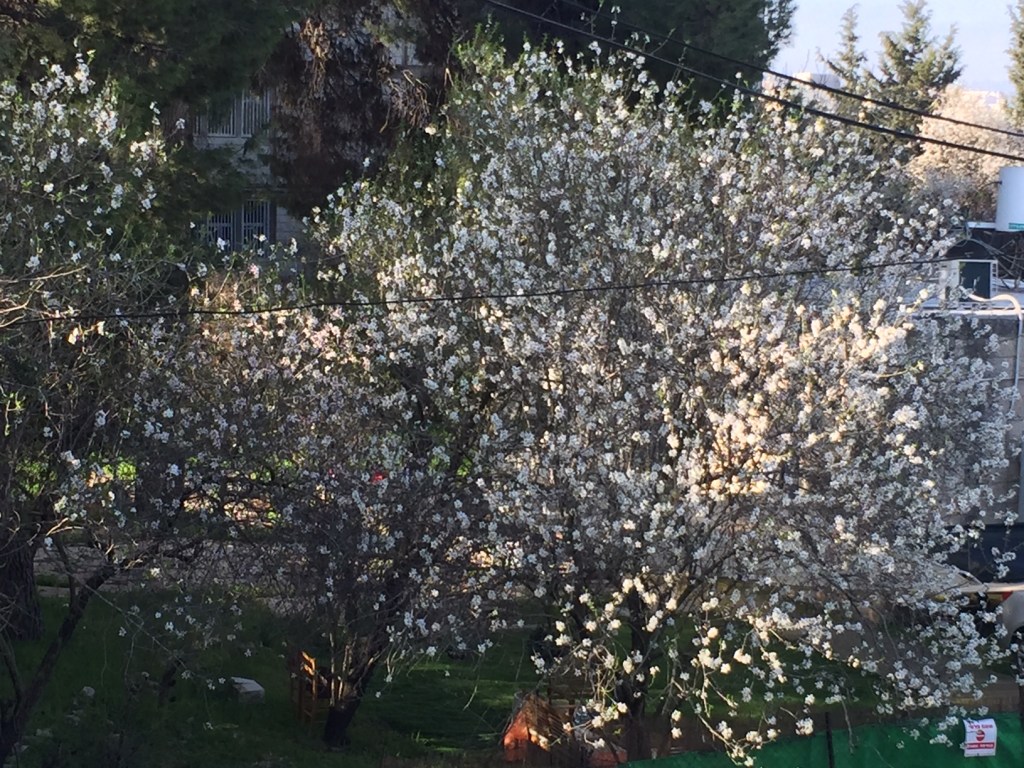
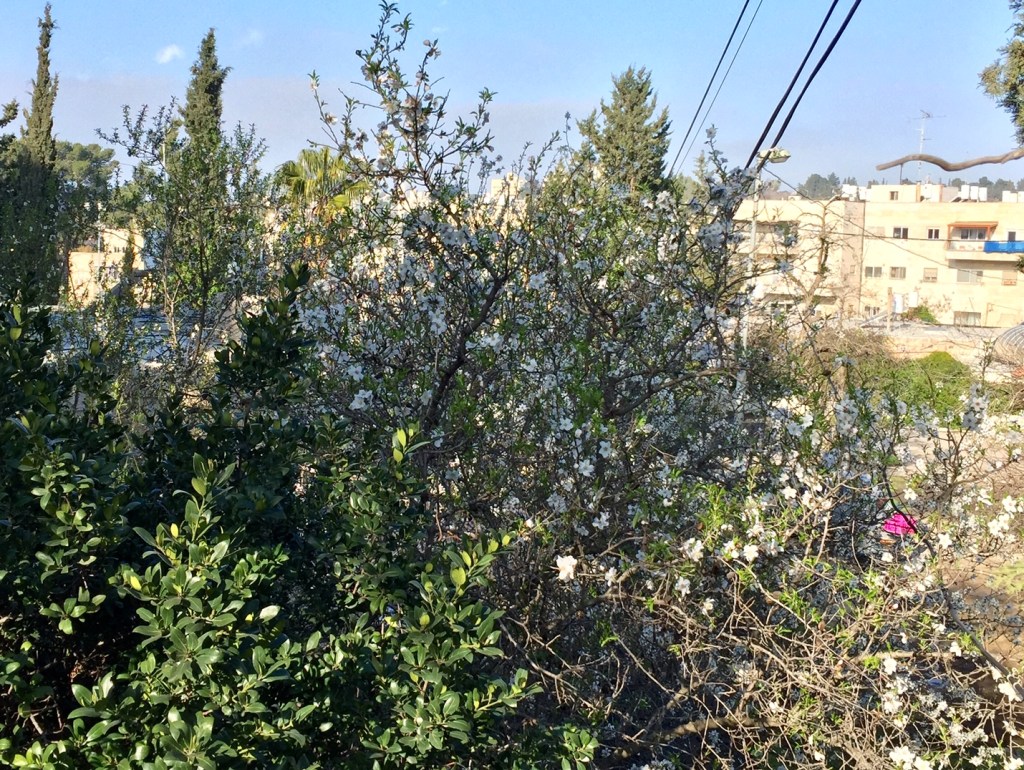
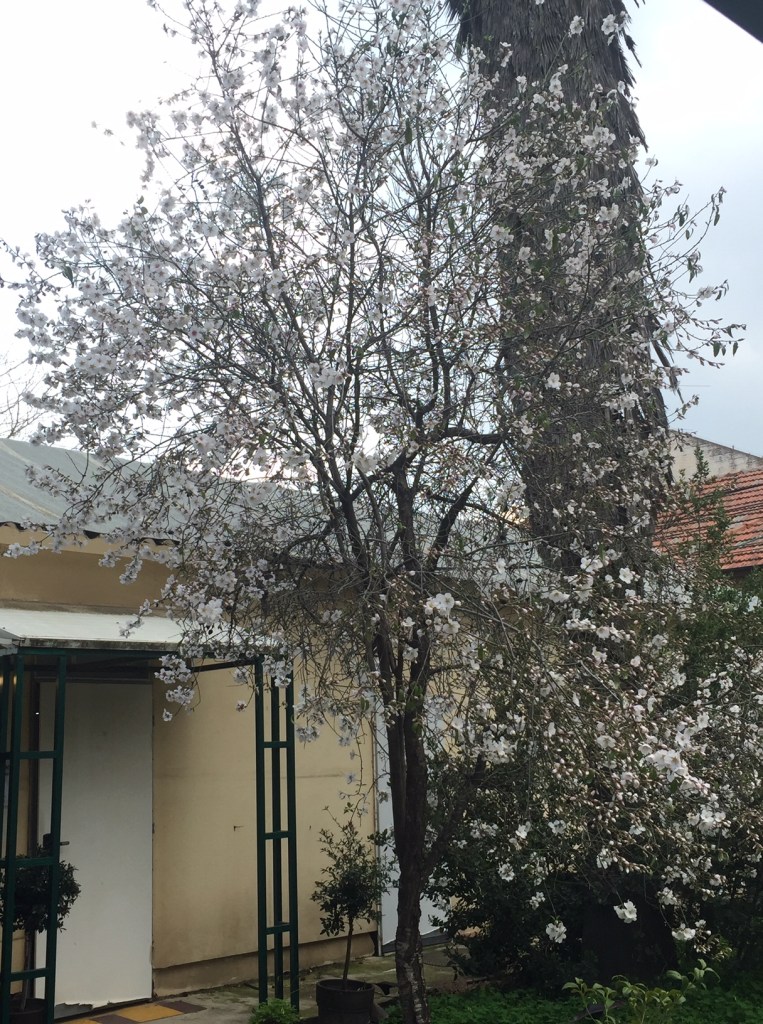
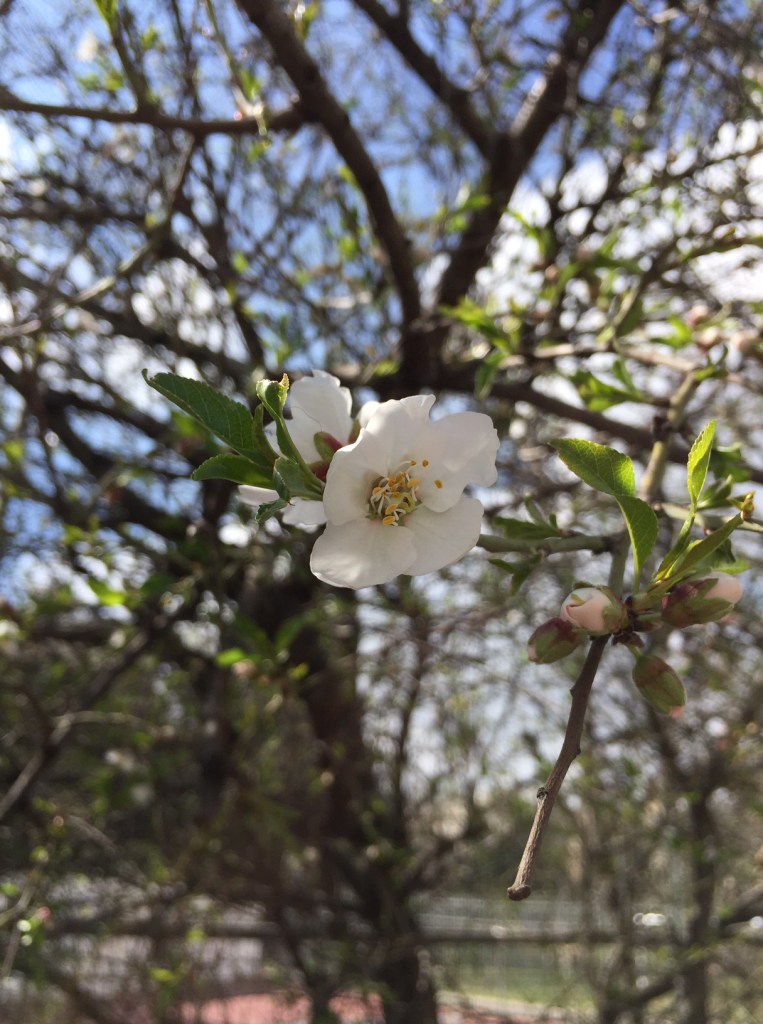
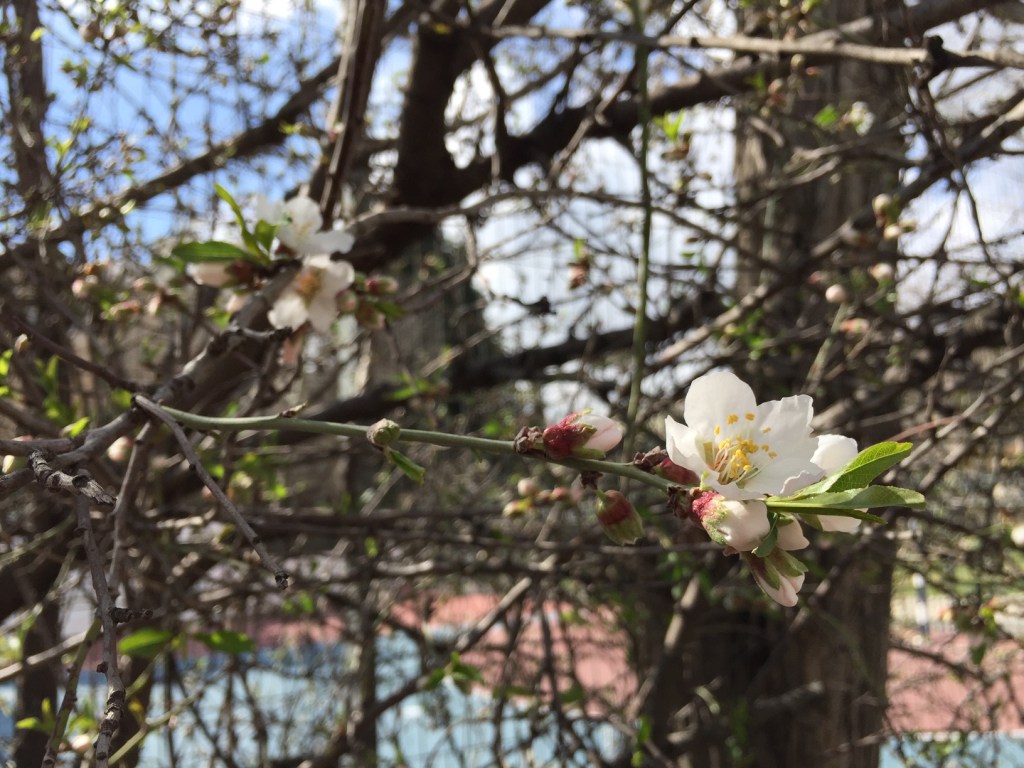
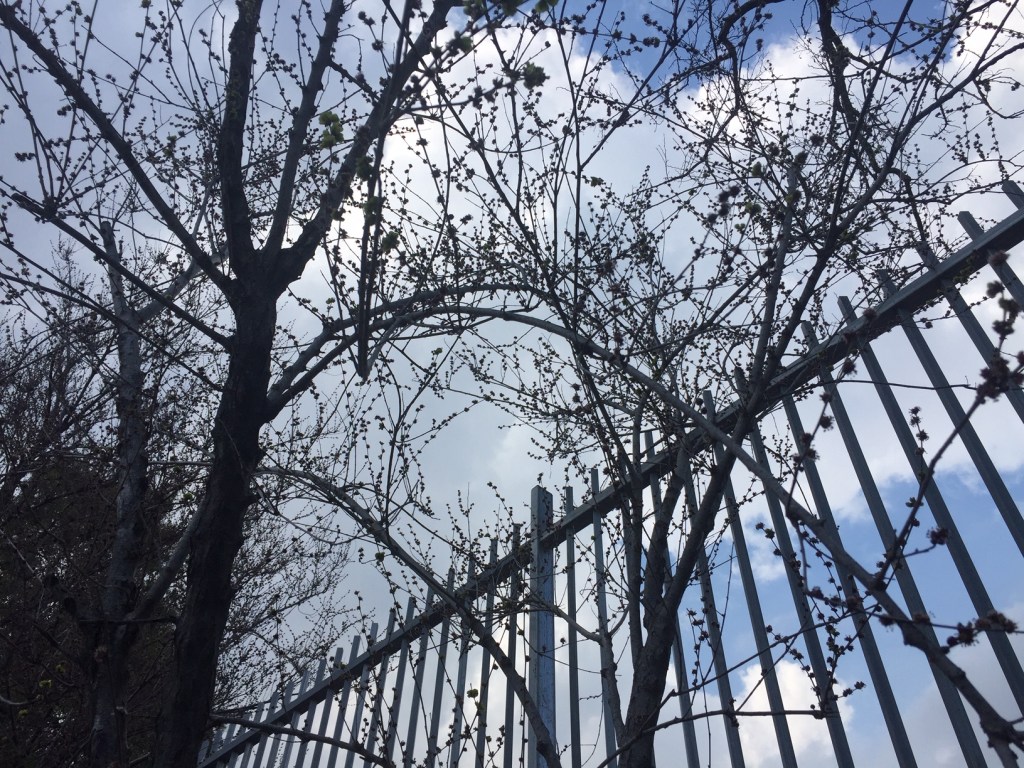
Meanwhile, on schedule for T”U BiShvat (the fifteenth of the month of Shvat), the shkediya (almond trees) begin to unfold their pale pink and white blossoms. At T”U BiShvat we sing: “HaShkediya porachat v’shemesh paz zorachat; tziporim merosh kol gag m’vasrot et bo heChag. T”U BiShvat higiya, Chag haIlanot! The almond trees are blooming, and the sun shines its rays; birds from the top of every roof bring the good news of the coming of the holiday. The fifteenth of Shvat has arrived, the holiday of the trees!” This year, they didn’t come into full bloom until a few days after the festival, but now in late February they are in full bloom in many yards and vacant lots, a joyful harbinger of spring. Other shrubs also are putting out blossoms.

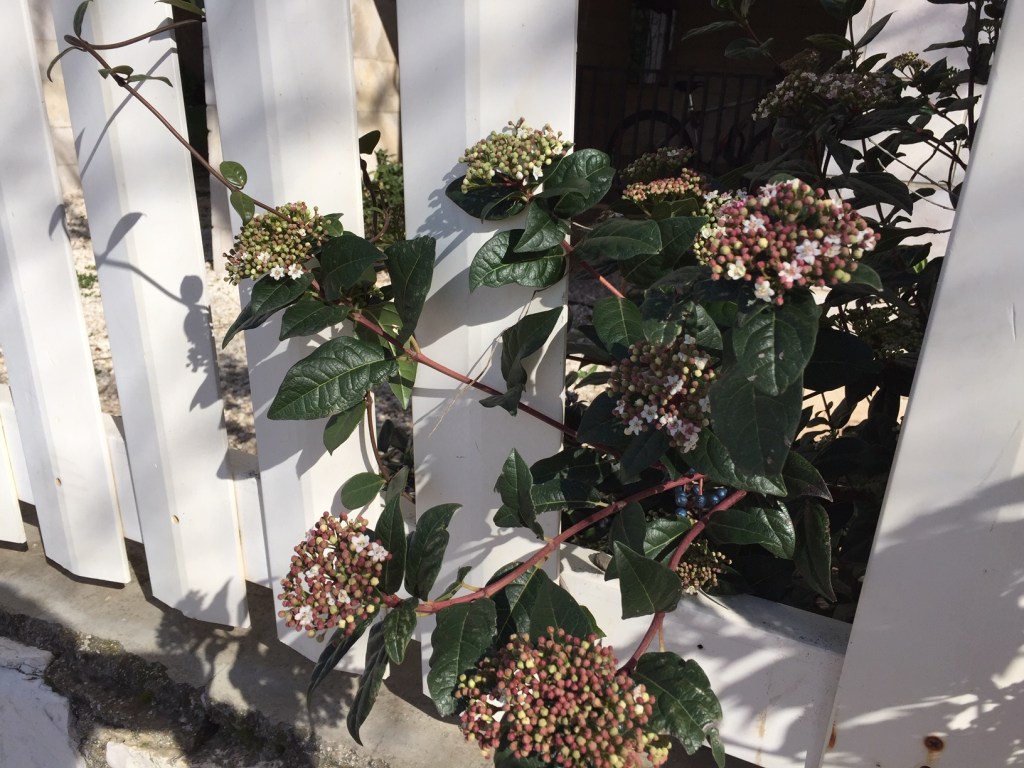
Fuzzy pink flowers poke out — not sure what this shrub is. Unlike the tedious summer and fall sky, monotonously blue all day, the winter sky in Israel is ever-changing.

The nights are still cool, and sometimes misty. The “locals” complain that winter is too long and cold. I tell about Vermont, but they have forgotten, if they ever knew, what a real winter looks like. Meanwhile, I feel as if spring is really already here.

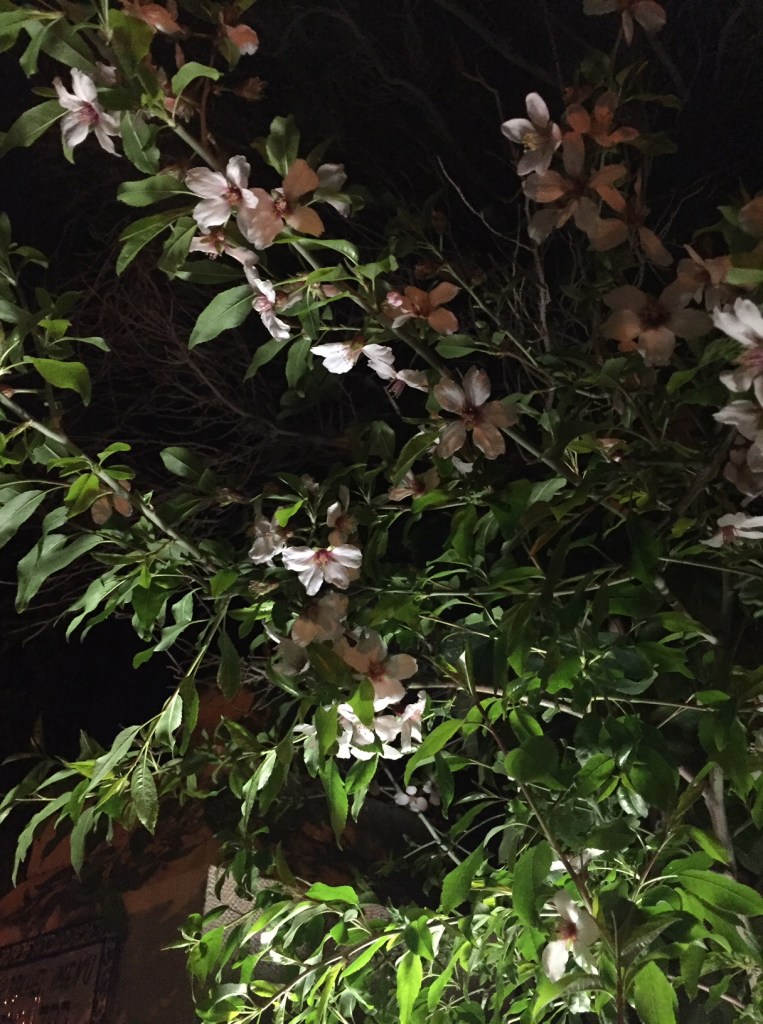
Almond blossom at night, lit up by someone’s front walk.

Dinner with the Family

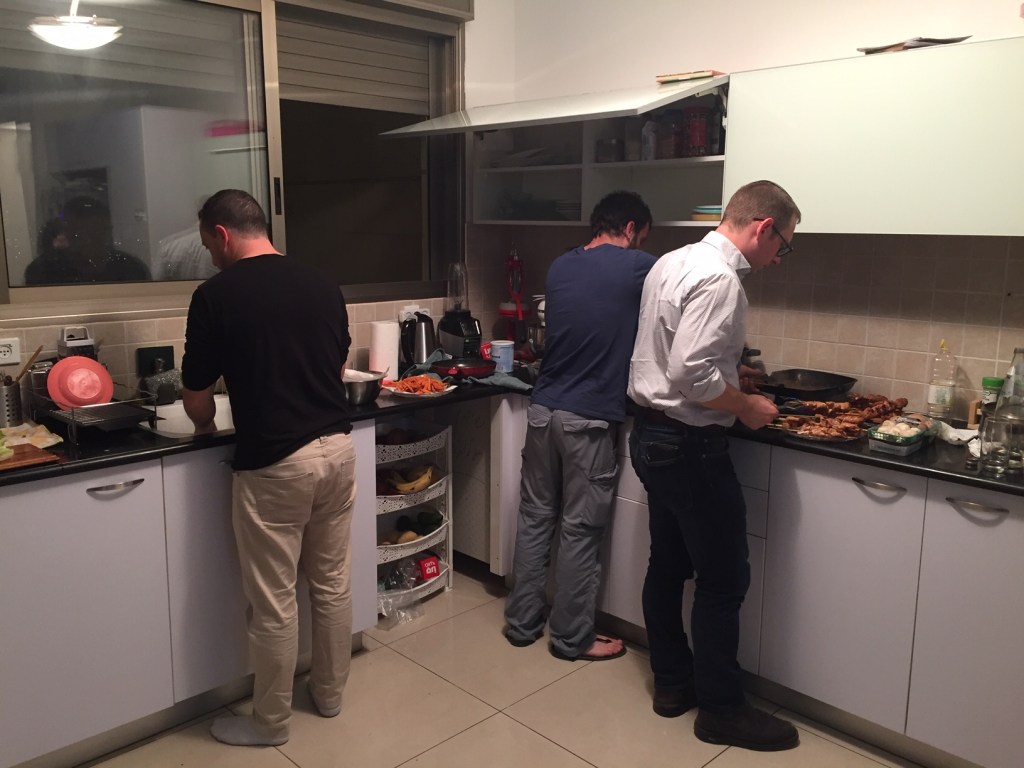
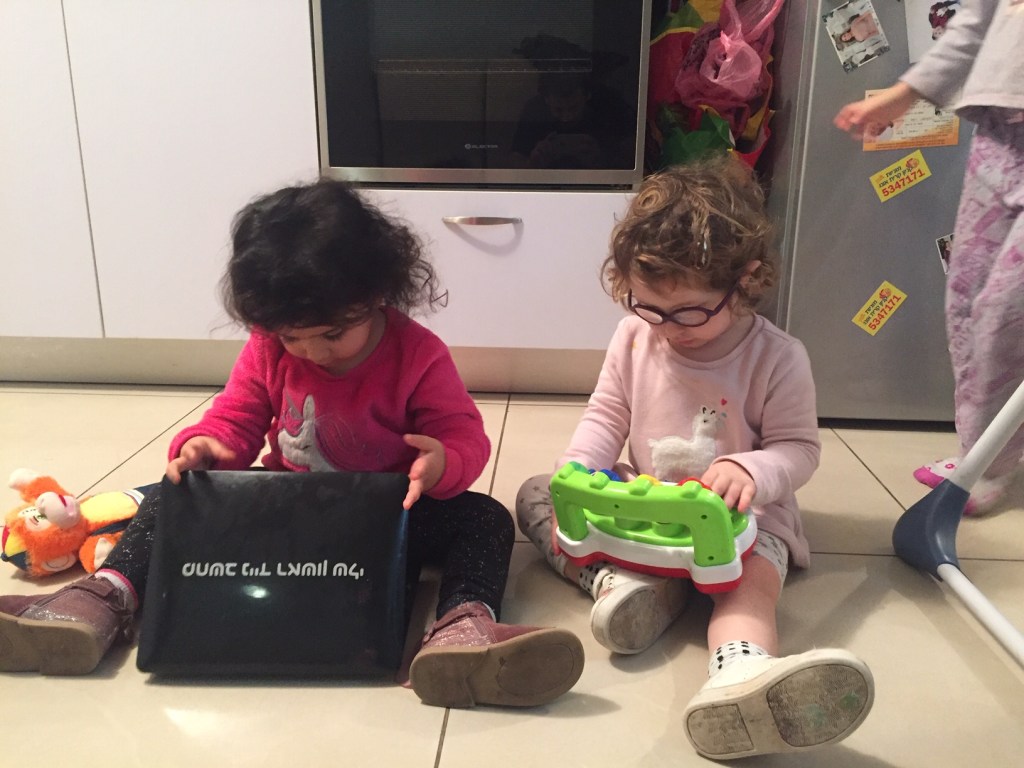
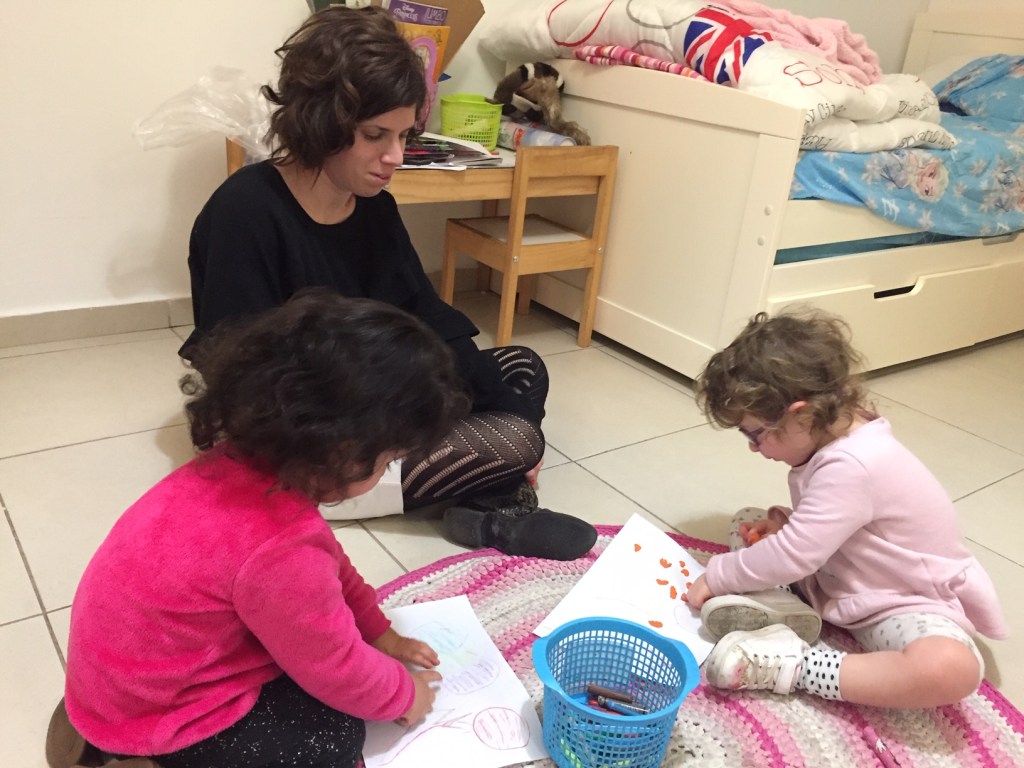
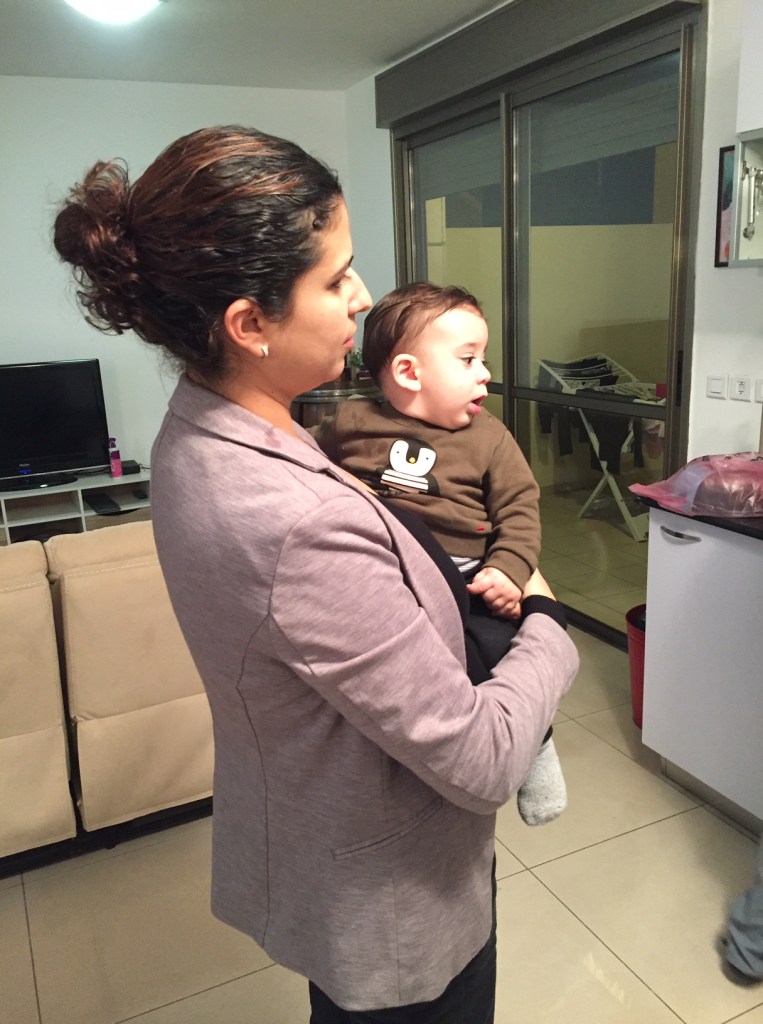
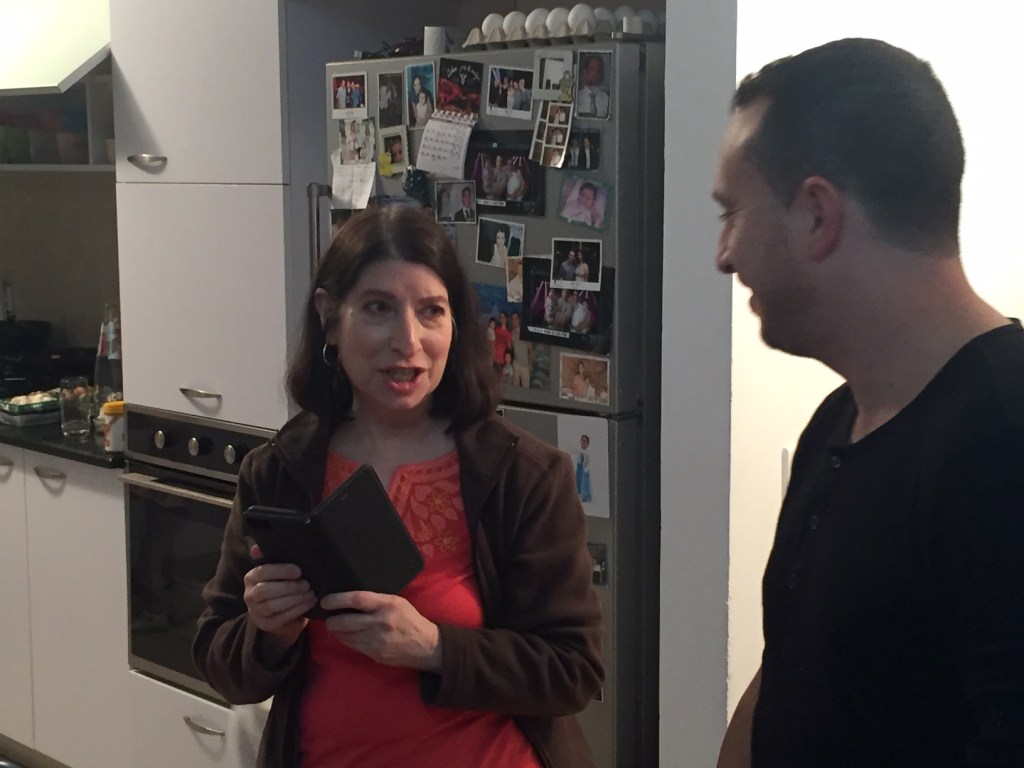
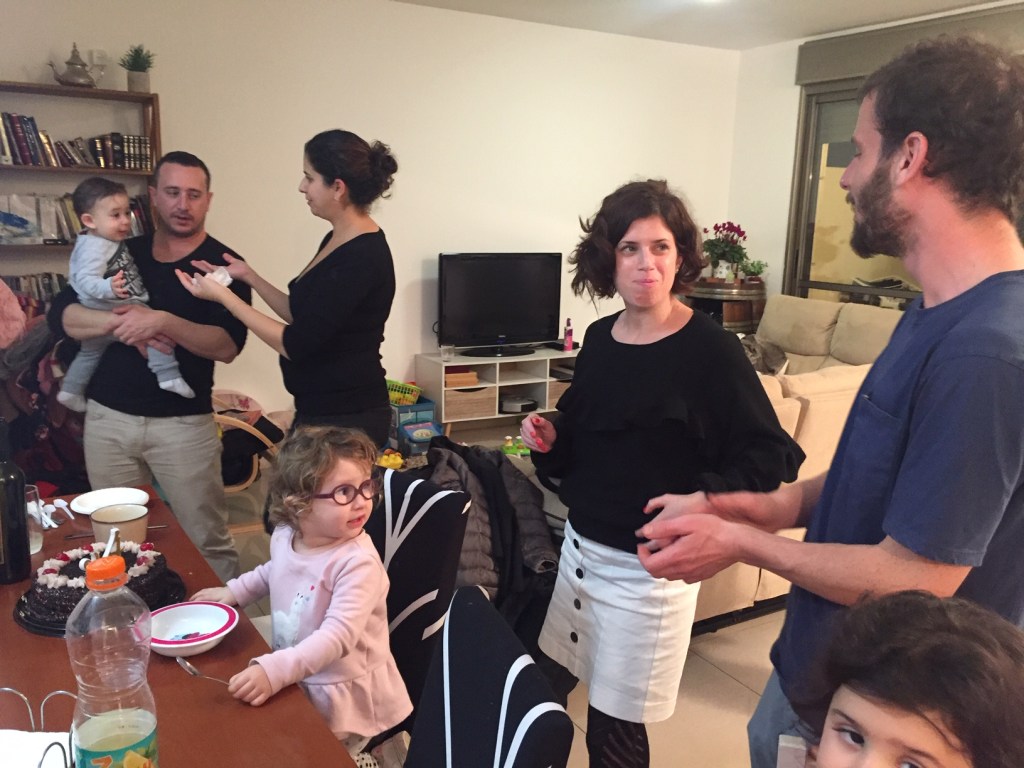
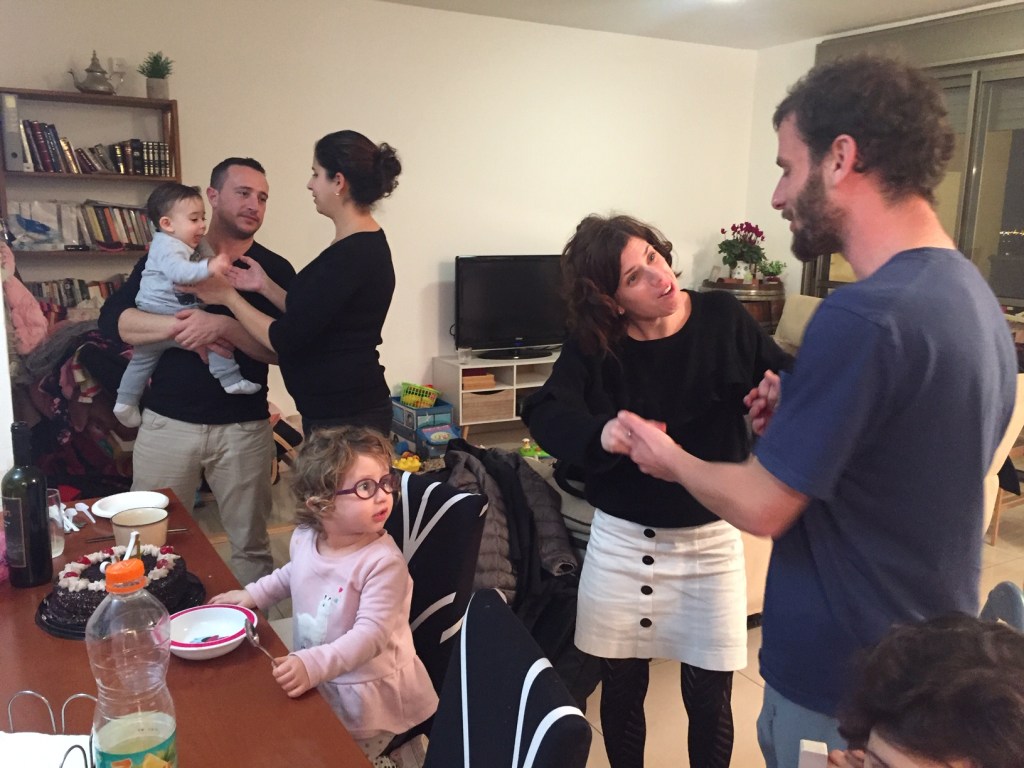
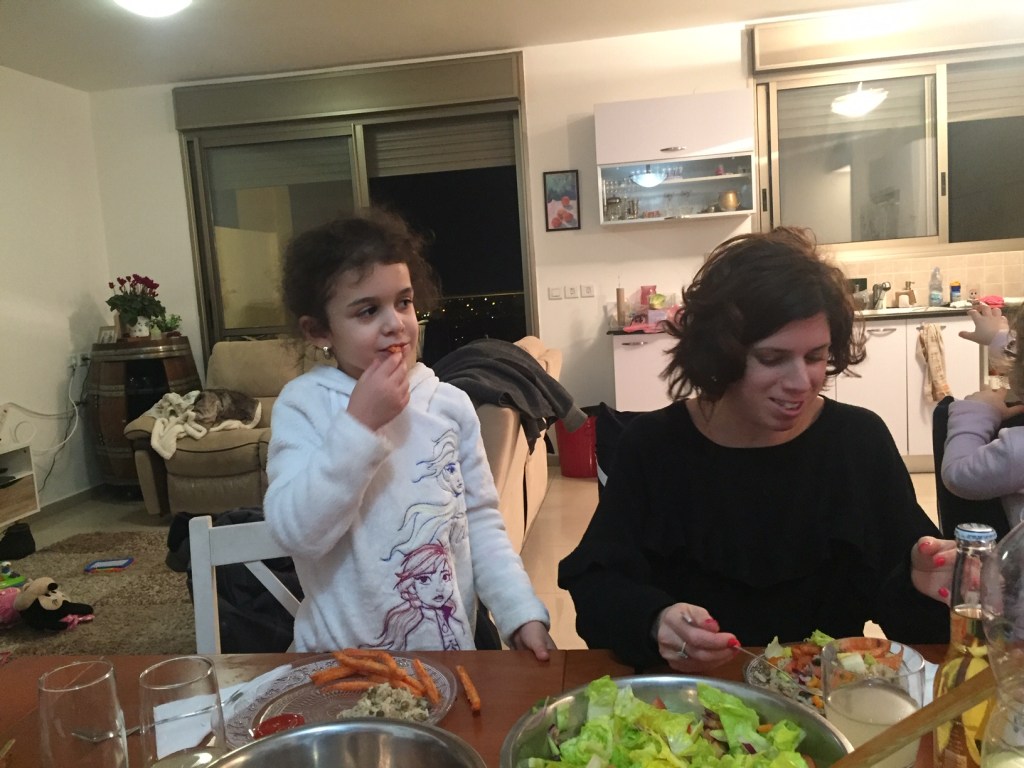
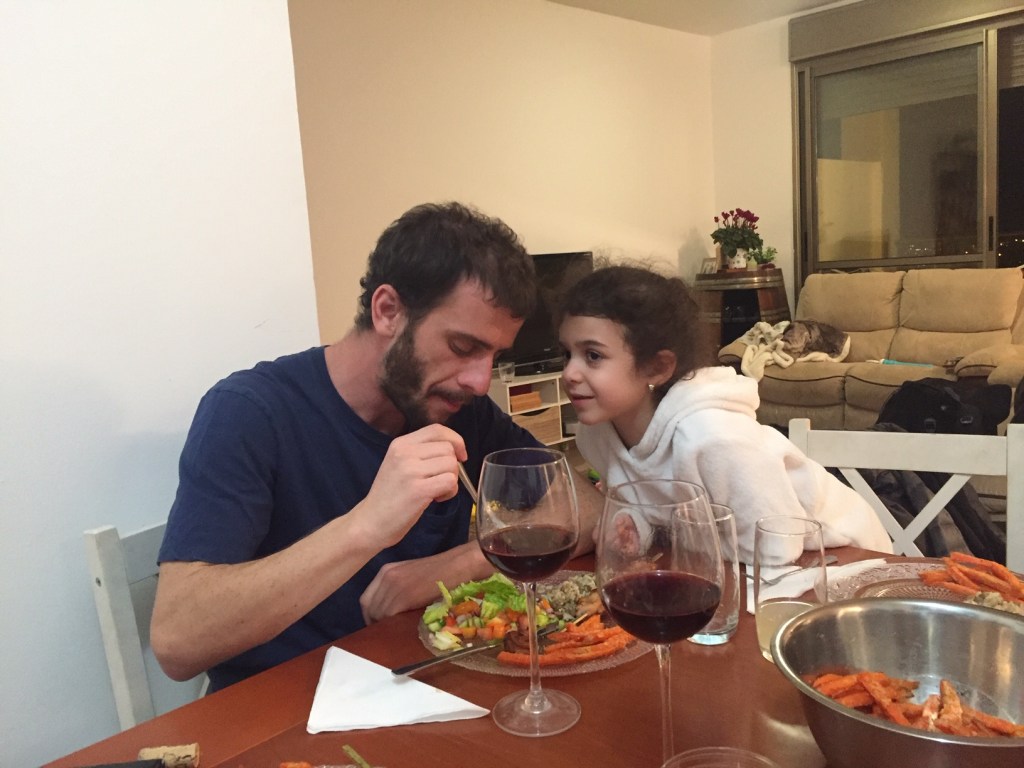
Deborah’s last night and day were spent (very happily, I hear) with Avishai and his family. I went along with Hagai, Yochi, Yoni the younger, and Golan for a family dinner for Deborah’s last night. Late the following night, she flew home to New York. The family dinner was delightful. Here are a few photos. I’m so lucky to be part of this!

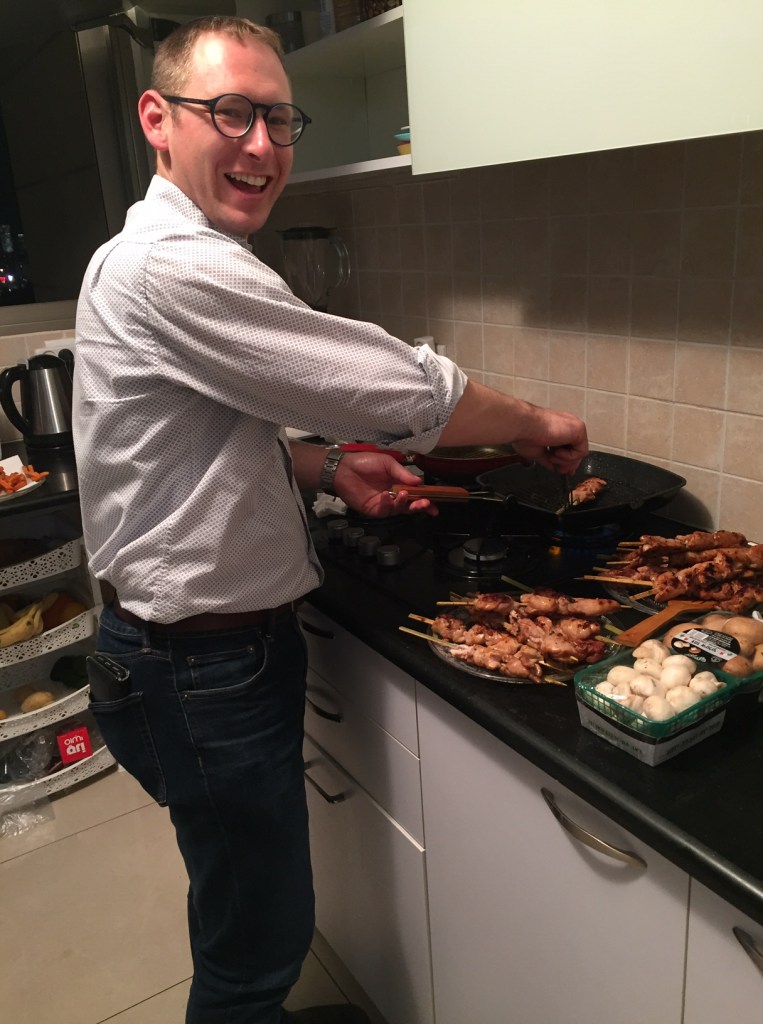
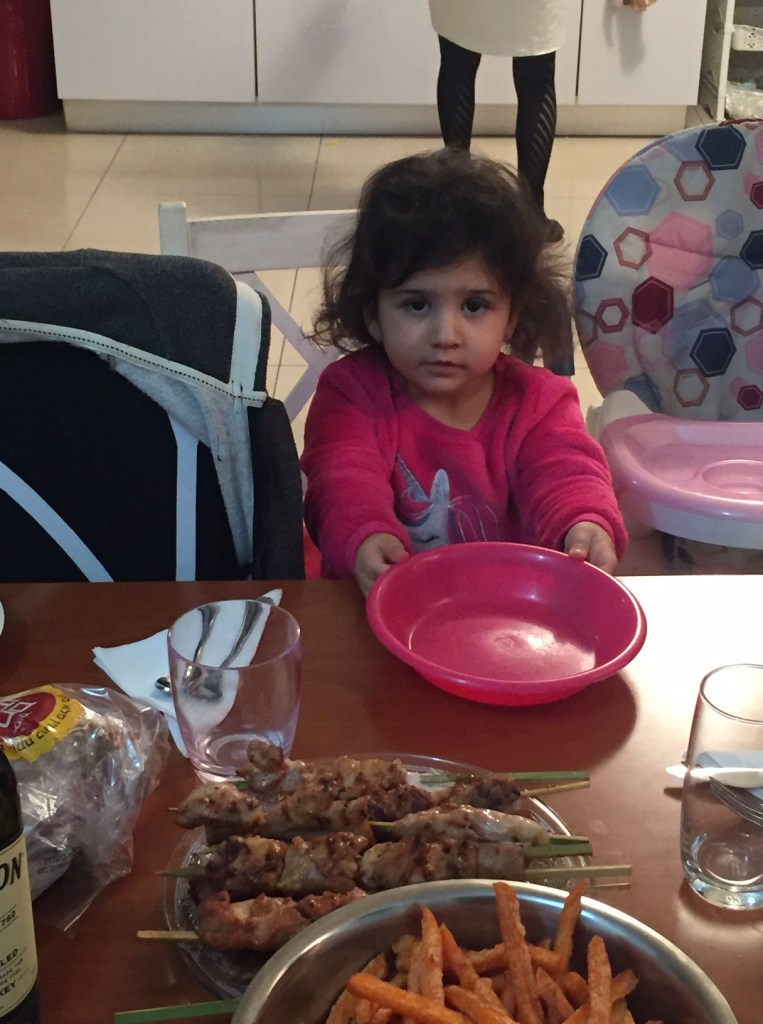
Yochi’s husband Yoni at work in the kitchen. Meat is his specialty — ironically, since Yochi does not eat meat! The rest of us enjoyed his labors!
Men at work.
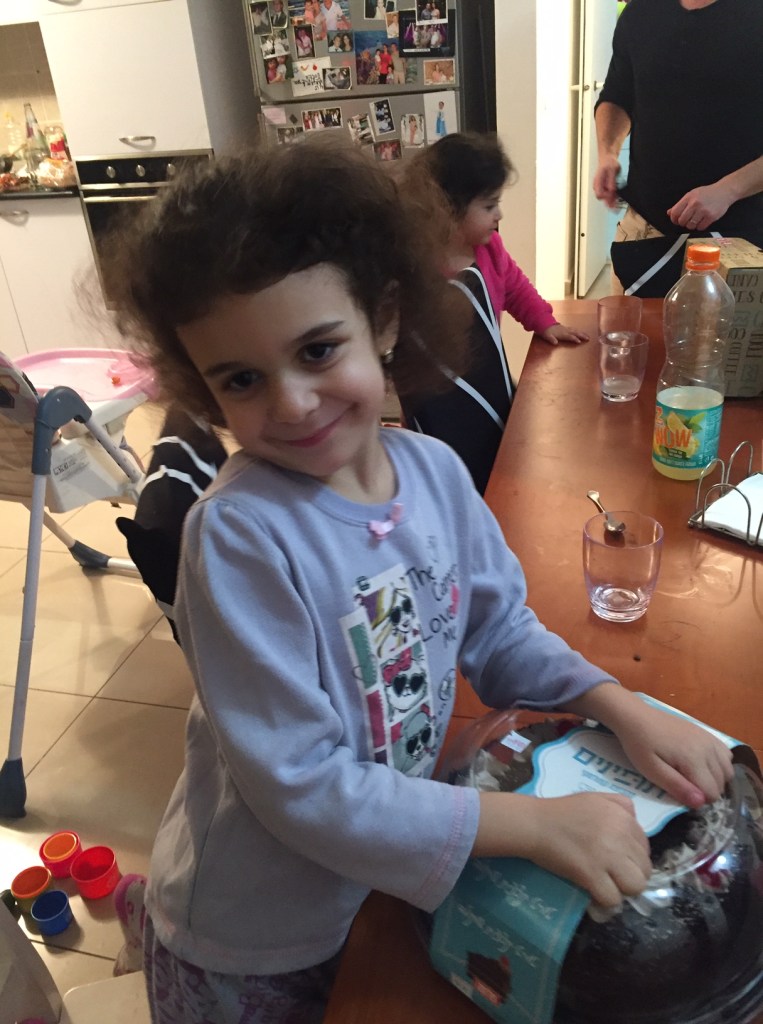
Ella and Golan — happy cousins.
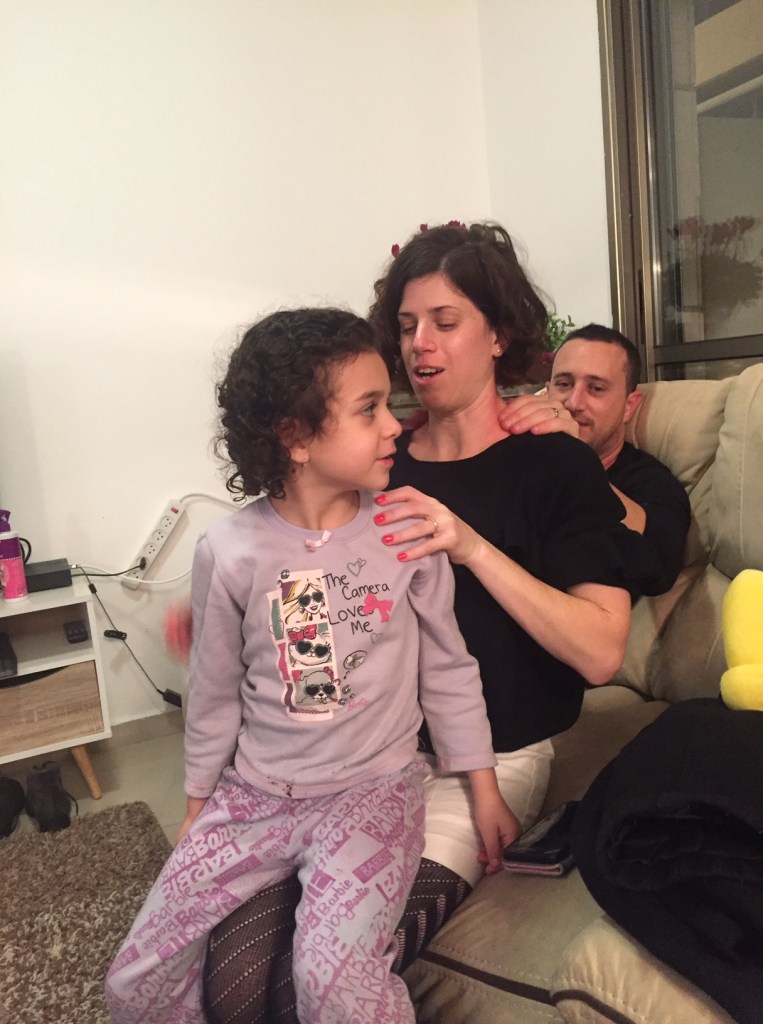
Yochi supervises some art making. Please note her stylish stockings — she is never without them.
Libat, Avishai’s wife, hold Shoham, the newest addition to the family.
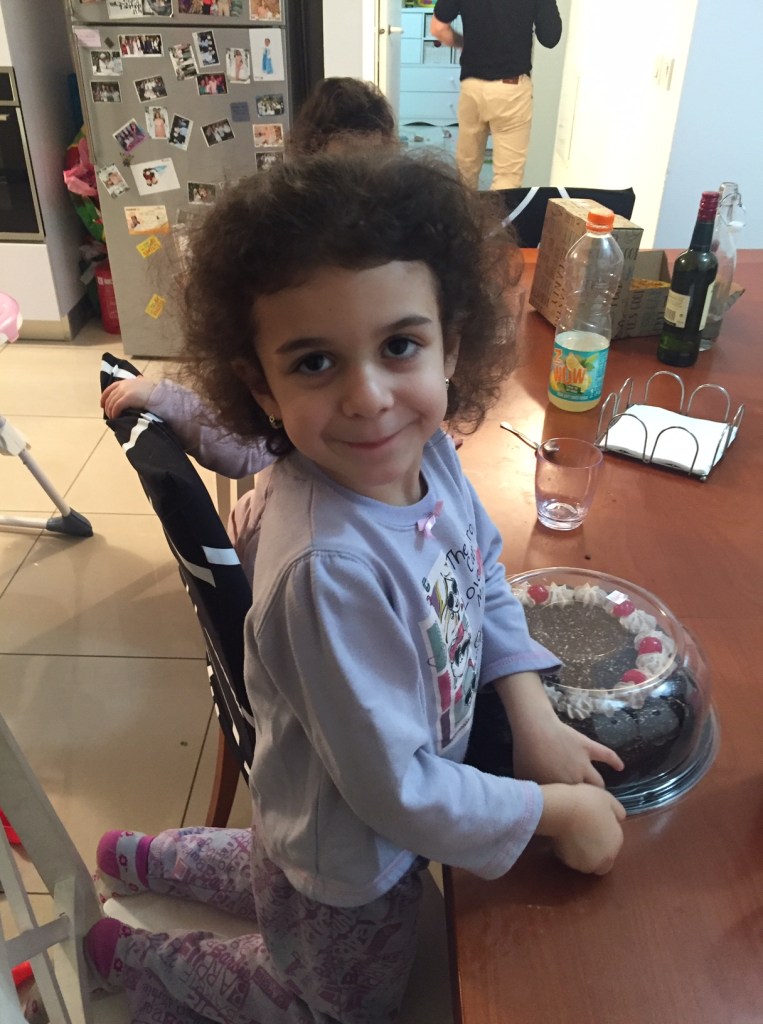
Shaili — and a cake
You can fill in the thought-balloon above her head…
“If you must take my picture, this is what you’ll get!”
Ella has such a different personality than Shaili!
A confidential moment with Dod (Uncle) Hagai
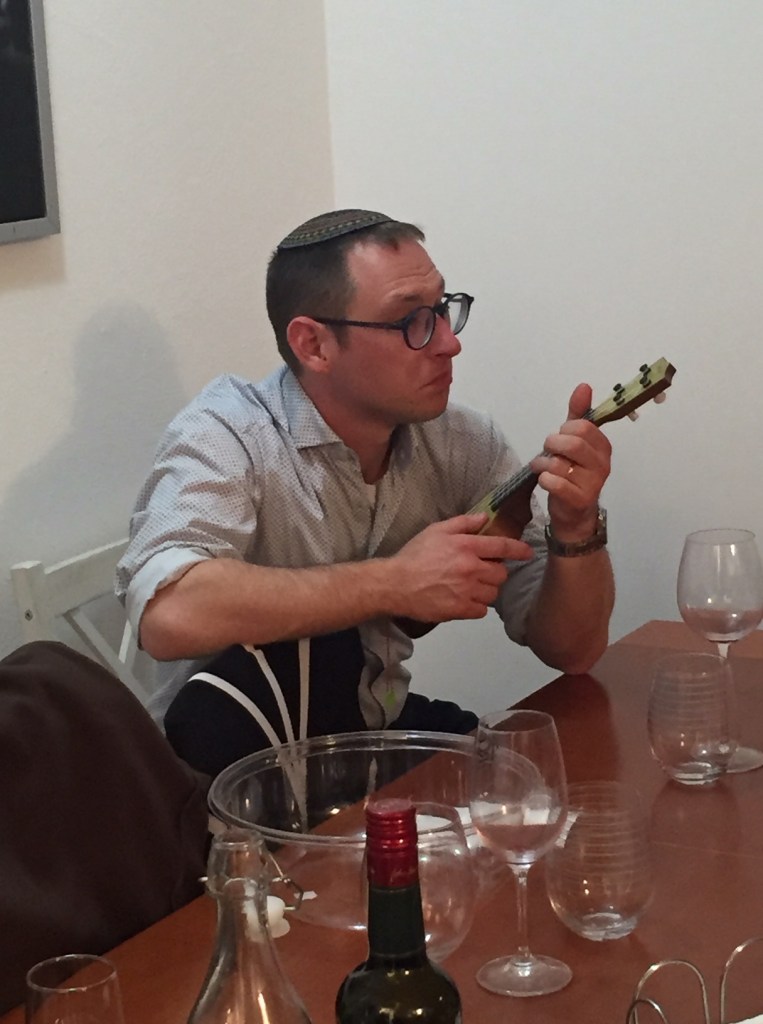
Yoni attempts a serenade on a top ukelele
Design a site like this with WordPress.com
Get started