Dwelling in the House of HaShem

Today was the first day of classes. It has been decided that I will take the Introductory+ Talmud (mostly Mishna) class on Mondays and Wednesdays, and the Intermediate Talmud class (Mishna and Gemara) on Sundays, Tuesdays, and Thursdays. (Yes, the week here starts on Sunday.) Today I attended the Mishna class from 8:30-11:30 in the morning, after which we had another hour or so of orientation (what to do in case of fire, earthquake, terrorist attack, and by the way, don’t forget to do your dishes and keep the place neat and tidy!)

Then we blew the shofar and recited Psalm 27. For the whole Hebrew month before Rosh HaShanah, Elul, it is customary to blow the shofar and recite this psalm, which includes the famous line, Achat sha’alti me’eit Adonai, otah avakeish: shivti b’veit Adonai kol y’mei chayyai, lakhazot b’noam Adonai ulvakeir b’heikhaloOne thing I ask of HaShem, I will request it: to dwell in the house of HaShem all the days of my life, to behold HaShem’s pleasantness and to visit in His temple forever. (Please note: I am using the term “HaShem”, meaning “the name,” in place of any other term, because when we say “Adonai” , meaning “My Lord”, we are actually substituting for the name of God, spelled yud hey vav hey , which we do not pronounce, even if we knew how. Also, I am translating literally, not altering for modern ears, so “He” and “His”.)

Then I went to a group about leading the egalitarian prayer minyan (why would I want do this when I’m on sabbatical? Why not? I love davenning!) And then, like a crazy person, I went to another two and a quarter hour class on Talmud. See, I am signed up for the half-day program, but it costs the same to go to the full day program, so if I decide I want to take more classes (nut that I am!), I can.

Some other day I’ll tell you about Mishna and Gemara — a little history. Today I only want to say that for me, studying Talmud is a kind of bliss. What this says about me, I’m not sure. As Dean Bernstein noted yesterday, by attending this program we are swimming upstream, even as clergy or future clergy; we’re choosing to take time out of the “normal progression” of life — school job, family — in order to sit around studying ancient texts that some would say are irrelevant to life today. I do notice that there are a lot of self-identified nerds here — people who like board games, Dungeons and Dragons, and, as one student put it, “Arguing about Harry Potter.” There is some connection — studying Talmud is kind of nerdy too.

What can I tell you? To me, the combination of translating the text (which is compact and full of abbreviations and peculiar Aramaicisms), unpacking the text, and trying to understand, both what the authors and editors intended, and what we might make of it today — while also getting to study in khevruta, in pairs — is simply the most fun, challenging thing I could be doing. It connects me to history, it connects me to spirituality, it pushes me to keep learning every minute. It gives me a way to connect with other humans while we share the joy of learning and discovering and sometimes arguing together. Today, I studied in khevruta in the morning with Alden Solovy (I mentioned him before — he’s a wonderful contemporary liturgist and poet); and in the afternoon with a delightful young woman from South Africa who had never in her life studied Talmud before. She has just made aliya (become an Israeli citizen — literally, made a “coming up”). She went to an Ultra-Orthodox school awhere they were not permitted to study Talmud (that’s for boys…) It was a true joy to witness her discovering this unique pleasure. We were studying something that, if you’re not inclined to be a Talmud-nerd, could no doubt seem a little pointless — an argument about how we know what time of night to say the bedtime Shema. She totally got the point of it, though — you could see her face light up.

So — I am here fulfilling my dream, studying Talmud in Israel. I’m sure it will be struggle sometimes (maybe even tomorrow!), but right now, I am just completely happy. I feel that I am truly dwelling in God’s house!
Clouds on the first day of school

There were clouds in the sky this morning when I got up — actual clouds! I had to smile when David Bernstein ,the Dean of Pardes, used clouds as an illustration of how differently many things may look from an Israeli perspective than from that of other countries (particularly the U.S.). As he noted, we say, “There are clouds on the horizon,” to mean something ominous is looming (perhaps a giant hurricane — or the second presidency of Lord Voldemort). But here in Israel, clouds are a delight — I can’t tell you how happy I was to see them. Of course they went away after an hour, not having dropped a single drip of rain — but they brought moisture, and shade, and that was good!

So these auspicious cloud brought me a good first day of school. It felt weird — and somewhat overwhelming — to be in the olive groves of Jewish academe again. The gestalt at Pardes is very reminiscent of the gestalt at Hebrew College where I got my MJEd and my smicha (ordination) as a cantor. It’s an institution that welcomes Jews of all backgrounds and “denominations”, English speaking Jews from all over the world. It’s small — from all the various programs combined there were perhaps 60 or 70 students there this morning, plus faculty and administrators. Still, introducing ourselves took forever — there are always those who have to say a little bit more than asked, and since that little bit more is often interesting and entertaining, who can complain?

Today was a time to introduce ourselves, and then we had the first part of our orientation — I’ll share some the Dean’s words in moment. Then they fed us lunch. The food was good, the racket in the khadar okhel (dining room) close to deafening. After that we had meetings with teachers in order to make a final assessment of which level we belong in. I am something of an anomaly, it seems — I am in good shape to go into the intermediate level for Khumash (Torah and Haftarah), but less qualified for intermediate Mishna and Gemara. (Each week we read a section of Torah, the Five Books of Moses, and a corresponding Haftarah, a reading from the Prophets. Mishna and Gemara make up the books known as Talmud — from the root lamed mem dalet, which has to do with learning and teaching. The way I’ve lately been explaining Talmud is that just as Christians have their “New Testament” which mediates and builds on the Hebrew Bible, so Jews have Talmud, which mediates and builds on and explicates the Hebrew Bible — as well as telling stories, setting rules of behavior, and several other things. Jews are not minimalists — the Talmud is a long shelf of books!)

The question of what level classes I should take should sort itself out over the coming weeks. In the meantime, rather than more reportage, I thought I would share with you some of the words from Dean Bernstein that struck me this morning. I’m sure he’s said them a million times — they had a polished air — and yet they were powerful and moving to me, enough so that I copied them down verbatim.

Dean Bernstein said (or, as the Talmud would say, R. Bernstein omer): All the books that you see around you [in the Beit Midrash, the study hall] belong to you; they belong to you in the way that Shakespeare belongs to the English-speaking world, that Moliere belongs to the French-speaking world, that Dante belongs to the Italian-speaking world… We hope that when you leave here you will be more literate, more passionate, more open to other views, more moralWe believe that Torah will have an impact on your lives, but we don’t necessarily presume to assume how it will have an impact… There was much more, but you get the idea. He also noted that Pardes was the first Beit Midrash to open its doors to women , in 1972. Which doesn’t sound like a big deal, but actually is pretty huge…

Getting back to those clouds…did you know that one reason we build sukkot (huts, tabernacles) at Sukkot is to help us remember the heavenly protection of the clouds when we traveled in the midbar (desert or wilderness)? I wonder — is there also connection with God’s pillar of cloud which led us through the desert? I’ll be looking for clouds, and looking differently at clouds — as Rabbah Mitchell said, “I really don’t know clouds at all.”

Finding my way

I know I promised to tell you the history of the San Simon Monastery, the battle there, etc. However, I find myself so struck with a million little quotidian experiences — Hachayyim HaYisraelim HaYomYom החיים הישראלים היומיום Which is to say, the daily Israeli life. So today let me share how my day went, what I noticed along the way…

I’m feeling very proud of myself for having navigated almost all the tasks I set out for myself on this, the last day before classes start. In Israel, September 1st is back-to-school day — unless you go to a yeshivah (religious school), in which case school begins on Elul 1. This year, Sept. 1 and Elul 1miraculously coincided, which our teacher Rabbi Meesh Hammer-Kossoy noted as a wonderful synergy. She spoke last night at the opening Pardes gathering of this, and of the joys of living in a country where the Jewish calendar is the THE calendar — one of the many things that drew me to this choice to live in Israel for nine months.

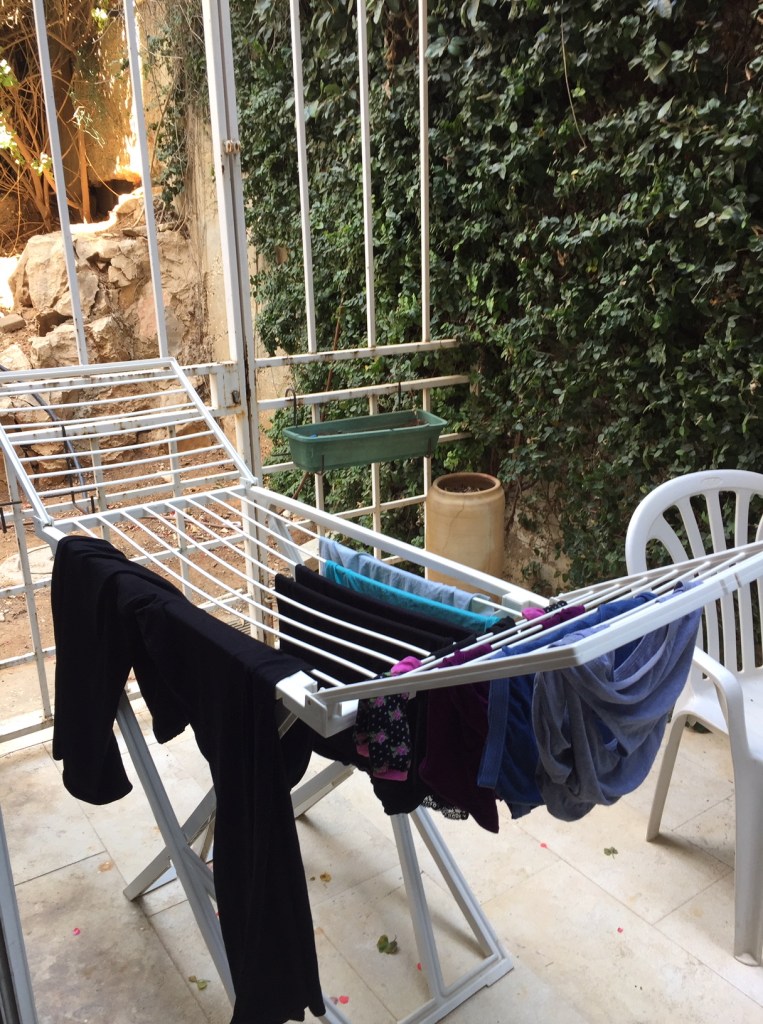
Anyway, my first task for today was to use the mechonat k’vissah (washing machine) for the first time. Thanks to landlady Jill’s instructions, I negotiated this, and hung my laundry out on a rack on the patio. I tried to put it well out of the way of the place where the drips come down from my upstairs neighbors’ mirpeset (balcony), either when they wash their floor or when they water the geraniums. Happily, my laundry also escaped being plastered with the red geranium petals that shower down all day and blow into my apartment through the french doors. I’m not sure how long to took to dry, as I was out for several hours — I’m guessing two would have been sufficient. It’s hot here in the daytime (around 85-90 degrees Fahrenheit) and very dry.

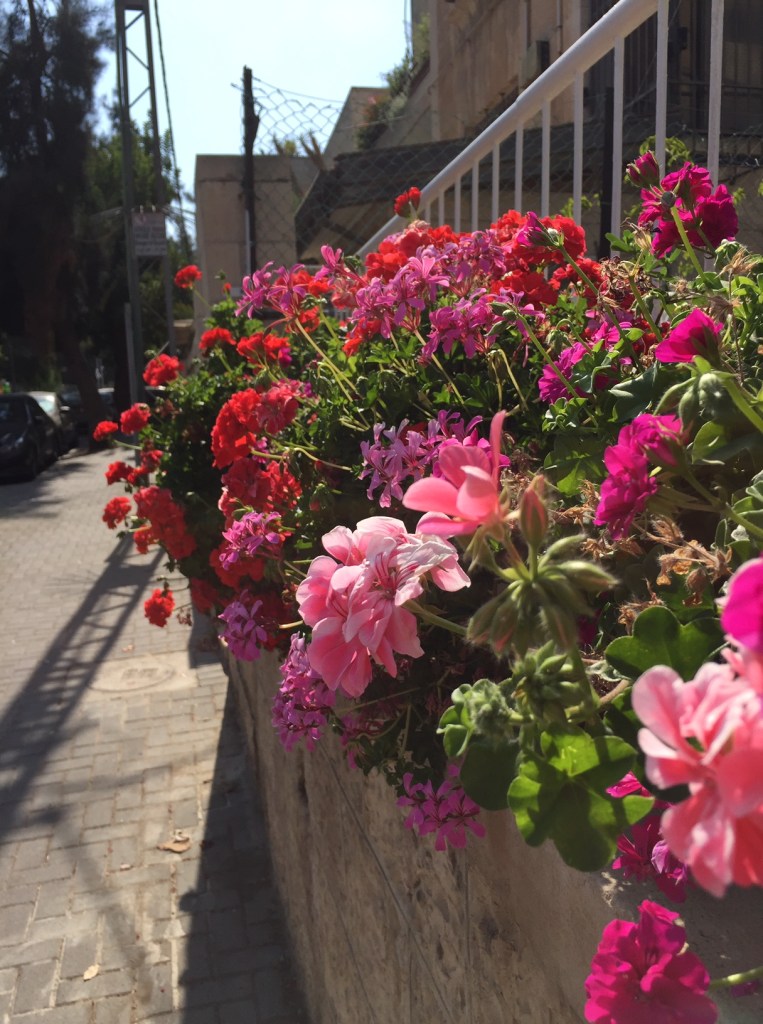
These are not my neighbors’ geraniums — but aren’t they pretty?
Test run…came out fine!

My next task was to drop by Pardes to retrieve my passport (which I accidentally left when I registered there yesterday), and since I was there, I researched what was nearby. I found a mattress store, where thanks to the salesman’s good English and his willingness to also talk to me slowly in Hebrew, I was able to order a mattress topper for my exceedingly hard mattress. Sadly, it won’t arrive for two to three weeks. Khaval! (Too bad!). I did actually succeed in sleeping soundly on my bed last night, but it’s hard on my older body. The salesman told me a story in Hebrew, which I more or less understood, to the effect that the mattress workers’ union had attempted to prevent the sales of mattress toppers as cutting into their business — at least, I think that’s what he said. Knowing Israel, I find it in any case possible…

Across from Pardes, and from the collection of stores where I found the mattress topper, is Kanyon Hadar — the Hadar Mall. Those of you in the States, please picture a mall like any other — sorry I didn’t get any pics, but really, just like a mall in Boston, let’s say, only a bit smaller and with more floors. Lots of clothing stores, food, housewares, and other things. People sitting in food courts eating and drinking things you don’t find in American food courts, like fresh carrot juice and superb pastry, and things you do, like hamburgers. BTW, I’m interested in the etymology of the word kanyon, which clearly is related to the word for “to buy” in Hebrew, liknot, but also possibly is meant to ring a bell for English speakers as well (like, the Grand Canyon of shopping?)

I had scoped out Kanyon Hadar yesterday and found it overwhelming, but today I was feeling a bit sharper. I managed to locate the office downstairs where one obtains a ravkav (literally, “many line”)– a card for public transportation. I sat in line for a bit — when the clerk was about to take someone who had arrived later in front of me, the nice lady who was sitting next to me bawled out the p’kidah (clerk) in Hebrew for not taking me! The clerk didn’t have much English, and her attitude with all customers, whatever language they spoke, was stricly no-eye-contact, I couldn’t care less about you. But I got my ravkav, took it to the other clerk (why couldn’t each of them do both jobs? Because it’s Israel — please!), and filled it. Now I’m set for bus travel.

The next task was the one I failed, for lack of patience. I found the Partners cellphone store, but after waiting an hour for my number to come up, I gave up. I think I was about to be the next customer, but the woman before me was having a louder and louder argument with the clerks (I think about the cost of her new cell phone), and it looked as though it was going to go on forever. There were several other clerks, but each of them was either occupied with the same customers from the time I got there to the time I left, or wasn’t taking customers, or — who knows?

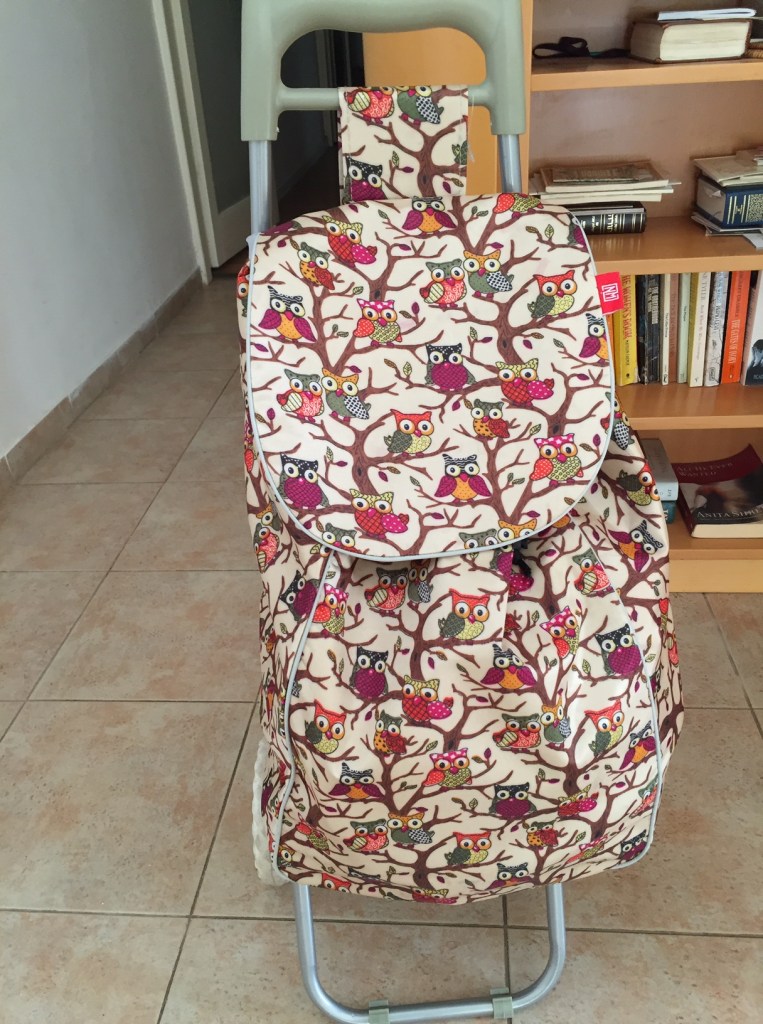
So I gave up and headed toward home. My next successful task was the purchase of this fine rolling grocery hauler (what do we call this Hebrew or in English? I’m really not sure!):

It’s made in China, of course. It’s very light ,and it holds a lot of groceries — or books, when I’m going to school.

After this purchase I made my way to the health food store. where I was happy to find almond milk (mishkeh sh’keidim, almond beverage), organic, made in Italy, and bread lelo gluten, and a lot of very tasty organic fruits and veg, including the best mango I’ve eaten in literally decades — since Mexico in 1982.

So that was my day. I still have to deal with my cell phone SIM card, and also open a bank account. After a long Skype chat with Deborah I made my first cooked meal — they had my favorite Canadian brand of rice pasta at the health food store, so I had pasta with garlic ,olive oil, lovely little tomatoes, and parsley, lightly cooked, with a dollop of labneh (soft yoghurt cheese) on top. So yummy! And do you know, when I was in Rolladin Bakery at the mall today, all I bought was a bottle of water? Not one of those insanely tasty looking pastries — which actually, in that moment, didn’t even appeal.

Signing off from Rehov Kheil Nashim…

Living in History

When we think of Israel, we often think of layers and layers of ancient history. One of my husband Bob’s favorite objects was a Stone Age tool that I picked up in the desert near where his son lives in Mitzpeh Ramon. There, ancient stone tools, 6,000 or more years old, are to be found simply lying on the ground…

But there is also a lot of recent history here — history that happened within the last century, or the last fifty years, history that is unfolding around me even as I write this. For instance: I live on Kheil Nashim Street, off of Bilu Street, off of Hizkiyahu HaMelekh Street. Hezekiah the King goes back to Bible times, but these other names have much more recent histories.

Bilu is an acronym: in Hebrew it looks like this: ביל׳׳ו It stands for Beit Ya’akov Lekhu Venelkha — House of Jacob, let’s go! (It’s a quote from Isaiah 2:5). Bilu rang a bell with me — I knew I’d studied it in Jewish history class. The bilu’im were early pioneers from Russia, escaping the pogroms. The first group came here in July of 1882, when Palestine (as this land was called then) was in still in the control of the Ottoman Empire (Turks). According to our friends at Wiki, “The group consisted of fourteen university students from Kharkiv led by Israel Belkind, later a prominent writer and historian.” Not too surprisingly, “After a short stay on a Jewish farming school”, they were unsuccessful at establishing an agricultural coop. They were then lucky enough to get financial help from the good Baron de Rothschild, who got them going in the wine industry. In 1886 they built a winery (which I rather think is still there).

What of Kheil Nashim? Nashim means women, and kheil is the compound form of khayyal meaning soldier, so I was not surprised to learn that Kheil Nashim is the old name for the women’s branch of the Israel Defense Forces. Its acronym (there is a strong Jewish tradition of acronyms, going back to the Talmud) is khein, meaning grace. In the US I think we have a notion that there is greater equality in the IDF than in the US armed forces, but this proves to be less than the truth. I mean, a women’s branch of the army referred to as “grace”? If you were an officer in this branch, you were known as k’zinat khein — which, as one author writes, sounds in Hebrew like “charm officer”. Women were not given combat jobs, any more than in the US army. Rather, they were detailed to clerical and support duties, and to asigned to look decorative hanging on the arms of male soldiers or dignitaries.

It was not until 2009 (I believe — I seem to have lost the citation) that the name kheil nashim was dropped. It’s also fairly recently that women were allowed to enter combat units. Even now, I have read they represent something like 3 percent of combat soldiers. However, after the Alice Miller case in 1994, when a young woman sued for her right to become an Israeli fighter pilot, the right of women to do equal duty has improved significantly in the Israeli forces — as in the US, of course. (And yes, I do know that there’s an argument to be made that the right to go into combat has to be offset by the right to be a conscientious objector….)

Tomorrow I hope to tell you about the history of the neighborhood I am living in. For such a placid, gentrified, area, it has a very contested recent history. My interest started when I noticed a marker at the San Simon Monastery and park yesterday, which explained that this Greek Orthodox monastery had been the site of a bloody battle in the War of Independence…

More tomorrow…

First Shabbat in Jerusalem

The weekend in Israel is Friday and Saturday, rather than Saturday and Sunday. Friday is for getting ready for Shabbat. I had a somewhat restless Thursday night, so I didn’t manage to get up until 10:30 am on Friday. Then I really had to scurry to get to hasuper for my groceries; they close at 2:30 on Fridays, which is about the latest any place seems to stay open.

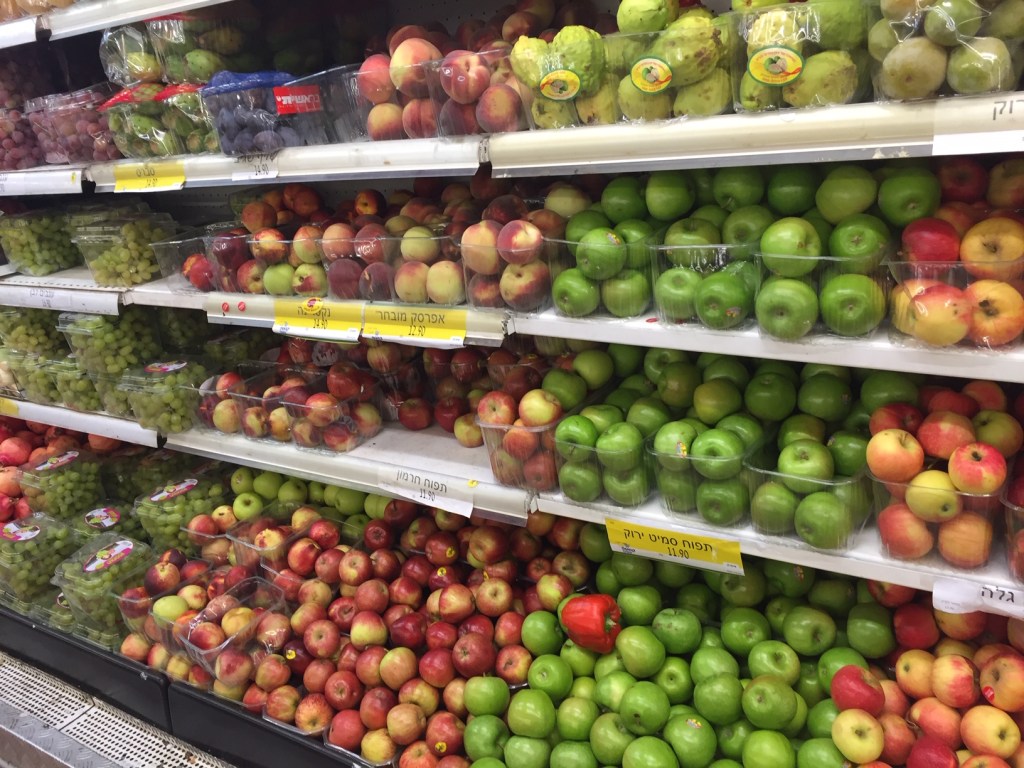
My nearest super isn’t very super at all, at least in size. It’s bigger than the tiny hole-in the-wall shops called makoliot (I’m hoping I got the plural right on this), but very small by American supermarket standards. Crowded and expensive, too. Next week I hope to get organized to take the bus to Mahaneh Yehudah, Jerusalem’s fabulous market. (BTW, mahaneh does not, as I once supposed, mean market — it means camp.) However, in a pinch the Co-op Shop is a ten minute walk away, and while it is pricey, it has a good selection of veggies and fruits, nice breads and cheeses, and a bit of everything else you might need.

Some things I do not recognize — at the top, the lumpy yellow-green things, for instance…

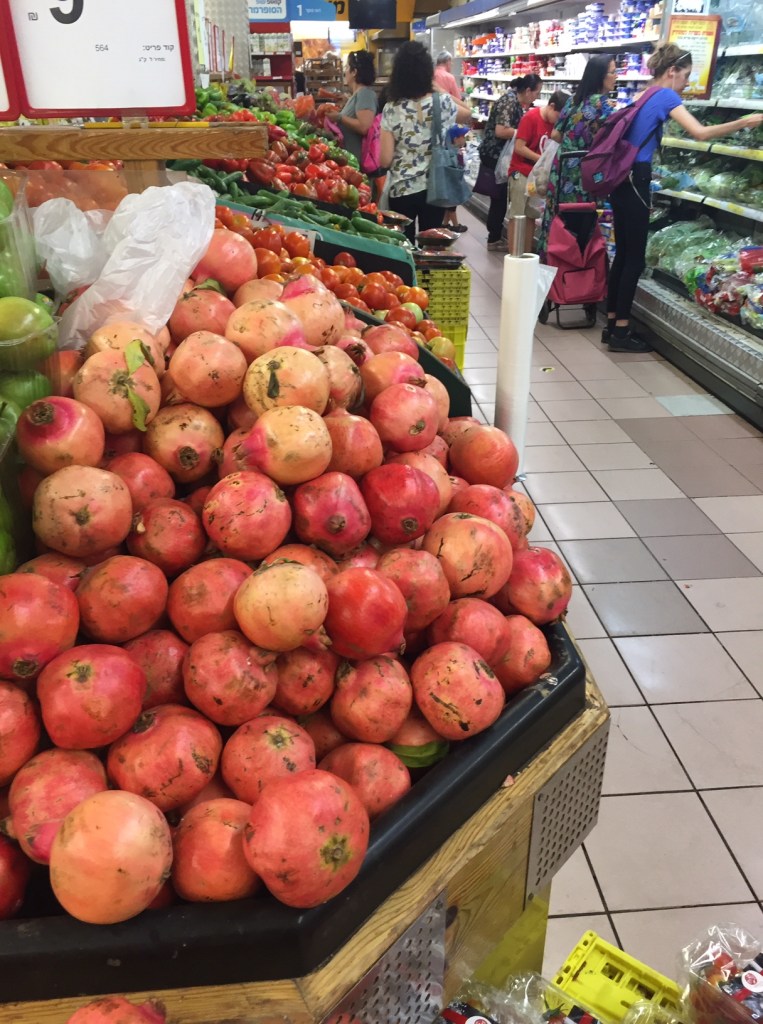
I managed to carry my groceries back in my backpack — a rolling cart, like the ones you see old ladies using in New York, is clearly on my list of necessities. Like a fool, I didn’t buy any of the pomegranates, which are currently in season — next time!

After my grocery foray, my landlady dropped by to bring me a duvet — not that I need it now, I am sleeping with the window open, the fan going and only a sheet, it’s in the low seventies at night. But it will come in handy later. Jill is great landlady. She showed me how to work the stovetop, the oven, and the curious little European washing machine (mechonat k’vissah). Then she stayed to chat for a little.

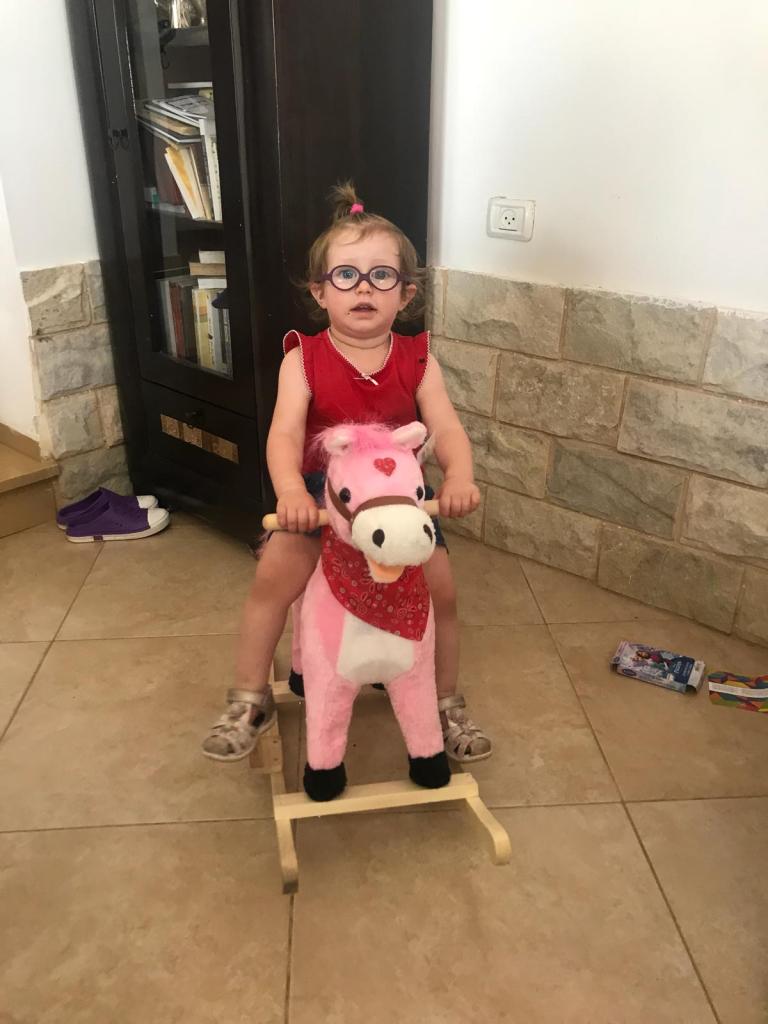
Then my middle grand daughter, Yochi, dropped by with her husband Yoni and their daughter Golan. I promise to get you an up to date picture of this extremely cute child soon, but in the meantime, here’s an older one:

This prodigy brought me two little round challot that she made in gan (kindergarten — a gan is literally a garden). She was a bit shy, and very anxious to listen to a particular song on her mother’s iPhone, which of course none of us could understand the title of — was she speaking English or Hebrew? Not sure. At least it wasn’t “Baby Shark” (you can ask my other grand daughter, Ariel, about that one…oy!)

As Shabbat approached, I showered and changed and set out for services at the Mizmor leDavid minyan. It was about a 35 minute walk, but a pleasant one — not too hilly, with lots of nice apartment buildings to look at as the sun sank slowly, gilding the already golden Jerusalem stone. Sweet scents wafted from the gardens around the apartment blocks. Most of what is growing here is probably not native — it all reminds me very much of things I’ve seen in Southern California (where it’s not native, either). The ring-necked parakeets are also not native, and aren’t very good for the local environment, but I must confess I enjoy seeing the flocks of big, green, long-tailed, screechy birds flying over, just as I do in California.

Mizmor leDavid was just what I’d hoped for — a romping, stomping Kabbalat Shabbat service of Carlebach tunes. There’s a mechitza (barrier between the men and the women), but it’s not a very imposing one. The guys were really rocking out — the women less so, although some of us did get up and dance to the niggun (wordless tune) after Lecha Dodi (the song that welcomes Shabbat as a beautiful bride). I sat next to another new student, named Rachel, who just finished her years in the army. She’s from Canada originally. She claims to be shy — she wasn’t singing much — but she moved here on her own at the age of sixteen, went to a boarding school, and made aliyah four years later. In the army she served in foreign relations, and also in the civilian police force.

Four of us Pardesniks left the services after Kab. Shab. and walked a few blocks to the home of Rabbi Meesh Hammer-Kossoy, where we were welcomed for a delicious Shabbat dinner. Rabbi Meesh and her husband (another Yoni) are in their late thirties/early forties I would guess. Yoni’s elderly father was also there, and Meesh and Yoni’s two teenage sons, who were models of decorum and actually joined in the conversation. The two other Pardes students were David, who arrived two months ago from London, and Alden Solovy (I suggest you look him up — he’s an interesting man!), who lives here. They were each quite entertaining, and Mees and Yoni provided not only a big spread of delicious food (chicken, roasted potatoes, many side dishes with vegetables and the seeds of a pomegranate from their own tree) but also a very stimulating conversation. Since it was Shabbat Rosh Chodesh Elul – -the beginning of the month of Elul, in which we prepare for the Days of Awe –Yoni gave us a poem to mull over after dinner (in English), and Meesh had us musing on the weekly parsha (Torah portion) and the theme of Tzedakah, looking ahead to the liturgy of the High Holy Days when we say that t’shuvah, t’filah, u’tzedakah ma’avirin at roa hagzera — return/repentance, prayer, and doing acts of social justice can avert the severity of God’s decree for our year ahead.

All in all, I had not had such a stimulating conversation in — I’m not sure how long! I walked most of the way home with Rachel, learning about her astonishing background. When we parted ways, I felt completely safe walking in the warm night air, with people out everywhere, mostly religious, chatting and singing and enjoying the Sabbath.

Today I attended a picnic for Pardes students in a park near the school, which was also enjoyable, although a bit of a deja vu to my time in seminary. There weren’t many folks there my age….but the potluck food was good, the company was pleasant, and it was fun to hang out and “talk Jewish”, as well as singing songs and blessings together.

After a nap, I walked over to the nearby San Simon Park, which has a Greek Orthodox Monastery in its midst. This is a very popular place — it was full of families and people of all ages enjoying the Shabbat afternoon, playing, picnicking, and checking out the books in the little free libraries (this idea has evidently made it here from the states). The books were in Hebrew, Russian, French, and English. Around me I heard French, Spanish, Russian, and a good deal of American English — and a little Hebrew, here and there. I will have my work cut out for me to really speak much Hebrew here –one Pardes student told me, “That’s why I went to Middlebury to study Hebrew this summer!” (oh, the irony…) But I’m determined to use my Hebrew whenever I can — and since I am in a very French neighborhood, perhaps I will dust off my French as well!

Shabbat Shalom and Shavua tov from Jerusalem!

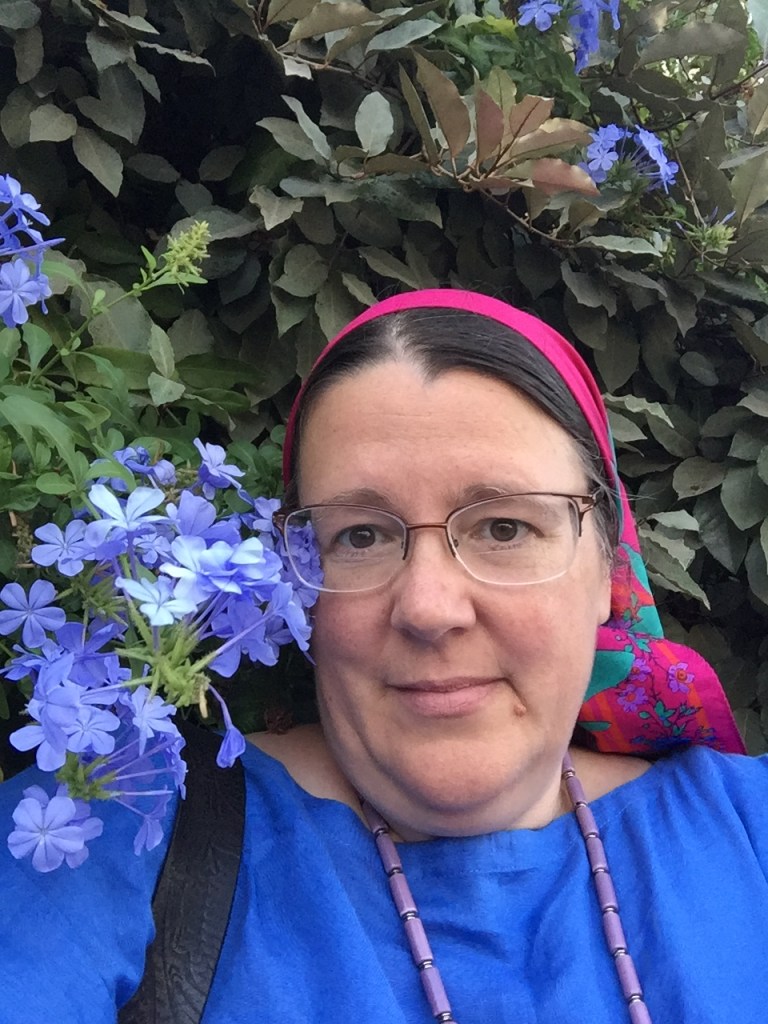
On my my way to Mizmor leDavid in my Shabbos clothes — I thought my shirt looked good with this particularly blue plumbago.

Israeli Breakfast

My Hebrew textbook tells me that the average Israeli does not eat much for breakfast. Like Americans, they gobble a few bites on the run, perhaps managing cafe and maybe some kornfleks. (This refers not just to cornflakes but to any cereal — there is another Hebrew word for cereal, but it is seldom used.) And indeed, I bought myself a nice big box of kornfleks at the supermarket (commonly referred to as hasuper) this morning.

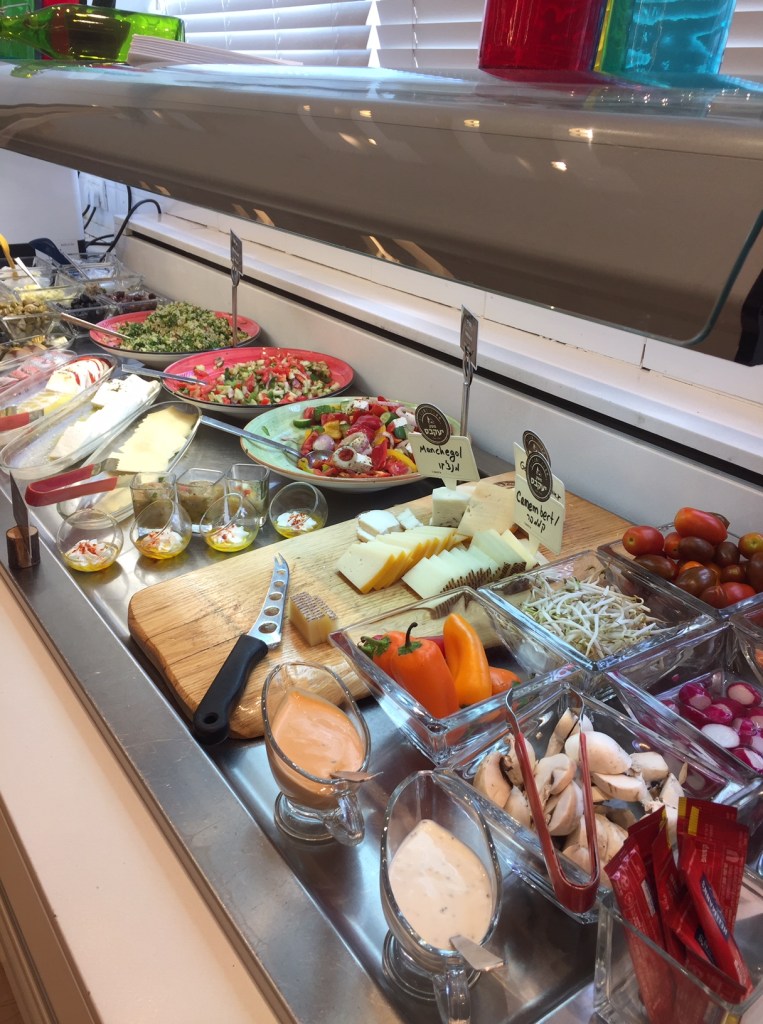
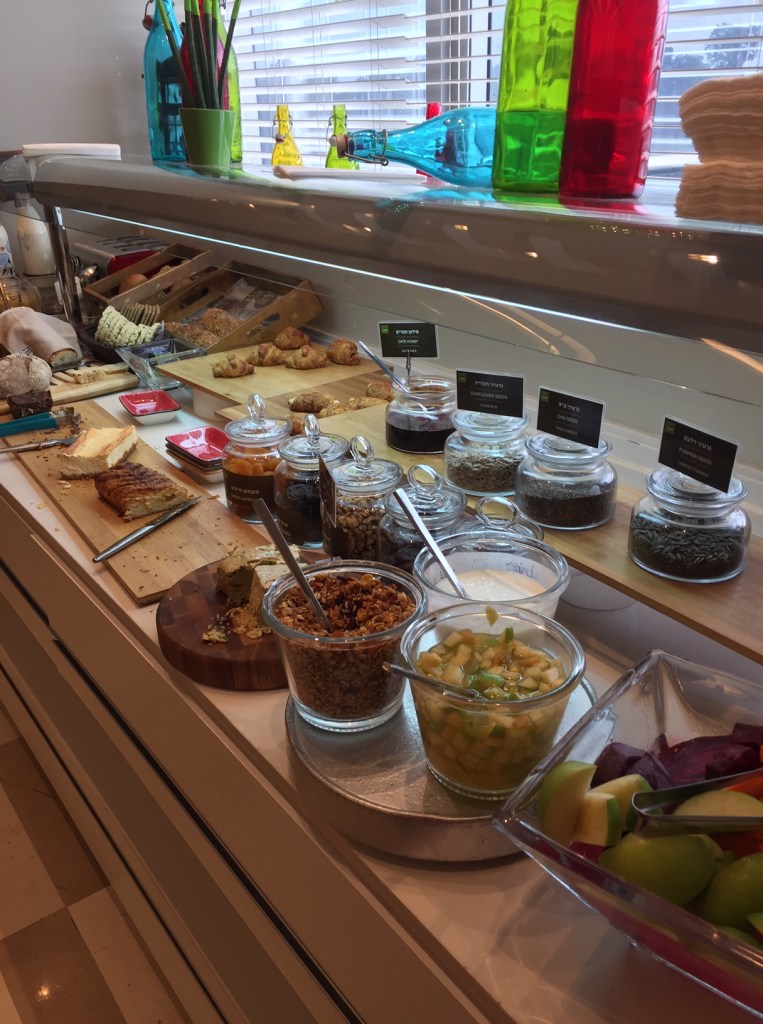
However, hotels carry on the fine Israeli tradition of a breakfast buffet which puts anything you can get in an American hotel, even a very good one, to complete shame. Yesterday, after a good night’s sleep at the Sadot Airport Hotel (which is not at the airport- -there are no hotels at the airport, possibly for security reasons – but rather a twenty minute drive away in Be’er Yaakov) I awoke to this:

Cheeses, salads, salad ingredients and dressings…

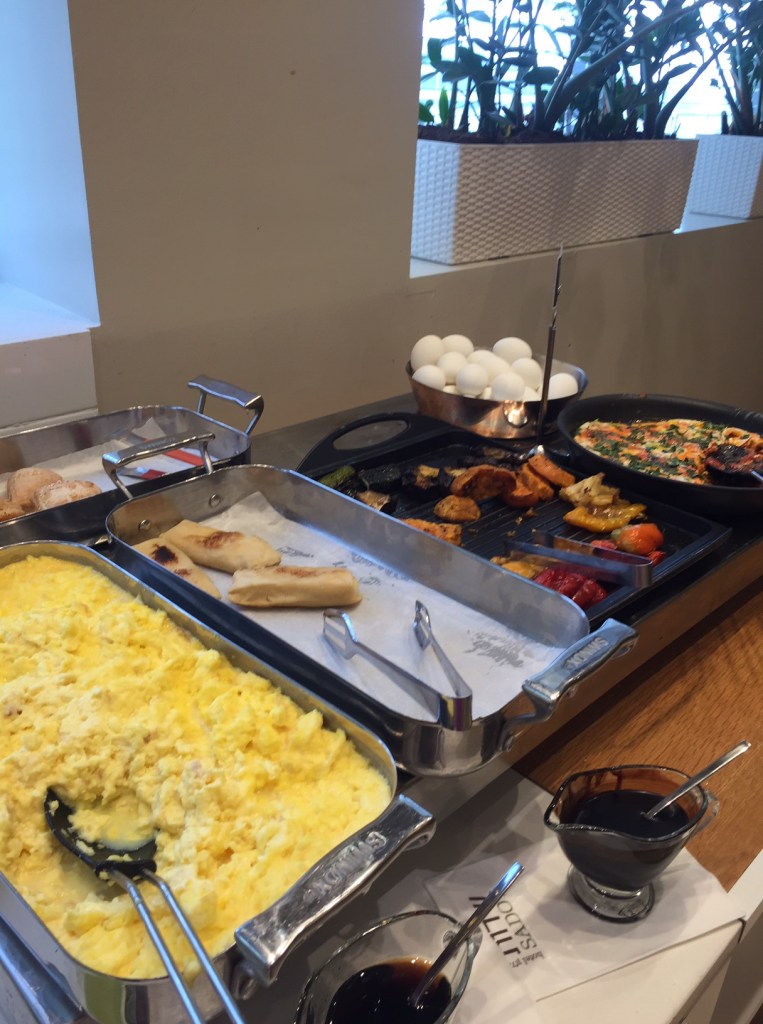
And this:

Scrambled eggs, blintzes, roasted sweet potatoes, shakshuka (eggs poached in spicy tomato and bell pepper sauce), burekas (cheese stuffed pastries)…

Also this:

Assorted dried fruits, home made breads and pastries, cheese cake, apple strudel, halvah, vegetables and a juice maker (out of sight on your right) for juicing them…

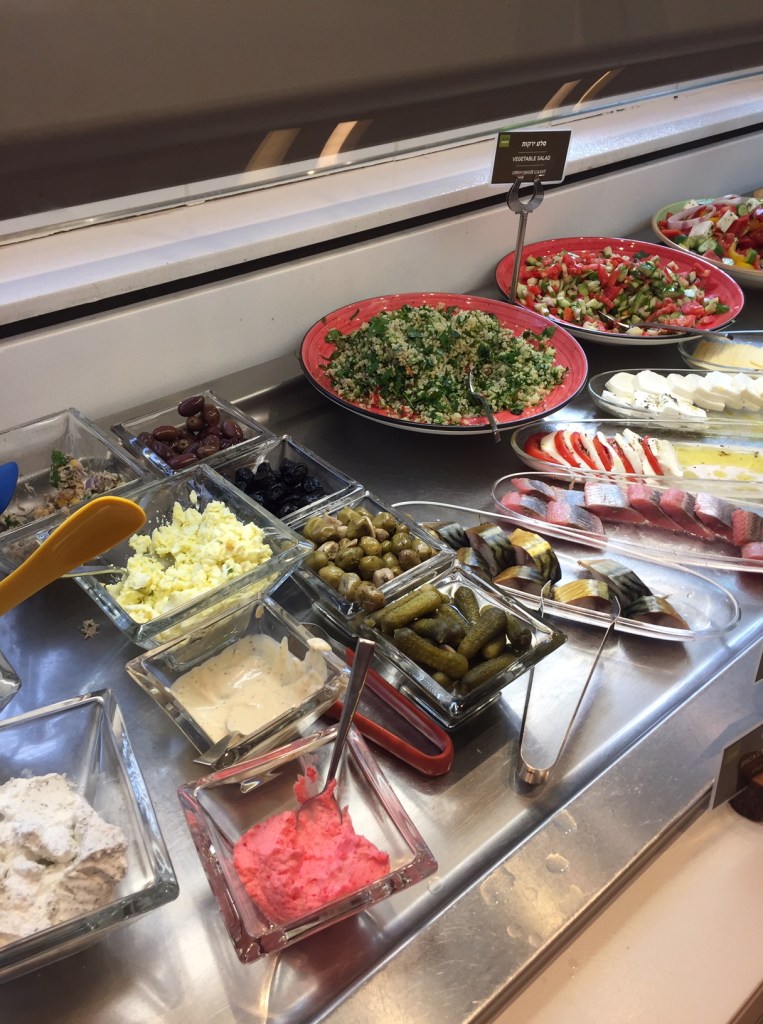
And this:

More salads, pickles, assorted pickled fish dishes….

Not pictured, a selection of respectable(not sugary) dried cereals, things to put on top of them, and also a tea bar with a variety of interesting herbal and regular loose teas, with a fleet of teonim (tea pots) in which to infuse them. Also, mitz tapuzim (orange juice), limonata (lemonade), and an espresso machine with many settings.

Now, I have to say, kudos to Malon Sadot (Sadot Hotel) for one of the best such spreads I’ve seen and eaten from. Not every Israeli hotel does as well, for sure. And the price of a room, including the breakfast, is not all that high. But also, let’s face it, in comparison with any Israeli hotel breakfast, the flabby pastries, greasy meats, sugary cereals, and rubbery eggs one receives at U.S. hotels –if there is even breakfast — look even sadder than usual in comparison.

As for me, I’ll be back to my kornfleks — or possibly a simple fried egg — now that I am doing for myself. In fact, this morning I made do with bread, milk, and some fruit. Oh, and a bite of nice espresso flavored chocolate leftover from the hotel…

First Day

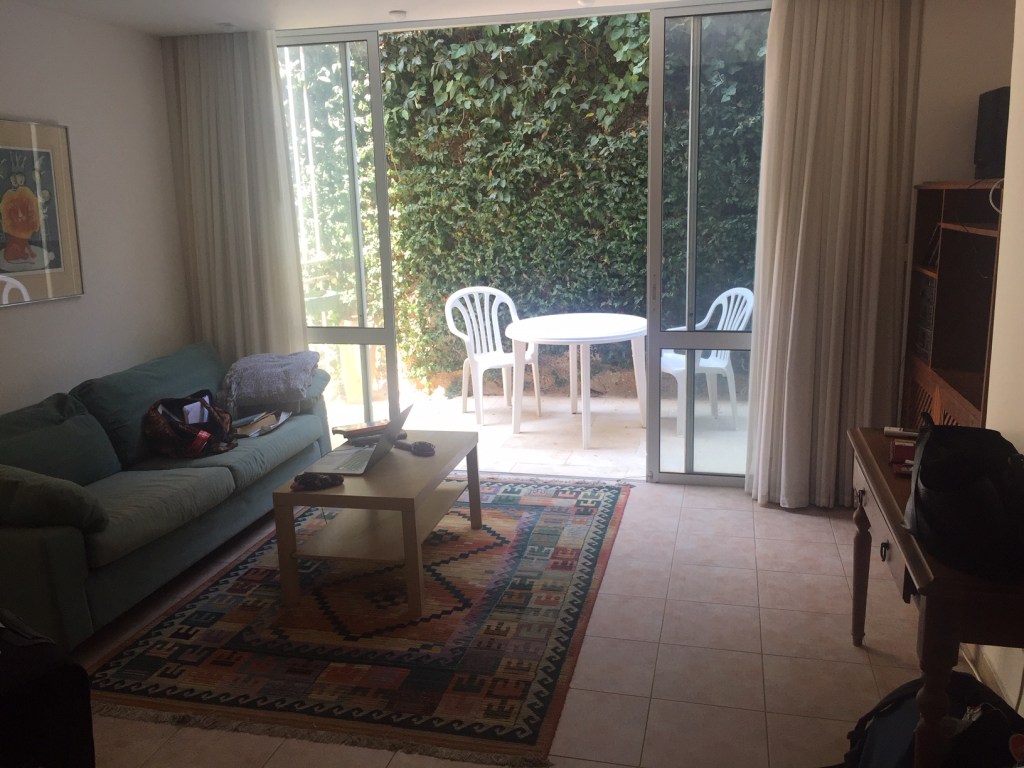
I am in my new apartment, in the Katamon area of Jerusalem. It’s perfect — everything I imagined. A small patio, living-dining area, compact but complete kitchen, tiny guest bedroom (if you want to come visit!), bathroom with little washing machine included, and bedroom. (Oops –I brought sheets, but it looks as though I will have to purchase blankets. Oh well — at this time of year I do not need them.)

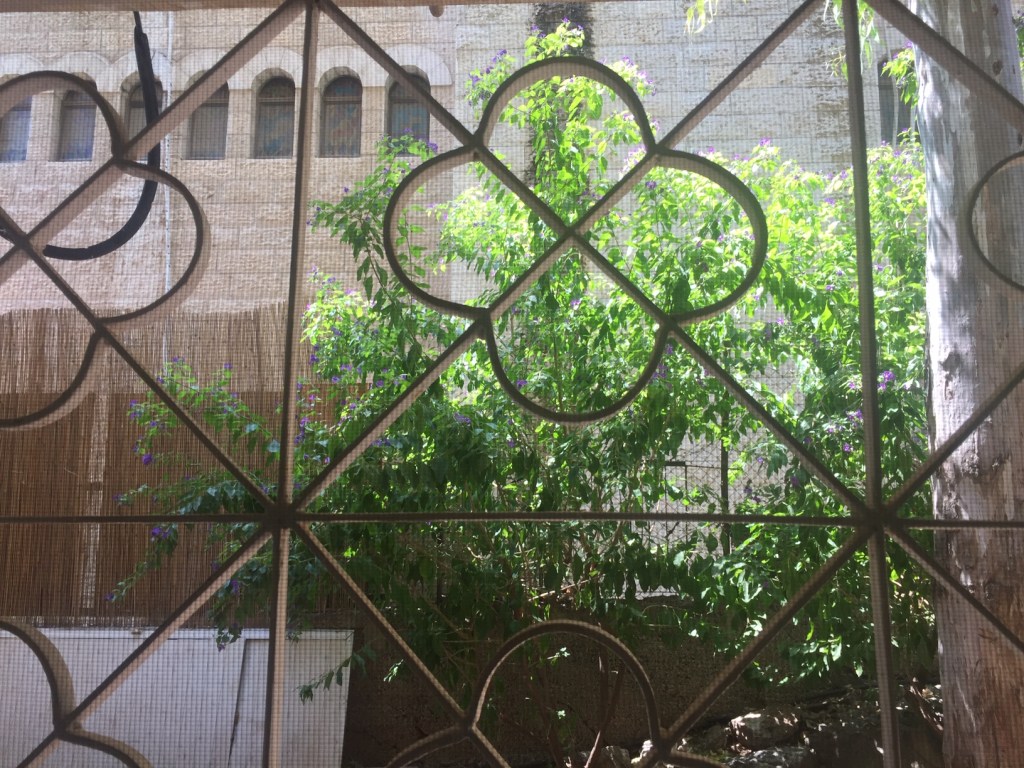
The view of the Beit Knesset next door, from my bedroom window.

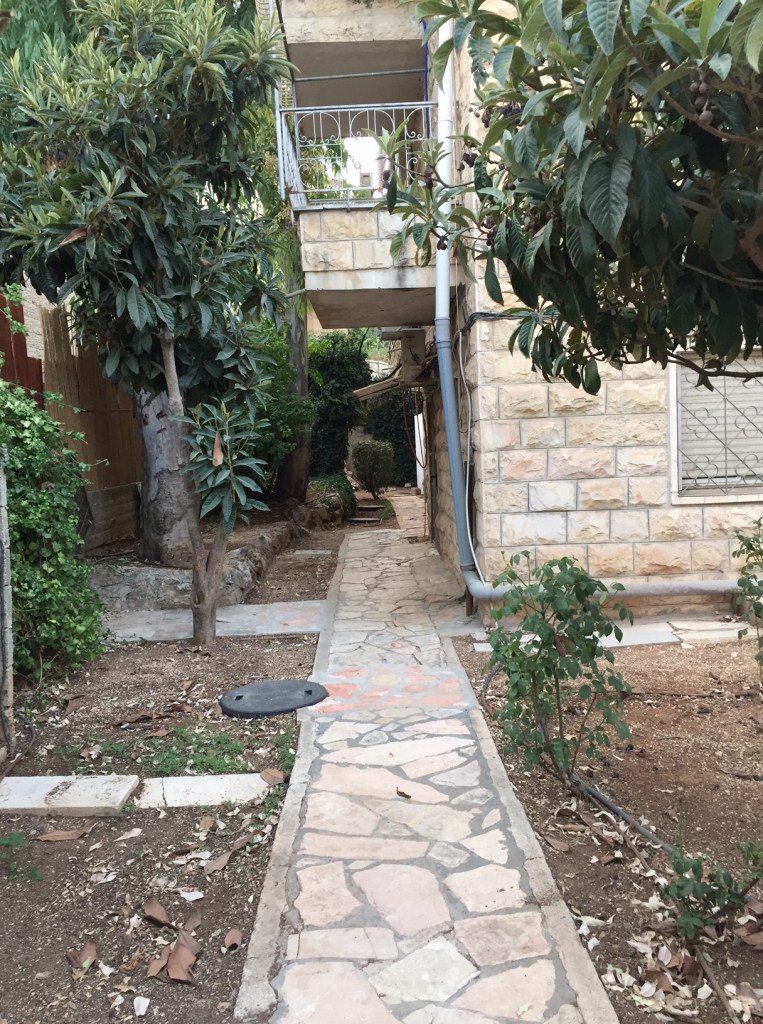
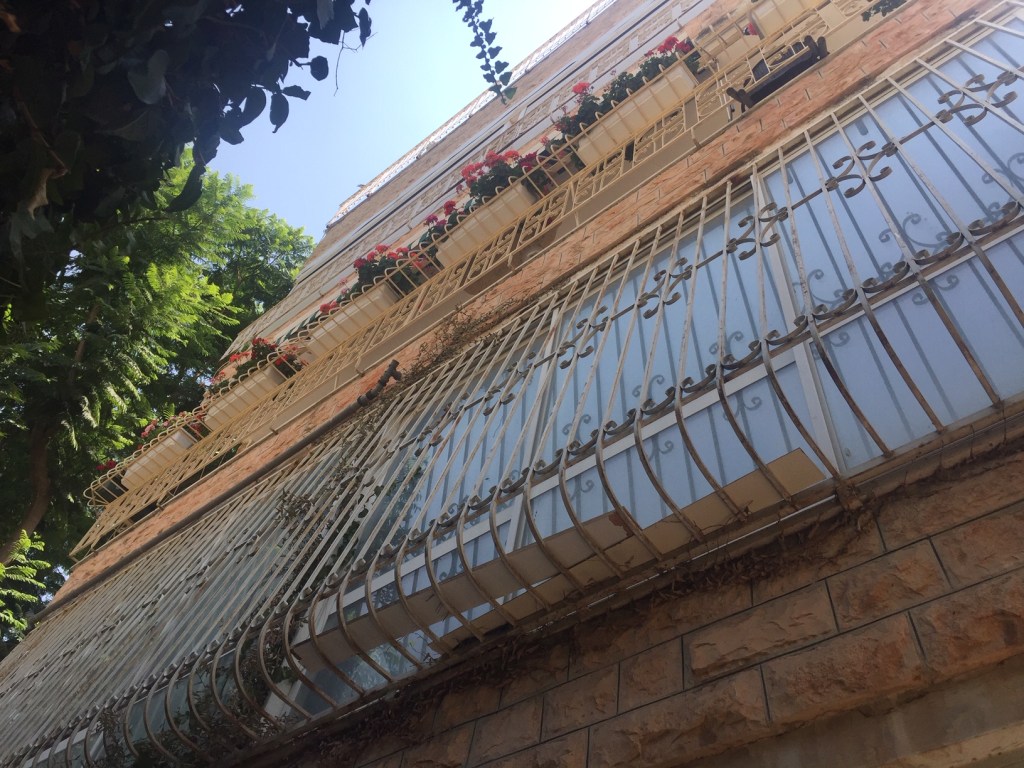
The windows look out at some flowering plants, and beyond them the neighboring Beit Knesset (synagogue). Everything here is built of the famous golden Jerusalem stone. From my patio I look up at the bright red geraniums in the window boxes of the apartment above. Today is hot and bright — summer in Jerusalem –but a nice breeze blows through the apartment from the open french doors to the patio.

The view upward from the patio

It’s quiet here on this little back street. I hear occasional voices or a song on someone’s radio, a scooter passes, birds squawk in the trees. The traffic is distant, a faint hum. I’m told that in the mornings I’ll hear the happy sound of children’s voices, because the Beit Knesset is also a Beit Sefer (school). For city living, this seems very peaceful.

The landlady comes originally from Australia, although her grandfather hailed from Tzat (sometimes spelled Safad). Apparently Jewish families sent their boys far away for fear of being conscripted into the Turkish army at the time of WW I. I thought the Brits already had Israel at that time — I can see I need to refresh my Israeli history. Anyhow, Jill, the landlady, lived in this apartment for twenty years, and says she has many happy memories. She was apologetic about it being small, but I cannot imagine why it would need to be any larger for one person.

For today I’ll settle in, unpack my many bags, visit the makolet (grocery market) down the street and buy some staples. My grandson, who kindly picked me up at my hotel near the airport this morning and drove me over here, will join me for dinner at some point. I expect I’ll succumb to a jet-lag recovery nap…And so, my days in Israel begin.

My new living quarters.

Introduce Yourself (Example Post)

This is an example post, originally published as part of Blogging University. Enroll in one of our ten programs, and start your blog right.

You’re going to publish a post today. Don’t worry about how your blog looks. Don’t worry if you haven’t given it a name yet, or you’re feeling overwhelmed. Just click the “New Post” button, and tell us why you’re here.

Why do this?

  • Because it gives new readers context. What are you about? Why should they read your blog?
  • Because it will help you focus you own ideas about your blog and what you’d like to do with it.

The post can be short or long, a personal intro to your life or a bloggy mission statement, a manifesto for the future or a simple outline of your the types of things you hope to publish.

To help you get started, here are a few questions:

  • Why are you blogging publicly, rather than keeping a personal journal?
  • What topics do you think you’ll write about?
  • Who would you love to connect with via your blog?
  • If you blog successfully throughout the next year, what would you hope to have accomplished?

You’re not locked into any of this; one of the wonderful things about blogs is how they constantly evolve as we learn, grow, and interact with one another — but it’s good to know where and why you started, and articulating your goals may just give you a few other post ideas.

Can’t think how to get started? Just write the first thing that pops into your head. Anne Lamott, author of a book on writing we love, says that you need to give yourself permission to write a “crappy first draft”. Anne makes a great point — just start writing, and worry about editing it later.

When you’re ready to publish, give your post three to five tags that describe your blog’s focus — writing, photography, fiction, parenting, food, cars, movies, sports, whatever. These tags will help others who care about your topics find you in the Reader. Make sure one of the tags is “zerotohero,” so other new bloggers can find you, too.

Design a site like this with WordPress.com
Get started