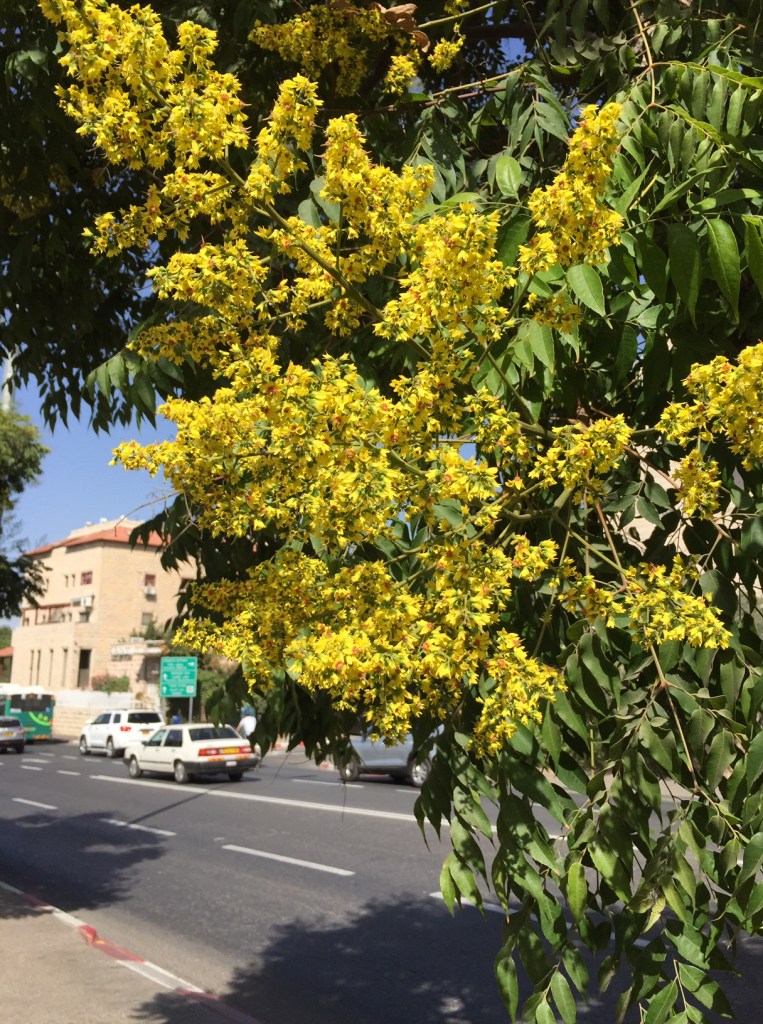
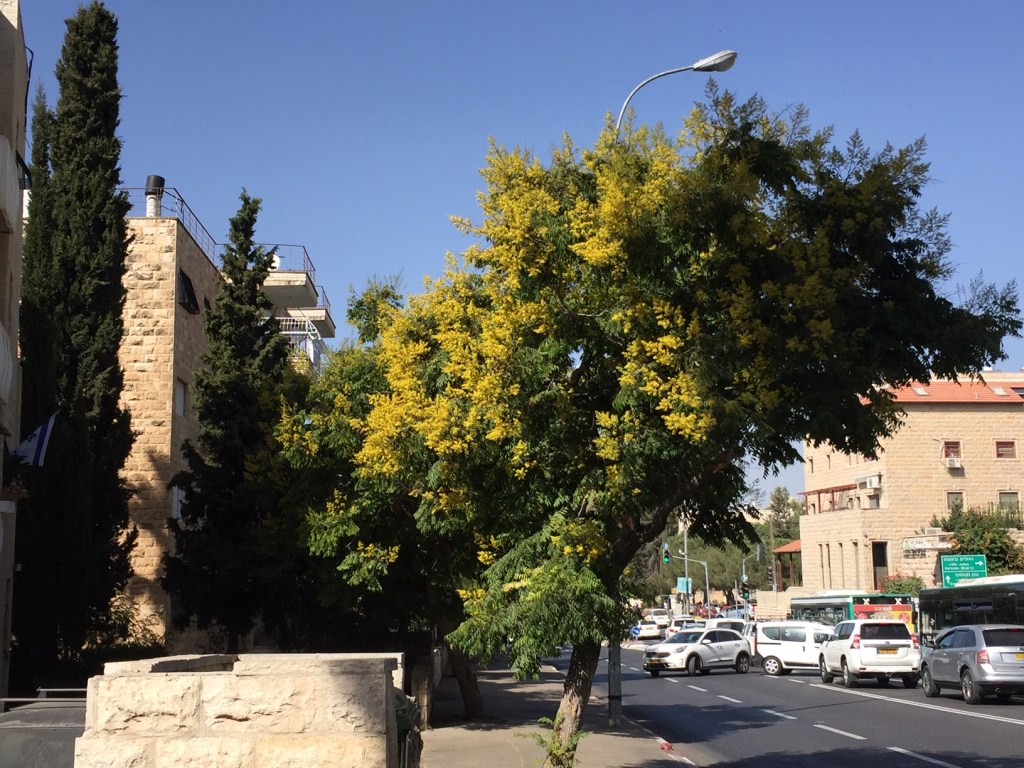
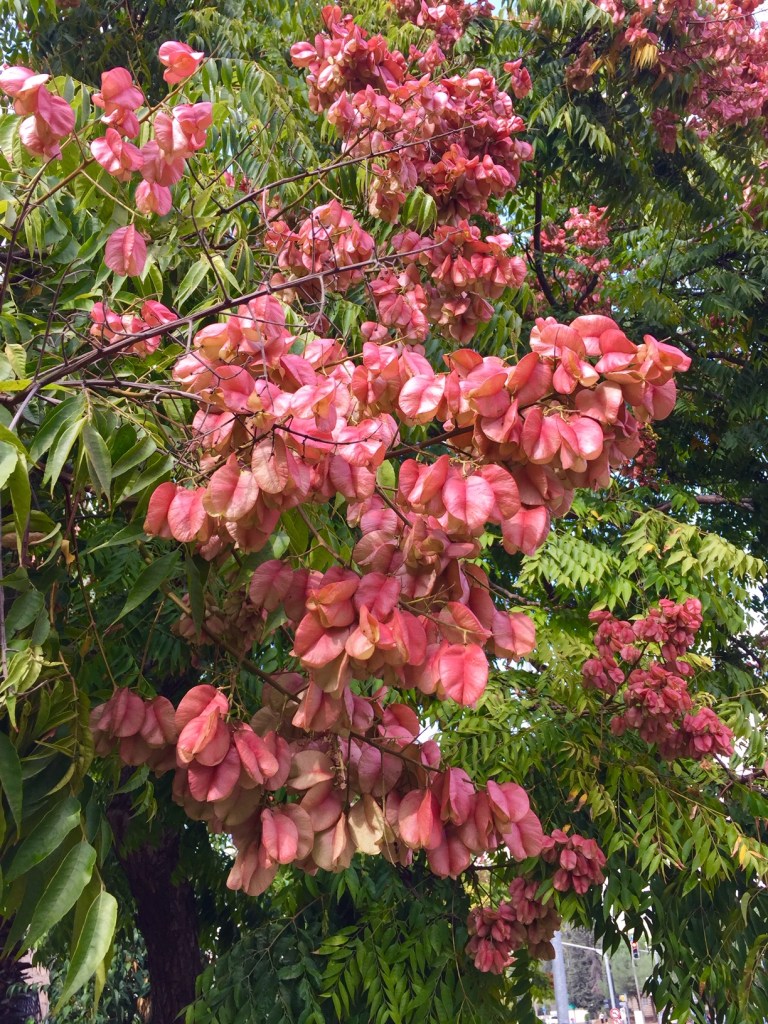
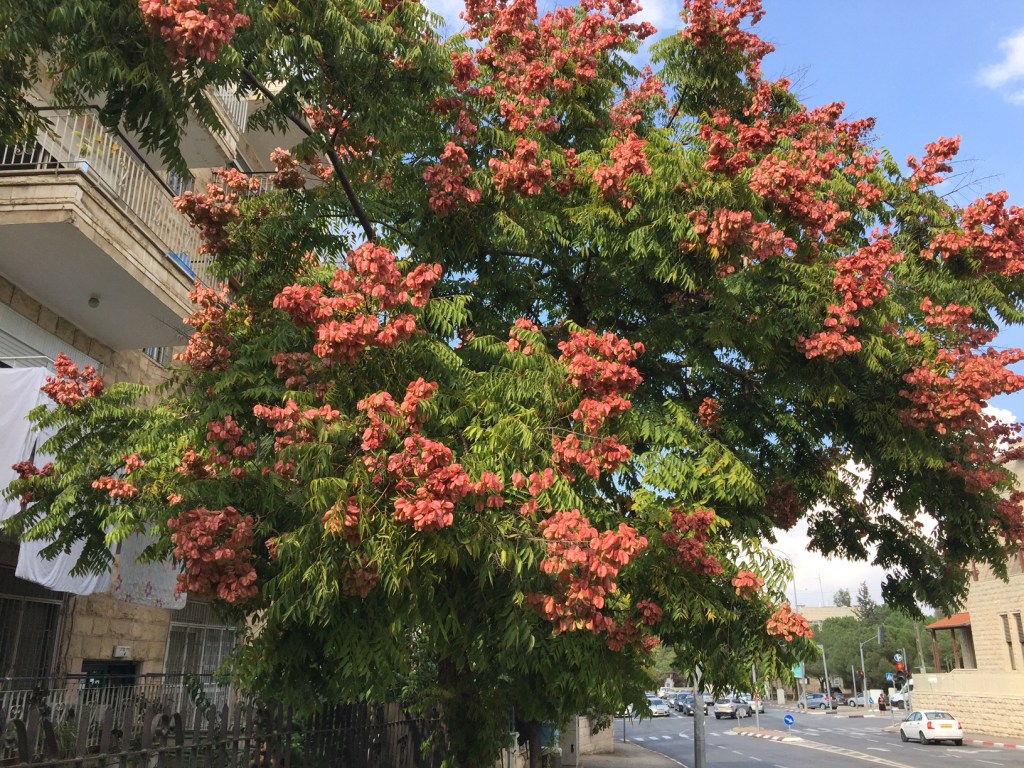
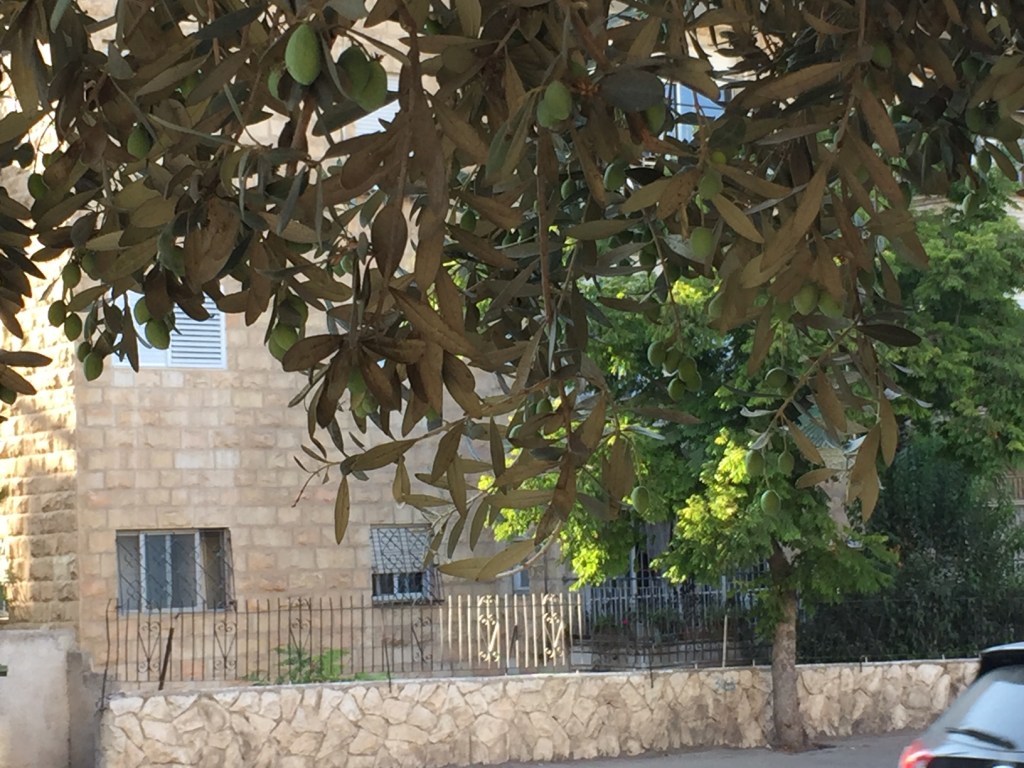
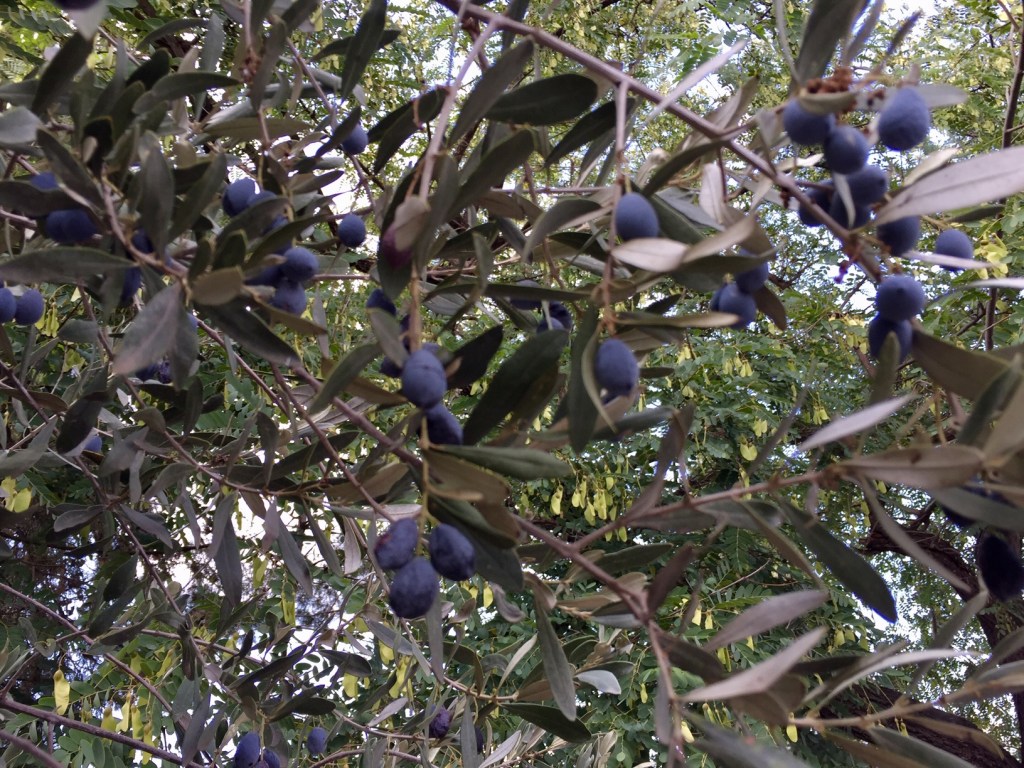
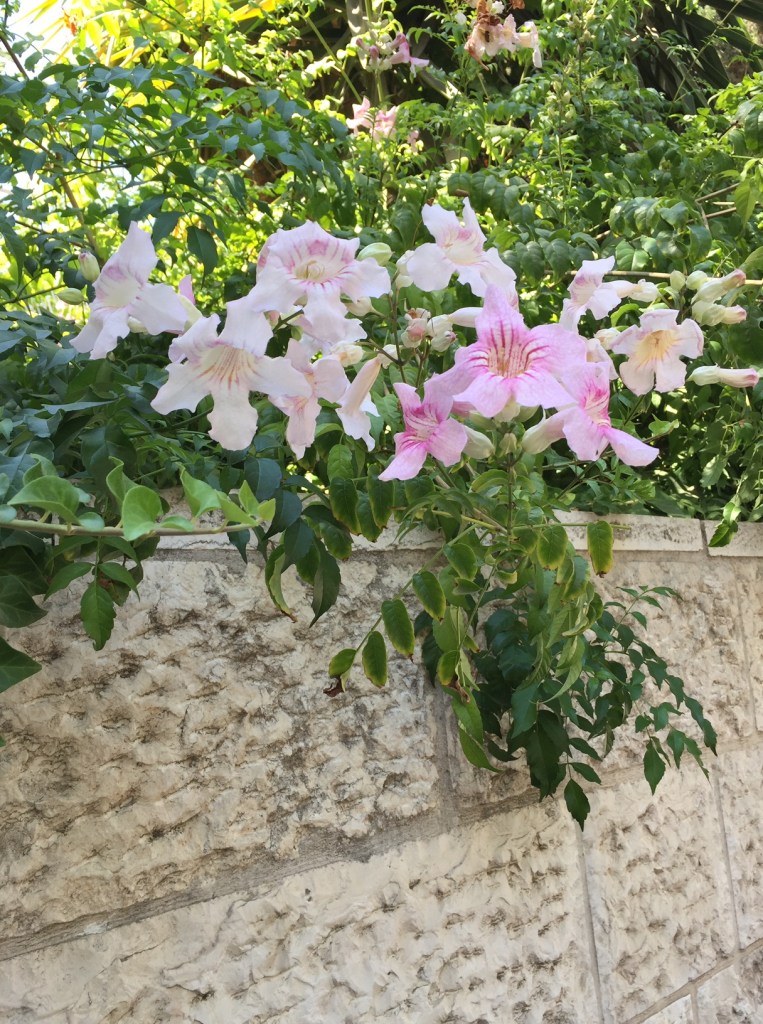
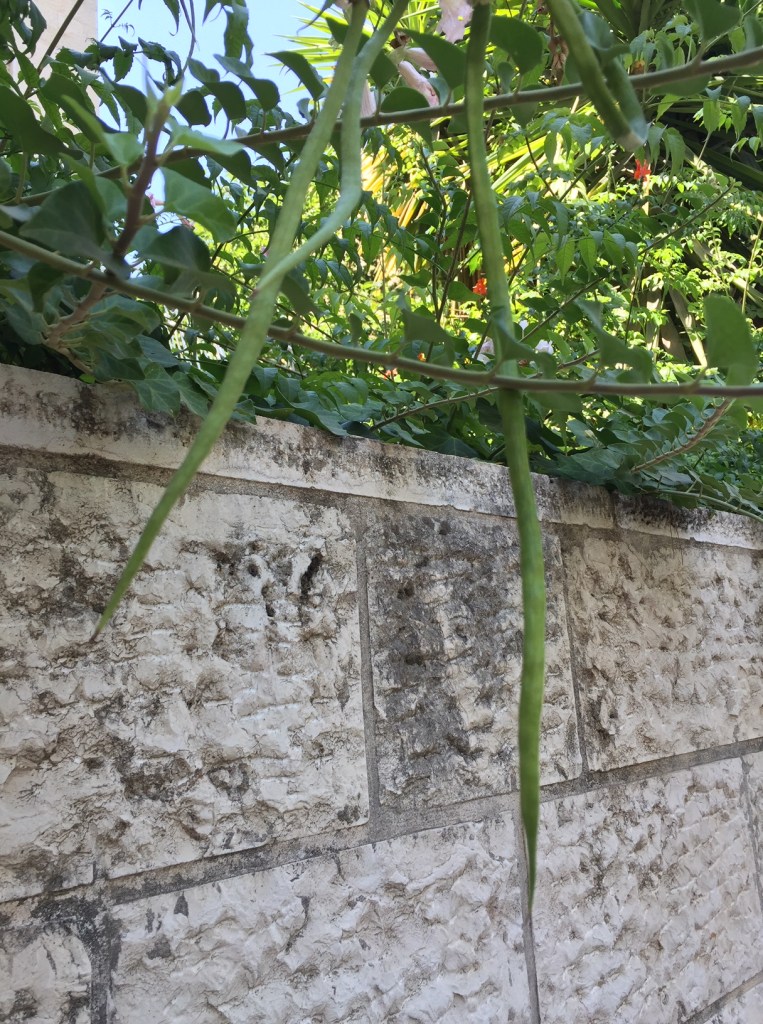
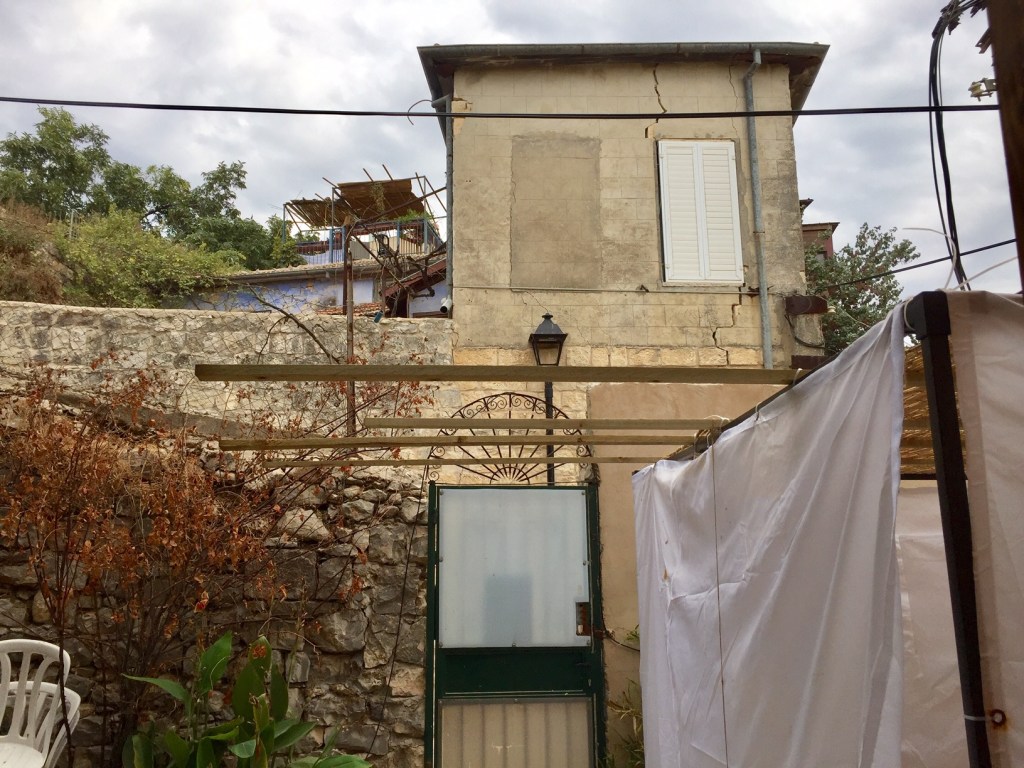
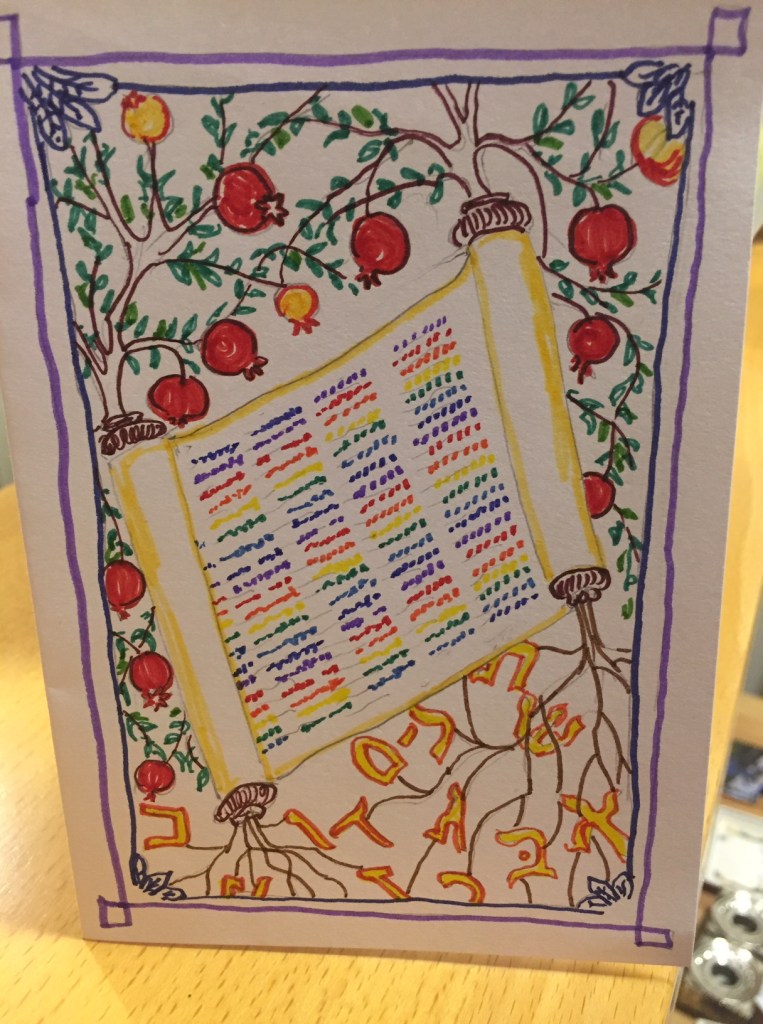
Today I’ve been thinking about different kinds of change and transformation. There are the changes that happen in the natural world: blossoms turning to seeds or fruits, plants dropping their leaves and sprouting new ones. In our human bodies, too, these time-related changes take place — we grow up, we grow older, we grow old. Year after year our holidays return, part of the cycle of the seasons and part of the spiral of time that is our lives.
…becomes this……and this. The seeds are even prettier than the flowers, no?
The Elul cycle of holidays — which takes us from welcoming the New Year to experiencing teshuva at Yom Kippur, then to the joy of dwelling in our sukkah, and at last to the ecstatic rejoicing of Simchat Torah — is intended to transform us. But we may, like one friend of mine, wonder if anything is really happening. She says, “I sit there in services and I think: am I changing? Is this changing me? When is the change going to happen? How is this going to change me? Hurry up, let me be changed!”
This……becomes this.
Sunday night in Israel we put out clocks back — we changed time, or rather, we changed our perception of time. In reality, everything is the same — the sun rises, the sun sets, ein chadash tachat hashemesh, there is nothing new under the sun, as Kohelet said. But because we rearranged our clocks, for us the sun rises “earlier” and the dark comes on “earlier”.
This…
On the morning of Simchat Torah I attended services at Nava Tehilah, the Renewal minyan. We danced and danced, sang and sang — all kinds of songs and dances, including a moment when we broke out into groups of four and did square dancing, singing “Or zarua, zarua letzaddik, ulyishrei lev, ulyishrei lev, ulyishrei lev simcha” — “Light is sown for the righteous and for the straight-hearted, joy” — to the tune of “Oh, Susanna”. Under the chuppah (marriage canopy), the Chatan Torah (Bridegroom of Torah) was honored with the reading of the last of Davarim (the end of the Torah). Then they unrolled the whole Torah around the room, and each of us, our hands protects by tallitot and silk scarves, held up the edge of the scroll, while designated readers performed a ritual a la Zalman Schachter-Shalomi, going to each of us and asking us to point out a random verse, which they then read and converted into a blessing for our year. Then the torah was rerolled, and the Kallat Torah (bride of Torah) was invited to come under the chuppah while the opening chapters of Genesis were read. “VaYar Elohim ki tov…And God saw that it was good…”
…becomes this.
Something shifted in me then. Or maybe because the fall weather is coming on, the cooler nights and days, the soft rain, the darkness falling early. Or perhaps just enough time has passed, and I feel more confident that I will make it through this year without disaster, that the daily necessities will be accomplished, that the tasks that seem overwhelming will be completed, that every mountain and hill will be made, if not low, then at least surmountable. I opened a bank account last week. I seem to have nearly conquered the fleas. A few days ago, two people stopped me for directions on the street, and I was actually able to tell them where to go in Hebrew — such a small thing, a few words and gestures, but it felt like such a huge accomplishment.
We change, and we are changed. And yet, we are still ourselves — perhaps more than we want to be! I am still an anxious person, a shy person, a controlling and bossy person. I am still a grieving person, a sad person, a mourning person. One of the most striking things I am experiencing here, too, is how much being in a foreign environment brings to the fore characteristics, tendencies, and preferences that I don’t notice much in my home environment. I like to tell people I am a “post-denominational” Jew, but here, especially at Pardes, I am an ardent Reform Jew. I chafe against the strictures of Orthodoxy. And yet, I am living a more religious life than I ever have, without thinking much about it — keeping kosher as a matter of course, keeping Shabbat for the most part, going to services every Friday or Saturday and davenning mincha (afternoon service) five days a week.
And who will I be when my time here ends? Mi yodea — who knows? I will be in some ways changed and in some ways the same as I always was. Will I have ripened, born fruit in some metaphorical way? It remains to be seen…
There’s so much I’ve promised to share with you: my Simchat Torah experiences, my trip to Tzfat and visit with the family, the totally fascinating twelve hour tiyyul to the periferia… And yet, today I just have to tell you about today, because it was a good one!
To begin with, it’s fall now for real, and the weather is delightful. It’s cool at night — under 60 degrees Fahrenheit — so I can leave my window open and not run the fan all night. The flea situation is coming increasingly under control, so I can sleep in peace, too! This morning when I left the apartment I was wearing long sleeves and a shawl. It was partly cloudy but there was some sun, there was a breeze but not too strong, it was cool but not cold — perfect!
It was our second day back at school after the long break. It felt good to be going to class. My first class was Gemara with Leah. We started a new section: Seder Nezikin (Damages), Tractate Bava Kama, Chapter 8. I don’t have a regular chevruta in Leah’s class — it’s been something of a sore subject, as the person who started out as my regular study partner ditched me — but today I sat in with two really nice people and we had an excellent study session. We were mostly reading p’sukim (verses) from the Torah, which is much easier than reading Talmud, although we did also start the Mishna that opens our chapter. Anyway, I felt my translation skills were better than usual, and I wasn’t holding anyone back. We were reading about what the Torah specifies as punishment or restitution for causing bodily harm. You know the passages, I’m sure — if you kill someone, mot yumat, you should be put to death, and then famous bits about “an eye for an eye, a tooth for a tooth” etc etc. Of course, the rabbis of the Talmud completely reworked all of this, so that what seems like the plain (not very pleasant) retributive justice of the Torah becomes a system of monetary compensation. It promises to be an interesting topic of study.
My next class was a bit of a bore — it always is, it’s in lecture format and teacher doesn’t ever being an historical perspective to the Bible, but talks about it as if it all could have — and probably did – really happen. But it wasn’t terrible –we had a couple of interesting discussions. Then it was time for our Thursday “Take 5”, where any member of the Pardes community can speak for five minutes on a topic of their choosing. It was the birthday of my young friend Mimi, who comes from Amherst, Mass.. She spoke a little about her birthday, and then about Lilith, who is a Jewish mythological figure with whom she feels a deep connection. (For more about Lilith, see here: https://www.myjewishlearning.com/article/lilith-lady-flying-in-darkness/ ) Mimi read us two really beautiful (and learned) poems about Lilith, which I will try to get and share soon. Then we davenned Mincha, and then we had a tasty Thursday community lunch.
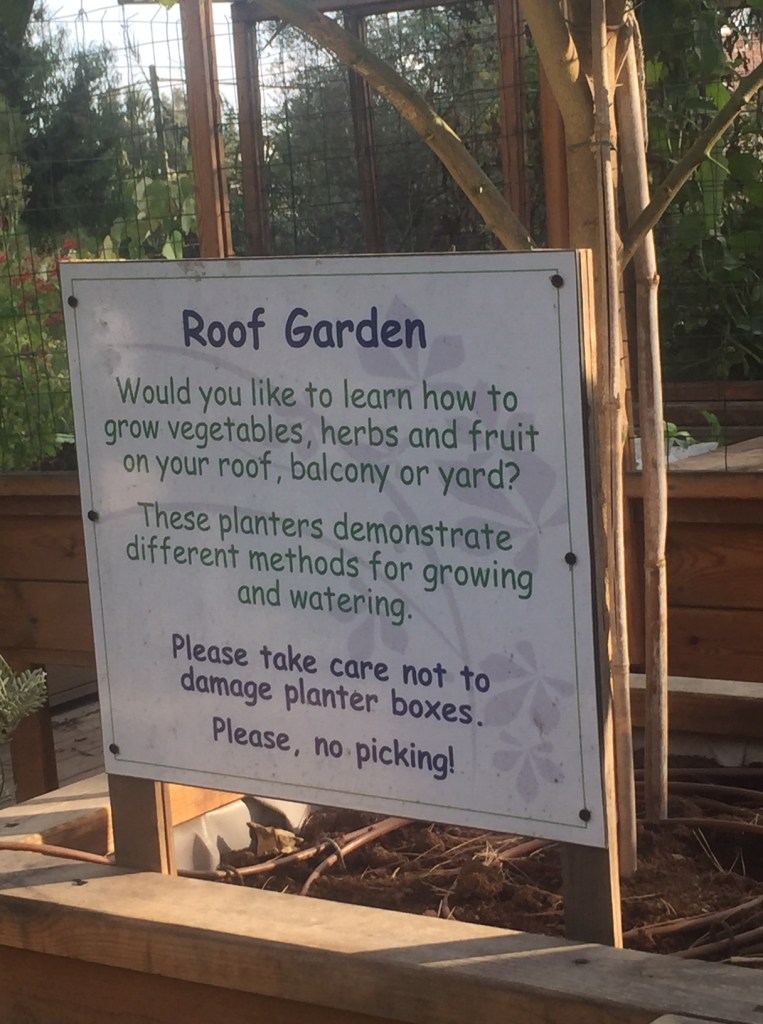
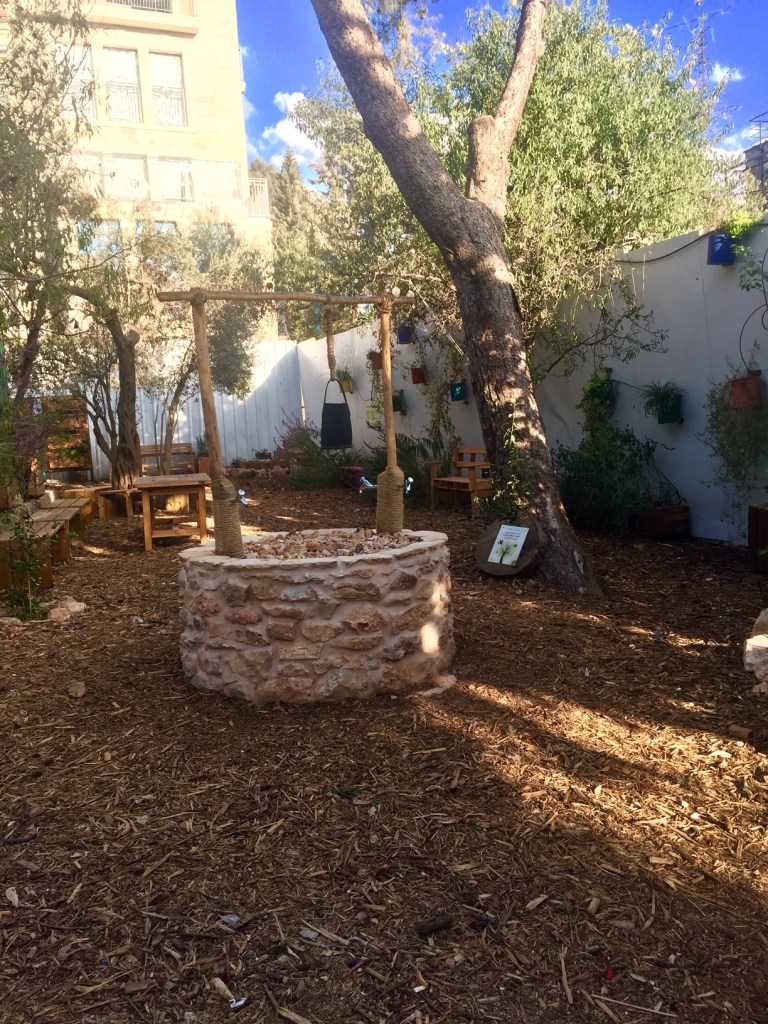
At the community Garden, there are a few signs are in English…Community Garden
The community heard that there might be plans to build on the land around the museum, and so people gathered together and began making a beautiful garden, in hopes that this would prevent development. It seems so far to have been successful. The garden is large, well designed, and a lovely place to visit, and the city seems to be more or less in support of it. The Museum doesn’t pay any attention to the garden nor does it offer any programs with it (because this is Israel), but in fact, the garden draws many more visitors to the museum than would otherwise come to see an outdated exhibit.
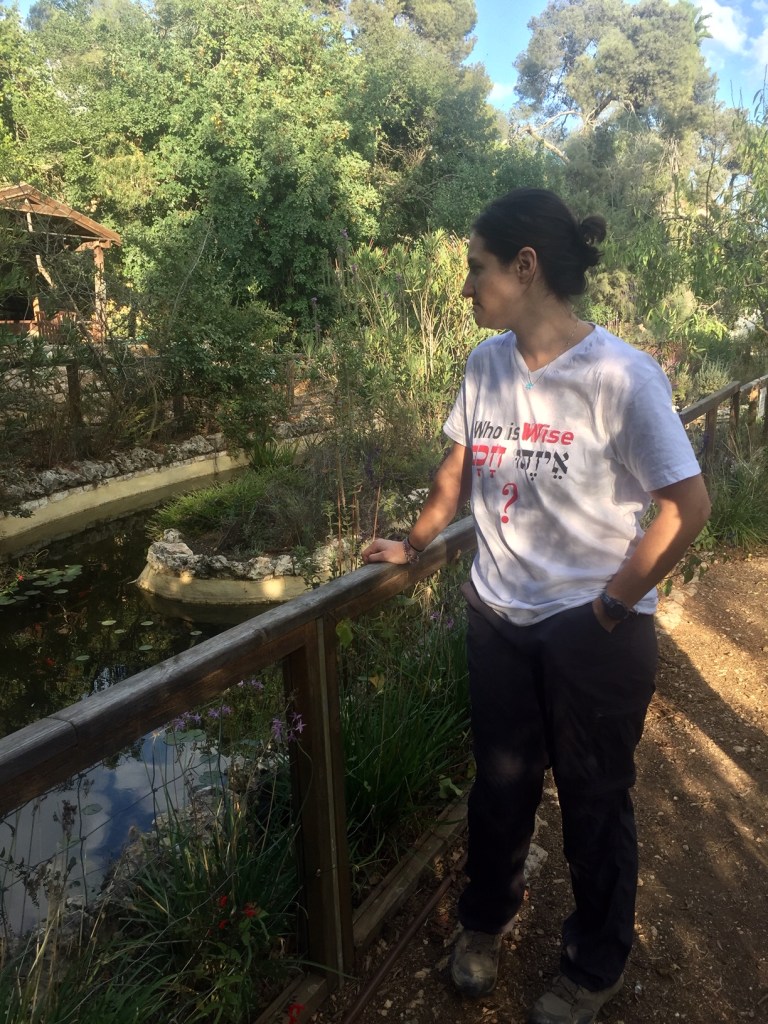
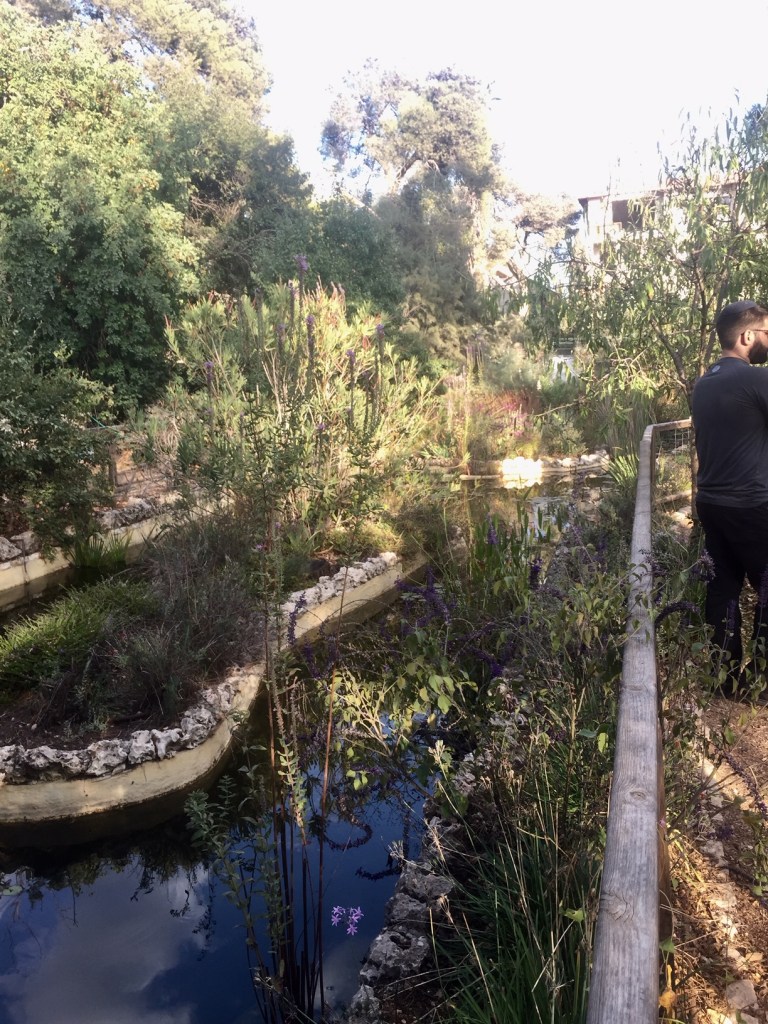
My friend Sara beside the beautiful water feature in the Community Garden. It was restored from the original that belonged to the house, which had been untouched for seventy years. The shirt says “Who is Wise? Eizhehu chacham?” On the back is the answer: the one who learns from every person!
We were given a tour by my landlady, Jill, who happens to be one of the coordinators of the garden. Then we four Pardes volunteers, along with the rest of the people who volunteer at the garden, were put to work loosening the hard dry soil and planting the tiny corms of species freesias. It was a lovely afternoon, the gardens are beautiful, and the people who work there are friendly. And what bliss it was to do a little work in the dirt!
Water feature
Then I walked through the German Colony to the bus, and traveled back to near Pardes for my first ulpan — Hebrew language class. To my surprise, there were two other Pardes students in the class, as well as two other people. The teacher is a young woman of 28 who is studying to be an audiologist and speech therapist. The lessons have a formula based on the Pimsleur method of teaching language. At first I was skeptical, but as the class went on, I saw that indeed I was learning Hebrew in a kind of organic way. There is a grammar element, but it is mostly about speaking. It was really a fun class.
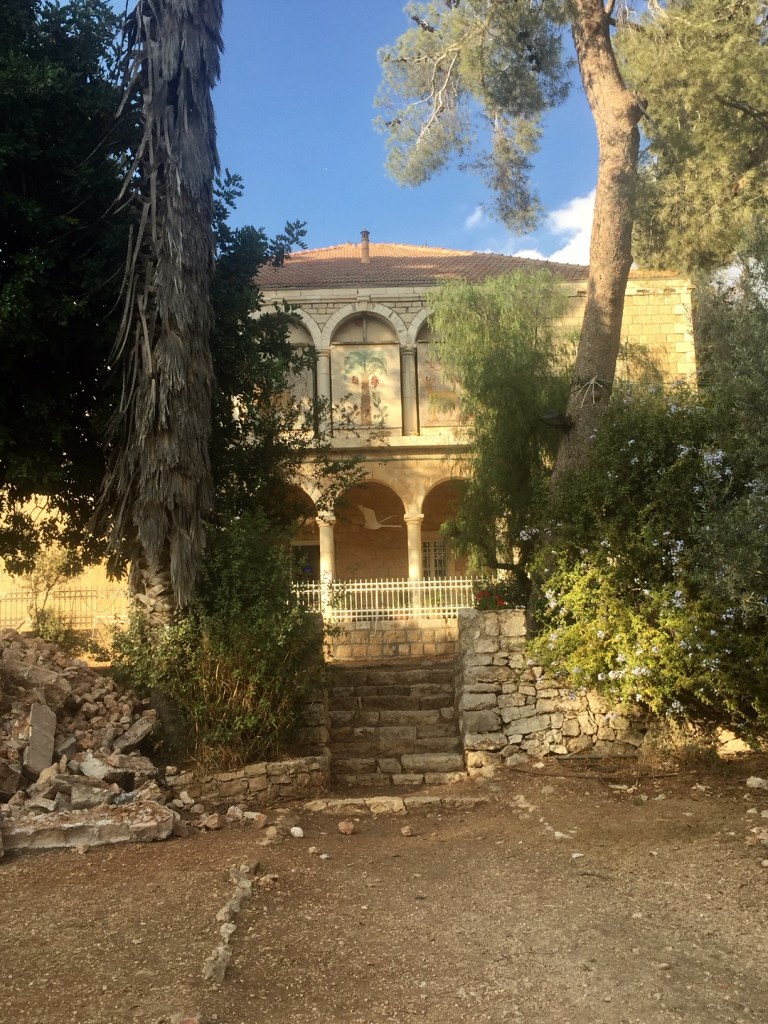
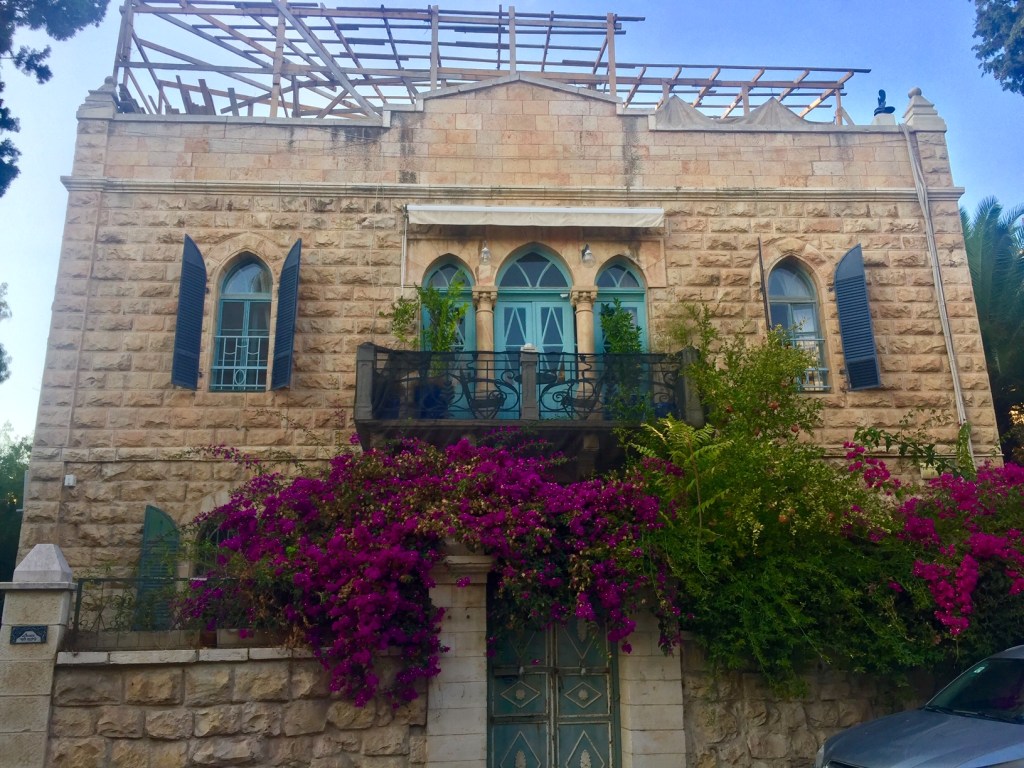
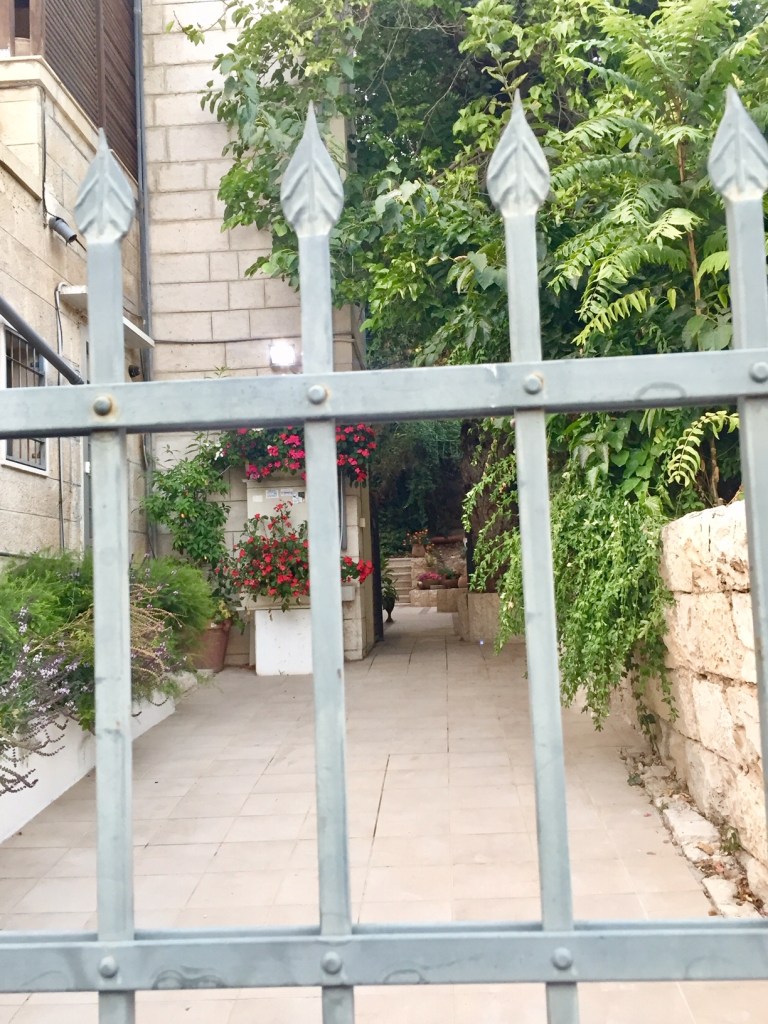
Beautiful villa in the German Colony
I left feeling energized about my Hebrew learning again. On my way home I got to thinking about a new word I had hear in class — ofanayyim. An ofanayyim is a bicycle. But it’s in the plural — like the word for sky or heaven, shamayyim. So what is an ofen? I remembered that I had learned on Duolingo the term b’ofen clalli, meaning “usually”. Ofen is a way — you could say b’ofen clalli translates literally to “in a usual way”. So a bicycle is literally a “ways”.
Thanks for sharing this wonderful day with me! I’ll get on with the other topics soon!
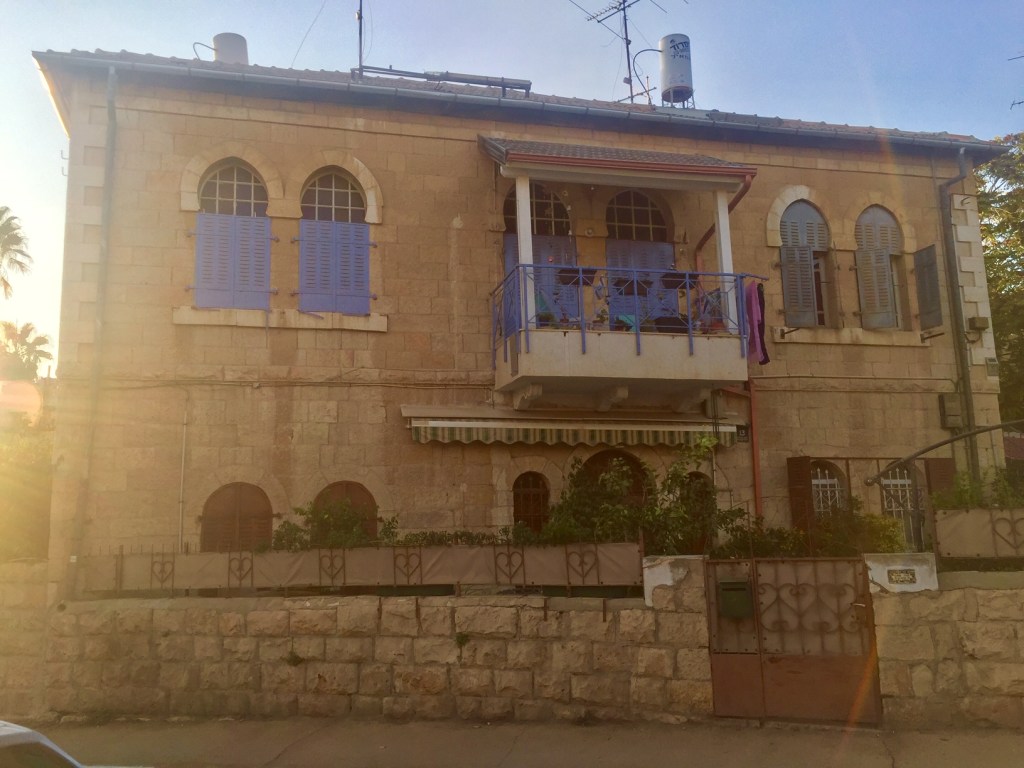
At 5 pm, the sun sinking behind another German Colony villa
A lot has been happening. I want to tell you about my Simchat Torah experience (partly a let-down, partly a big uplift). I want to share my pictures from Tzfat and elsewhere. Most of all, I want to tell you about an amazing tiyyul I went on yesterday, where we spent the day visiting some locations in the periferia — the periphery, the parts of Israel that get (or have gotten in the past) less attention and support from the government. At at a mundane level, I’d love to tell you about my experience with an Israeli bank…
But tonight I’m tired after my first day back at school, plus going up to the center and opening a bank account…so I’m just going to share a few impressions, along with a few photos.
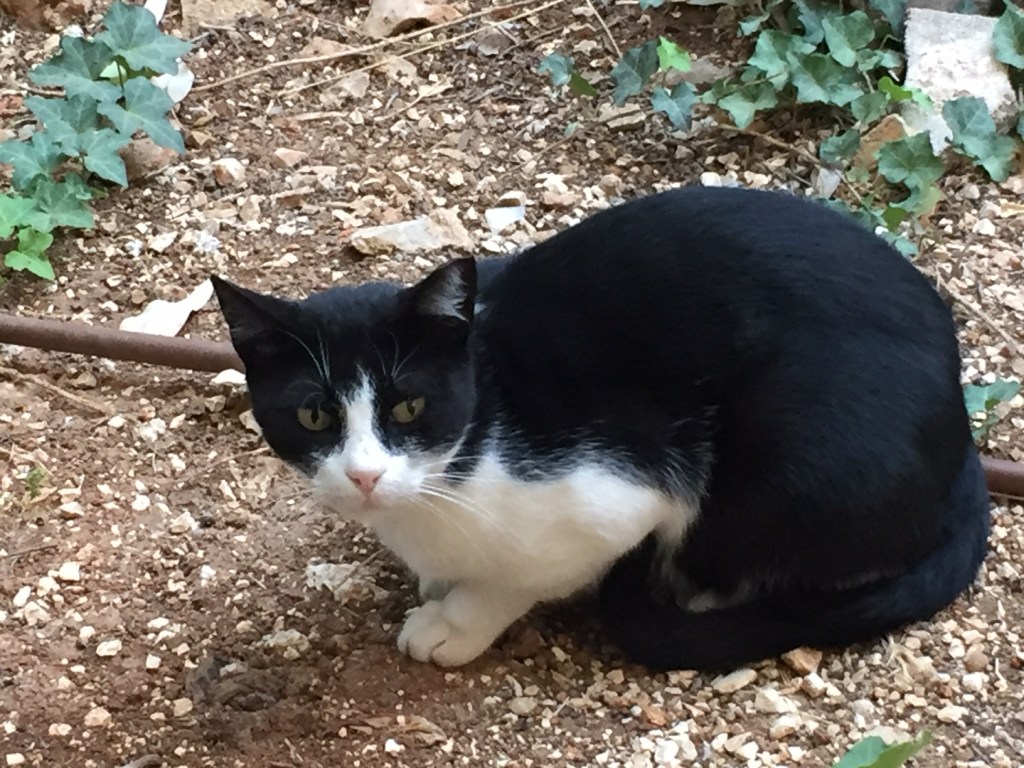
So — what kinds of things do you see when you are out walking around Jerusalem day and night? Cats, of course — we’ve spoken of them. I got a terrible scare when I was passing one of the big green dumpsters (known as tzfardea, frogs, I read) the other night and something leaped out. The poor cat was also terrified…
This cat sits in the garden outside my window and eyes me. Did she bring me the fleas? I think she has been spayed — she has a clipped ear. She may even be someone’s pet.
At the mall, which is a great people-spotting location, you can also see Greek Orthodox priests in long black polyester robes (hot!), and young Israelis both Arab and Jewish in stylishly abbreviated forms of dress. Also, Islamic women with headscarves and long dresses. And, of course, everywhere, also people who wouldn’t look strange in Brattleboro on a summer day.
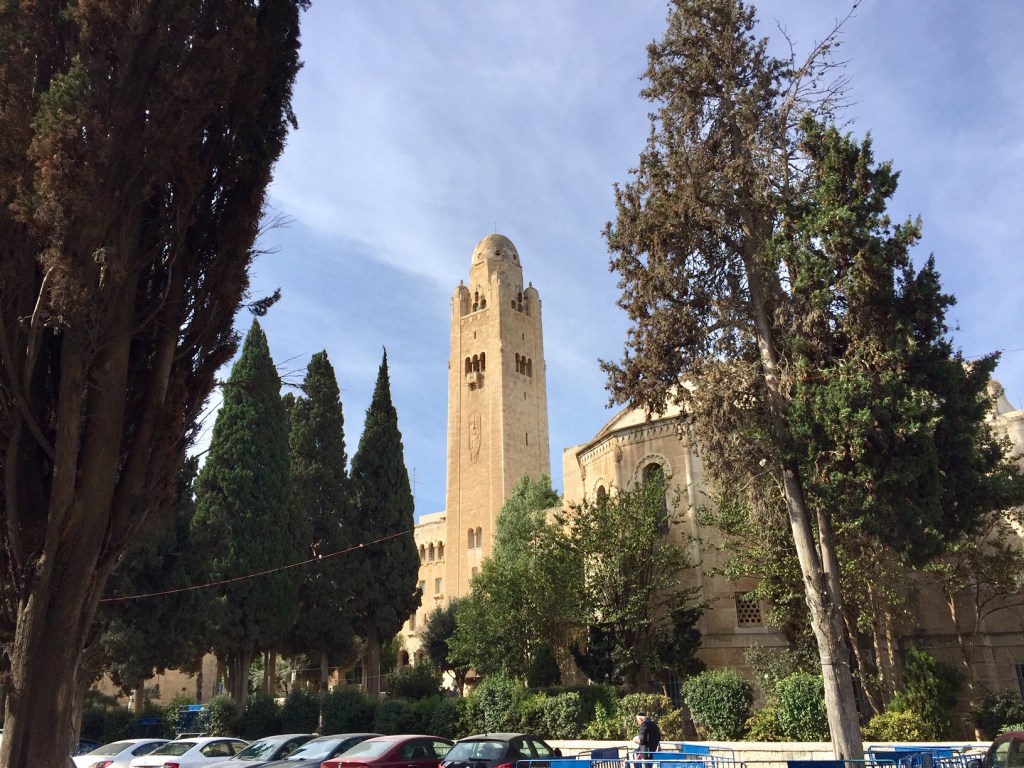
This imposing “oriental” structure is … wait for it… the YMCA.
You also see interesting architecture from various periods – -and a lot of very boring architecture as well. Lots of apartment buildings made of stone, blocky and unprepossessing, usually with balconies and often roof gardens. Sometimes, beautiful old villas with arched windows and lovely gardens. Further out, a jumble of modern buildings which are covered with signs and lit up at night — typical city.
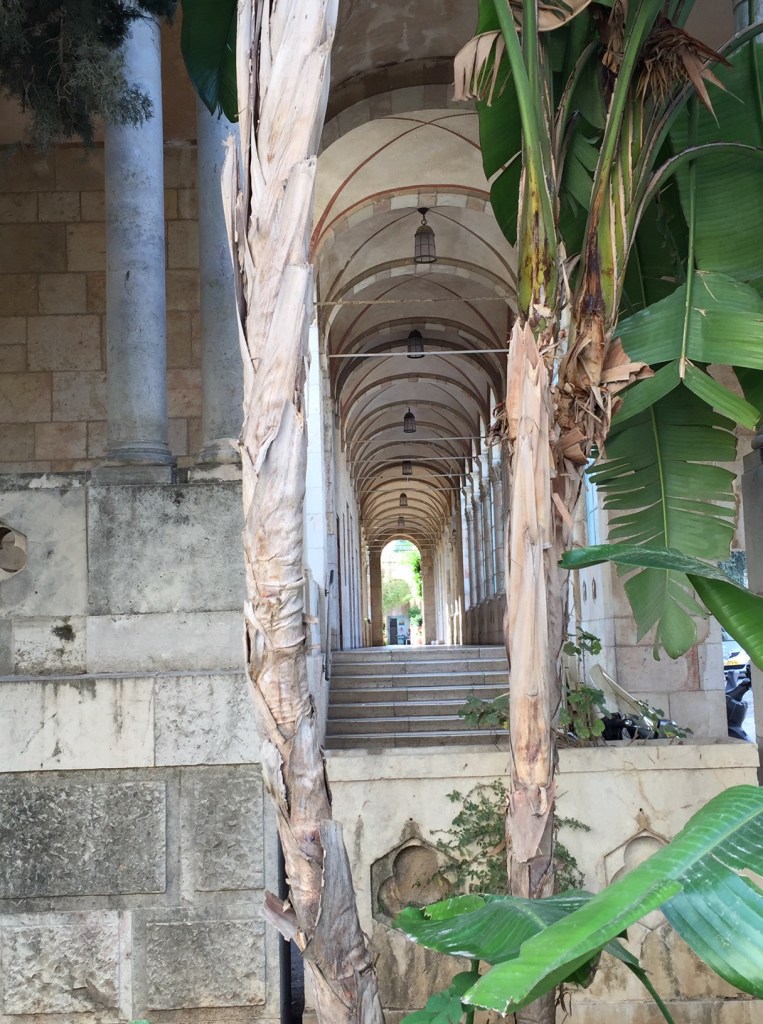
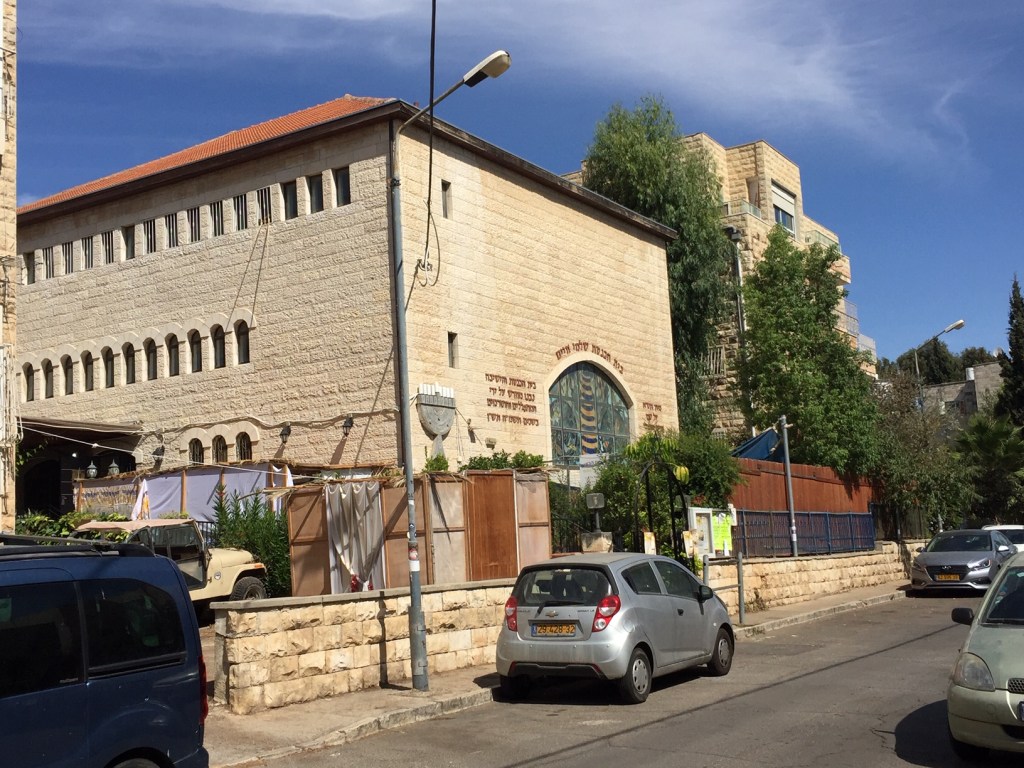
Inviting colonnade at the Y (banana tree, foreground). My building — very typical — in the background. Foreground, the big Sephardi synagogue and preschool. At night the windows are often lit up from within — they are painted art glass, jewel toned, like Chagall windows.
And what do you hear? Well, from this synagogue above, and from all the hundreds of shuls across town, you hear enthusiastic male singing. You also hear this singing from yeshivot, and from private homes, especially on Shabbat. It’s usually in unison, and it’s almost always guys. Sometimes there’s some Mizrachi (Middle Eastern) chazzanut — vocal ornamentation, or some harmonizing. Often, it’s just a bunch of enthusiastic guys bellowing the top of their lungs. If I had to think of an analogy, I’d say it’s like an Israeli version of Shape Note singing.
You can hear birds — bulbuls warbling rather like robins, and parakeets screeching, and crows cawing and imitating other birds. You can hear plenty of cars, trucks, buses, motorcycles. Once in a while you hear an ambulance siren — not often, Thank God. Nowadays, as the fall comes on, you hear thunder from time to time. You also, at least in my neighborhood, hear kids yelling and sometimes crying, people talking on their cell phones, and conversations in many languages. In the early hours you hear the garbage trucks. From time to time you hear the “pop, pop” of fireworks — some people, especially in Arab neighborhoods, like to celebrate festive occasions with firecrackers. From passing cars on larger streets you occasionally hear music, especially Arab or Arab-influenced pop music. Oh yes — and at the beginning of Shabbat and holidays, you hear the city siren announcing that it is candle lighting time. And yet, you also often hear a beautiful silence, especially at night or on Shabbat.
And the smells? I have to say, I’ve never felt so assaulted by scents as I do here. The air is more humid than you might think, and the hot weather has lingered (although today was blissfully cool, breezy, and almost scentless). You smell the rotting garbage in the dumpsters, which seem to fill up rapidly even though they are emptied often. You smell cat poop and dog pee. At night, you smell also jasmine and plumeria, heavily sweet. You smell exhaust fumes, and your neighbor’s barbecue, and the brisket that someone is serving in their sukkah. Now that rain is beginning to come, you smell wet stone.
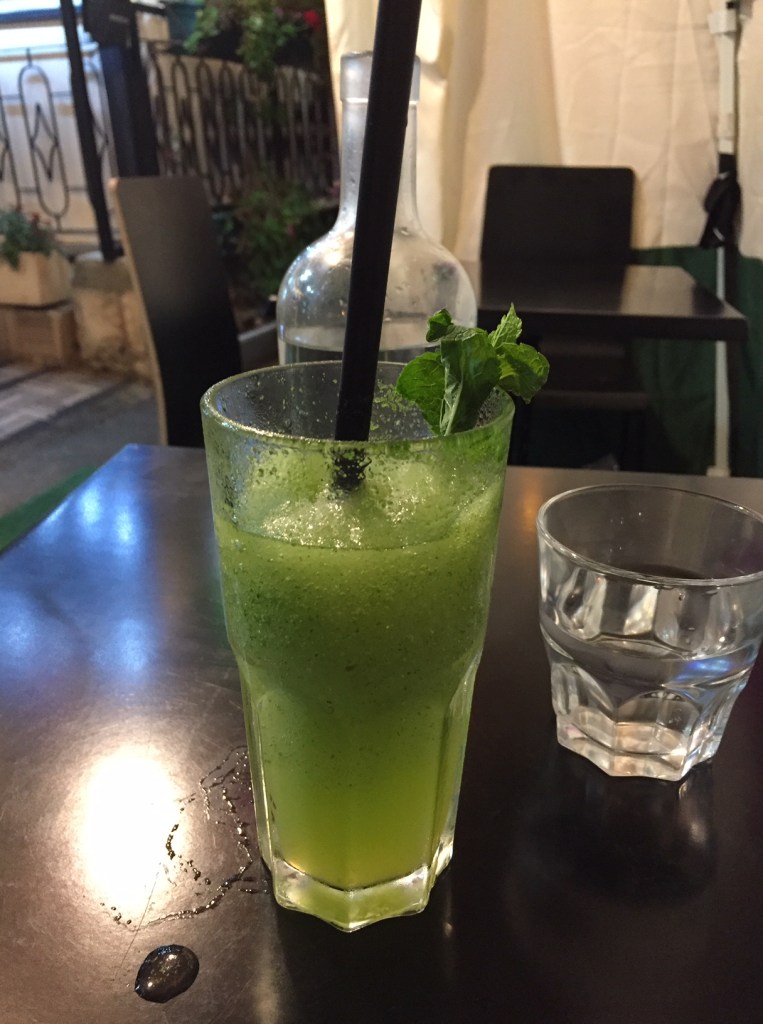
You can order a limonana — lemonade and mint blended with ice (limon, lemon, and nana, mint) — and smell mint and lemons.
There is always something to see, to hear, to smell – -and to think about. I promise to tell you about more weighty and significant things, in some of my next posts. And also, to share views of Sukkot, of Tzfat, and more. Stay tuned.
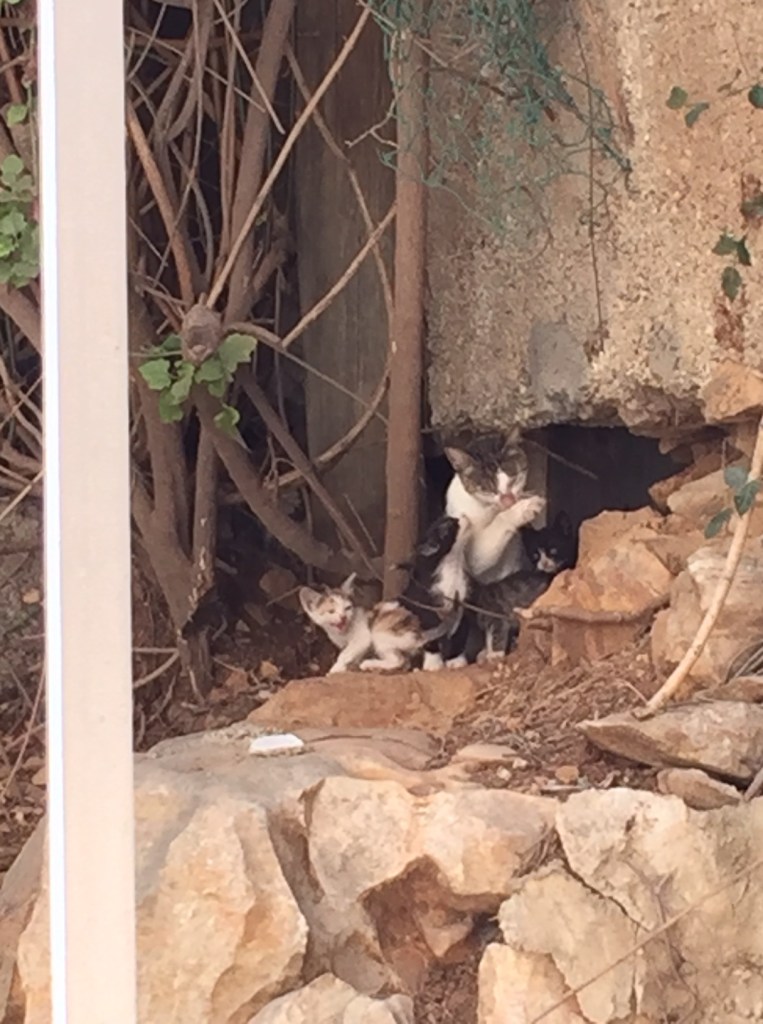
This cat had four or five kittens under a bush near my front steps — they’ve grown up now and moved away, but they left me a small gift, as you can read below…
Well, no hashanot for me — or, as the English has it, no hosannas. I set my alarm for 6:30 this morning, but somehow it didn’t go off, and I slept until 7:20. After even the most cursory shower and breakfast it was too late to walk to Hoshana Rabba services as I had intended. And there went my opportunity to attend this service, which I have never either led or attended.
So, what did I miss? A short explanation of Hoshana Rabba from Wikipedia: “Hoshana Rabbah (Aramaic: הוֹשַׁעְנָא רַבָּא, lit. ‘Great Hoshana/Supplication’) is the seventh day of the Jewish holiday of Sukkot, the 21st day of the month of Tishrei. This day is marked by a special synagogue service, the Hoshana Rabbah, in which seven circuits are made by the worshippers with their lulav (palm, willow, and myrtle branches) and etrog (citron — looks like a lumpy lemon), while the congregation recites Hoshanot (songs of praise). It is customary for the scrolls of the Torah to be removed from the ark during this procession. In a few communities a shofar is sounded after each circuit. “
My colleague and friend Cantor Hinda Labovitz offers this “look behind the scenes” at all that the cantor has to accomplish in this service. She writes,” I like to call this service the ‘Olympic Ice Skating Finals of Jewish liturgy’… Basically it’s a mash-up of 98% of Jewish chant modes you hear from throughout the year. […] it’s got elements of weekdays, Shabbat, Shalosh Regalim (Pesach, Shavu’ot, and Sukkot), and High Holy Days .” Cantor Labovitz davens from “a color-coded siddur that visually cues all of these transitions, some of which are quick. […] this ‘wacky’ service includes prayers for rain and deliverance, seven lulav-parades around the chapel, and (literally) whacking the willows.”
So, am I bummed I missed it? Kinda. This was my one chance in the foreseeable future to go to Hoshanna Rabba in Jerusalem. Reform Jews don’t do Hoshanna Rabba, so I won’t be leading it any time in the next few years, probably, either. However, looking on the brighter side… During sukkot I have eaten in someone’s sukkah every day so far: for the first few days in the two sukkot at Laurie Rappeport’s in Tzfat, on Thursday in the sidewalk sukkah at Pesto, a little Italian restaurant up the street from me, Friday with my friend Yehudit for Shabbat in a sukkah in their small parking lot, and yesterday on the mirpeset of my friend Tamy for Shabbat lunch with some lovely people. Tonight I will go to services for the beginning of Simchat Torah, the last day of the month of holidays we’ve been celebrating, and tomorrow I hope to attend morning services, an afternoon potluck, and then an evening egalitarian celebration with musical hakafot (parades with Torah scrolls). So perhaps it’s not too bad to take today off.
Off, of course, doesn’t exactly mean relaxing…which brings me to the other reason that I am not singing hosannas today. I’m engaged in a frenzy of cleaning, which began, most inappropriately, Friday night at 11 pm when I got home from a one hour walk home after Shabbat dinner with Yehudit. What could possibly compel me to start mopping late at night on Shabbos — I who not only hate cleaning but scrupulously observe the Shabbat prohibition against it? Let me rewind…
A day or two after I got home from my nice visit in Tzfat with the family (yes, I’ll post some pictures soon!), I found that I was covered with bug bites. Now, I’ve had a bit of a problem with mosquitos here — there seems to be some wet, vegetative place nearby where they breed. These were too abundant to be mosquito bites, though. I spent a horrible several hours reading online about bed bugs. Then I started looking for evidence. May I just say, I have much to be grateful for, and right now, I am more than anything grateful not to have bedbugs!!!! However…the bedbug has a common cousin, another little flat blood sucker — the flea. Yes, thanks top the plague of “Trash cats” who hang around my stoop in search of the food that the former tenant used to provide, I am now afflicted with fleas. And when I came home late Friday night I was wearing a short enough skirt to see that they were crawling up my legs. Hence, late night mopping on Shabbat. I can’t wait to ask my Talmud teachers if the principle of pikuach nefesh (saving a life) would allow for this. Flea do carry diseases sometimes, and so it seems as thought one might be allowed to break the mitzvah of Shabbat rest in order to get rid of them — but I didn’t wait to find out. I am a Reform Jew, and fleas totally gross me out!
The locus of the fleas, it now appears, is actually outside. I have for the most part managed to eradicate them from my apartment — at least, for the time being. I’ve been mopping, vacuuming, and doing laundry like a fiend. Today I had repeatedly dumped hot soapy water over the area in front of my door, and I have removed the door mat in which I believe the flea eggs were hiding. But I imagine in may be some days or even weeks before I am totally free of this little creeps. I’m going up to the store soon to buy some baking soda to spread on the carpet and the sofa, and if I can find it, some not-too-toxic-to-people spray or powder to spread outside.
In the meantime, I wish you all a happy Simchat Torah. I”m sitting on my mirpeset, the sky is blue, the air is cool the shrubs near me have burst into yellow flowers, I have Brahms Clarinet Quintet on Spotify — so, if I am not singing hoshanot, I am at least content!
We learned in the mishna: This is the principle with regard to the roofing of a sukka: One may not roof the sukka with anything that is susceptible to ritual impurity or whose growth is not from the ground. The Gemara asks: From where are these matters with regard to the roofing of a sukka derived? Reish Lakish said that the verse states: “And there went up a mist from the earth, and watered the entire face of the ground” (Genesis 2:6); just as mist, i.e., a cloud, is a substance not capable of contracting ritual impurity, and its growth is from the ground, i.e., arises from the ground, so too, the roofing of the sukka must consist of a substance that is not susceptible to ritual impurity and its growth is from the ground. Since the mitzva of sukka evokes the clouds of glory with which God enveloped the Israelites in the desert, the legal status of roofing should be like that of a cloud. The Gemara asks: This works out well according to the one who said that the sukkot mentioned in the verse: “I made the children of Israel to reside in sukkot” (Leviticus 23:43), were clouds of glory, as it is reasonable that the roofing of the sukka is modeled after clouds. However, according to the one who said that the children of Israel established for themselves actual sukkot in the desert, and the sukkot of today commemorate those, what can be said? According to that opinion, there is no connection between a sukka and a cloud. As it is taught in a baraita that the verse states: “I made the children of Israel to reside in sukkot”; these booths were clouds of glory, this is the statement of Rabbi Eliezer. Rabbi Akiva says: They established for themselves actual sukkot. This works out well according to Rabbi Eliezer; however, according to Rabbi Akiva what can be said?
Talmud, Sukkot 14 and 15
In one of the two sukkot at Myrtle the Turtle Guest House in Tzfat, where I am staying with family
In the midst of the lengthy discussions about how to construct our sukkot (booths, huts)– measurements, materials, locations — as well as how to prepare and shake our four species (etrog — citron, hadas — myrtle, arava — willow, lulav — palm) — this intriguing paragraph appears. Remember, anything that is not in bold type is not in the original, so you can see it is quite open to interpretation. And as far as I can see, the question raised at the end — “According to Rabbi Akiva, what can be said?”– is not adequately answered.
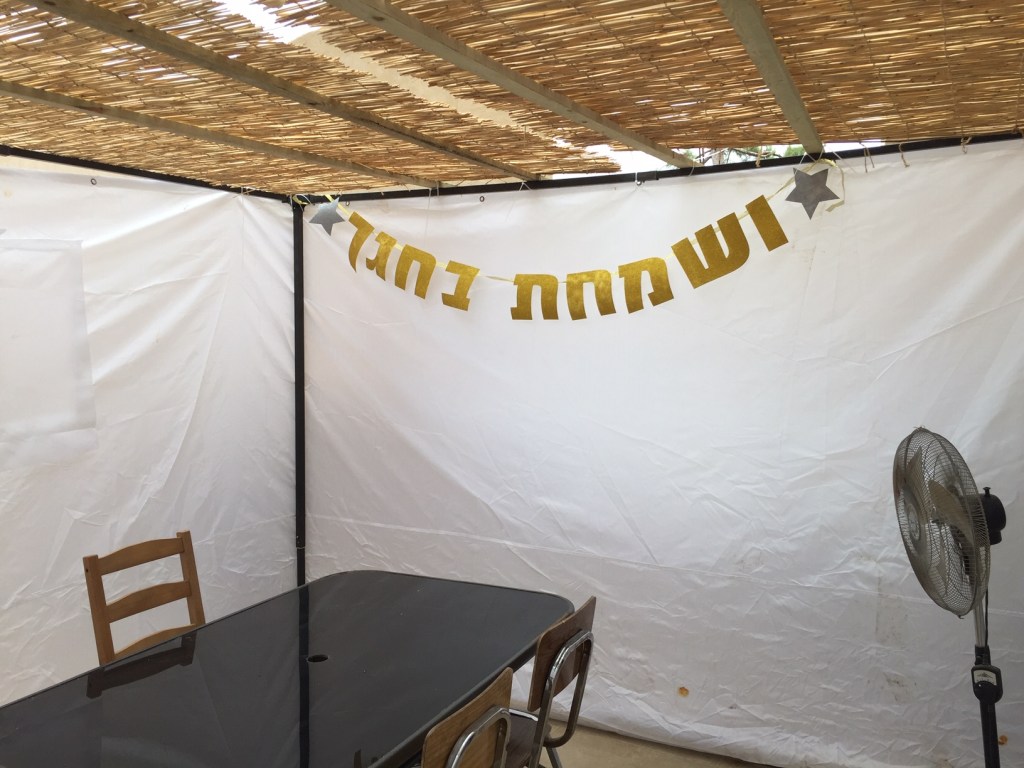
The other sukkah — the Hebrew reads, “And rejoice on your festivals.”
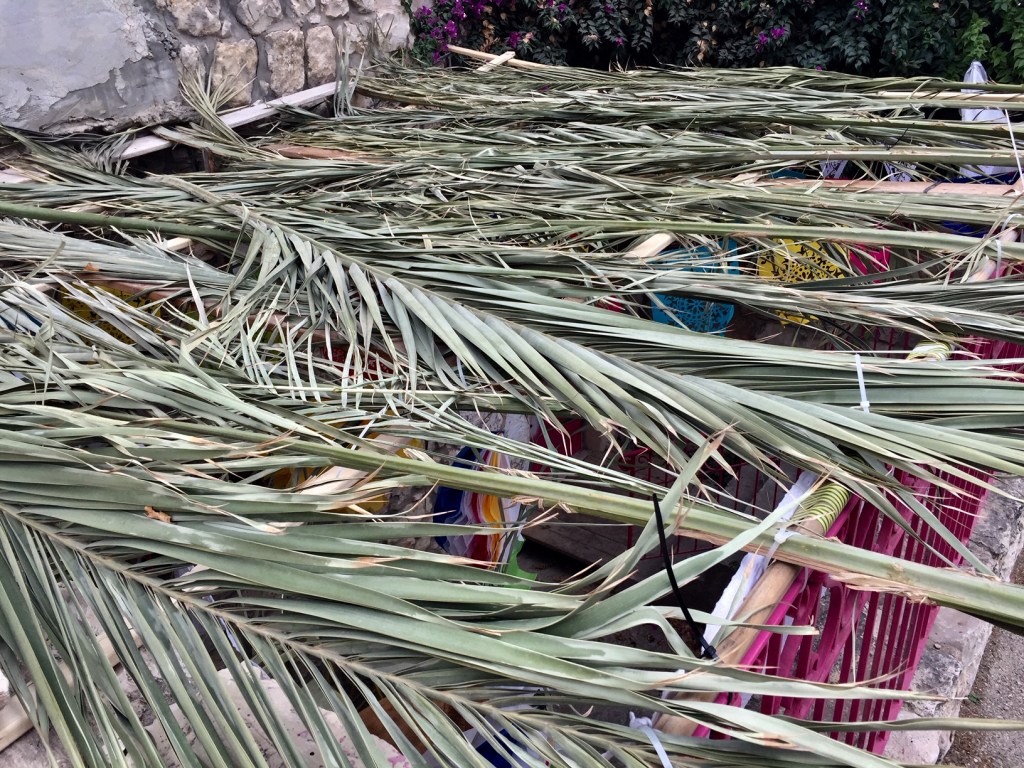
Here I sit on Chol HaMoed Sukkot — one of the intermediate days of Sukkot — not in the sukkah because there is a ferocious wind/ rain storm outside. Schach — the plant material that roofs a sukkah — is not impervious to rain; indeed, it would not be kosher if it were. The whole point of sukkot is that they are fragile. Rabbi Lord Jonathan Sacks, one of the great modern exponents of observant Judaism, writes, “Sukkot is the festival of insecurity.” He prefaces this by observing, “Sukkot, [is] a metaphor for the Jewish condition not only during the forty years in the desert but also the almost 2,000 years spent in exile and dispersion. For centuries Jews lived, not knowing whether the place in which they lived would prove to be a mere temporary dwelling.”
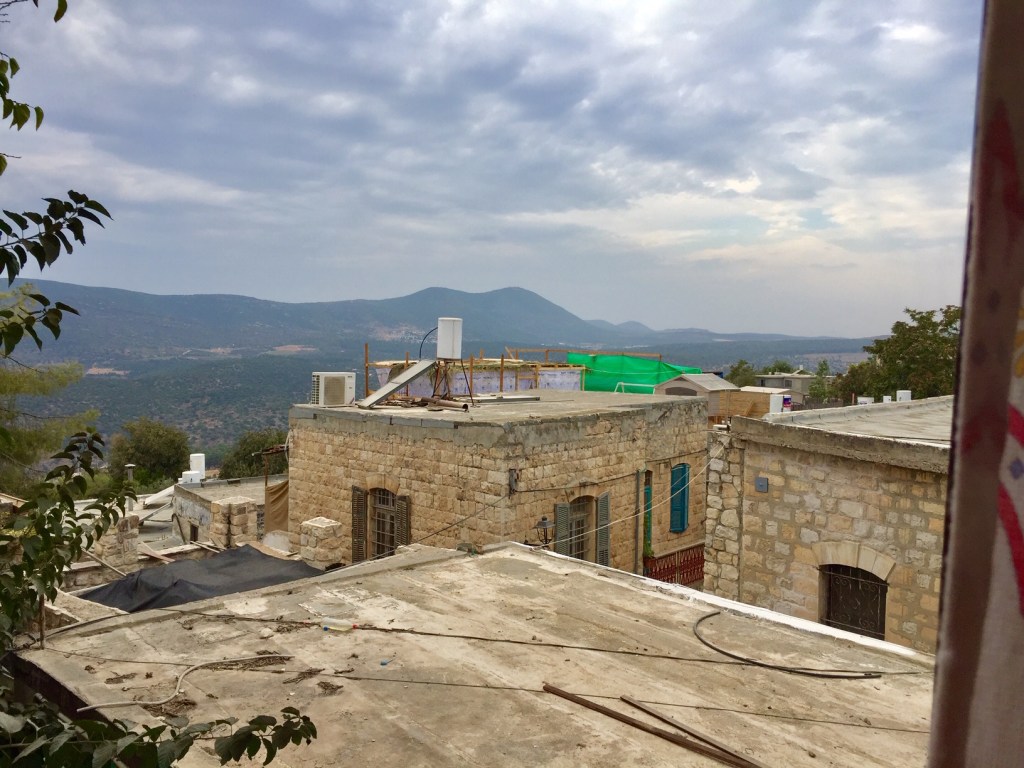
Rain clouds gather over Mount Meron and the Artists Colony — view from the guest house. Note sukkah next to solar water heater on the central roof.
But if we were protected, not but sukkot mamash, actual sukkahs, but rather by ananei kavod, clouds of glory — would rain still fall in our soup? Or indeed, are the clouds of glory not so metaphorical either, but the long waited for rain clouds than begin at this time of year? On the “Secret Jerusalem” Facebook page someone posted, after a recent storm in that city, “All right? Who said T’filat Geshem?!” As she then explained , this is the prayer for rain — geshem — that we say/sing annually on Sh’mini Atzeret, the eighth day of Sukkot — so it’s not time to say it yet! And yet — here is the blessed, blissful rain, bringing up the sweet smell of damp stone and settled dust.
One sukkah in the foreground, the other on the roof upper left.
Rabbi Sacks writes, “What is truly remarkable is that [Sukkot] is called, by tradition, zeman simchatenu, ‘our time of joy.’ That to me is the wonder at the heart of the Jewish experience: that Jews throughout the ages were able to experience risk and uncertainty at every level of their existence and yet – while they sat betzila de-mehemnuta, “under the shadow of faith” (Zohar, Emor, 103a) – they were able to rejoice. That is spiritual courage of a high order. I have often argued that faith is not certainty: faith is the courage to live with uncertainty. That is what Sukkot represents if what we celebrate is sukkot mammash, not the clouds of glory but the vulnerability of actual huts, open to the wind, the rain and the cold.”
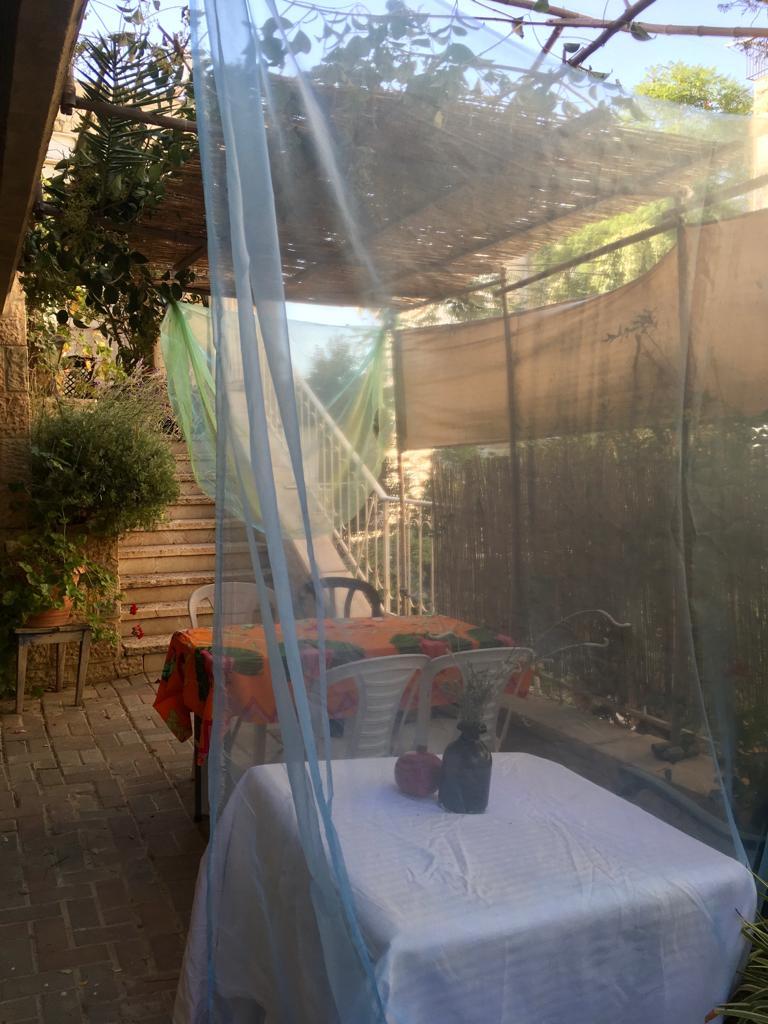
The sukkah of a friend in Jerusalem
Today I read of another English rabbi, Jeffrey Newman, who was arrested while protesting with Extinction Rebellion in London. He was leading everyone in Sukkot prayer, holding his lulav and etrog. This beautiful and necessary rain storm outside my hostess’s windows is possibly also a bit aberrant, earlier and heavier than usual, quite probably influenced by global climate change. We all need Rabbi Sack’s “spiritual courage” now — “the courage to live with uncertainty”. Daily in our prayers we ask God to protect us from the destruction we ourselves have wrought: ufros aleinu sukkat sh’lomecha, spread over us the sukkah of your peace. I recently read a poetic description of the sky as kippat shamayim, the kippah, or scull cap, of the skies. But for me when I look up, whether into clouds or blue, I see sukkat shamayim — the fragile hut of the heavens.
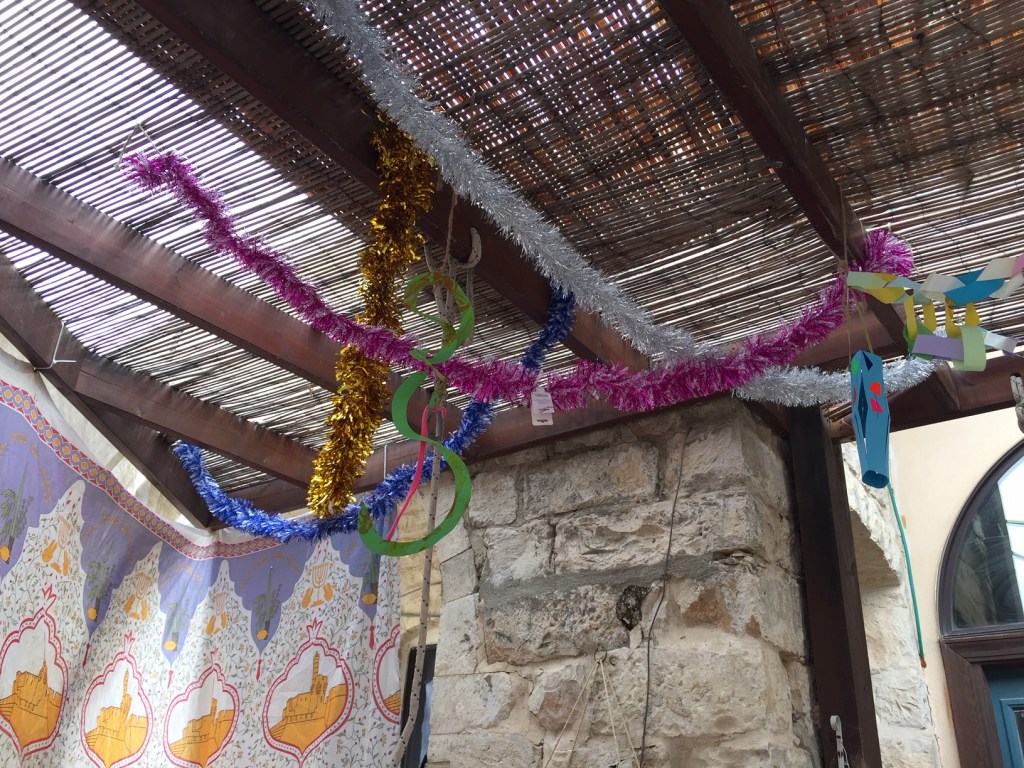
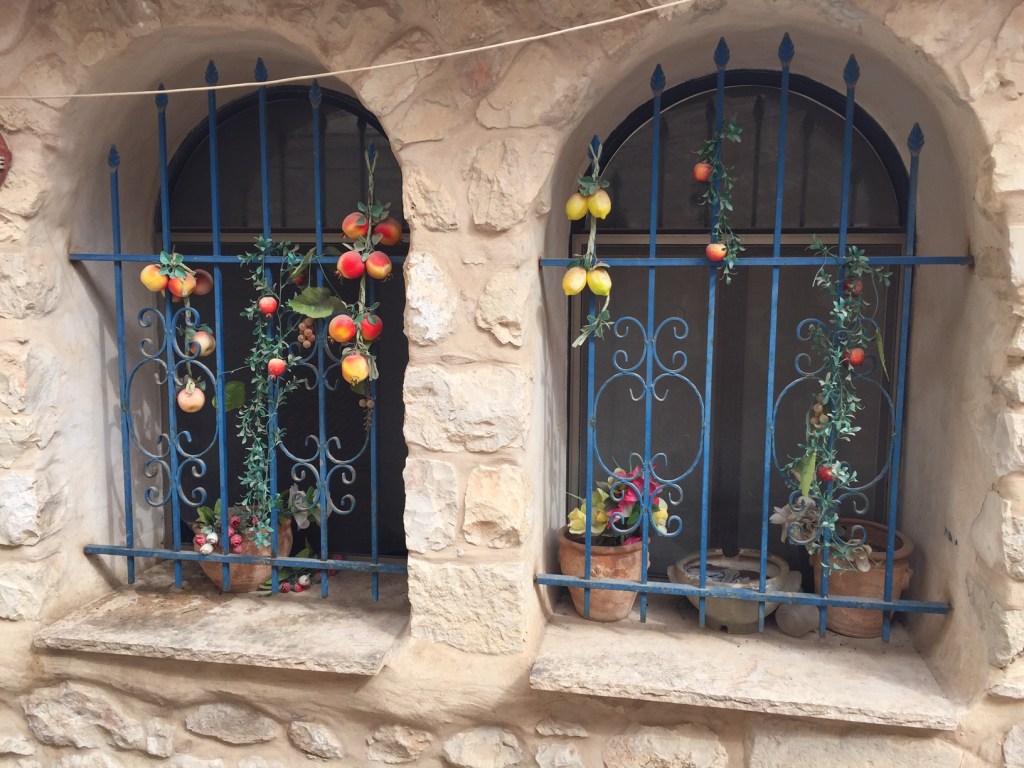
Sukkot decorations in Tzfat
Outside the thunder rumbles. On the beach in Ashkelon three hours ago, five people were injured by lightning, three of them severely (may they be completely healed!). Still, the plants turn their faces up to the rain, welcoming every drop. Moment by moment, we rejoice in all the abundant gifts we have to rejoice in, and then, we must join Rabbi Newman in the streets.
Before Yom Kippur, we received a message from Pardes explaining the holiday. (They are very conscientious about educating us, and they make no assumptions about our level of knowledge — which is fair enough, since we run the gamut from Hebrew speakers with considerable Gemara experience, many of whom have made aliyah and lived here for some years, all the way over to the young man who asked me the other day, “What’s a simcha?” [Simcha, for my readers who do not know, is any joyous Jewish celebration — from the word sameach, meaning happy] ) . After giving us the times for beginning and the end of the fast, they shared the following “fun fact”: Israel is the only modern country where the entire country including the airport fully shuts down one day per year. I would say tthe one thing that struck me the most on Yom Kippur was this blissful silence — the cessation of all labor. No planes going over, no vehicles except for the occasional ambulance (apparently, people take their fasting more seriously than they should, and so visits to the hospital increase markedly on Yom Kippur). Oh, and some people — mostly small children — on scooters, bikes, and roller skates. In Israel, Yom Kippur is also known as chag ha’ofanayim (the bike holiday) because, with the streets utterly empty of motorized traffic, non-religious people have a lovely time riding their people-powered vehicles.
I went to the Great Synagogue for Kol Nidre. It’s a huge building, modern, very imposing but not at all beautiful, in a style that one visitor refered to as “Soviet architecture” (you can see more here: http://www.jerusalemgreatsynagogue.com/ ) I sat at the very back of the steeply raked ladies balcony. There wasn’t an empty seat in the house, and indeed, many were standing. I think this was what I liked most about the service — the feeling of so many Jews gathered in anticipation of the holiest moment of the year. The singing of the Chazzan, Tzvi Weiss, was on the showy side, but lacking, in my opinion, both real beauty and real feeling. His one high point was Sh’ma koleinu — Hear our voice — which did seem to express genuine emotion. The choir was also disappointing — the arrangements seemed very dated, and the singers weren’t as well in tune as an ensemble of this nature must be (they don’t use any tuning devices, not even a pitch pipe, much less an organ, but this is truly no excuse). In between the Kol Nidre and the Maariv service we were treated to an half hour davar in Hebrew and a blatant ask for money in English. I decided to return to Yeshurun the next day ,where I had been for Rosh HaShanah.
When I came out of the Great Synagogue, it and several other shuls on King George Street had just let out, and the street, empty of cars, was filled with people, many in white, milling around, talking excitedly. It was quite different from the way we in Brattleboro file silently out of shul after Erev Yom Kippur services, but it was a wonderful sight. I floated back down the hill to my apartment, passing others coming out of the uncountable shuls of Jerusalem in the joyous, exalted spirit of the beginning of the fast.
I allowed myself to arrive at Yeshurun next morning about half an hour after services had begun — knowing they would last many hours. Apart from being under the freezing blast from the air conditioner, I had a good seat despite not having reserved it. I really like the cantor there, Chazzan Asher Hainovitz. He was assisted, as on Rosh HaShanah, by another chazzan who led the Shacharit part of the service, who was competent if not extraordinary. (You can read about Chazzan Hainovitz here: https://yeshurun.org.il/en/about-en/) Chazzan Hainovitz sings beautifully — he has a warm baritone, and his chazzanut comes from his heart. As the services wore on, he perhaps lost some of his vocal strength and declaimed rather than sang some of the service, but I found it all beautiful and moving, and was several times in tears. Yizkor is short in an Orthodox service (and Musaf, including the Avodah, is long). Nonetheless, I thought of all my lost people — my parents, my aunt Betsy, my husband Bob, and my dear friends Rupa and Sandy, as I said my Yizkor prayers.
During Avodah, many people, including in the women’s section, sank down between the seats during the times of prostration. Chazzan Hainovitz used a different nusach (tune) than the one I was taught for Avodah, but it was beautiful and the ritual held its power for me. In Nechama’s 20 Great Sugiyot class we had talked about the Avodah. She said (and this I believe is common) that she finds that part of the service uninspiring. She shared with us a new song by Ishay Ribo, and contemporary Israeli religious pop artist, which she (and the rest of the class) found deeply inspiring. (Here it is: https://www.myisraelimusic.com/blurring-the-lines-between-religious-and-secular-new-song-by-ishay-ribo/) The song is ok, but in general I find this kind of Israeli music to be not unlike Christian pop music but in Hebrew — as music, it doesn’t touch me very deeply. I had to put in a word for the power of the Avodah – -the extraordinary poetry (worth reading in translation — look for an Orthodox or Conservative machzor) and the ritual theater which brings alive the experience of being in the Temple with the Kohen Gadol. After Yom Kippur, Nechama told me she had paid more attention to this part of the service based on my words, and she got what I was talking about — so that made me happy!
I skipped Mincha — too tired, with my fast — and took a nap! Then I walked to a closer-by synagogue, Yedidya, for Ne’ilah. This was a total disappointment — the person leading had no recognizable nusach and not much voice, either — but I heard the final blast of the shofar, and then made my way to a classmate’s apartment for a cheerful breakfast with many Pardes students.
And did I atone? Did I achieve teshuvah? Was I changed? I don’t know — but it did feel, in some way, as if a weight had been lifted from my shoulders. I went to the Sukkot Yom Iyyun — day of study — the next day at Pardes feeling more ready for whatever comes next. What came next that day was partly joyful: study together, and eating together, and then retrieving my mattress topper — and partly deeply discouraging: the new of the synagogue attack in Halle, where a Pardes alum, a rabbi, had taken his rabbi wife and some of his students to help beef up services in a tiny shul.
But now is Sukkot, Zman simchateinu, the season of joy. We will sit in our sukkot experiencing our fragility and our dependence on the Divine, rejoicing even in the face of the sorrows and terrors our world brings. I wish you all Chag Sukkot Sameach from Tzfat, the city of kabbalah, where I will be celebrating with family. Look for an update in a couple of days.
I will definitely tell you about Yom Kippur in Jerusalem — I would be remiss not to. But in this post, I just want to catch up on sharing some odds and ends. And I will throw in a few photos that I haven’t yet posted that might be interesting.
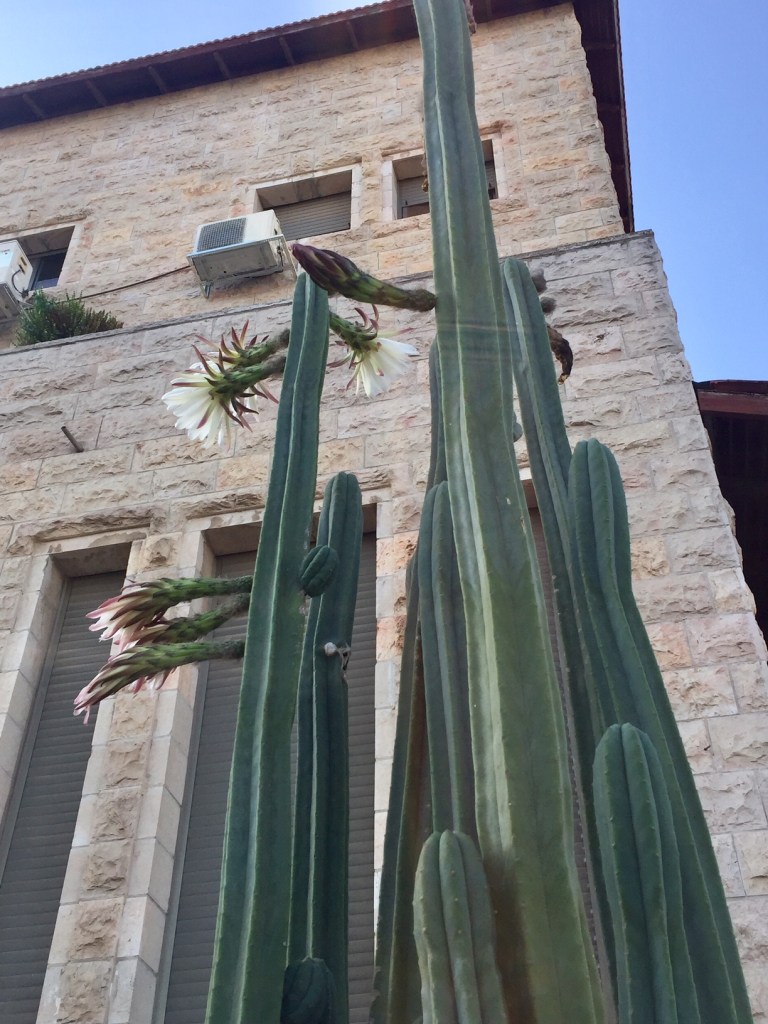
I noticed this blooming cactus in someone’s yard on my way to school this morning. Each blossom was about the size of a teacup.
I’ve been in a little book group at “Night seder” on Monday. (Nighttime study is a tradition in Yeshivot — we have it optional one night, most have it required every night!) We’ve been reflecting on Alan Lew’s This is Real and You are Completely Unprepared, and also generally sharing about our lives, the process of teshuva (return or repentance), and how to be more present and purposeful in our lives. I shared with this group my experience years ago of keeping a joy journal, and so we started sharing by WhatsApp three joys a day. Today these are the joys I shared with the group: 1. I went to the mattress store last week to inquire after my mattress topper, which, when I ordered it five and half weeks ago was going to be delivered “in two to three weeks”. Oh, they said, we called and called — your American phone number doesn’t work — we called to say it isn’t ready. Come back next Thursday. So today I went and — it was ready! Of course, they had forgotten about delivering it, and they dumped it into my arms with the words, Zeh kal — it’s light. So joy 2. was that I managed to shlep it home, partly walking and partly on the bus. I’m very much looking forward to sleeping on it! And joy 3. While I was sitting at the bus stop, an old man struck up a conversation. He had only one or two words of English, and my Hebrew ain’t much, but I managed to learn that his daughter teaches on Long Island, that he has been to the United States twice, and that he was born in Jerusalem near Mahaneh Yehuda, his father was also Israeli, and his mother was from Iraq. I also learned that he doesn’t have a lot of patience with the Haredim (Ultra-Orthodox) — “Kolhazman lo lo lo — zeh lo tov!” “All the time no, no, no — it’s not good!” He learned from me that I am studying at a Yeshiva, that I am a Masorti Jew (Either “conservative” or “Traditional”), and that I live “Near Boston” because Vermont and New England didn’t ring a bell with him. It was a delightful conversation!
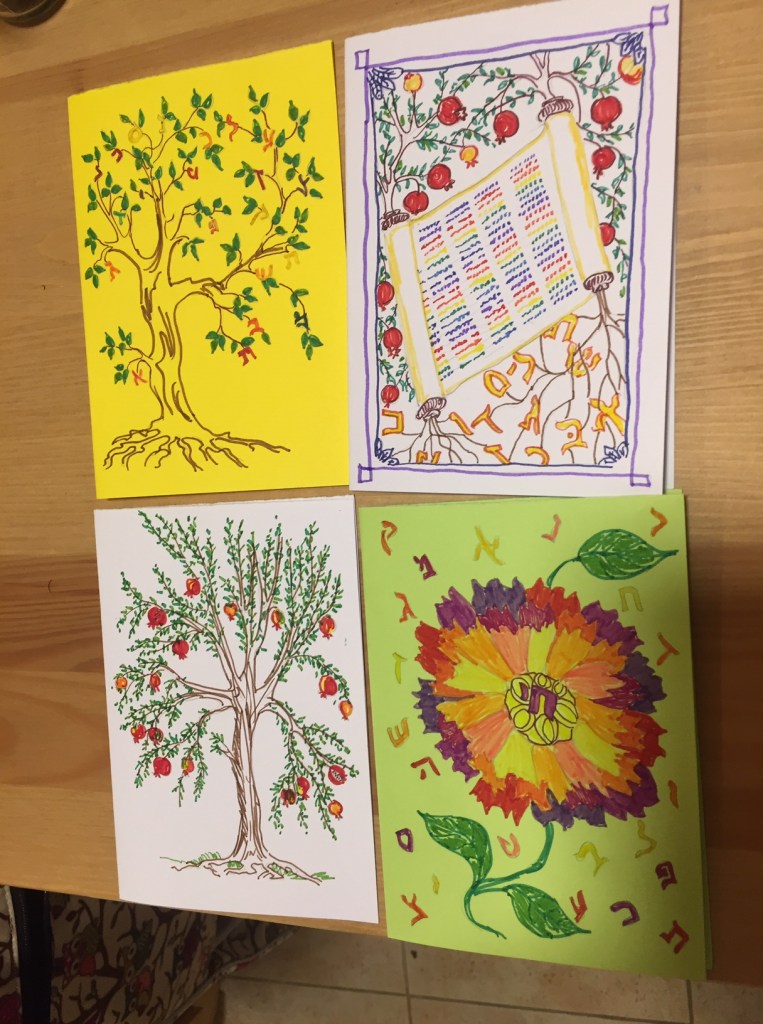
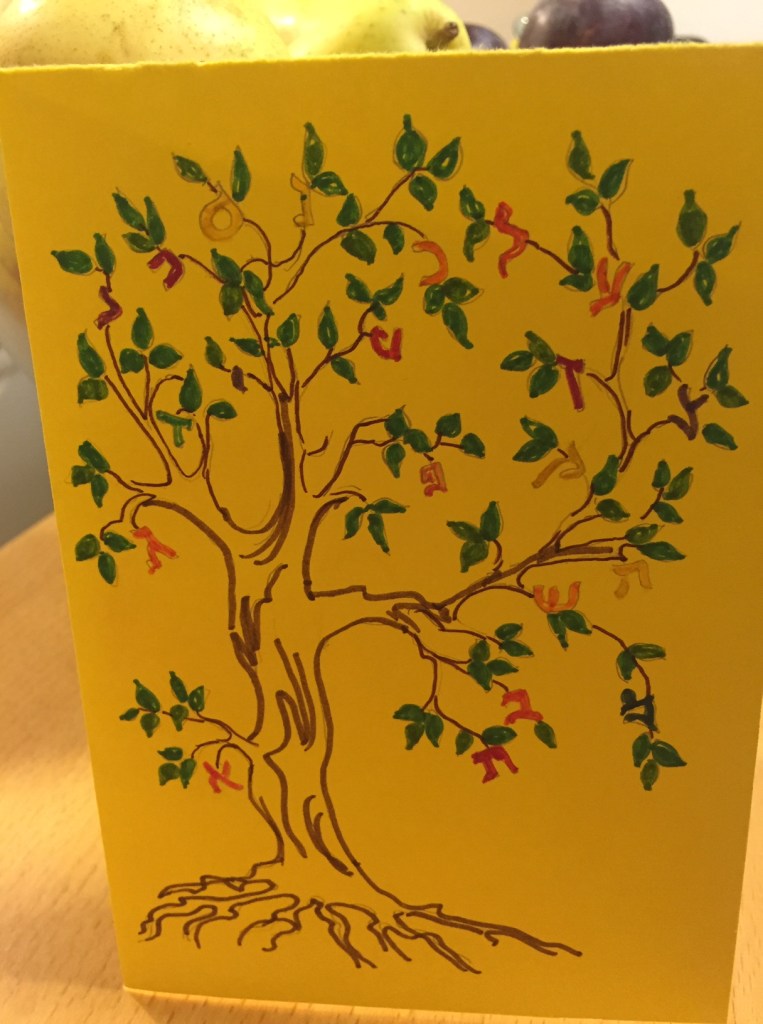
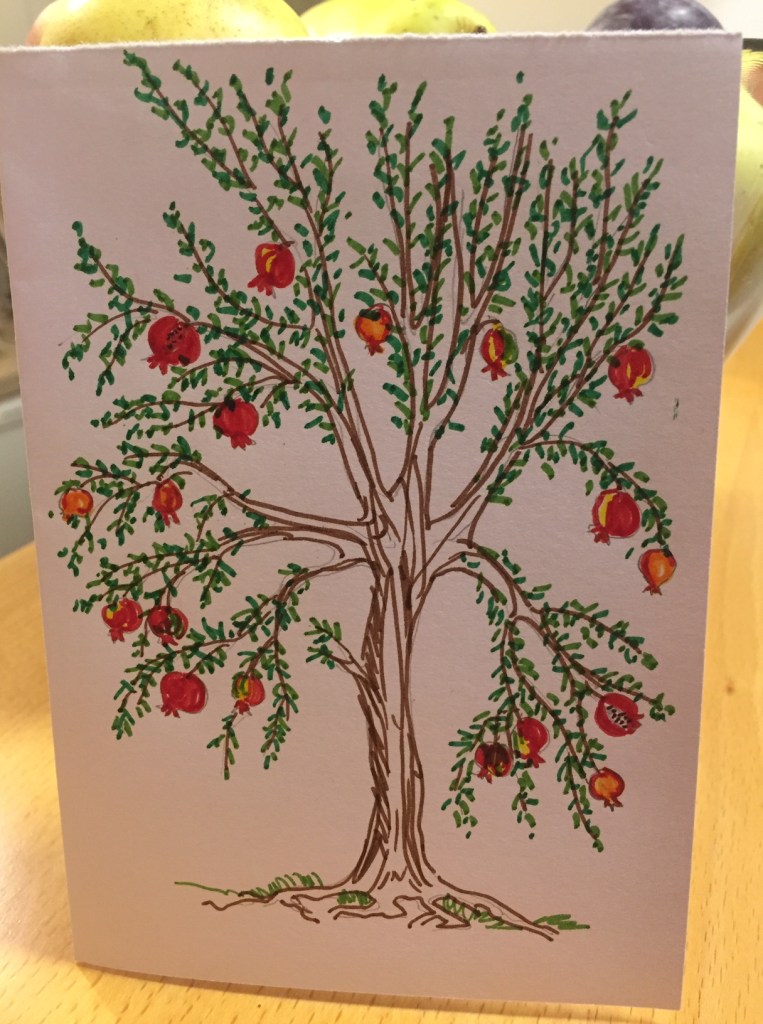
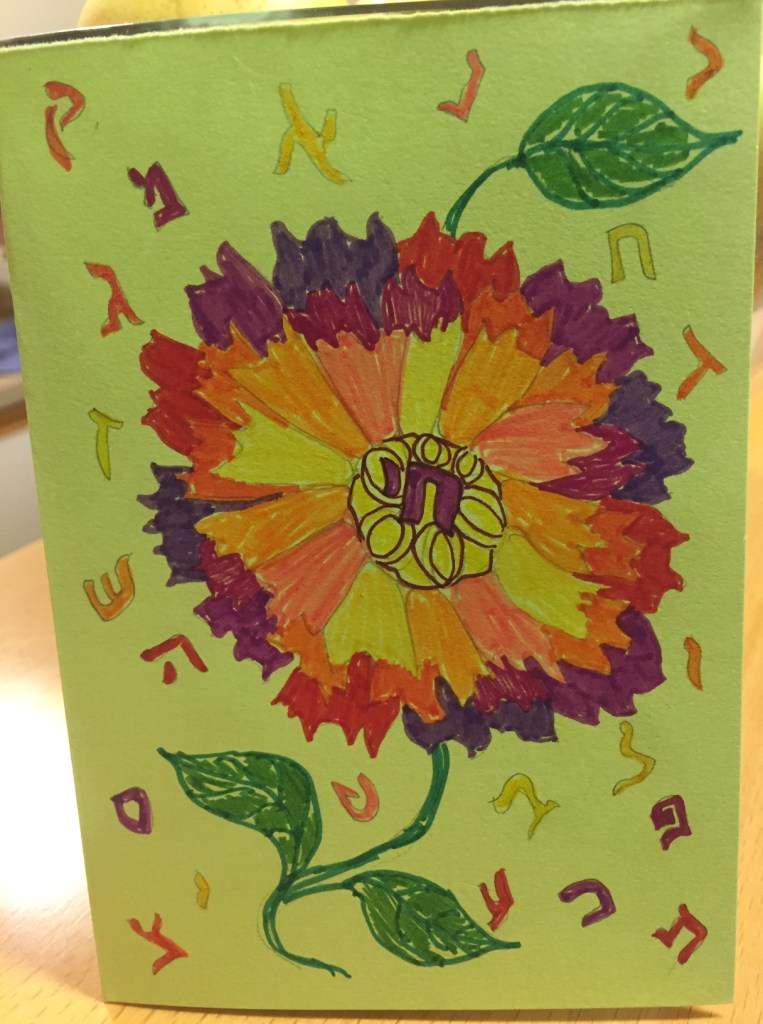
I have joined the Chesed Committee. Mostly, this committee makes soup to give to people who are sick, but we also try to do other nice things for people. We decided we wanted to take note of fellow students’ birthdays, so I assigned myself the job of drawing the birthday cards. Here are four examples I did one evening. I like the one at the bottom the best- -he was also celebrating the anniversary of his (adult) Bar Mitzvah.
I do a lot of walking. I walk twenty minutes each way to and from school. I walk to the super — either the one up the hill ten minutes, or the one near school that is bigger — and the do’ar (post office), and the organic food store, and the mall. I walk to various synagogues. I do occasionally take the bus, and what a blessing that is! But on my way to and fro, I see a lot of interesting things. I see new buildings going up — buildings that are going to be luxury apartments, but that look as though they are being built by cheap Arab labor in a very old-fashioned and possibly not up-to-code manner. I see all kinds of gardens — gardens in pots, gardens on roofs and balconies, vegetables, flowers, shrubs, cacti, weeds, gardens that are beautiful and gardens that have gone to hell and are full of trash. I see Jerusalemites going about their daily lives — walking, running, biking, scootering, driving, taking the bus. Walking their dogs, wheeling or carrying or holding the hands of their numerous children. Sitting on benches chatting or looking at their phones. I see posters for religious lectures, yoga and Pilates and Feldenkrais, arts events, political parties, and commercial ventures. Today, I saw a row of stands selling etrogim (citrons) for Sukkot, as well as place that is selling sukkah kits.
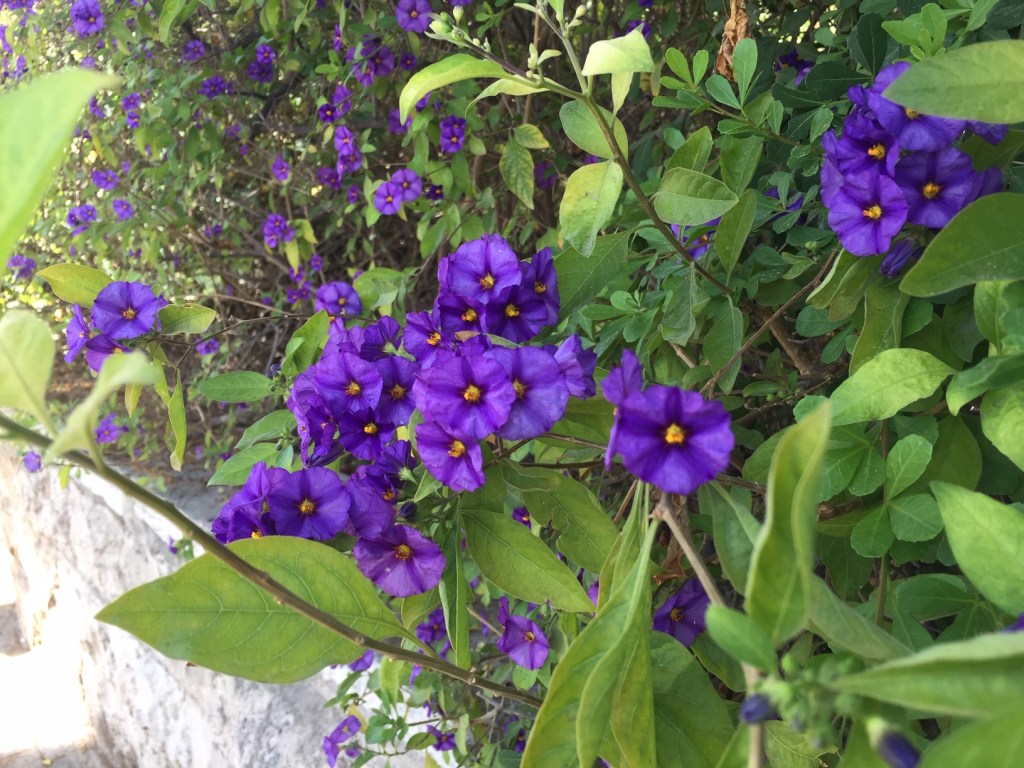
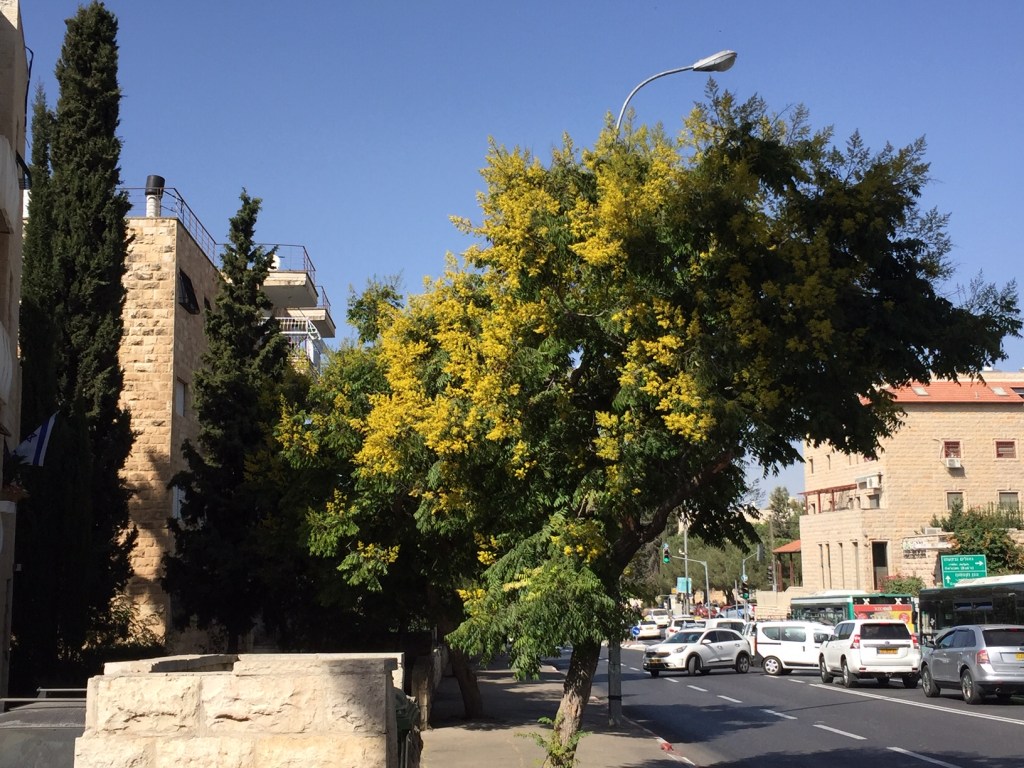
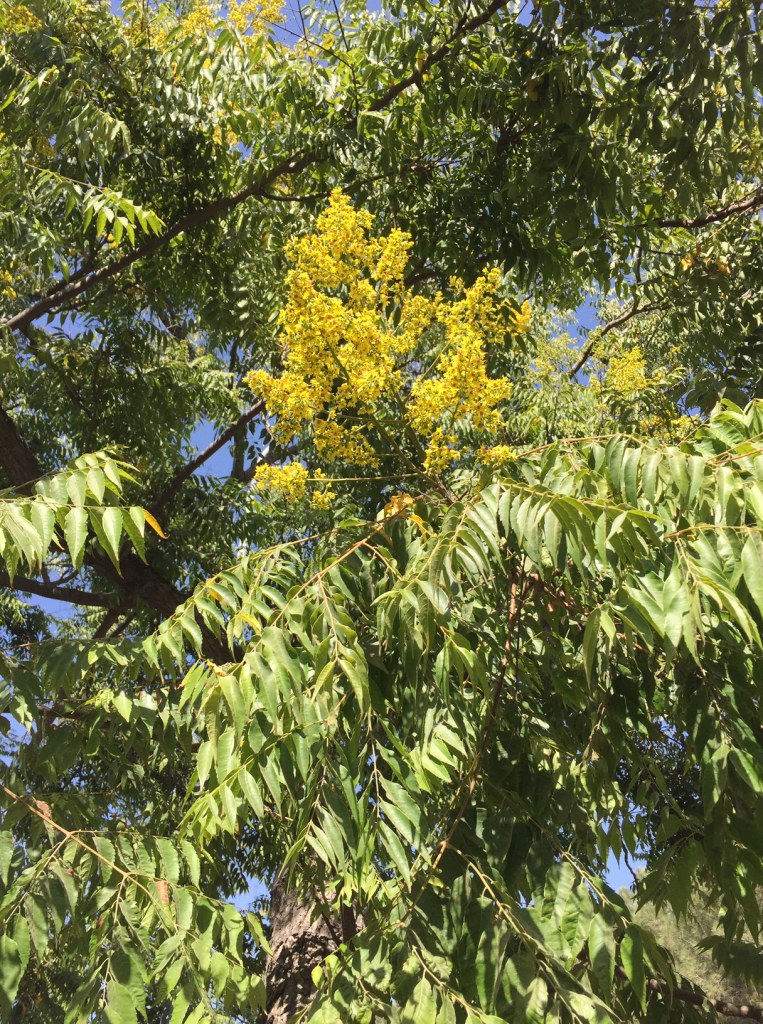
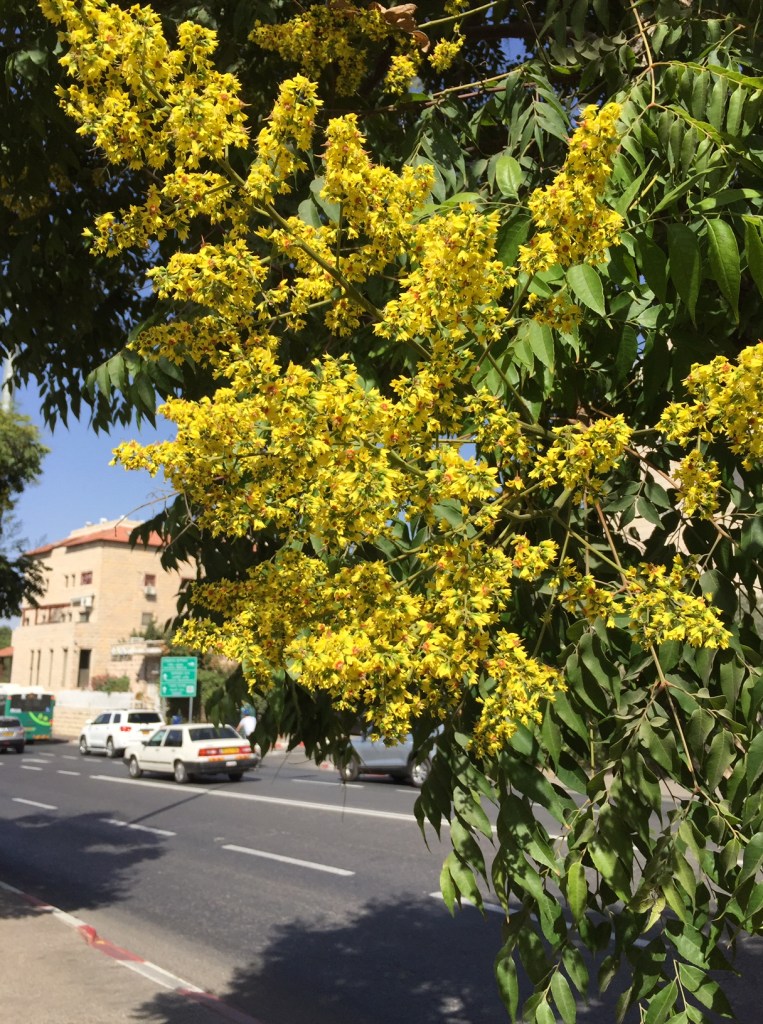
One plant I see in every garden, including next to my apartment, is this shrub. It’s about ten to twelve feet tall. This photo shows the blossoms about life size (if you are reading this on your computer). It’s a woody shrub, and yet I feel that it suggests the solanaceae. Anyone know what it is? A week before Rosh HaShanah these trees burst into bloom along General Pierre Koenig Street (where Pardes is).They are honey-smelling and full of pollinating insects.They are gone by now — the street is covered with yellow blossoms….Again, I have no idea what these are.
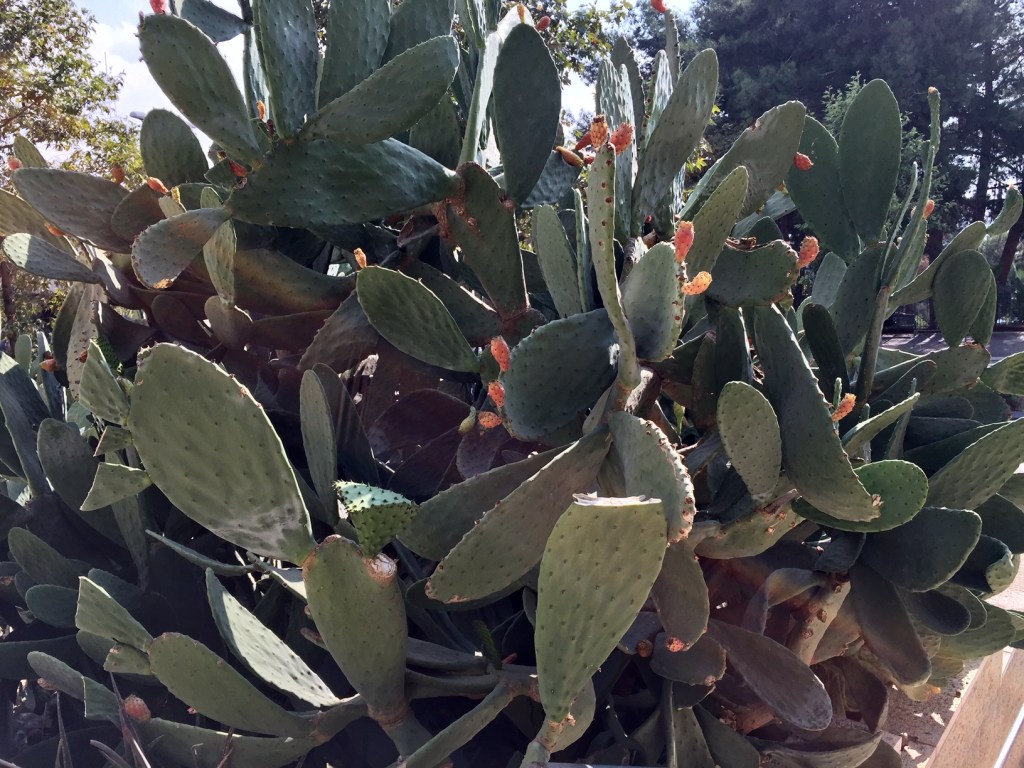
One day when I was walking over the hill to meet Yochi and Golan, I saw this amazing sabra (prickly pear).
I don’t think these photos capture how large it was — taller than me, any way, and several times as wide!
So I’ll leave you with some photos of our tiyyul to the Southern Excavations. Its seems like ages ago! I do promise to write about Yom Kippur — it was a great experience, but I missed Brattleboro and leading my congregation. But that will ahve to wait…Tomorrow I set off up north to Tzfat for Sukkot, accompanied by my grandson Hagai. I’m looking forward to a fun, restful few days with family.
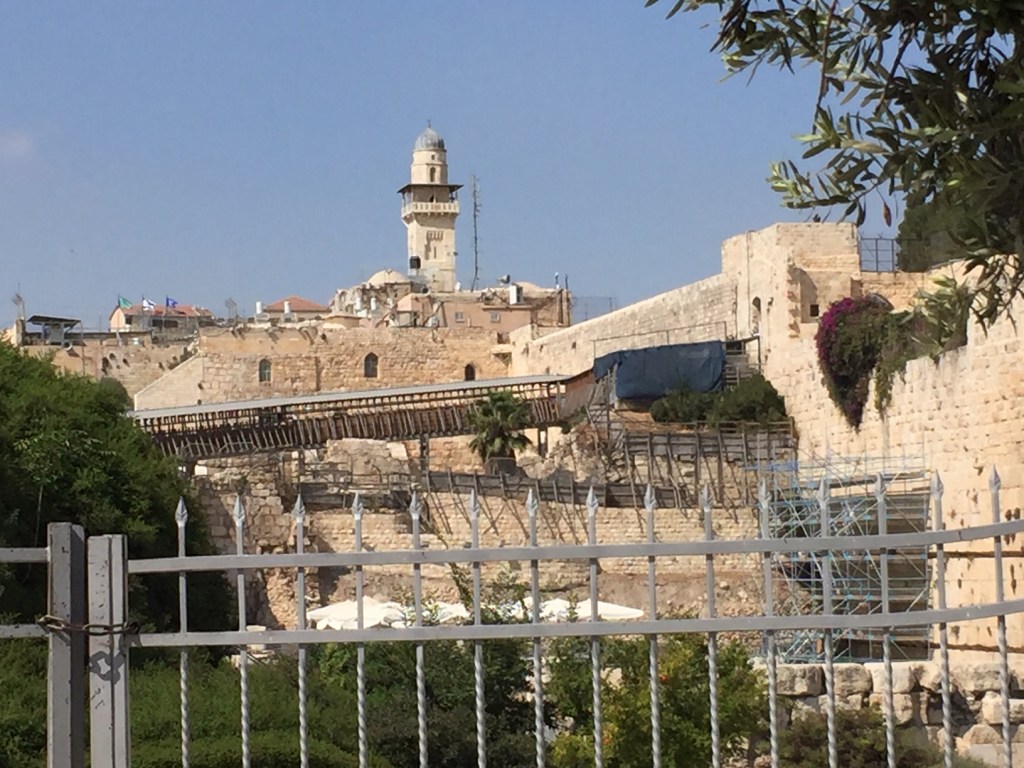
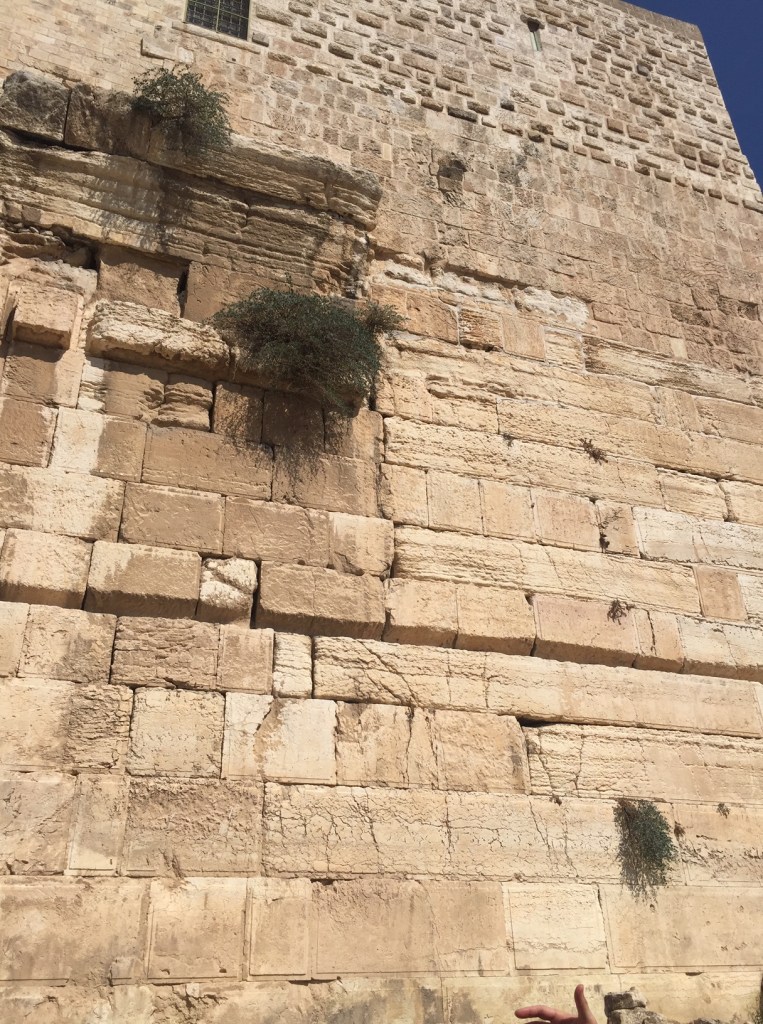
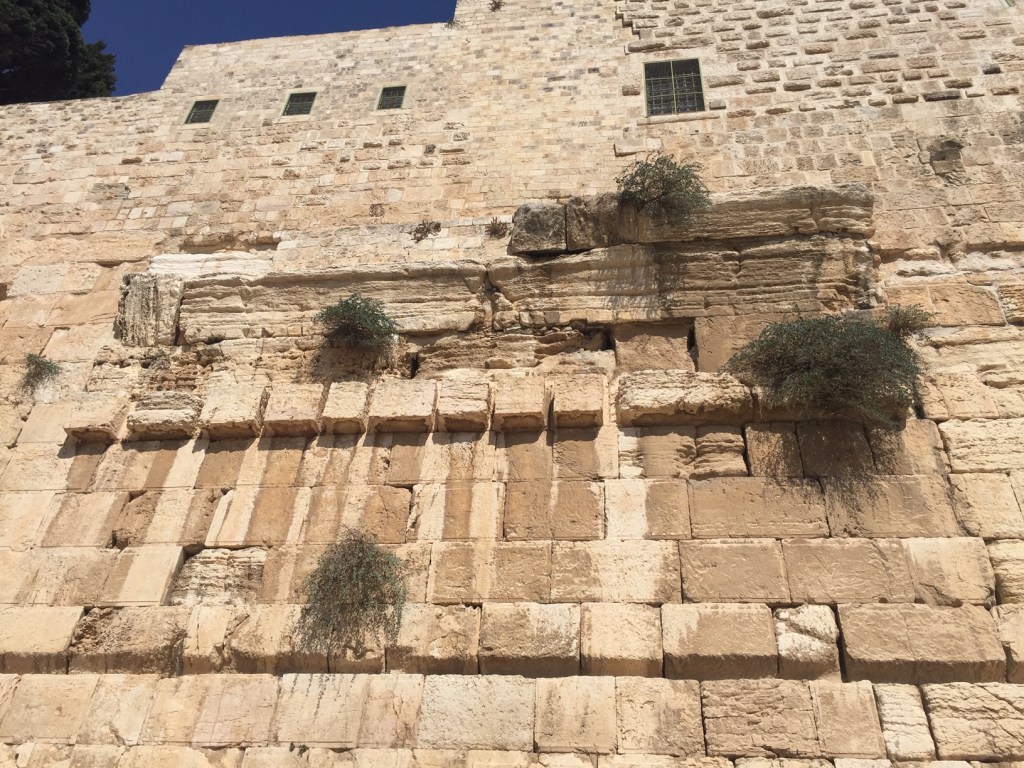
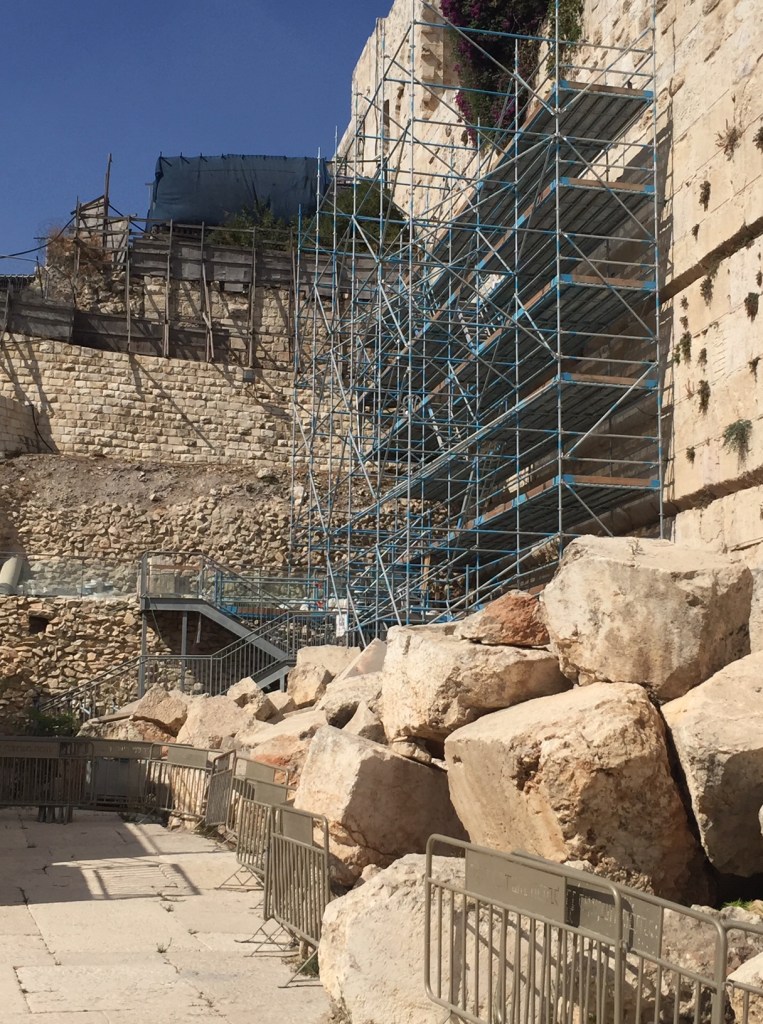
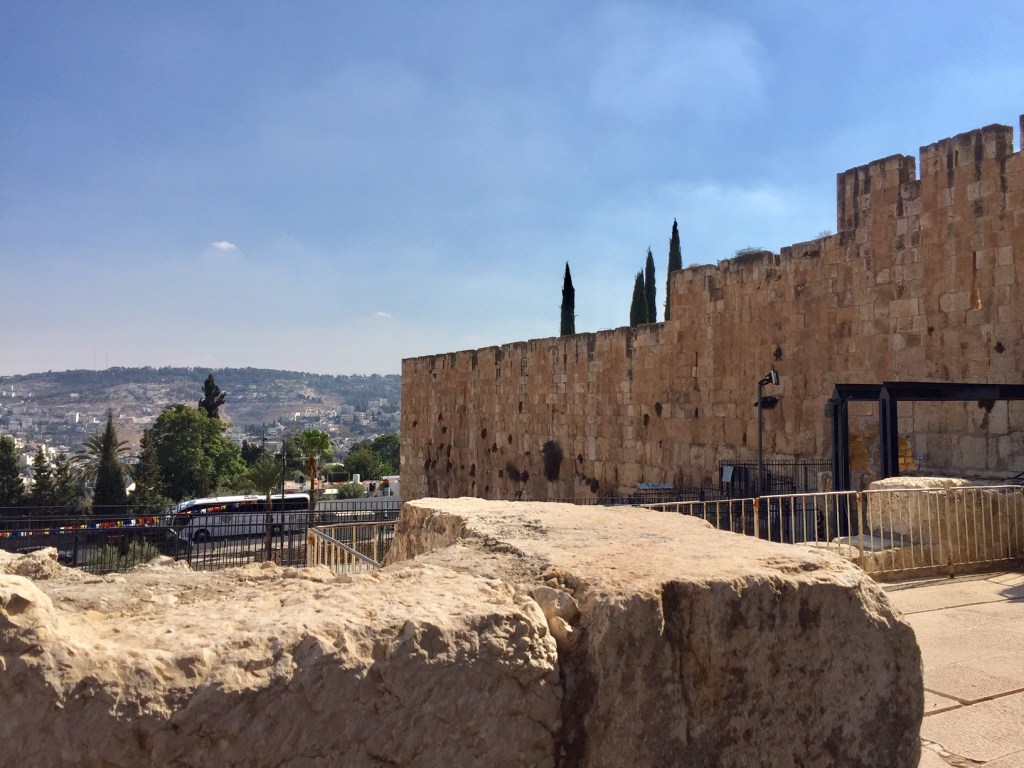
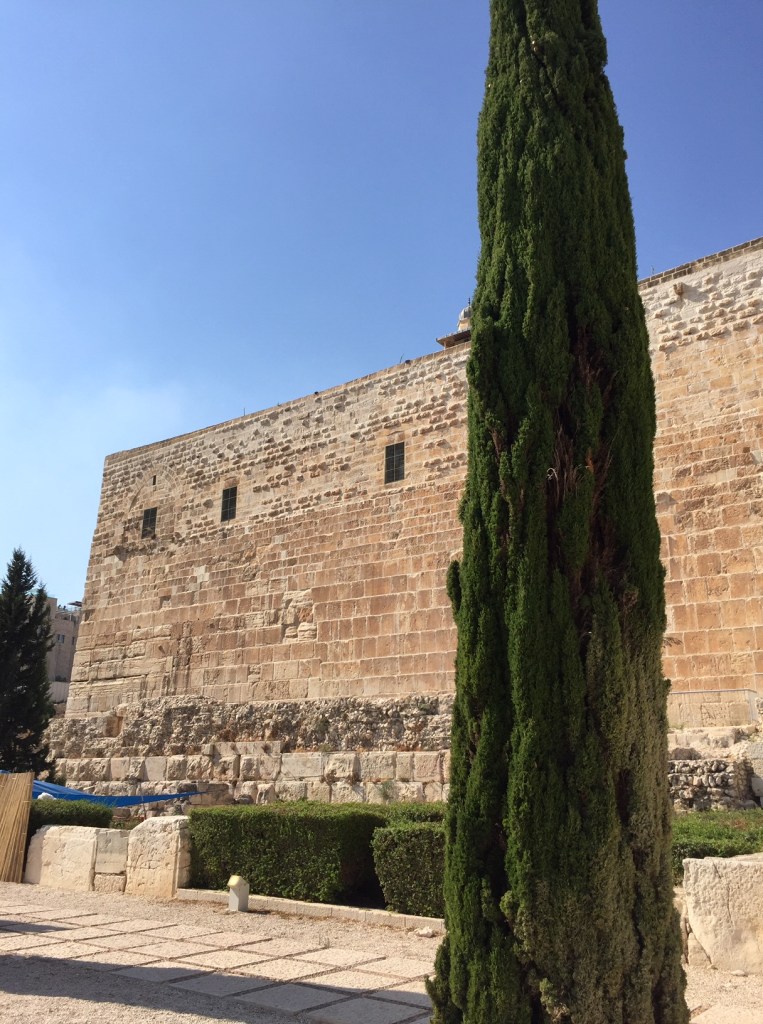
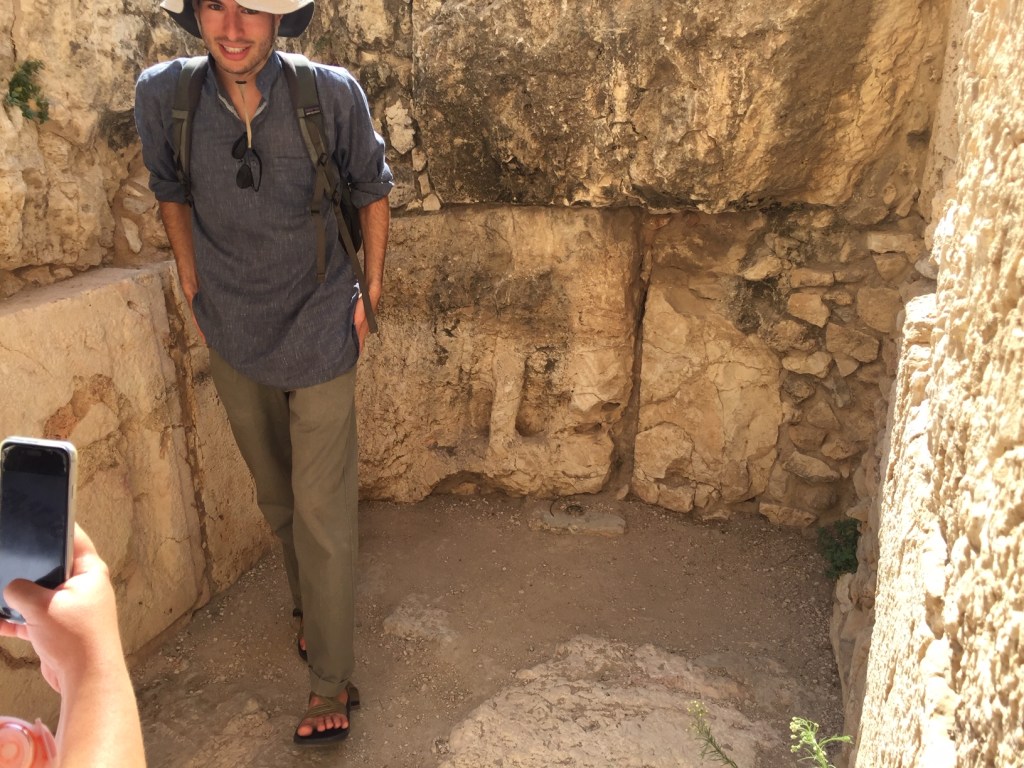
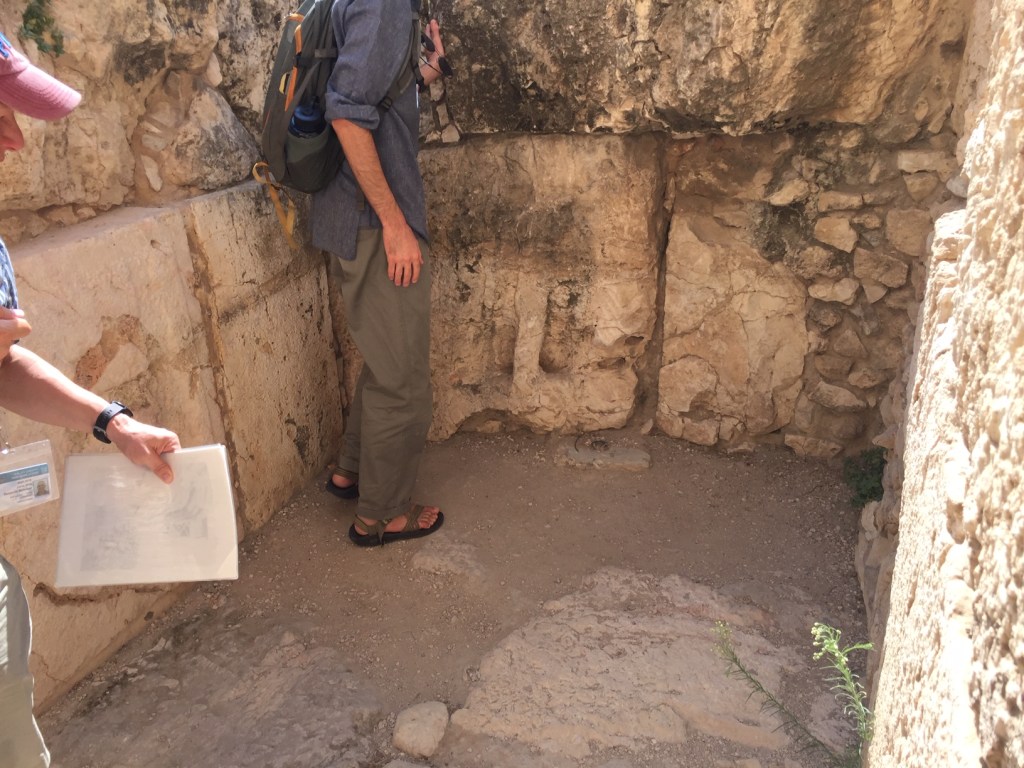
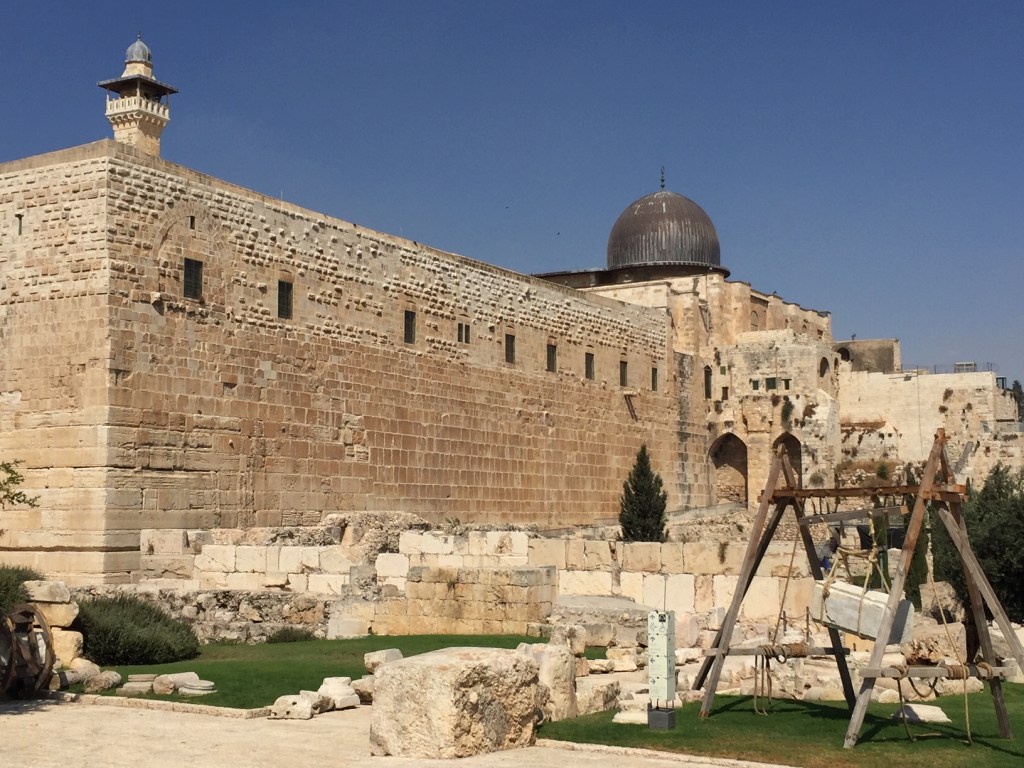
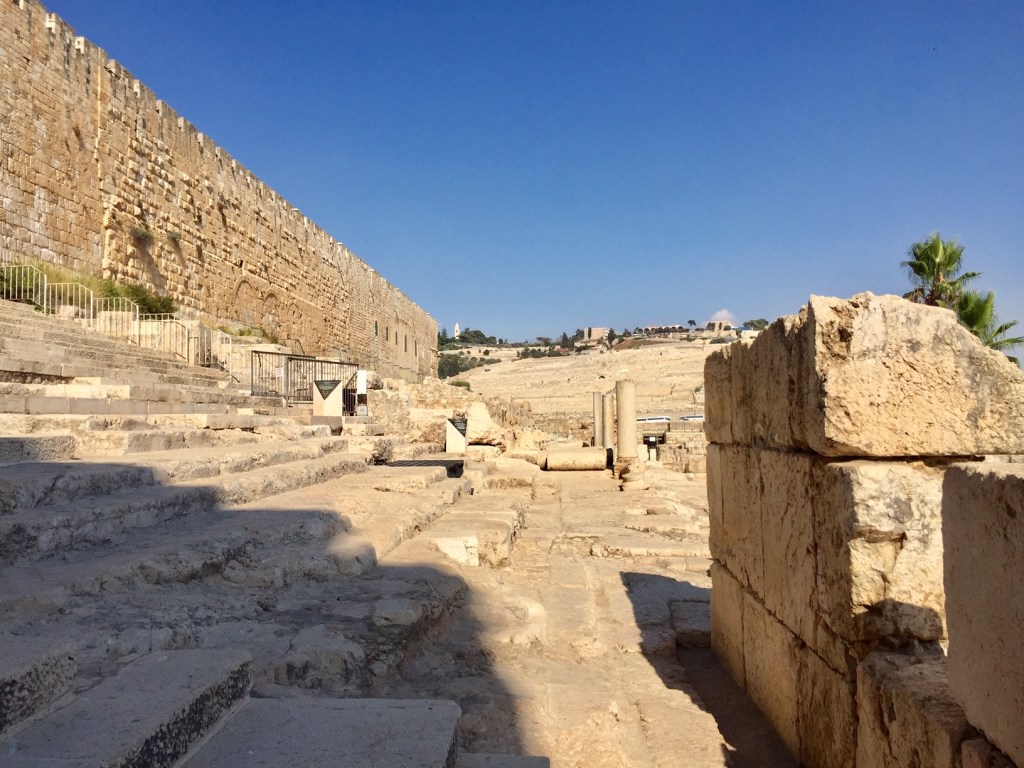
The ramp in the middle ground goes up to the top of the Temple mount. Jews can go up for certain hours on certain days, but can no longer enter the mosque or the Dome of the Rock. This is Robinson’s Arch — you see the remains of the archway at the top of the photo. This is where Women of the Wall proposes that women be given a place to pray. Sharansky had a whole proposal to open this up and make it a good place, but it fell through due to lobbying from the ultra orthodox. Sadly, Women of the Wall also became divided over this issue, as some of the original members want to see the Western Wall opened up for more room for Women to daven, while the formal organization accepts the idea of Robinson’s Arch. The small bricks at the top are more modern, the big chunks of stone are the original foundations of the Temple. Mixed davenning — men and women — can currently occur on this uninviting scaffolding. Well out of sight of the Western Wall and its segregated davenners. The wall at right is modern — 13th century or something!Remember, this is just the foundation of the Temple that once was. Along the street where the old entrance to the Temple once was, they’ve found what some archeologists believe to be shops. This one, according to our guide, sold animals for sacrifice — hence the place to tie them up (back left, behind Jonathan). The roof of the mosque. Competing religious narratives, and cultures building on top of other cultures in order to intentionally erase each others’ supremacy… We sat on the steps here in the shade, and imagined another time…in the background are the graves on the Mount of Olives.
I felt proud this morning when Leah told the Intermediate Talmud class that she could see how much we had progressed in the past month. I could see it too — I was aware of things my chevruta and I had gotten that other chevrutot had missed, and I had the extraordinary joy of not only recognizing a verse of Torah that was cited, but understanding its implications in the b’raita that cited it. Did my chevruta and I get the whole story? Not a bit! But we got more than might be expected, so that when Leah began unpacking it further for us, I completely got what she was saying.
Let me share with you a little bit of the gemara we were studying:
Rabbi Yirmiyahad words — or a thing –together with Rabbi Abba. He (Rabbi Yirmiya) went and sat at the thresholdofRabbi Abba (apparently to apologize). Whenthemaid poured out the (dirty) water, the droplets of water landed onhis head. He said, They have made me into a trash heap (ashpah). He recitedabout himself: “Who lifts up the needy out of the trash heap (ashpot)” (Psalms 113:7). Rabbi Abba heardand went out to greet him.He (Rabbi Abba) said to him: Now I must go out to appease you, as it is written: “Go, humble yourself and urge your neighbor” (Proverbs 6:3).
Not all the stories in this sugiya have such happy endings — this is also the section where Rav goes to “appease” a butcher he knows, who has offended him in some way or with whom he has had an argument. He meets Rav Huna on the way, who says, “You are surely going to kill him.” Sure enough, when he gets there to apologize the butcher says, “I will never forgive you”, and a bone from the animal he is chopping up flies up and stabs him in the throat, killing him on the spot!
Apologies, making things right, appeasement, forgiveness — these are all on our minds in these days before Yom Kippur. In Judaism there is a tradition of cheshbon hanefesh — literally, an accounting of the soul. We are required to review our faults and to seek out those to whom we need to make amends or from whom we need to request forgiveness. In the teachings I’ve encountered in the liberal U.S. circles I travel in, it has always been understood that too much breast beating can be bad for a person, and can indeed can cause them to avoid true repentance through an overage of guilt and shame. I first learned from Andi Waisman that rather than smiting our chests during Yom Kippur we should rather tap them gently, so as to comfort ourselves in our time of regret and repentance. Rabbi Noah Kitty, my first teacher in Judaism, suggested once that we students keep a joy journal during the month of Elul, strengthening ourselves for the difficult process of atonement by first remembering all that is good in God’s beautiful world.
It was a severe shock to my system, therefor, to encounter the methodology used among the Orthodox here. We were gathered into the Beit Midrash and asked to write down for ourselves (not, thank God, to share) the following (please be forewarned — I do not advise using this method, which had a very adverse affect on me — but perhaps it will be different for you):
2 ways in which I can be a better daughter or son
2 ways in which I can be a better sister or brother
3 ways in which I can be a better student
3 ways in which I can be a better roommate, partner, or spouse
2 people I need to ask forgiveness from
Is there somebody I need to tell something to, and should not wait (accompanied by a story of the lovely young friend who is killed in a car accident before the person can tell him…etc etc)
2 people I need to forgive
2 mitzvot I didn’t do well, or didn’t do enough, or didn’t do at all
The 2 things I did this past year that I am most proud of
The 2 things I am most ashamed of
3 goals I’d like to set for myself for the coming year
What kind of person do I really want to be?
How can I go about becoming this person?
2 people I look up to, and what is it I most admire about them?
To be in a room full of people and to be asked to answer these questions, while being instructed not to reflect but to write immediately so that I wouldn’t try to fool myself about my own iniquity (ok, he didn’t use that word, but he implied it) did not have a good affect on me. Instead of joining the afternoon trip to pack food for the needy, followed by tashlich (ritual throwing off of sins) in the Gazelle Valley, I went home in tears, shaking with anger.
I’ve had several days to reflect on why I don’t think this is an optimal way to achieve teshuvah (return, repentance). In the immediate aftermath I went to talk with a new friend nearby who comes from an Orthodox background, who confirmed for me that this is indeed standard practice in Orthodox circles — adding that this was one reason why she had not attended. I then contacted one of the Pardes leaders, and today I went and sat with her to try to explain why I felt that this was not the way to go with a group of people who are genuinely good-hearted and seeking truth and a connection with the Divine, as all Pardes students appear to me to be. It was an interesting conversation. She was completely open and receptive to hearing what I had to say — in part, I believe, because I had taken a long time to think through how I would speak — but she did indeed confirm that this kind of things is standard practice, and has been done for years at Pardes.
Here are my takeaways. First, know that in any room full of people, no matter their age, there will be many who have lost their parents, their siblings, their friends, and their spouses. Don’t ask them to think of “ways to be a better child, sibling, spouse, etc.” without some preface to the effect that you know that many have lost their loved ones, perhaps even recently, and that while it is natural to have regrets about how we behaved toward those we have lost, it’s important also not to drown in the guilt. The gemara we read today is relevant here: Rabbi Yosei bar Ḥanina said: Anyone who asks forgiveness of his friend should not ask more than three times, as it is stated: “Please, please forgive; And now, please.” (Genesis 50:17 — this is Joseph’s brothers asking him to forgive them; there are three pleases, or three asks of forgiveness). And ifhe dies (or is dead), one brings ten people, and stands them at his graveand says: I have sinned against the Lord, the God of Israel, and against so-and-so whom I wounded. In other words, when we have guilt for things we did to someone who has died, we can apologize before God and before living people, and make it good again.
Also, try to avoid using words like “ashamed” and “guilty” altogether. Enough already – -we’re Jews ,we get it! Perhaps most important, don’t start from an assumption that the best way to achieve repentance is through shame and guilt. Don’t start from an assumption that we are all hard-hearted folk who need to beat ourselves into submission in order to feel sorry. Consider that the people who most need this process are the very ones who will never engage in it. World leaders (naming no names), CEOs of rapacious corporations (not to mention CEOs with rapacious habits…), Haredim (“Ultra-Orthodox”) who throw stones at people who pass through their neighborhoods in what they perceive to be inadequate clothing — these are people who could benefit from this list of questions, but they either aren’t doing cheshbon hanefesh at all, or don’t appreciate the full list of things for which they should be sorry before God. But a bunch of earnest seekers at a Yeshiva? Really?!
As I processed all this, I was repeatedly reminded of a congregant who one year said that the BAJC High Holy Day services were very hard for her to sit through, because she experienced the English prayers in our old “Wings of Awe” machzor as deeply shaming. I was surprised at the time — they didn’t affect me that way. Now I feel for that woman, and I wish I could tell her about my experiences this week. Each of us comes to these Days of Awe with different areas of tenderness, soreness, loss, grief, guilt and shame. Most of us, if we are showing up for shul, thinking about teshuvah, trying to repair our relationships, are really doing the very best we can. Sometimes we need help cracking open our hearts, but often enough, the hearts are already cracked and sore, and what we need most is some healing balm.
Here in Jerusalem, the balm arrived yesterday in the form of a sweet series of thunderstorms, which rained down the very first rain since last March. May we all experience the forgiveness of the Universe as falling like that rain, unexpected and delightful, cooling our anger and quenching our sorrows. And may we all be ready, even if we are the wronged party, to say to any poor drowned petitioner on our doorstep, “I need to make amends.”
As I write, the second day of Rosh HaShanah is winding to a close. At 7:45, it’s fully dark out, and quite cool for a change — I’ve actually closed the French doors in the living room.
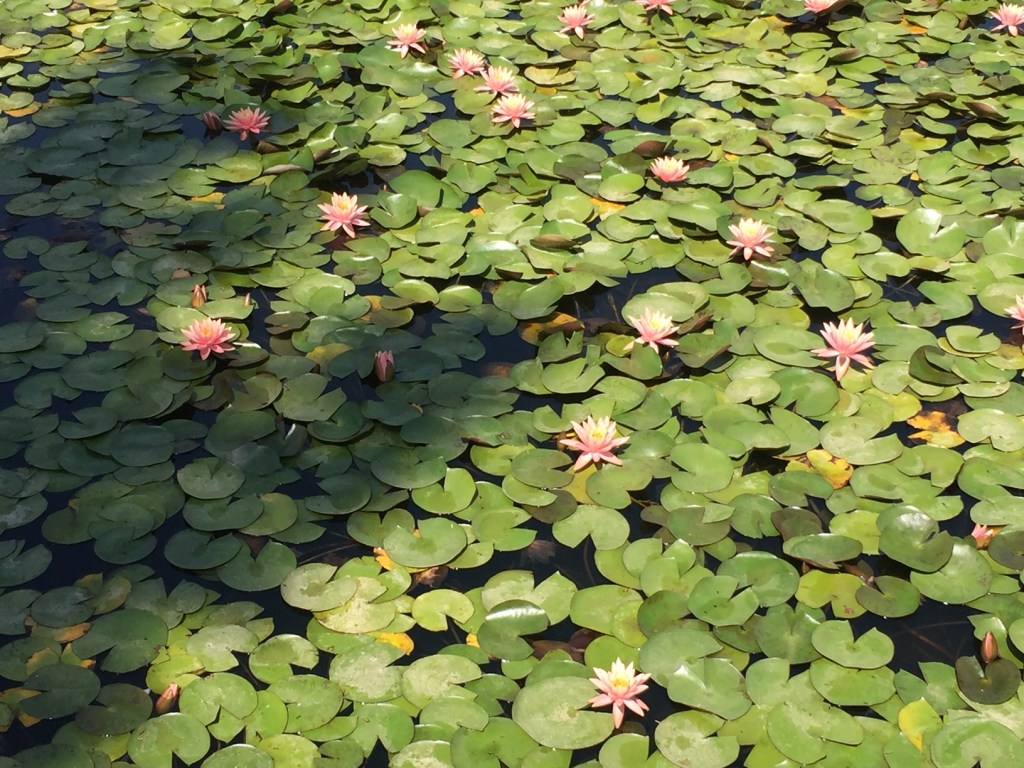
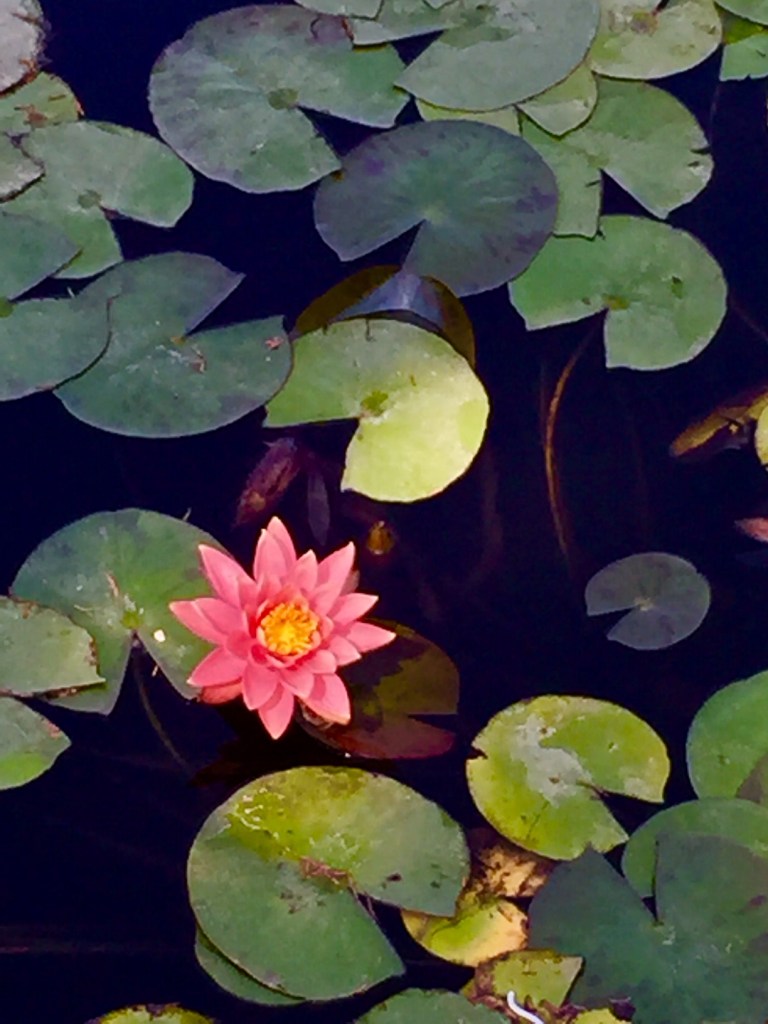
Lotus pool
My holiday has been a sweet one, thank G-d! I’ve enjoyed, first of all, being in a country where most people are celebrating and following the same calendar. I’ve loved the piles of pomegranates in the shops (as well as the trees loaded with pomegranates in many yards), the supermarket specials on honey and apples, the sound of children attempting to blow shofarot. the crowds of festively-dressed people in the mostly vehicle-free streets.
Water lily
After a mellow Shabbat, I joined the general bustle on Erev Rosh HaShanah, hiking up the hill to buy an extra bottle of wine (one must not come without wine or candy to any dinner one is invited to). In the evening I walked in another direction to join my teacher Leah and her family davenning with a Modern Orthodox minyan in the basement of a library. The service was short and sweet. It’s customary here to bring one’s own prayer book, which means occasionally one finds the leader doing a prayer that isn’t in the book one happens to have. I brought my Koren-Sacks machzorim (High Holy Day prayer books) from Vermont — published by Koren here in Jerusalem in the building next to where I go to school, with a commentary by Rabbi Lord Jonathan Sacks the former Chief Rabbi of Britain. They’re beautiful books, and when I’m missing a prayer, I just read the interesting commentaries.
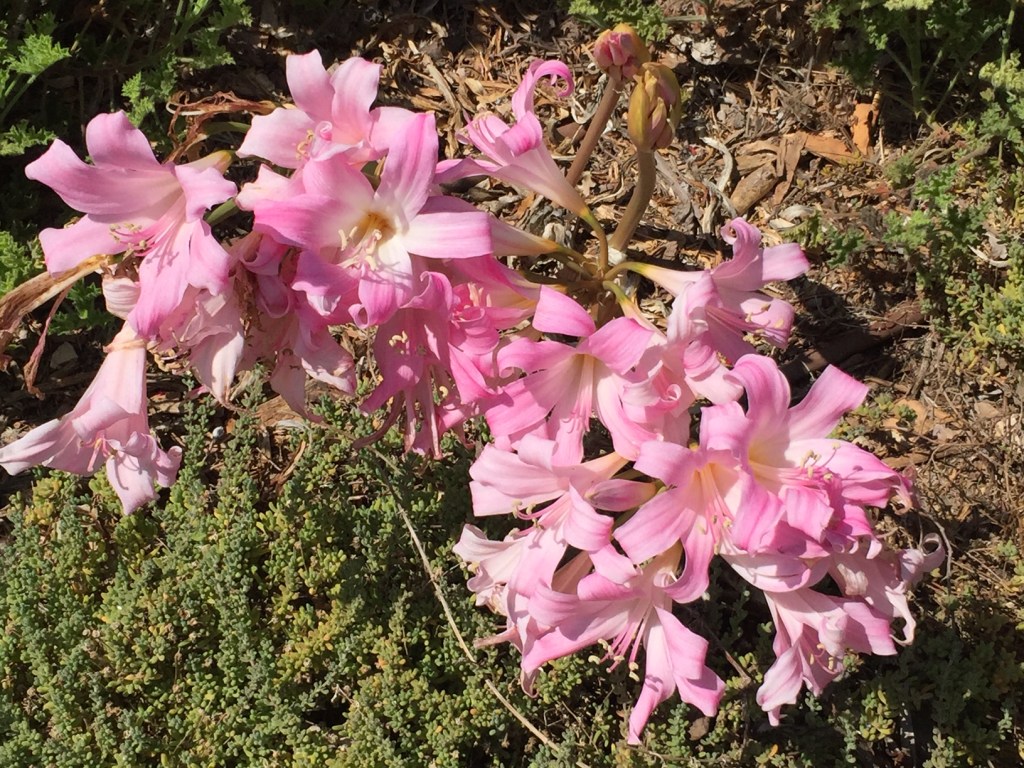
Fall-flowering amaryllis
The leader of the service had a sweet, plaintive voice. His nusach (tunes, modes, motifs) was a kind of Ashkenazi/Mizrachi mash-up — it was familiar, but with a nice Middle Eastern twist. The folks at BAJC who complain that our our High Holy Day nusach is vanilla would have enjoyed the variation I think.
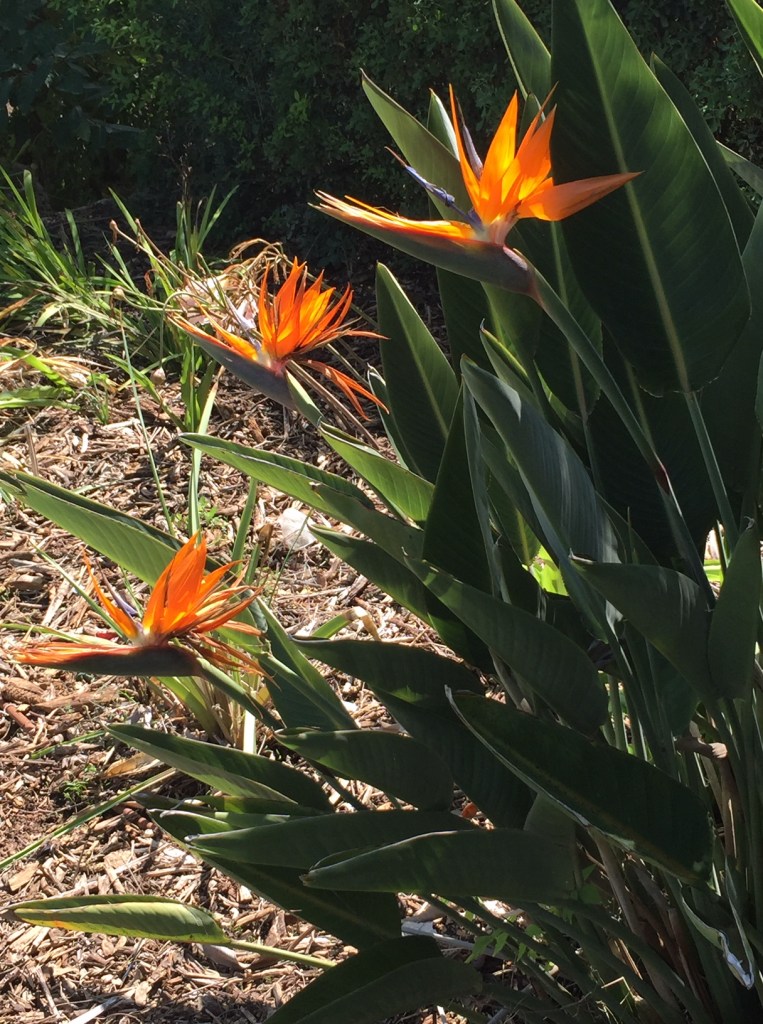
Birds of Paradise
After dinner I walked home with Leah and her husband and daughters and one of my classmates, David from England, who seems to turn up at a number of events I’m at somehow. He’s a cute boy, with that terribly dry English humor and a desire to stir up trouble when he can, just for fun. When we got to the house, some other Pardes students arrrived — Helen, with her boyfriend Ben who is in rabbinical school, and Brandon. Just in passing, I need to say that all of my classmates seem to be, not only really nice, but alarmingly smart. Brandon, for instance, at the age of 35 speaks Korean, Japanese, and Mandarin, as well as Hebrew and his native English. Helen and Ben both have degrees in astrophysics.
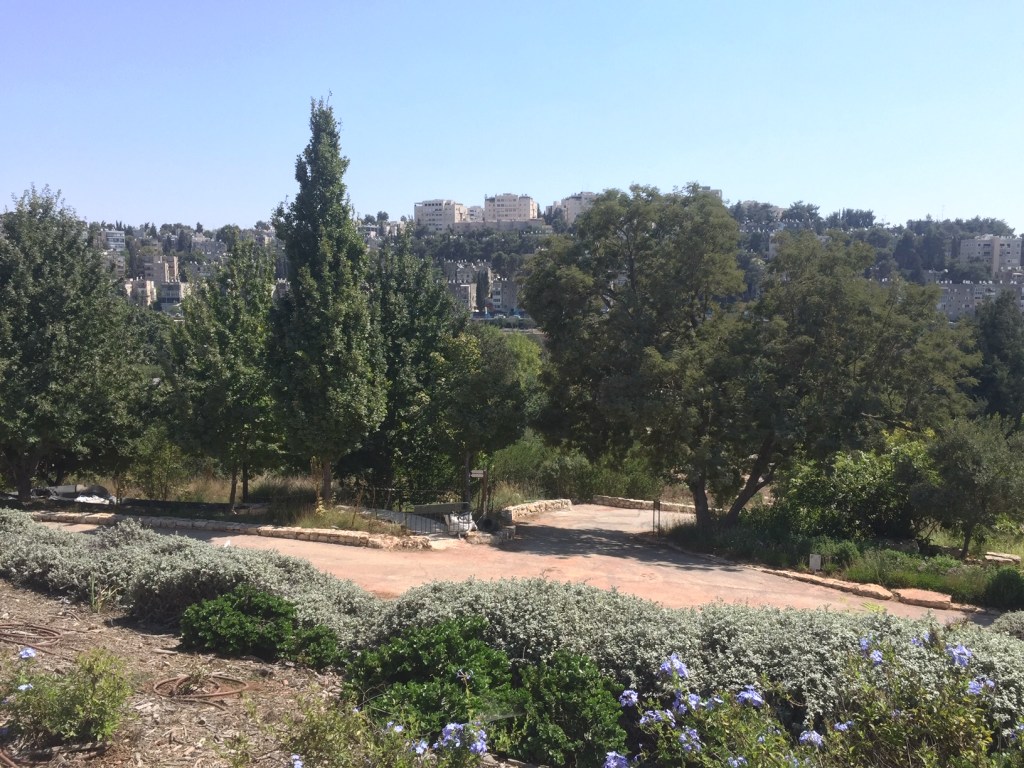
View from the Jerusalem Botanic Garden — my apartment is on the other side of that hill
Leah has three grown daughters — her grown sons were away. The daughters each had a distinctive look and manner — one is a school teacher, one is in the army, and one, who was very stylish and glamorous in plum colored lipstick and a blonde bobbed flapper-style haircut, is in college. Leah’s elderly parents were also there; they live down the street. They are American originally, but Leah’s husband is something like seventh generation Israeli, which is quite rare. He is also a professor, and so we were treated to a lecture in Hebrew (which I got the gist of) about the tradition of eating symbolic foods on Rosh HaShanah. Here’s more about this custom: https://www.star-k.org/articles/kashrus-kurrents/628/starting-the-new-year-right-a-guide-to-the-simanim-on-rosh-hashana/ Down the center of the table were plates of fresh dates (previously frozen — they become sweet when you do this, otherwise they are rather astringent), a pomegranate, a special gourd cooked in honey, black-eyed peas, and little pancakes, some made with leeks, some with beet greens. Also a more familiar plate of sliced apples, and a dish of honey, as well as round challot. At each of our places we had a beautiful card that the paterfamilias had made up, with the blessings written out over photos of the various foods. The blessings are based on puns that Rabbi Abaye made in the Talmud — except the for the apples and honey and round challah, that is a European tradition. We had some conversation about how interesting it is that in the Southern U.S. people also eat black eye peas at the secular New Year — a custom that comes from Africa, I believe. I restrained myself from mentioning that the black eye peas in the south usually have a ham bone in them…The dinner conversation proceeded in both English and Hebrew. Leah had made an ample dinner — meatloaf, roast chicken, various vegetables, and rice. After we bentsched (did the after meals blessing), I walked home with the Pardes students, each of us splitting off in a different direction as we came to our neighborhoods.
In the North American section, an old friend…
On Rosh HaShanah I set my alarm for six, and set off for the Yeshurun synagogue shortly before 7 am. (I was advised by my grandson-in-law that this would be where to hear some good chazzanut .) The sun was coming up, the air was cool, and the streets were still relatively empty — only Orthodox men were out and about, on their way to services. Here, you sometimes have three synagogues on a block, so I passed many on my way. It was a half hour walk, and despite being uphill all the way, it was quite a nice way to start my morning. I found the synagogue, a big one just down the street from the very grand Great Synagogue, and made my way up to the balcony where the women sit. There weren’t many women present yet, or even too many men down below. I found out why as the services progressed — it turns out a full Orthodox Rosh HaShanah takes more than six hours, and so most people don’t show up until much later. (It’s amusing to think that some people in Brattleboro complain about the services when they last three and a half hours…) As the morning wore on, the balcony filled with women, mostly my age or older, and mostly in the kind of hat one associates either with the Queen of England or with African American church ladies. I felt quite out of place in my headscarf!
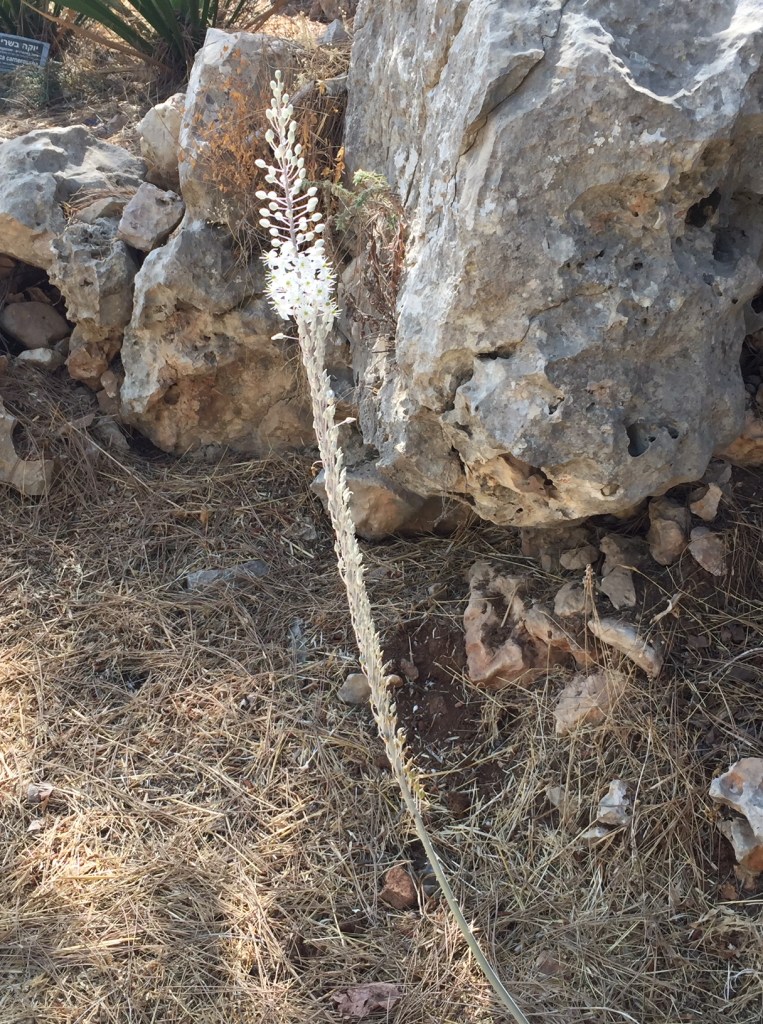
Sea Squill — Chatzav Matsui — mentioned several times in the Talmud
The first part of the service was led by a fairly skilled person, but when the chief cantor emerged in his white robes and hat, the service went from “not bad” to excellent! His nusach was perfect, his voice was beautiful despite his age (60s? 70s?), and his delivery was very moving. Six hours is a long time, and for about four of them I needed to pee, but I felt it was a really great service nonetheless. The Torah leyner (for the sad story of Hagar and Sarah) was excellent as well, and the shofar blower had a surprisingly sweet and even tone. From time to time the cantor was joined at the bima by one or more meshorerim (harmonizers), but there was no formal choir. In addition to the extra singers he also often had what I took to be a small grandson hanging onto his hand, which was really so sweet.The whole thing was somehow at once grand and heymish (homey).
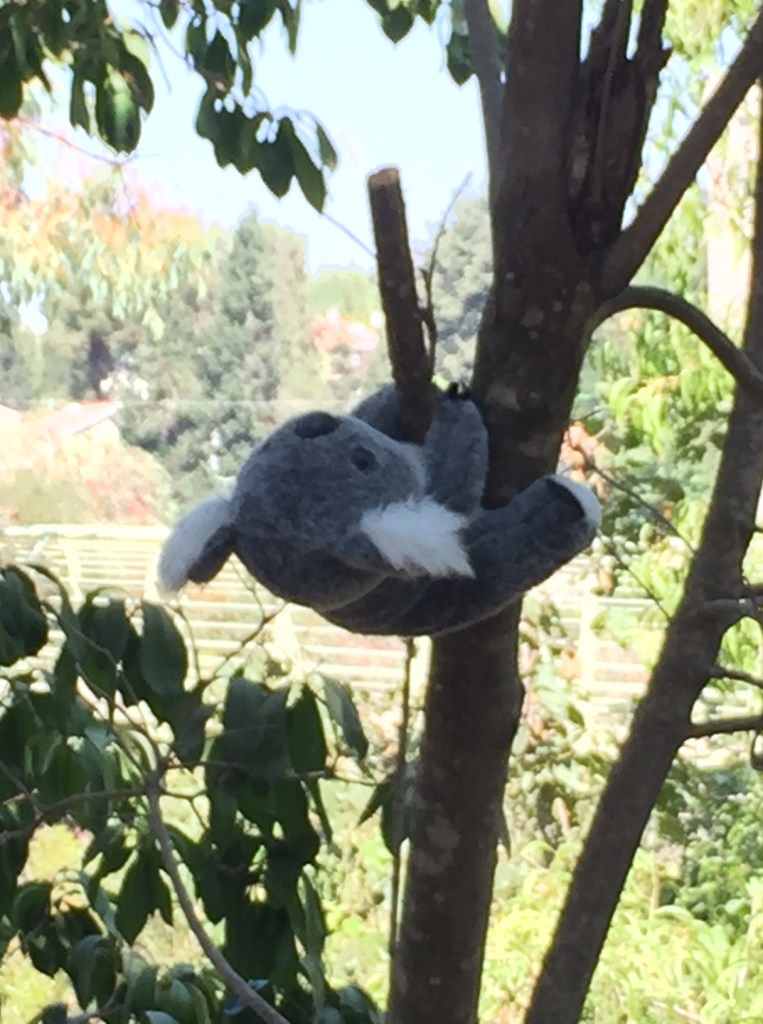
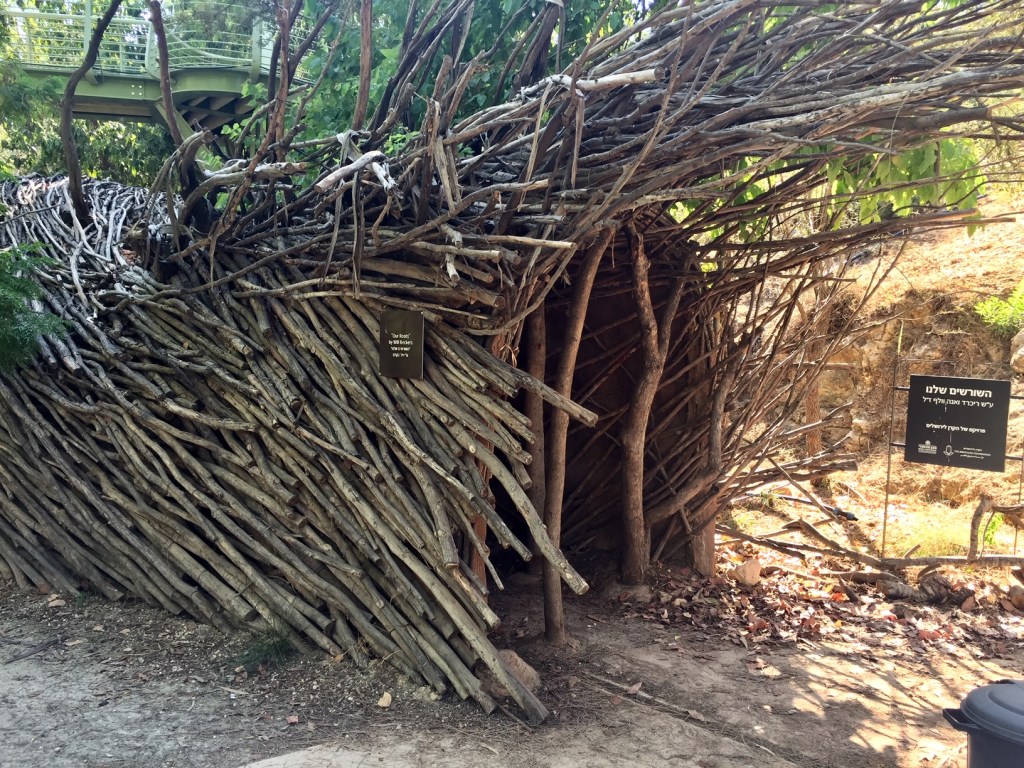
Evidently demonstrating to children who would be living in this kind of tree, if this were Australia…
At 1:15 I galloped down the hill and found the home of my classmate Sara Laya, who lives a couple blocks over from me. She had prepared an astonishing feast — salmon roasted with pomegranate and rosemary, “smashed” potatoes, roasted veggies, a quinoa salad with date and pomegranates, and much more, including an extremely decadent chocolate pomegranate torte that was parve (neither dairy nor meat) and gluten free and made with coconut sugar, and yet managed to be totally delicious. The company was really pleasant — four of my younger classmates plus Sara Laya — and the conversation was really interesting. We spoke of feminism and Orthodoxy, music, art, politics, the curious habits of many of our teachers, and where to find the local compost pile. I stayed and did the dishes, and watched the sky turn pink and then violet from Sara Laya’s third floor apartment.
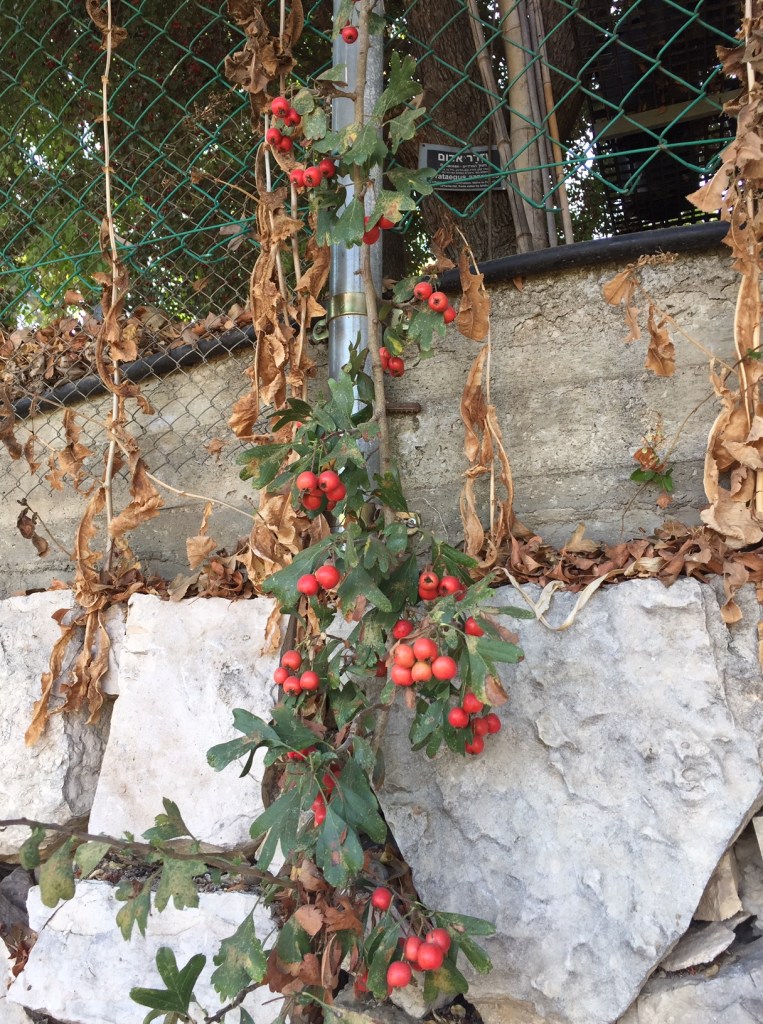
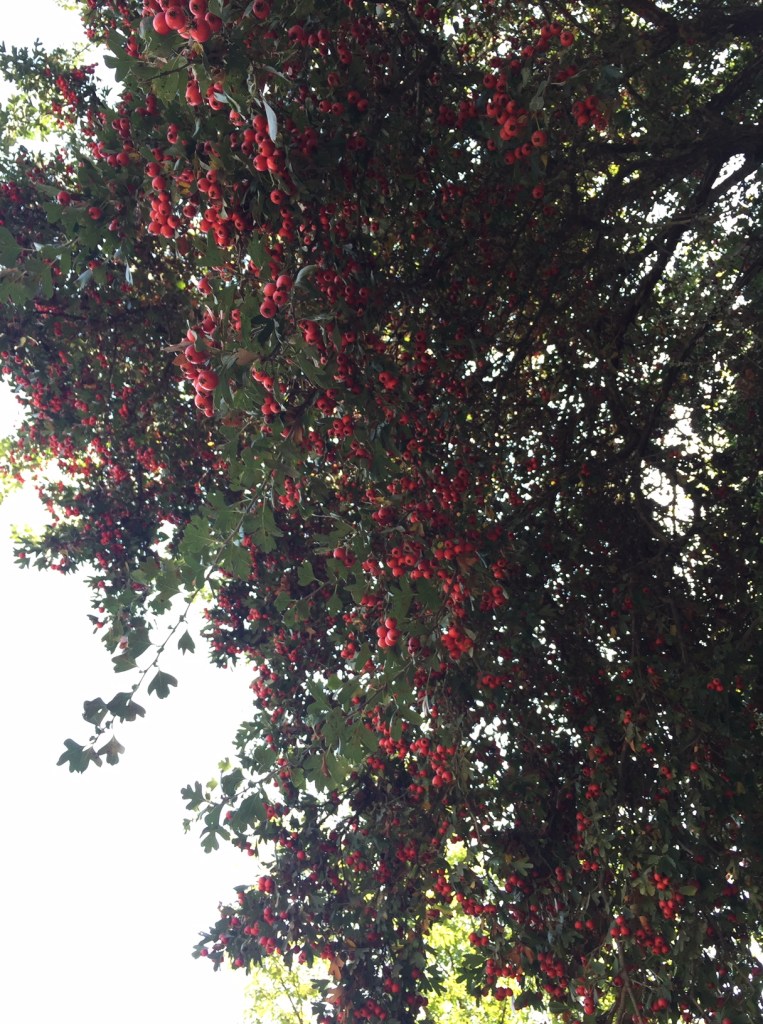
I’ve never seen Hawthorns so heavy with fruit
Today I set my alarm for 7:30, thinking I might get up and go to shul again for the latter part of the service, but I was unable to rouse myself — I slept until nine! Then I had a perfect day of a different kind: I had a leisurely breakfast on my patio, listening to the services at the Sephardi synagogue next door. I burned my toast when they first blew the shofar, but after that I was more careful, and fulfilled my mitzvah of hearing it without further mishap. (By the way, we recently studied Talmud Rosh HaShanah 27a and b in Nechamah’s “Greatest Sugiyot” class, and so I know that, “If one was passing behind a synagogue, or his house was adjacent to the synagogue, and he heard the sound of the shofar…if he focused his heart, he has fulfilled his obligation” — that is, the mitzvah to hear the shofar on Rosh HaShanah. So I’m covered!) Next door they seemed to blow it more times than the Ashkenazim do, and their blower had a more wailing style, less decorous and more like what I imagine it probably sounded like in Bible times. Their songs are also very Middle Eastern sounding, although at one point I heard them singing the old “Avinu Malkeinu” that my teacher Brian Mayer says is from Second Avenue theater! While I ate and listened, I read an interesting book I picked up at the English-language bookshop about feminist approaches to the Bible readings of the High Holy Days.
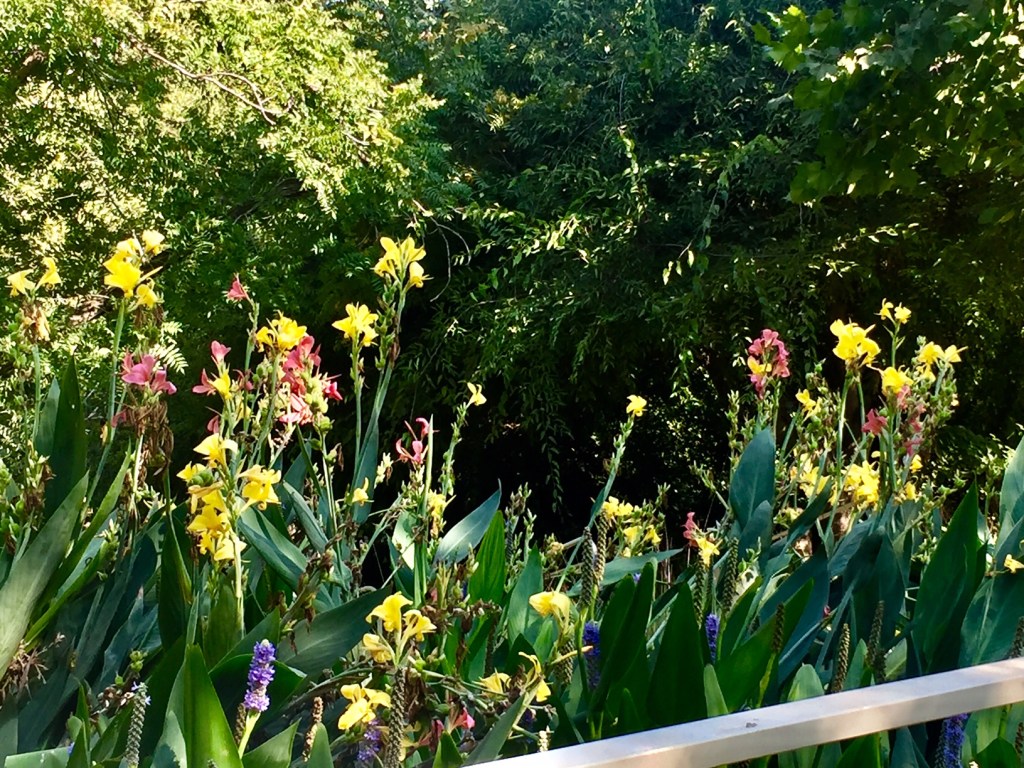
Cannas in a watercourse
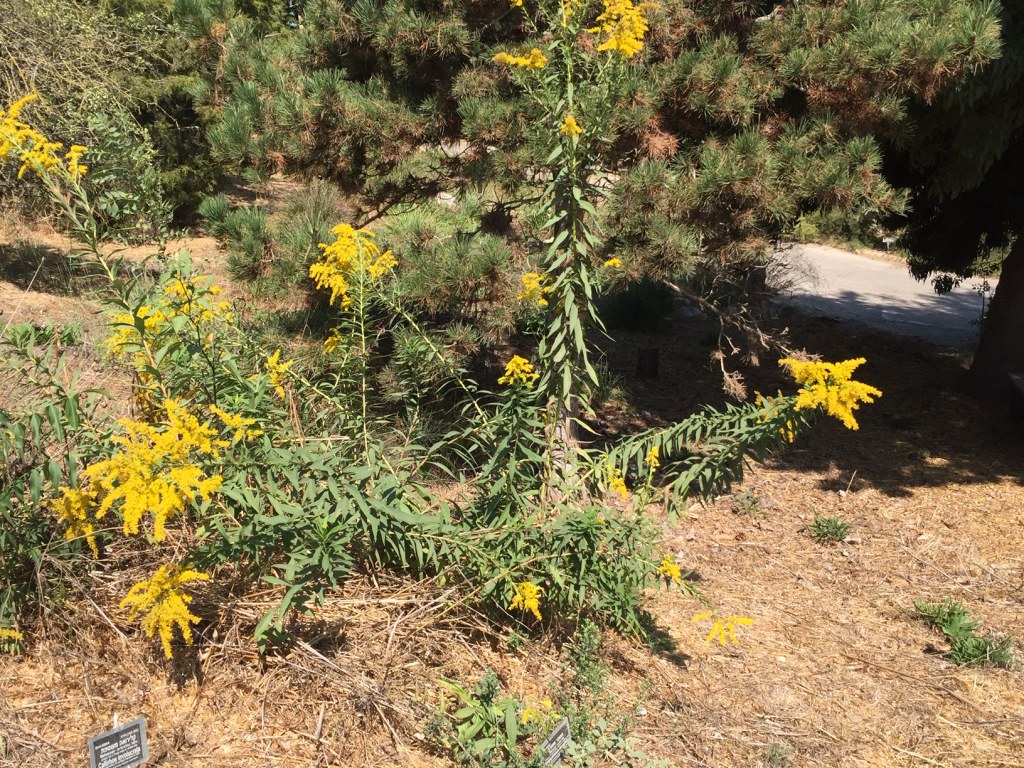
Before the davveners were out of musaf (the “additional” part of services), I had finished my meal and packed myself some water and a snack, and I set out over the hill and down the other side to go to the Botanical Garden. It was open today, although not staffed — there was one Palestinian or Israeli Arab manning the gate and taking the money. Not too many people go to the gardens on a major holiday, so I had a very nice few hours wandering around in relative solitude. It’s not the best season for the gardens — it will all really come alive once the rains arrive in October or November. Still, I took many pictures and saw lots of beautiful things, some of which I have posted through this piece and at the end.
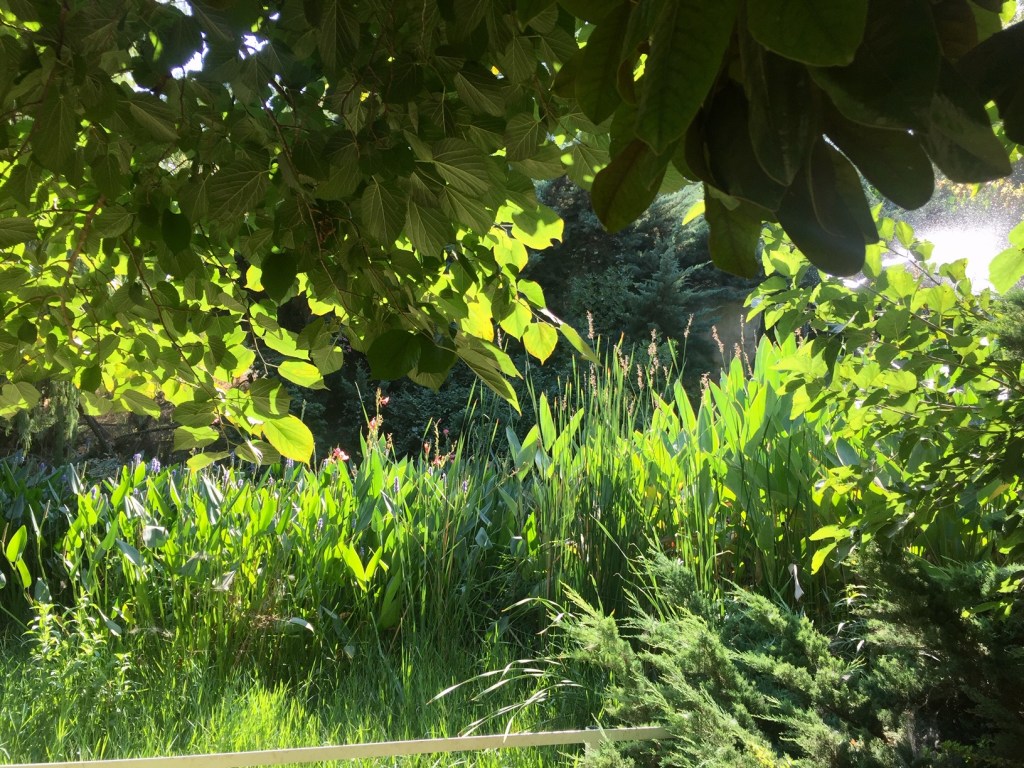
Ahhhh — green!
I also saw a lot of birds. There were some warblers and other LBJs (little brown jobs) which I was unable to identify, but with the help of my trusty cellphone I did identify the following: Syrian Woodpecker (I also see him here on my phone pole — his call is exactly the same as our Red Bellied Woodpecker); Common Redstart (a completely different bird from our Redstart); Chukars (a kind of partridge, very beautiful); Eurasian Jays (also quite stunning); Palestinian Sunbirds (similar to hummingbirds but bigger — I see them here sometimes too); the familiar naturalized Ring Necked Parakeets, and also naturalized Myna Birds; the ubiquitous bulbuls, pigeons, and turtle doves; and, very startling, a European Oystercatcher wading in the lotus pool.
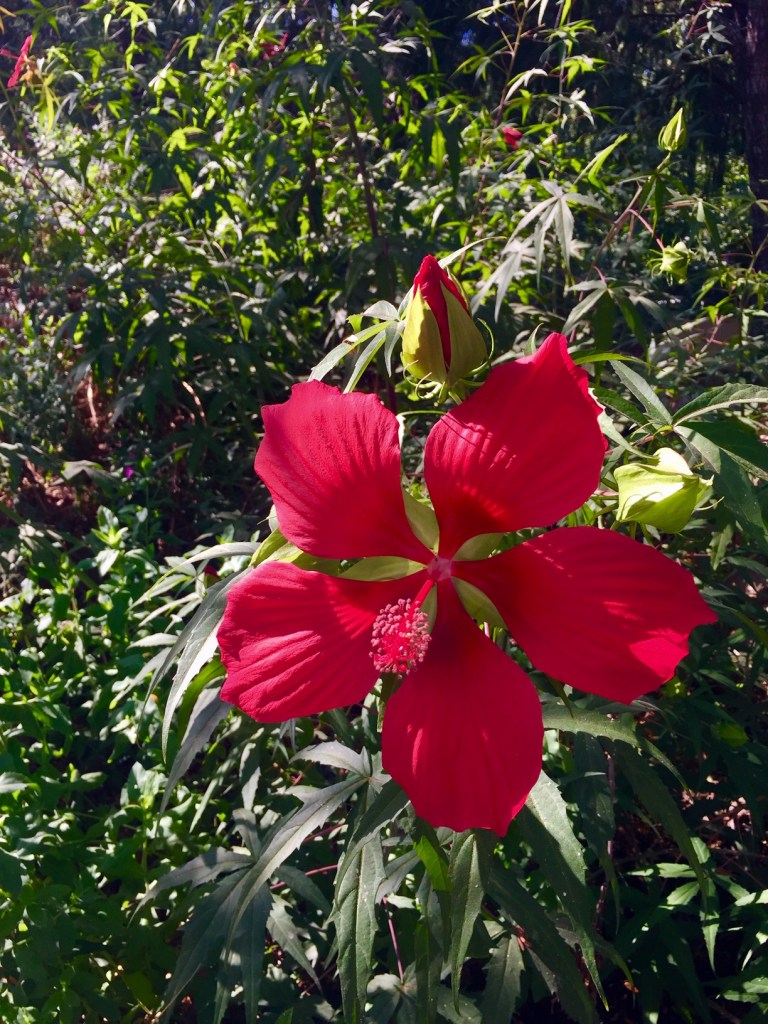
Some kind of hibiscus
So — a sweet holiday all around. I know there are other things I’ve meant to write about — my tour of the Southern Excavations at the Temple Mount, and the second day of our Shabbaton in Ein Gedi — but they will have to wait for another day I guess. I wish that you may all be sealed for a good year — g’mar chatimah tovah!
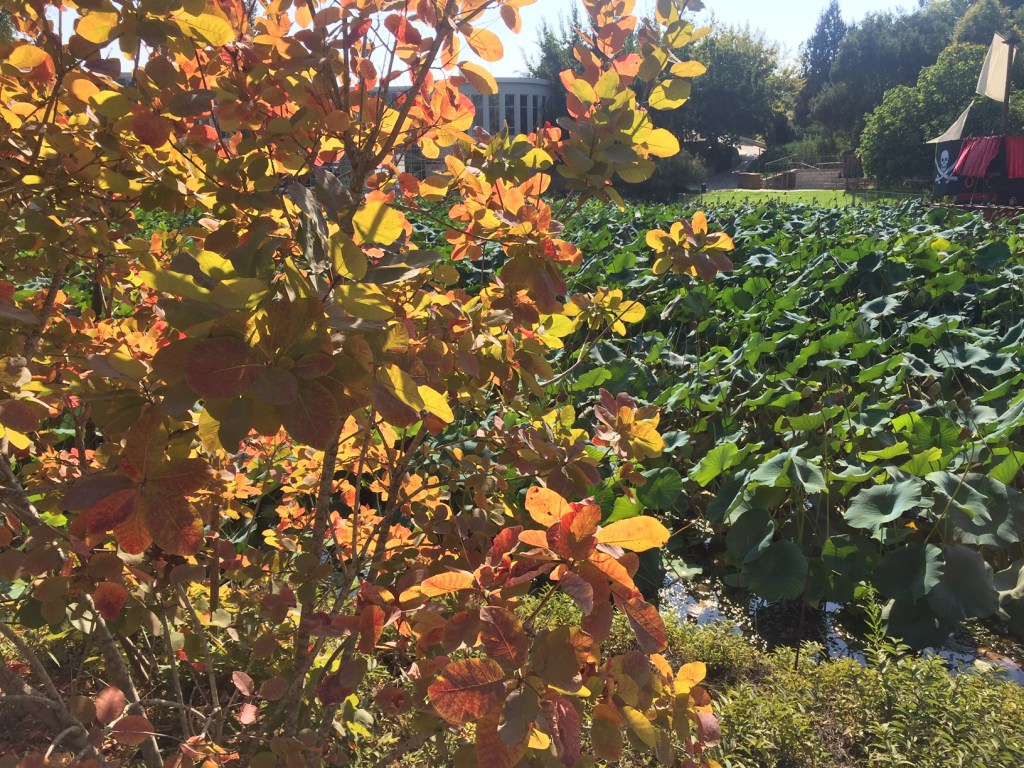
The only fall color I’ve seen in Israel — a Smoke Bush (cotinus).Pretty cool, huh?
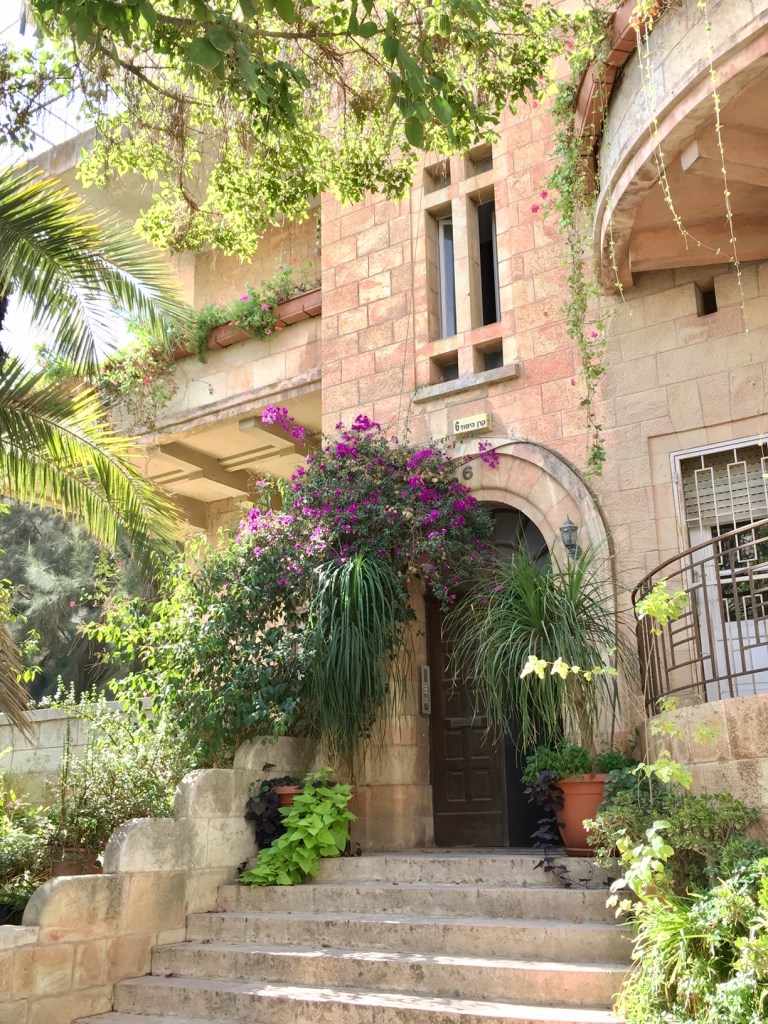
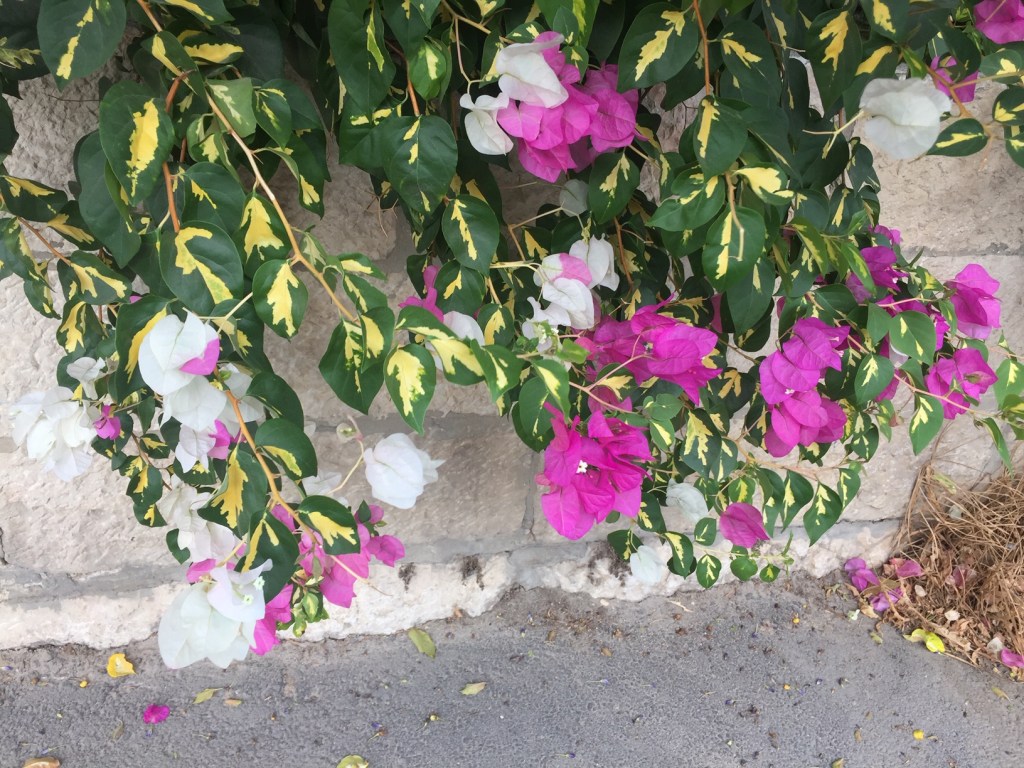
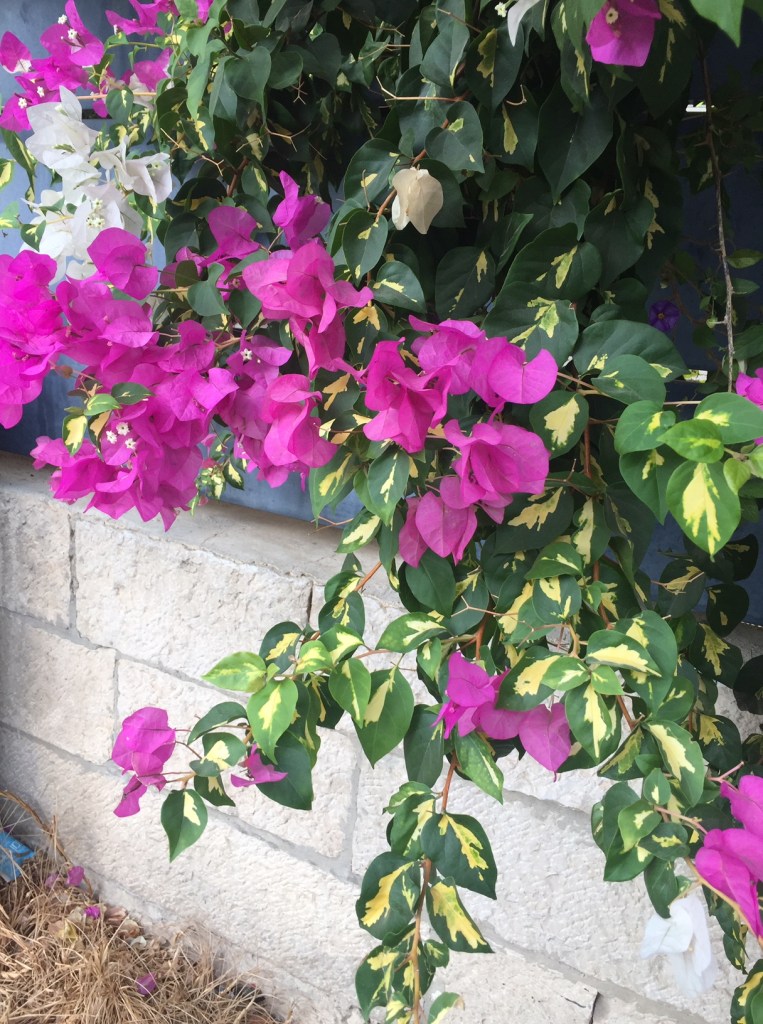
Sometimes G-d seems to be sending us messages — even those of us who don’t really “believe” in “God”. I got up from my seat just now and saw that two bougainvillea bracts had blown in through the french doors onto my tiled living room floor. “Where did these come from?” I asked myself — although it’s really no big question, as bougainvillea is one of the most common plantings here. I know the people on the top floor of my apartment building have a bougainvillea – when I look up from my mirpeset it’s hot pink bracts flare against the intense blue of the sky.
But in asking, I received another answer. Tomorrow, September 29th, is Bob’s and my 28th wedding anniversary. At our wedding, my sister and a family friend scattered dried bougainvillea blossoms which they had collected from the friend’s greenhouse, in place of the traditional confetti. I can see in my mind’s eye the pictures my husband’s son and daughter-in-law took — my smiling sister in her banana-yellow jacket upending the basket of cerise flowers over Bob in his tweed jacket and me in my Prussian blue dress with the metallic gold dots. I can’t share those pictures, which are not digitalized, but here (above and below) is bougainvillea I took a few days ago.
Bob and I used to go out to dinner at T.J. Buckley’s for our anniversary — in the “old days” we paid for our meal with organic shallots we’d grown ourselves. (Here’s the link, for those of you who may have missed the pleasure: https://tjbuckleysuptowndining.com/) In years like this one, when Rosh HaShanah and our anniversary coincided, we’d move the dinner to another night. When I’m sitting in services tomorrow night (not leading anything at all, for the first time in well over a decade), I may be thinking of Bob, and of Michael Fuller’s delicious and beautiful (and entirely treyf) pate plate. We didn’t make it out of the house on our very last anniversary, but the year before that, even with Bob in his diminished condition, we did. In my heart I’m there with him again, or even further back, standing under that shower of bougainvillea on a crisp September day, newly married, newly settled in our little house, and feeling as if all my life’s wishes had been answered.
Originally I took these photos because I’ve never seen a variegated Bougainvillea before…