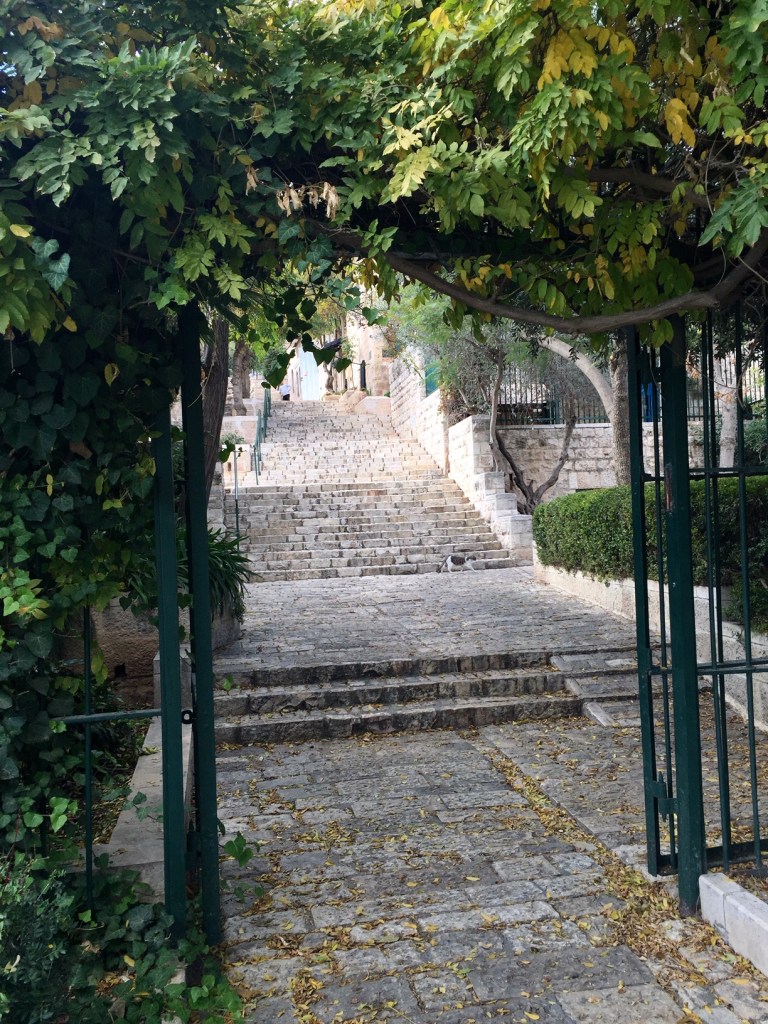
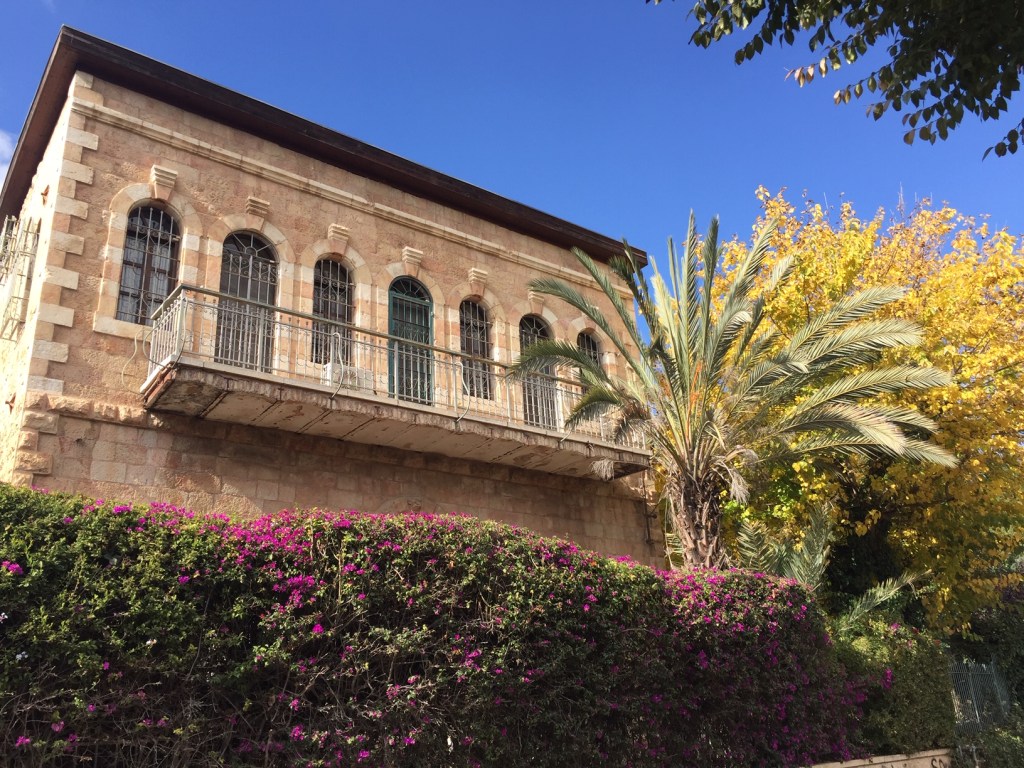
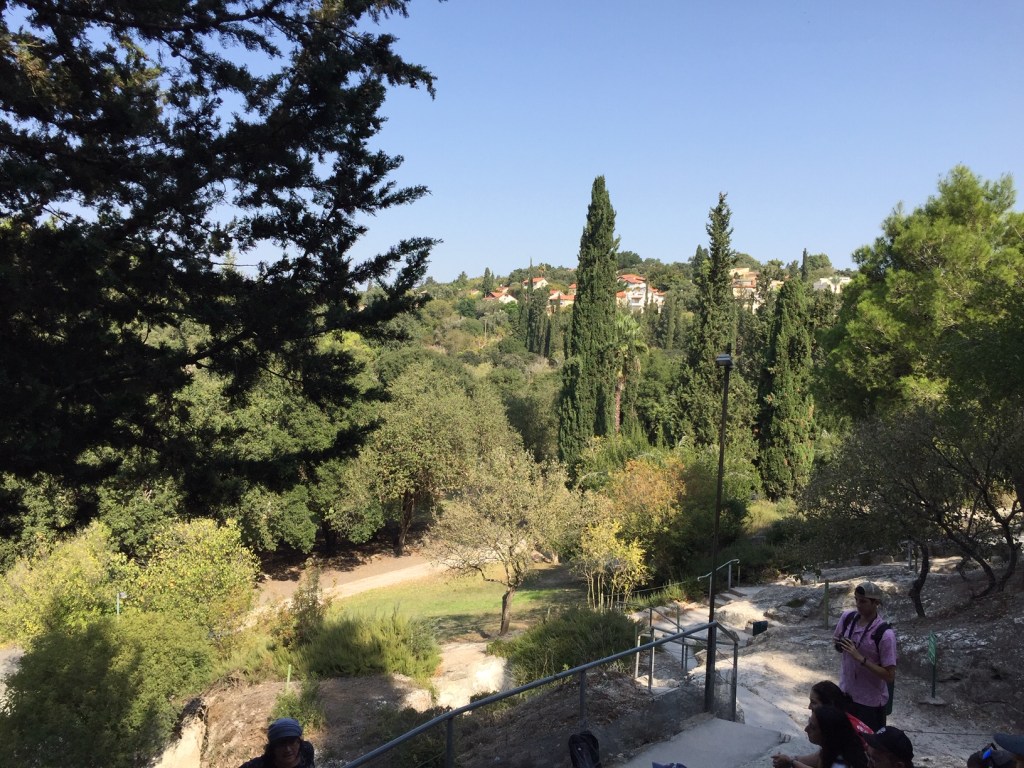
Winter in Jerusalem. Haze settles down on the hills — a mixture of moisture and fine dust. The city looks moody and atmospheric, a backdrop for a movie in which people have lots of intimate and ultimately despairing conversations. The wind picks up, blowing the white furniture on your mirpeset into the corner and covering it with a brown film. Leaves come down, branches, and random things people in higher apartments left outside. Then rain in great gusts.
Perfect weather to stay inside — especially if you have a cold. Read a book, watch “The Crown” on Netflix with its equally gloomy lighting. Drink tea. Feel sorry that you are not attending all the parties you were invited to: a birthday at Birateinu (Our Beer), a sufganiyah and mimosa brunch, Shabbat dinner, a Motsash (Motsei Shabbat — End of Shabbat) hot chocolate party. Feel, at the same time, glad you don’t have to go out at all!
Have you wasted your life? Are you wasting it now? When are you going to do something remarkable, write that novel? Here you are in Jerusalem, and you’re not doing a thing different from what you would do at home. Are you, in fact, capable of facing these days, weeks, months ahead, struggling with your pitiful Hebrew, contending with foreignness every time you leave the apartment? Was this, after all, a good idea, these months abroad? Do you really have it in you? You light your Chanukah candles, your Shabbat candles, watch the days pass, feel sorry for yourself.
Then one day you wake up feeling better. The sun is out, the wind has died down, the rain has washed away all the dust. Green shoots are poking up out of the bare soil and out of cracks in every wall and sidewalk. Your nose has largely stopped running. You pull yourself together, take your agala (“Bubbe cart”) and your list, set off for the shops. You manage to sign up for a mardon (membership card) in the natural foods store without using more than one or two words of English. You find an enormous organic cauliflower, and – -the find of the month — black currant jam and marmalade from Chivers of England. You make a date to meet friends from out of town for dinner. You do some laundry and hang it out, sweep, wash dishes, attack the mildew that grows on every sheltered surface in your basement apartment.
Life goes on, after all. You are not incapable of tackling it. Perhaps, even, there is something to be said for being in a place where instead of snow and ice, there is only dust and rain, Where “cold” is 45 degrees fahrenheit, where lemons ripen in people’s small yards, and where most of the population is actually celebrating the same holiday you are….
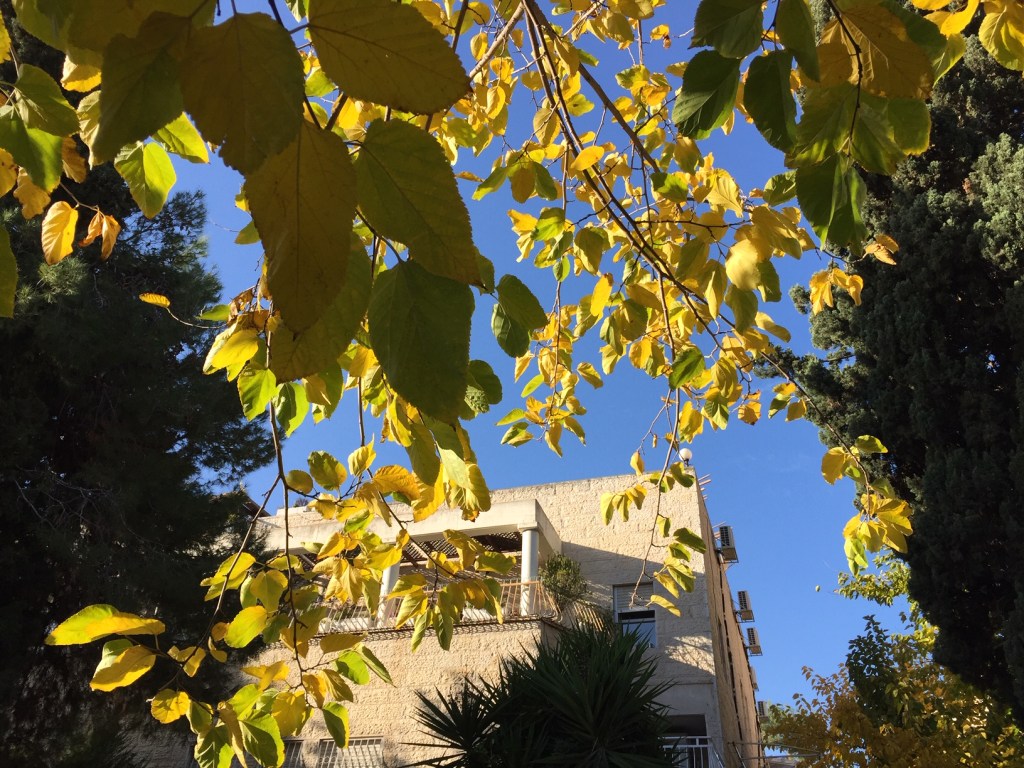
Winter in Jerusalem. Some days warm and sunny, with the deciduous trees turning yellow and dropping their leaves, like October in Vermont. Other days (like today) chilly, extremely windy, with heavy rain showers and occasional rays of sun. Yesterday the air quality was officially rated bad — with lots of humidity and dust, or “fine particulate matter”, pulling a blanket of haze down on the city.
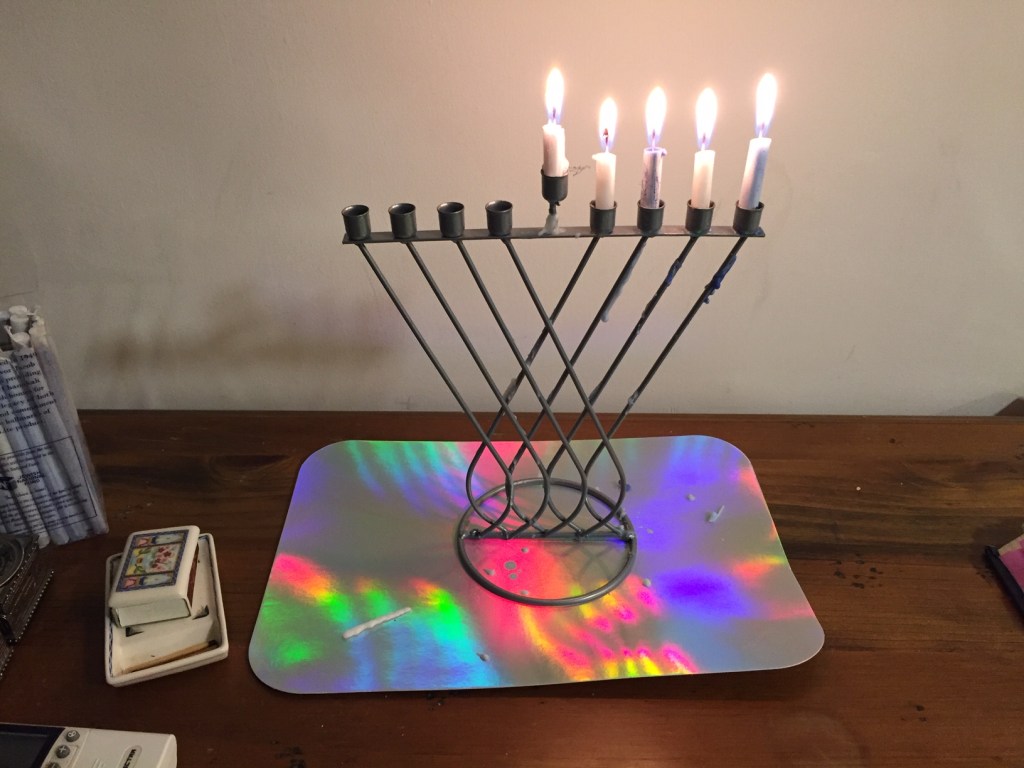
Underneath, I used the shiny cardboard cover for a baking pan — it makes a pretty show!
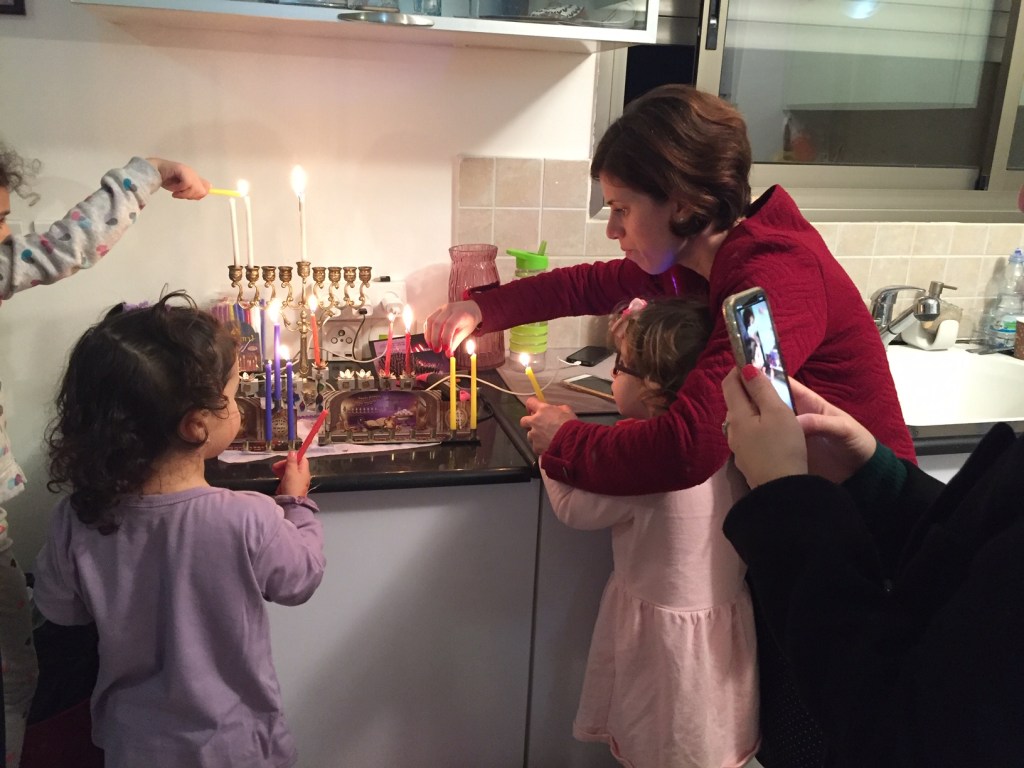
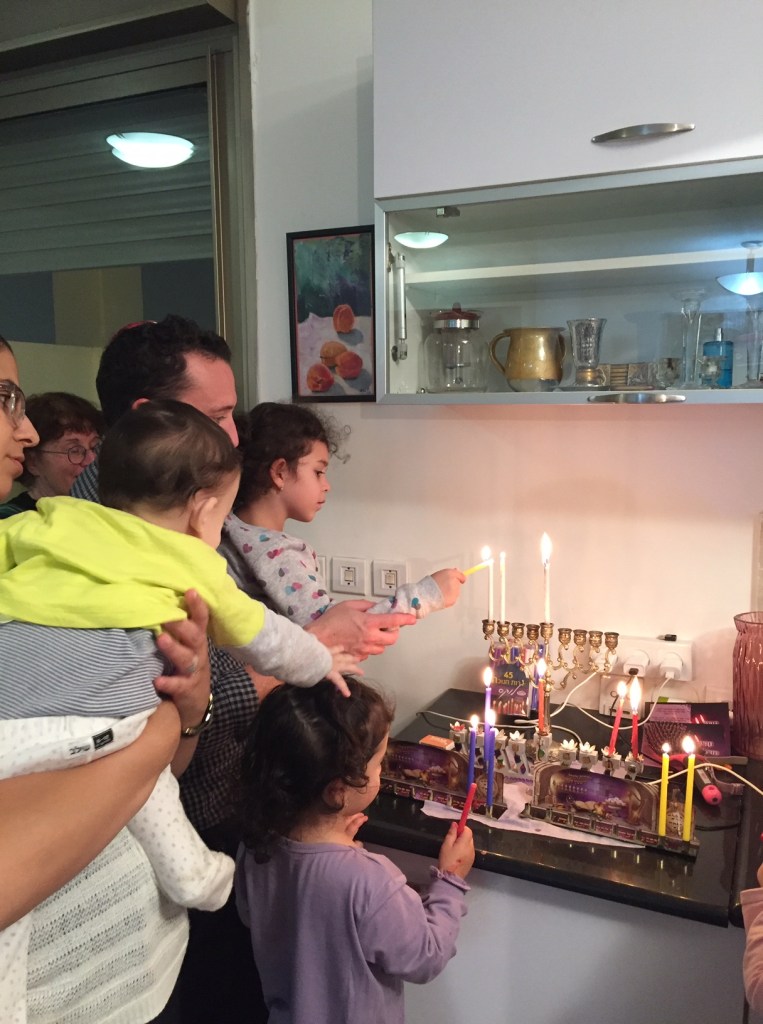
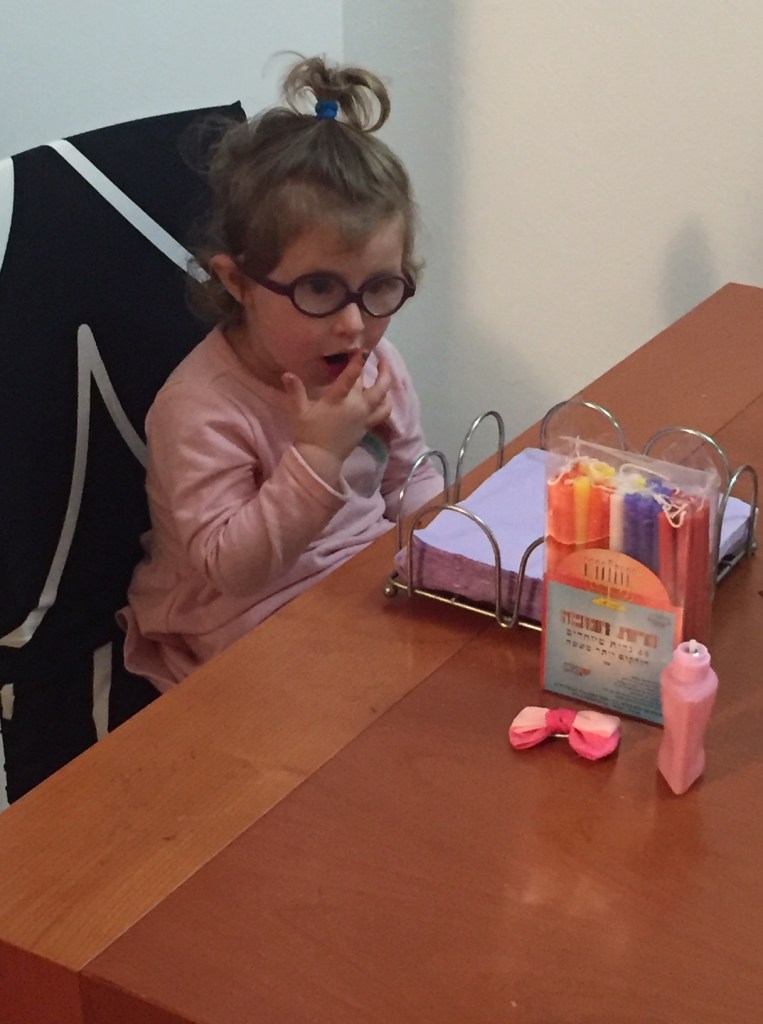
I had thought to try an olive oil and wick chanukiah this year, but in the end, settled for what was easiest — buying the last, slightly damaged chanukiah at Shufersal (the supermarket) and using the candles that a previous tenant left in the apartment. We recently read the the Mishna and Gemara on lighting for Chanukah in two different classes. I now know that as a ground floor dweller, I am supposed to put my chanukiah outside b’reshut harabim (in the public domain), not more than a hands-breadth to the right of the door as one goes out (so opposite the mezuzah), not too high. But I don’t have a glass box to put it in, and didn’t want to start a fire or have it blow out. And no one walks past my windows. So I put it on the table, which is the option one is really only supposed to follow if one is in fear — which is the last thing I feel here about putting up a chanukiah!
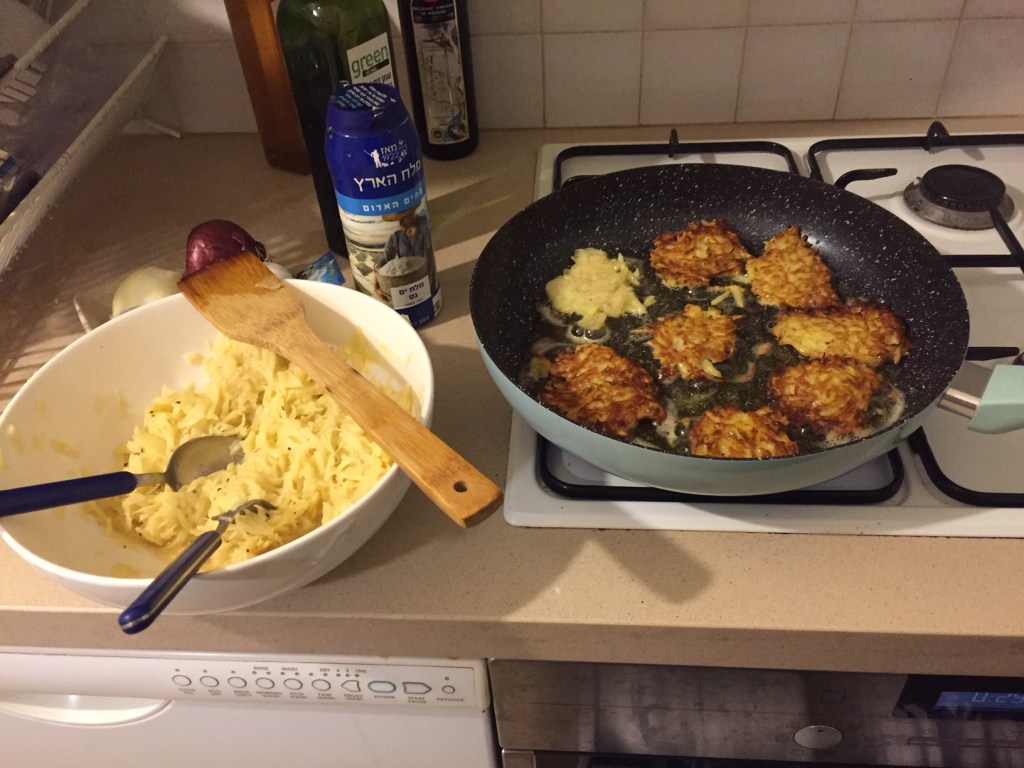
My Hebrew College teachers Cantor Doctor Brian Mayer and Cantor Lynn Torgove came by as the first night of Chanukah was coming in — a nice gift for the holiday. They were on their way to a levavot (latkes in Hebrew) party at the home of one of Brian’s sons, who is here teaching English for a year at the only school in Jerusalem where Israeli Arabs study with Israeli Jews. They’re here in Israel for two weeks. After they left I lit my first candle, and made levavot, most of which I took my Mishna class the next morning.
I used olive oil, and a little corn flour — they came out quite tasty.
The second night I went to Tel Aviv with granddaughter Yochi, her daughter Golan, and grandson Hagai. We went to the apartment of my oldest grandson, Avishai, and his wife Libat, and their three wonderful children. Laurie, the mother of my grand kids, was also there, and Gal, the youngest granddaughter, who is back for a few weeks from a stint selling Israeli cosmetics in the US. It was a fun evening.
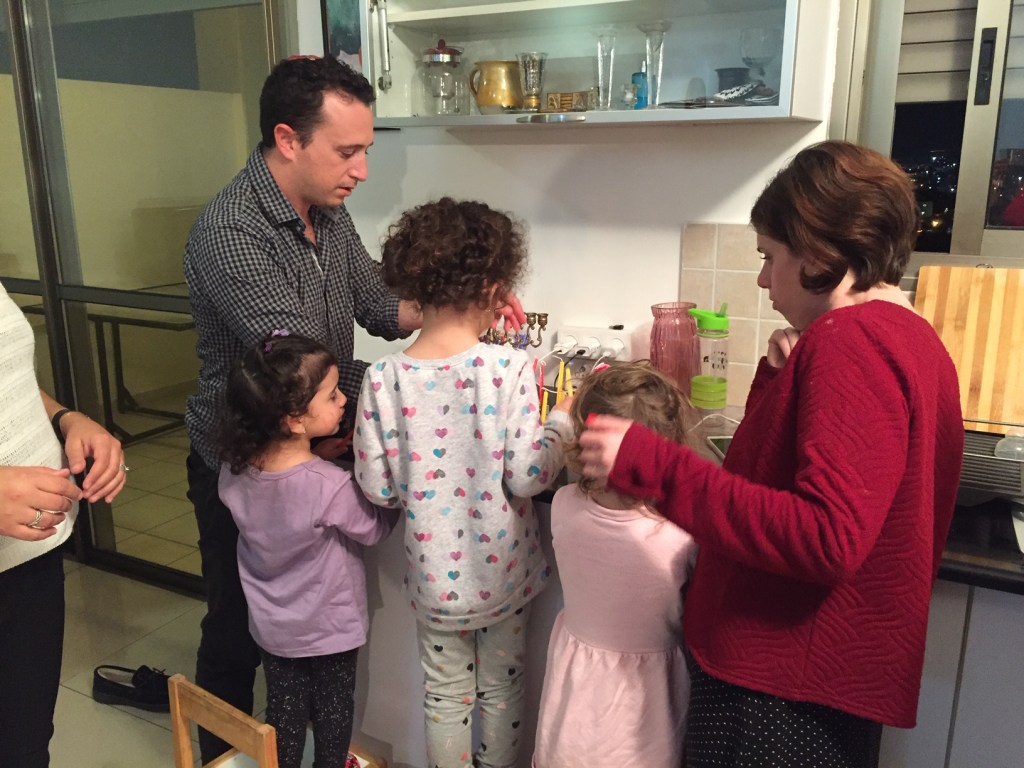
Avishai, his daughters Ella and Shaili, Golan, Yochi Ella and Golan, the two cousins, are almost exactly the same age — a matched pair, one dark haired and one blonde, both as cute as can be Libat, Avishai, their daughters Ella and Shaili, Golan and her mom Yochi.The newest addition to the family, Shoham, reaches form his mother Libat’s arms toward the light his sisters are kindling. Savta (Grandma) Laurie looks on from behind.
We hung out, lit candles, sang brachot (the tune is different here in Israel — probably a Mizrachi — Middle Eastern — tune). Then we ate a vegetarian dinner — a nice bean stew, sweet potato latkes, sufganiyot. I got to practice my Hebrew comprehension as the siblings chatted in their speedy Hebrew.
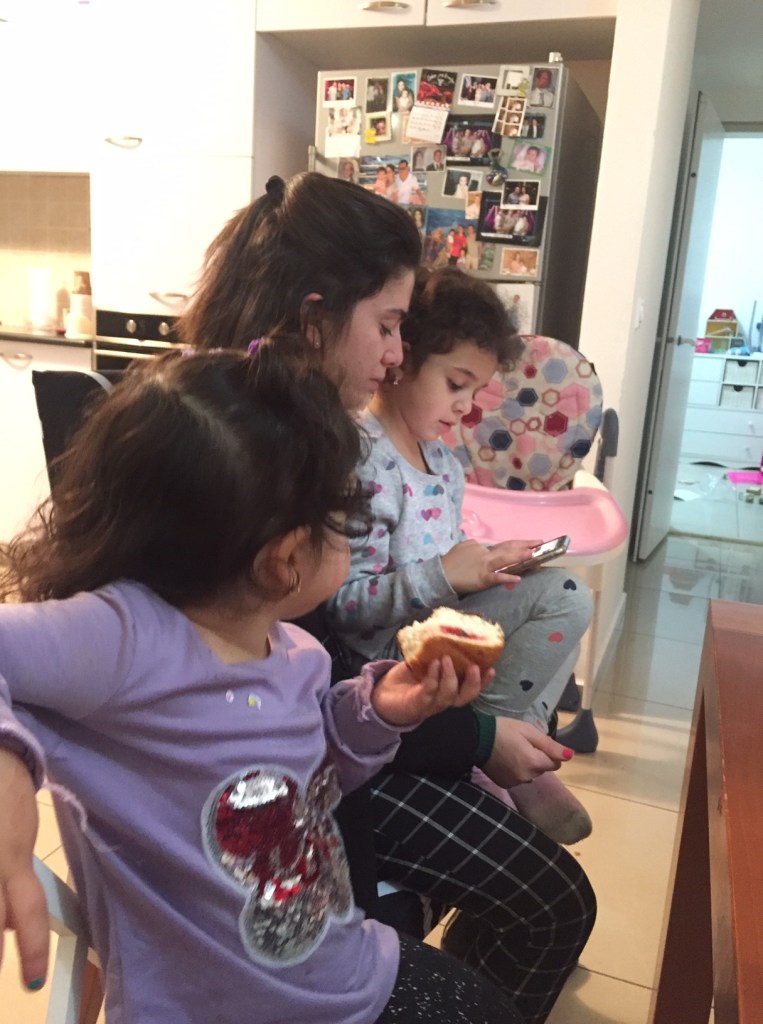
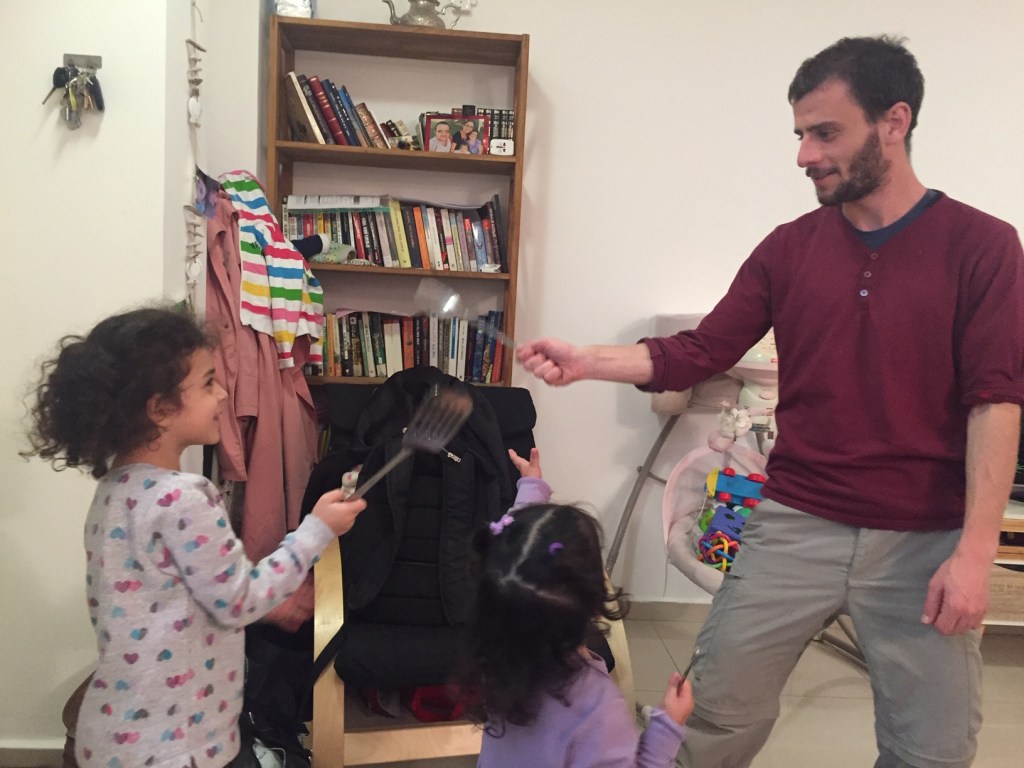
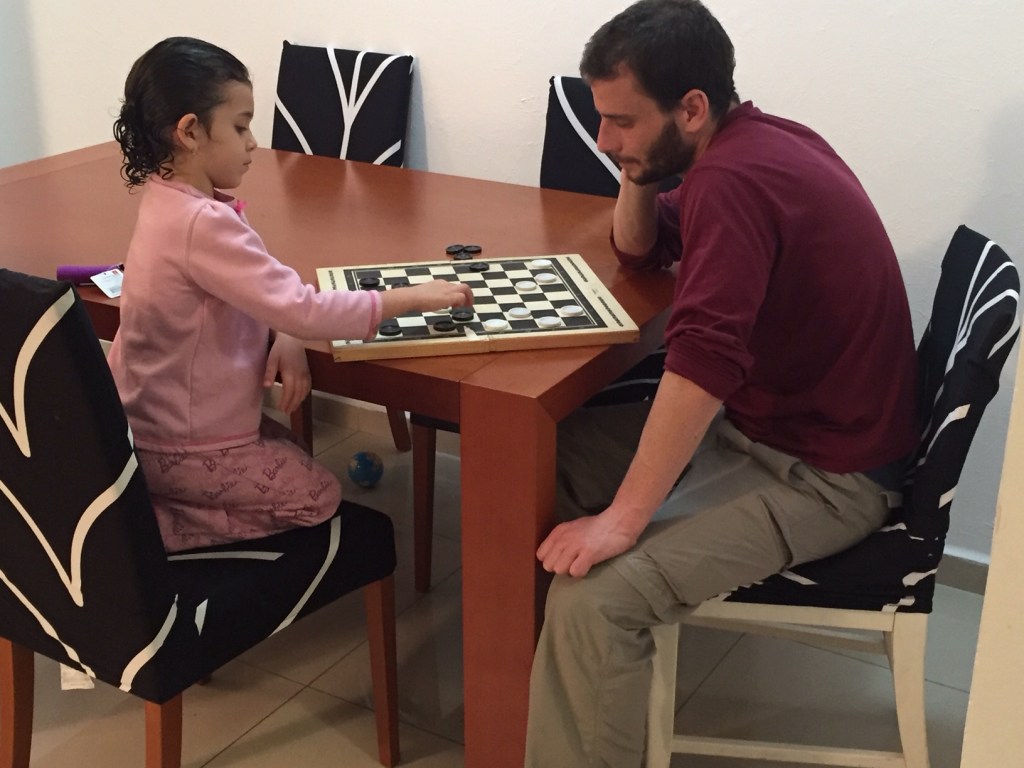
Proud abba Avishi with his first boy, ShohamGolan looks mesmerized by her sufganiyah (doughnut) (hidden under the table)Dodah (Aunt) Gal (youngest of my grand children) plays a game on her phone with Shaili and EllaShaili fencing with her Dod (Uncle) Hagai (with kitchen utensils) — little sister Ella wants to get into the actionSuch a good uncle! Playing sheshbesh (checkers).It’s hard to get a picture of Safta Laurie, she is usually busy documenting the event herself!
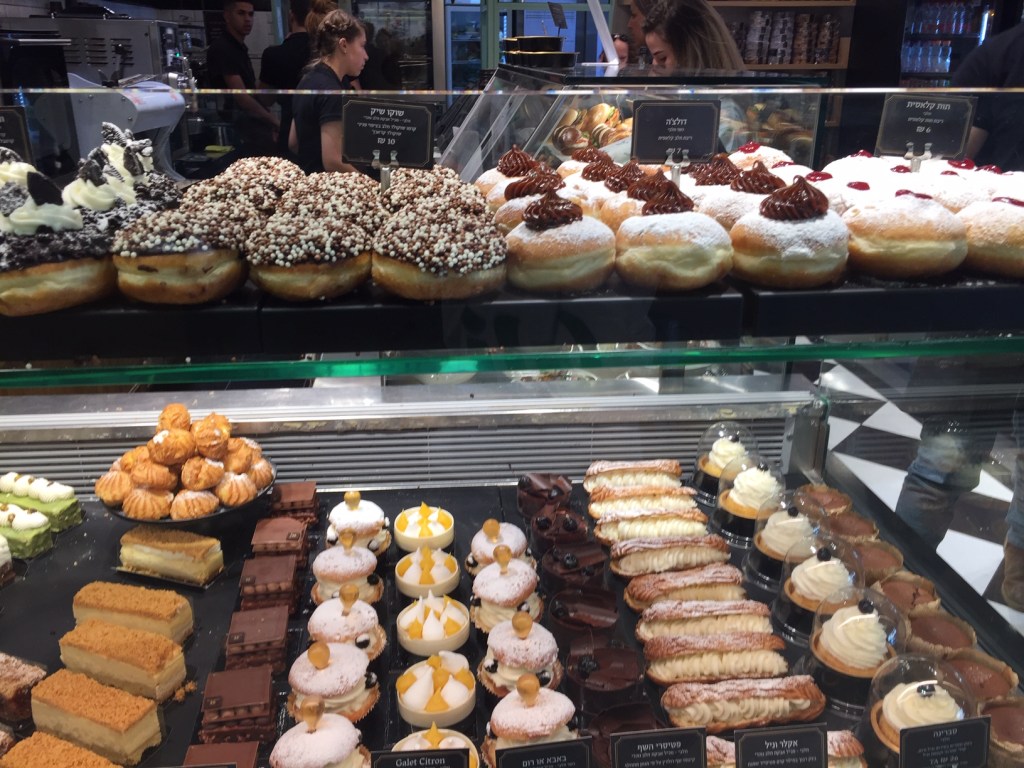
Christmas does exist here, but not in my neighborhood. I’ve seen one apartment with a Christmas decoration in the window. Chanukiot are everywhere — many outside apartments in glass cases for all to enjoy the mitzvah) and sufganiyot are ubiquitous. The best sufganiyot are rumored to be at a bakery in the city center (mercaz ha’ihr), but for sheer fanciness you can’t beat the chain of Roladin bakeries. In my Mishna class we did a taste text from three bakeries — the simplest strawberry jam ones from Roladin were by far the tastiest.
For the third night of Chanukah I made two more batches of latkes — one with onions and one without, at the request of the one of the hosts. The party was at the apartment that friends Alden and Doug share. In commemoration of the tradition of Doug and his mother (of blessed memory — she died in August), we ate latkes and chicken wings. It was a very convivial gathering — half the student body there, it seemed. Doug talked about his mom, and how they first came to eat chicken wings and latkes (after a fortuitous trip to Wegmans). There was plenty to drink — alcoholic and otherwise — and plenty of interesting conversation. It was pleasure to get to know some of my fellow students outside of a classroom or tiyyul. I walked home with three of my classmates, and found the trip to be short, as compared to walking to the party alone with my burden of latkes! A (Jewish) friend invited me to join a Christmas party at her house, and afterward to join her for midnight mass in the Old City. But I had had a long day, and it was really kind of nice not to think about Christmas at all!
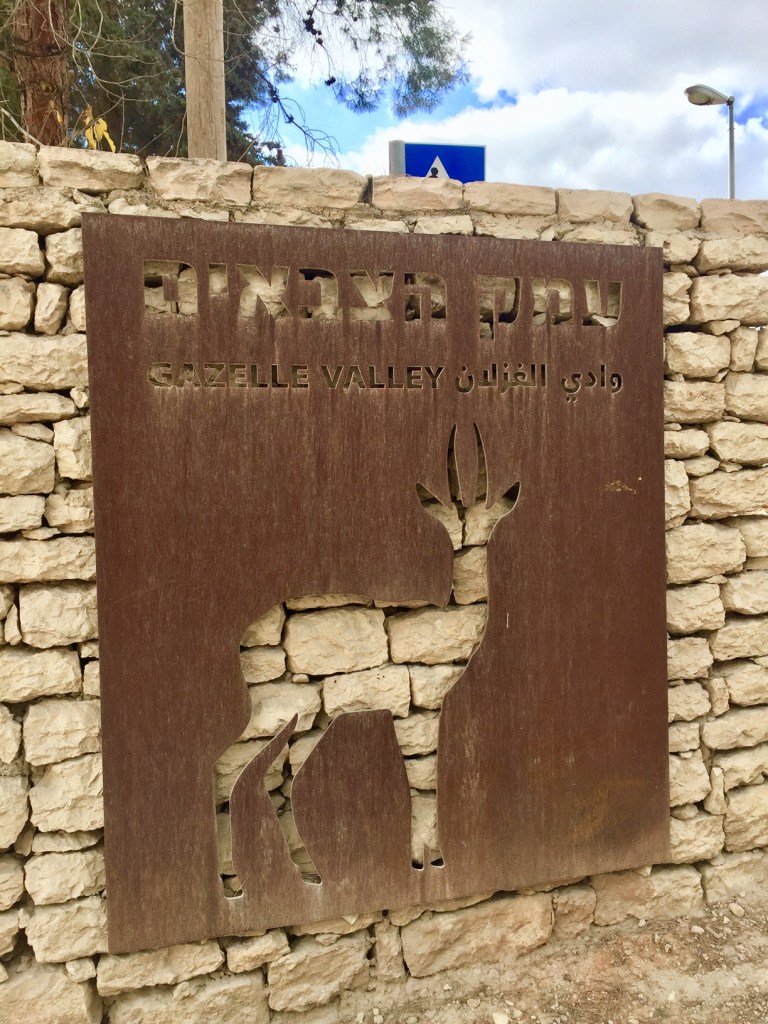
After my day of being in the Old City, and in particular my visits to the Western Wall and the Church of Holy Sepulchre, I decided that I needed a day without so much religion. I set off over the hill for the Gazelle Valley — Emek HaTzeva’im. This small nature reserve is located in a valley in the middle of a lot of development. It was once fruit orchards, and wildlife, including gazelles, roamed there freely. According to the Reerve’s website, “This valley was once a home to a herd of over 30 wild gazelles. In the year 1993 their passage to the mountains surrounding Jerusalem was blocked by a new highway, and those gazelles were trapped in the valley. In the following years the herd gradually disappeared due to the threats of feral dogs, jackals and even humans, who chased the gazelles to the highway, where most lost their lives. A decade later, the area was designated to become a luxurious housing project, and the gazelle’s fate seemed doomed. Luckily for them, their human neighbors came to their aid. For more than 12 years the inhabitants of the neighboring streets fought to save the valley,and in the year 2015 Gazelle Valley Park was established.”
As you will see from the pictures I took, the Gazelle Valley does not feel very much like wild nature. Nonetheless, it is a valiant attempt to create hateva ba’ir — nature in the city. I spent several happy hours wandering around, looking at birds (I had brought my binoculars) and eating my lunch. Let me take you on a tour…
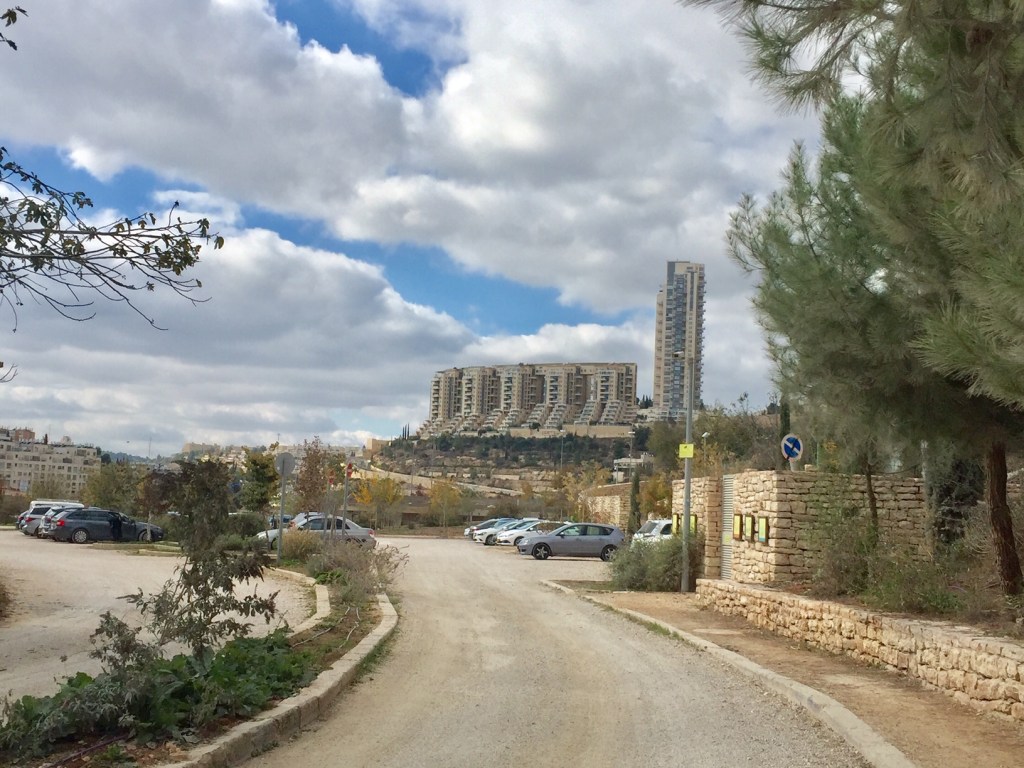
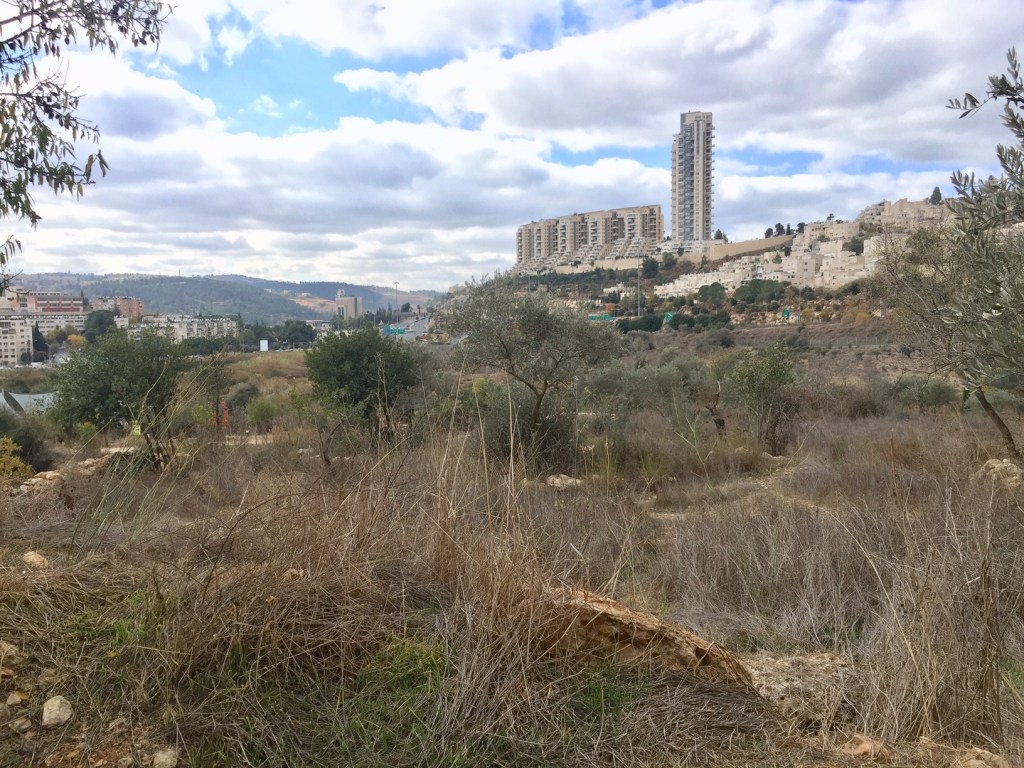
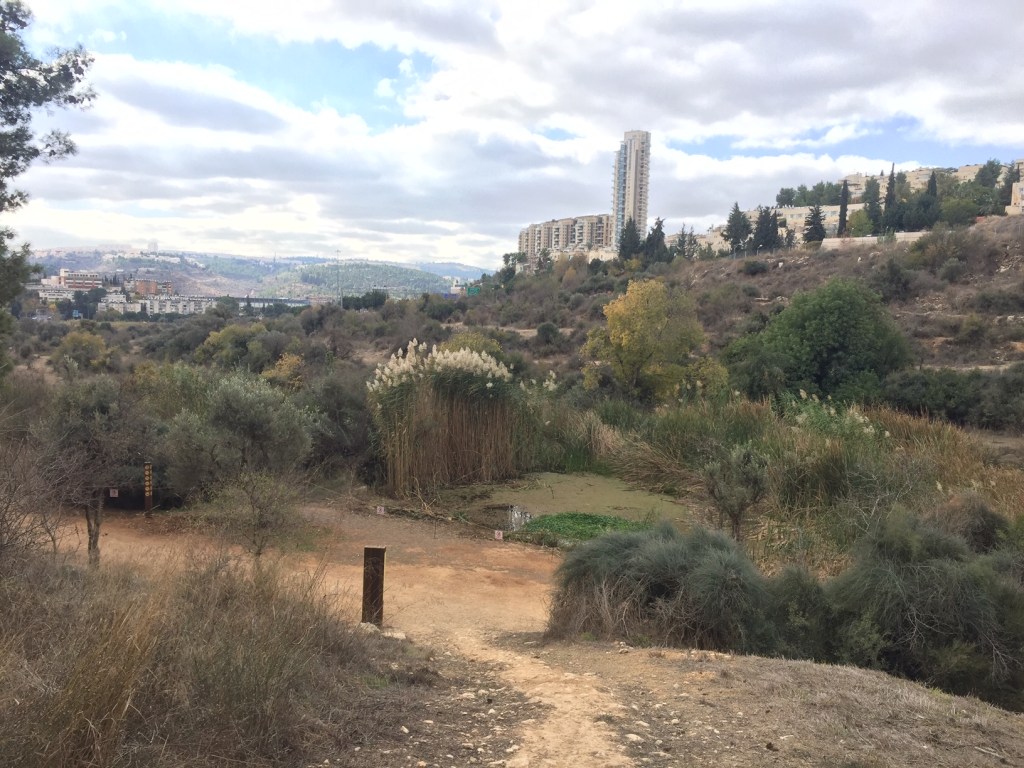
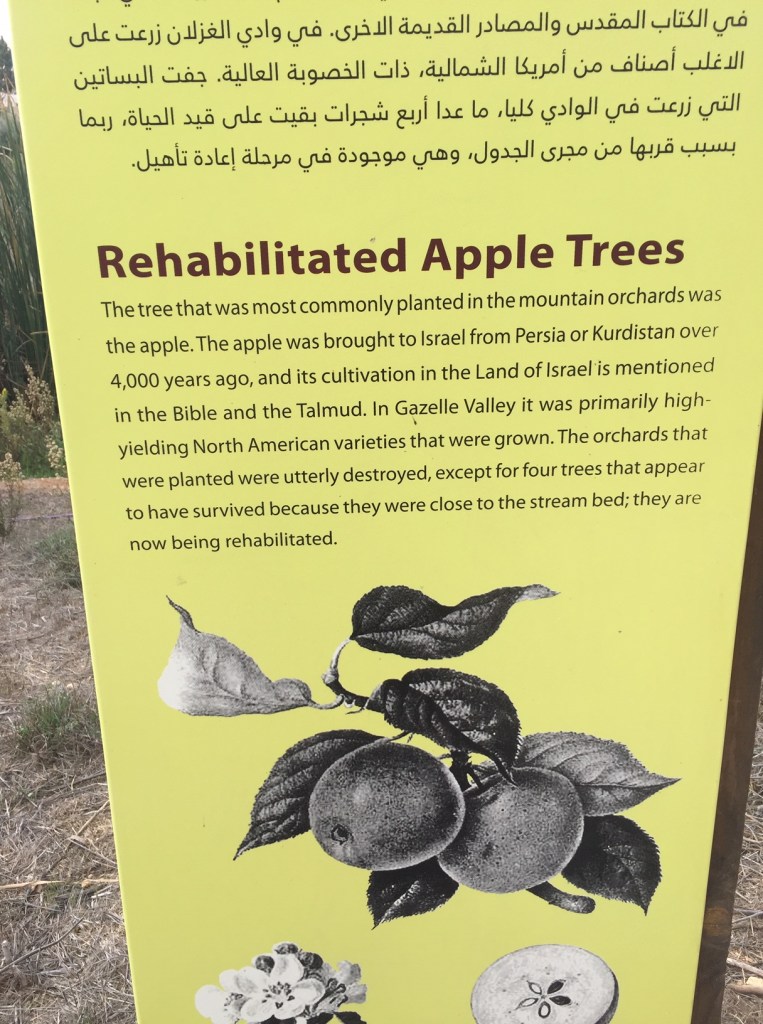
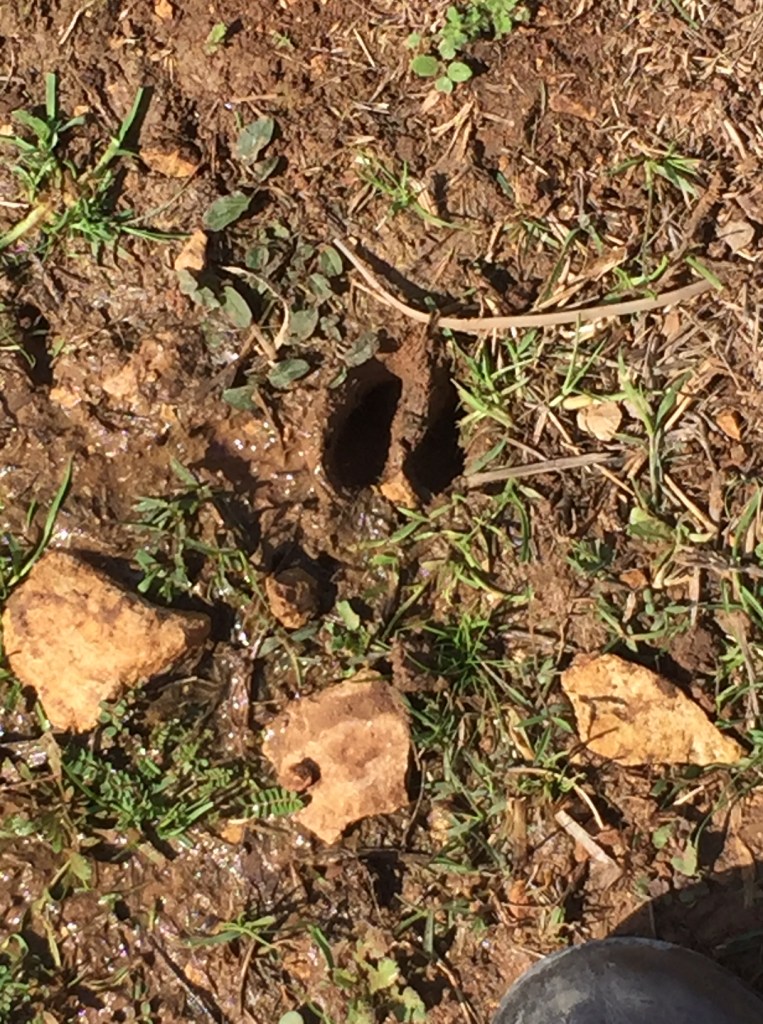
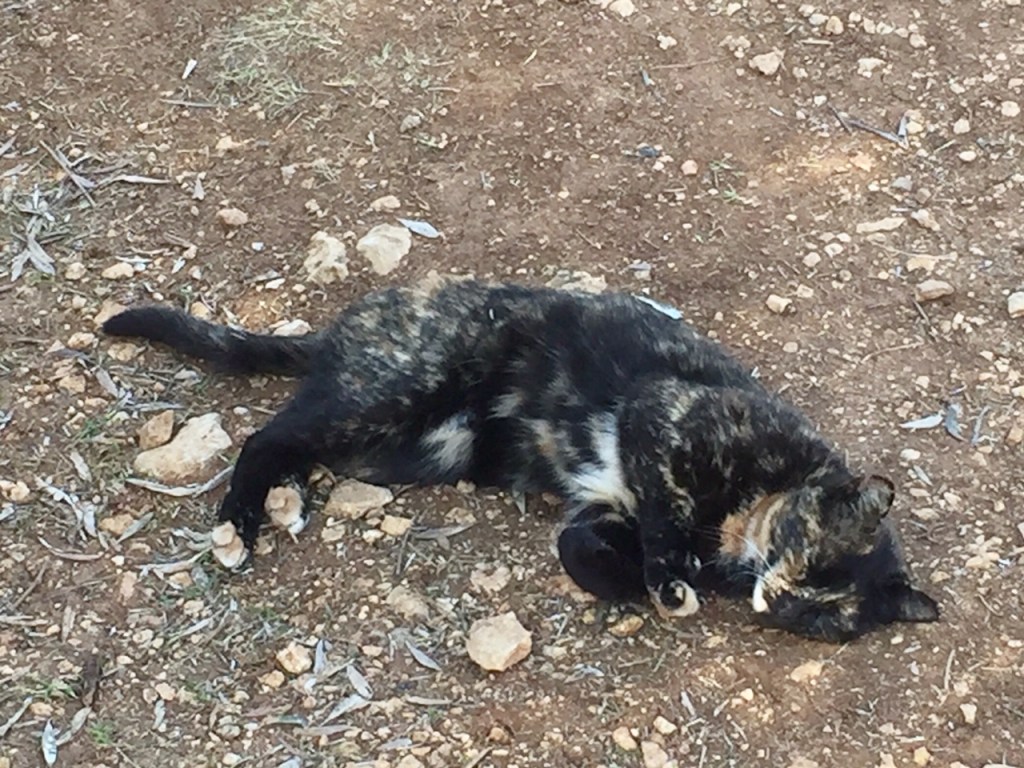
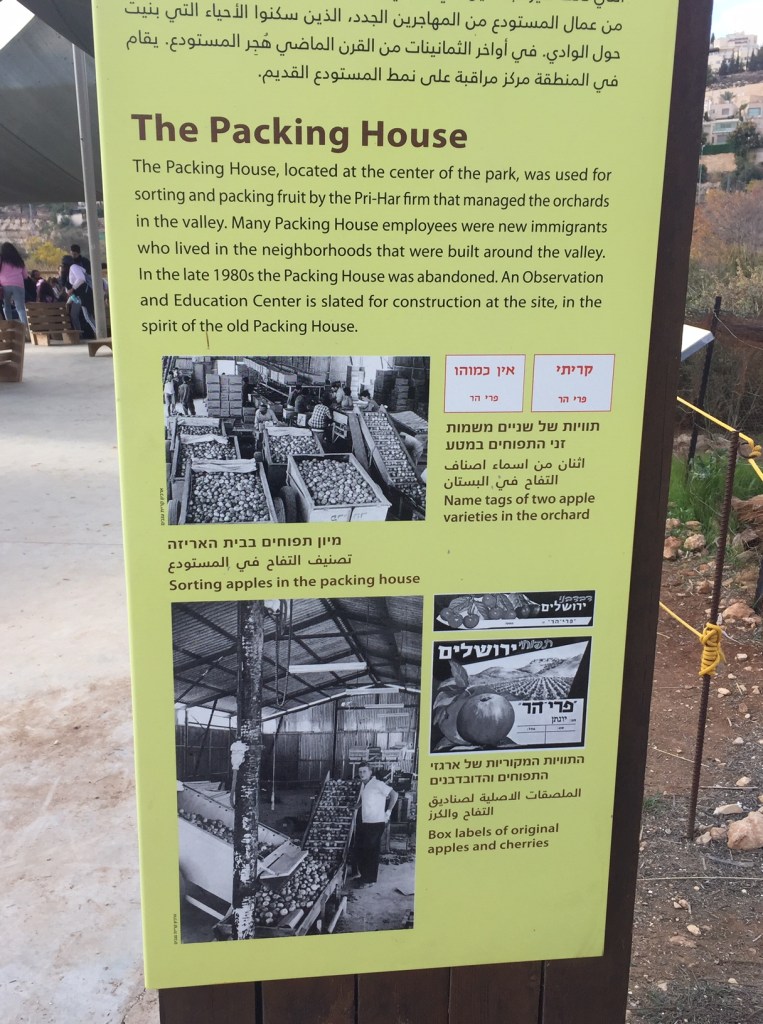
This is the parking lot of the Gazelle Park. The hideous development in the background looms over a huge section of South Jerusalem. There is no escape from this ugly building — it towers over the reserve. As you see, there is water in the midst of the park. They have created an area where water flows down the valley and is recycled back to the top. It attracted birds and amphibians. This was my first sign that there are actually gazelles in the park. Smaller than a deer hoof print. More than half of the park is fenced off from humans, and that’s where the gazelles were hiding.Even in this place where people are attempting to preserve and restore the natural habitat, the furry plague of Israel is at home. This kitty followed me for some time, inviting me to pat her, which I don’t do with wandering cats, even apparently healthy ones, for fear of ring worm.A school group was having an educational session in the area behind this sign.
I sat for a some time in the bird blind, looking into the swampy area at some birds. Then I sat on a bench and ate my lunch. I moved a chair close to the largest are of water, and observed many interesting water birds, including some I’d never seen before. Here’s a list of birds I saw in the Gazelle Valley: White Wagtail, European Marsh Hen, two or three different unidentified warblers, European Goldfinch (as seen on the cover of Donna Tartt’s The Goldfinch), Northern Shoveler, European Stonechat, some kind of Lark, Feruginous Duck, Garganey, Common Coot, Jackdaw, and a flash of yellow in the reeds that was probably either a Yellow or a Citrine Wagtail.
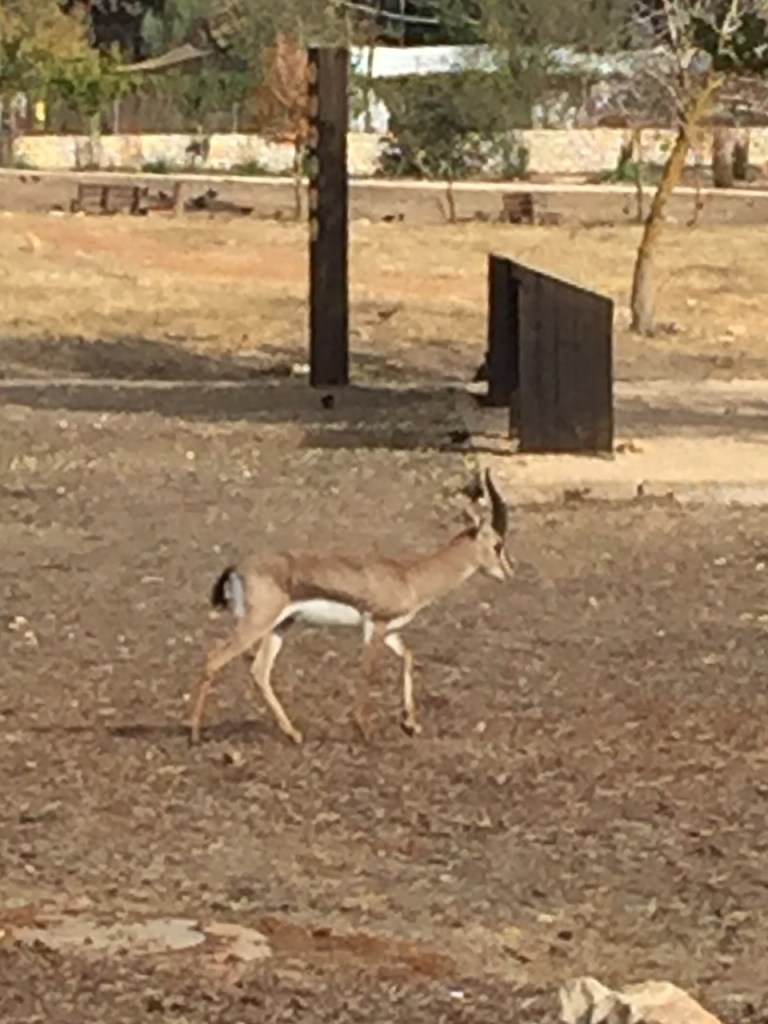
And finally, I saw a gazelle, ambling placidly across the picnic area.
It was at some distance, which is why the photo doesn’t have great resolution.
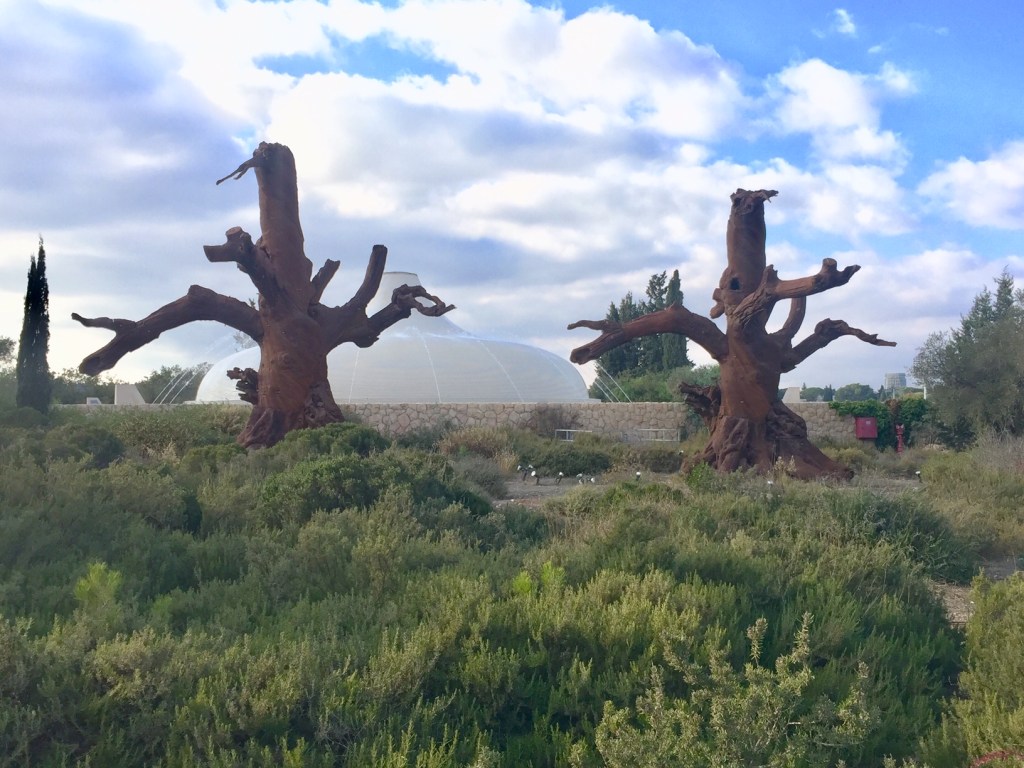
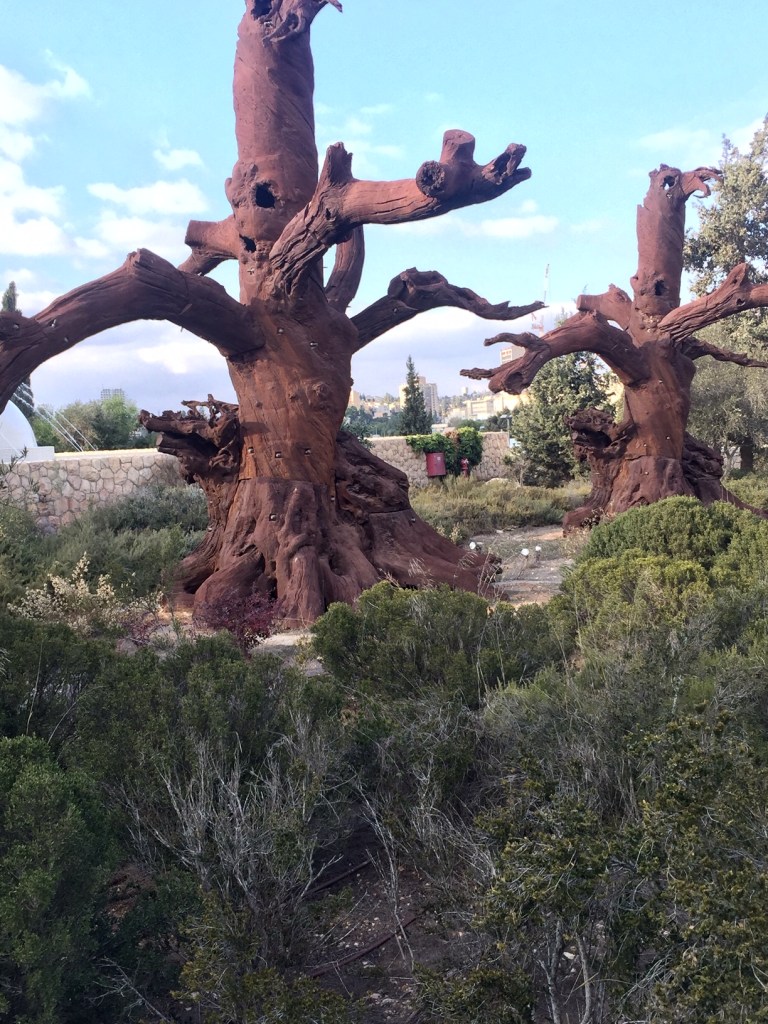
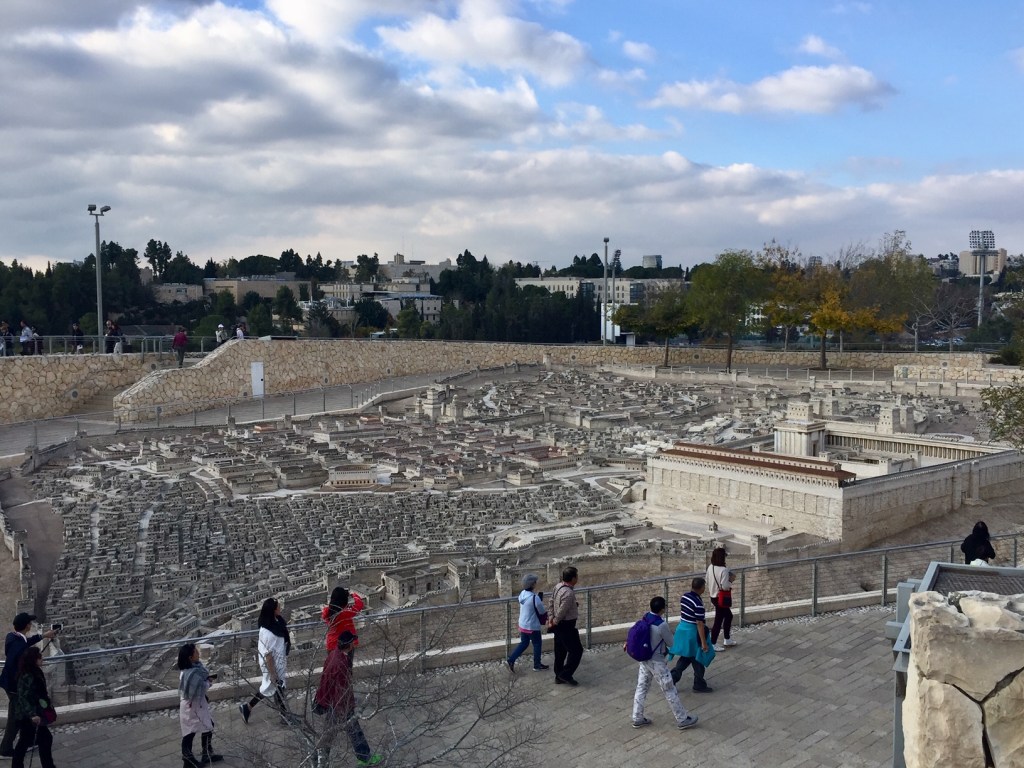
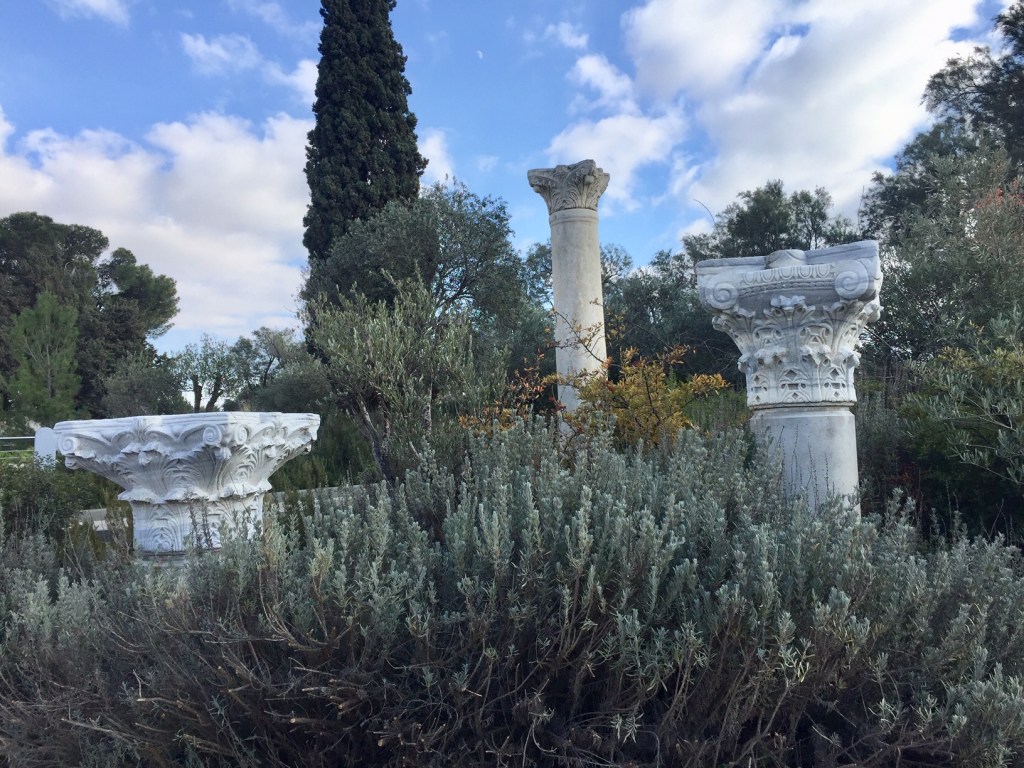
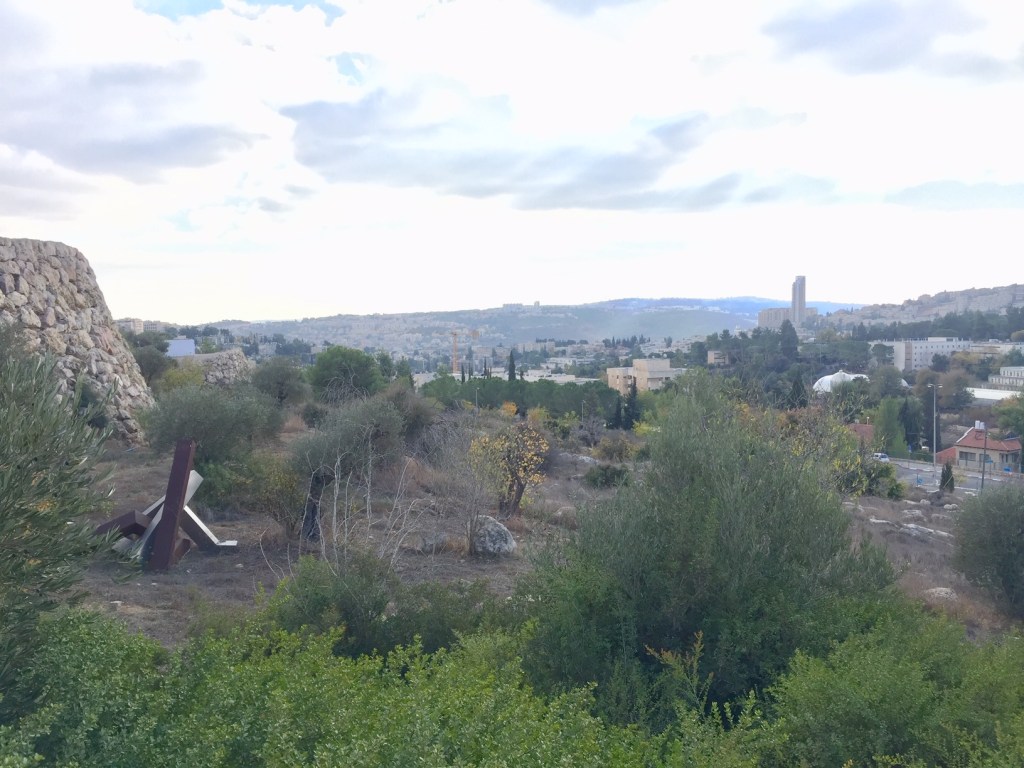
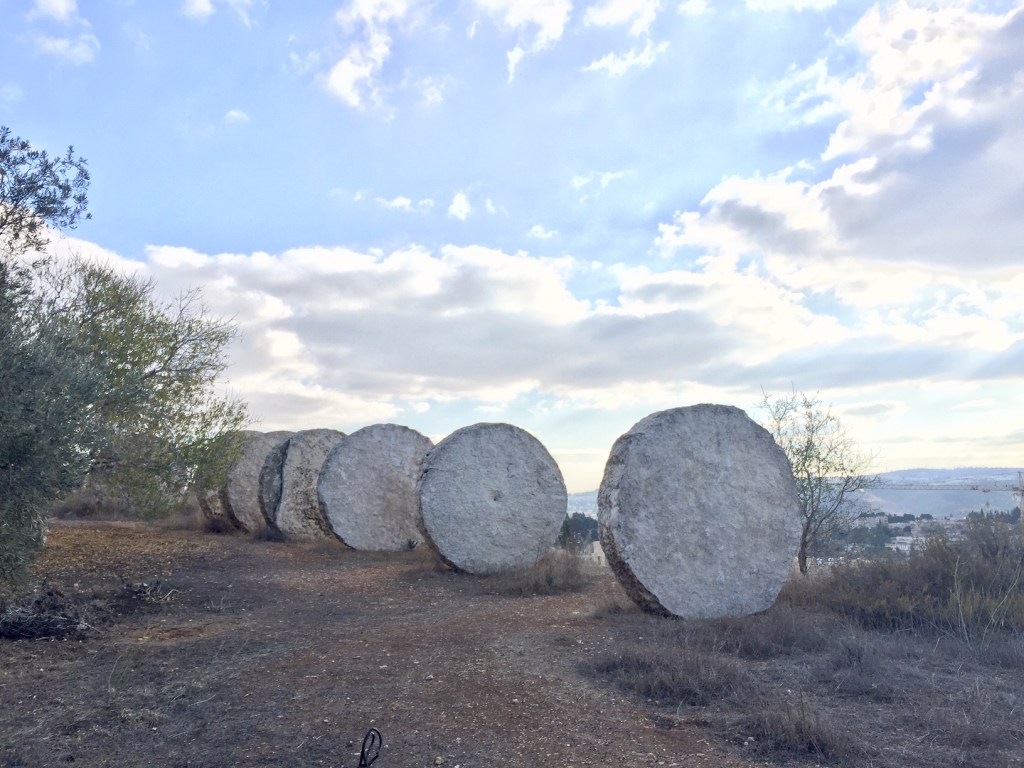
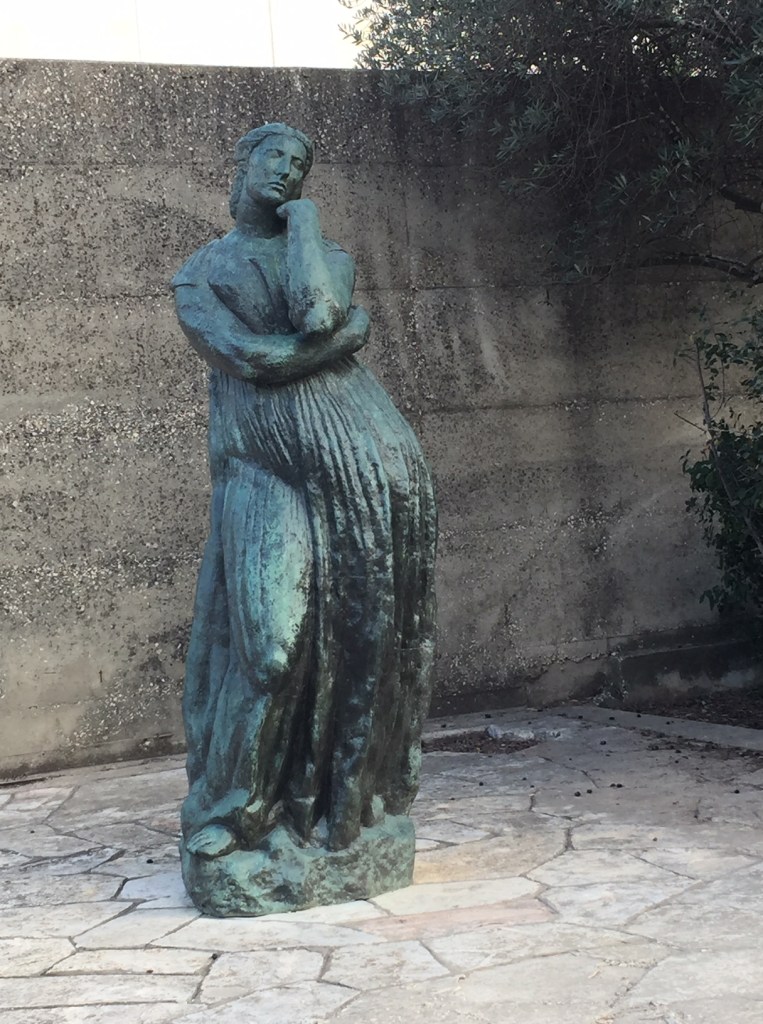
I finally left the Gazelle Valley preserve and set off for the Israel Museum. It was a moderately long uphill walk, through some nice neighborhoods. At last I approached the back of the museum. It was such a nice day that I could hardly bear to go inside. I lingered outdoors, mostly in the sculpture garden, which I had not bothered to see on previous visits. Here is some of what I saw:
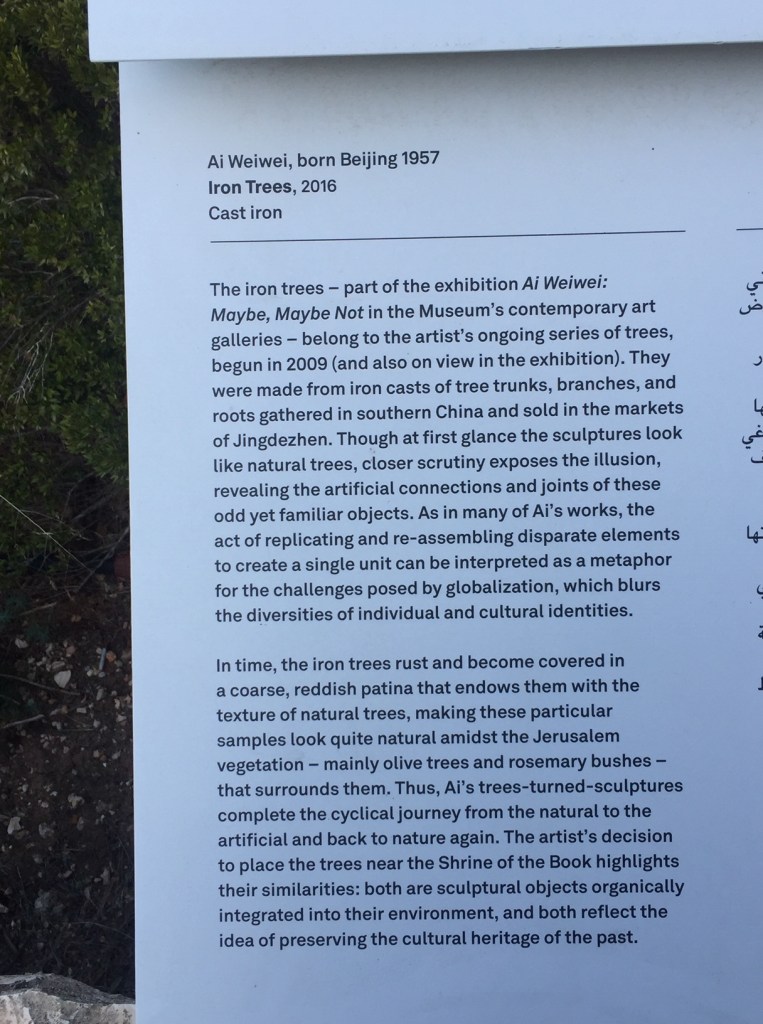
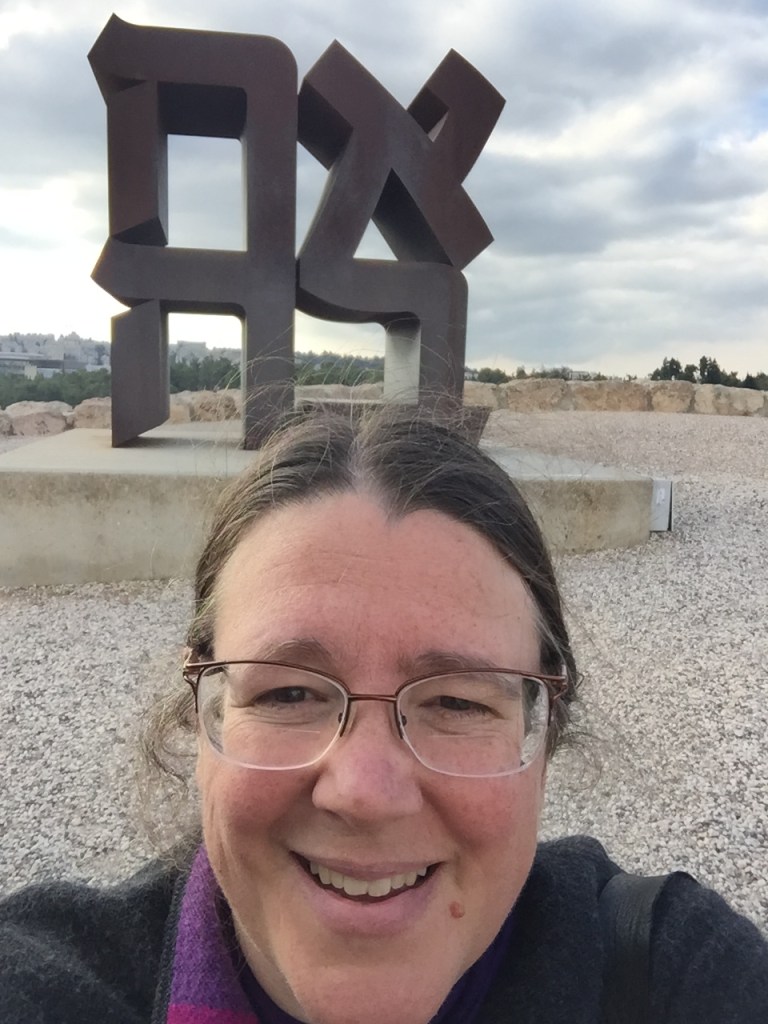
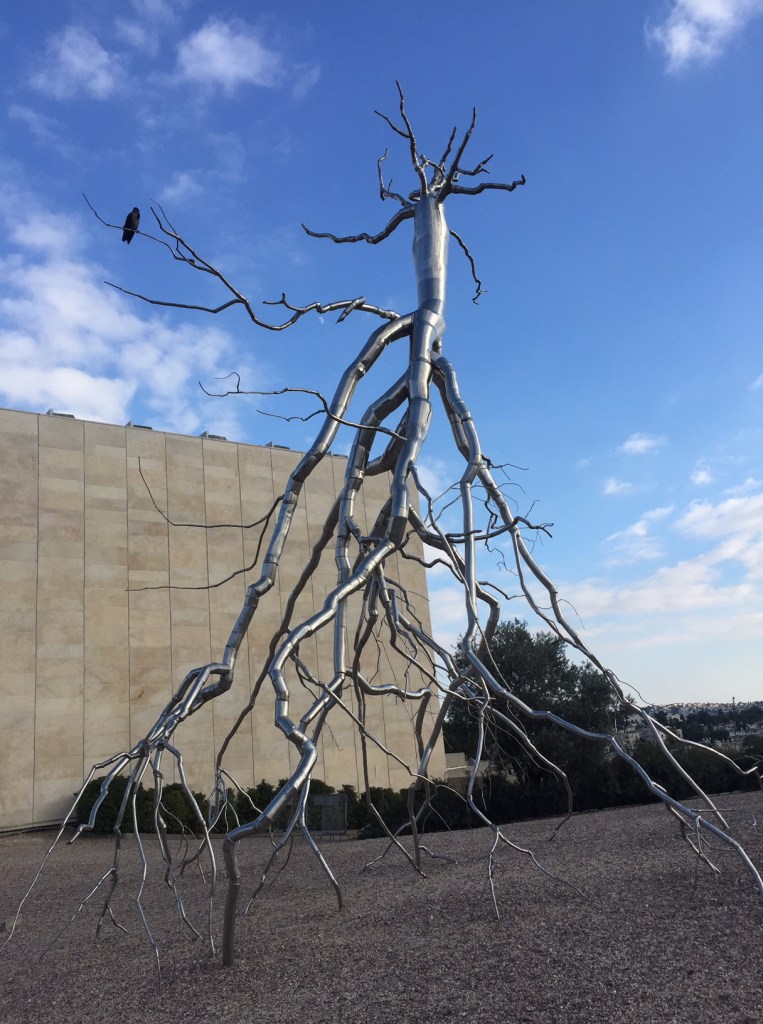
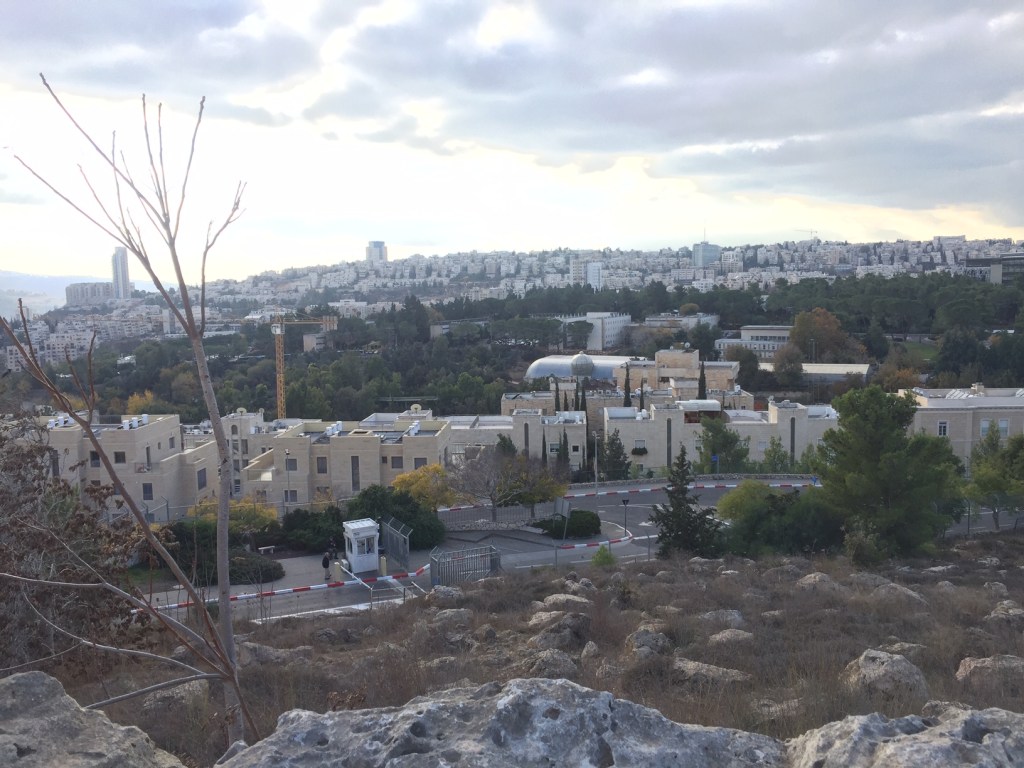
No, they’re not real trees…The white dome in the background, with water playing on it, is the roof of the dim sanctuary of the Shrine of the Book, where they house the fragments of the first seven “Dead Sea Scrolls” found at Qumran. You can read more about the Shrine of the Book here: https://www.imj.org.il/en/wings/shrine-book Near the Shrine of the Book is the model of Jerusalem in Temple times. I have visited it twice before, and there were tour groups, so I didn’t linger. You can read more here: https://www.imj.org.il/en/wings/shrine-book/model-jerusalem-second-temple-period A view form the sculpture garden down the valley. Top right, note that we still have not entirely escaped the hideous apartment building above the Gazelle Valley. This also gives you a sense of where I was in the morning in relation to the museum, which is behind me in this photo.Here I am in front of the the most iconic sculpture at the Israel Museum. This is AHAVA (Love), by Robert Indiana, given in 1977, “To the people of Israel in a spirit of international brotherhood” by Beverly and Dr. Raymond Sackler. (Yes, those Sacklers.)
According to the website of New York’s Museum of Modern Art (MOMA), “Few Pop images are more widely recognized than Indiana’s LOVE. Originally designed as a Christmas card commissioned by The Museum of Modern Art in 1965, LOVE has appeared in prints, paintings, sculptures, banners, rings, tapestries, and stamps. Full of erotic, religious, autobiographical, and political underpinnings—especially when it was co-opted as an emblem of 1960s idealism—LOVE is both accessible and complex in meaning. In printed works, Indiana has rendered LOVE in a variety of colors, compositions, and techniques. He even translated it into Hebrew for a print and a sculpture at the Israel Museum in Jerusalem.” From Wikipedia: “Love‘s original rendering in sculpture was made in 1970 and is displayed in Indiana at the Indianapolis Museum of Art.”
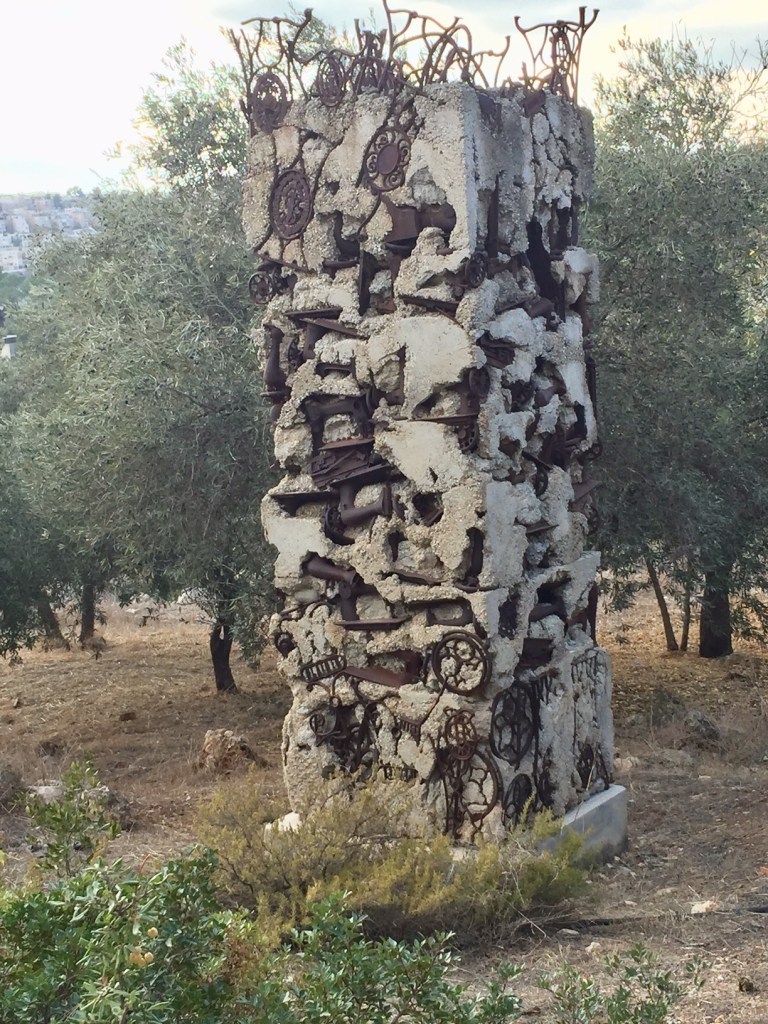
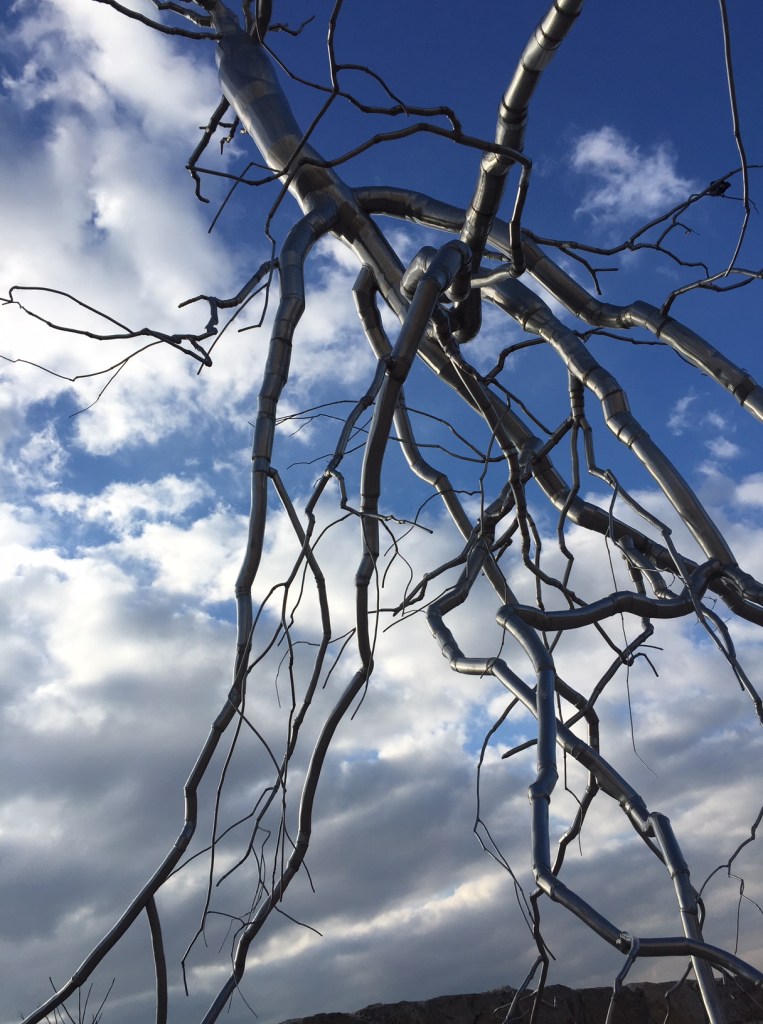
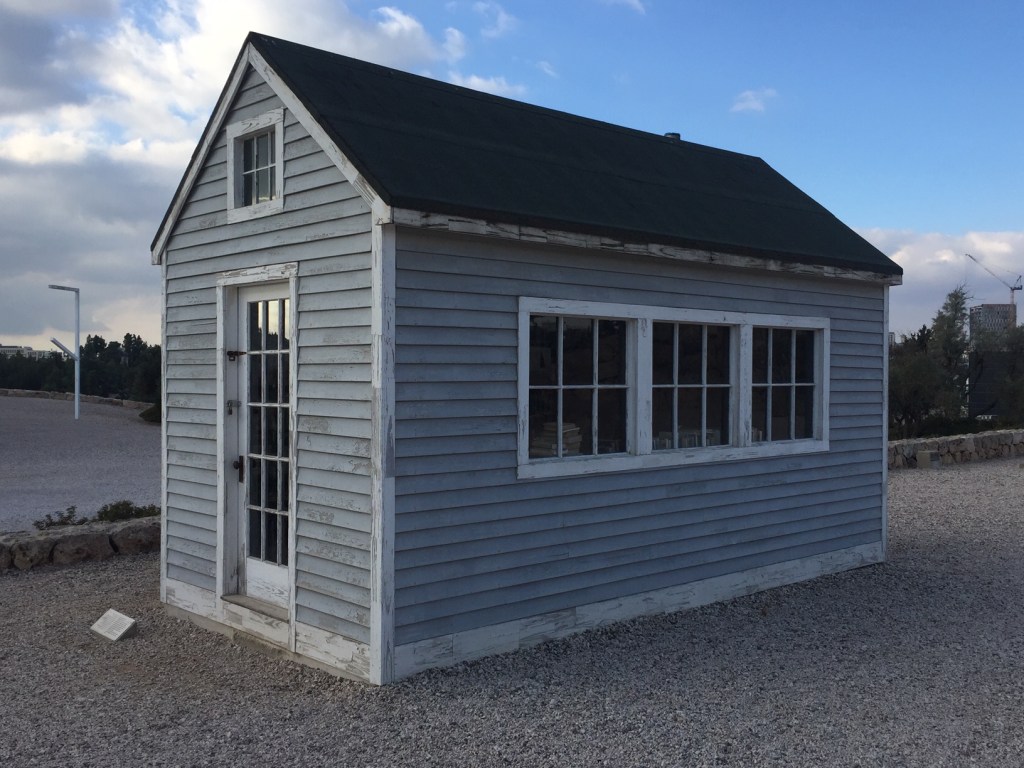
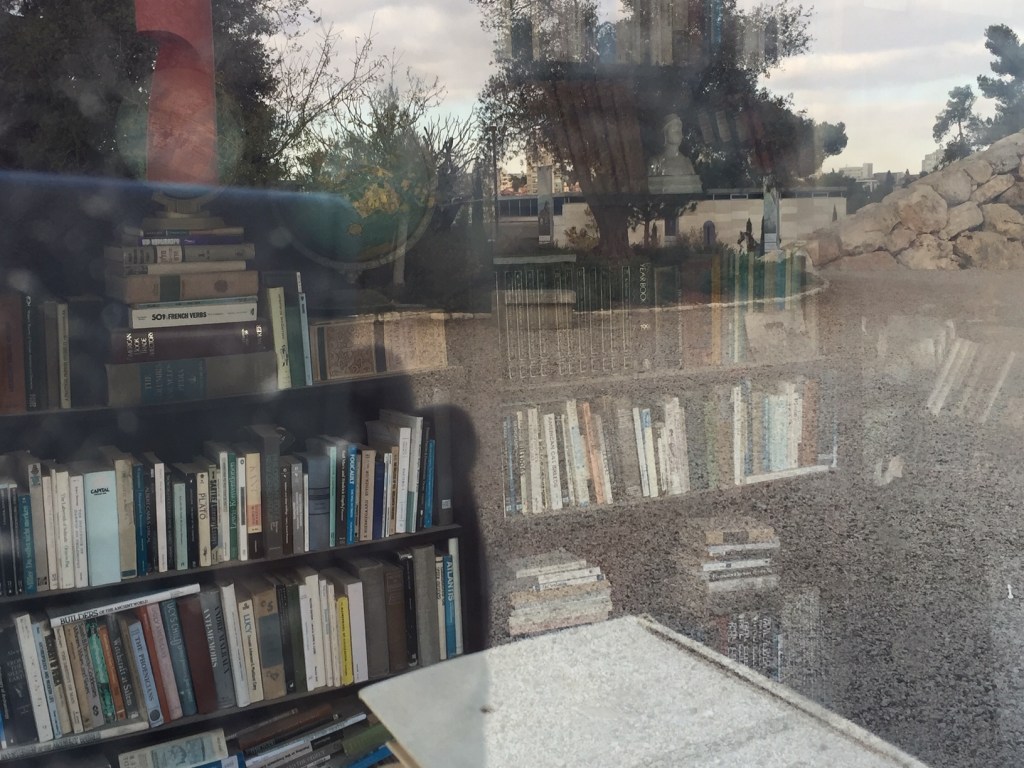
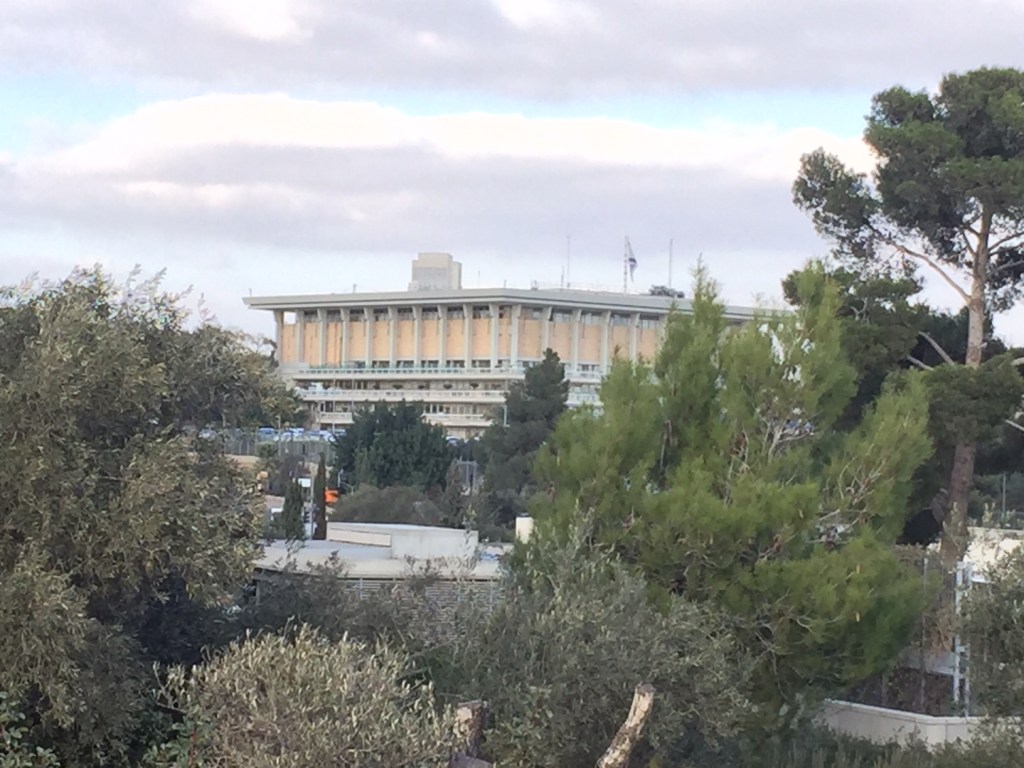
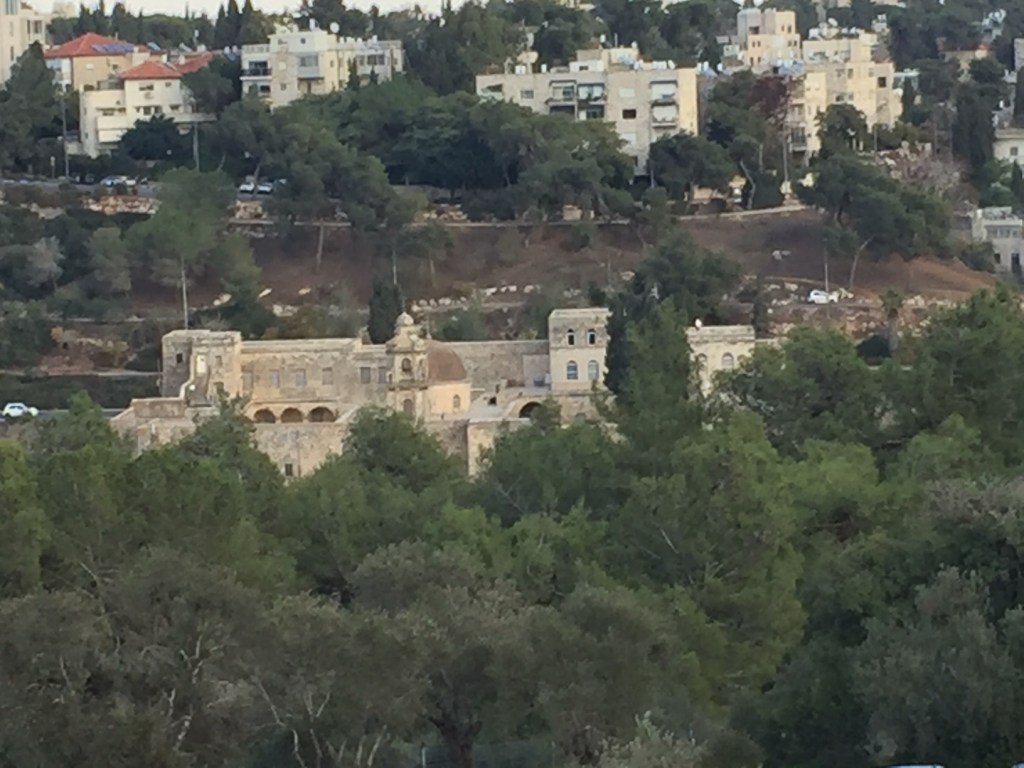
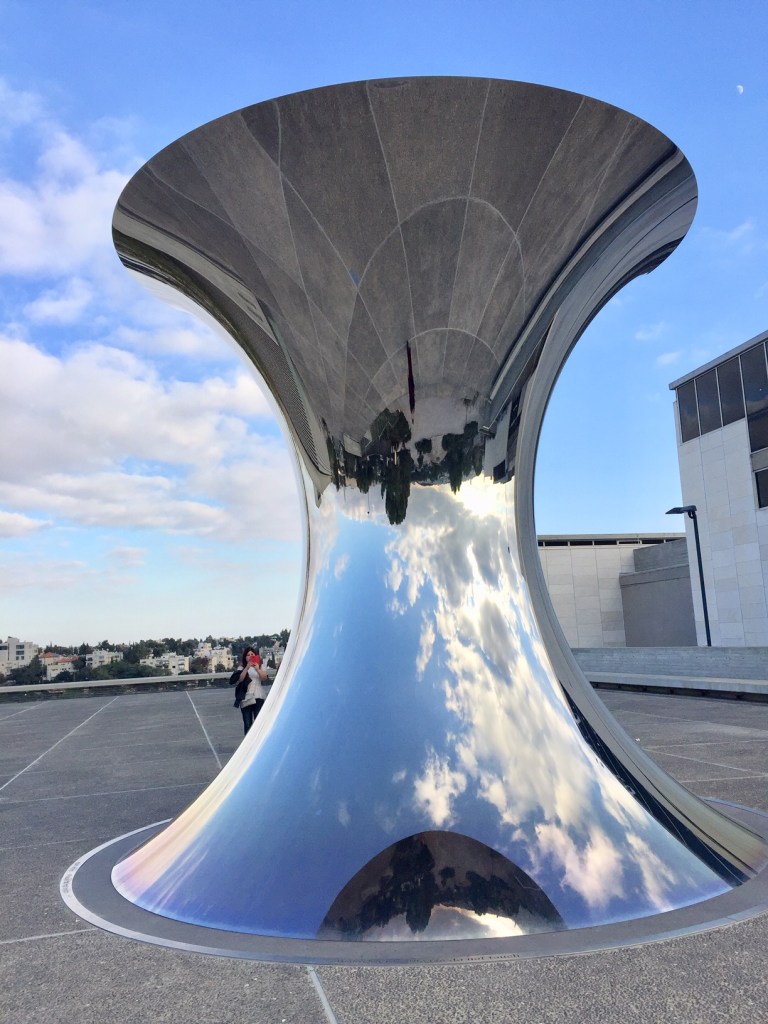
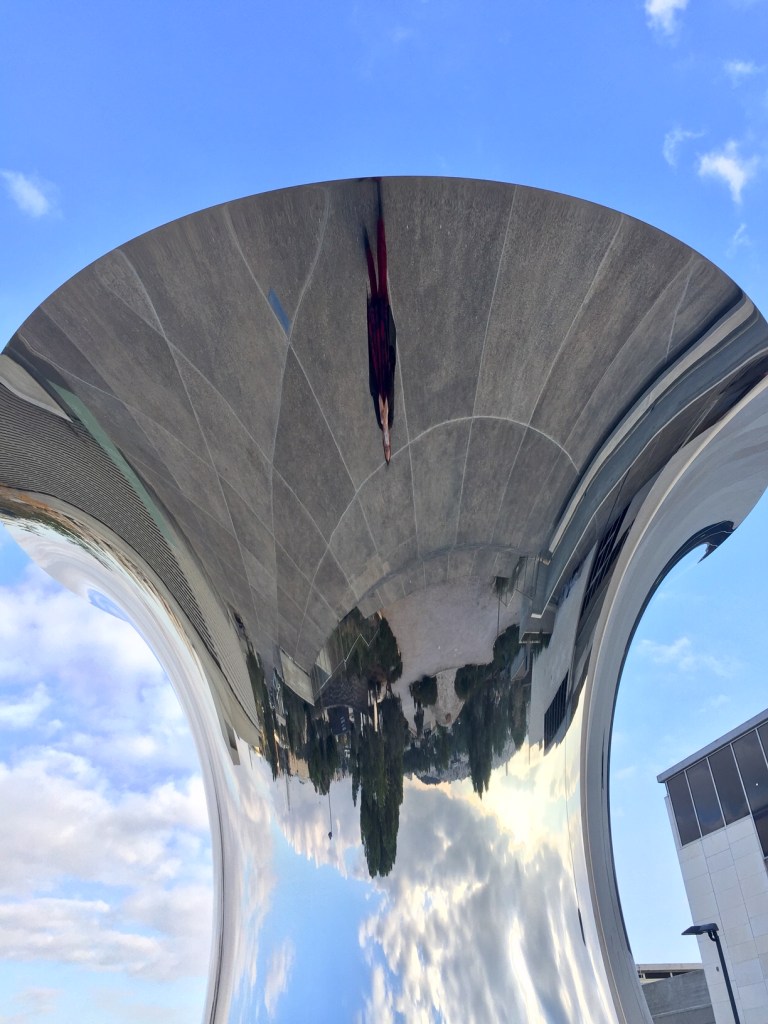
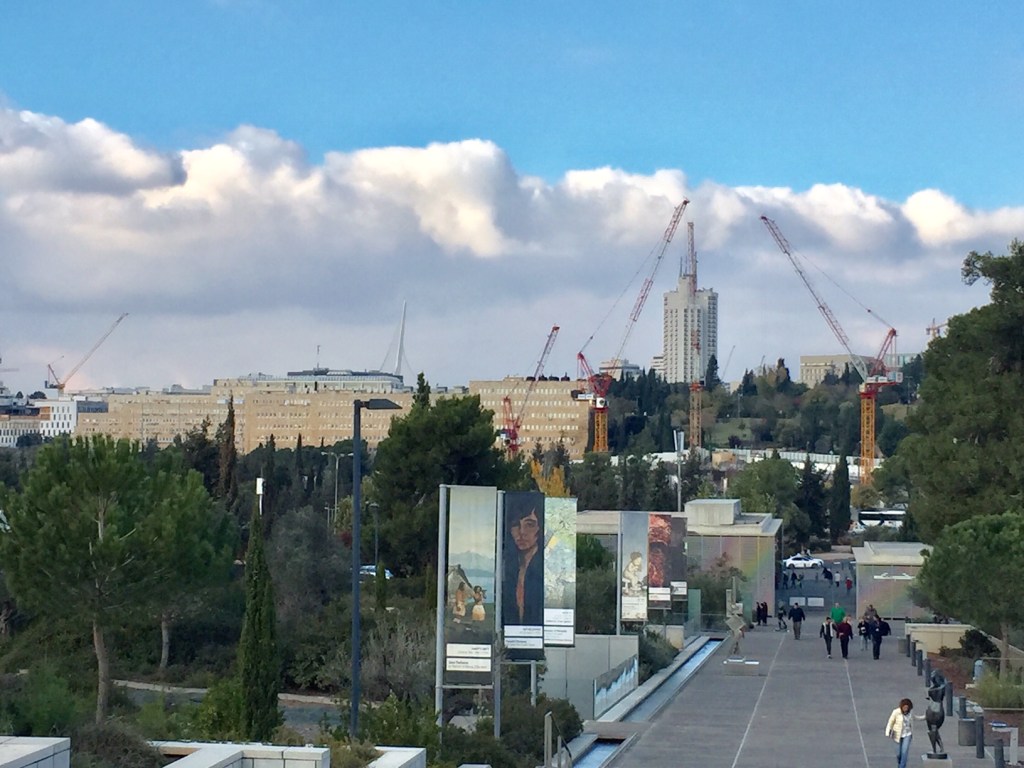
“Homage to the garment district,” Arman, 1974 — concrete embedded with sewing machines“Negev”, Magdalena Abakanovicz, 1987I didn’t record the title of this one. It’s a tree upside down — I loved that the crow was sitting in the “roots”.I law down under it to get this view. The sky often has a vast feeling here i Israel…Another view of the valley. In the center you see the conservatory at the Botanical Garden (see my post about my visit to the Botanical Garden for a close-up view.)“The antiquarian shop,” Mark Dion, 2008. His materials included: .wooden furniture, metal furniture, books, plaster busts, various tools, magazines, paper ephemera, framed photographs, postcards, maps, cigar boxes and other containers, stationery supplies, bottles, tins, lamps, globes, William Morris wallpaper, pegboard, sweaters, locks and hardware, portfolio, photographs and printsA look through the front windows. You feel the oddness of things, juxtaposing this seeming little shop from Cape Cod withe reflections in the background. It was disorienting — when looking into the “Shop”, or at its outside, I felt that behind me should be salt marshes and other New England buildings. I asked myself, “Is this really art?” But if art is something intended to produce complex emotions, then this is art. I don;t know if it would strike me as art if I found it on the grounds of an art museum on Cape Cod, however! From the Israel Museum you see the Knesset. It’s startling to think that the complex, contentious, and oft-times dysfunctional political affairs of the State of Israel are conducted right here. I also have this feeling when I walk up the hill from my apartment and come within spitting distance of the building where the Prime Minister lives.In the valley on the opposite side of the museum is the Monastery of the Cross, an Eastern Orthodox monastery located in the park in Valley of the Cross. According to Wiki, “Legend has it that the monastery was erected on the burial spot of Adam‘s head—though two other locations in Jerusalem also claim this honor—from which grew the tree that gave its wood to the cross on which Christ was crucified. It is believed that the site was originally consecrated in the fourth century under the instruction of the Roman emperor Constantine the Great, who later gave the site to king Mirian III of Kartli after the conversion of his kingdom to Christianity in 327 AD. The monastery was built in the eleventh century, during the reign of King Bagrat IV by the Georgian Giorgi-Prokhore of Shavsheti.” I’m planning to get there to see it one of these days.An odd and fascinating sculpture…It the top, my reflection, holding up my phone to take the pictureAS I made my way down the central walkway to the restaurant, this view truck me. Jerusalem is building all the time. I love the way these cranes are juxtaposed with the profile of the “David’s Harp Bridge” in the distance (designed by Santiago Calatrava as part of the Jerusalem light rial system, opened in 2008). After looking at so much sculpture, I saw this skyline a a continuation of that theme.
I ended my afternoon at the museum with a delicious late lunch in the restaurant. I started my meal with “The hot dish – green, red, zhug, chickpeas and tahini”, and finished it with Apricot Kebab on a bed of lentils. Then I made my way out to the bus stop, where I waited in the cold evening for my ride back to my neighborhood. It had been a good day.
One of the better aspects of Pardes, for me, is the efforts they make to expose their students to a wide variety of ideas and opinions about what it means to be an Israeli and what it means to be a Jew. I have found these lectures, discussions, panels, and educational trips to be uniformly thought-provoking. Even though I came here to follow my dream of studying Talmud, in some ways I feel I am learning more and being more deeply challenged by these other aspects of my studies.
I want very much to share everything with you, dear readers. Toward this end (as well as to deepen my own learning and reflection), I’ve taken copious notes at most of the programs I’ve attended. Now I have pages and pages, and I wonder where to begin. In some cases I feel I might simply summarize the lecture and refer you to the lecturer’s book. In others, I feel that I am continuing to accrue information and that my own view is continuously evolving. This is particularly true when it comes to the whole matter of Israel/Palestine, Settlements/Occupied Territories/Judea and Samaria, and so on. I’ve just come back from a talk/discussion with a Palestinian Christian activist and citizen of Israel which I found both deeply enlightening and profoundly discouraging. I want to tell you about that, and the trip to Hebron, and the faculty panel on “The Green Line and Me”, and so on…
But on this rainy cold day, as the dark draws in at 4:30 pm — a true Israeli winter day — I feel the need to share some hope and sunshine. So let me tell you about my weekend, and about my past week, which I spent more as tourist than as a student.
On Tuesday I set off for the Old City. I got off the bus beside the Bloomfield Park.
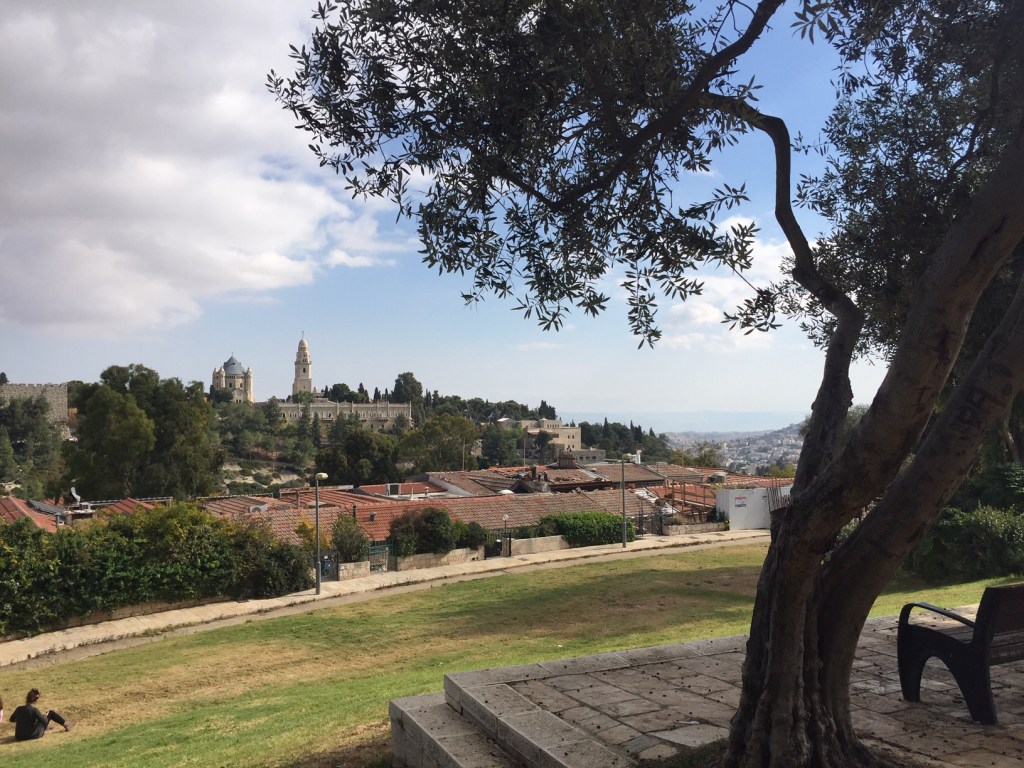
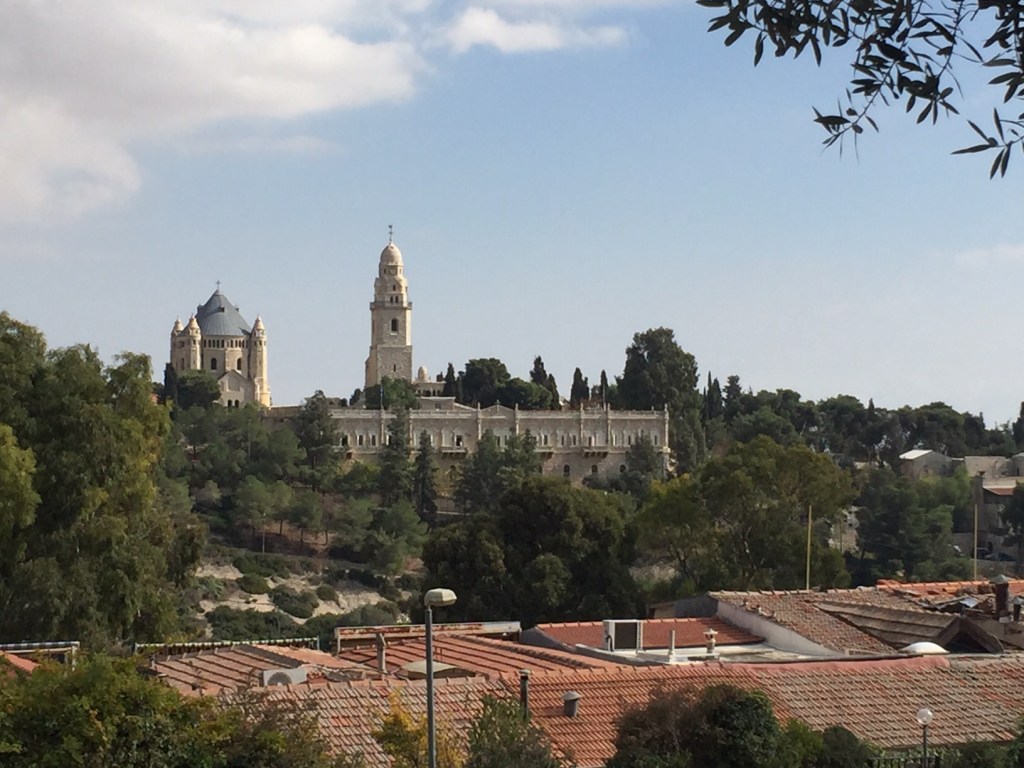
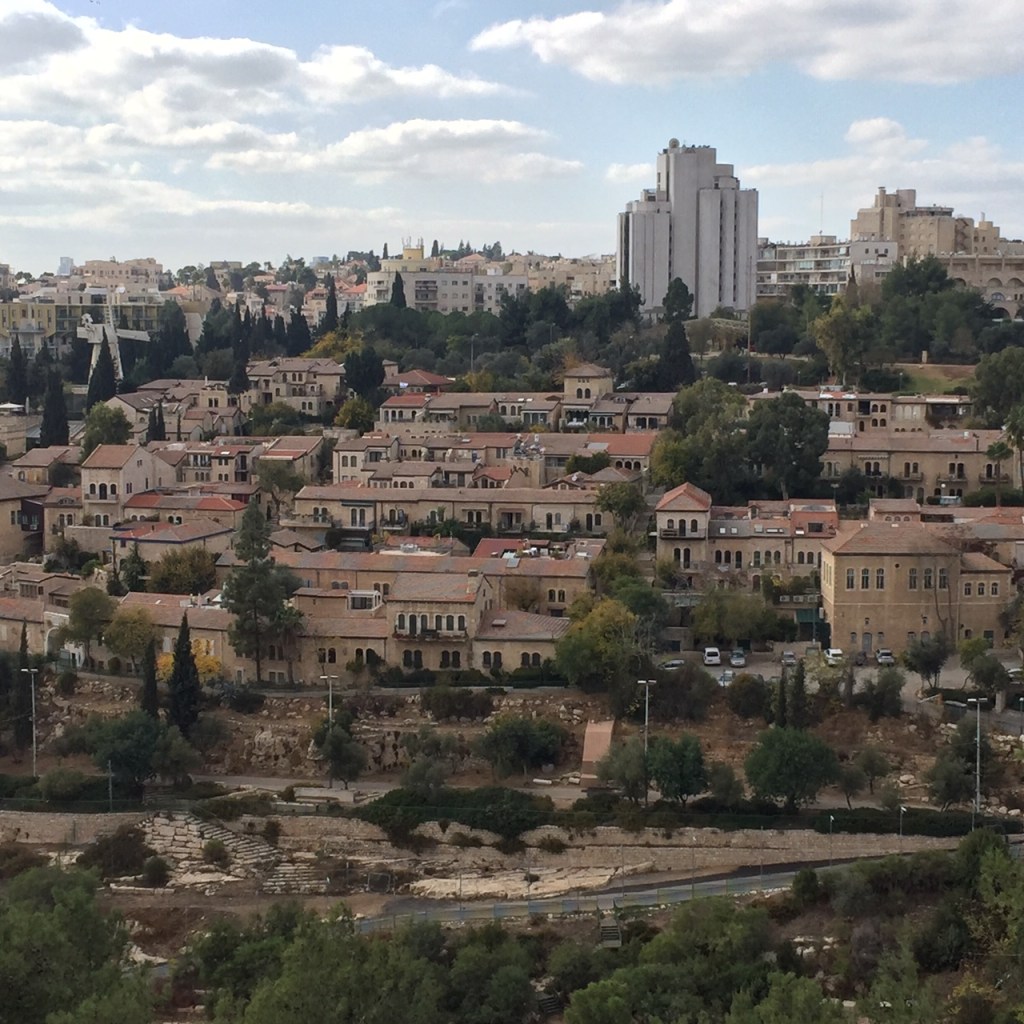
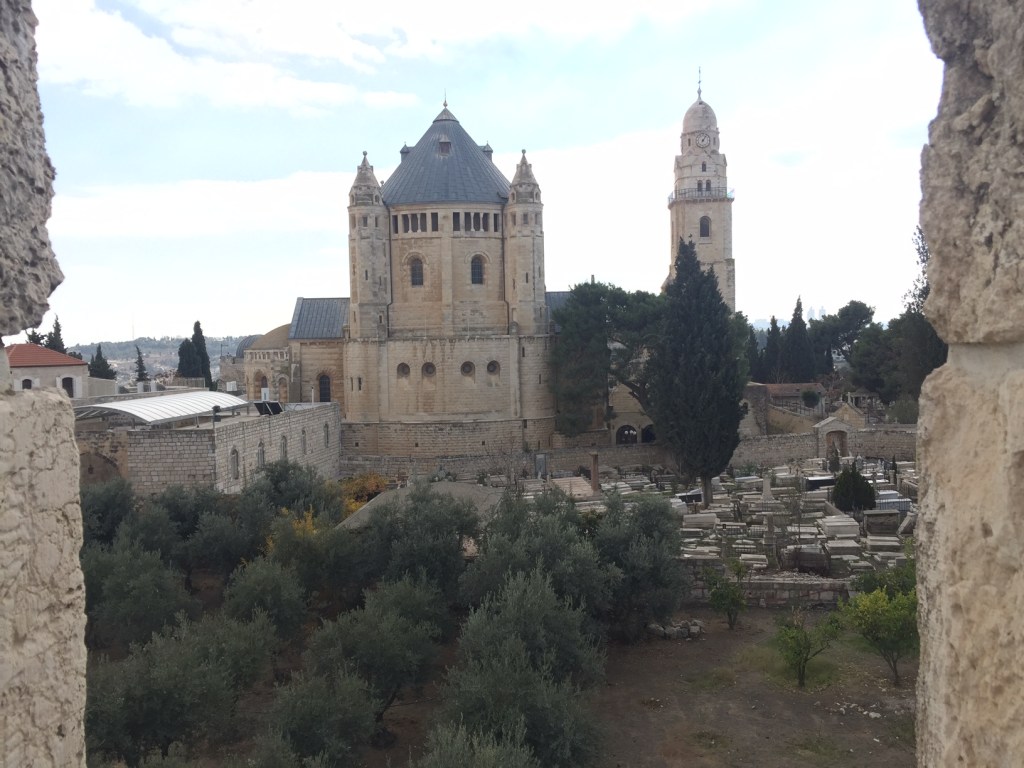
This is the view from the Bloomfield Park, looking over the roofs of Mishkenot Sha-ananim to the Church of the Dormition. The corner of the wall around the Old City is at the left of the picture. The church is not old — it was built in the 19th Century. It is very pretty ,though. And imposing! Christians believe that Mary went to sleep on the spot where the church is now, and was lifted up to Heaven.
I walked around the park looking at the view.
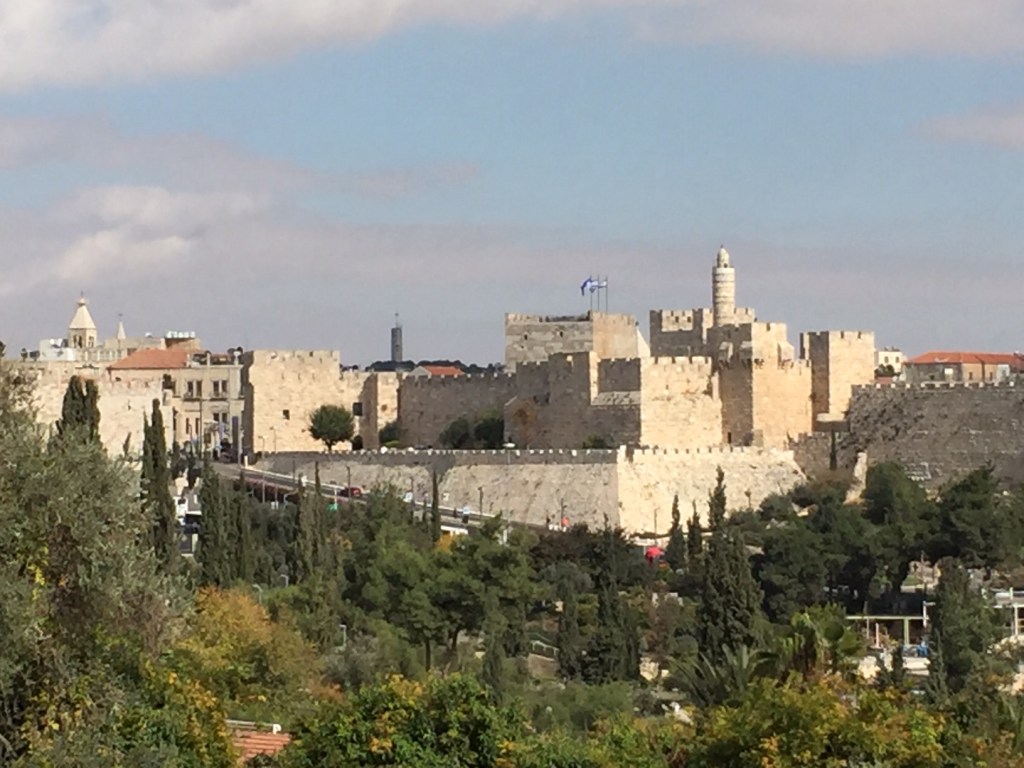
Looking left of the church, you see the Old City — the Tower of David, the outer wall, and, to the left of this photo, the Christian Quarter.
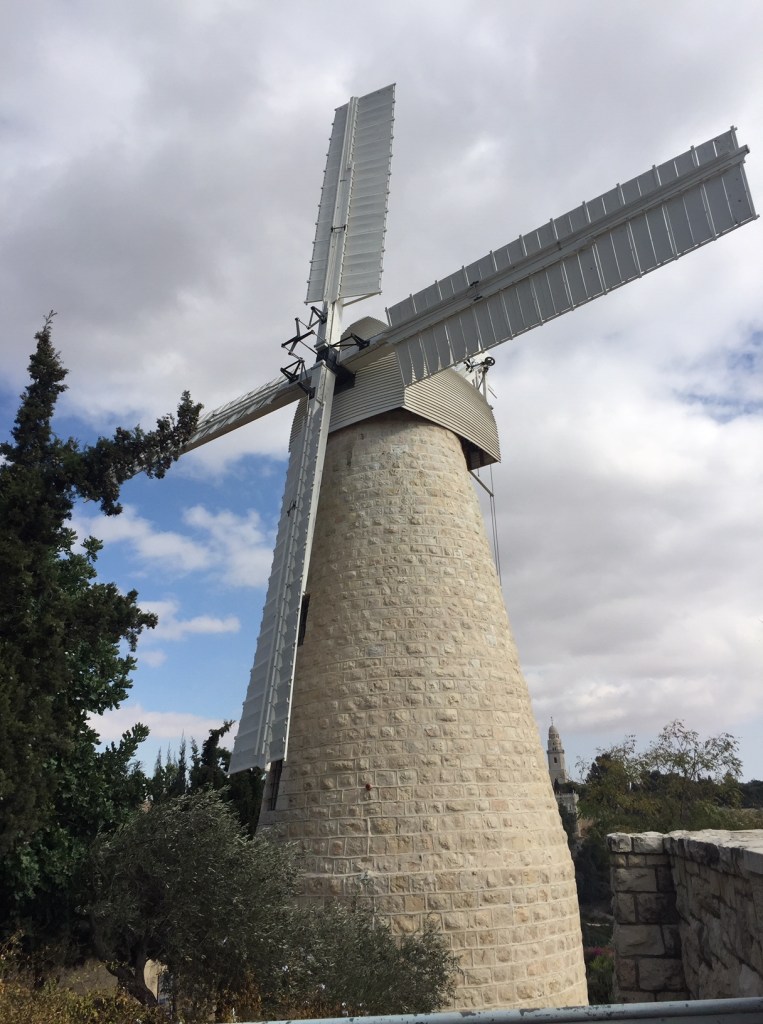
Below the Bloomfield Park is the Montefiore Windmill. According to Wikipedia, “The Montefiore Windmill [was] designed as a flour mill; it was built in 1857 on a slope opposite the western city walls of Jerusalem, where three years later the new Jewish neighborhood of Mishkenot Sha’ananim was erected, both by the efforts of British Jewish banker and philanthropist Moses Montefiore. Jerusalem at the time was part of Ottoman-ruled Palestine.”
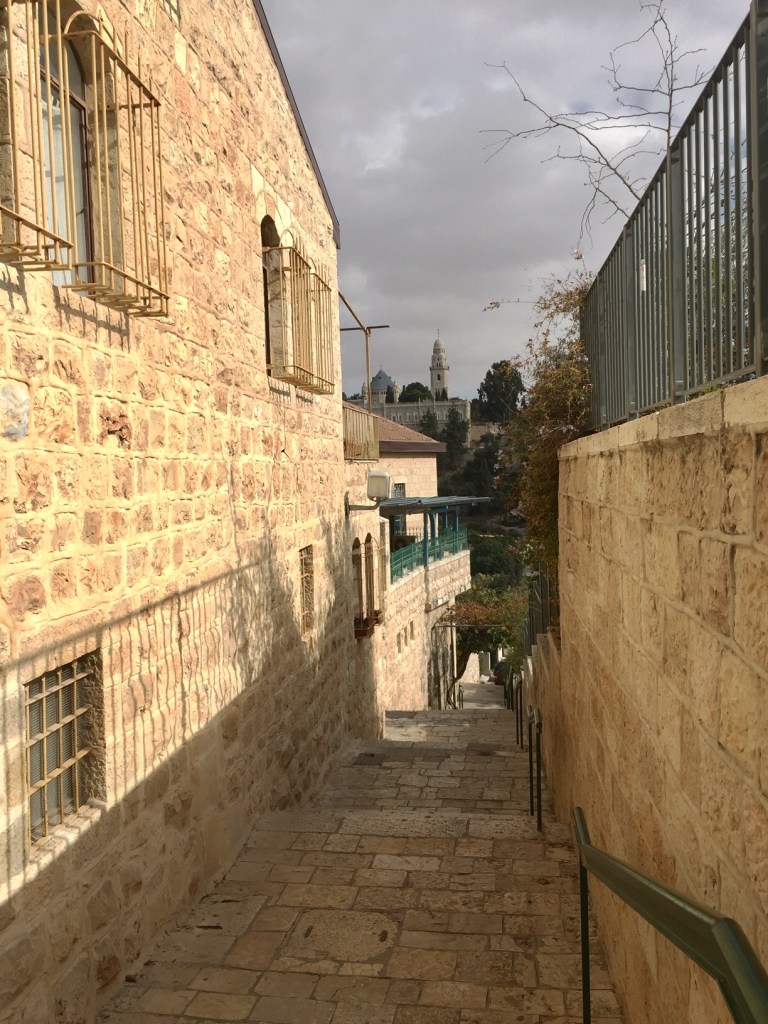
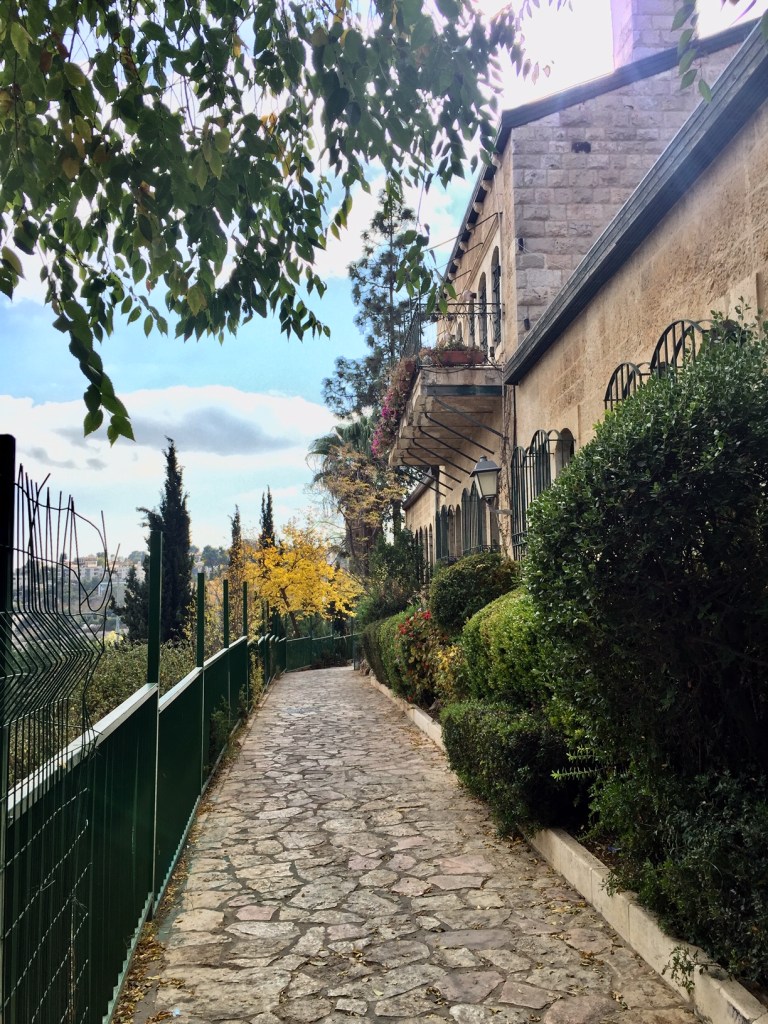
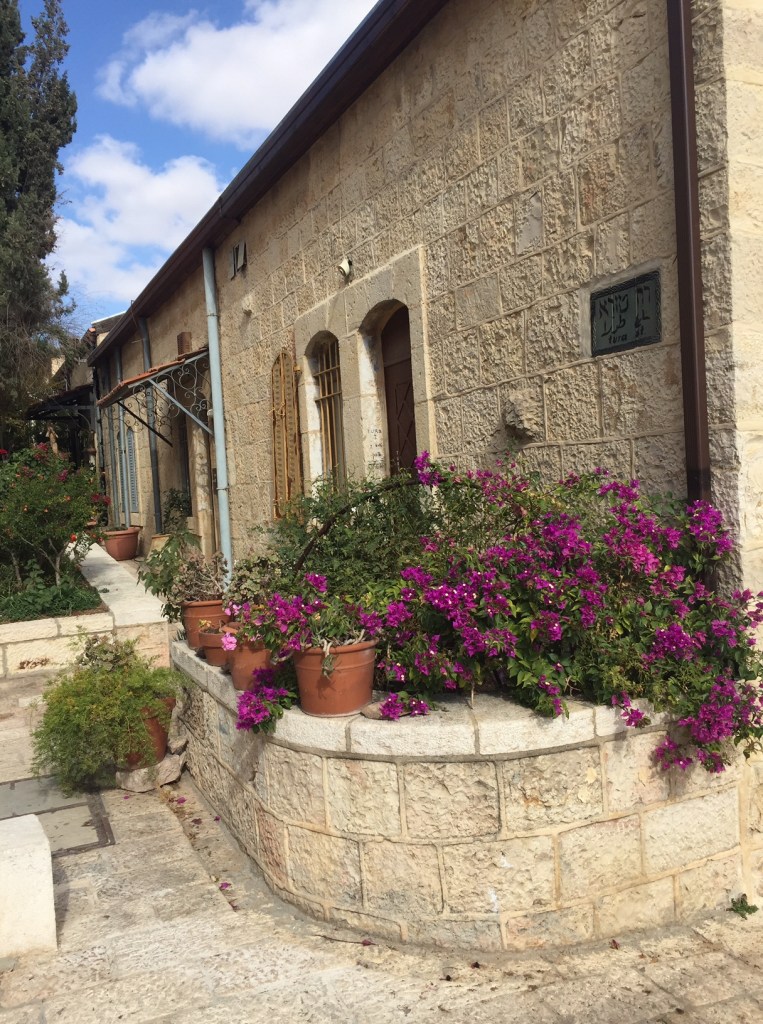
I wandered down the slope from the windmill, through the extremely picturesque streets of Mishkenot Sha’ananim. Montefiore also built this neighborhood, in 1860. It was originally built as an almshouse, with the intention of getting people out of the crowded, dirty, and disease ridden Old City. People were frightened to live outside the city walls, however, because banditry was not uncommon. Montefiore actually paid people to live there in the beginning. After the 1948 Arab Israeli War, “when the Old City was captured by the Arab Legion, Mishkenot Sha’ananim bordered on no man’s land in proximity to the armistice line with the Kingdom of Jordan, and many residents left in the wake of sniper attacks by Jordanian Arab Legionnaires.[6] Only the poorest inhabitants remained, turning the complex into a slum.”
It’s far from a slum nowadays! “The no-man’s-land bordering Mishkenot Sha’ananim was occupied by Israel during the 1967 War, together with the rest of Eastern and Old Jerusalem.In 1973, Mishkenot Sha’ananim was turned into an upscale guesthouse for internationally acclaimed authors, artists and musicians visiting Israel. Apart from guesthouse facilities, it is now a convention center and home of the Jerusalem Music Center.” (Wiki)
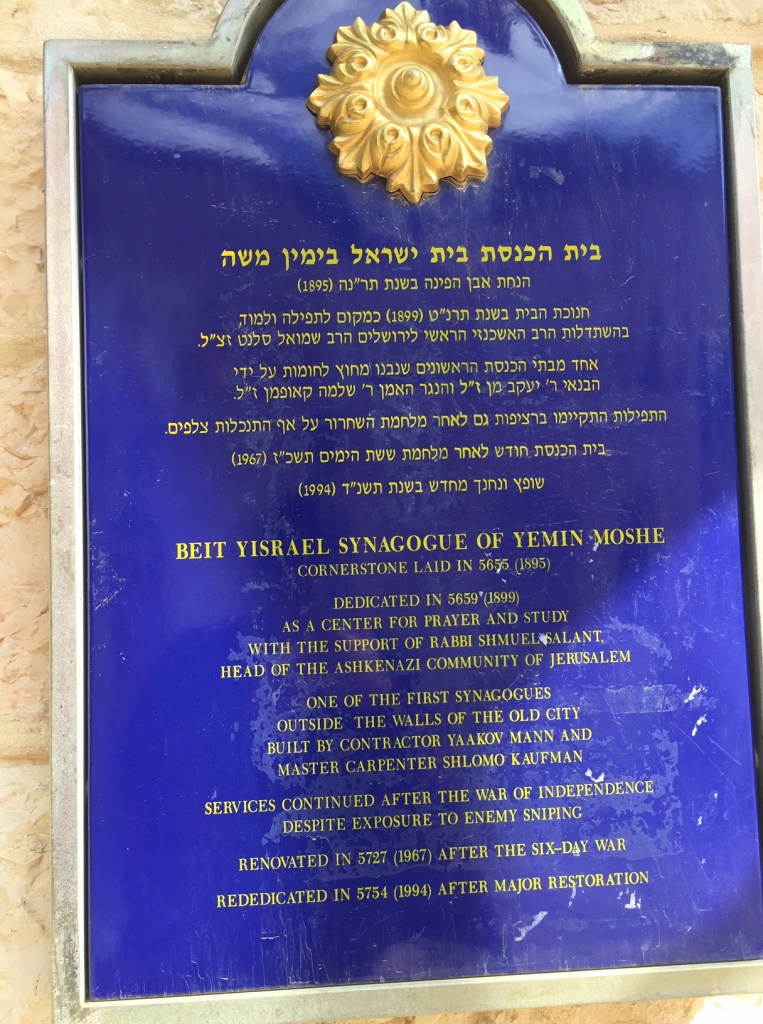
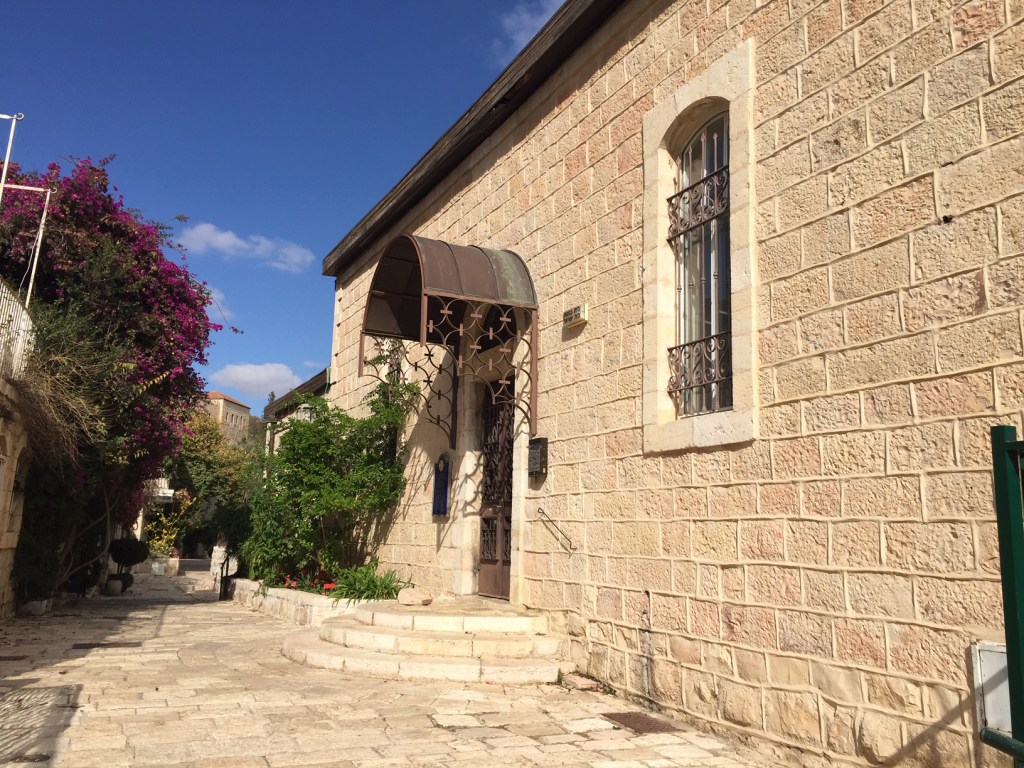
Beit Knesset Yemin MosheNote the kitty — they are everywhere! Yes, it’s Fall/Winter here, and some trees do turn colors — mostly yellow –and lose their leaves for a time.
Below Mishkenot Sha’ananim is the Geh Hinnom — know to some as Gehenna. In Rabbinic tradition Geh Hinnom became synonymous with Hell — some say because idolators used to sacrifice their children there in pre-Israelite days. Nowadays it is a very placid park with an amphitheater for concerts. It does have a peculiar configuration with regard to the Green Line — I invite you to look at a map:
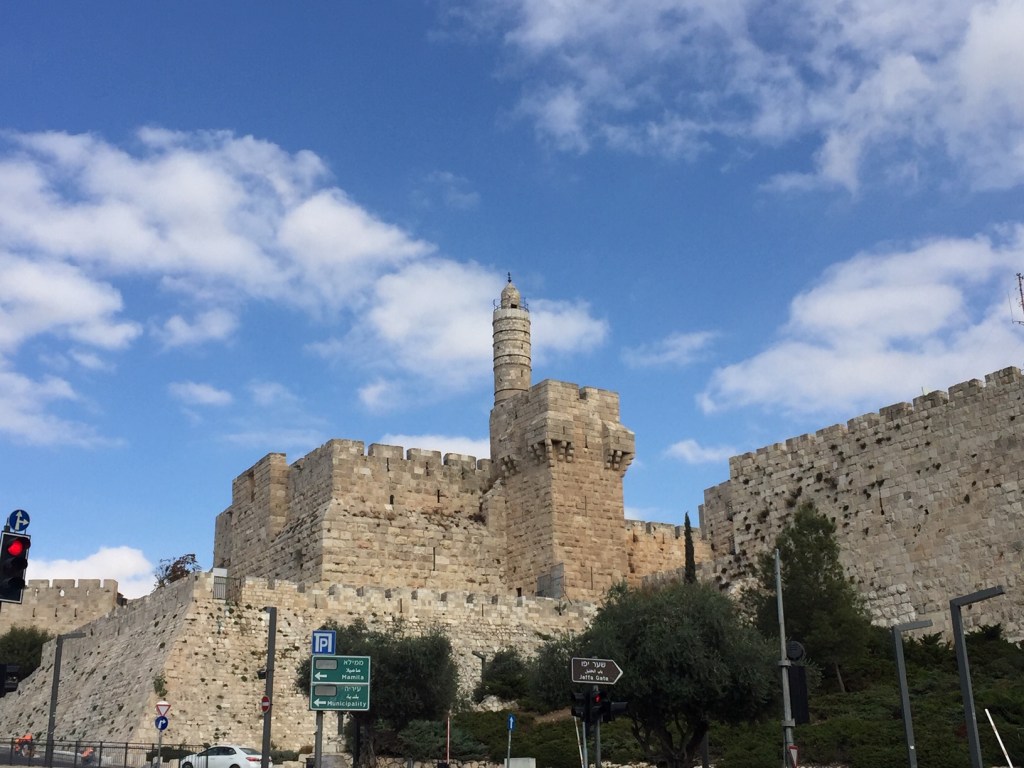
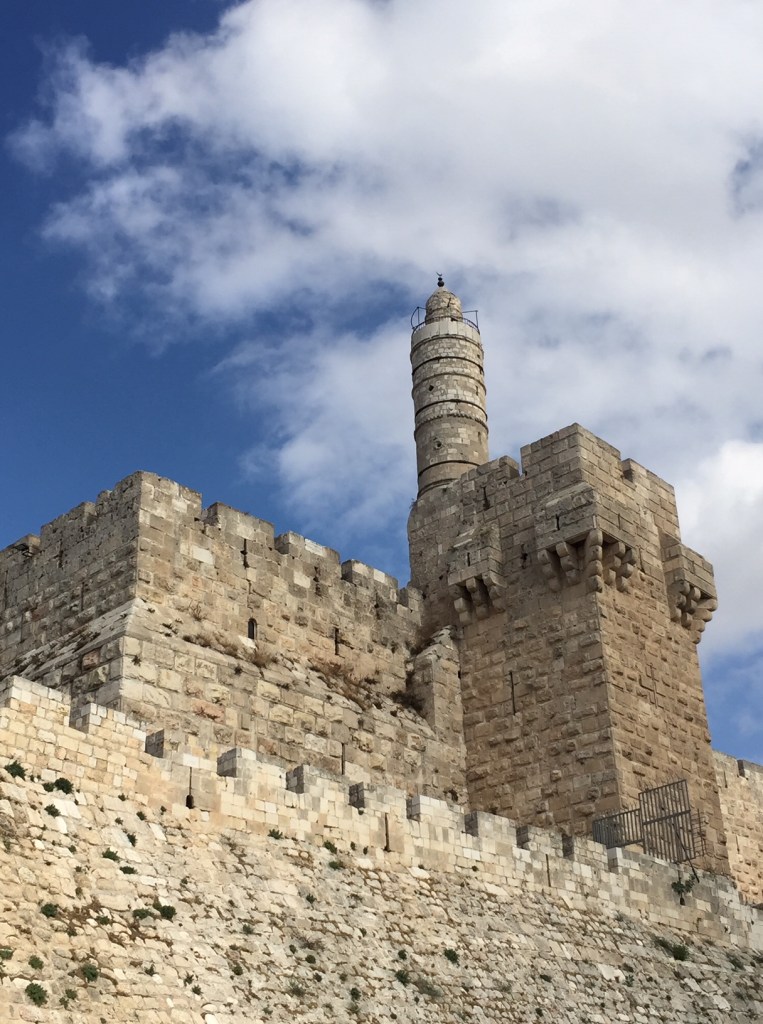
I climbed up out of the valley of Hinnom, and arrived at the Citadel of David.
Layers of history. Yes, the round tower is a mosque — not still in use, I believe.
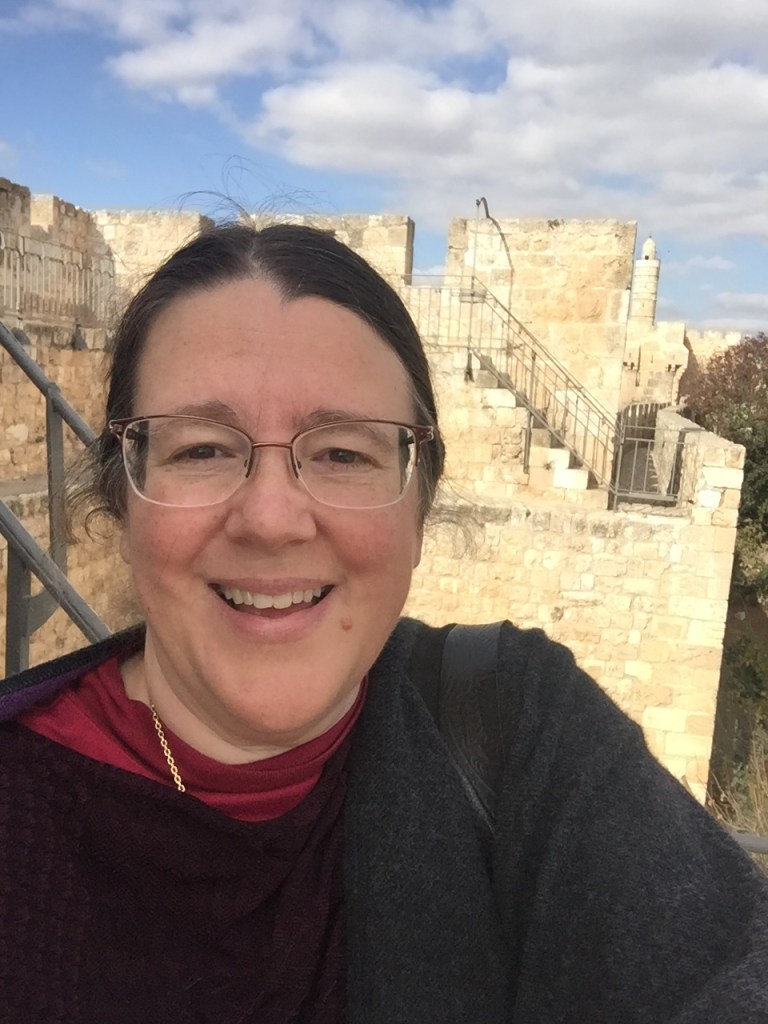
I decided to retrace a walk that I took with my husband Bob back in the mid-90’s, when we made our one trip together to Jerusalem. We walked along the top of the wall around the Old City — the southern half of the walk, which is broken by the Temple Mount. So up I climbed, to see the view again.
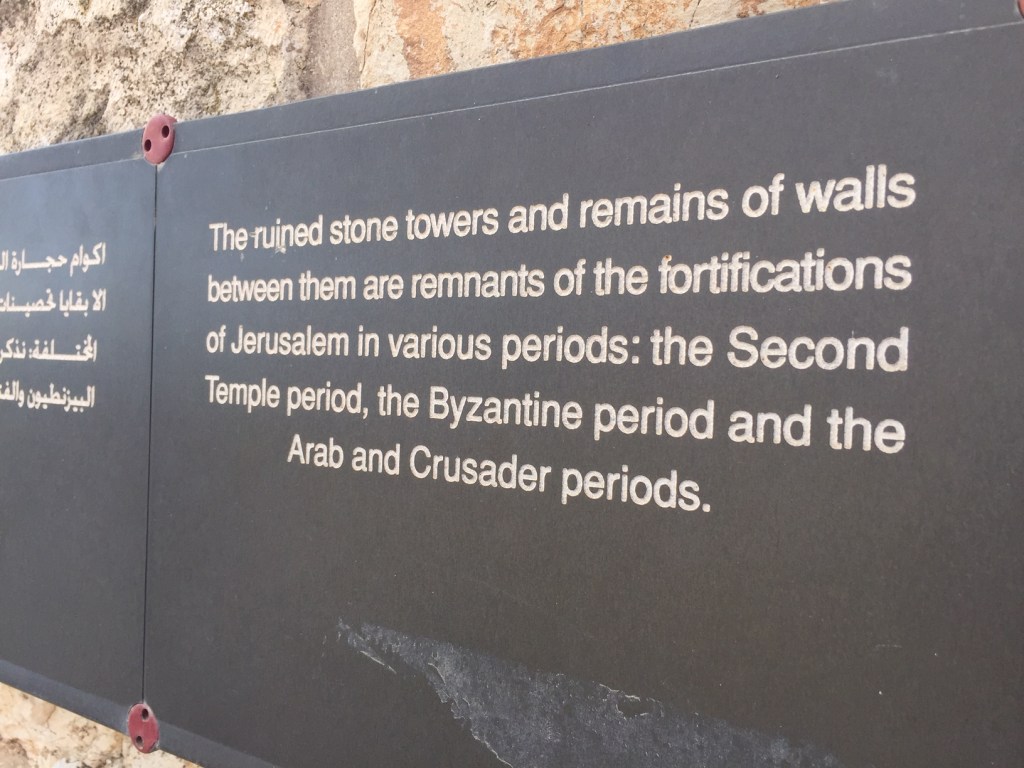
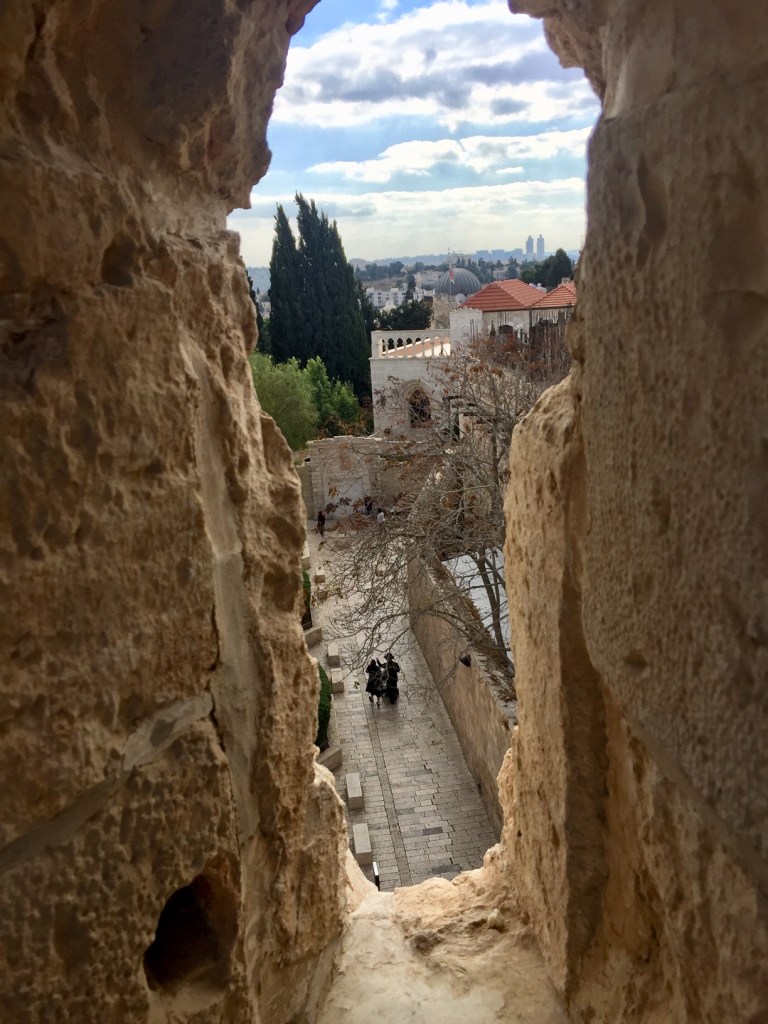
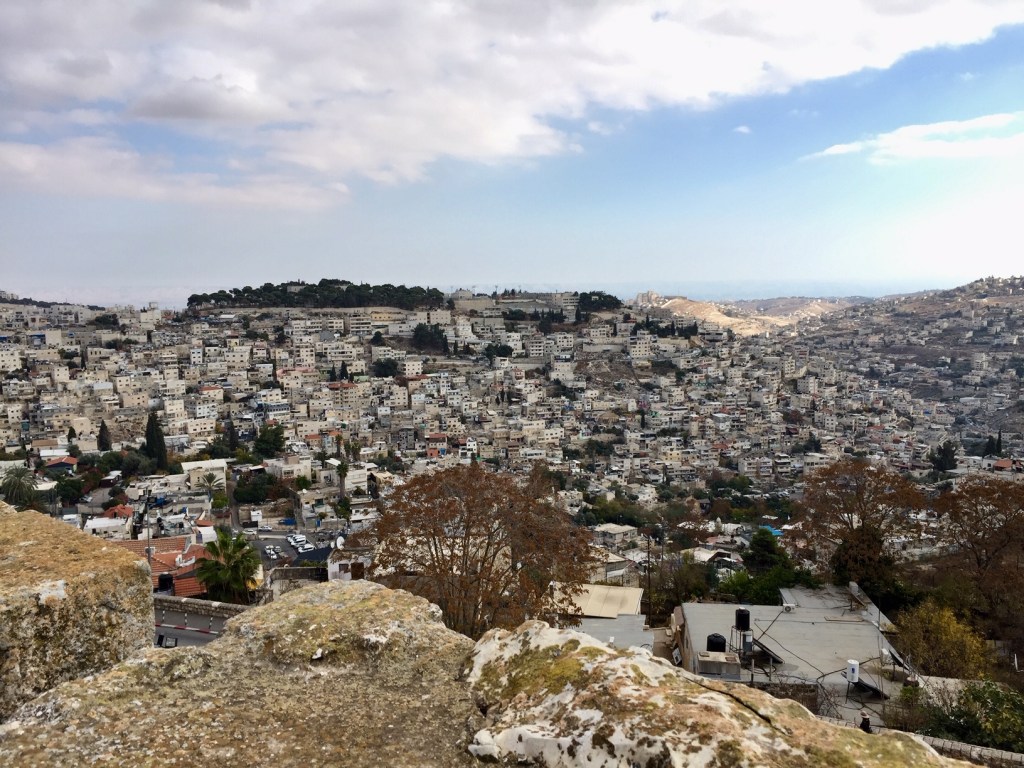
View of Mishkenot Sha’ananim from atop the Old City walls. In an album at home I have a picture of Bob, recovering from a bad cold, lolling against the wall somewhere near here.Close up view of the Church of the Dormition, with Armenian Christian cemetery in front of it. View through an arrow-slit — the walkway to the left of the church. The Haredi couple wandered by at just the right moment — in a couple of minutes the whole walkway was filled with tourists! This is Silwan, in Arab East Jerusalem. In the very faint distance you can see the blue mountains of Jordan. Silwan was once Siloam — as in, the Pool of Siloam, in Nehemiah. Jewish settlers are now attempting to push Arab residents out, with some collusion of the government.
After completing my walk on the wall-top, and eating my lunch up there, I climbed down by the security gate that leads to the plaza of the Western Wall. I had last been there with Women of the Wall, making a futile attempt to enter with Torahs. Now it was easy to go through security and make my way to the womens’ section. It was a very different feeling to be there alone — but not necessarily less conflicted. I found a siddur (prayer book) and davened mincha (afternoon prayer) sitting in one of the chairs that have been set up for davenners. Then I went up to the Wall. After a bit a space opened (it is always crowded, and one has to wait). I stood close to the Wall, and tucked into its cracks the prayers of two Christian pastors whom I encountered in two different locations last summer. I’ve been carrying them around in my pocketbook, never looking — one from a Haitian Uber driver and evangelical pastor I encountered in Florida, and one from a Church of the Brethren pastor I met at my friend Steve’s retirement party in California. I leaned my forehead on the Wall for a little, and thought about the people I’ve loved and lost. It’s a holy place for me, but not comfortable. I feel the oppressive presence of Orthodoxy, the weird proximity of the Mosques above that I may never enter, and generally a sense that we should pray where we find ourselves, and not fetishize locations so much. And yet…
I didn’t take pictures at the Wall, because I’ve been several times over the years and have many. But after I’d left the plaza and begun to wend my way toward the Christian Quarter (which I never previously visited), I did take a couple of pics.
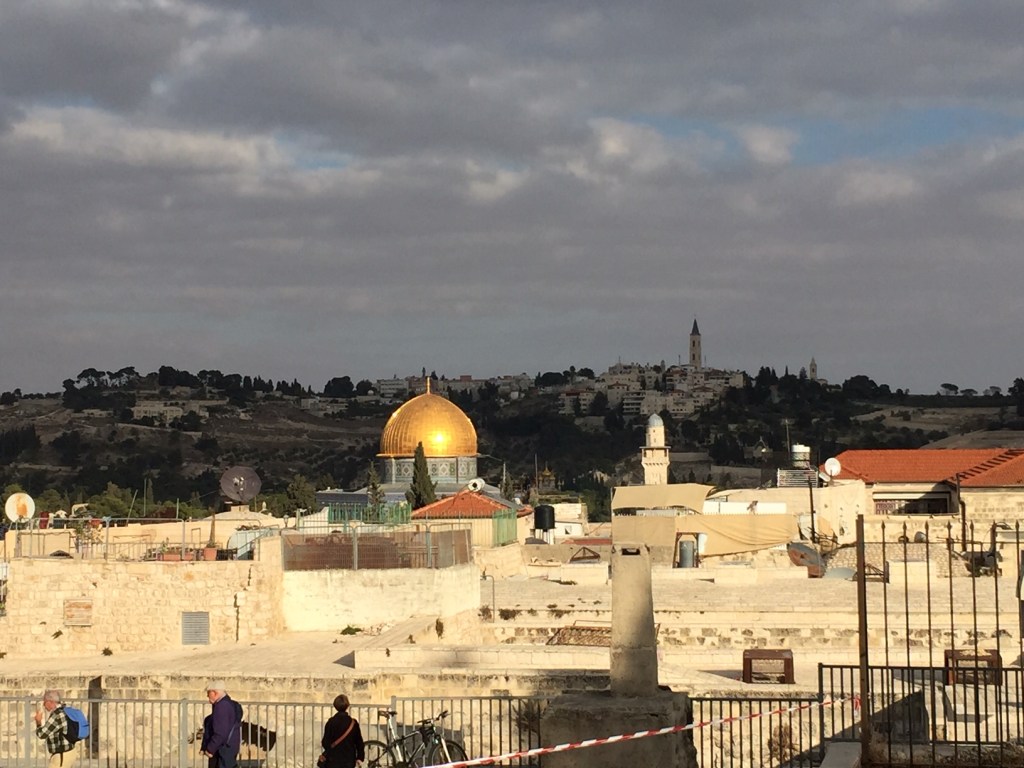
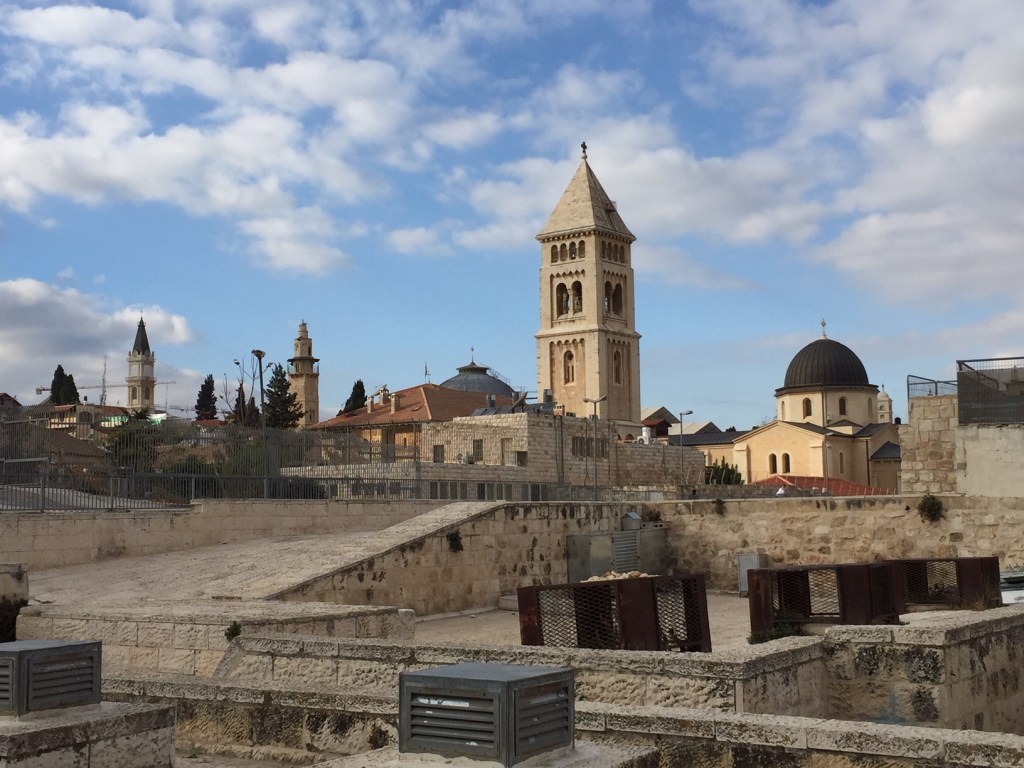
This is the one I like the best. Cloud have shadowed the Mount of Olives, and the Dome of the Rock is alight. Turning the other way from my rooftop perch I saw the spires and domes of the Christian Quarter.
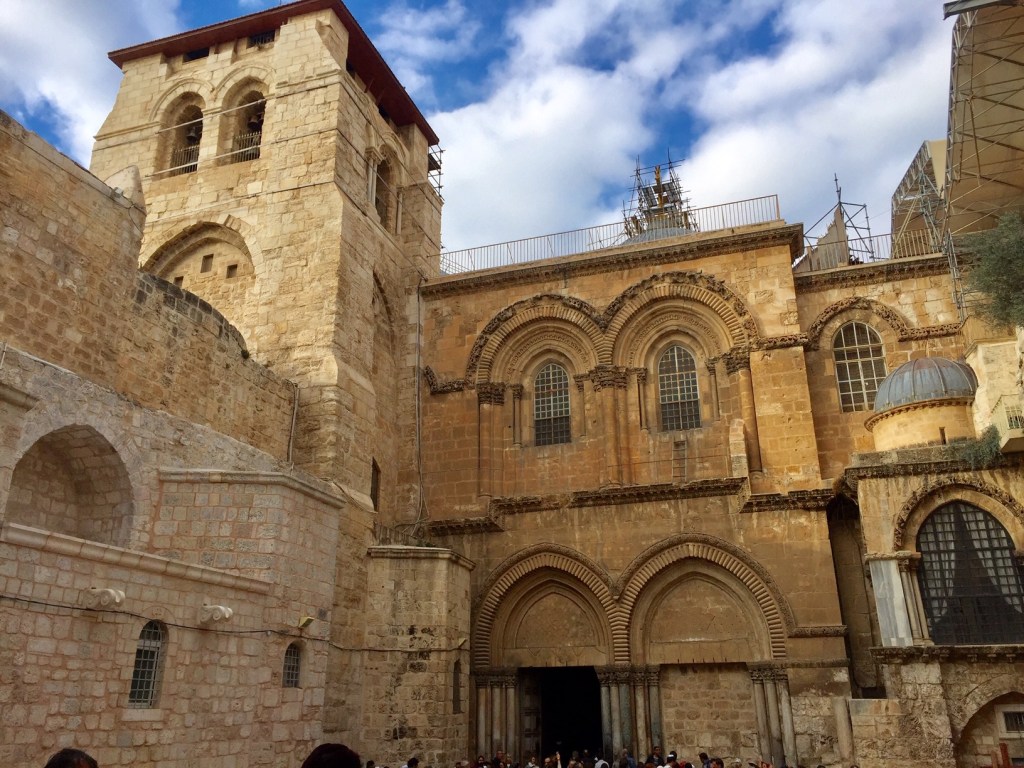
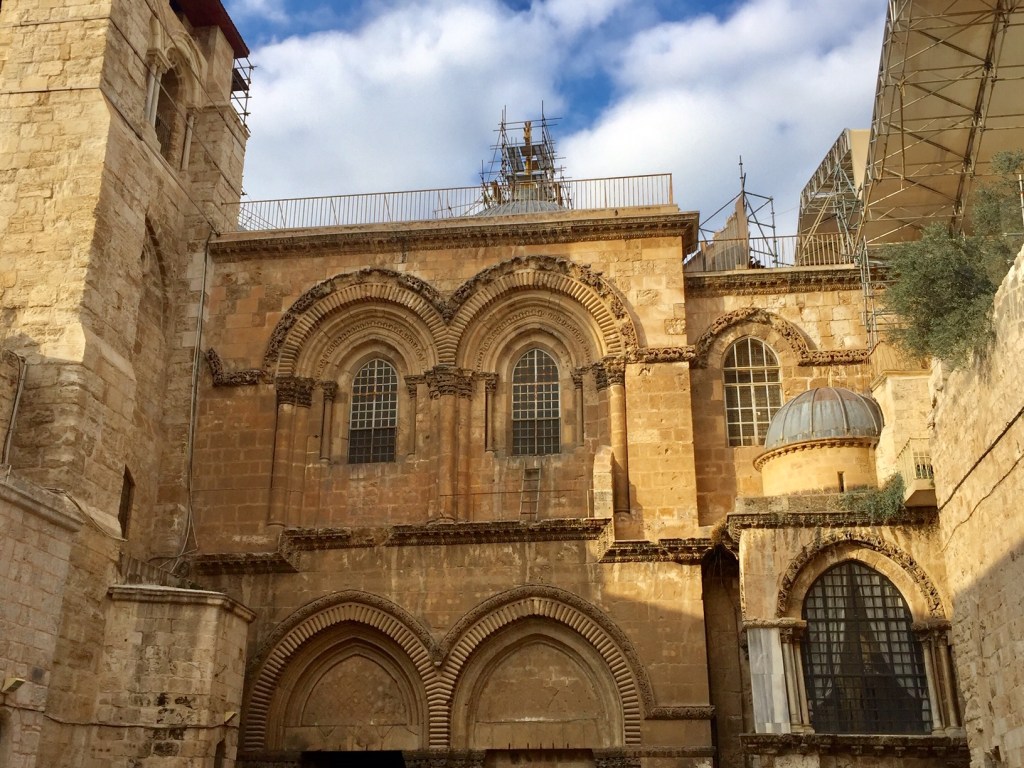
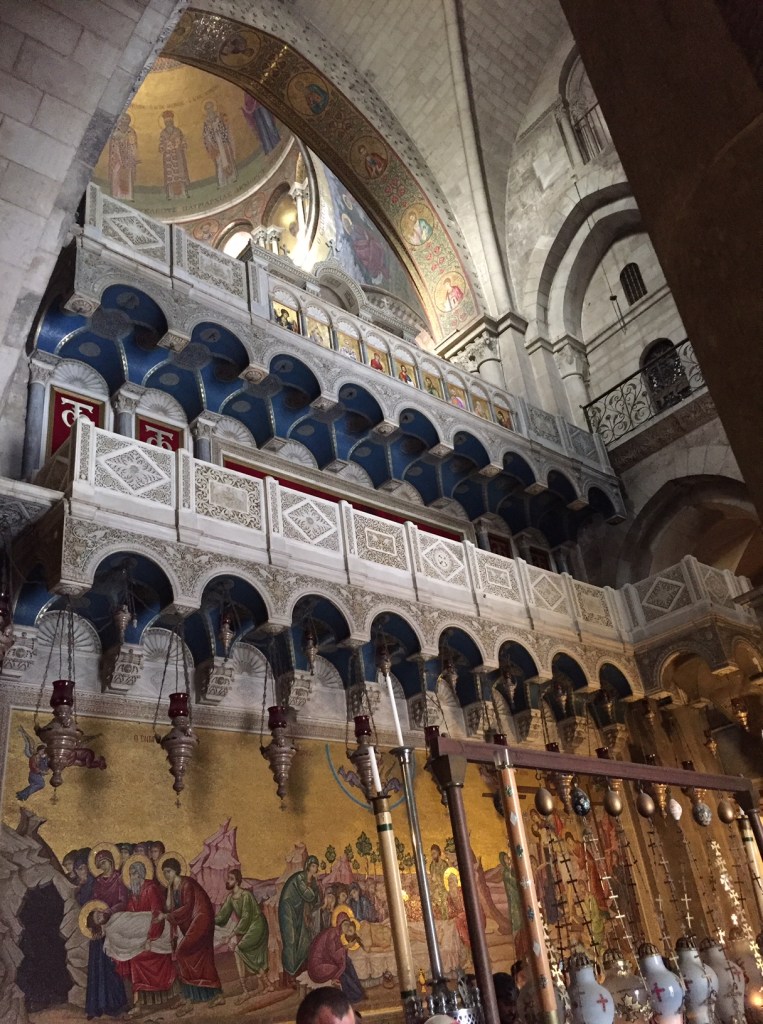
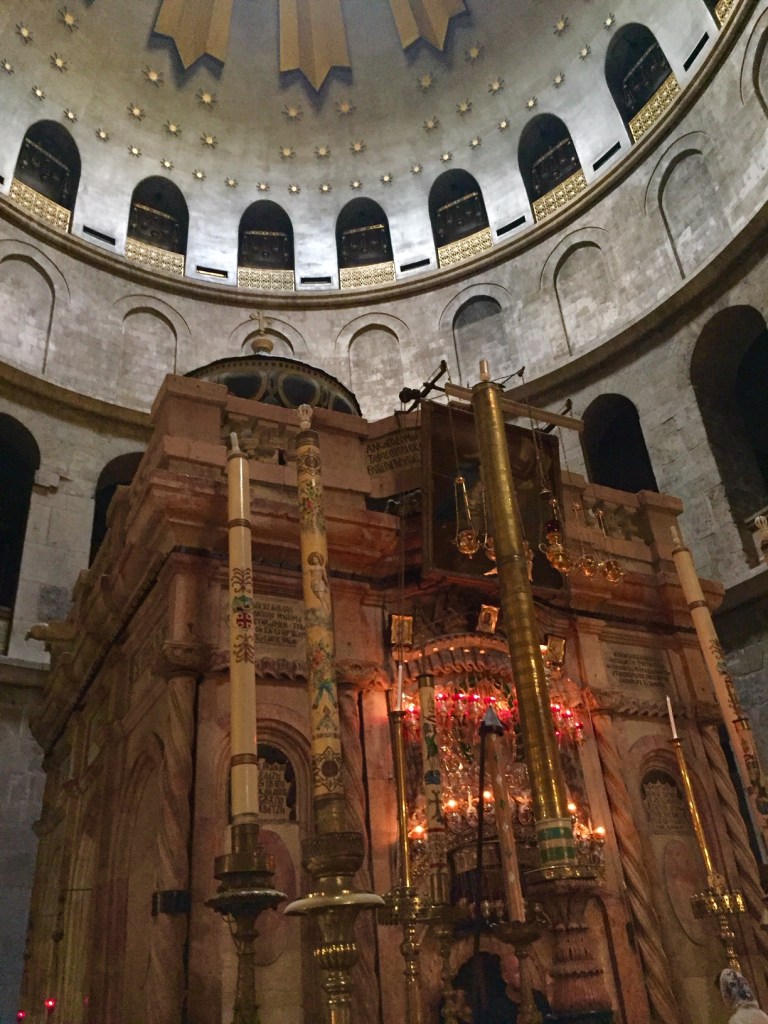
I was determined to visit the Christian Quarter, which I’d never done, and in particular the Church of the Holy Sepulchre. This church marks the end of the Via Dolorosa — the path Jesus is said to have walked on his way to be crucified. Jesus is supposed to have been crucified on this site — there’s a piece of rock sticking up in one part of the church that is supposed to have his blood on it. (The whole blood and suffering thing is one of the aspects of Christianity that has always creeped me out…). His tomb, from which he arose, is also reputedly here. You can read all about the church here: https://en.wikipedia.org/wiki/Church_of_the_Holy_Sepulchre
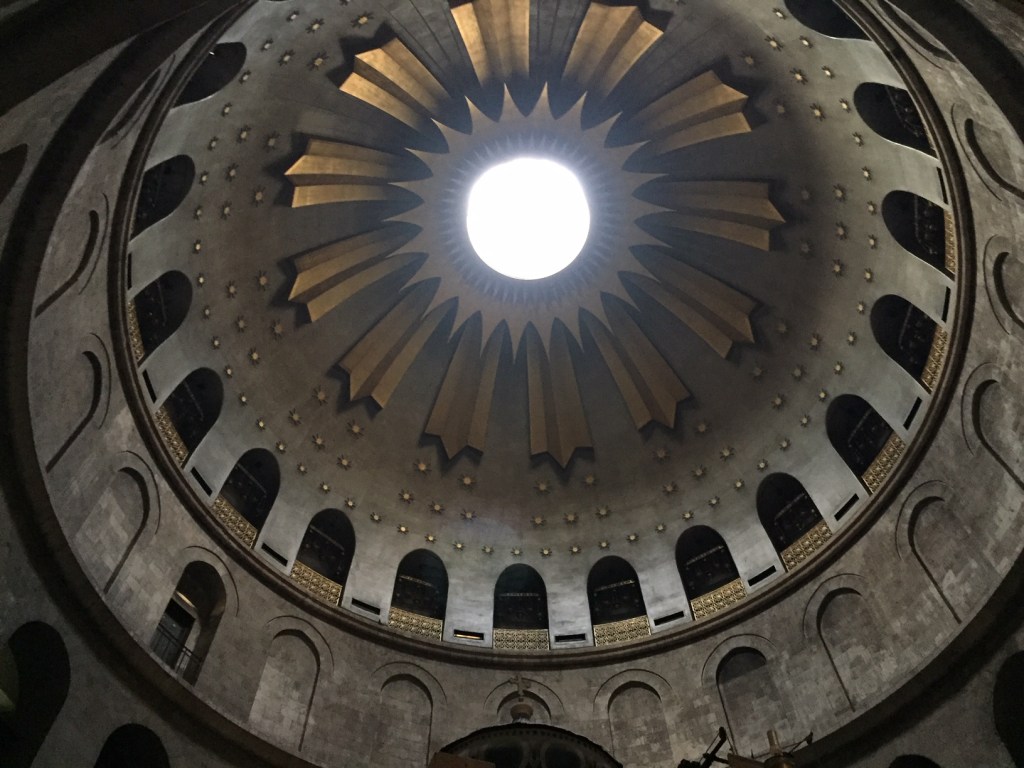
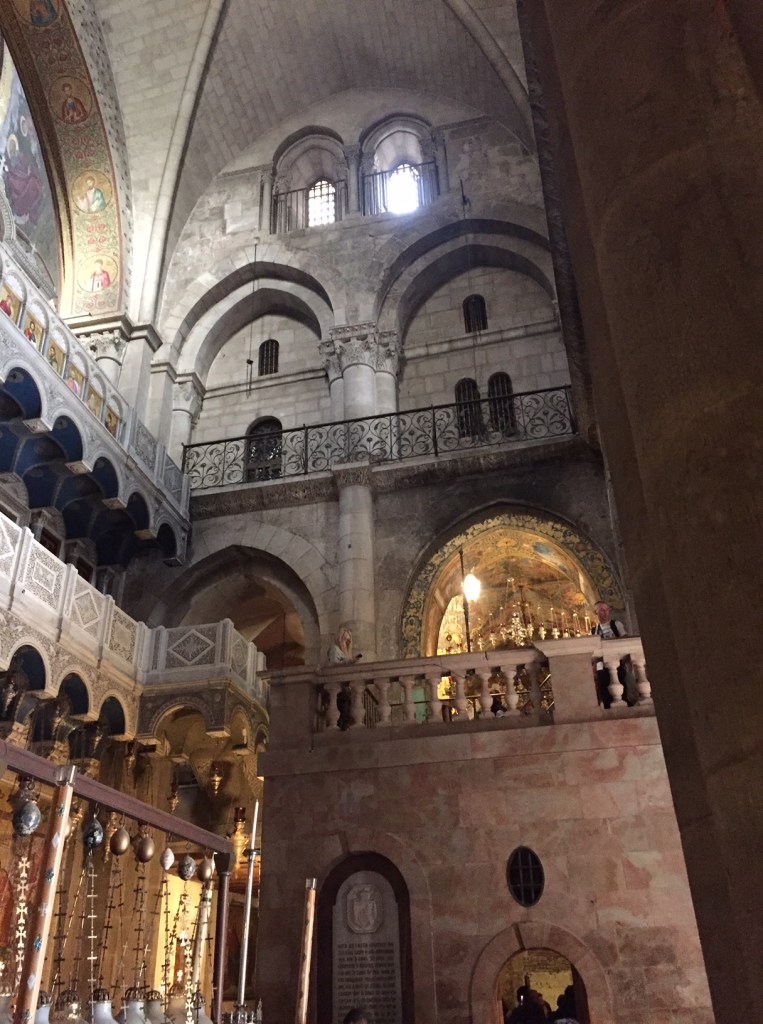
The entry to the church. Beautiful stonework.The church has many sections ,each belonging to a different sect of Christianity. Some parts are very old, some newer.I loved the frescoes in this section.This is said to be Jesus’s tomb, I think — there was a long line of pepple waiting to go in one by one.The dome above.
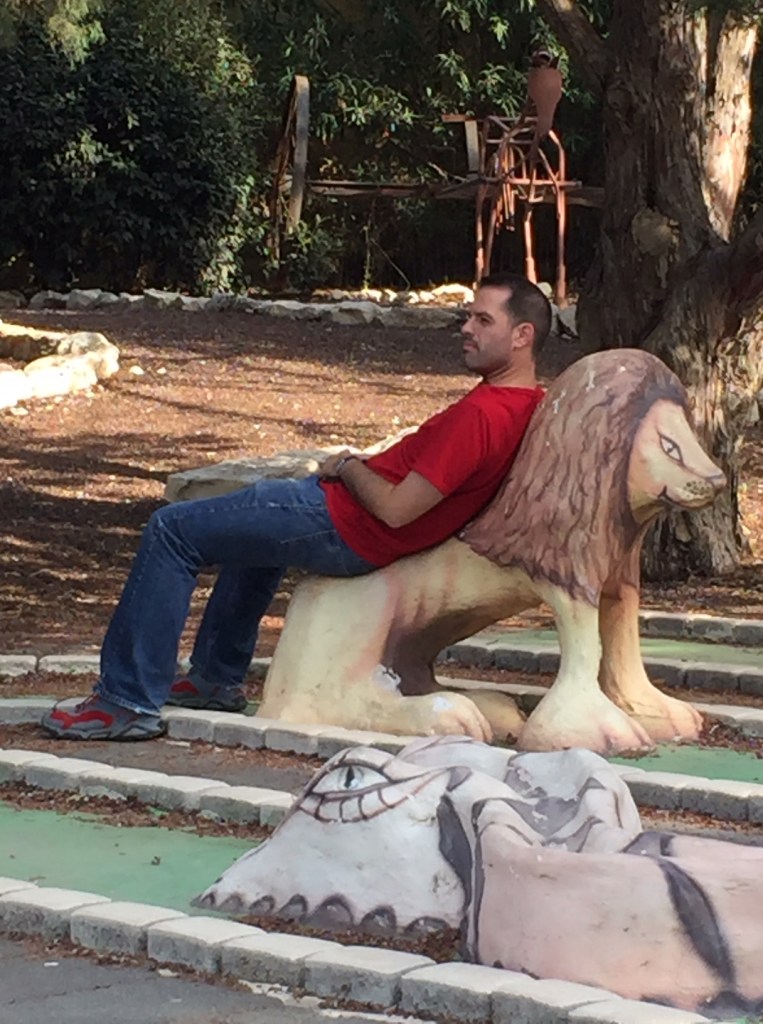
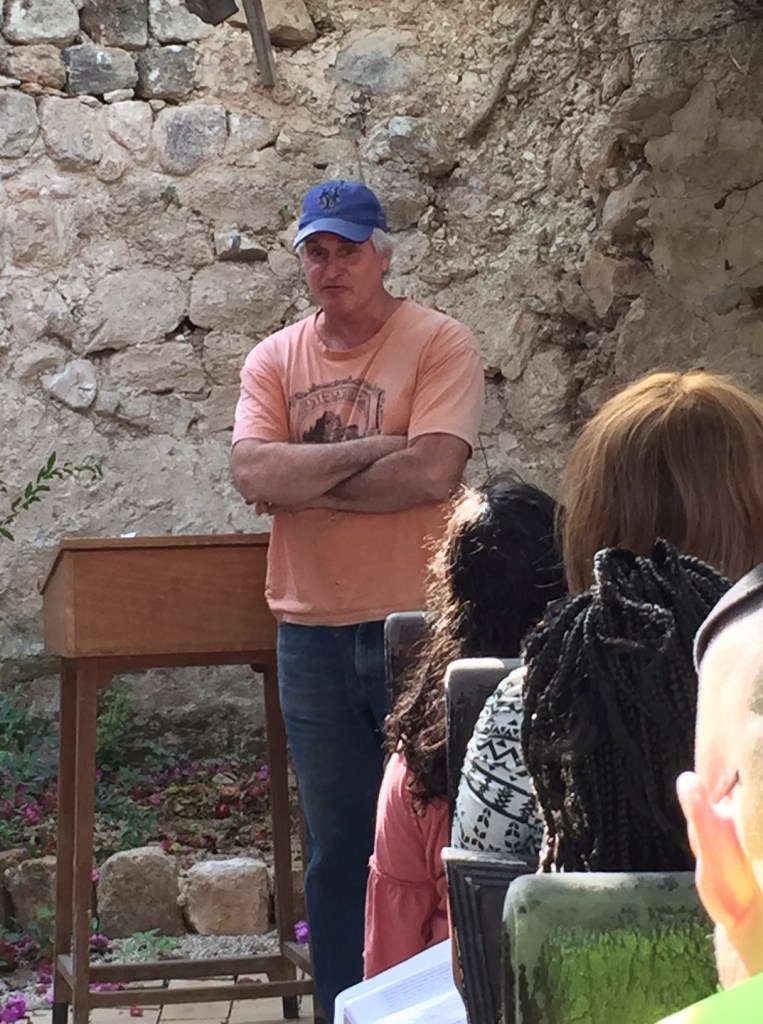
Helen says hello — from the mini-est of mini-golf courses at Kibbutz Daliya. Among other things, she’s trained as an astrophysicist, and she crochets hats for cats in her spare time.This is Doug — he’s my friend Alden’s apartment-mate for the year.
Our second day of the “Rabbinic Seminar” began with a tasty breakfast buffet at Kibbutz Daliya. (For more on what an Israeli breakfast buffet consists of, please refer to my post from August 30.) Then we climbed back on the bus and set off for Tzipori. In his old age, when his health was not good, Rabbi Yehuda haNasi relocated the Sanhedrin and the seat of Jewish learning from Beit Shearim to Tzipori. Tzipori was a major Roman town. It was considered to be a more salubrious place to live, with good plumbing and Roman baths. There’s is a major archeological site there, but we actually didn’t visit it. Instead we visited a former Pardes student on his guest houses out in the countryside. Jamie, our guide, was rather mysterious about this man, and “something surprising” that he had discovered in his backyard. Our suspense was further increased as our large bus traversed narrow alleyways, finally resorting to backing up the hill for about a quarter mile to the gate of Tzippori Village. (We clapped for Tzion, our driver — he was definitely showing off the skills of an Israeli bus driver, and impressive skills they are.)
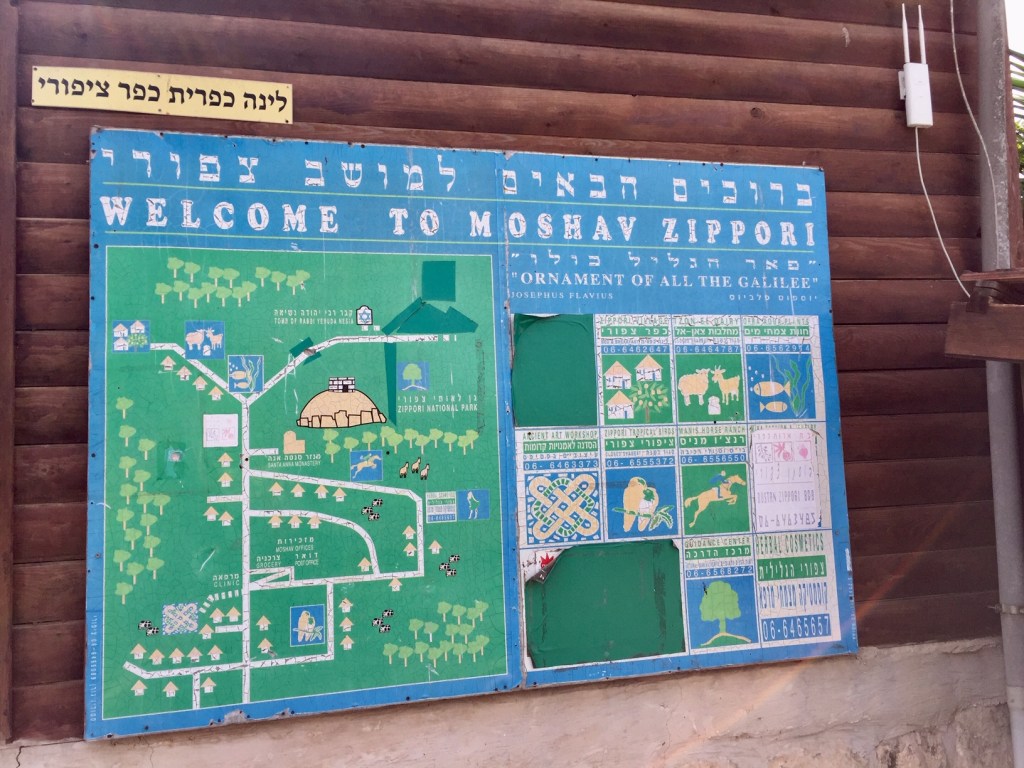
This is the man with the surprise in his back yard…his name is Mitch And this is the sign for his guest house village.
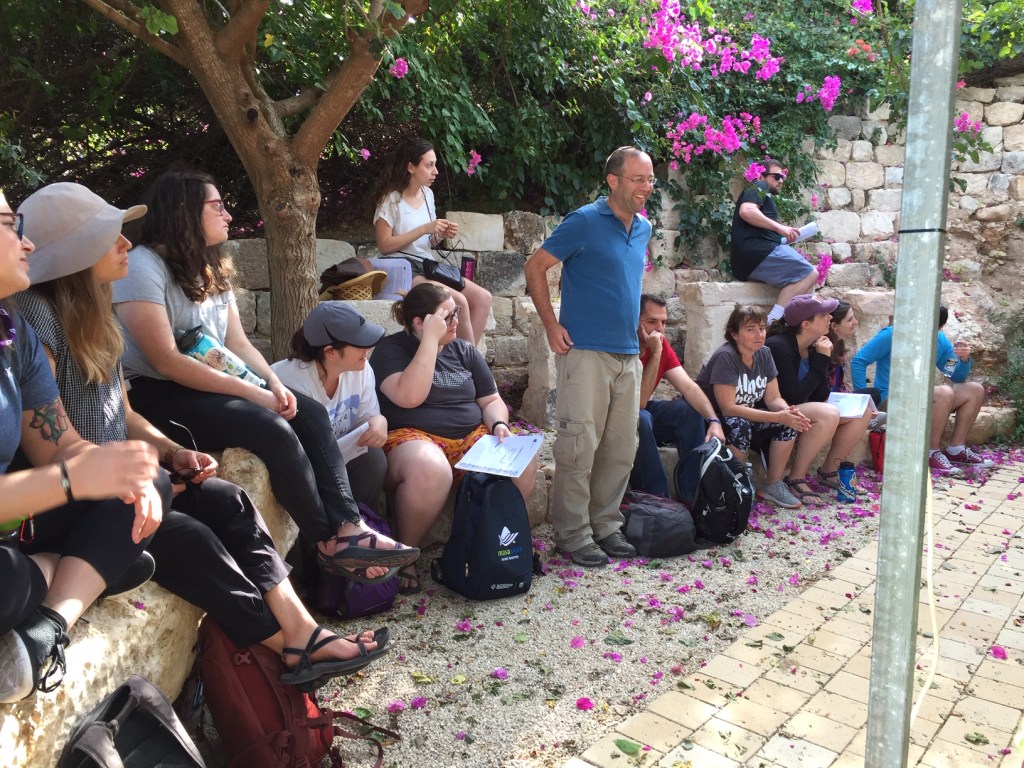
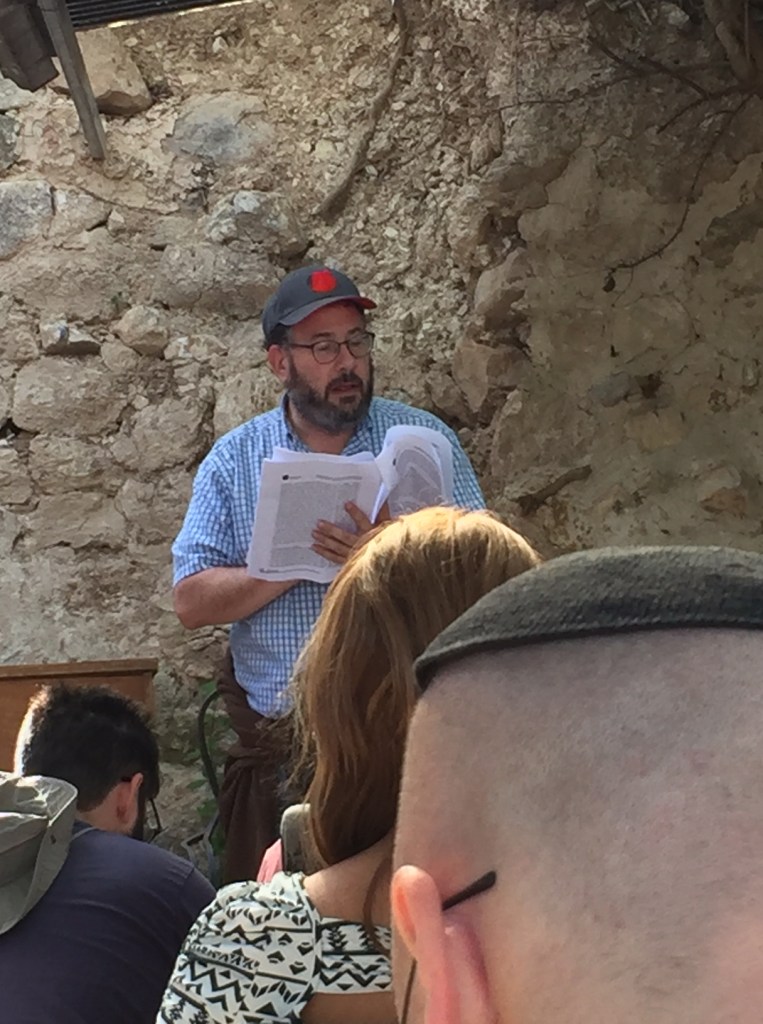
In the 1970’s Mitch moved to Israel, and after living for a time in Jerusalem, he decided to buy some land in the country next to a rather dilapidated village. He built the whole guest village himself, including a scale model reproduction of a Crusader castle. (Take a look here: http://zippori.com/?lang=en) At some point, he was beginning to dig a place for a swimming pool, and he came upon something surprising. This is us listening to his story:
Jamie, our guide, is in the blue shirt. He’s originally from England.With the sunglasses, my iconoclastic friend Mimi. She lives in Amherst when she’s in the States — some of you may know her? She’s a feisty lesbian feminist who was raised Orthodox — she wears tzitzit (fringes), not just a prayer shawl but a tallit katan that you wear all day every day. And has hairy arm-pits — I thought that had gone out of style?
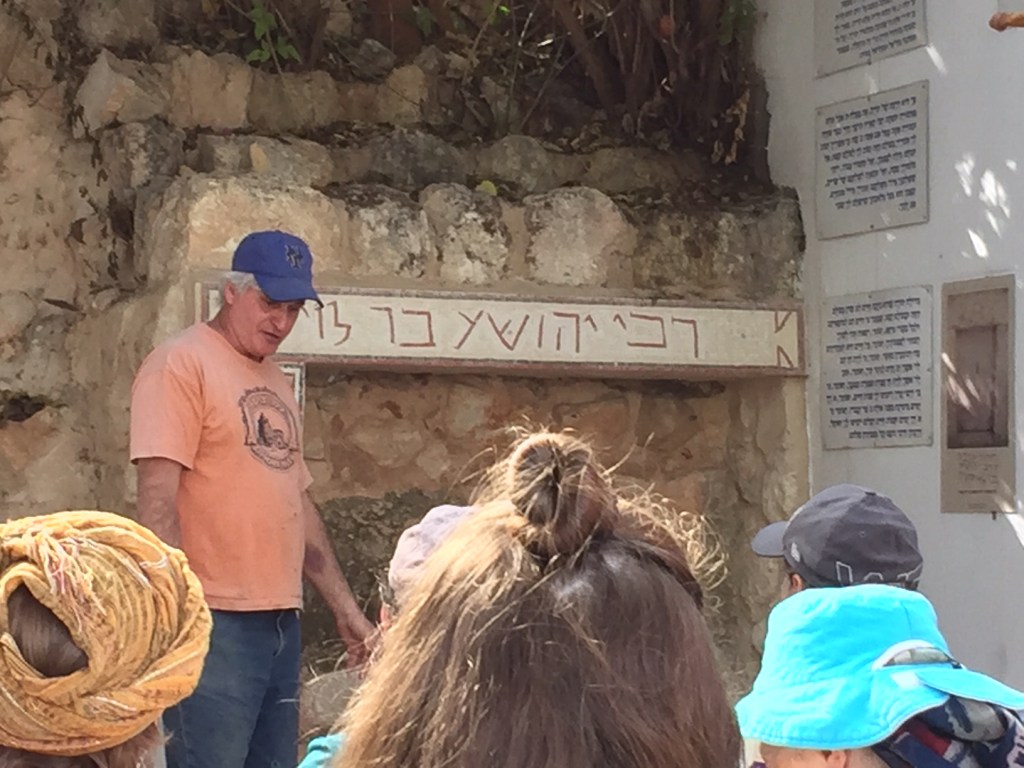
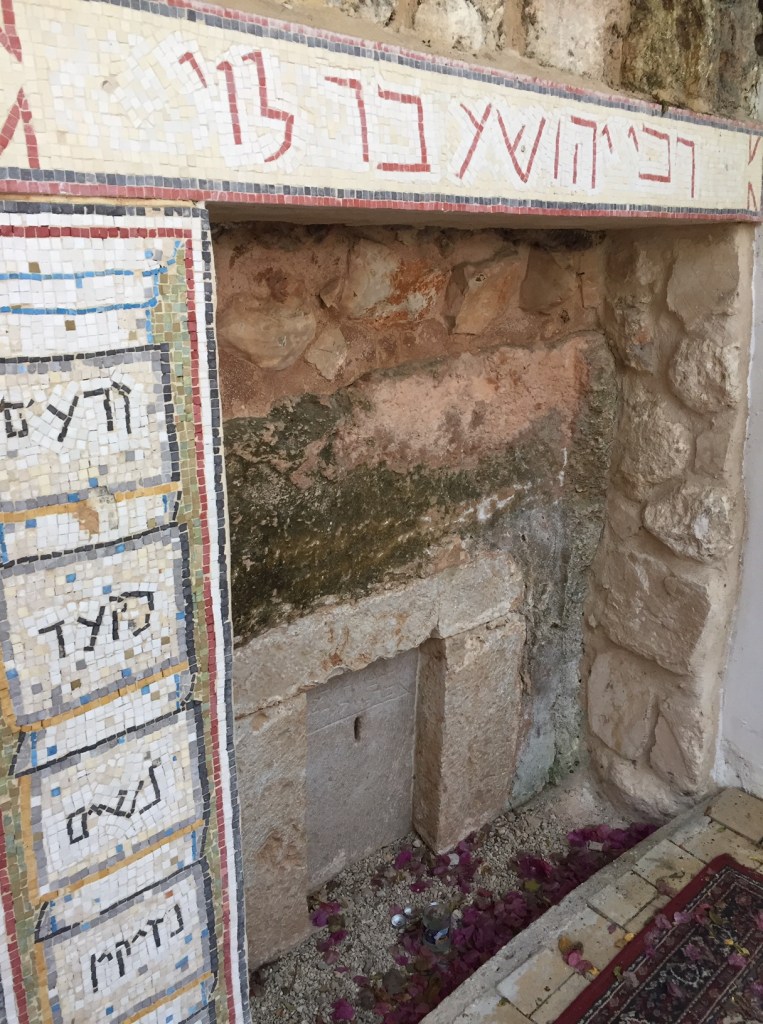
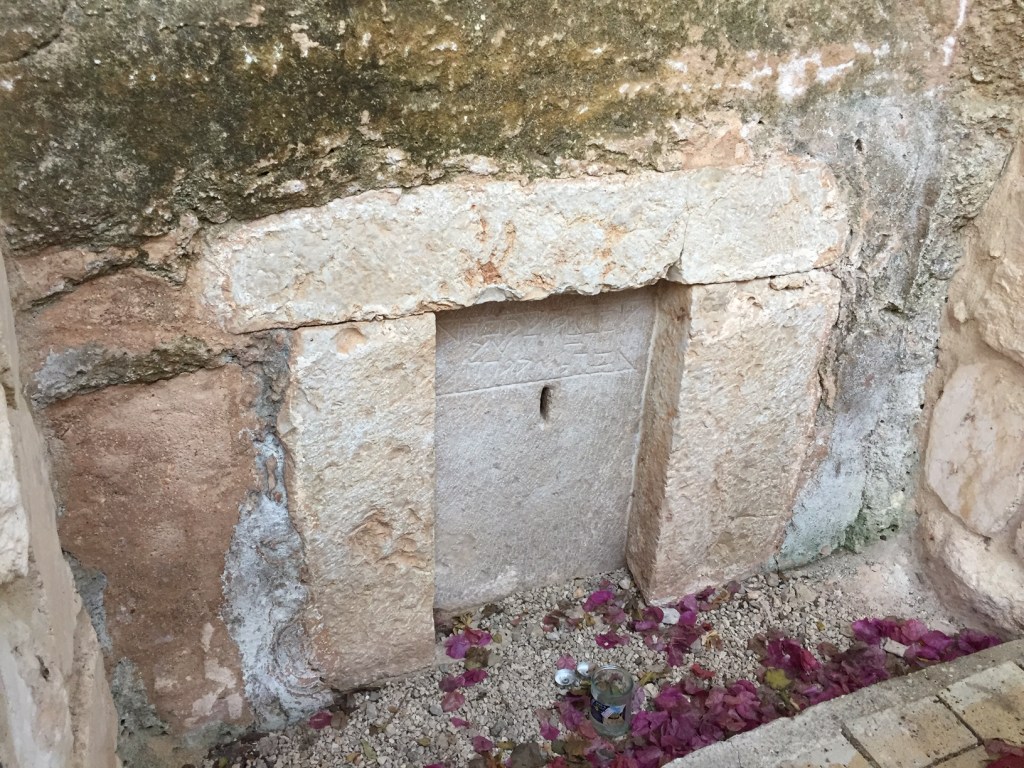
What Mitch discovered, as he soon realized, was a stone marking what is apparently the real, actual grave of the Talmudic figure, Rabbi Yehoshua ben Levi. By his own account, he was excited, but also worried. Once word got out that he had such an important holy site on his property, the Haredim might step in and make the place unlivable. He was still working on his guest houses, and developing his business. Also, he knew that if the government knew he had an important antiquity on his property, there would be no end of red tape. He called his lawyer. You can read the whole story (un to 2012, anyway) here: https://www.jpost.com/Opinion/Columnists/The-Human-Spirit-Bucking-authority Eventually, archeologists uncovered tomb, and entered it. Inside, there are apparently stone shelves for five people. One has a sealed tomb on it.
Mitch shows us the outside of the tomb, which is not open to the public — it has been resealed. Mitch himself made the mosaics that surround the grave. However, the gray stone with the hole in it is the original. The Hebrew lettering on it specifies that this is the tomb of Rabbi Yehoshua ben Levi.Behind this stone is a cave, with five shelves. My recollection of Mitch’s speech is that there is one sealed tomb, and four shelves that are either empty or have open tombs that have been robbed. We Jews do not traditionally bury our dead with items of value (except, of course, for old books that receive a holy burial in a grave along with a body). However, in this time period there was Roman influence, so sometimes valuables were buried with people.
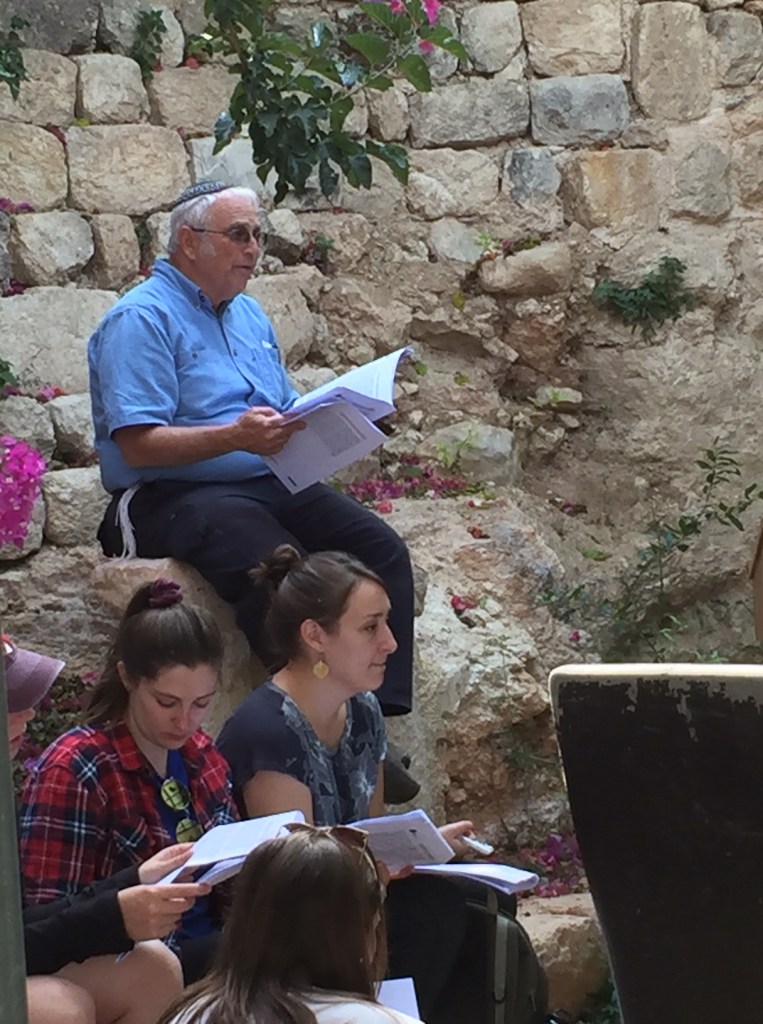
After we heard the story of the tomb from Mitch, we did some learning with Tzvi about Rabbi Yehoshua ben Levi. There are several wonderful midrashim about this rabbi. We read from Masechet Ketubot 77b that several other rabbis were very wary of catching diseases (possibly leprosy) from those who were poor and ill, but Rabbi Yehoshua ben Levi would sit and study Torah with them, “Saying: the Torah is a loving hind and a graceful doe [Prov. 5:19]. It bestows grace on those who learn it, does it not protect them?” When R. Yehoshua was subsequently dying (not, presumably, from a disease he caught from those he studied with), “The Angel of Death went and appeared before him. Rabbi Yehoshua ben Levi said to him, ‘Show me my place in paradise.’ [The angel] said to him, ‘Very well.’ Rabbi Yehosua ben Levi said to him, ‘Give me your knife lest you frighten me on the way.’ He gave it to him. When he arrived there [in Gan Eden — the Garden of Eden, or Heaven] he lifted Rabbi Yehoshua and he showed it to him. Rabbi Yehoshua jumped and fell into that other side.” Having made his escape into Paradise, Rabbi Yehoshua refused to hand back the angel of Death’s knife, until ordered to do so by God — “Give it to him, it is necessary to kill the created.” He seems to have been hoping to save others from death, but God had other ideas. The good rabbi remained in Gan Eden, where he was warmly welcomed by Elijah the the Prophet and Rabbi Shimon bar Yochai.
Tzvi teaching us this story. Rav Meir learning with us. Most of our teachers are rabbis, but Meir is the only one whom we sometimes call by his title. Leah taught us that that Talmud teaches an the order of importance of titles in the Talmud, but that those with no title are considered the greatest of all!
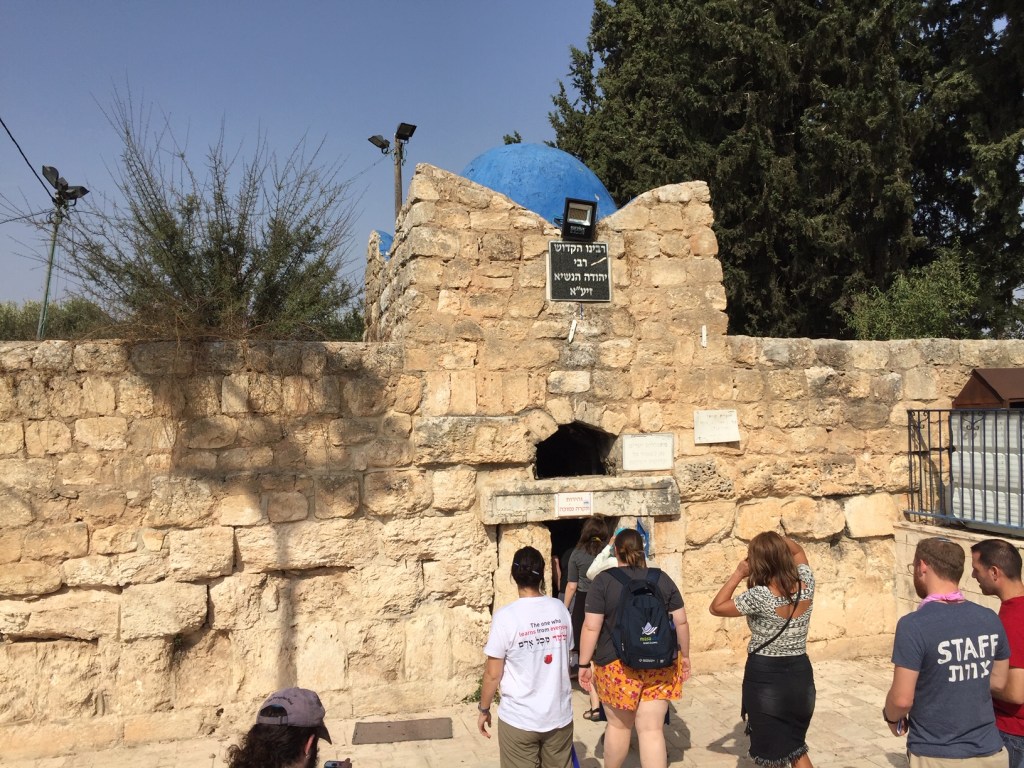
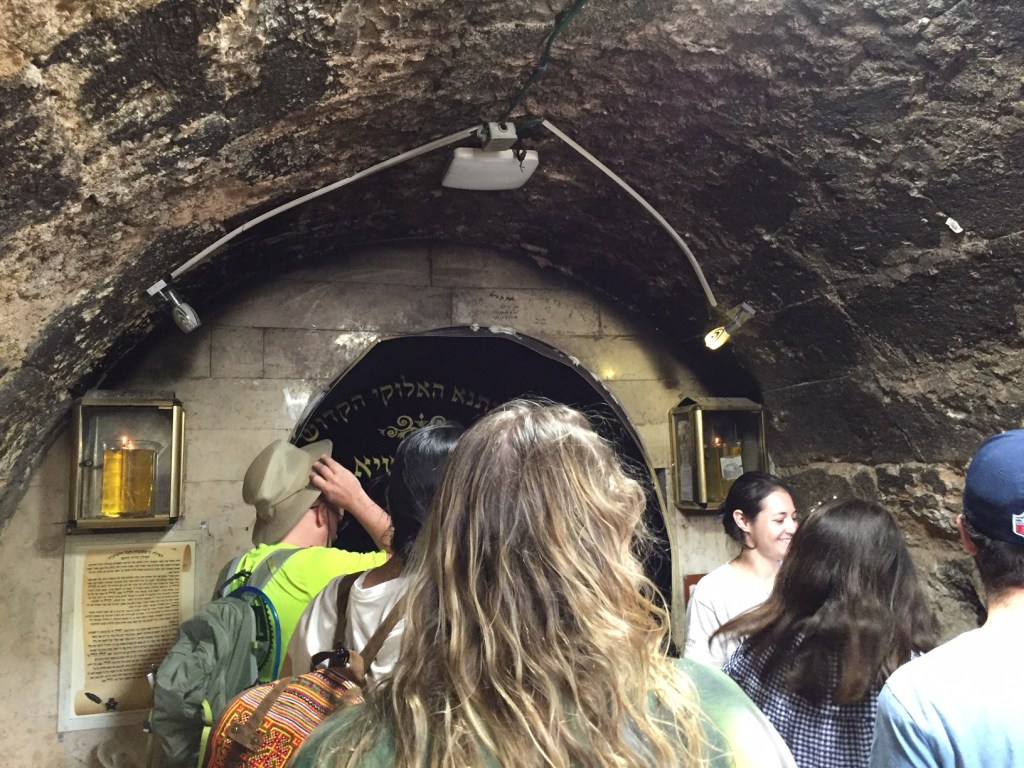
We would have been happy to linger at Mitch’s, I think — and he was clearly enjoying showing us around. We went down into the olive grove where the olives were being harvested — by beating the trees with a stick and letting the olives fall into white sheets underneath. But we had to get back on the bus and drive onward. Our next stop was the putative tomb of the grandson of Rabbi Yehuda haNasi — confusingly also called Yehuda haNasi. Here, we did some learning about rabbinic history with Jamie and Meir.
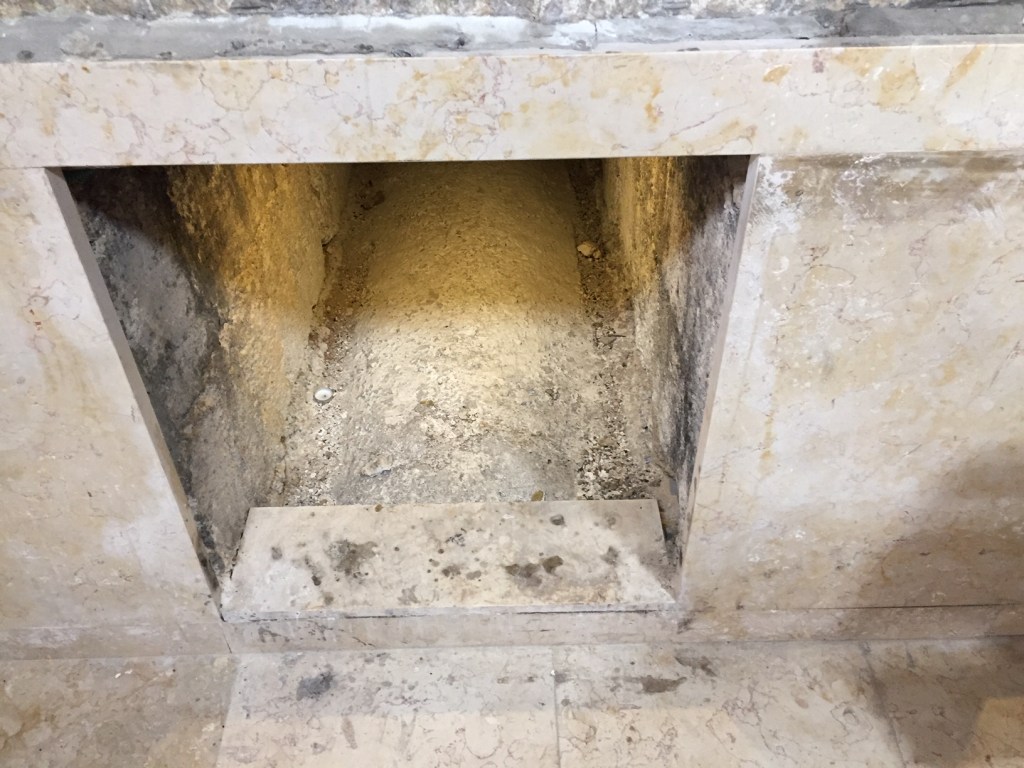
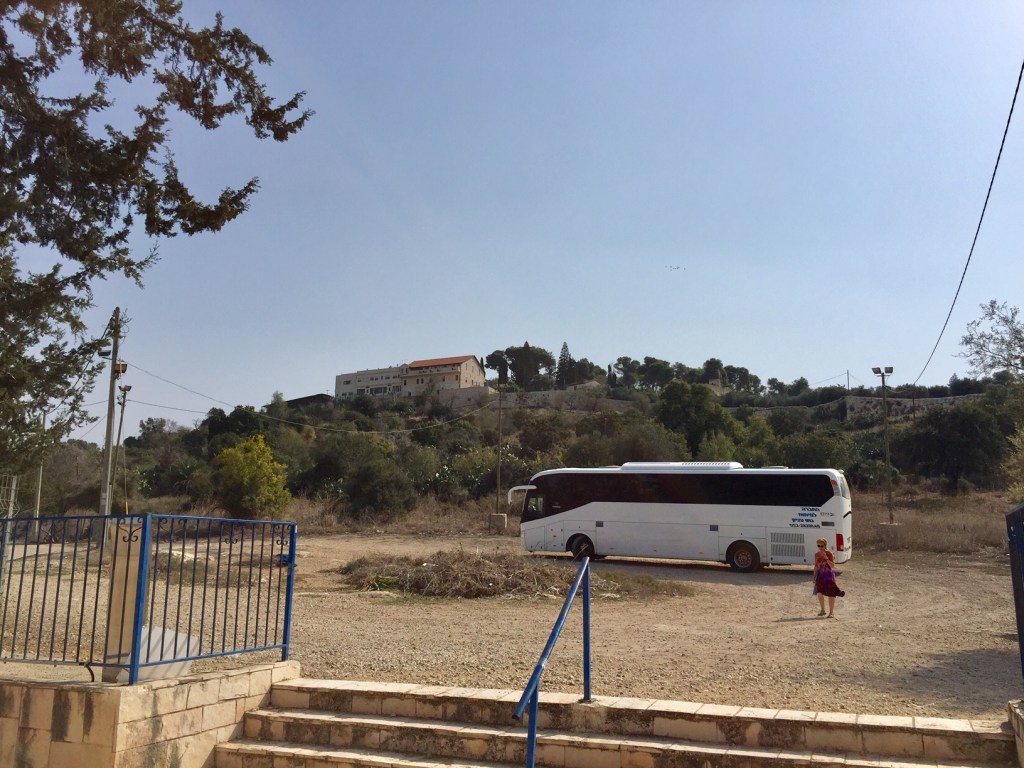
The outside of the tomb…And the inside — decorated in the Chassidic manner…Someone is certainly buried here……. Our trusty bus. We almost always have this bus. It’s made in China. Someone told me that Israeli buses are made with a shorter wheelbase, in order to get around the narrow streets and sharp curves of this ancient country. I don’t have a picture of our driver, Tzion. He’s bald, olive skinned, middle aged but still strong. He looks like the perfect Israeli — like he’d give you the shirt off his back, but also would kill you if necessary. BTW, that’s a Christian monastery in the background. The Christian tradition is that Tzippori (Sepphoris) was the original home of Joseph and Mary, Jesus’s parents. Beit-lechem (Bethlehem — means “House of bread”) is not far away, although of course on the other side of the Green Line.
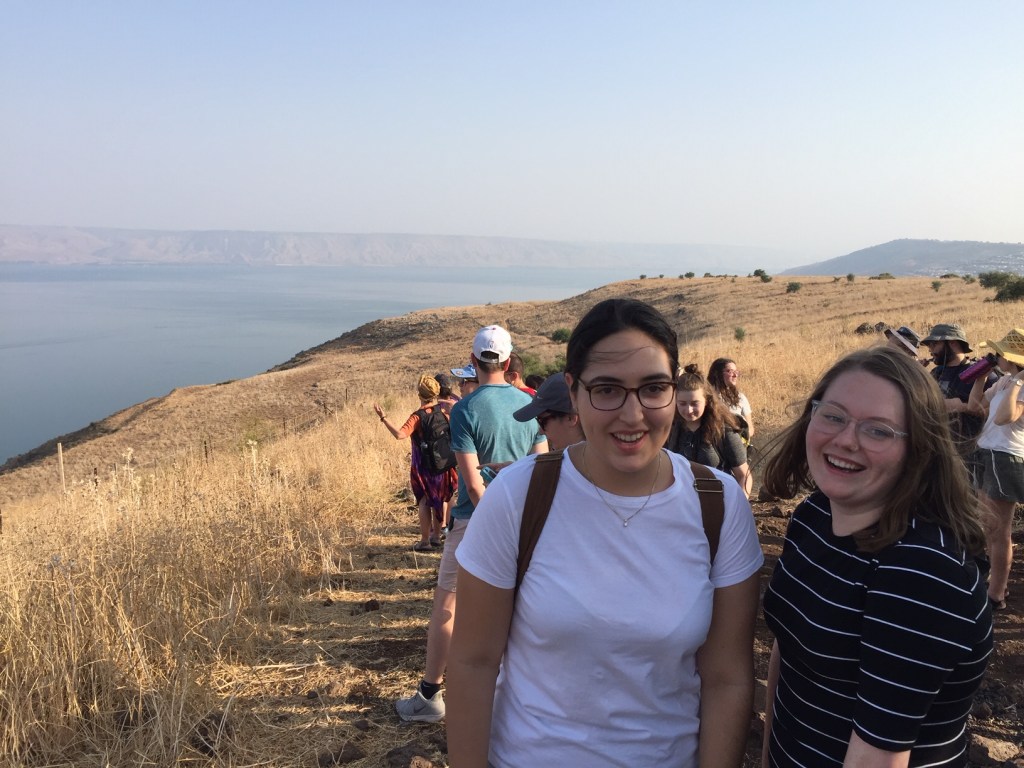
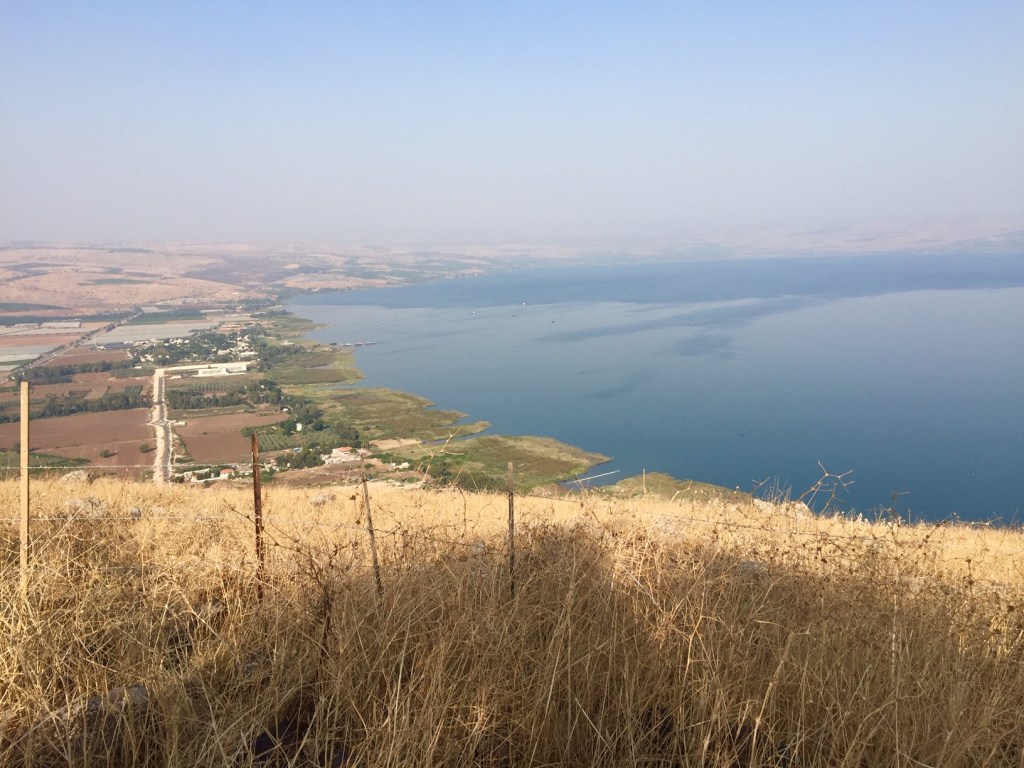
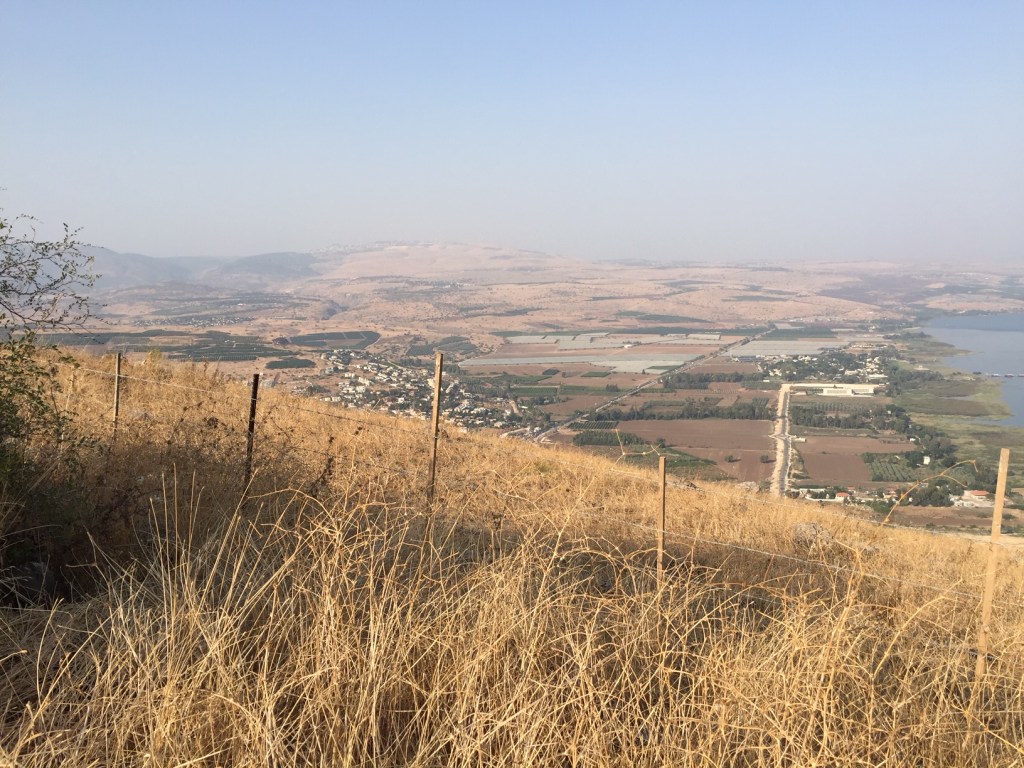
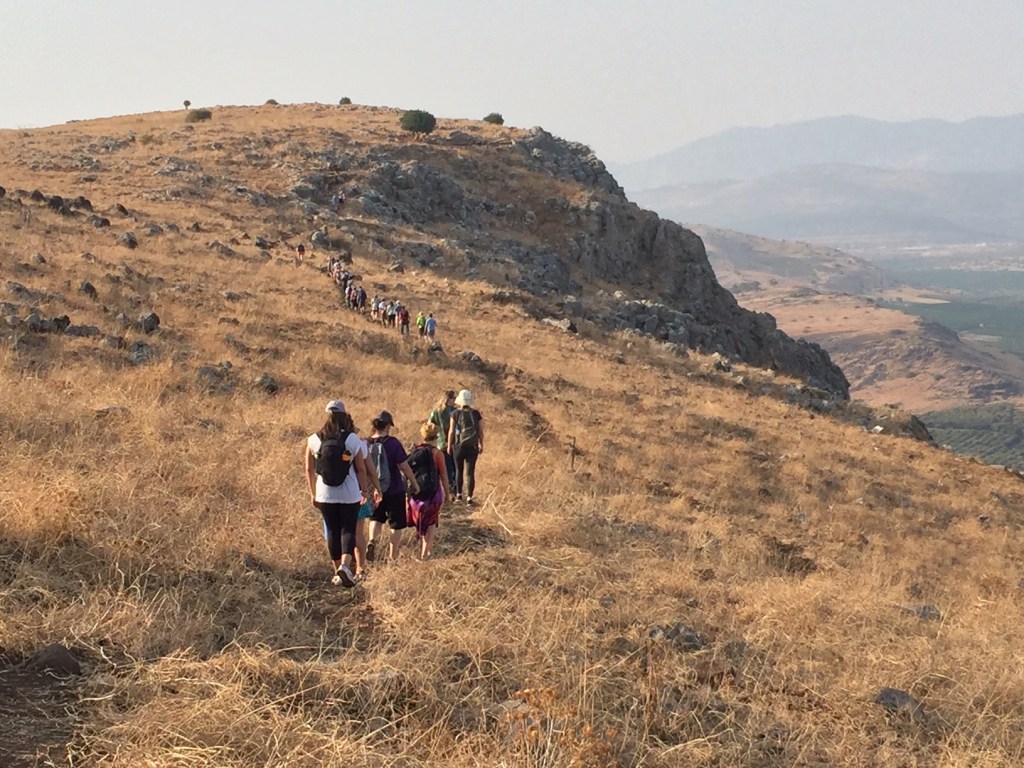
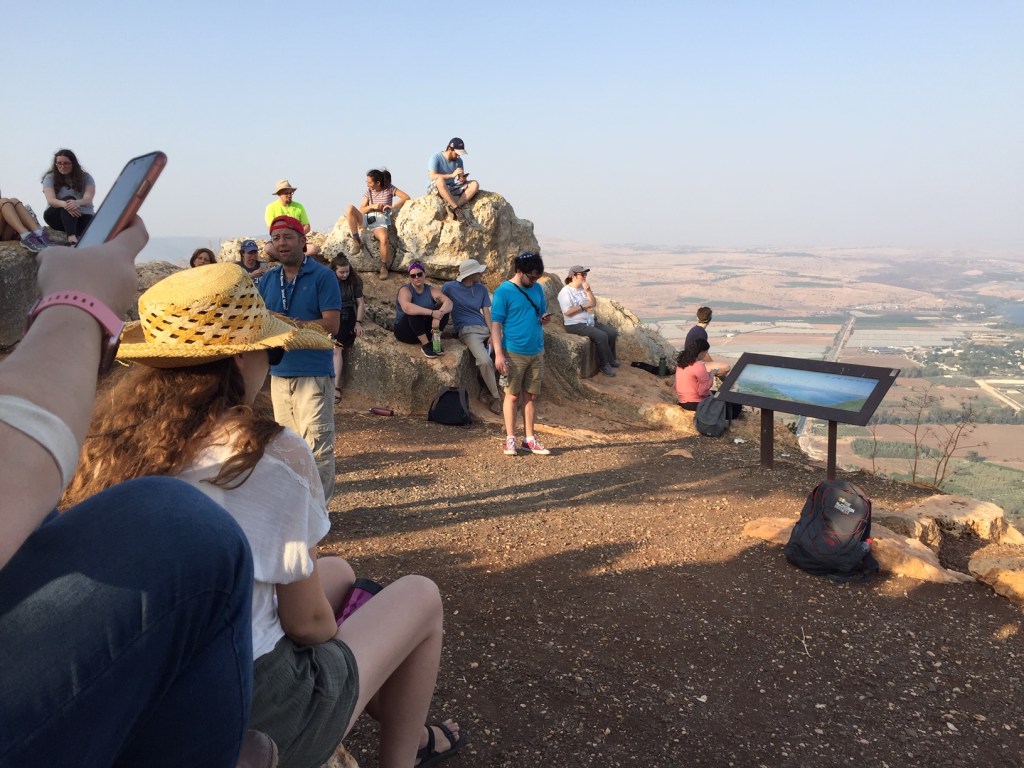
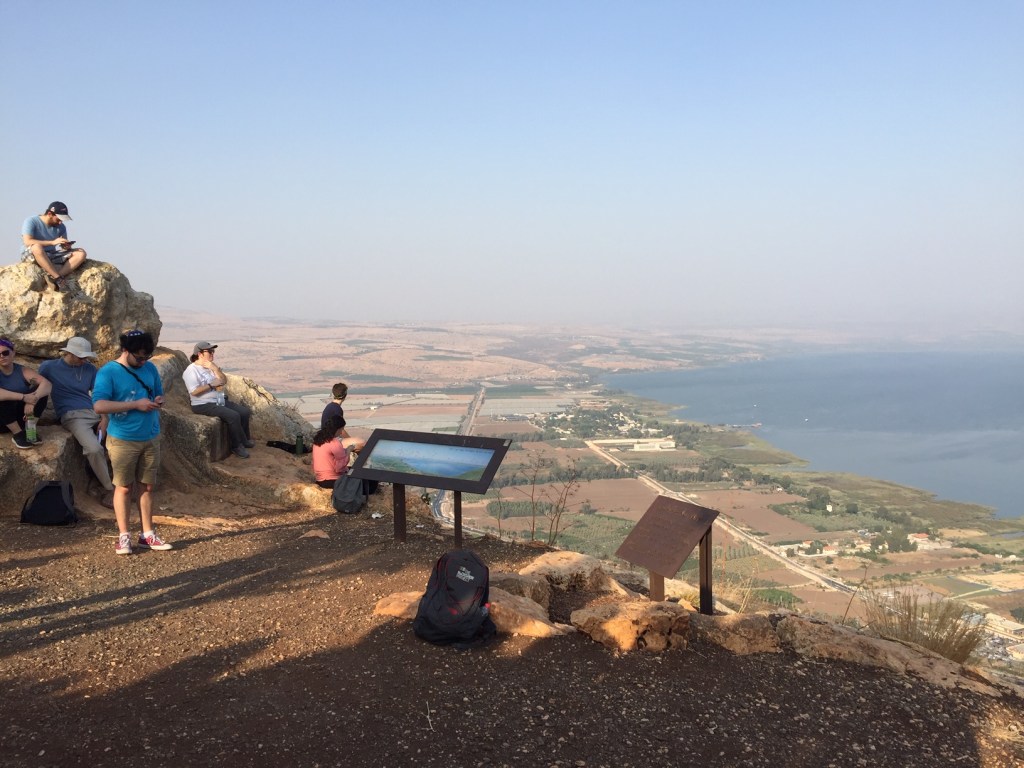
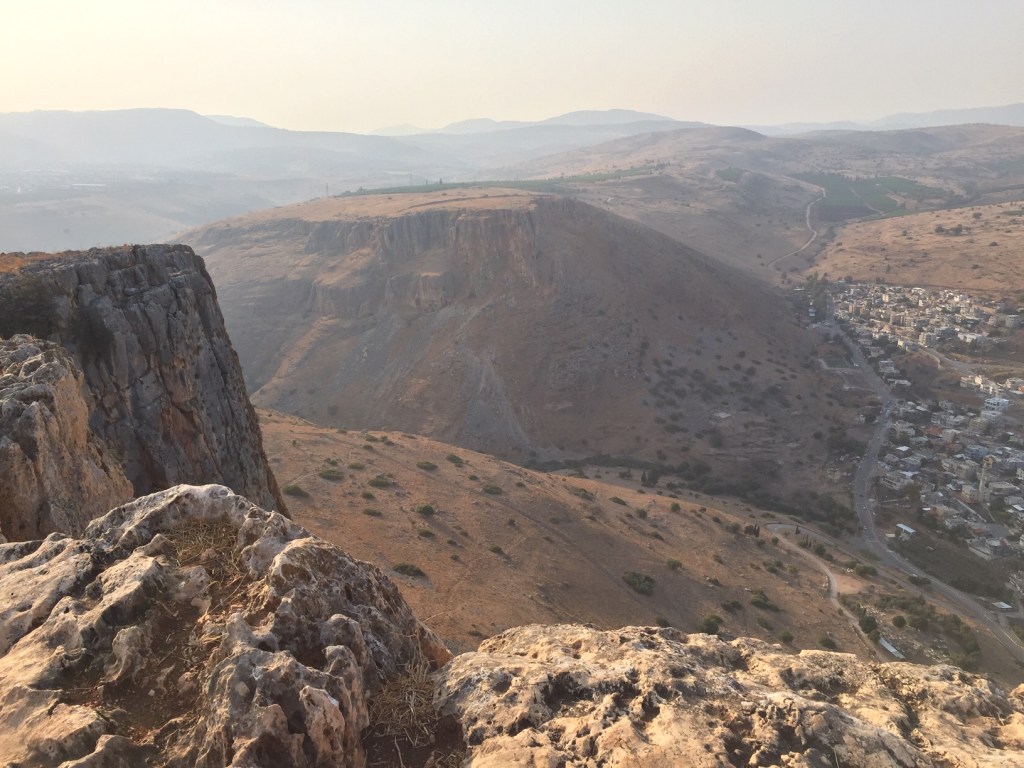
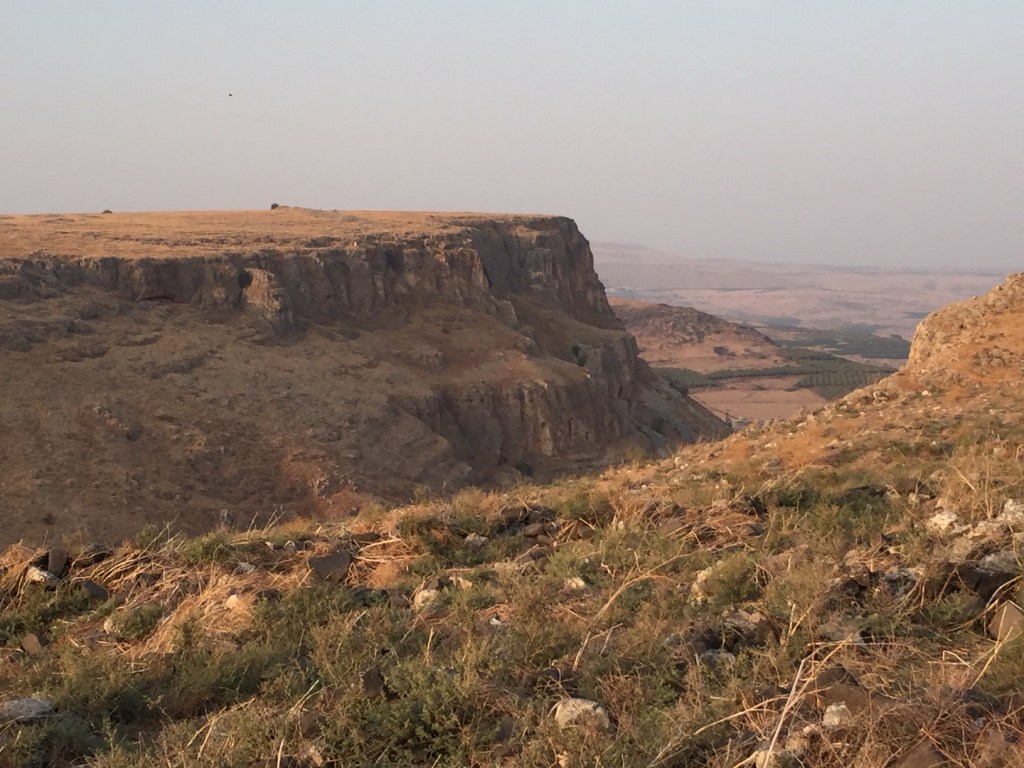
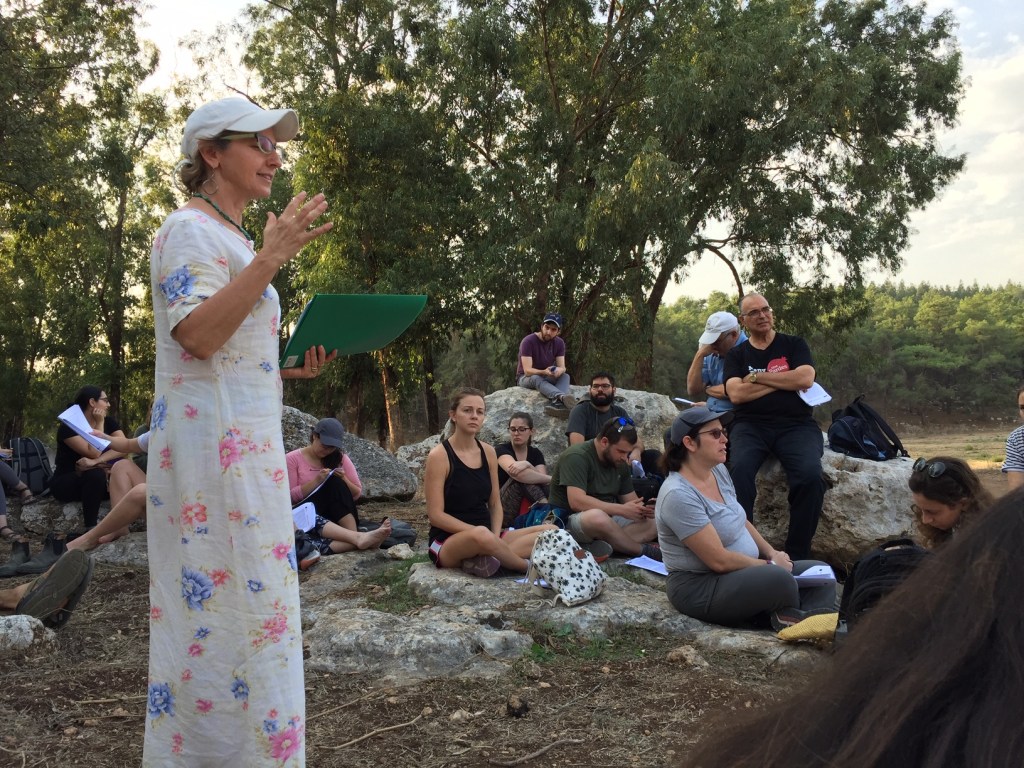
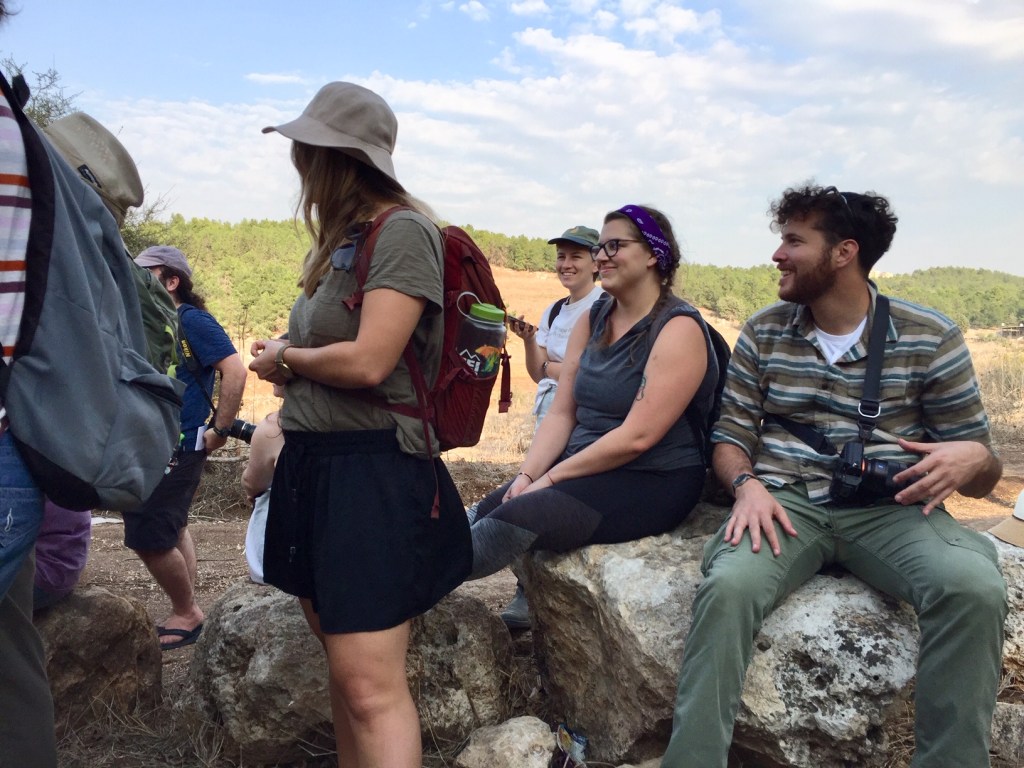
We drove onward across the country, winding our way uphill to the beautiful Arbel National Park. Here, we sat at picnic tables and made sandwiches with the ample fixings sent along by the man we all know as Chef. It was unseasonably hot — we jockeyed for shade. There were numerous school groups and tourists also visiting the park. After a convivial lunch we set out on a hike through the dry grass on the high hills looking down on the Kinneret — the “Sea of Galilee”. My classmate Bruce had brought his binoculars, and we got a good look at a hawk, but I don’t know my Israeli birds very well yet. We tentatively identified it, by its hovering behavior, as a harrier of some kind.
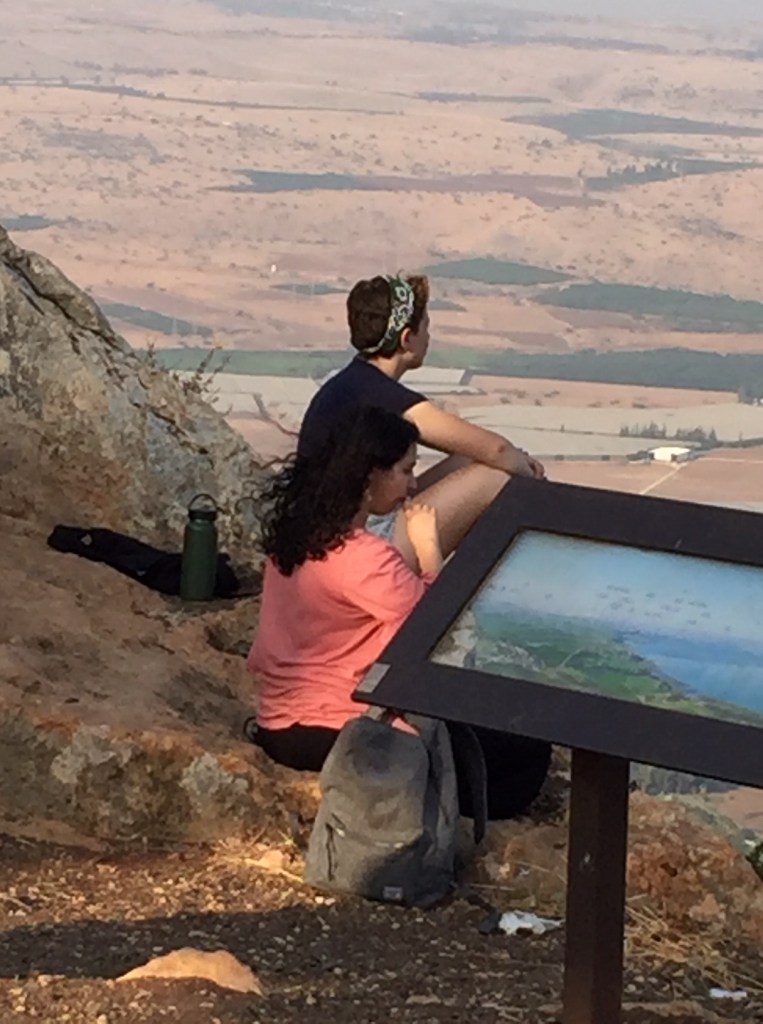
I turned back to get a photo of the view — that’s the Kinneret, with Jordan on the other side — and I caught Rachel and Emunah looking very pretty. Northern end of the Kinneret. On the very farthest hill is Tzfat.
We stopped for a bit at a look out. I know we did some learning here, but to be honest, I was tired and hot and overwhelmed by the scenery, and I had not brought any paper to make notes, so…
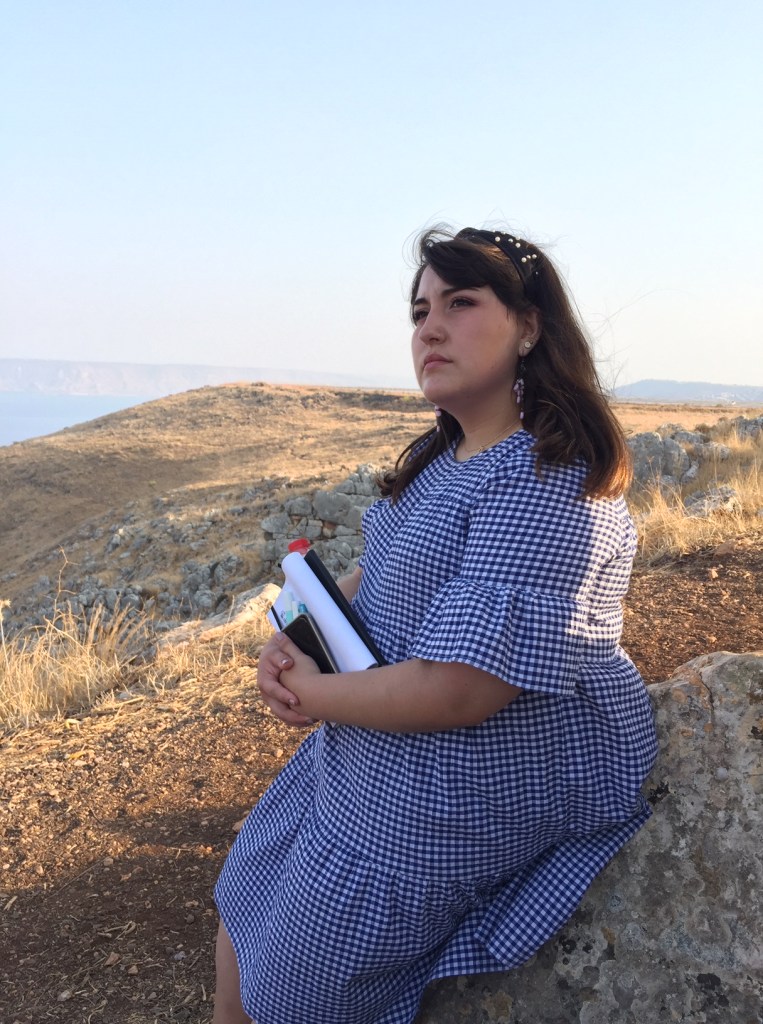
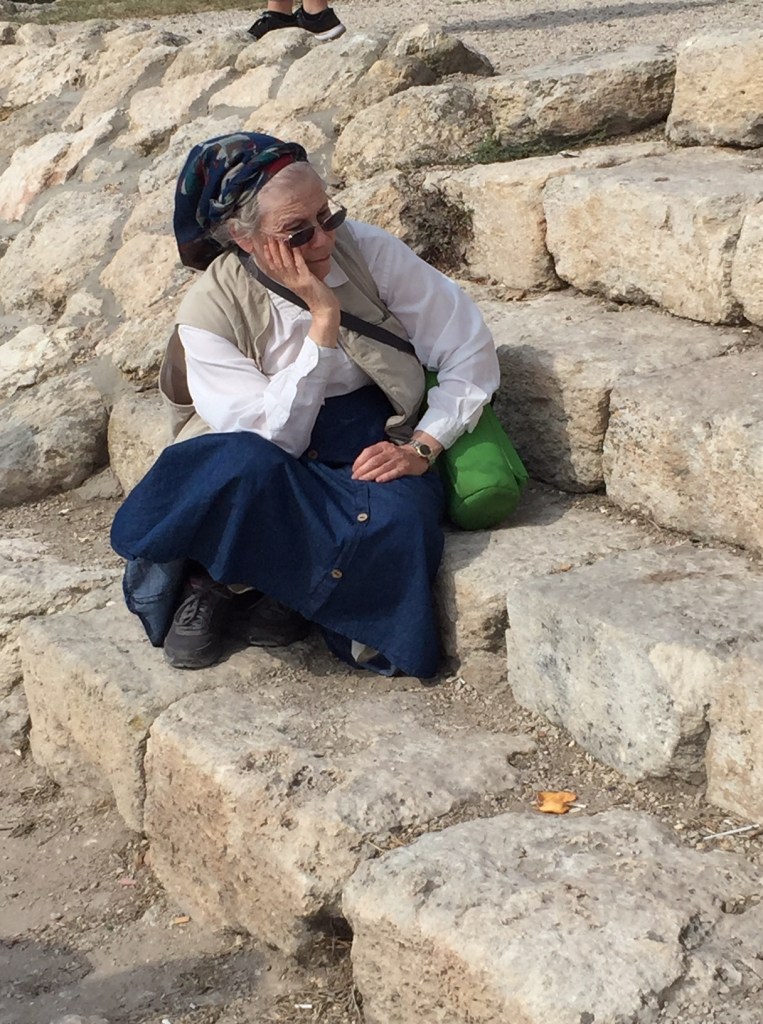
Liana and ElizabethThis is my friend Abigail, from Chile, looking very pensive and heroic!
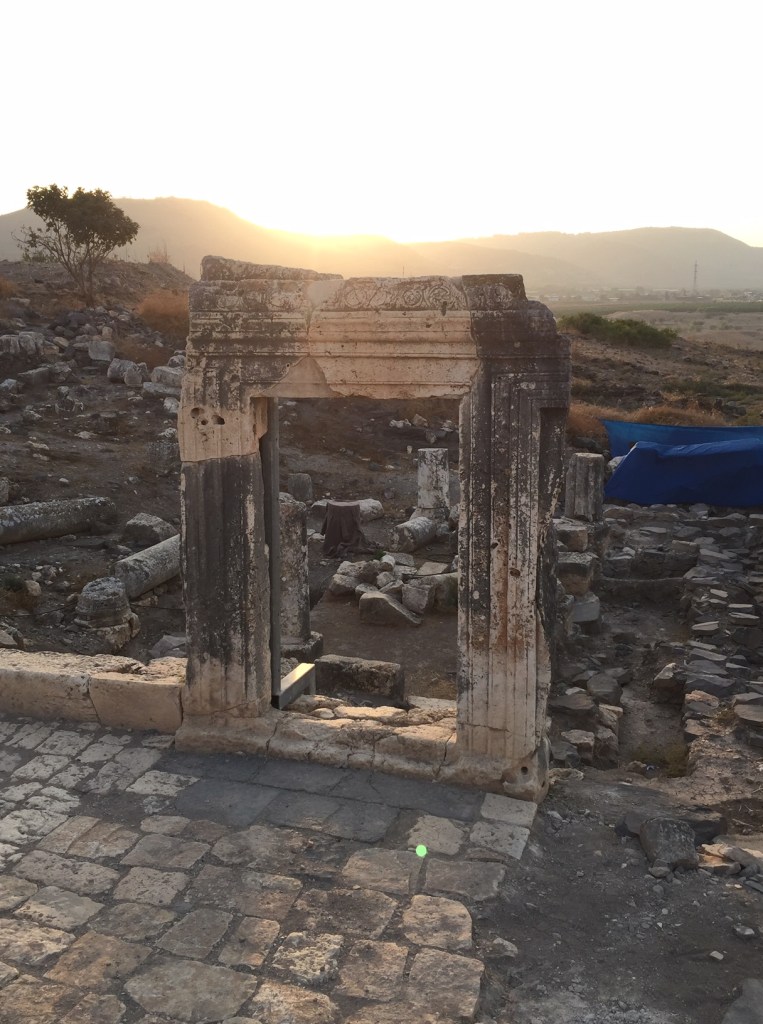
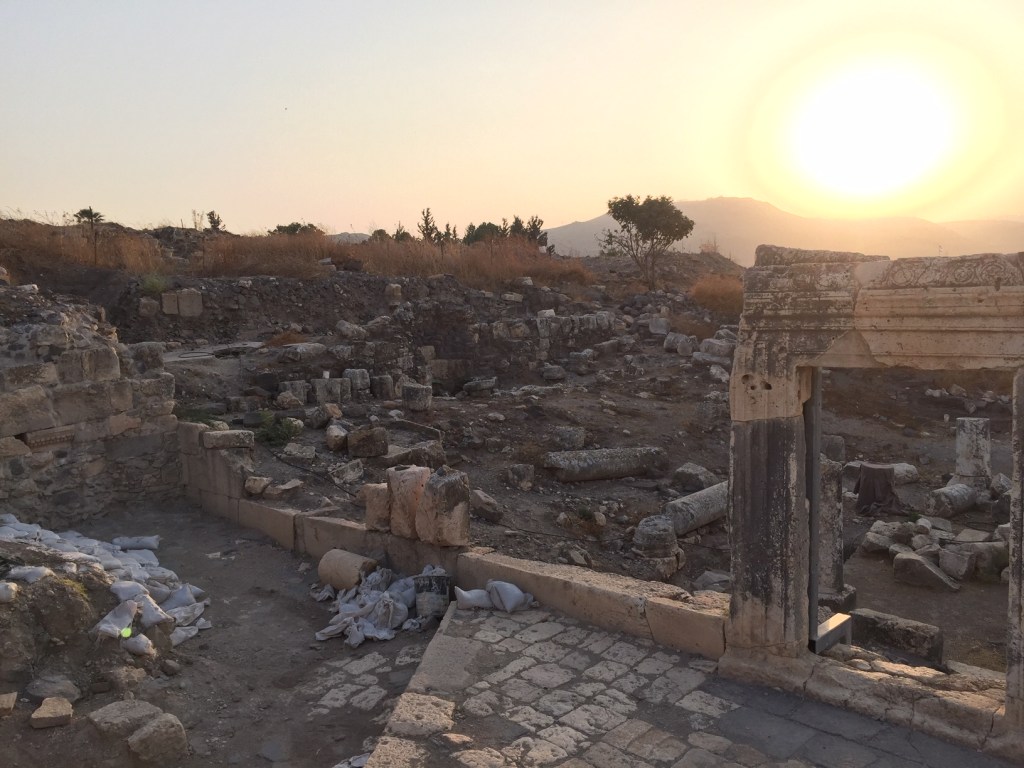
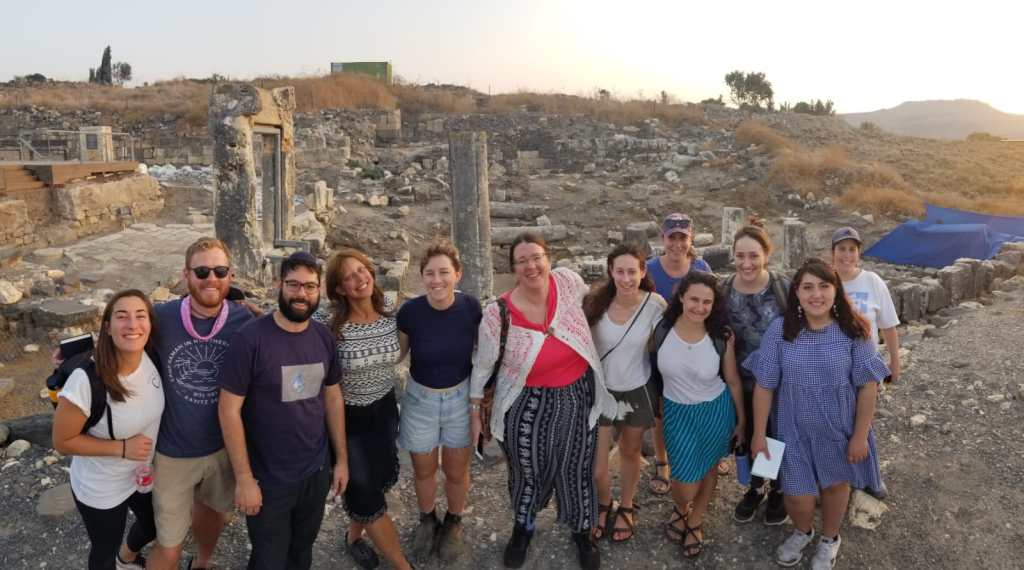
After a pause for popsicles at the snack bar (I had mango and passion fruit — it was amazingly good), we hopped back on the bus and drove a little way down the road to an ancient synagogue. Here we split into two groups — egalitarian and traditional — to daven mincha. The sun was setting, and it was very beautiful.
It’s an active archeological site, hence the blue tarp.This is the the view looking the other direction.Everywhere is Israel are places like this…The egalitarian davenners. Photo by Joe Brophy.
Our tiyyul had ended. The sun was setting — it was too late to spend time in the city of Tiberias, where the Sanhedrin had its last location. We drove down to the resort town briefly to drop off Yarden, who was going off to pend her weekend doing more hiking (!). As for us, we set off back to Jerusalem, in the gathering dark.
The flood of new information and experiences that I have been soaking in have made me dawdle and delay about my blog posts. How am I ever to convey all that I am learning? We’ve had a number if interesting speakers at Pardes, we have gone a couple of tiyyulim, we heard a panel speak on a complex topic. Meanwhile, I’ve also been leading my daily life, which includes visits with family, hanging out with friends, and going to services, as well as attending classes and the basics of keeping house. And, to be honest, I’ve been spending far too much time on Facebook mourning the loss of my alma mater, Marlboro College.
The “Rabbinic Seminar” (actually a tiyyul with some study along the way) perhaps lends itself to a simple photo essay — heavy on the photos, light on the essay! So here we go…
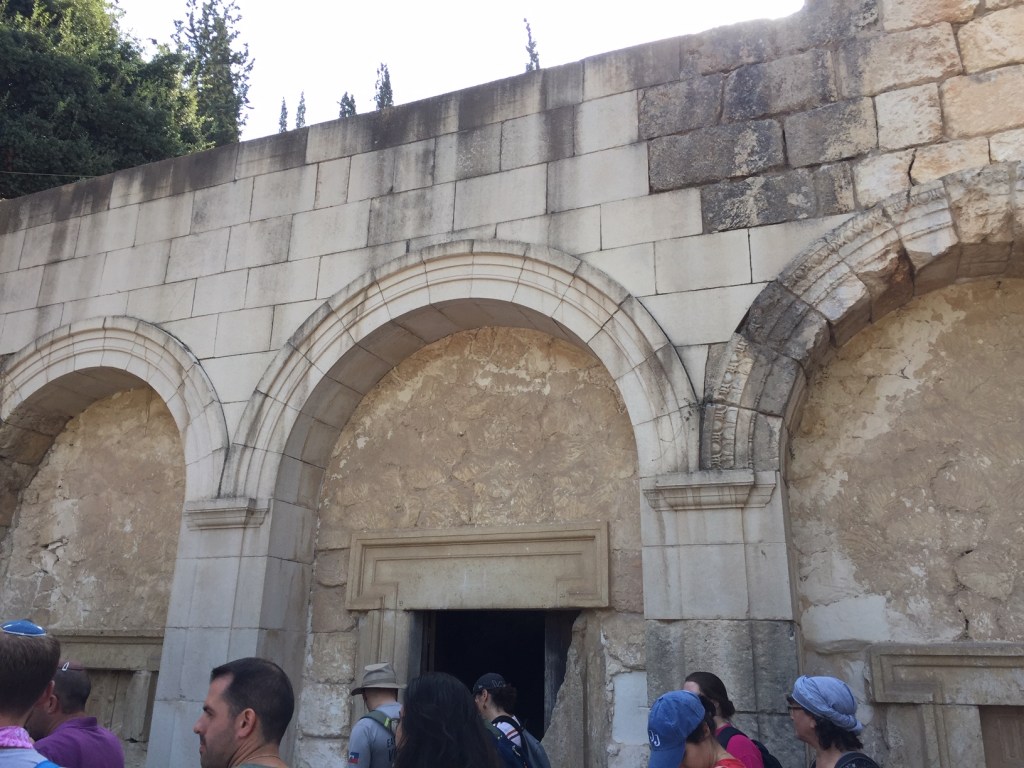
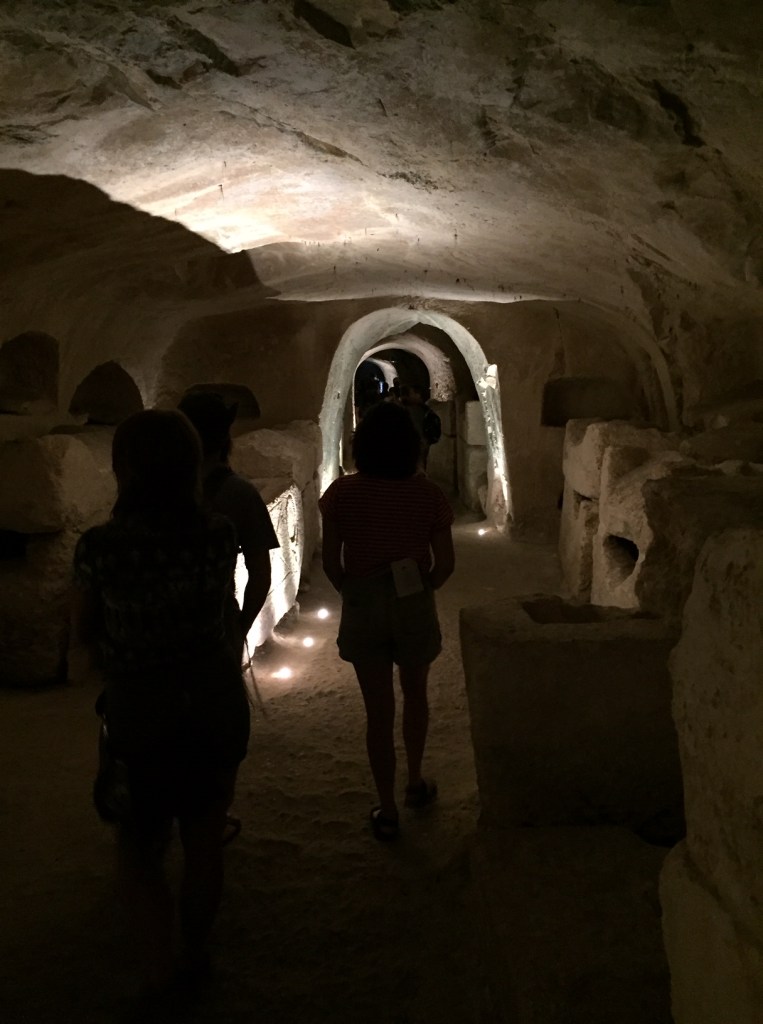
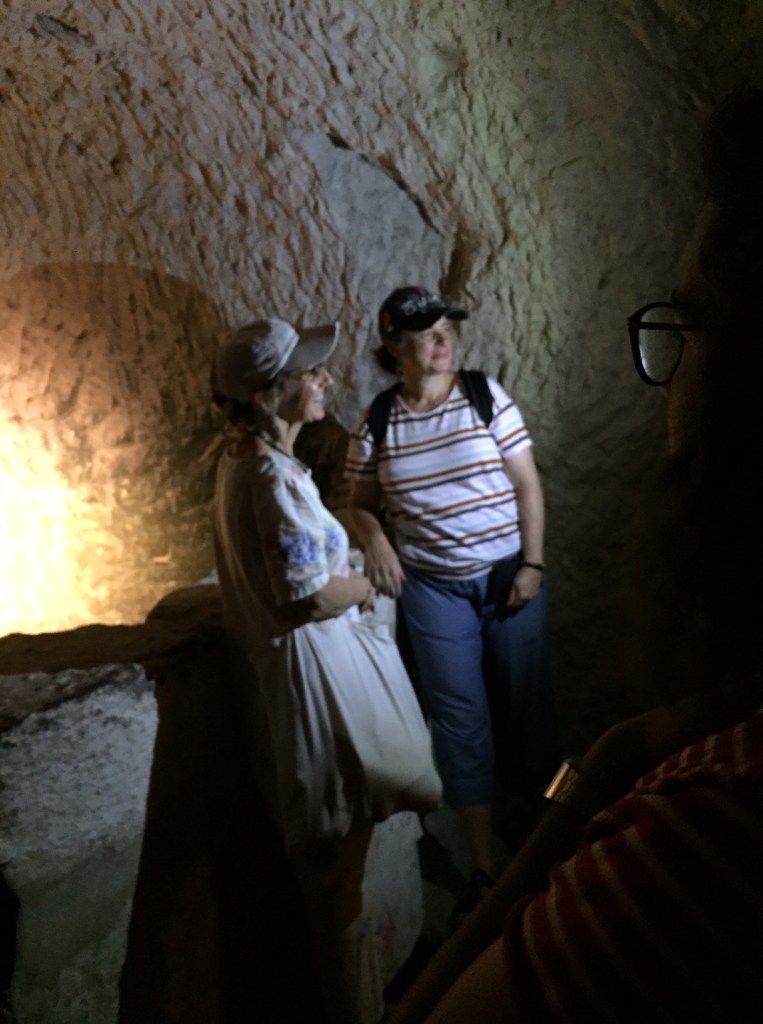
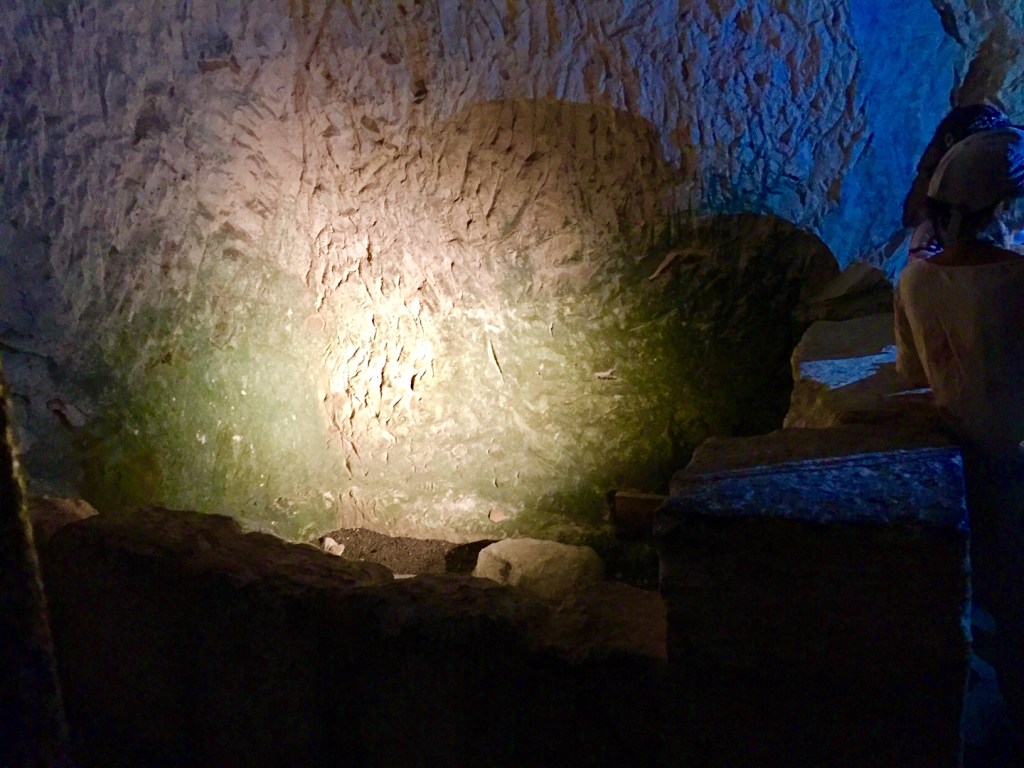
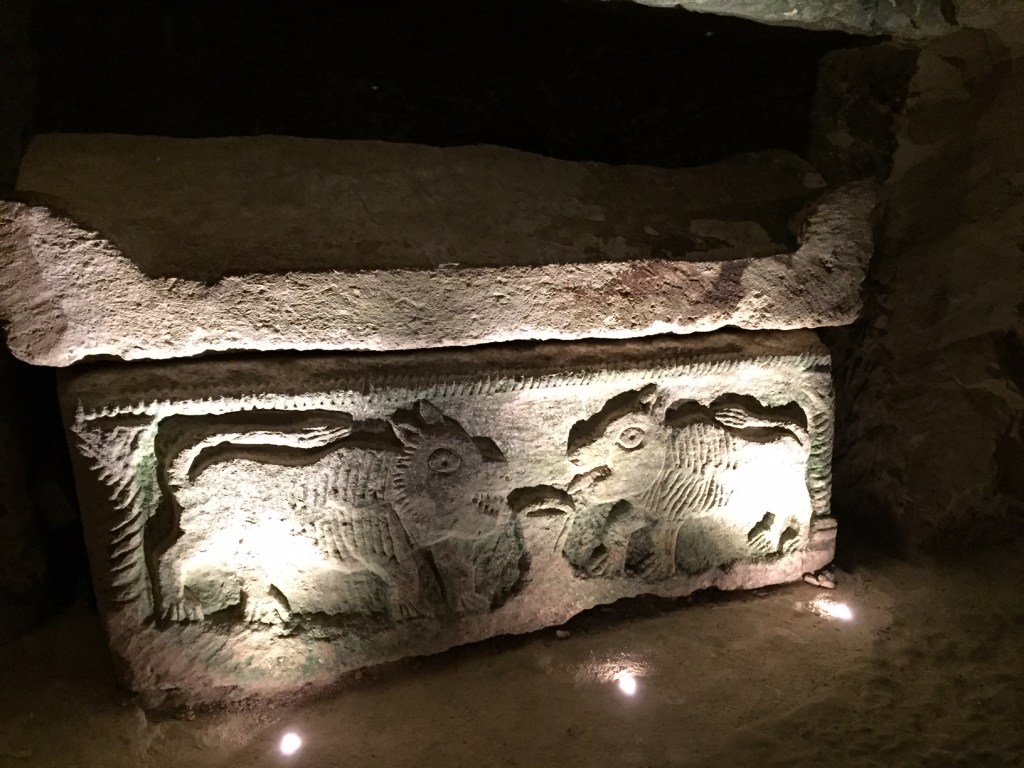
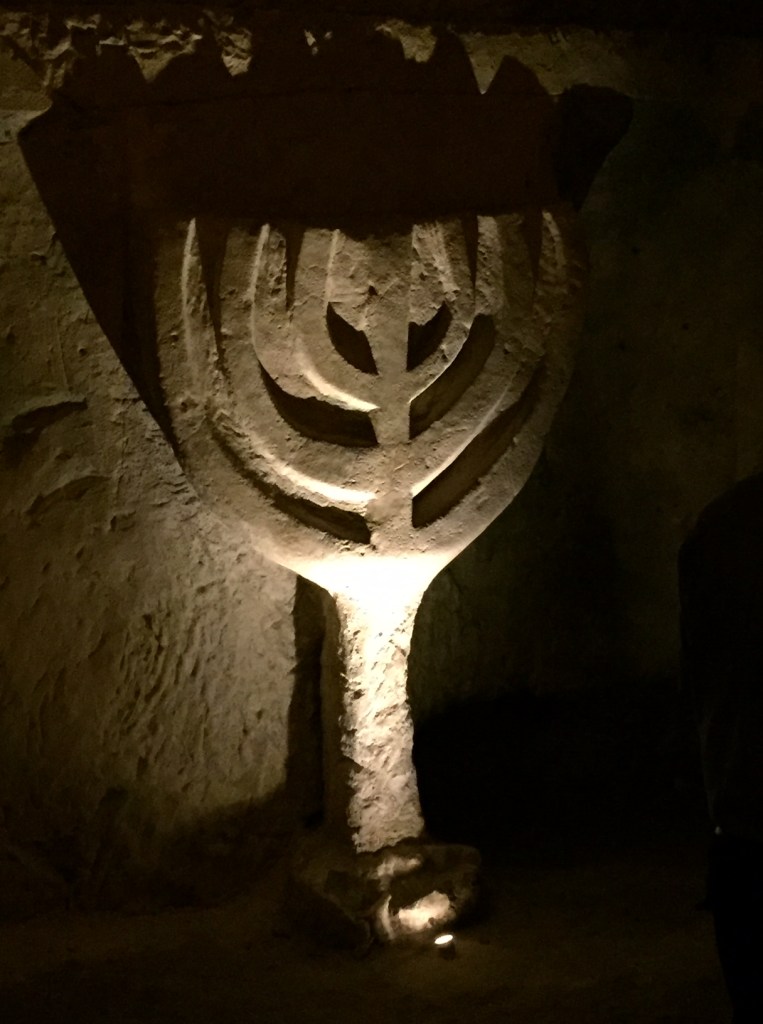
In the burial caves at Beit Shearim
In early November a group from Pardes, including most of our teachers, set off on a two day trip to retrace some of the footsteps of the Talmudic rabbis in the years following the fall of the Second Temple. The first place the Great Sanhedrin moved to was Yavneh, in 70 CE. (You can read about the Sanhedrin here: https://en.wikipedia.org/wiki/Sanhedrin) The story goes that Rabbi Yochanan ben Zaccai was sneaked out of Jerusalem in a coffin during the siege by the Romans. He asked the Romans for permission to establish a center of Jewish study at Yavneh. His request was granted. In Jewish memory, he stands for the position that there is life in diaspora, there is connection with God outside of the Temple, and there is continuance of Judaism even when a seismic change occurs.
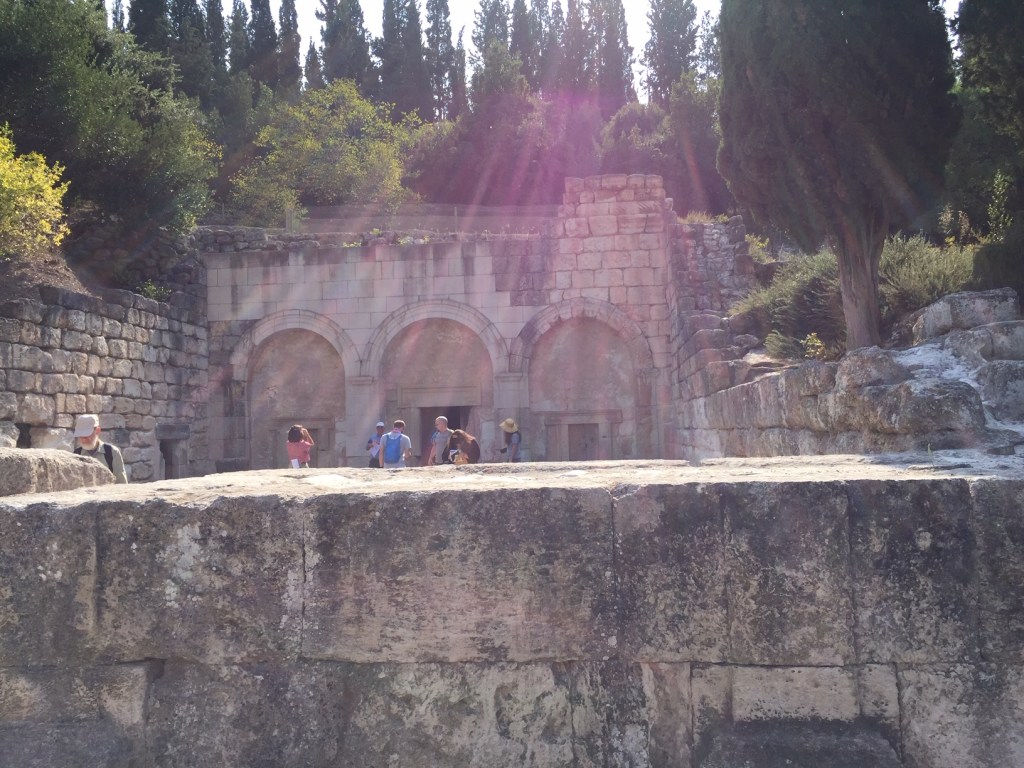
We, however, skipped Yavneh and went straight up to the Galil, to Beit Shearim, which was the fourth location of the Sanhedrin. In 180 CE Rabbi Yehuda haNasi reportedly moved the Sanhedrin to Beit Shearim and compiled/edited the Mishna. There is a major archeological site at Beit Shearim. The part that has been excavated and is open to the public is a series of caves with sarcophagi, including the probable grave of Rabbi Yehuda HaNasi himself.
Outside the tomb of Rabbi Yehuda haNasi (Judah the Prince) — note heavenly rays! 😉Teachers Meesh and Rahel in front of R. Yehudah’s grave (like having your picture taken at Graceland…) The grave itself. Although not marked with his name, there are number of signs that archeologists find convincing that this is indeed R. Yehuda’s grave.
While a considerable number of caves have been excavated, apparently the whole hillside houses a huge Jewish cemetery, which is yet to be dug up. From the part that is open to the public, here are a few more photos — it’s a fascinating place!
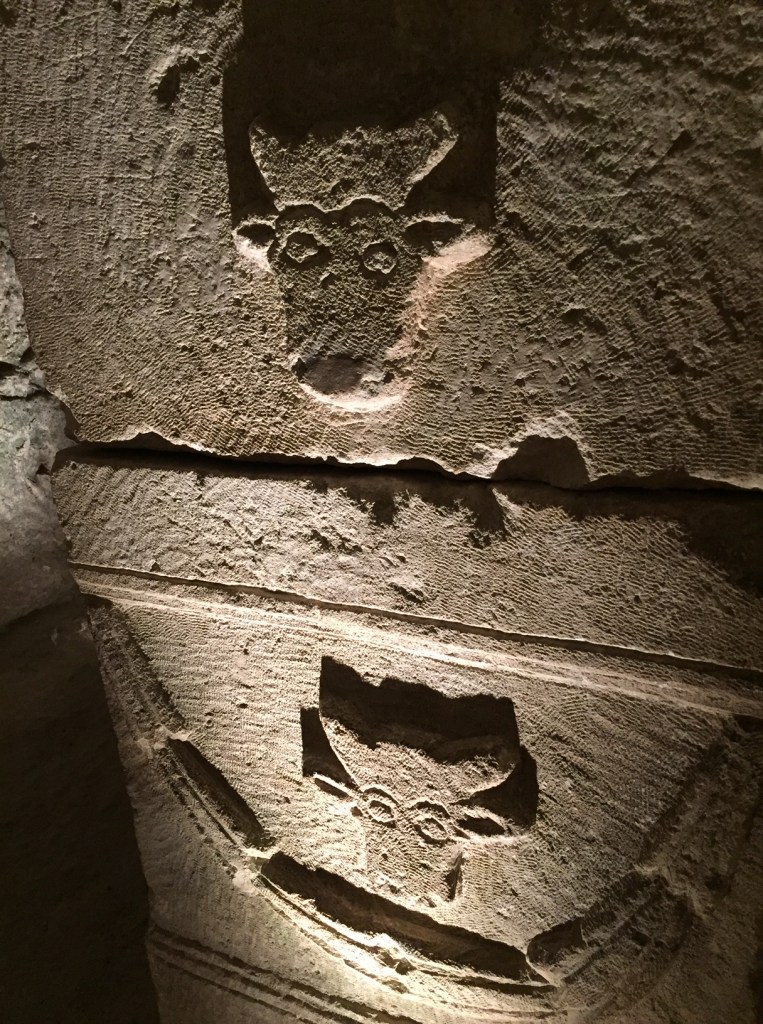
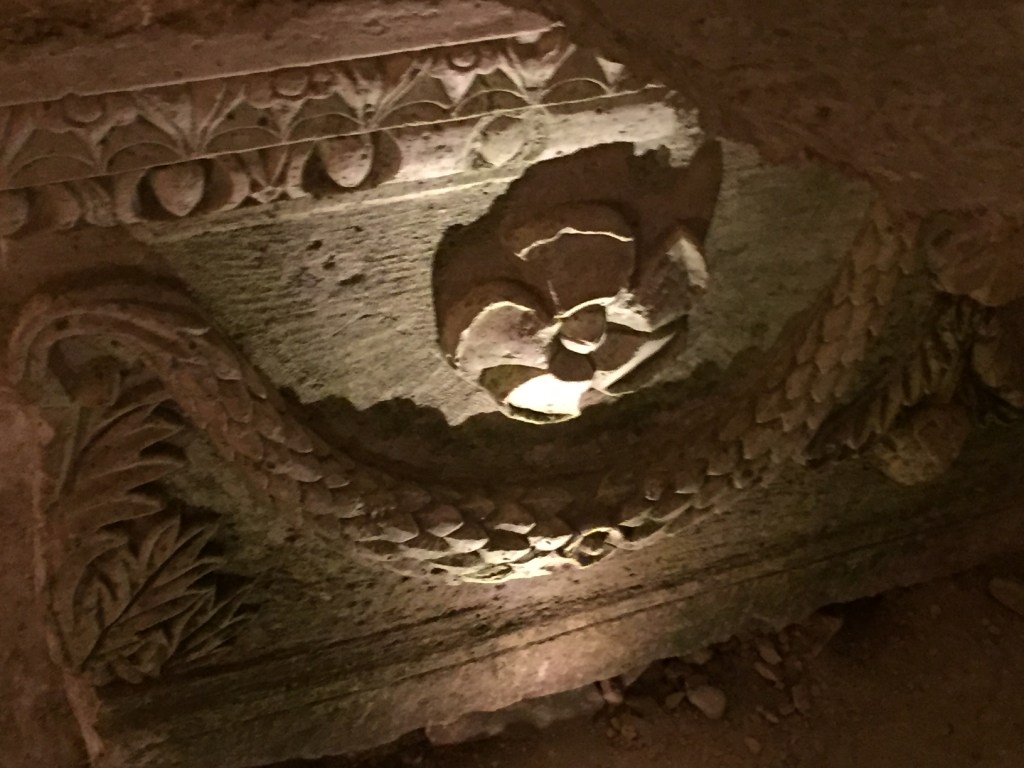
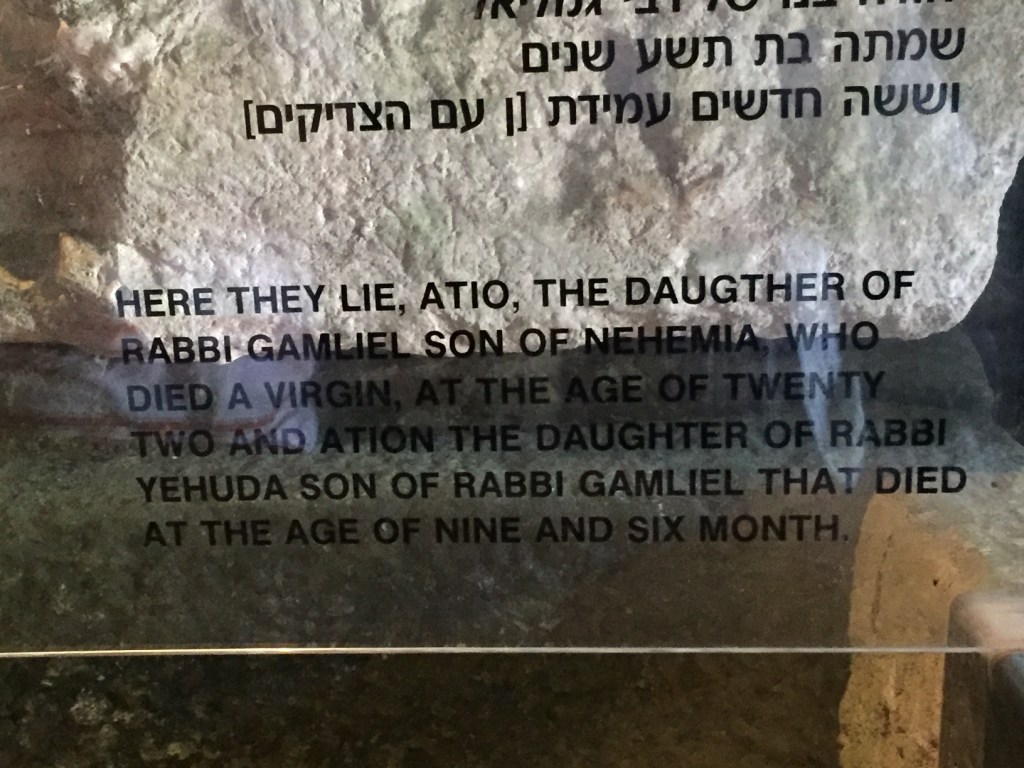
It was a time of Greek influence, hence the sarcophagi. If you would like to know more about this amazing site, look here: https://en.wikipedia.org/wiki/Beit_She%27arim_National_ParkLions (a Jewish symbol)Translation of an inscription on a tombIn case there was any doubt that this is a Jewish site…
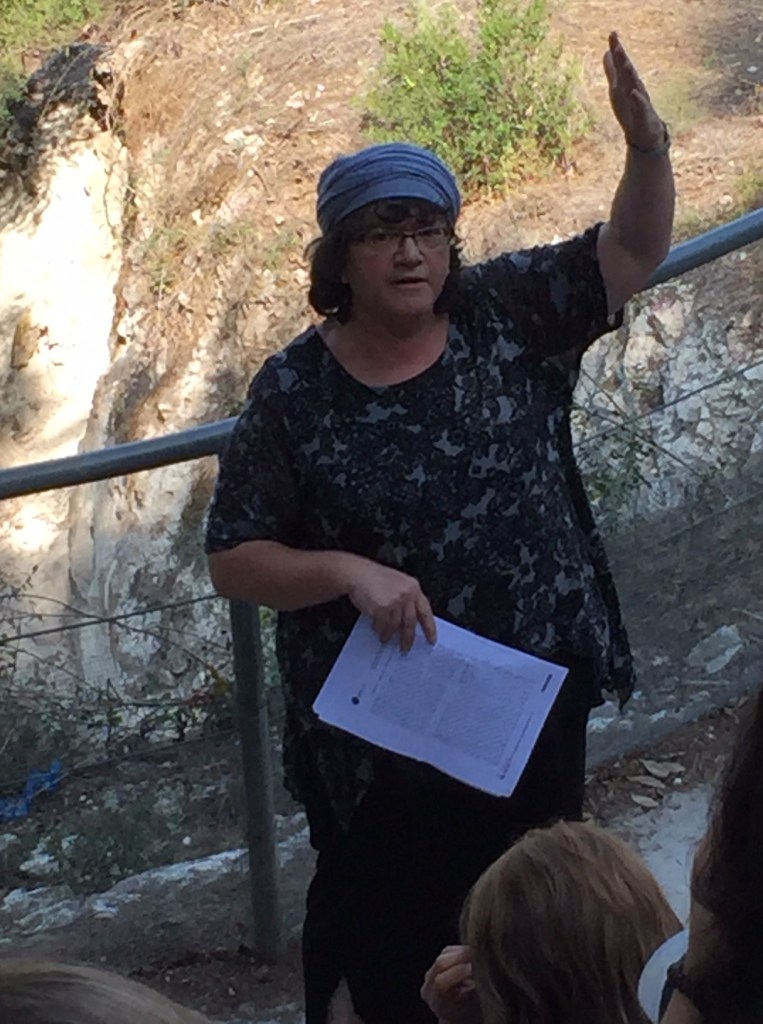
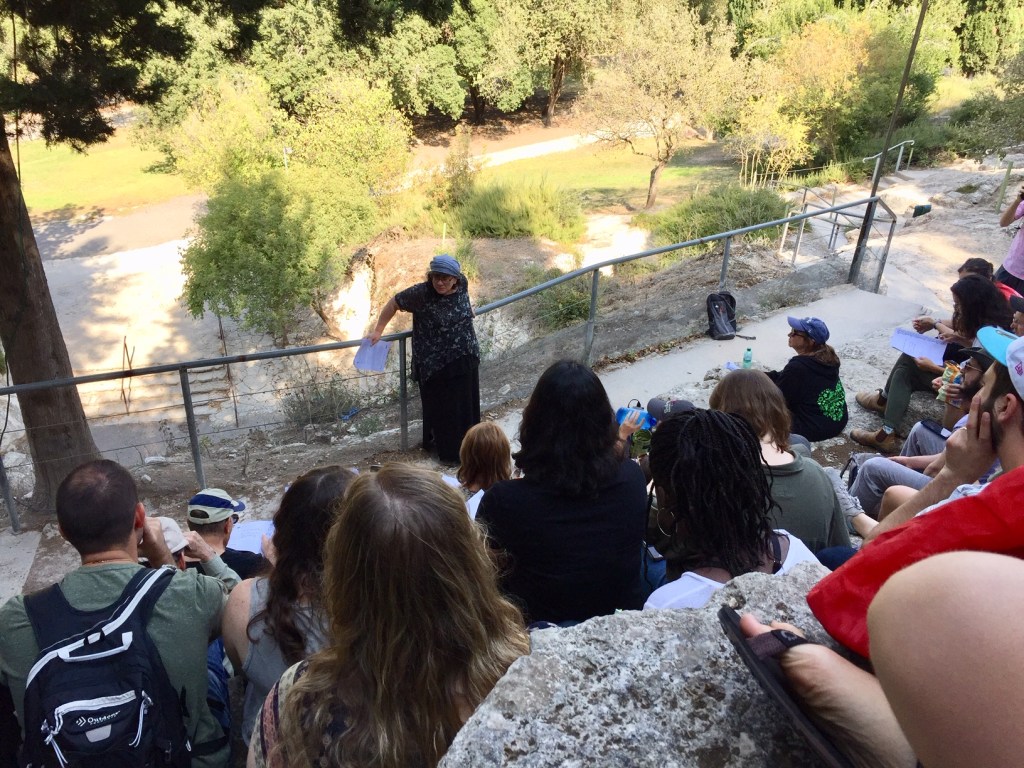
Once outside the caves, we clambered up a hillside and sat to listen to Leah give a teaching on some texts from the Talmud about Rabbi Yehuda HaNasi.
This is Leah.This is the view of modern day Beit Shearim — a lovely spot in the southern Galil. And this is us, learning about Rabbi Yehuda haNasi. The Tosefta says R. Yehuda, also known simply as Rebbe, had “beauty and strength and wisdom and riches and old age and honor and glory and children”. More than his fair share of everything ,apparently…according to Talmud Bavli Tractate Brachot his “table never lacked either radish or lettuce or cucumber, either in summer or winter.” In other words, he was rich.
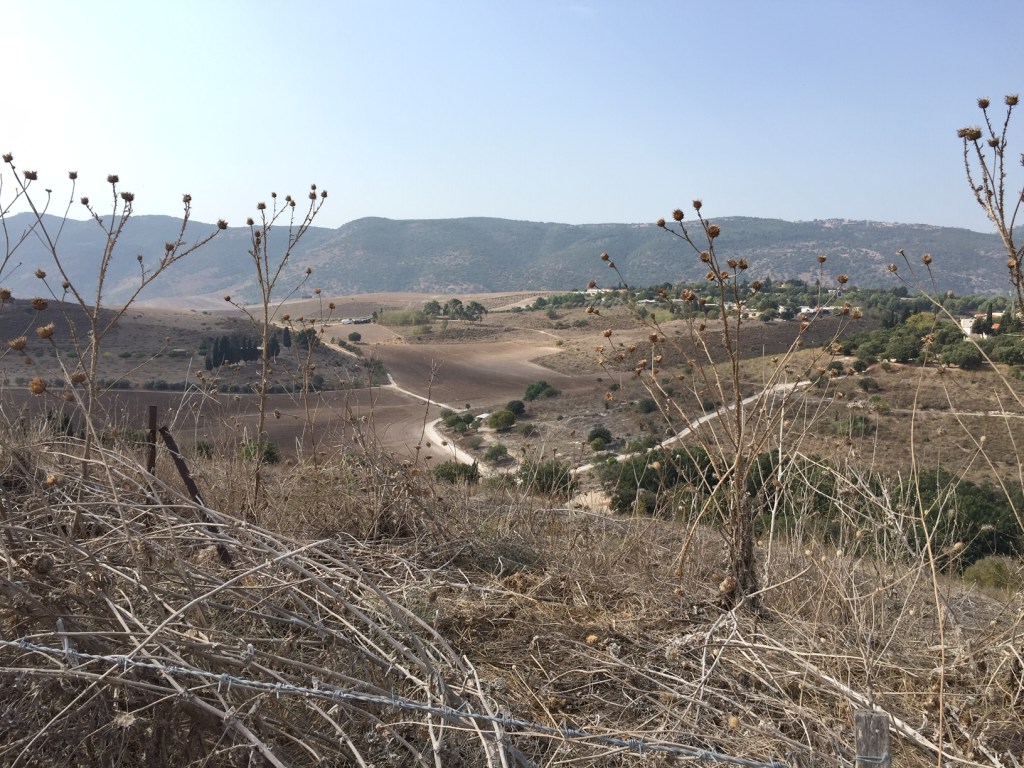
At the top of the hill above the archeological site there’s a great view:
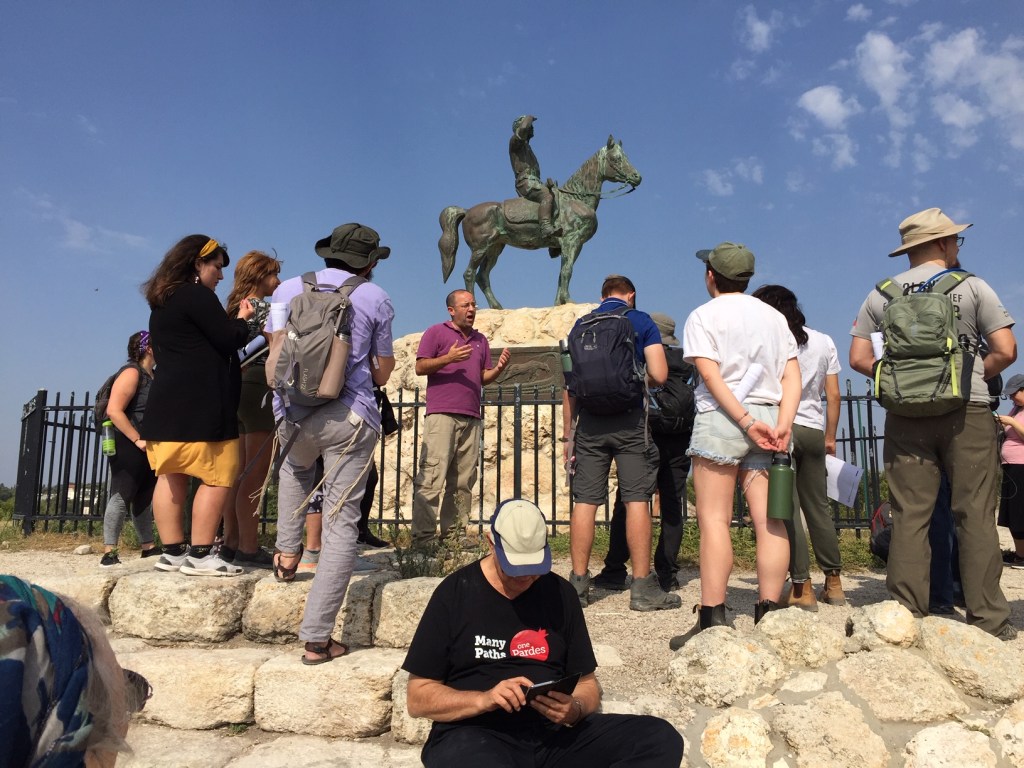
There’s also a monument to early Zionist Alexander Zaid. He was, among other things, one of the founders of HaShomer, an early Jewish defense group. He was a farmer in the Galil. You can read more here: https://en.wikipedia.org/wiki/Alexander_Za%C3%AFd
Our regular guide and teacher Jamie Salter talks to us about Alexander Zaid.This is my friend Yehudit.
Then we walked over to a ruined basilica (ancient meeting hall — this word is from Roman times, and while it used now for a church, it was not a religious structure originally). We sat amid the ruins and Rahel taught us about the Sanhedrin and its movements.
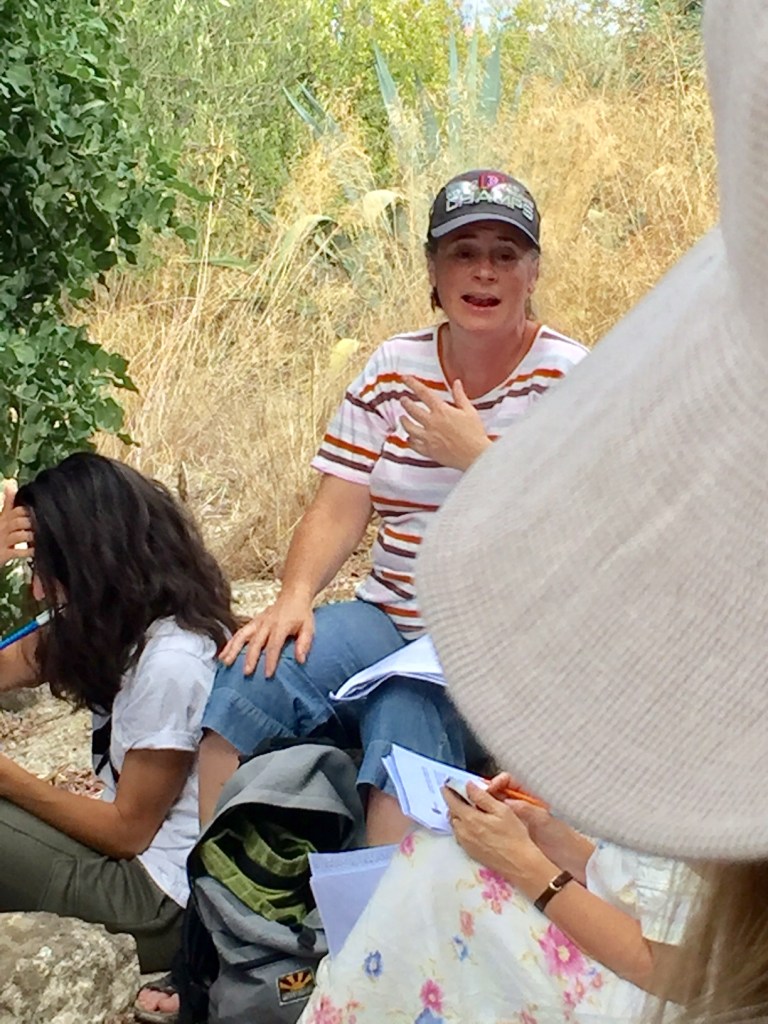
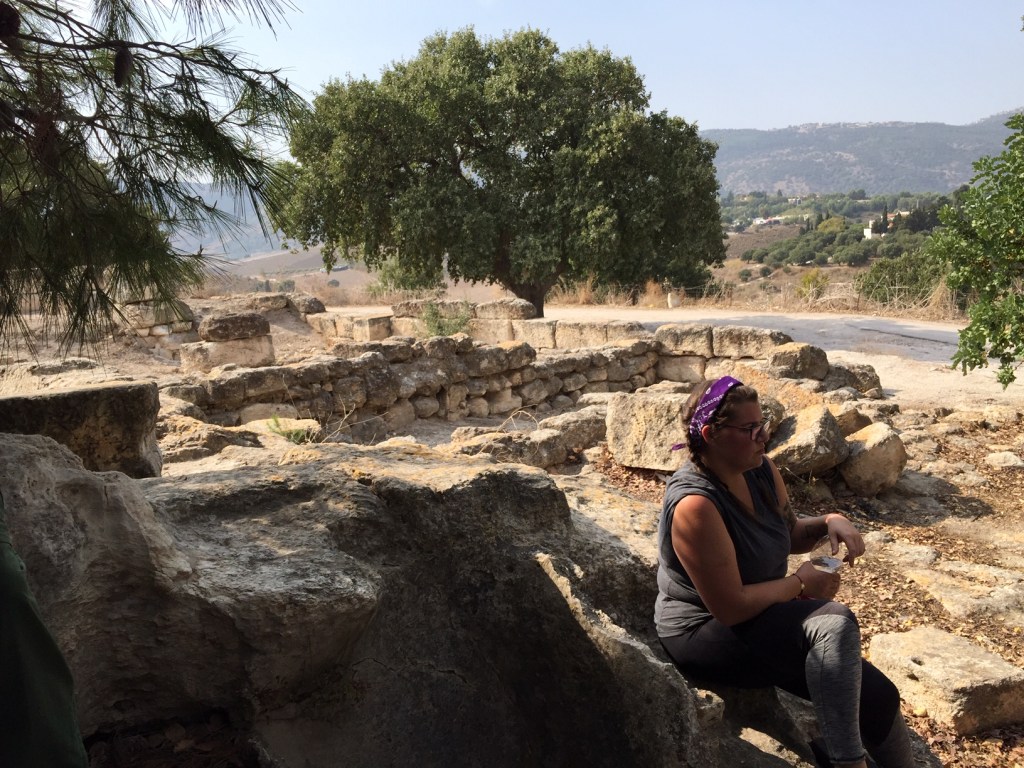
Rahel is always very passionate about her teaching. Elyssa amid the ruins.
After our study session, we walked down the hill and had lunch at the picnic tables under the trees. Some stray cats attempted to join us (I don’t think there is a location in Israel without stray cats). Then we re-boarded the bus and set off for Usha. Usha is not a modern town — it is an archeological site where there once was a town in rabbinic times. It is the second place where the Sanhedrin alighted (after Yavneh). Today it looks like this:
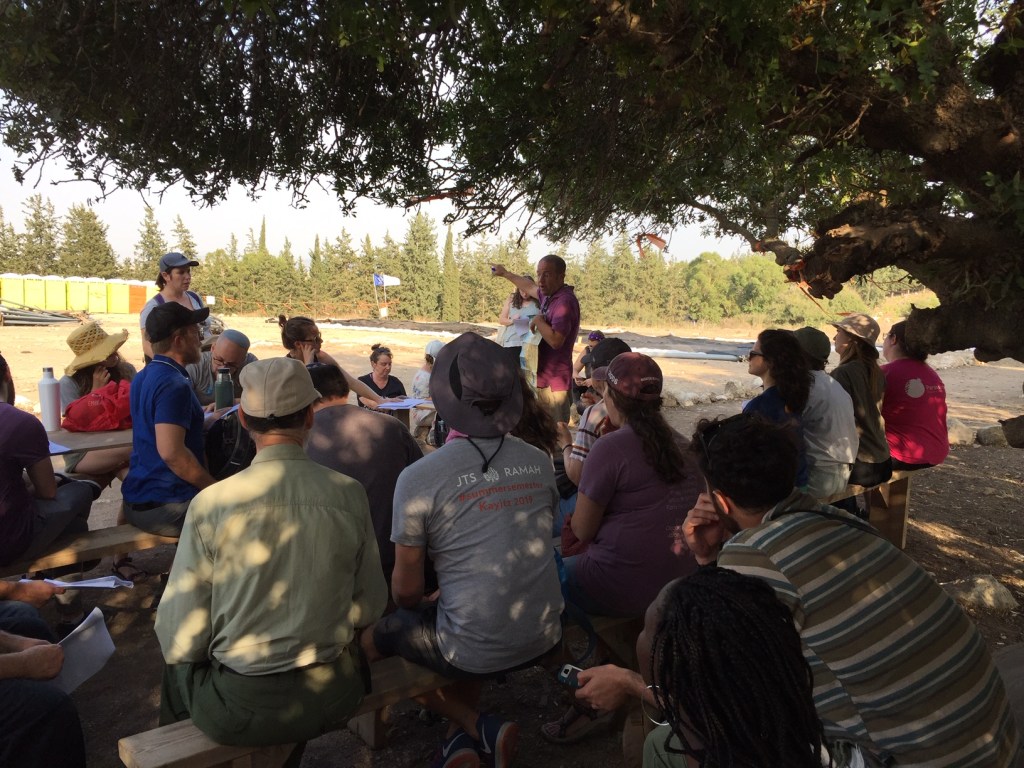
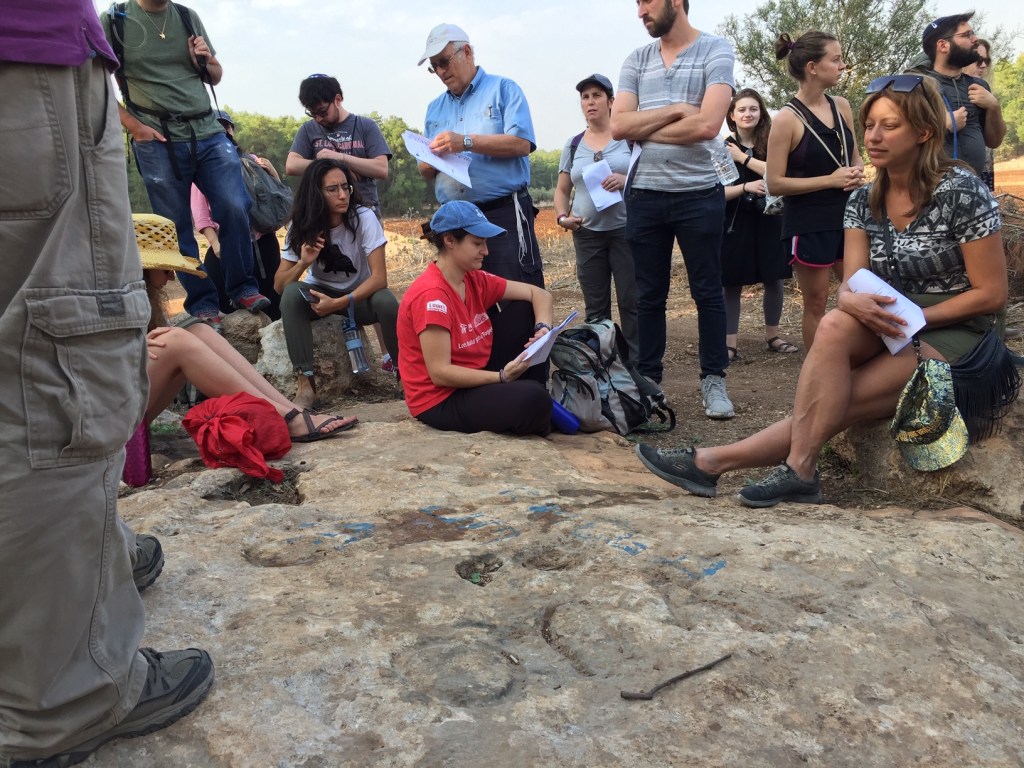
In this picture we are sitting under a tree next to the excavations. We are on the Shvil HaSanhedrin — the Sanhedrin Trail. You can read more about it here: https://www.israel21c.org/sanhedrin-trail-to-be-israels-1st-interactive-hiking-path/ Here we learned something about the history of Usha with Jamie. Then we set out on a modest hike across to the town of Shefaram, which is now an Arab town, but was once another seat of the Sanhedrin (its third). We stopped on a rock that has a mysterious Hebrew inscription that may be very old — or not. Some believe it marks the edge of the Shabbat boundary of Usha during rabbinic times. Here, we studied with Meesh two versions of a story about Rabbi Yehudah ben Bava. It tells how Rabbi Yehuda ben Bava gave his life in order to keep alive the tradition of Smichut — of the “laying on of hands” of three elders in order to ordain rabbis who could also serve as judges. The Romans were attempting to kill this tradition. Rabbi Yehudah “went and sat between two large mountains, between two large cities, and between two Shabbat boundaries: between Usha and Shefaram, and there he ordained five elders. When their enemies discovered them, Rabbi Yehuda ben Bava said to the newly ordained sages, “My sons, run for your lives!”” The upshot was that Rabbi Yehudah, who was elderly, was run though with three hundred iron Roman spears, but the newly ordained rabbis escaped to preserve tradition.
Rabbi Meesh tells us about Rabbi Yehuda ben Bava.Rav Meir is in the middle; to his left is Rabbi Jill from the West Coast, the only other ordained clergy studying right now at Pardes (that I know of)Happy students — Yarden in the hat, Liana, Elyssa, Barry
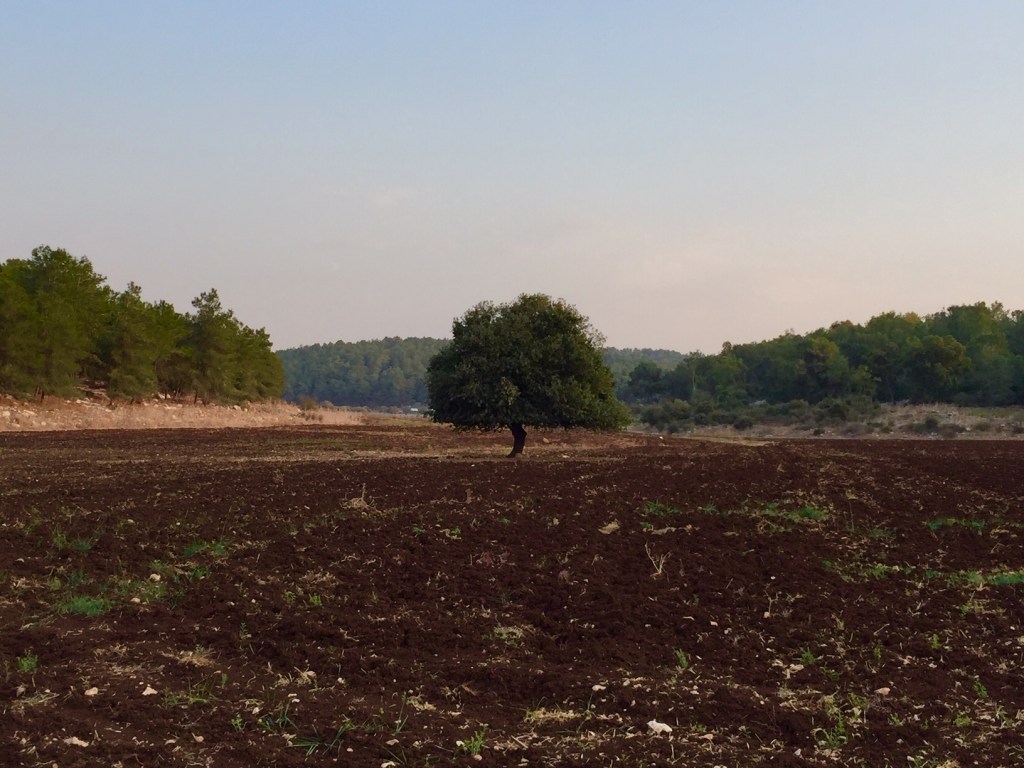
One hardly knows whether any of this is true, and if so how much. I’m coming to think of the Talmud as more like an historical novel than straight history. One thing is for sure — there are no high mountains beside Usha and Shefaram, only smallish hills, and the two towns were never big cities. But it was nonetheless interesting to sit there on the rock and think about this story. After we studied, we davenned mincha. By then it was getting late, and so we hurried onward as the sun set. We crossed a plowed field, and came up the hill to discover a dump, where not only trash but numerous well-decayed animal corpses were strewn about. Walking through the remains of dead sheep is not very pleasant, especially when the stench still lingers about them. I wondered if this was an Arab attempt to dissuade Jewish hikers from traveling the new Shvil Sanhedrin.
We found a mostly skeletal dead horse beside this nice field…
We arrived in Shefaram, where we visited another kever (grave) of a famous rabbi — Rabbi Yehuda ben Bava himself! Like most such sites, it is not really where he is buried. Since he was run through with Roman spears not too far from here, it’s not impossible that he could be buried here. However, the ARI, Rabbi Isaac Luria, the great Kabbalist rabbi in Tzfat, in a much later time had a vision, and most of the “gravesites” (not including the one we had seen in the morning, which is probably a real site) were set up according to where he “Saw” that they were. Much holiness has accrued at these sites nonetheless, and people flock there to pray. Like many such places, it failed to impress me, but I am not a chassid in any sense.
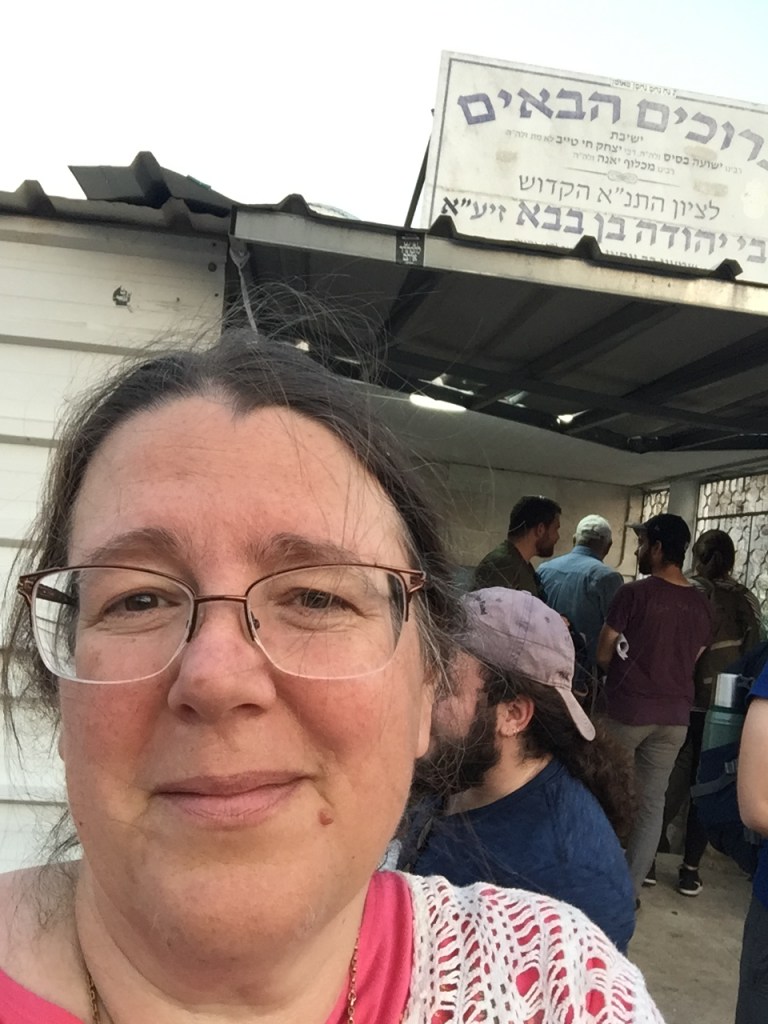
Here I am, in front of the kever of Rabbi Yehuda ben Bava, looking tired and skeptical
We piled onto the bus in the gloaming. Arab faces peered at us from the surrounding houses; I didn’t feel particularly welcome. As night fell we set out for Daliyah al-Karmel, a Druze village. When we arrived there we ate at Nura’s kitchen, which is run by Nura and the women in her family. The food in the ample buffet was by far the best I’ve eaten in Israel so far. You can see lots of pictures here (the web site is in Hebrew, but the pictures will give you the idea! https://www.nurah.co.il/ ) After our delicious meal, Nura herself shared with us, with Rav Meir translating, something of her history, the customs of the Druze, and more. The Druze are a fascinating people — you can read more here: https://en.wikipedia.org/wiki/Druze_in_Israel Although they branched out from Islam, they do not consider themselves Moslem. The Druze in Israel are loyal to the State of Israel, and the Druze in the Golan are neutral, but tend to favor Israel over Syria (for fairly obvious reasons). The town of Daliyat haKarmel was clearly a thriving one — we drove by many restaurants and shops.
For the night we had the distinct pleasure of staying at Kibbutz Daliya, is quite deluxe guest houses. I would like to go back there some time — it was a very comfortable and welcoming place! After our long day we slept well, and arose the next day for more travel and study — watch for my next post!
We sang, among other things, Pitchu li sha’arei tzedek — Open to me the gates of justice
On Rosh Hodesh Cheshvan, I had the option to attend services at Pardes. It was billed as egalitarian, but in order to satisfy the needs of all, they had made it unpalatable to many. The initial email was inviting. It read in part: ” We are really proud that this is a space that Pardes has created in order to celebrate the new month together as a community, even through all the potential discomfort, and are excited to introduce you to it. The project of creating this prayer space looks more like an ongoing conversation than a google form, so please come talk to us.” However, the Google form read in part, “Q: Who is counted to make minyan? A: Anyone who has a Jewish mother or has completed a conversion that included a beit din of three men, a mikveh immersion, and, additionally for men, a brit milah or hatafat dam. This is a standard based on trust, not checks. Anyone who comes forward with a desire to lead or participate will be considered to have met this standard. That being said, each of you is a critical part of our community and our prayer, and are welcome and encouraged to attend.”
This left me in an impossible quandary. My Beit Din for conversion included one woman, and one transgendered person (male to female). The trans person would probably count, since she had not had the surgery, but the woman, clearly not. So I could either lie by omission, or tell the truth and not be counted. This did not feel comfortable to me, and I opted out. So many others agreed with me that they were unable to make any kind of minyan and cancelled the event. Many of us, instead, chose to go do Rosh Hodesh with Women of the Wall.
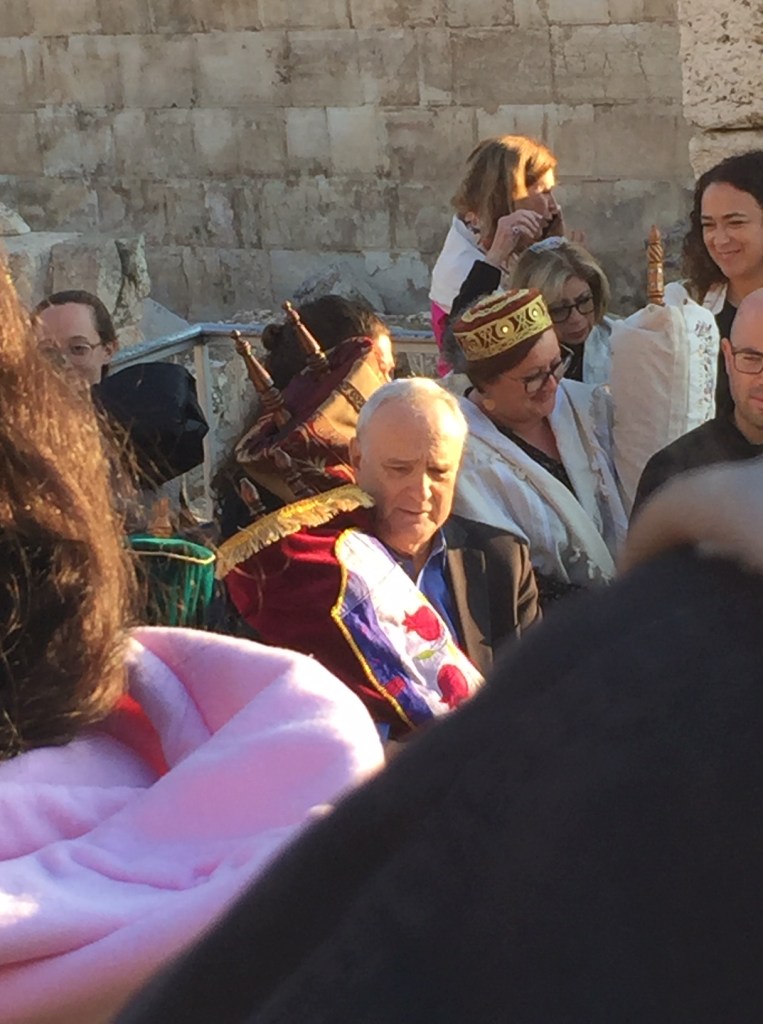
I happen to have a very personal connection to WOW: my granddaughter, Yochi Rappeport Zierler, is its Executive Director. She let me know in advance that the decision had been made to attempt to publicly bring in Sifrei Torah. In recent times, WOW has been observing Rosh Hodesh every Jewish month, but they’ve been smuggling in a Torah because otherwise the security at the gate into the plaza won’t let them in. Yochi told me that Benny Gantz from the Blue and White Party, who is currently trying to form a government, had expressed his intention to support the proposal made originally by Natan Sharansky, and later redrawn with the knowledge and consent of Natanyahu. The plan would, according to Haaretz newspaper, “prepare a prayer platform at the southern part of the wall for the use of Reform and Conservative worshippers and Women of the Wall; to build a common entrance to all the platforms, all sharing equal status; and for the new platform to be run jointly by the state, the Conservative and Reform Movements and Women of the Wall.” This, it must be said, is really a very reasonable proposal. It does not change the current Western Wall arrangement overseen by the Haredim (ultra-Orthodox), in which women have a wee bit of wall and the men have the rest, and in which woman never pray out loud, never wear tallitot (prayers shawls) or T’fillin (“phylacteries”), and certainly never have anything to do with a Torah — despite the fact that the halakhah (Jewish law) in no way forbids women from doing any of these things. (For some of the history of WOW listen to this podcast: https://www.tabletmag.com/podcasts/290888/this-wall-part-iv-this-wall-is-my-wall)
My amazing granddaughter, Yochi Zierler. Behind her, Anat Hoffman, one of the founders of WOW.
“We want to put some pressure on Gantz,” Yochi said. “It’s enough! We’re done with hiding. The government needs to act!” Then she gave me the option to back out of coming — because at this sort of event, violence can and often does ensue. As an illustration, I have a friend who was supporting the WOW from the men’s side, and as a result got his stomach literally stomped on by a crazed Haredi man, resulting in internal damage and a hospital stay. So I undrstand there was some risk, but decided to go.
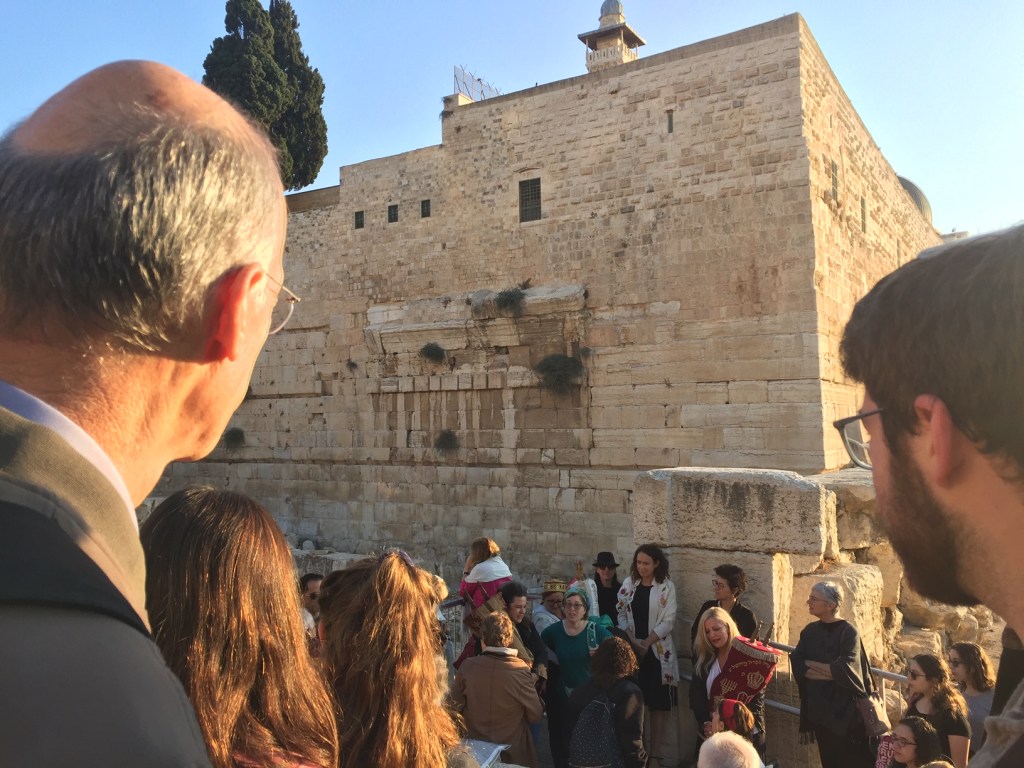
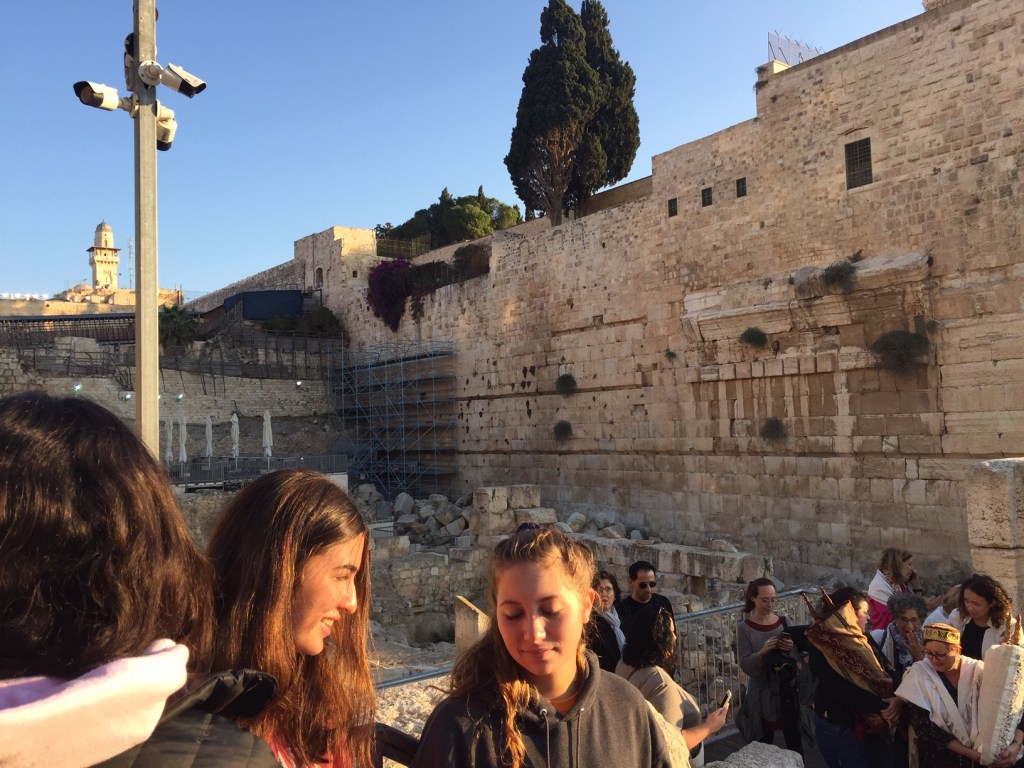
We arrived in the very early morning at Gan HaPa’amon — Liberty Bell Park. From there we took vans up to the entrance to the plaza of the Western Wall. We gathered at Robinson’s Arch, which is where the proposed liberal praying place would be.
Rabbi Saperstein on left, my friend Joe from Pardes on the right. Kudos to guys who come and support this endeavor.To get you bearing — this is the extension of the Western Wall. Robinson’s Arch is the protruding bit of wall toward the right, where there once was an arch under which pilgrims to the Temple marched. Bear in mind, the Wall is in fact the foundation of the original Temple.This is Rabbi David Saperstein. He is a really big deal, who is very quiet and modest about himself — I know because I had a conversation with him and found out absolutely nothing of what you can read here: https://urj.org/blog/2017/03/20/rabbi-david-saperstein-joins-urj-and-rac-senior-advisor-policy-and-strategy
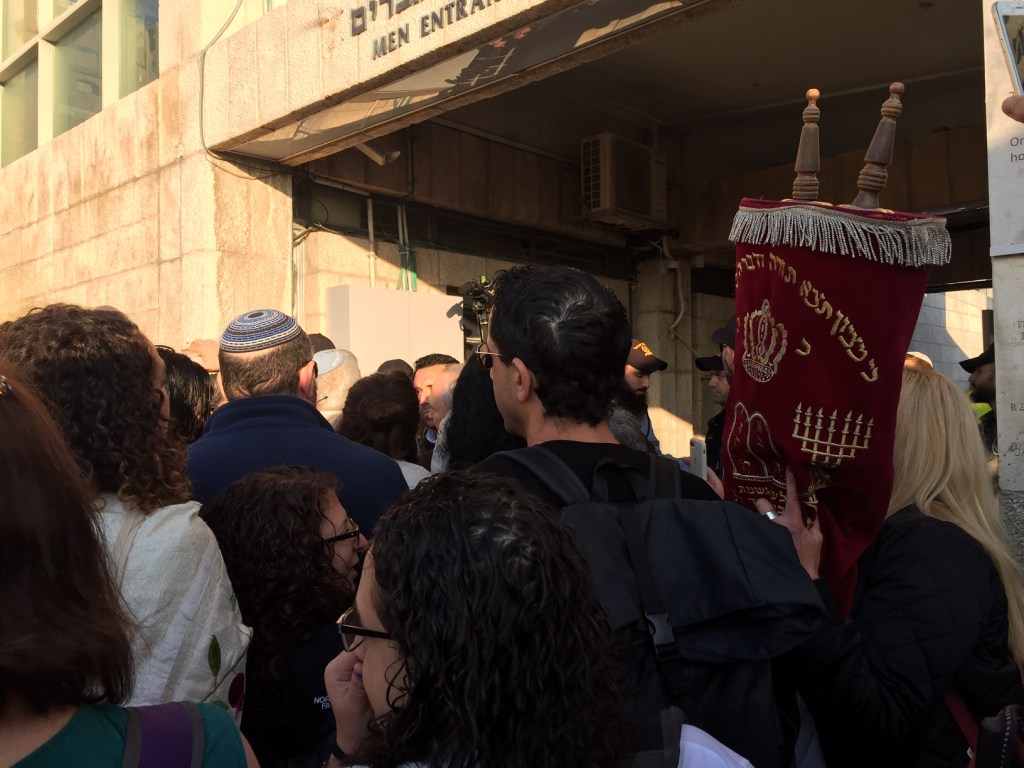
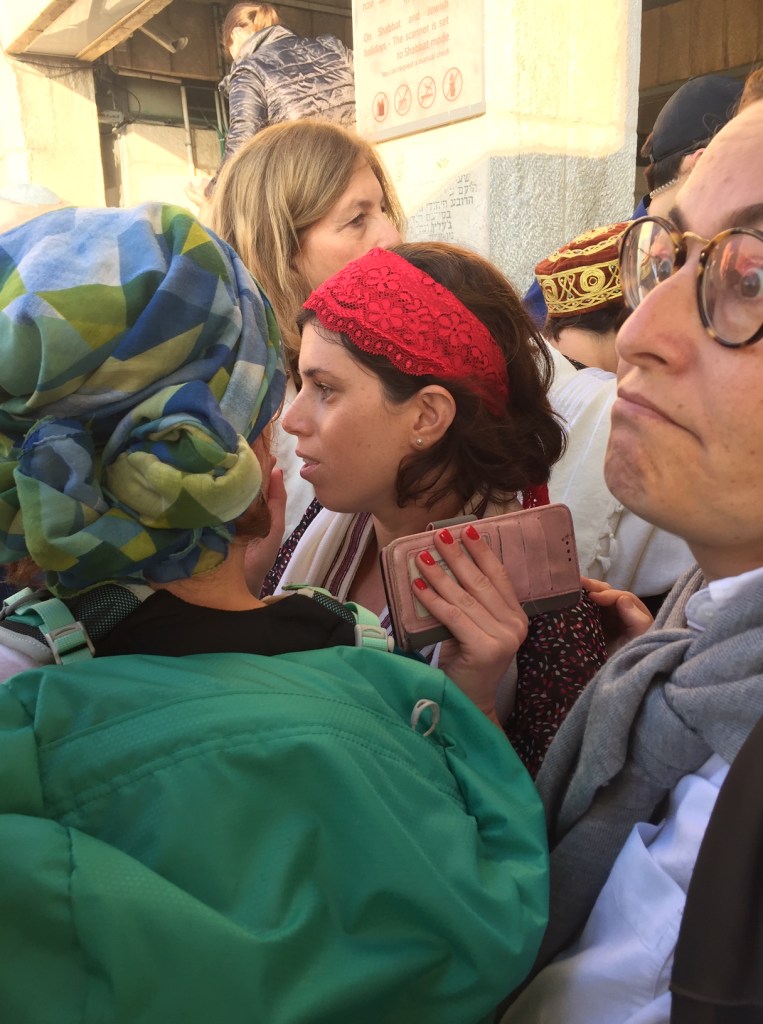
Then we marched up to the security gates to the Western Wall Plaza. There we prevented from entering either on the men’s or women’s side of the security gate (yes, it’s gender differentiated even at security). We stayed for more than an hour, singing, pushing, and persisting, while being heckled by haredim. The press was there, of course, interviewing Yochi and others. Finally, the decision was made to send the Torahs back to Robinson’s Arch. Then, we were at last permitted to enter — two at a time only, so they could frisk us — not for weapons but to small Torahs we might have concealed in our bags or about our persons. We made it to the woman’s side (and men to the men’s side). It was full on both sides with haredim — mostly young girls on “our” side, who had been bussed in from girls’ yeshivas, and some old ladies, while on the men’s side there were throngs of young man in black hats. A well known Orthodox rabbi had put out the word that people should come to oppose the unseemly doings of the Women of the Wall.
We davened a full Rosh Hodesh service, with Hallel (psalms of praise), out loud. A small piece of paper withe Torah portion had to stand in for the Torah itself. All around us the young women hissed like geese, and old women said things like, “You are ruining Judaism. You are taking it apart block by block.” Etc. etc. Nevertheless, we persisted. Our group was encircled by women security forces, who were there theoretically to protect us, but also, as it turned out, to prevent us from engaging in any conversations with the haredi girls. I know because my friend Anne-Gaelle got into such a conversation with four girls, whose ignorance of halakhah in no way stopped them from their certainty, and the security women rushed in to break it up immediately even though no voices were raised.
I told Yochi how proud her grandfather, the old rabblerouser, would have been. She said, laughing, “Oh, yeah. He would have said, if you have to be religious, at least be a rebellious religious.” Which is probably very close to what he would have said, indeed! As for me, I was conflicted. On the one hand, I have no wish to disturb the haredim in their devotions, and if they believe separation of the sexes is important, I’m happy to leave them to it. I am also perfectly comfortable davenning in a gender-separated space, as long as it is one where the barrier doesn’t completely prevent me from feeling a part of the larger community. But the problem, of course, is that no one faction should have control over the devotions of all of us. What is happening at the Wall is symbolic of a much larger makhlocket (disagreement) about how the haredim have seized the religious and ritual life of the Israeli population by the short hairs, despite the fact that most Israelis are not haredim.
No one was injured at this latest WOW event. We were hissed, and told to “Go back to America” and “Go back to Tel Aviv” (otherwise known, I guess, as Sodom and Gomorrah). Attempts were made to drown out our davening and our reading of the Torah. We were lucky. What will happen next is anyone’s guess – especially since Gantz looks no nearer to forming a government than Bibi Netanyahu was. I’m not sorry I had this opportunity to do what Heschel called “praying with my feet”, and when the next Rosh Hodesh rolls around (soon) I will likely be out there again.
As I write this, rockets are raining down on S’derot, N’tiv HaAsara, and the whole region proximate to Gaza, as far north as Tel Aviv. How ironic that I happened to put off until today the account of our final stop on the tiyyul in late October, to Netiv HaAsara and a wonderful woman there who is a peace activist. I hope you will all keep Israel and Gaza in your prayers these next few days, as it looks like a dicey time for all concerned. That being said, I can understand Israel’s choice to assassinate the leader of the Islamic Jihad, Bahaa Abu el-Ata. His group has been goign against agreements Israel has with Hamas and firing rockets and planning other attacks on Israeli civilians.
So — maybe it’s a good time to talk about peace here…
When we left Sderot we traveled a short way to the village of Netiv HaAsara. There we were welcomed very graciously into the home of a lovely older English-Israeli woman, Roni. When we had all gathered in her small living room amid the beautiful oil paintings done by her husband, Roni began by telling us the history of her village. It began as a settlement in the Northern Sinai, after Israel had annexed that territory as a buffer zone. It was a beautiful location, Roni said. Crops grew well, especially winter crops. They had a good relationship with their Palestinian and Gazan neighbors.
In 1979, to everyone’s astonishment, Anwar Sadat made peace with Israel. (Do you remember where you were when this happened? I heard it on the living room radio in my parents house — on Robert J. Lurtsema’s Morning Pro Musica. I was sixteen, a student at Marlboro College.) Israel left the Northern Sinai, and the settlers of Netiv HaAsara had to leave “our beautiful life in the Sinai”. The village was moved to the border with the very top of the Gaza strip, because they wanted to be as near to their previous home in Sinai as they could. There were 66 families. (There are now 230 families in Netiv HaAsara, with 20 more expected to move in soon.)
In Roni’s telling, the early years were good. Their relationship with their Gazan neighbors was friendly. Roni’s husband, an Egyptian-Israeli, worked at his specialty, which is agricultural development. But in the 1990s things went bad — it was the beginning of suicide bombings, tunnels, rockets, flaming kites… Now, when they hear the call of Tzeva Adom, Code Red, they have fifteen seconds to get to a shelter or safe room. Roni told us a story of how recently, in the stress of getting herself, her husband, and their adult daughter and her children into the safe room, Roni slammed her hand in the heavy metal door of the mamad, the safe room. Her daughter was so horrified at the sight that she fainted. EMTs were called, and while the red alert was still on, they were driven to the hospital. “Our community is very strong,”Roni said. “And we have lots of help. W have the Resilience Center. I have gone there. They help with PTSD. Of course, I think everyone is Israel has PTSD, really.”
“It’s wonderful when you only know one side of the story; you can be completely at home with yourself,” Roni said. She talked about how her husband, who had left Egypt with nothing but a suitcase because he was driven out, came to make his own peace with Egypt, finally returning there (with her) to live for five years to help the government with its agriculture. So, too he has come to know more about the Palestinian side of the story, and to work to help people within Gaza. She has friends in Gaza, with whom she communicates regularly by Skype. She sends packages — baby clothes, toys, and so on. “What does it matter how long the Palestian People has existed. They are here now, and they feel that this is their home, just a I feel that this is my home,”she said. “It is never going to be just one of us instead of the other. We’ve got to believe that the solution is there — and it is.”
She works with various organizations. One is the Gaza Youth Committee, which teaches young people to help clean Gaza rather than to storm the border in a futile (and life-threatening) attempt to cross. The help with olive picking at the Border, and work with a US program called “Stars of Hope”. (https://starsofhopeusa.org/) She also works with Lighthouse for Awareness of Gaza. This group meets at a nearby kibbutz once a week to learn about Gaza. She is also involved in something called “The Way to Recovery”. She introduces children from Israel and from Gaza to each other via Skype, and they send gifts to each other. There are two connected youth theater groups, one on each side ofthe border.
“If I want to be safe, I must give them a life,” she said. She noted that Gazans currently have at most six hours a day of electricity, and no clean drinking water whatsoever — even showering in their water is not really safe. You need three permits to leave Gaza — one from Hamas, one from the Palestinian Authority, and one from Israel. In other words, getting out is virtually impossible.
“Both sides are dreaming if they think one side can win,”she said. “There is a risk to open the border, but it’s a risk of hope. She said she is leaning now toward the idea of a one state solution. She doesn’t give up hope for peace some day.
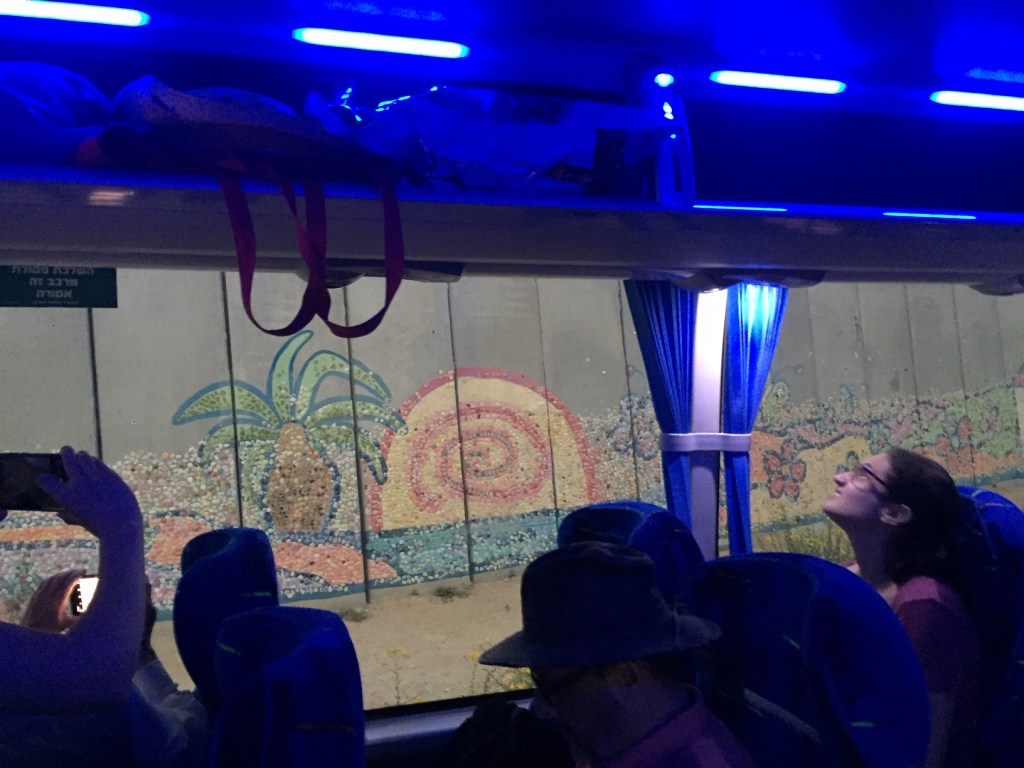
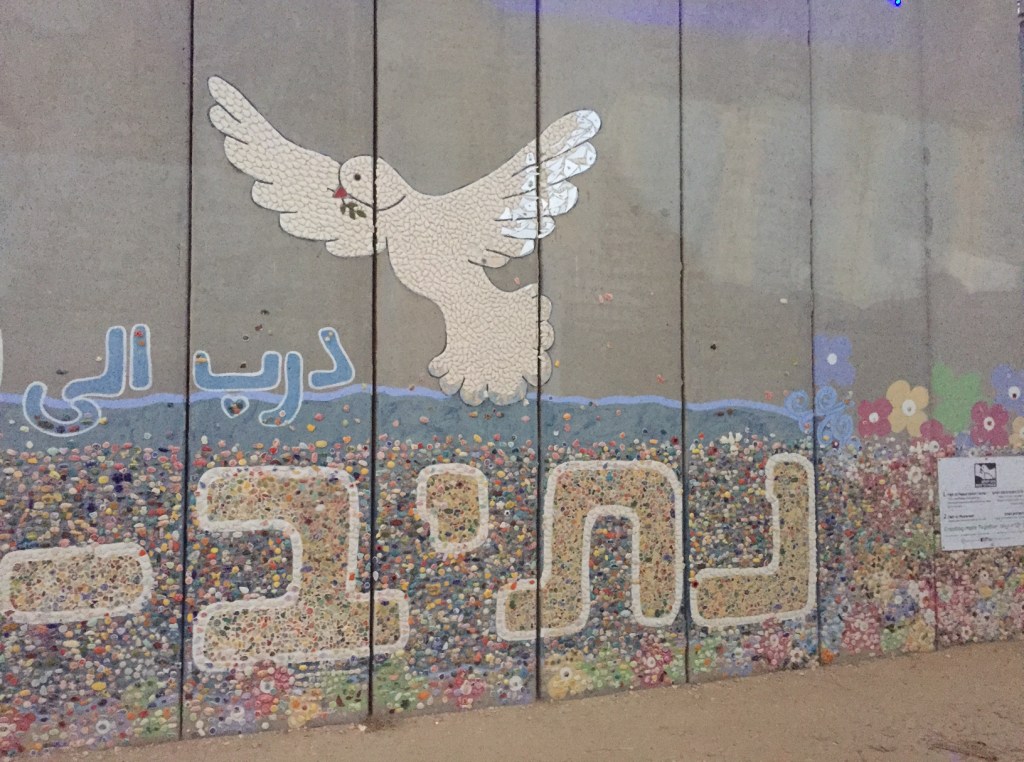
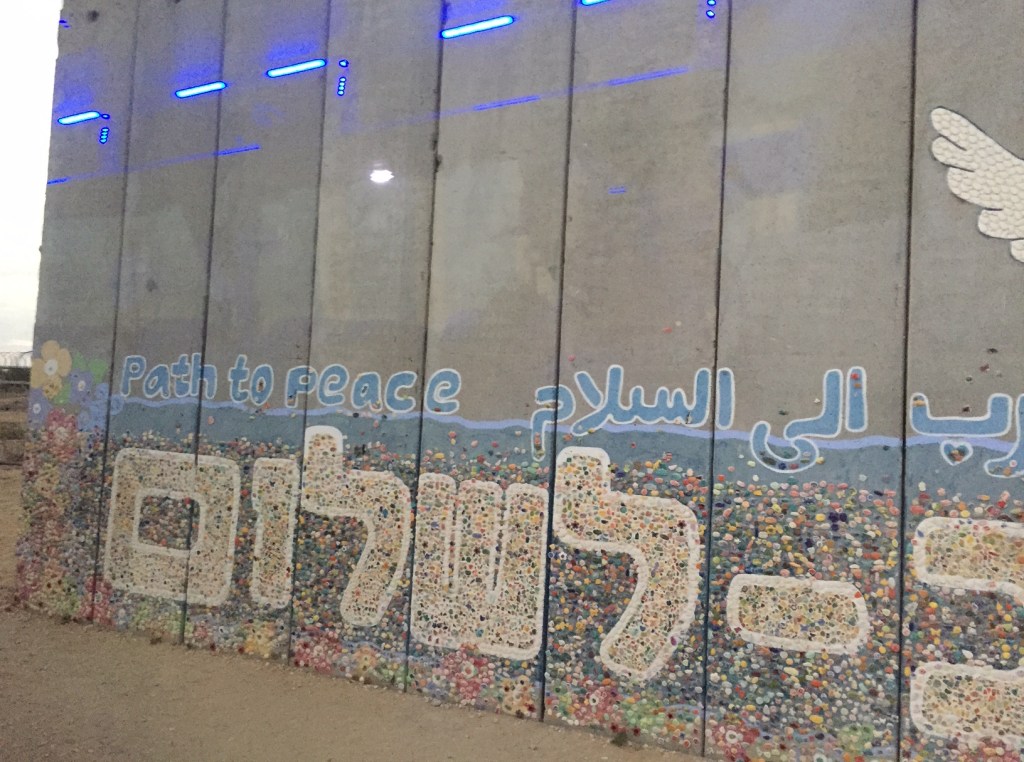
Afte she had spoke with us, she came on the bus with us to the nearby Peace Wall. Here are some photos. It’s an art project — you can read about it here: https://www.pathtopeacewall.com/ Keep praying, and maybe send some money to one of the projects mentioned above if you are so moved.
We were met by a woman named Orgenia (sp.?) who works for the Sderot Media Center. (https://sderotmedia.com/) She took us on a tiyyul around this small and surprising vibrant town, which has clearly decided to not only persist but thrive, even though it is a regular recipient of rockets launched from Gaza.
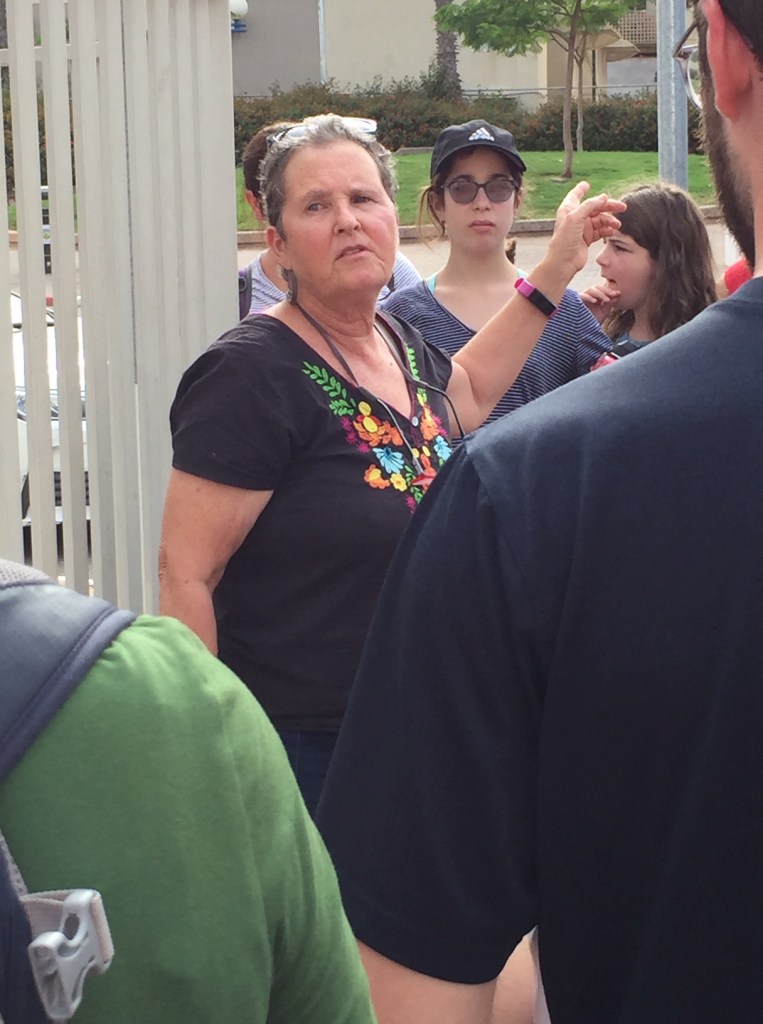
Orgenia, our guide
Sderot is a town of 25,000 people. It’s important to know that it was originally settled by emigrants from other countries in the Middle East (Mizrahi Jews) and from Russia. They did not arrive in Sderot or other periferia towns of their own accord. After the formation of the State of Israel, Ben Gurion thought that it was important to settle the whole of the country. When refugees began arriving in Israel, hoping and expecting to live in Tel Aviv or in Jerusalem, Ben Gurion put them on buses and trucks and shipped them off to the hinterlands, without telling them where they were going. While Sderot appears to be thriving now, in spite of its proximity to Gaza and its perennial rain of rockets, it was originally a rather hardscrabble place, settled by poor people who had been sent there against their intentions, if not their wills.
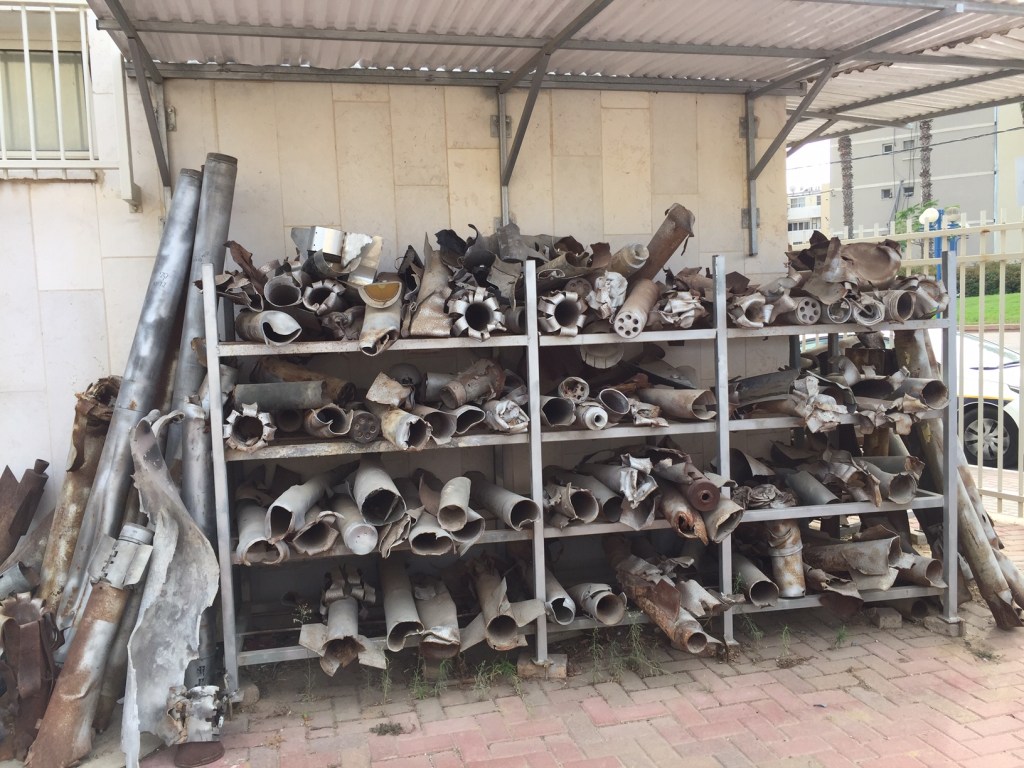
Home-made Kassam rockets from Gaza began to fall on Sderot beginning with the Second Intifada in 2001. Rocket landings increased drastically after Israel withdrew from Gaza in 2005. At that time, 1,000 missiles a year were falling on Sderot. Yes, one thousand. Though home made, the missiles can do a lot of damage, including, obviously, killing people. This is aside from the trauma and stress caused by having missiles falling without warning.
Here are a few of the rockets, stored outside the Sderot police station. They are home made out of hollow streetlamp posts and similar metal tubes.
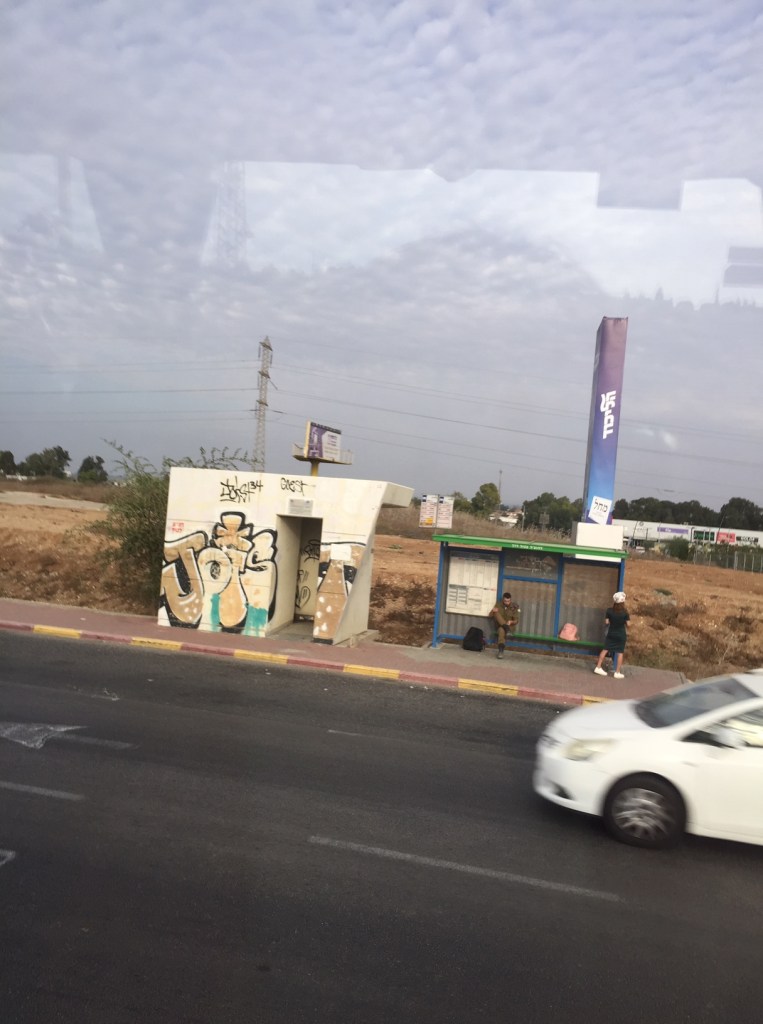
Little by little, the Israeli government and the larger Jewish world have taken notice of Sderot and helped rebuild and strengthen the community. Because of the “Iron Dome” missile defense program, most of the rockets are destroyed in the air now before they reach the town. However, missiles still fall, and so the city has built itself to be prepared. There is a siren that goes off if a missile is incoming. Residents know that they have thirty seconds or less to get to a shelter. When the missiles first started falling there were no shelters. Now, as our guide proudly showed us, there are shelters for every apartment and for every bus stop. Schools have been built to be one big missile shelter, so that kids don’t have to suffer the trauma of leaving classes and going to a shelter over and over again. Even playgrounds have shelters, built to look like fun places.
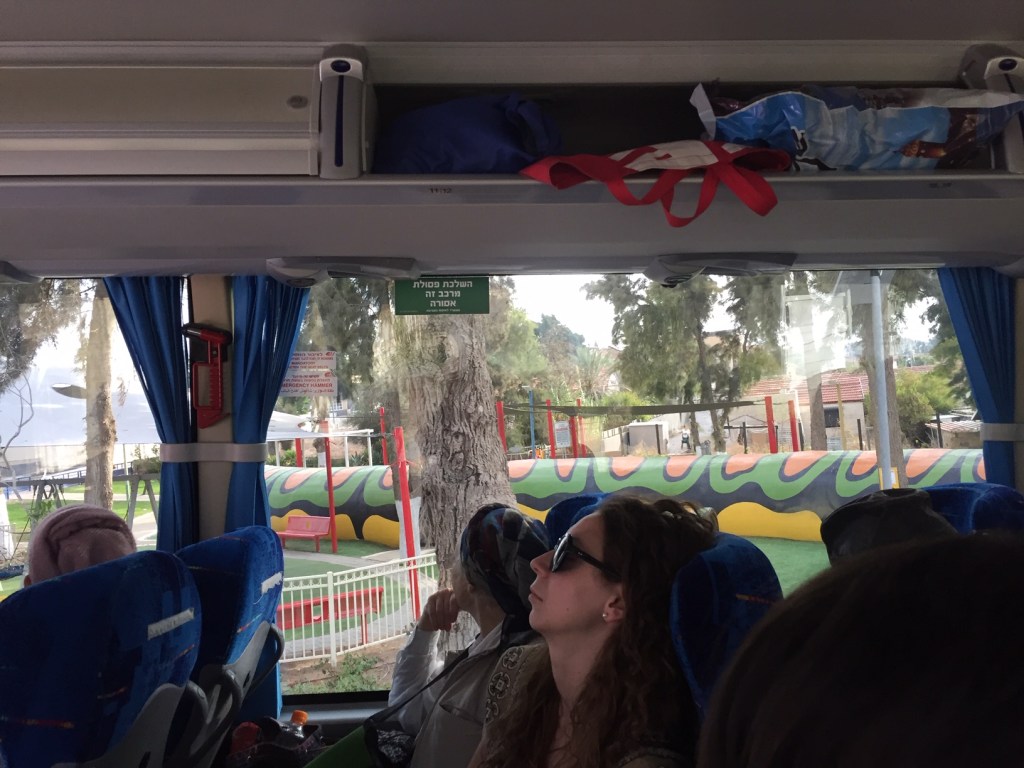
Here’s a shelter by a bus stop. Most shelters are painted intentionally with some kind of artwork — this is mostly not random graffiti.Another shelter.From the bus we see the playground with a giant “snake” that is in fact a fun shelter in which children can play, but can also duck into at a moment’s notice for safety.
Sderot is determined to be a lively arts community. Throughout the town there are sculptures of musicians, and the community regularly hosts a music festival. Our guide recommended to us a film, “Rock in the Red Zone” — here is the trailer. https://www.youtube.com/watch?v=RcH2AIc2hWk (I haven’t watched the movie yet, but it looks great.) The train now comes to Sderot, bringing city people. Also, a program called Yeshivat Hesder — a combination of yeshiva study and army service — is located in Sderot. If you did not know what you were looking for, you would see only a lovely little town. Amazingly, people are moving to Sderot. There is a certain attitude in Israel, expressed by our guide, that no matter where you are in this tiny country, a missile could reach you, or a terrorist blow you up. And so — why not live in a pretty, tight-knit community full of music?
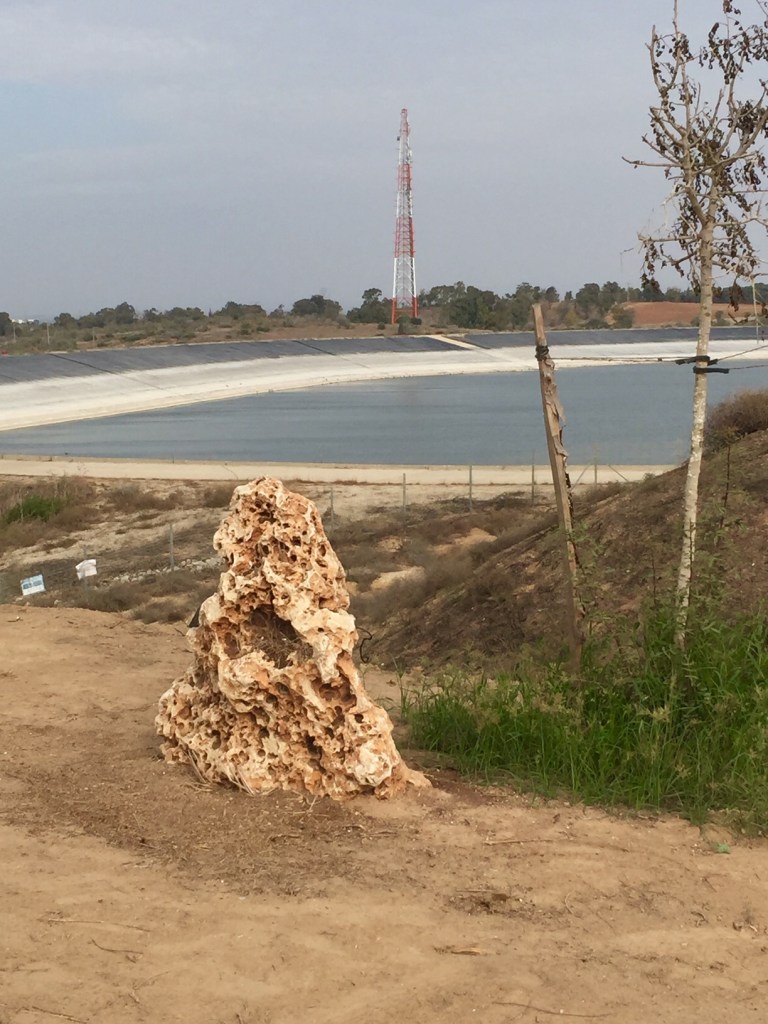
Orgenia took us to a spot that overlooks the Gaza border. We drove past a waste water treatment plant, where waste water from Tel Aviv is purified to become water for agriculture.
It’s strange to see this big pool in the middle of the desert…
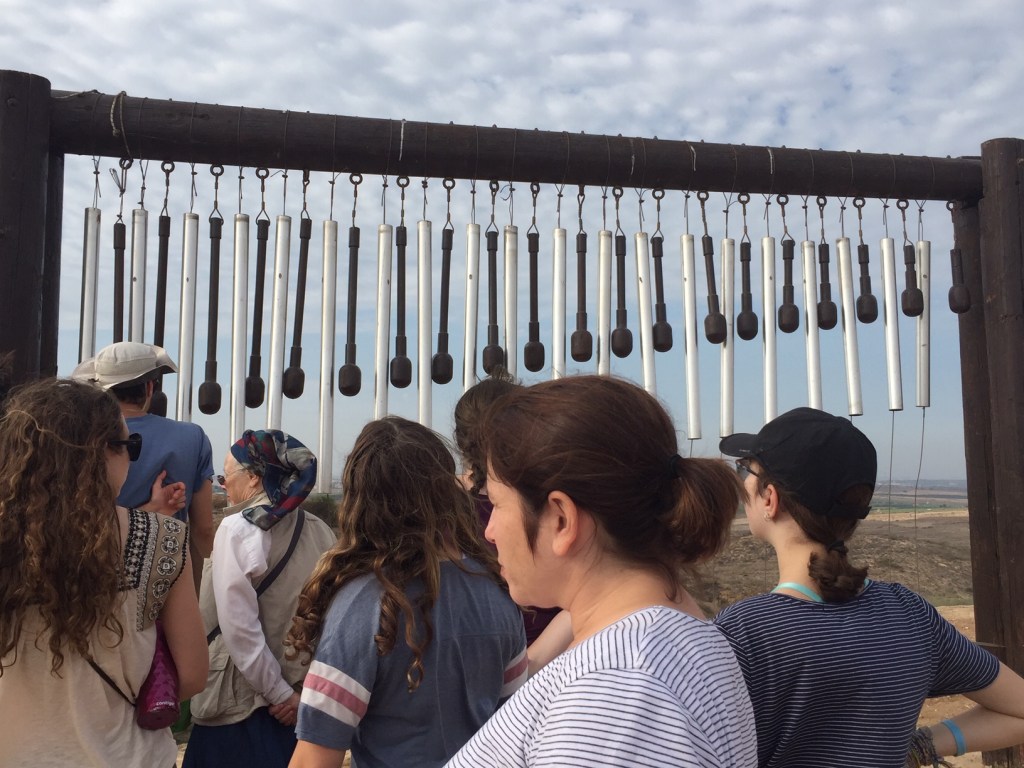
Orgenia made a phone call, and the big metal gate was opened electronically. We drove through, and down a dirt road. We parked near a memorial for one of the soldiers who died in a military helicopter accident, who came from Sderot. A giant wind chime was erected in his honor, because he was a musician. There were some soldiers there visiting the memorial.
They request that no one strike this to make sound, but that it be left to play only in the wind.
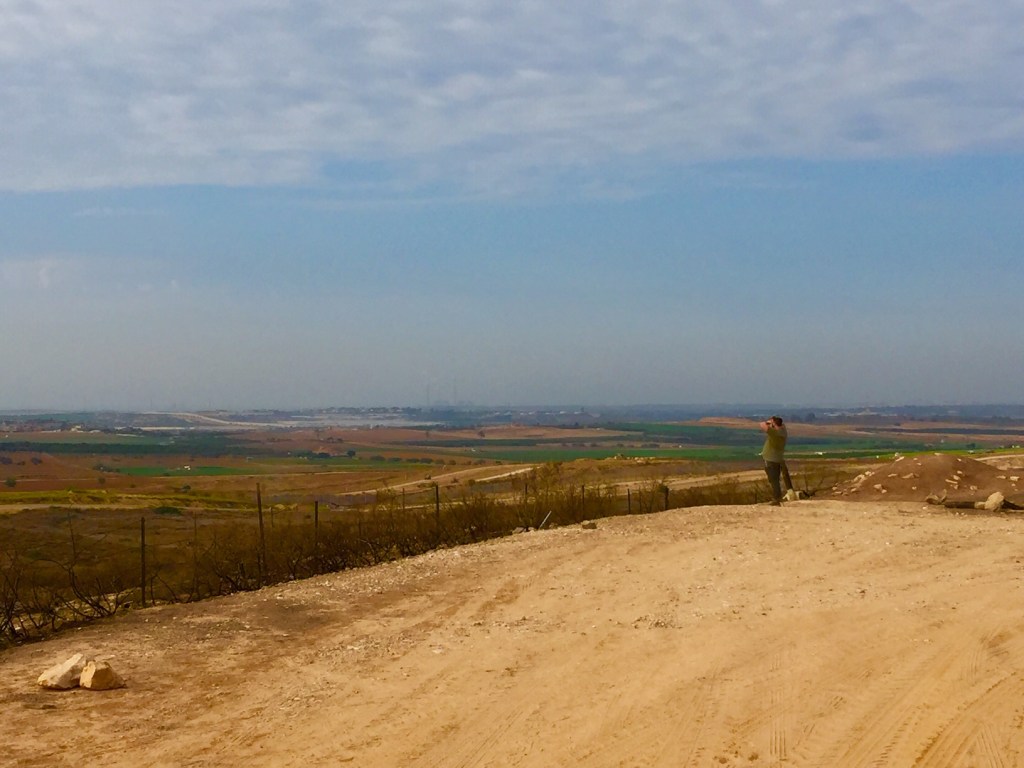
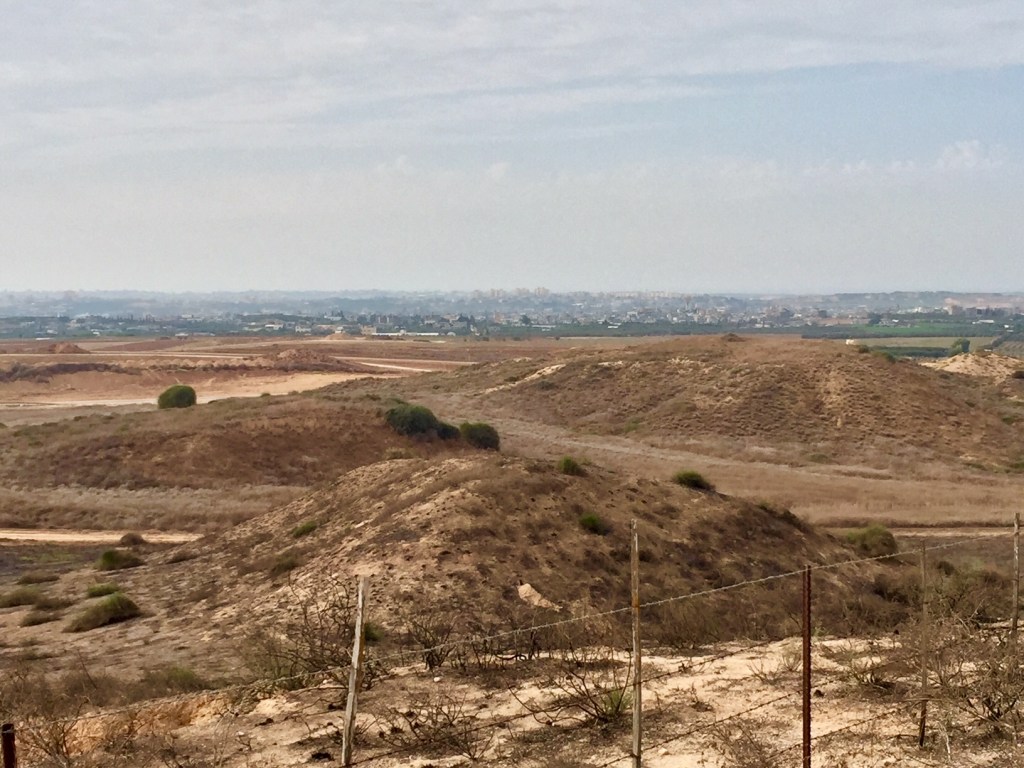
Beyond the wind chime, you see a road (open only to the military now), and a fence, and another fence — and then, there’s Gaza. Because Hamas has also been making tunnels under the border, Israel is building a wall now here — one that will be dug deep into the ground, with sensors. Those we spoke with who live on the Israel side of the border expressed sadness about the wall, and also a feeling that withdrawing from Gaza had not been a wise decision, but has only created more hostility, poverty, and despair. I don’t know what Gazans say — I am not permitted to go there, as Israel has blockaded Gaza since Hamas took over there. But as a Jew, I doubt I would be safe or welcome in any case.
The view toward GazaGaza City in the haze
Looking over Gaza, we davened mincha, the afternoon prayers. It was the most poignant davening of my life, especially Birkat Shalom, the brachah (blessing) in the Amidah or standing prayer that asks for peace.
Grant abundant peace over Israel, Your people, forever.
For You are the sovereign source of all peace.
So may it be good in Your eyes to bless Your people Israel
in every season and in every hour with Your peace.
Blessed are You, Adonai,
Who blesses His people Israel with peace.
There’s also place in daily prayers where liberal Jews such a myself add to the request for peace for the Jewish people (Am Yisrael) a prayer for peace for kol yoshvvei teiveil, all who dwell on earth. It was quiet up there looking over Gaza, and deeply mournful.
We concluded our trip with a very special visit to the home a peace activist in the village of N’tiv Asara, “The Way of Ten”, on the northern border of Gaza. It was a hopeful way to end our long day, and a perfect bookend to our visit with Khadra Elsaneh at Desert Embroidery in the morning. I need to practice my Hebrew and go to bed, so I’ll share that with you in a day or two. Shalom.
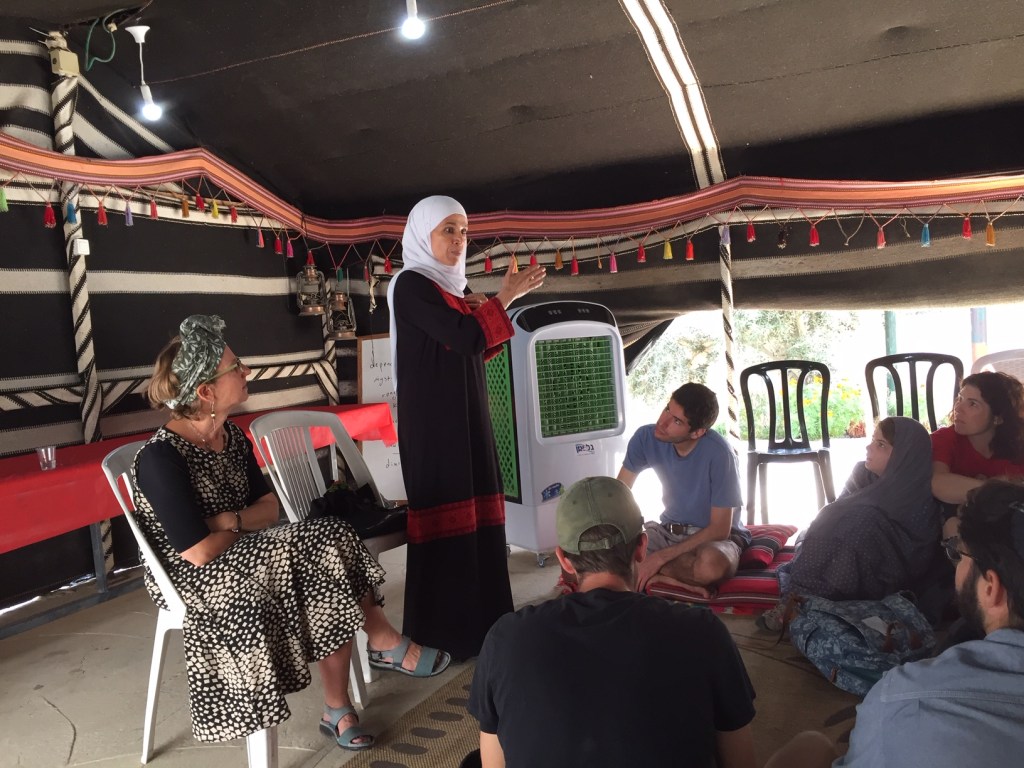
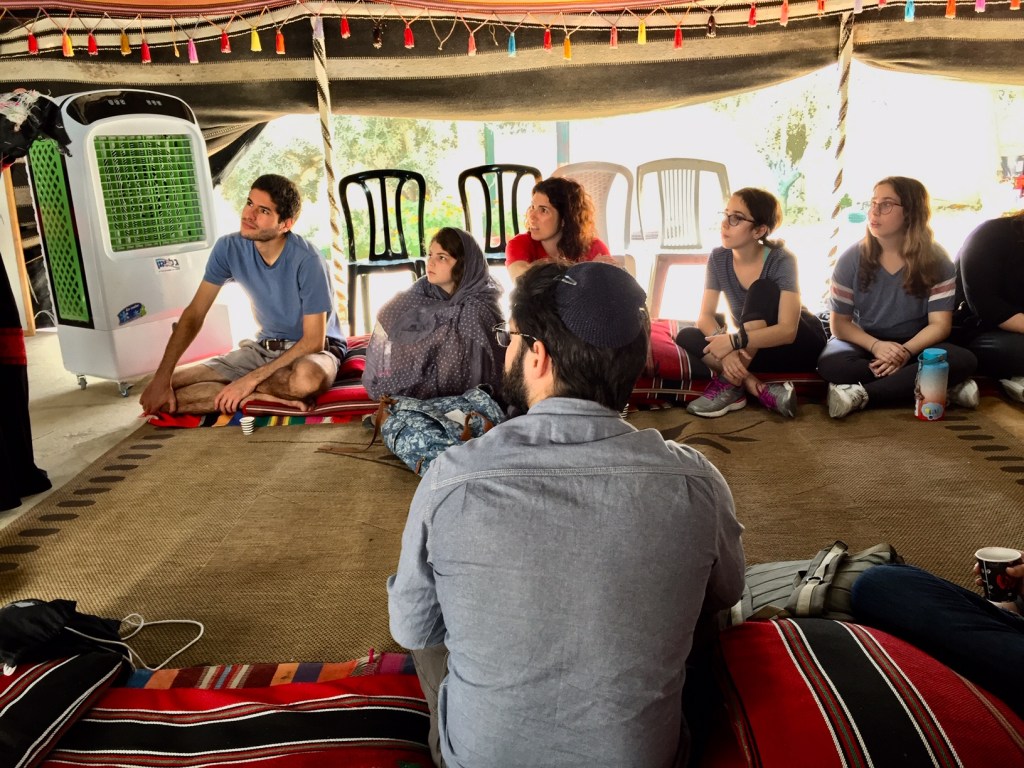
In the traditional Bedouin tent at Desert Embroidery
Beyond our studies of Tanakh and Talmud, Pardes is endeavoring to give its students a taste of the complexities of Israeli life, the political conundrums and the conflicting points of view. They have a difficult task — one I know some of my fellow students would say they are not completing adequately. But then — that Pardes students disagree is a given, and indeed an essential part of the Pardes education.
At the end of the fall holidays a group of us went on a twelve hour trip south to the Negev. This was billed as a tiyyul to the periferia — the periphery, meaning the parts of Israel that distant from the Mercaz, the Center. Israel is, as our teacher Meesh reminded us, “A dinky country”, and yet the perception of the vast majority of its citizens who live in the Center (Tel Aviv and its environs) is that places like Beer Sheva, Tzfat, and even Jerusalem are somehow curiously far away. The government, too, often fails to remember the importance of these “peripheral” communities. If you live in Southern Vermont, you may be reminded of the way that the power brokers in Burlington and Montpelier forget those of us down in the “banana belt”. In New York, the folks upstate are ignored by the urban majority. In the tiny yet populous nation of Israel, where seventy percent of the inhabitants live “between Gadera and Hadera” (https://www.google.com/maps/dir/Gedera/Hadera/@32.1260642,33.774801,8.05z/data=!4m14!4m13!1m5!1m1!1s0x1502b96580af56d3:0x890891e383854631!2m2!1d34.7770192!2d31.8123014!1m5!1m1!1s0x151d124252d125bb:0x3abe13857b8fe43d!2m2!1d34.9196518!2d32.4340458!3e0), any community more than say 45 minutes north or south of Tel Aviv is simply not worth worrying about. If you add in a dimension of ethnic prejudice and historical conflict, some communities, such as those of the Bedouin, are in a very difficult position
Our bus drove for about an hour and a half over through rocky hillsides and then through gentle farm country, at last arriving in the beginnings of the desert. We came to the Bedouin community of Lakiya, which is slightly north of Beer Sheva. There are two Lakiyas — the recognized one and the unrecognized one. Shortly after the establishment of the State of Israel in 1948, the new government, headed by European Jews, decided (of course without consulting the Bedouin) that it would be great improvement for Bedouin life if Bedouins ceased to be semi-nomadic and settled in nice sensible European-style towns. Seven towns were created, of which Lakiya (the recognized part) is one.
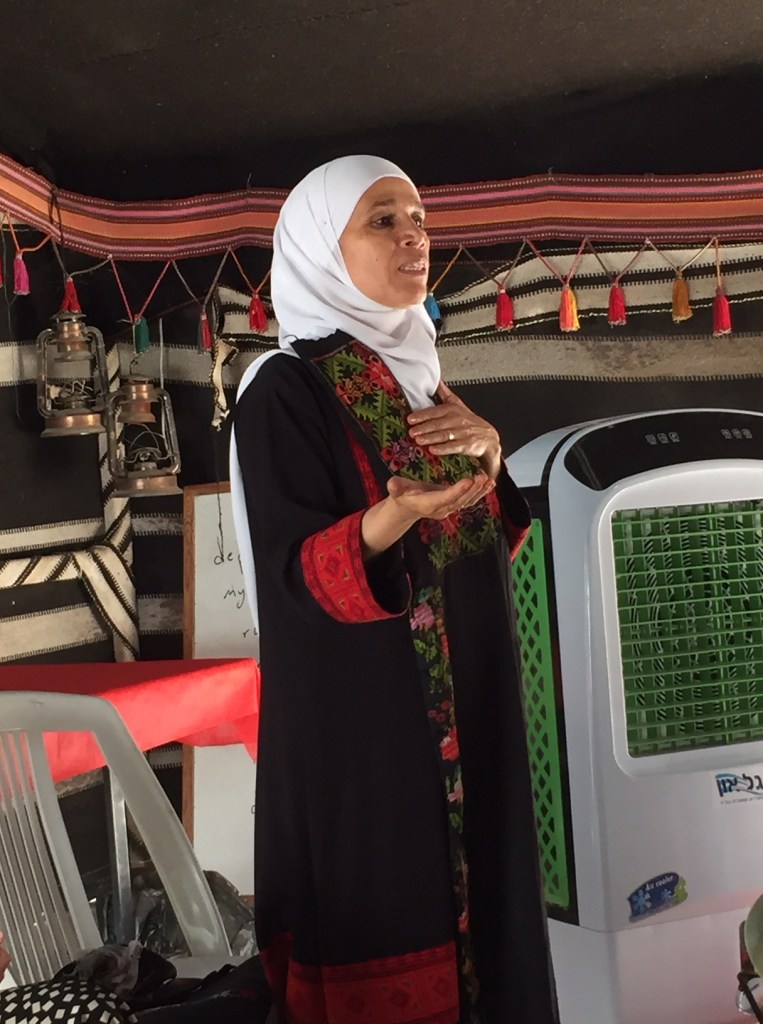
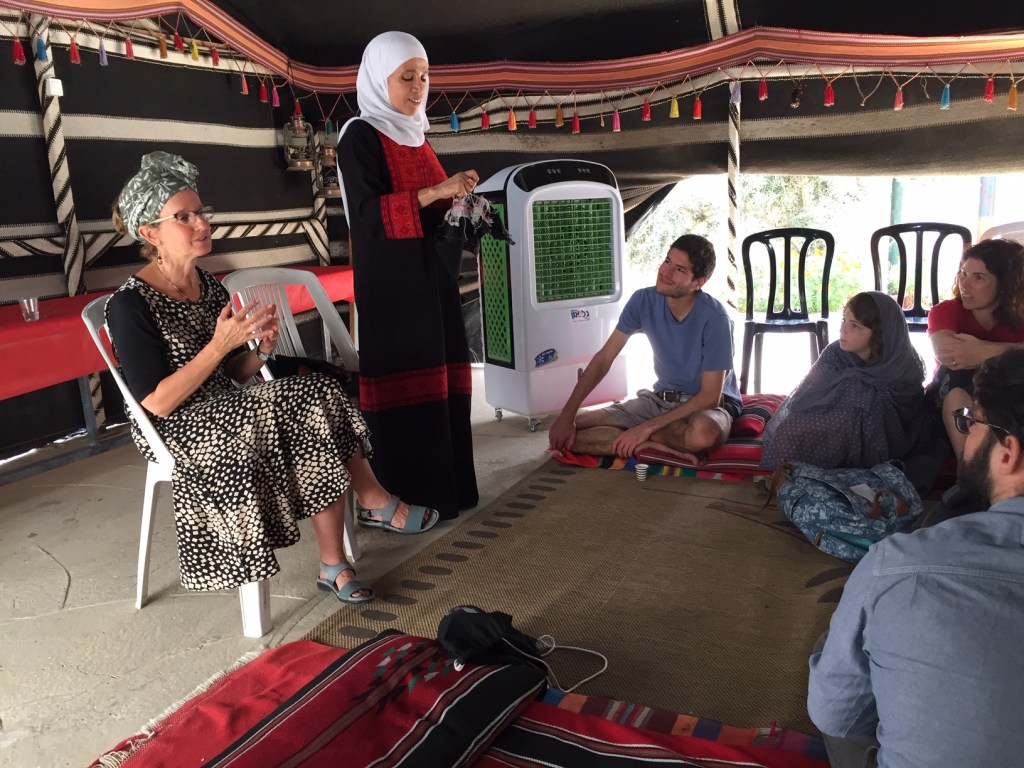
We first visited an organization called Desert Embroidery, in the recognized town of Lakiya. We passed a couple of beautiful and imposing mosques, and many homes and shops, as well as a health center and a community center, before arriving at the building and the large traditional goat-hair tent that house this remarkable organization. We sat under the tent — some in chairs and others on traditional cushions — and were served little cups of thick coffee, and then later of sweet tea. Meesh translated as one of the founders of Desert Embroidery, Khadra Elsaneh, spoke to us about how her project began, all that it now does, and the importance of its work. When I am directly quoting her I will use quotation marks.
Dr. Saneh
“Embroidery is the art of the Bedouin women. I embroider my love, my anger at my tribe that doesn’t allow me to go out — women embroider their emotional state. […] If we start with the embroidery, we have to make changes through the embroidery.” In the old days, the women did the cooking and shared in the agricultural work. The tent was dived, with men living on one side and women and children on the other. Women had many children; if the first wife did not produce enough children, the man would get a second, third, and so on. So — very Biblical. Women cooked pita three times a day, brought water from the well. When they went to the well, the men would watch form a distance. They could tell by what colors a woman’s embroidery was, whether was was married. The background color is always black. With red: married; with green or purple: unmarried; with blue: a widow.
Dr. Elsaneh and her sister (who is a professor at McGill University) saw how the loss of the semi-nomadic life had made things even more difficult for women than before. With the loss of the traditional way of life, women were more trapped. On the other hand, there was the possibility of education. In the non-recognized villages girls are not allowed to go to high school. In the recognized villages, girls do go to school — and some, like Dr. Elsaneh and her sister, go to University.
The women of Desert Embroidery have four projects. It started with the embroidery itself. In the beginning, women would pretend they were sick in order to go to the Health Center, where they would then have meetings about the embroidery project. Now, they don’t need to be as secretive –but there is still much resistance on the part of the male leaders – -so much so that the Desert Embroidery buildings were burned in 2006. Nonetheless, they rebuilt and they continue, making the beautiful embroidery which they sell, which pays for them to get education and hopefully go to college and beyond. When they come to be paid, they also attend a lecture on women’s health, helping them “to learn to speak up for themselves. Also, “To teach them not to marry their cousins”, because there is a very high incidence of children with special needs and birth defects because of the high rate of intermarriage, and the burden of caring for the children is on the women.
The second project is a mobile library. Like Brattleboro’s Bookmobile of old, it travels to five of the unrecognized villages, bringing books in Hebrew, Arabic, and English. Not school books, fun books. Books encourage literacy, literacy encourages women’s independence.
The third project is the Young Leadership program. This is a two year program for both boys and girls to learn about leadership. It especially encourages girls to think about going to college. It helps them with their language skills and to pick the right major. “There’s less [Arab on Arab — a significant concern of the Arab community right now] violence here in the south than in the north. Also, it’s changed — there used to be more girls kills [honor killings], now it’s more boys.”
The fourth project simply offers the use of their space for anyone in the Bedouin community who wants to learn languages.
Dr .Elsaneh shows us the stitches her grandmother taught her — Rabbi Meesh Hammer-Kossoy translates.
After the speech from Dr. Elsaneh, who is not only beautiful but extremely compelling, we went into the little shop. I confess, I bought more than I perhaps should have. Many of you can be prepared to receive a gift from me of exquisite Bedouin embroidery. However, if you would like to make your own purchases, don’t miss the web site, which also wil give you much more information about the whole project and the amazing work they are doing: http://www.desert-embroidery.org/
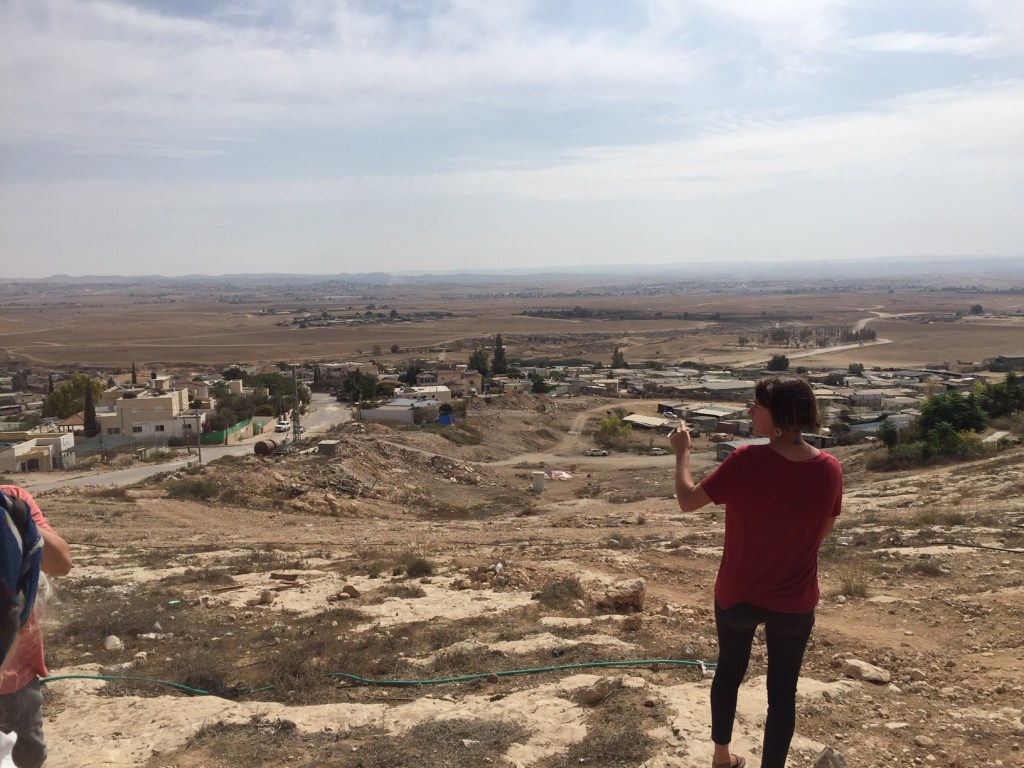
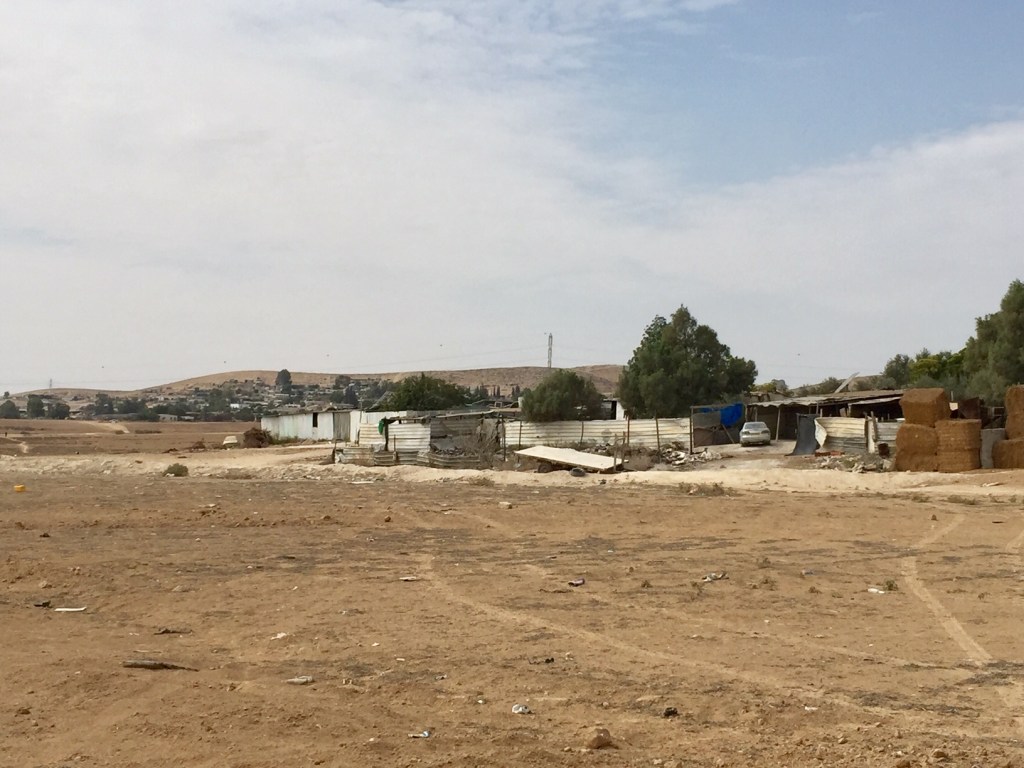
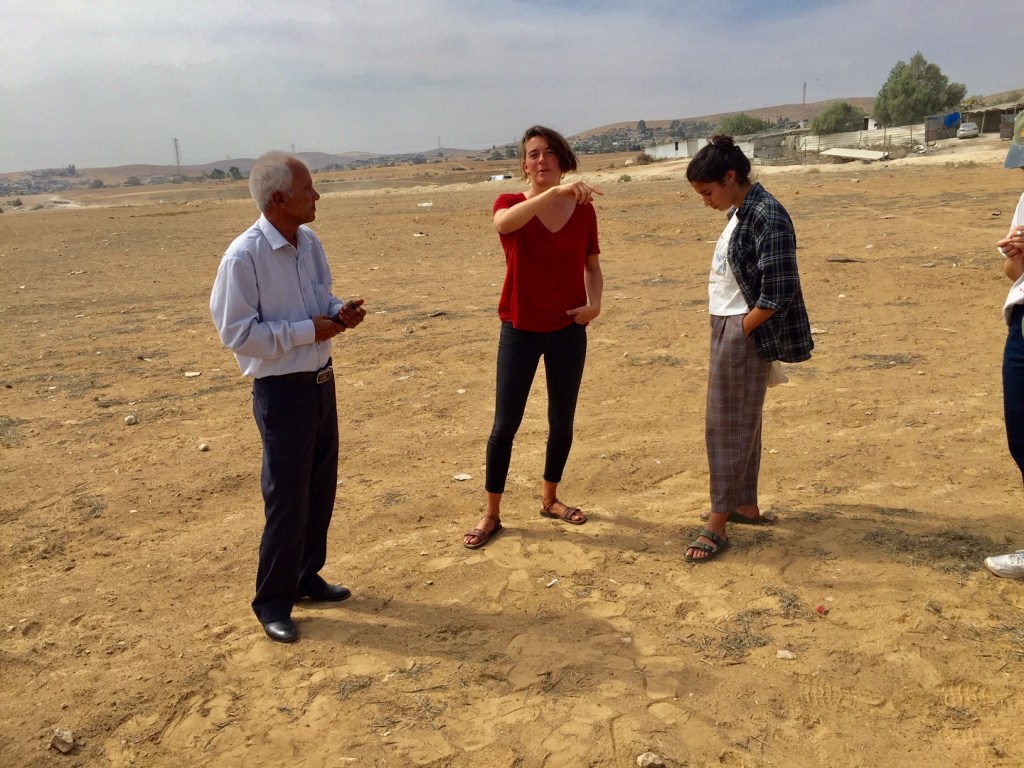
Our chaperones had difficulty prying us loose from the embroidery shop, but we got back on the bus at last and bumped our way across town and up a little hill that overlooks both the recognized and the unrecognized villages of Lakiya. Here our guide were two young women from the Negev Coexistence Program. (https://www.dukium.org/), one Jewish, one Bedouin Arab. Later we were joined by an older Bedouin man who is also an activist. We stood in the “field” (dry ground) outside the house of the young Bedouin woman, whose family is well-to-do and owns the house. As we looked over the two towns — one looking more like the shanty-towns of Africa or Mexico — our Jewish guide attempted to fill in our sense of the history of what we ere seeing.
Looking over unrecognized Lakiya
The Bedouin Arabs were semi-nomadic. They lived in tents, moving at certain times of year to follow the water. They knew whose land was whose, and will never — to this day — use land that they know belongs to another family. This is why there is unused land in the recognized town of Lakiya, even though there is a severe housing shortage. While the government of Israel portrays them as having been fully nomadic, with no ties to any part of the land, this is not actually correct. Of the 1 million people in the Negev, one third are Bedouin. “Before Israel”, claimed our guide, the population was 100 per cent Bedouin Arab. However, a little investigation shows that there was Jewish settlement of this area starting in the 1880’s. It is true that the southern part of the Negev was not part of the Biblical land of Israel.
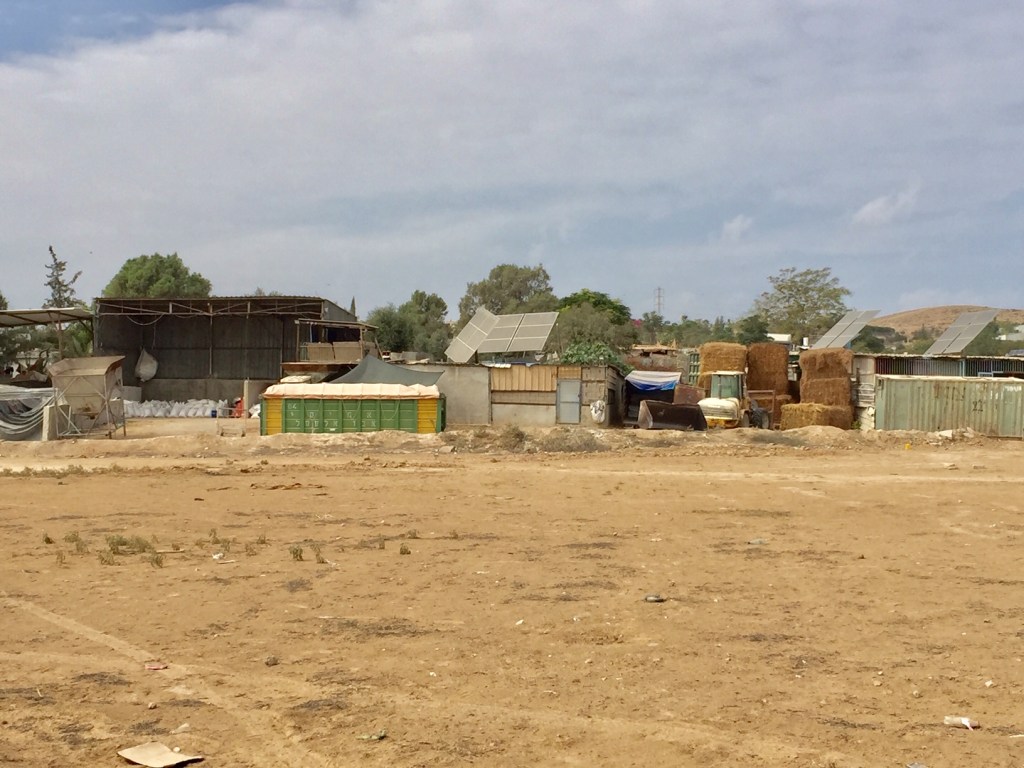
Unrecognized Lakiya close up –we ere drive to a spot nearby and stood here next to it while we heard more about the whole situation. Three passers-by gave us three different reactions: one ignored us, one waved, and one gave us the finger.
As of now, the Bedouin only have 2 % of their original lands. 76 % of women are unemployed. (But it’s worth noting that before Western influence, women wouldn’t have been “employed” in the sense we use this word now — and one reason they are not employed now is that their husbands would rather they weren’t) There is a high incidence of weapons and drugs in the Bedouin communities. Currently there are about 300,000 Bedouins living in the Negev. 150,000 are in state-recognized villages, 150,000 are in unrecognized villages. No Bedouin are living a semi-nomadic life any more, although they do continue to have camels and goats and to ado agriculture where they can. They are all — this is important — citizens of Israel. Their identity cards say the name of their tribe, emphasizing the Israeli government’s view that they are nomadic and have no land that is truly theirs.
The government of Israel spends “Billions of dollars” on Bedouin development — but only in the recognized villages. Remember, these are the villages that the government told the Bedouin were where they could live, back at the start of the State of Israel. The unrecognized villages, which the government says have no right to exists, and which it therefor is regularly demolishing, have no infrastructure. The Bedouin who live in these villages are attempting to get them recognized. In this era when the population of Israel is burgeoning, and the (right wing) government wants to develop the Negev for its Jewish citizens, this recognition is not coming any time soon. Meanwhile, the lands around these villages are often understood by the government to be either army land (60 % of the Negev is a military zone), or nature preserves. One tactic used is that the Jewish National Fund plants those trees you and I may have sent money for, on land that the Bedouin are attempting to farm, and around the unrecognized villages, preventing them from spreading. Kids in the unrecognized villages do go to school, but there are no schools in the villages, so they are bused long distances over often dangerous roads — and in the winter when there are floods and mudslides, they often don’t go at all.
Our three guides — the Jewish Israeli in the middle, flanked by the older an the younger Bedouin Israelis.
I found a lot of this presentation compelling. One certainly could not help but make comparisons to the treatment by the United States government of the native peoples. There is, or instance, a Bedouin Authority, a bureau of the government which seems to be similar to our Bureau of Indian Affairs, with about as much interest in the true needs of the Bedouin as the BIA has in the true needs of the Native Americans. That the Bedouin community was utterly mismanaged by the founders of the State of Israel seems clear — probably more out of European cluelessness and the view that “our Western way is the best way” than out of malice. Not that the results were any different. I believe those of us on the tiyyul approached with open hearts and minds. Many of us were put on guard, though, when the young Bedouin woman activist, who is wealthy and highly educated, not only identified herself as a “Palestinian” , but said that the Israeli government is “Fascist”. In her view, the State of Israel has no right to exist, although she generously grants us Jews the right to be Jewish as long as we don’t think we have the right to have a state here.
I wonder if the young are more radicalized around these issues, or simply less tactful (as the young often are)? It seems that the older man was simply advocating for the rights of his people to live where they have traditionally lived, and to have the services they deserve as Israeli citizens. I wondered if the misguided policies of the government over the years have alienated and radicalized the young. In the end, I was left with the feeling that the Bedouin have been poorly served. It would be interesting to see what a more left leaning government might do to try to change the situation.
For the second half of my report on our trip (a visit to Sderot and another town on the Gaza border) stay tuned!