Once we had returned to Jerusalem, Deborah and I had a day to do something touristy around town. She was interested in visiting the Israel Museum, where she and I and Ariel’s husband Chris had all been together back in 2014. I suggested that we stop on the way and visit the Monastery of the Holy Cross, which sits in the valley below the museum. I’ve passed it dozens of times in a car, bus, or on foot, and had always wanted to see inside. So after a leisurely breakfast we set out to walk over the hill and down to the Monastery.
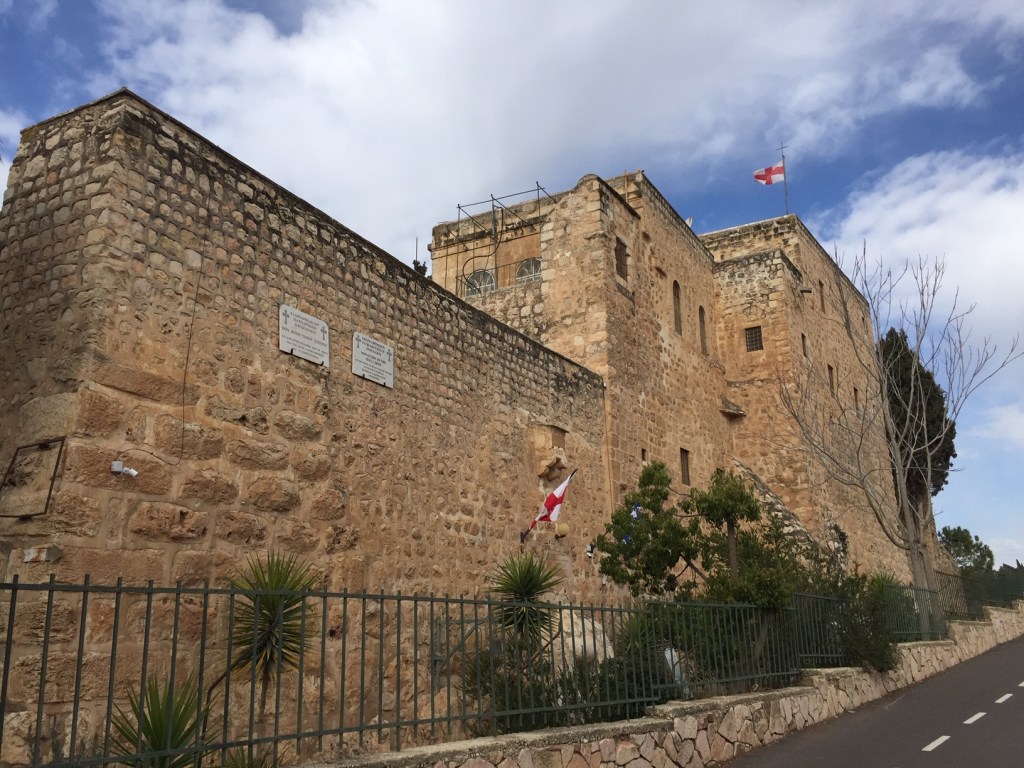
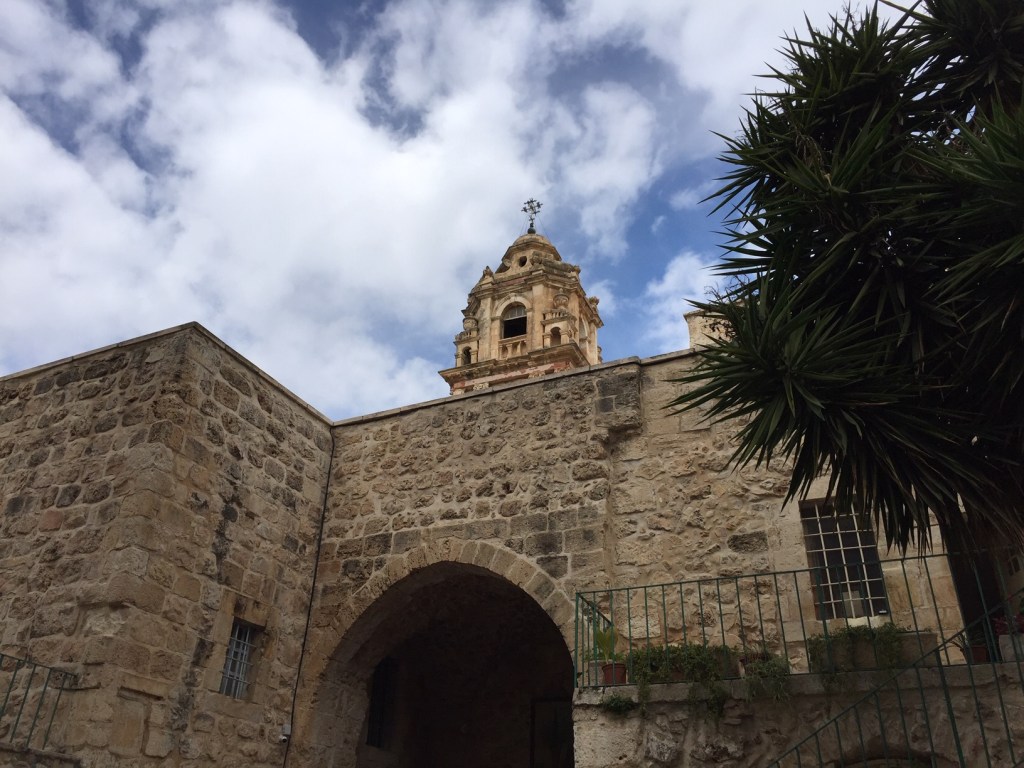
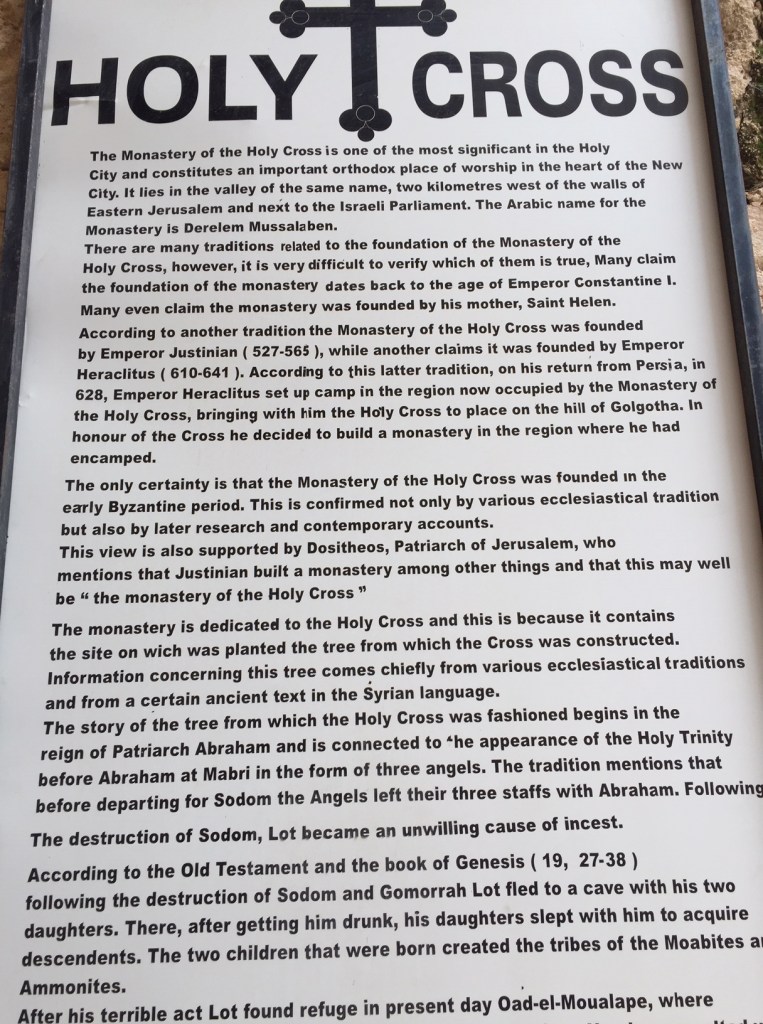
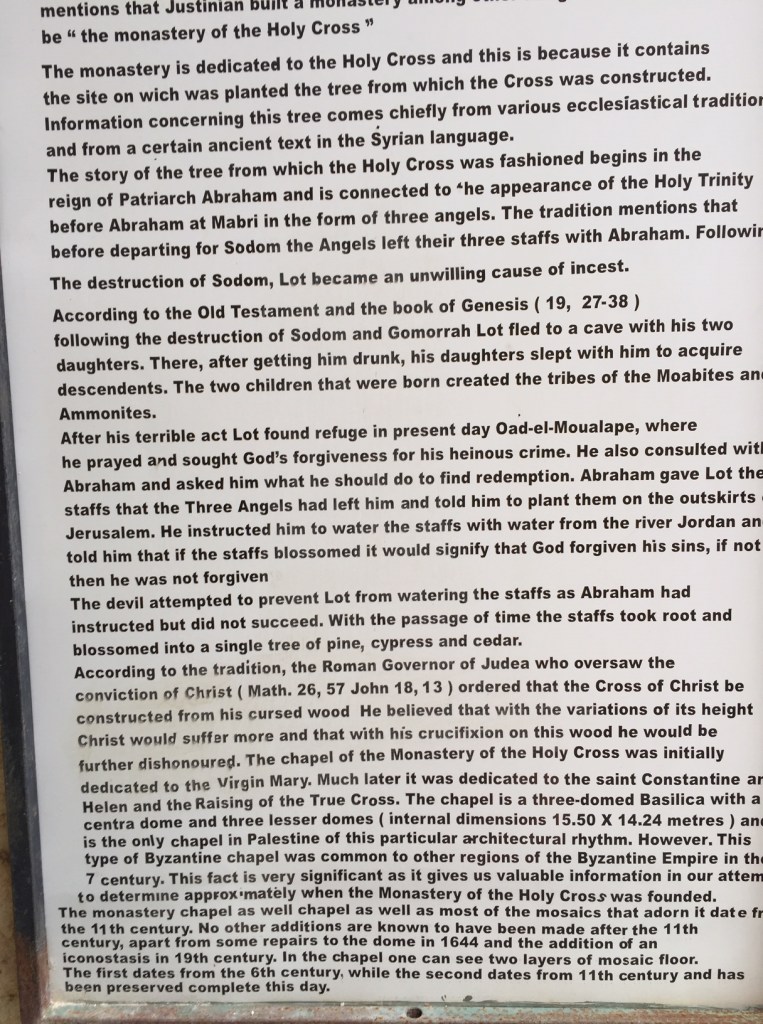
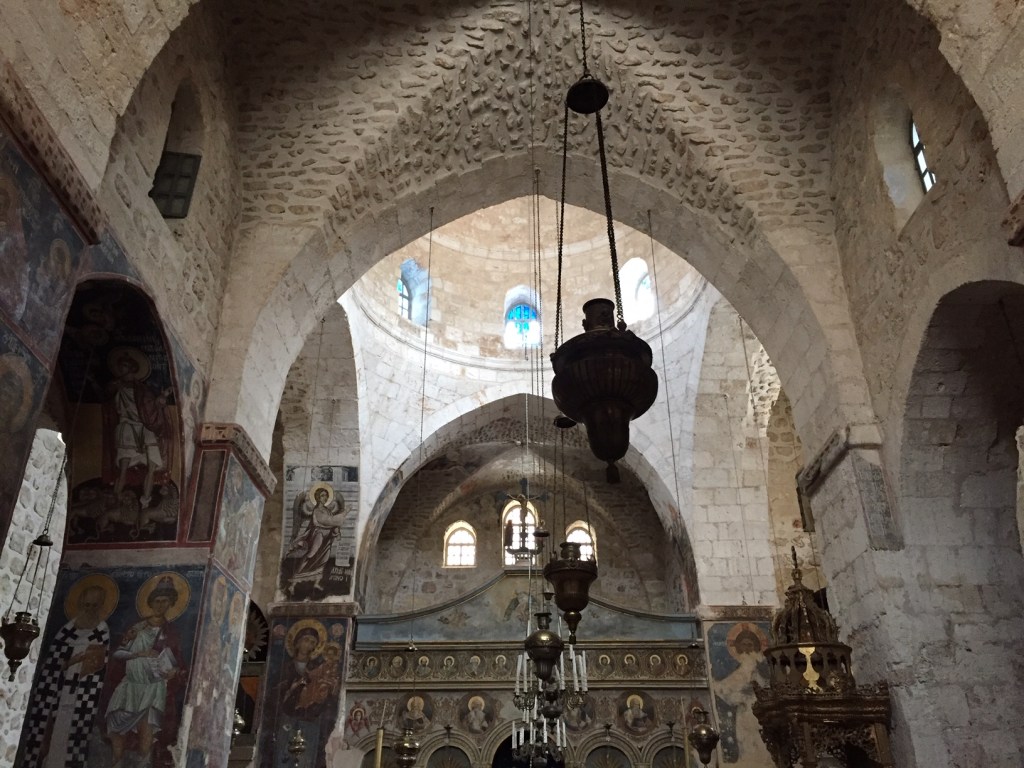
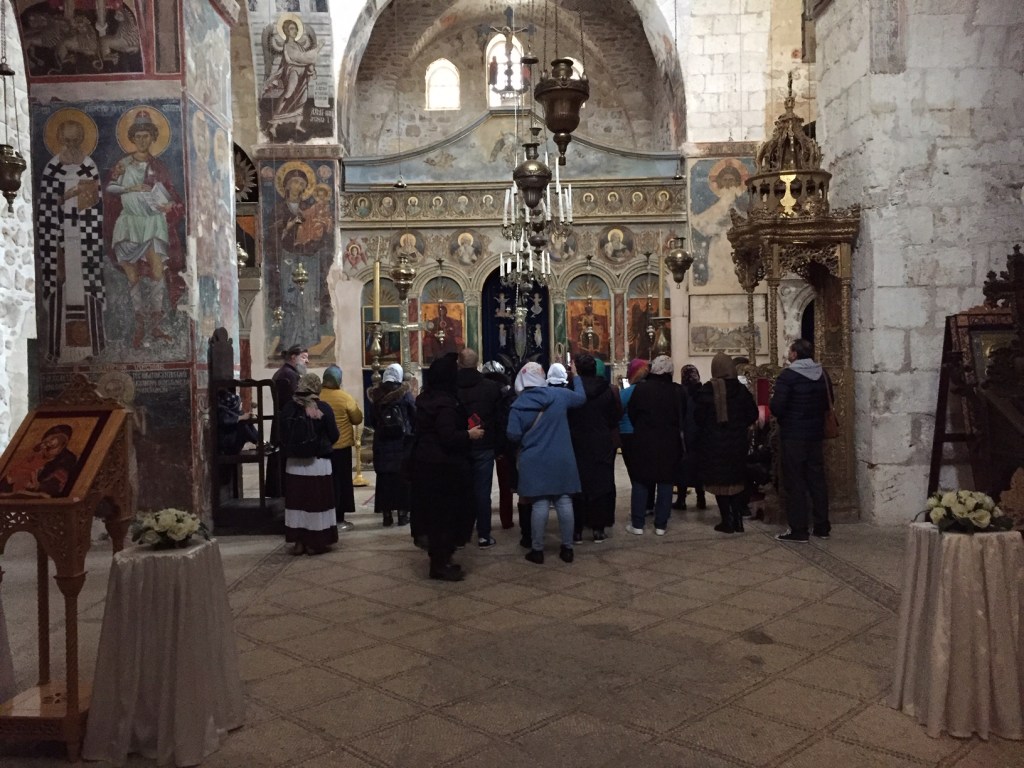
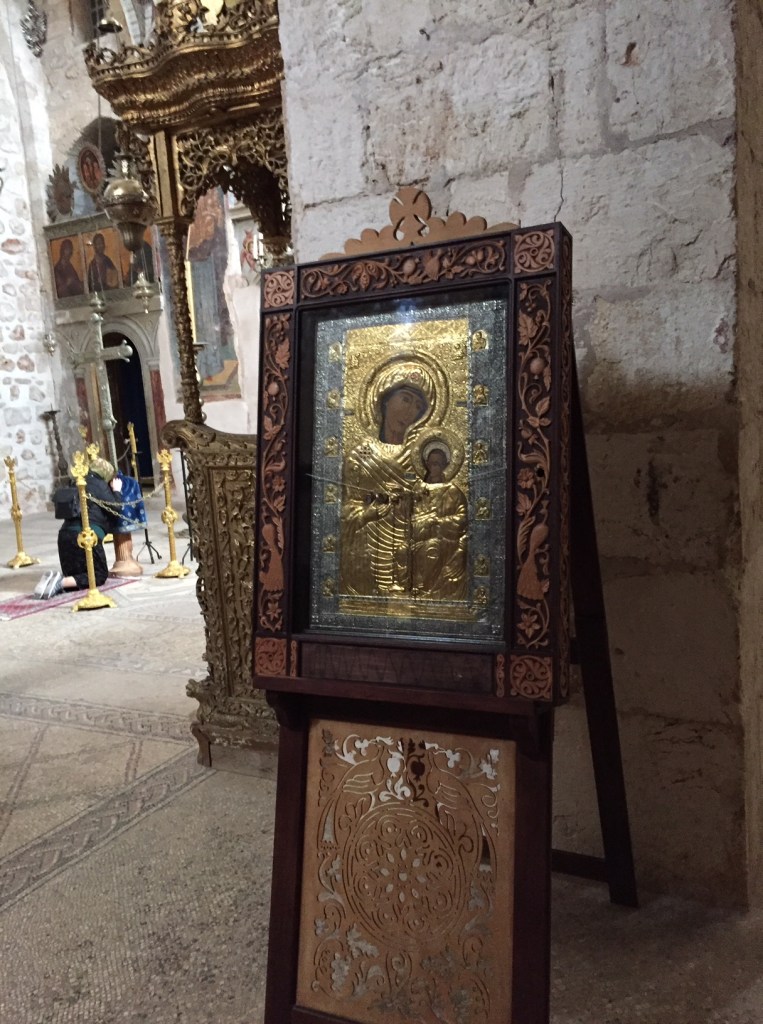
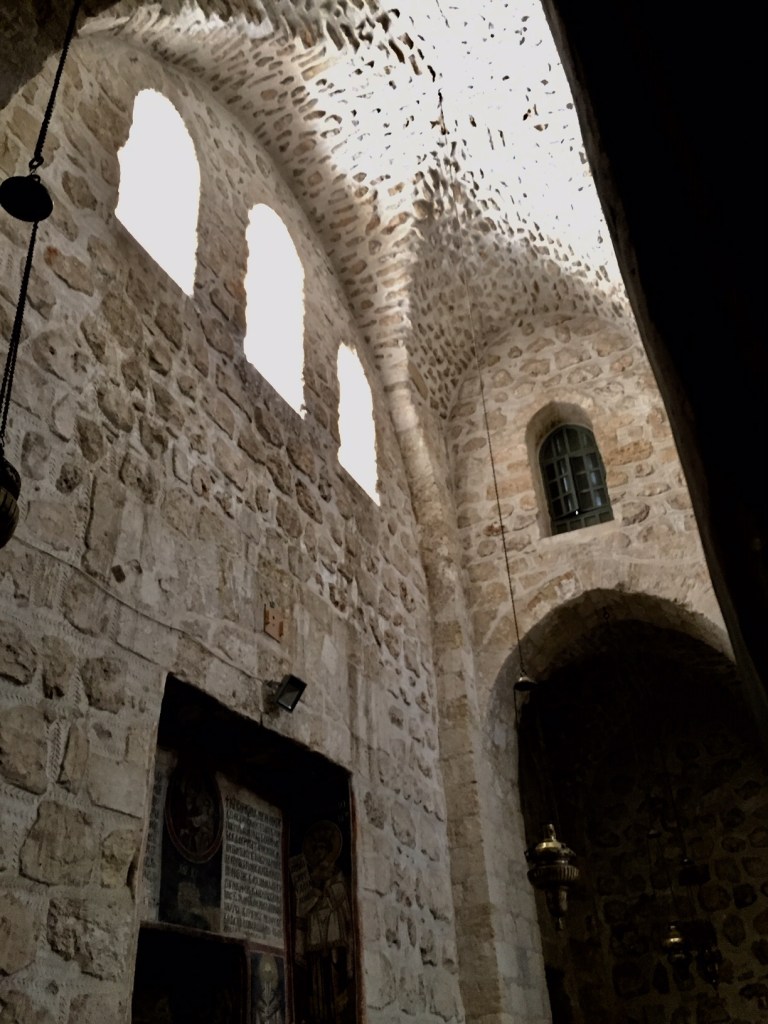
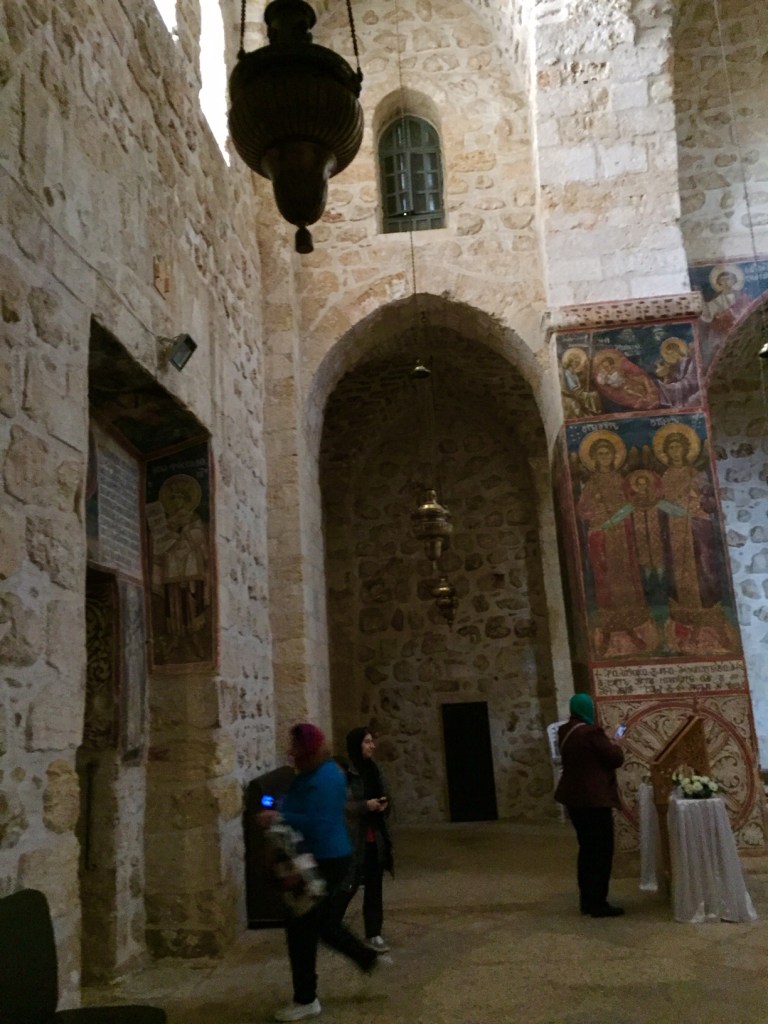
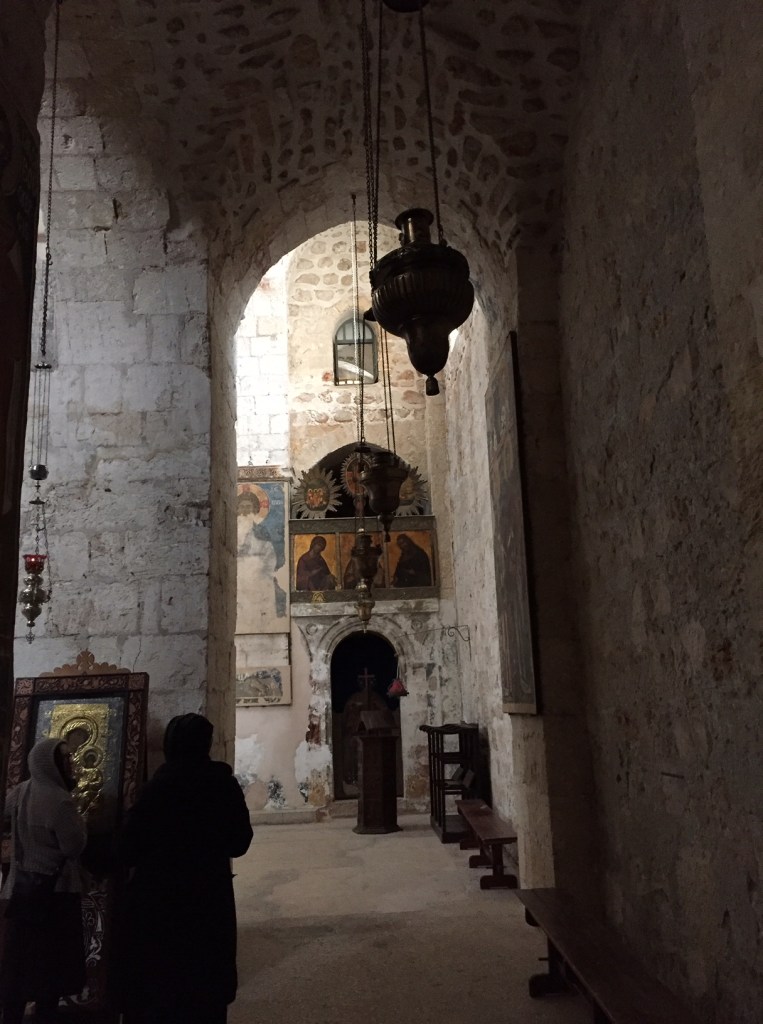
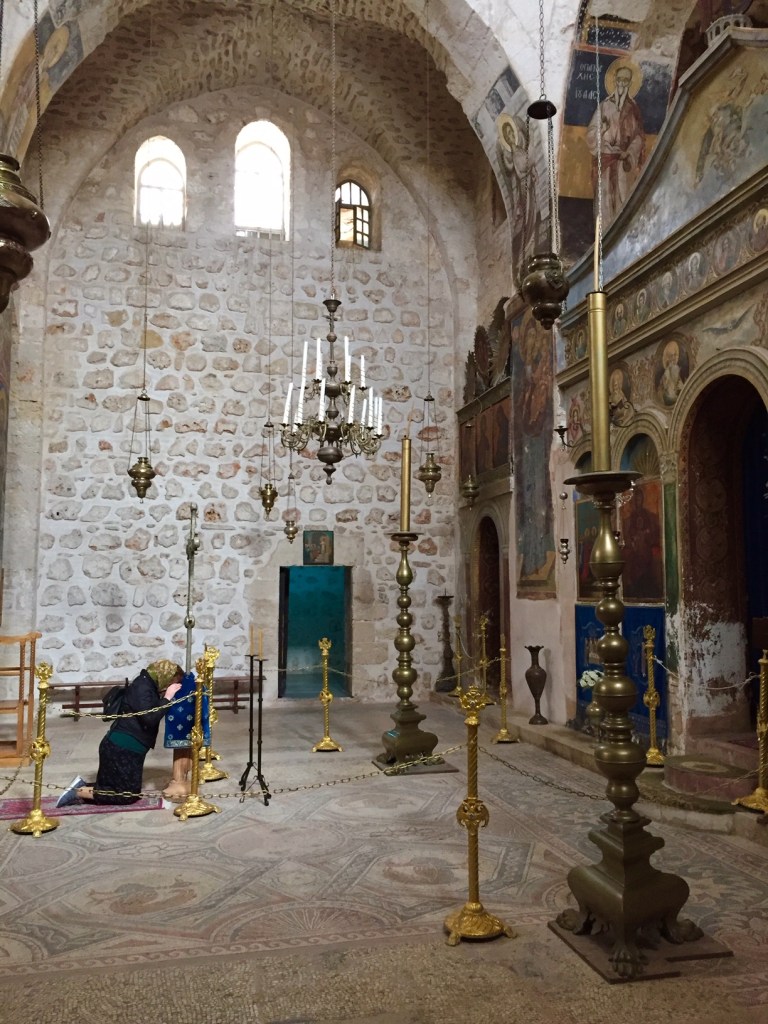
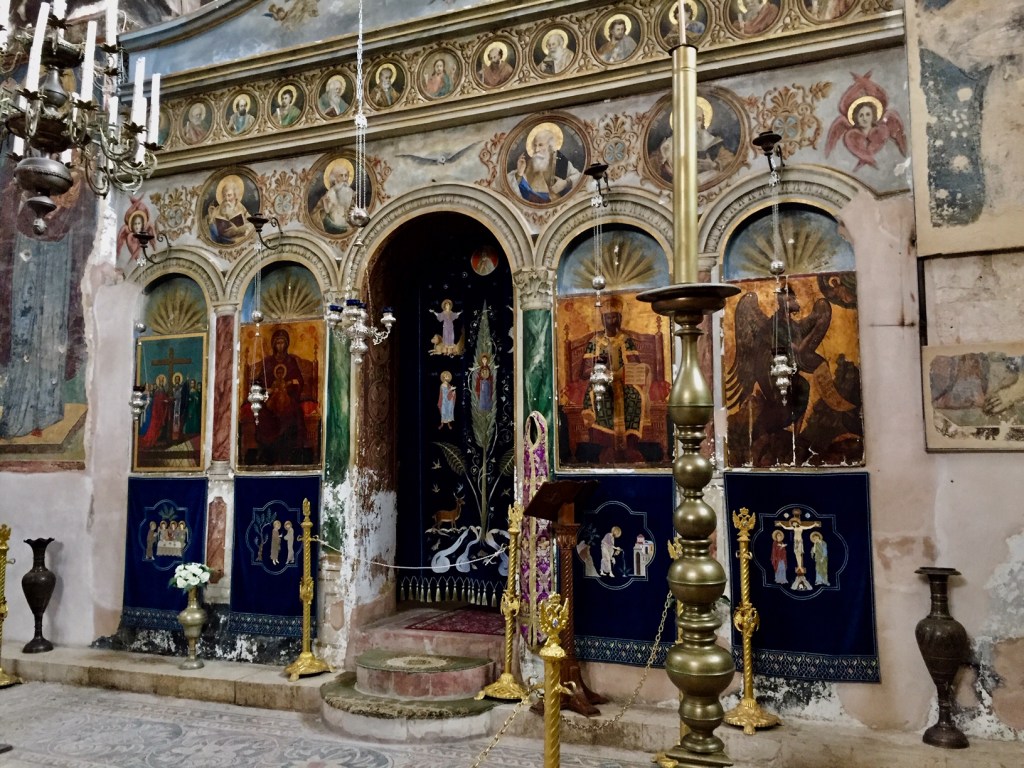
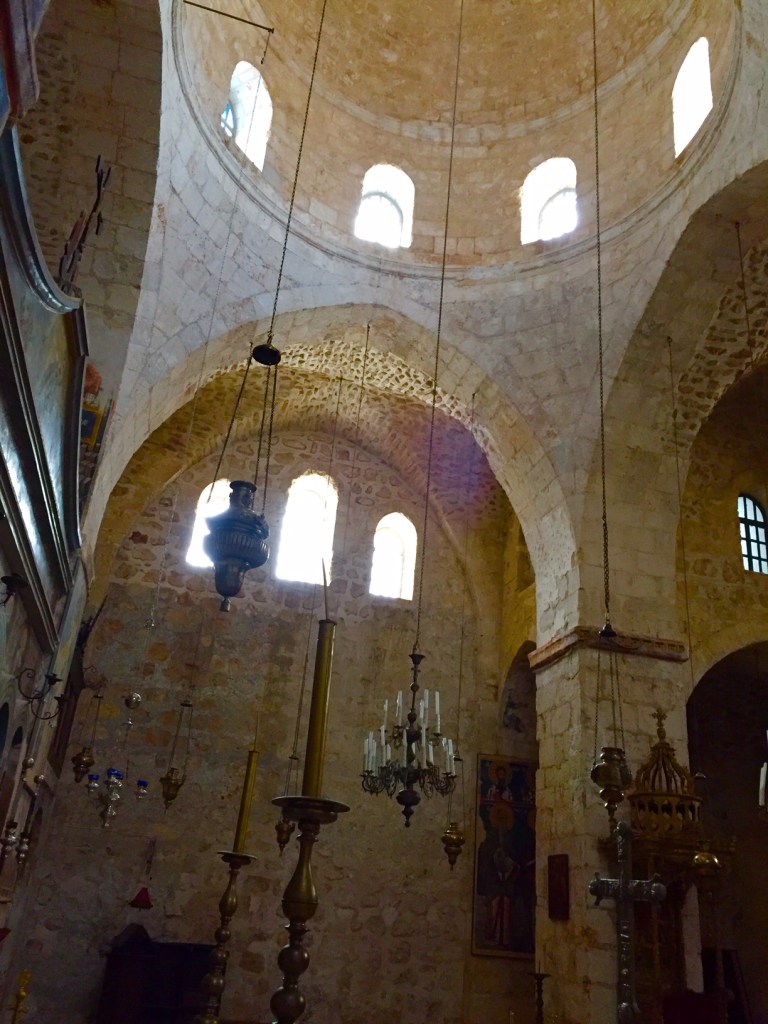
From the outside, the Monastery is rather forbidding. You wouldn’t guess what a wealth of beauty awaits you inside. We came in on the heels of a group of Greek Orthodox tourists — but even if we hadn’t, there didn’t seem to be anyone taking admission. As we entered, the tourists were chanting a prayer. One sweet soprano voice soared above the others in the resonant space of the sanctuary. Here below is the history of the Monastery.
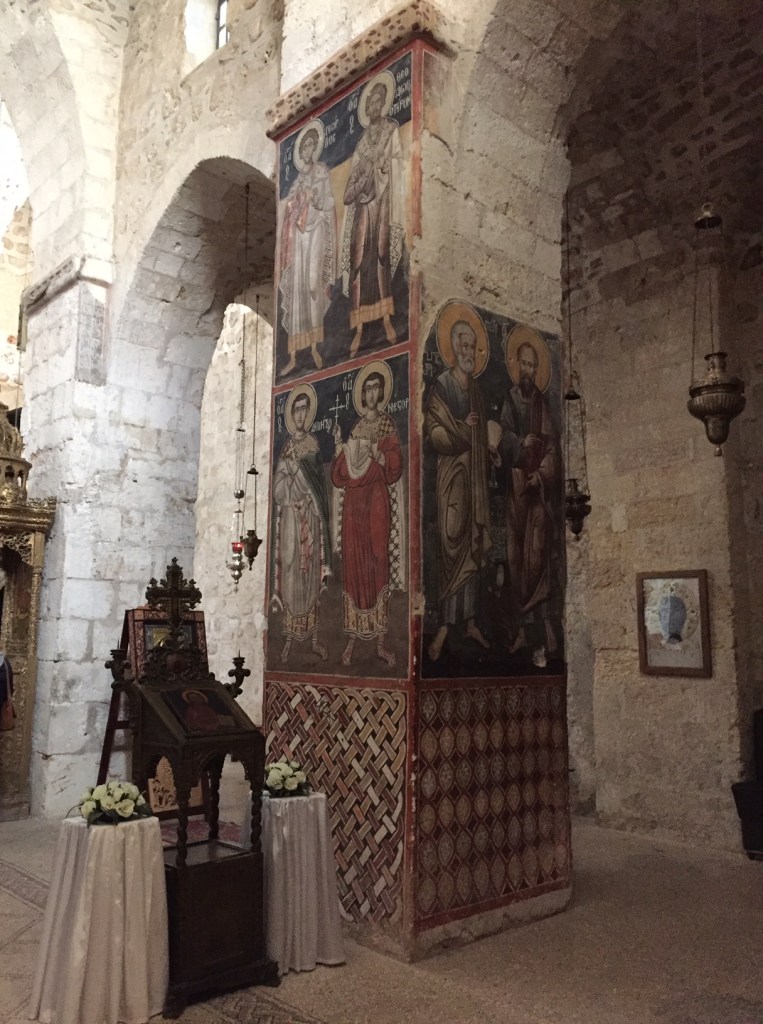
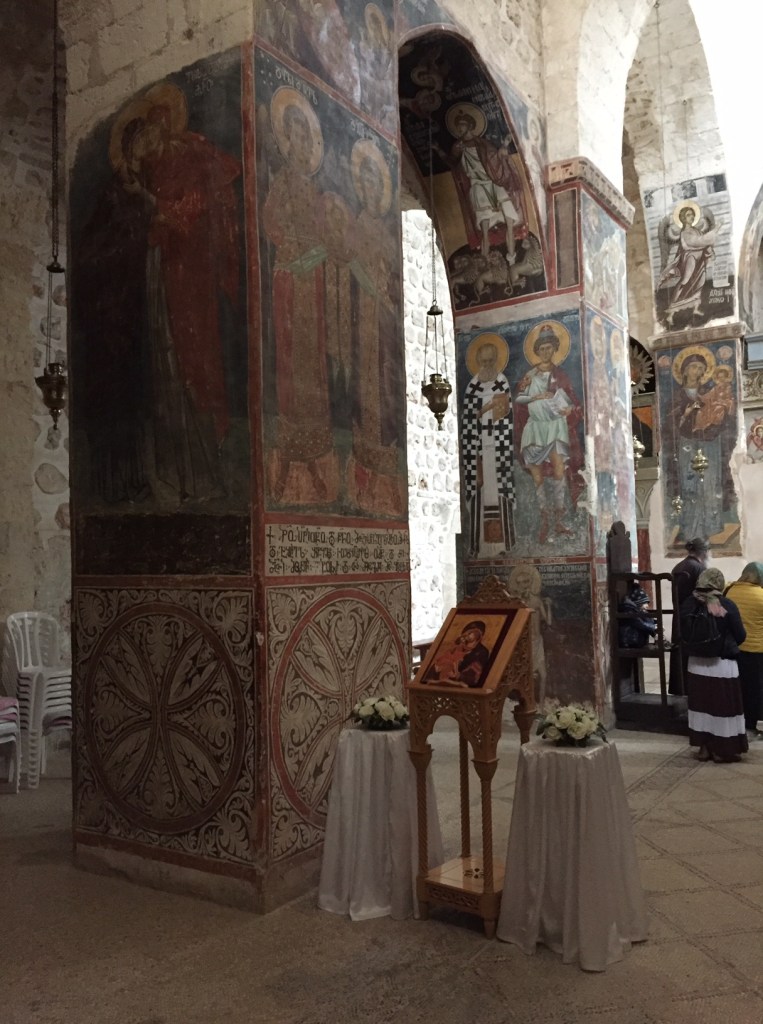
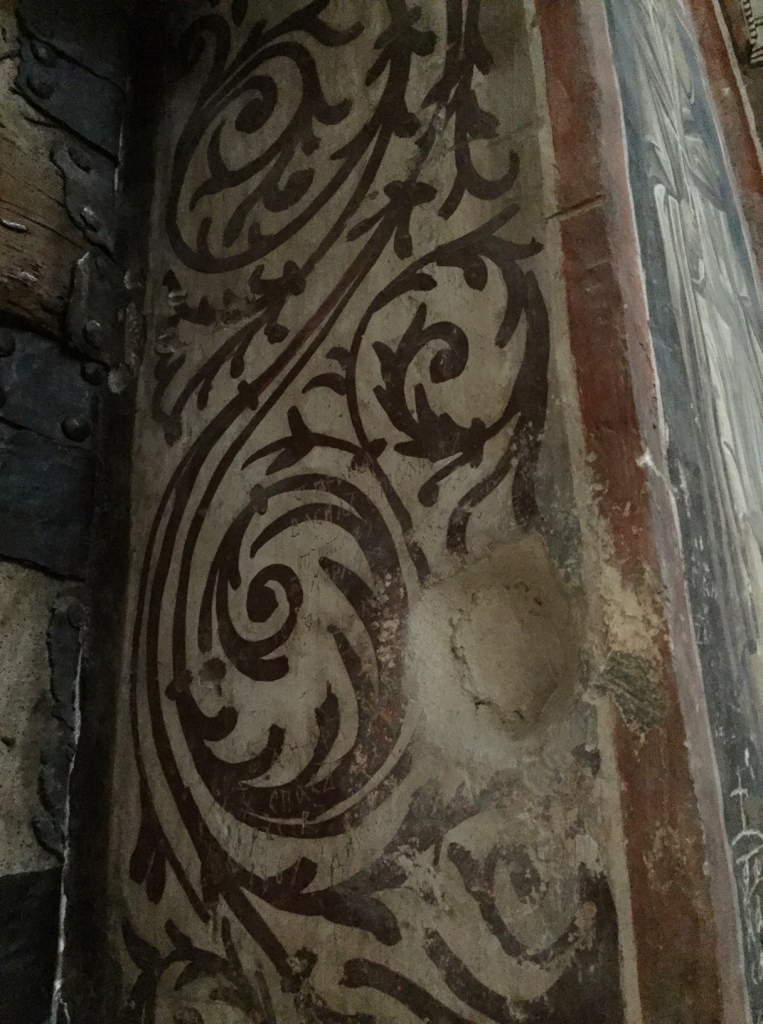
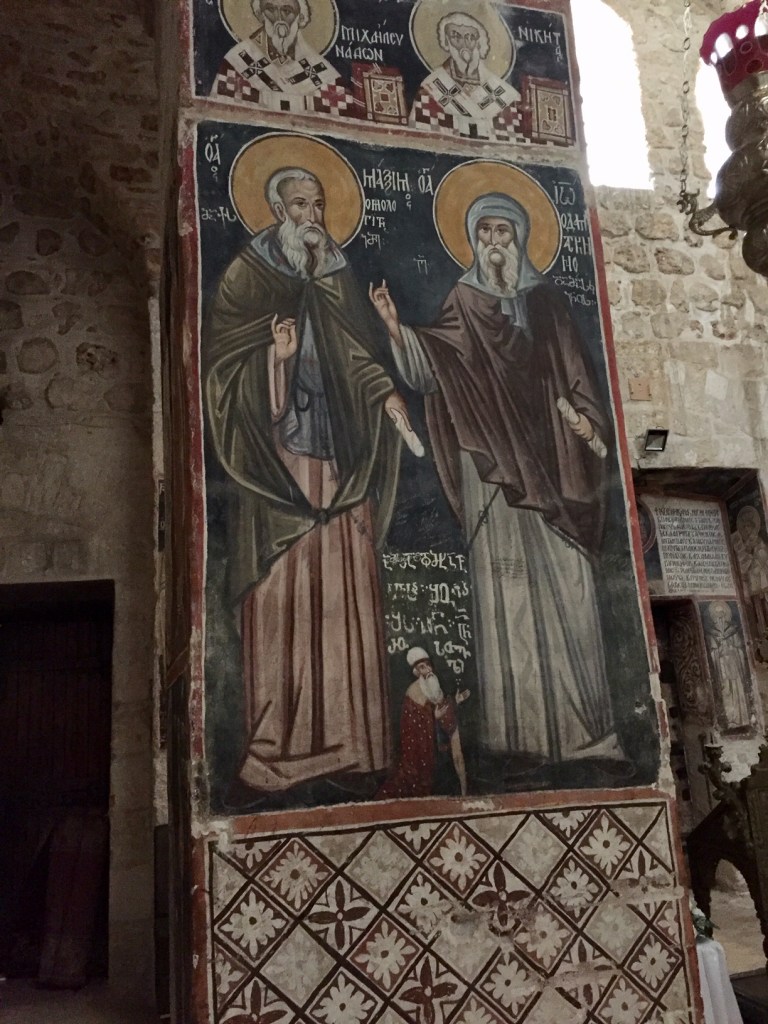
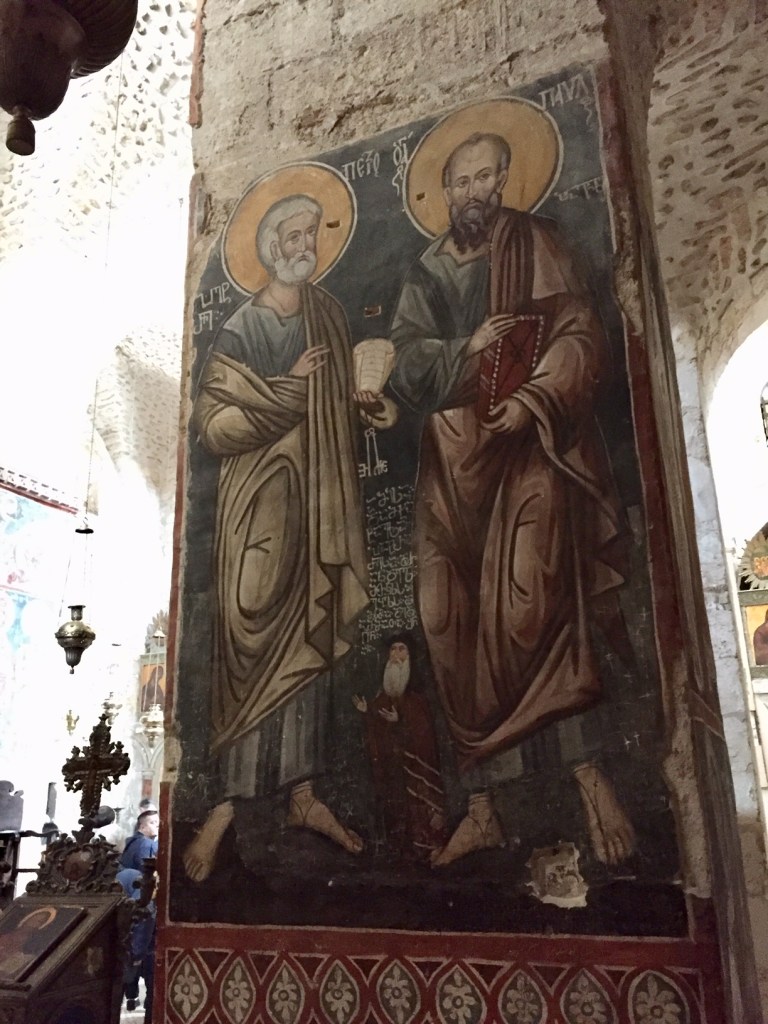
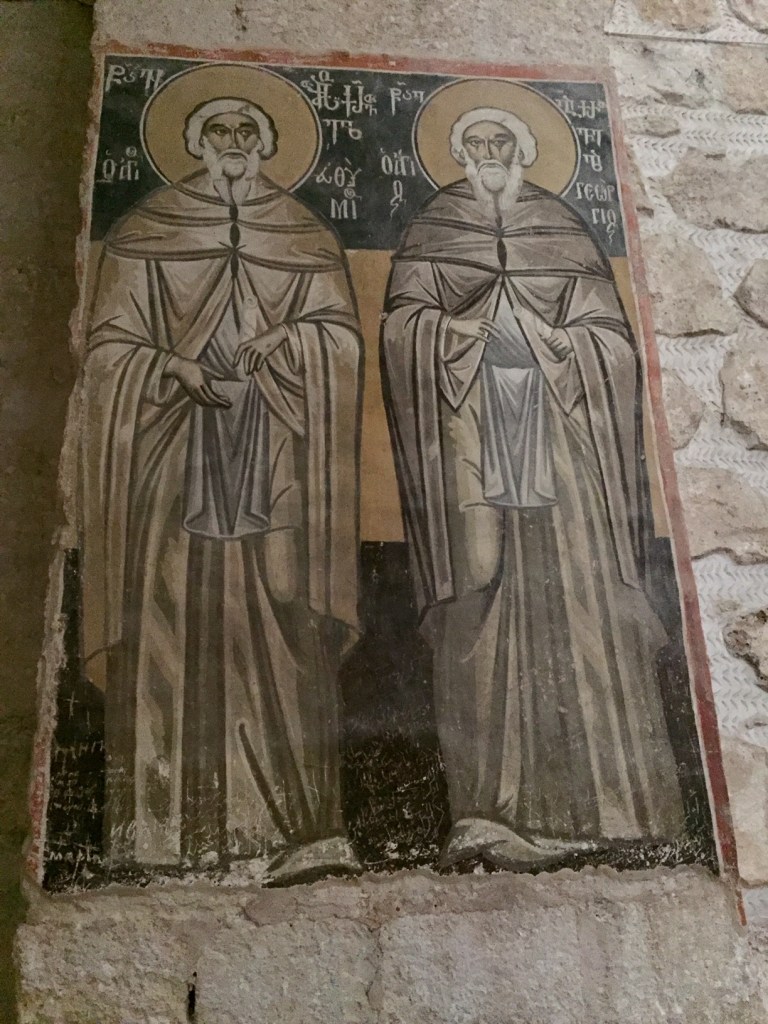
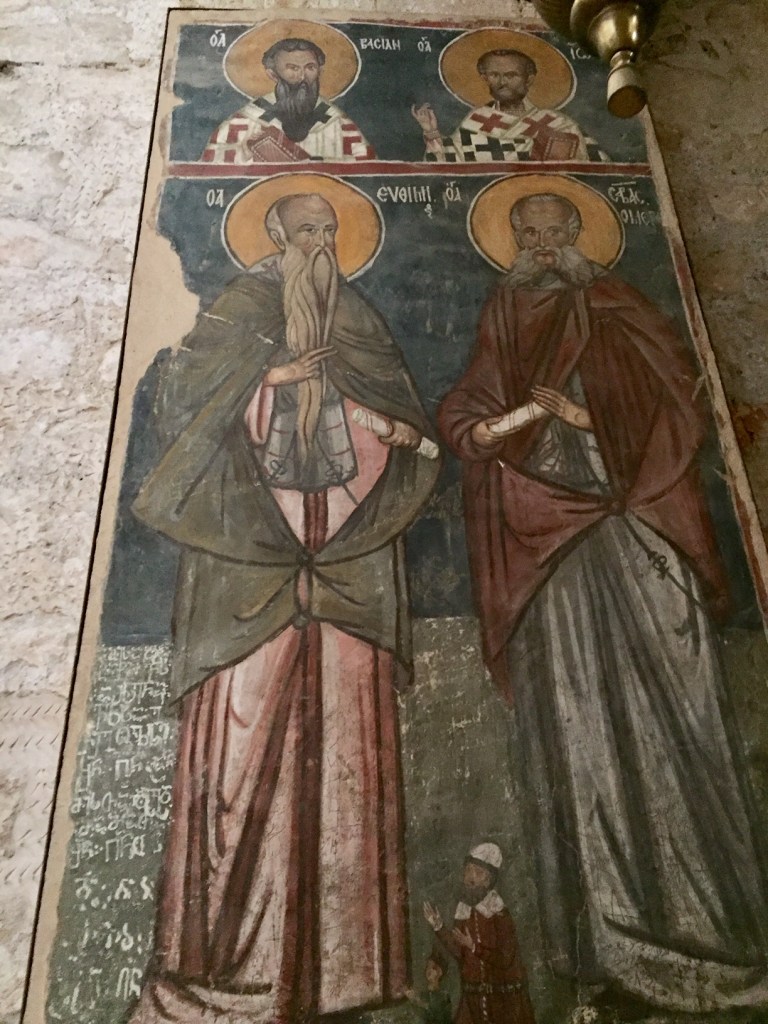
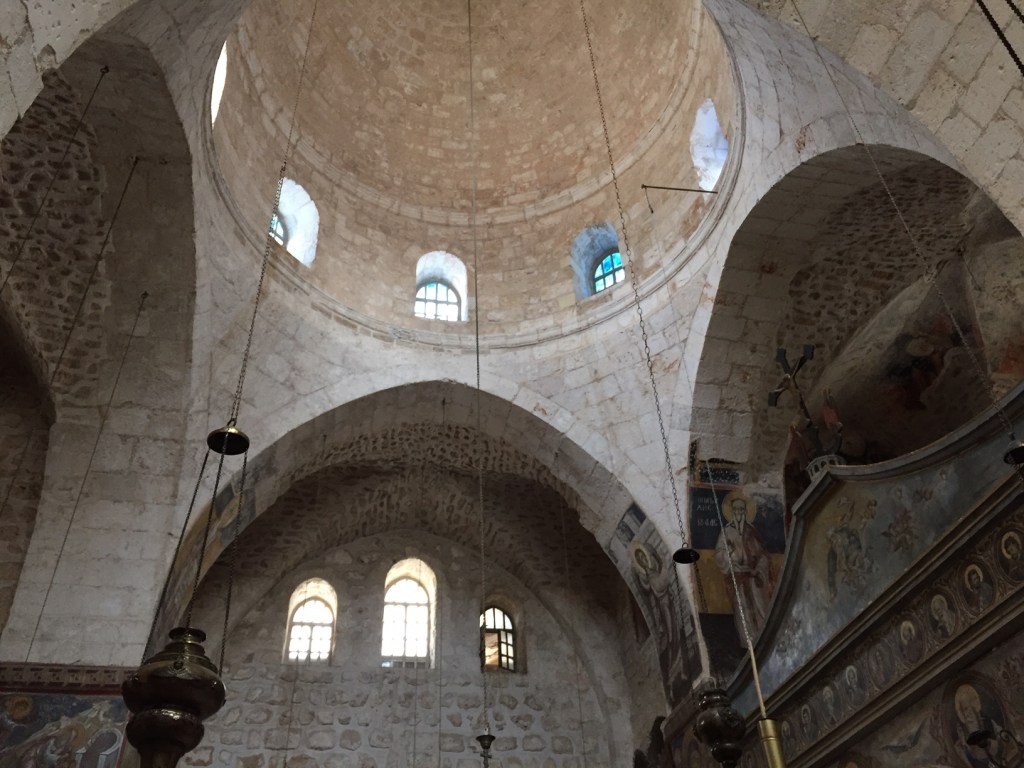
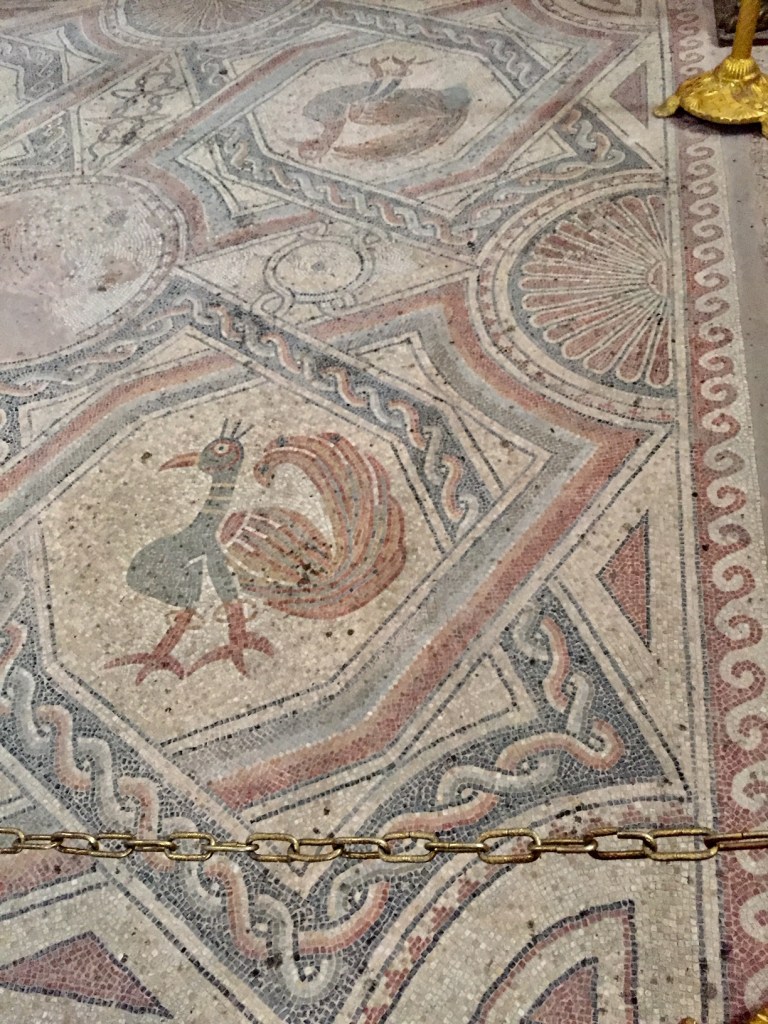
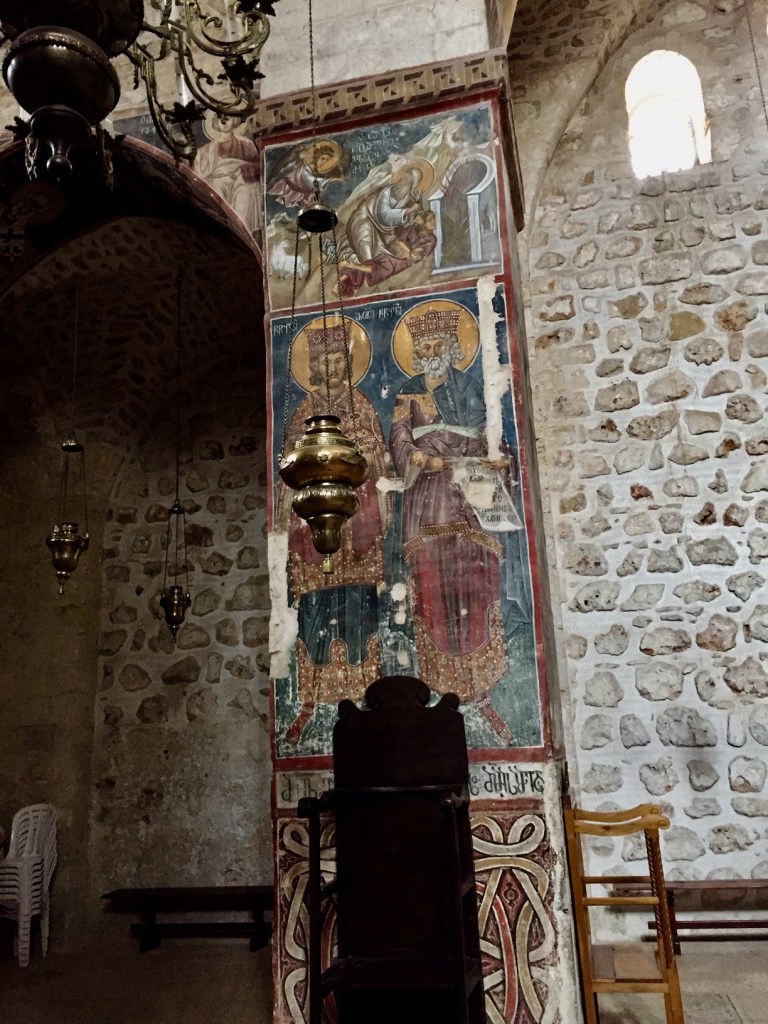
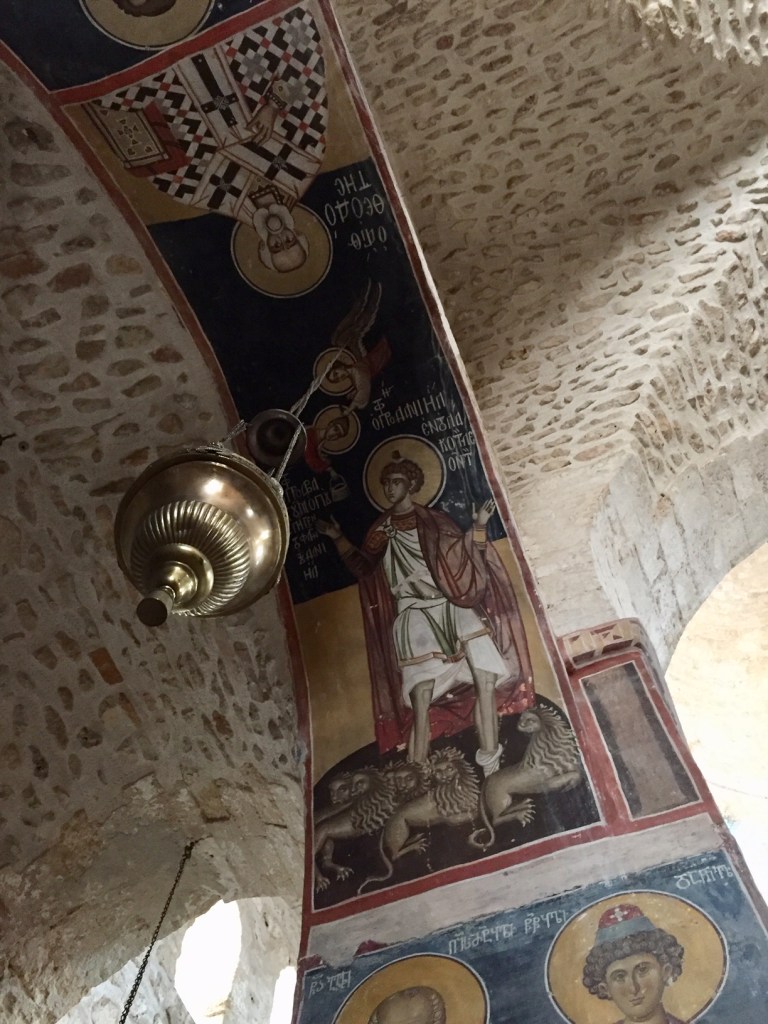
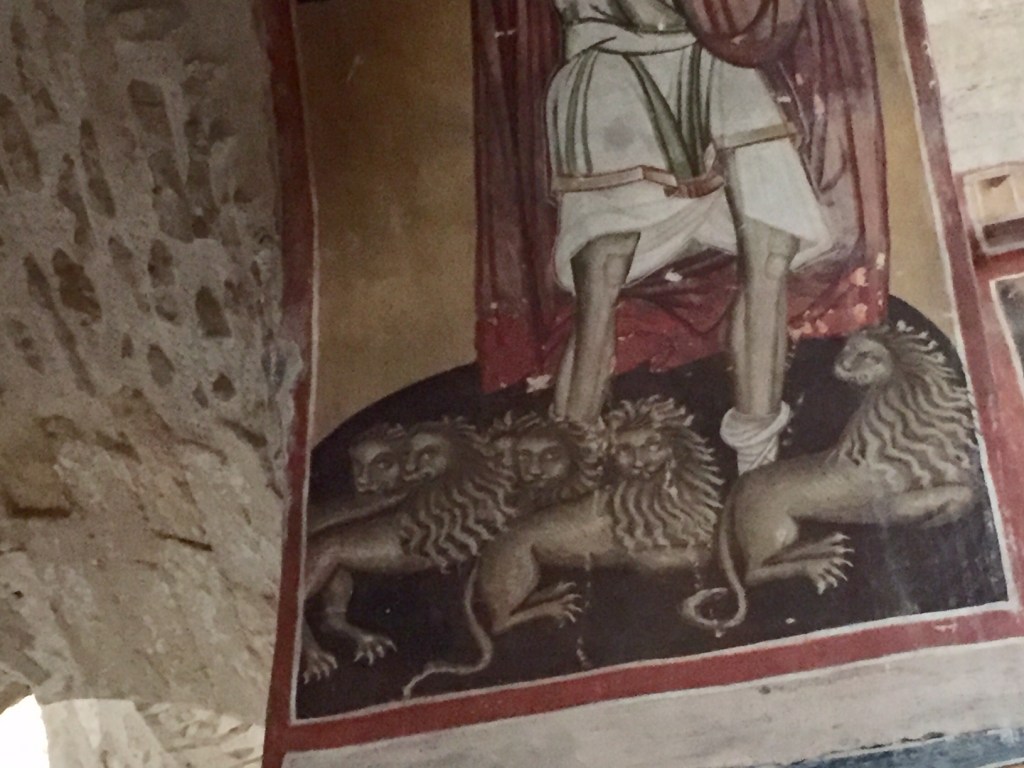
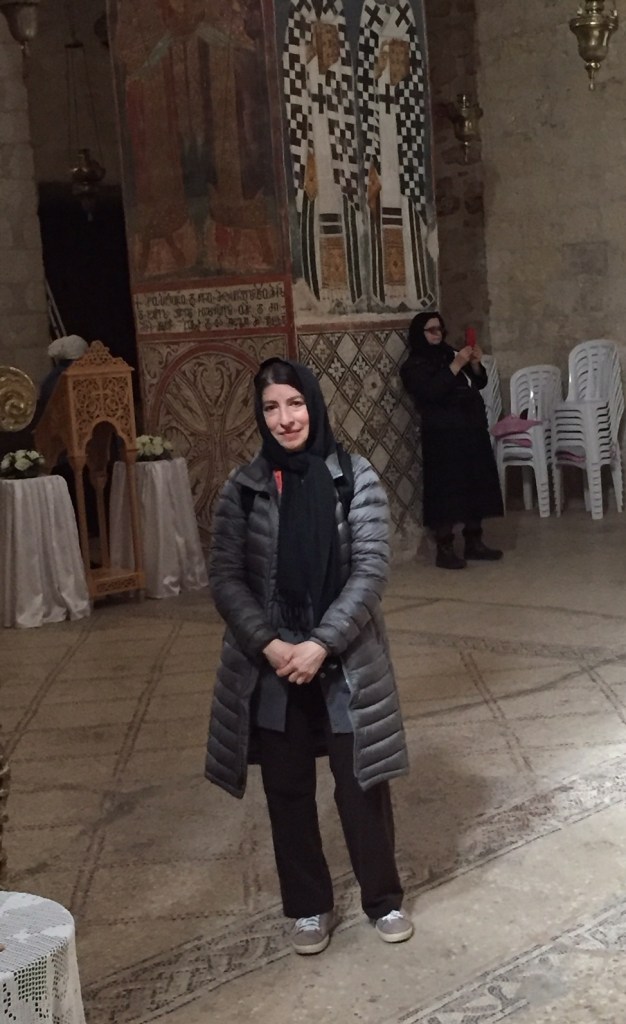
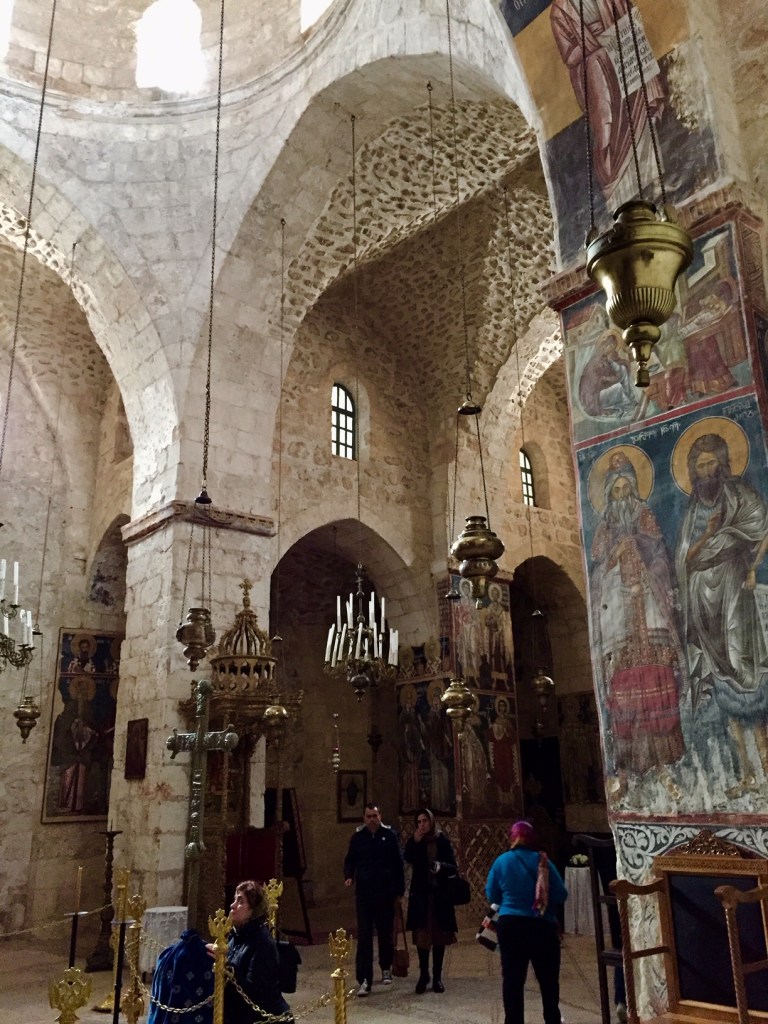
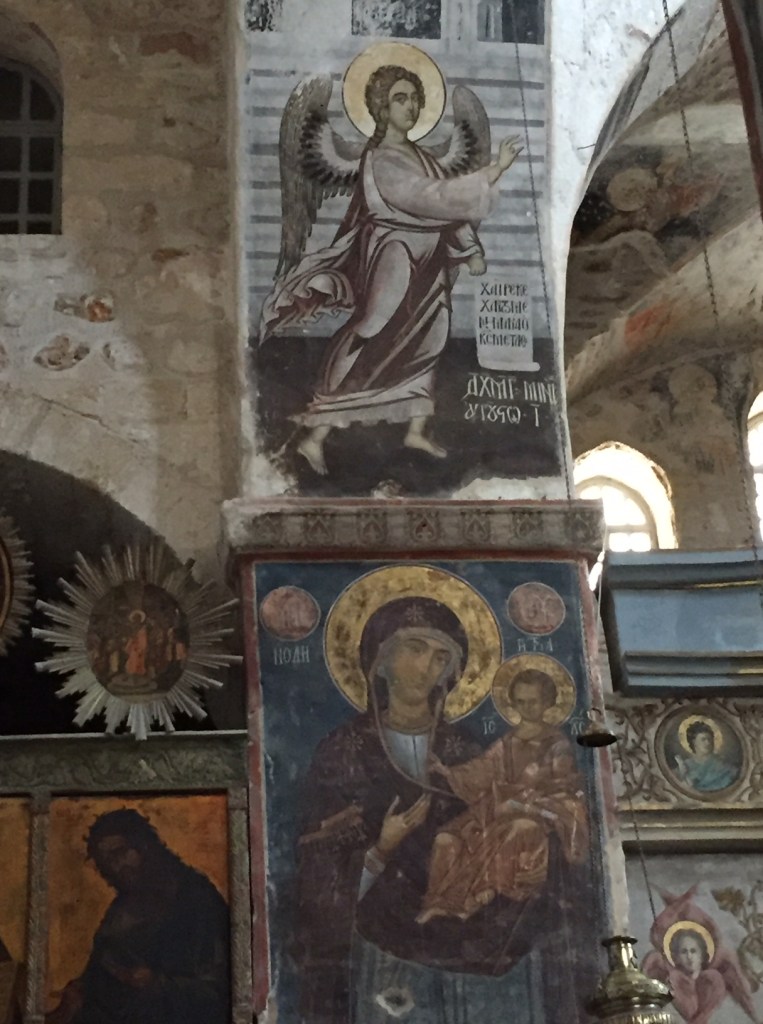
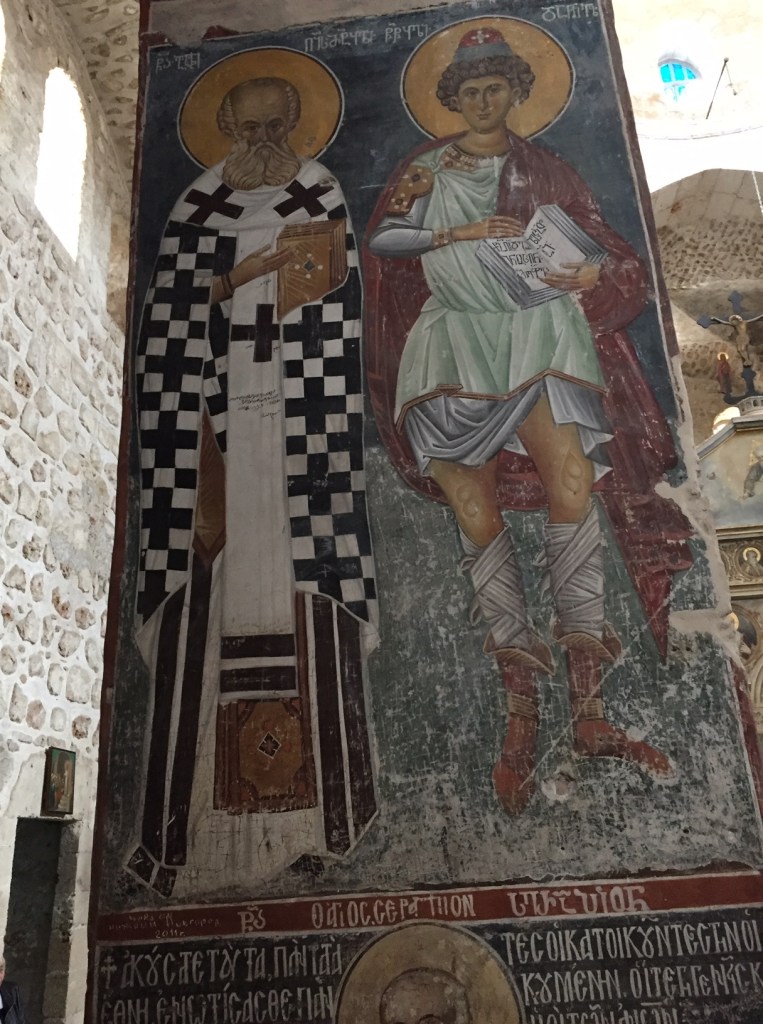
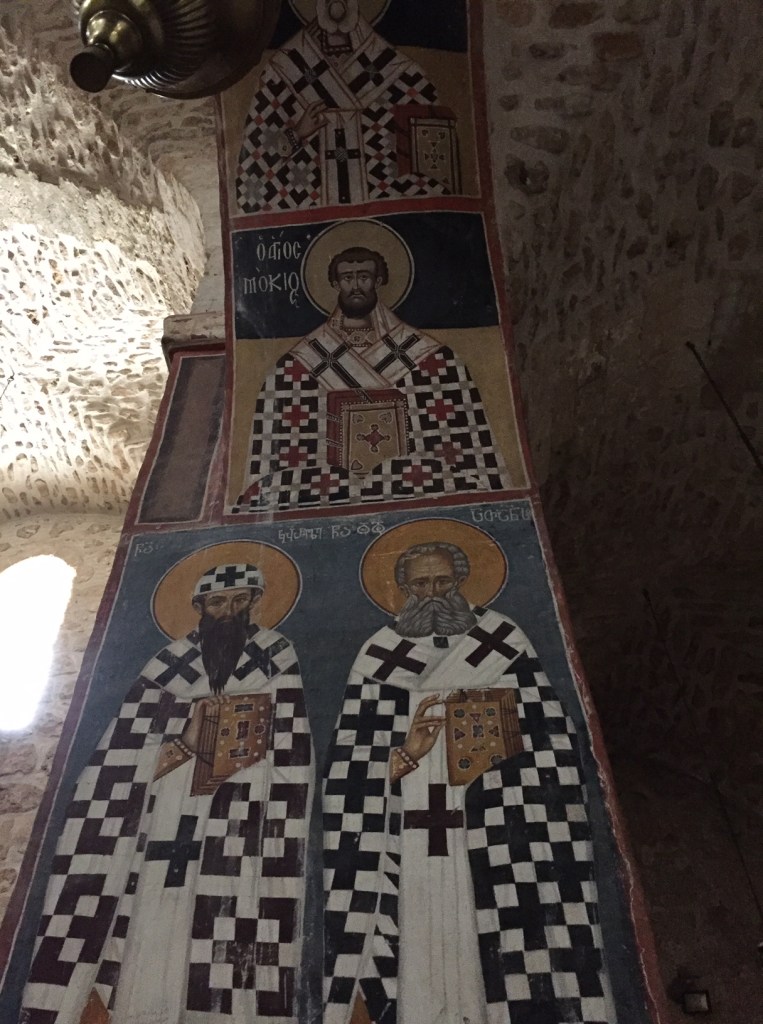
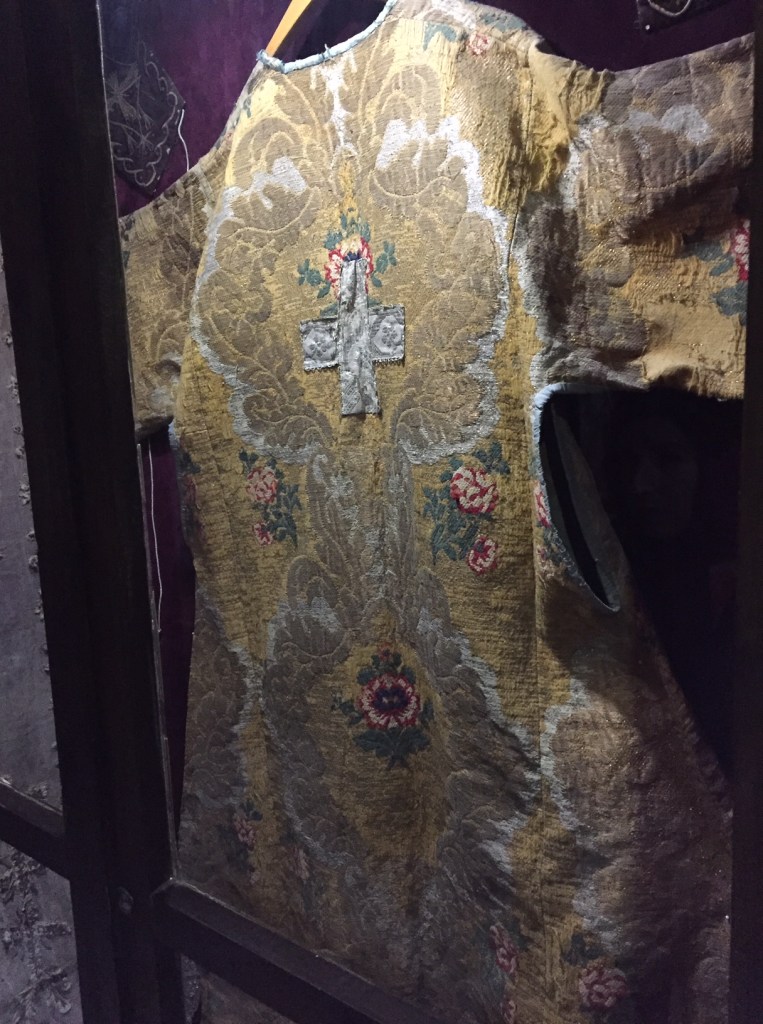
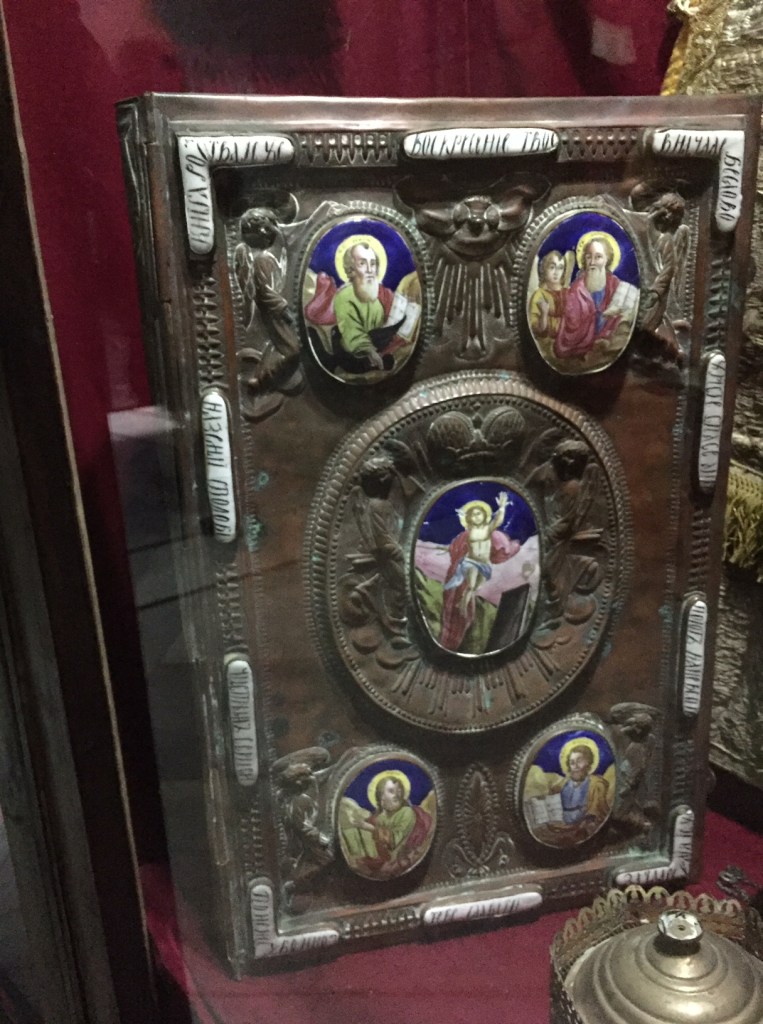
Christian midrashGreek Orthodox pilgrimsEvery pillar has paintings of Biblical figures on each sideIcon Even the details are beautifulI can’t read Greek so I have no clue who any of these guys are…I really like the lions!Deborah looks oddly at home… I love the knowing look this angel is giving us across the centuries.You can meditate on the geometrical patterns in these robes, I think.In back of the sanctuary there is a short hallway with glass cases. In them are some gorgeous old robes like this one…… and some fabulously decorated old books, like this one.
We left the stillness of the sanctuary, and went in to the little hall behind it. There were glass cases full of church relics. At the very back, the pilgrims were involved in kneeling to kiss what I seem to recall was meant to be a fragment of the cross. If all the purported fragments of the “True cross” that are kept in churches around the world were put together, you could build a whole new church! We tiptoed away, back through the sanctuary and out into the beautiful crisp day.
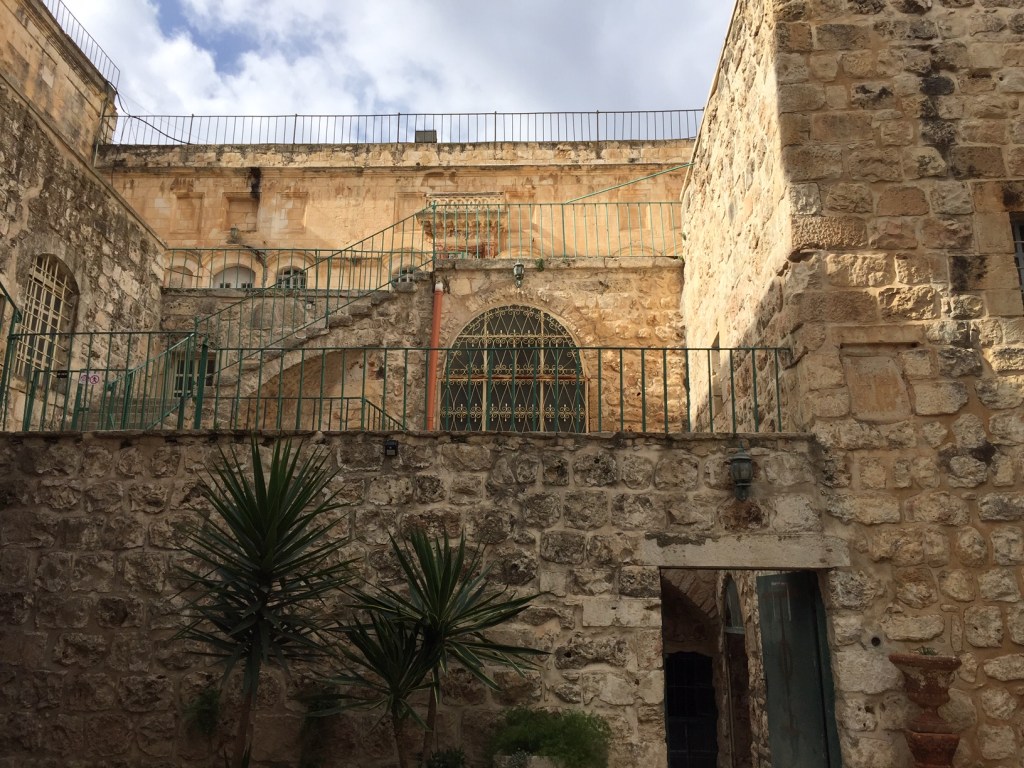
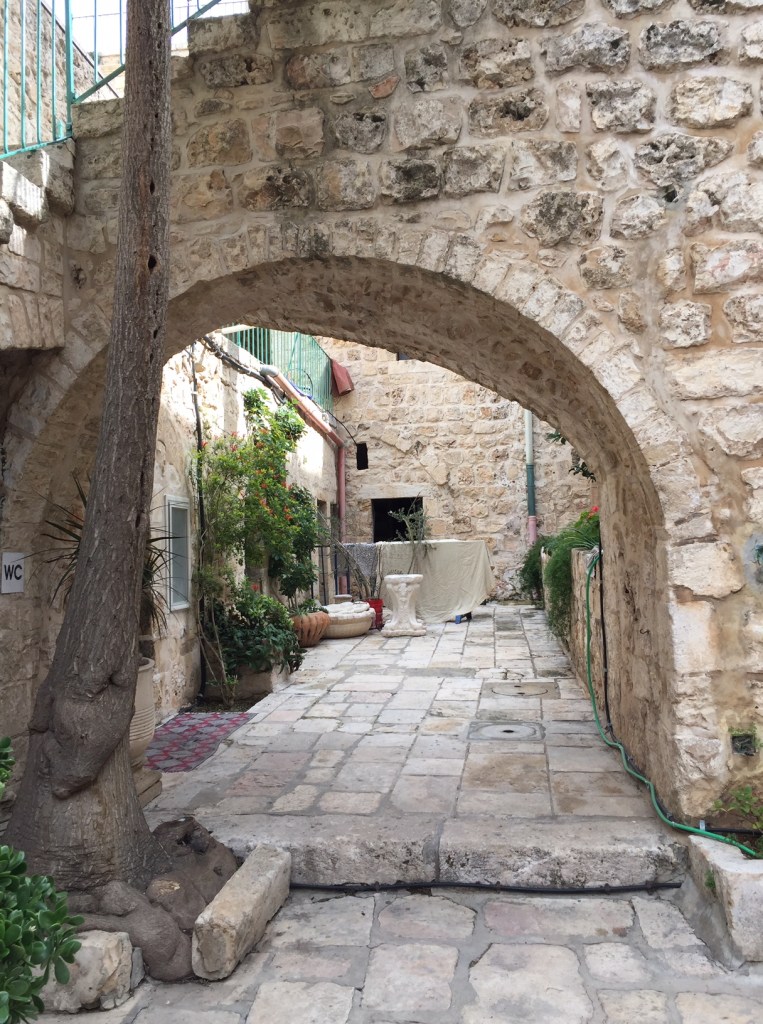
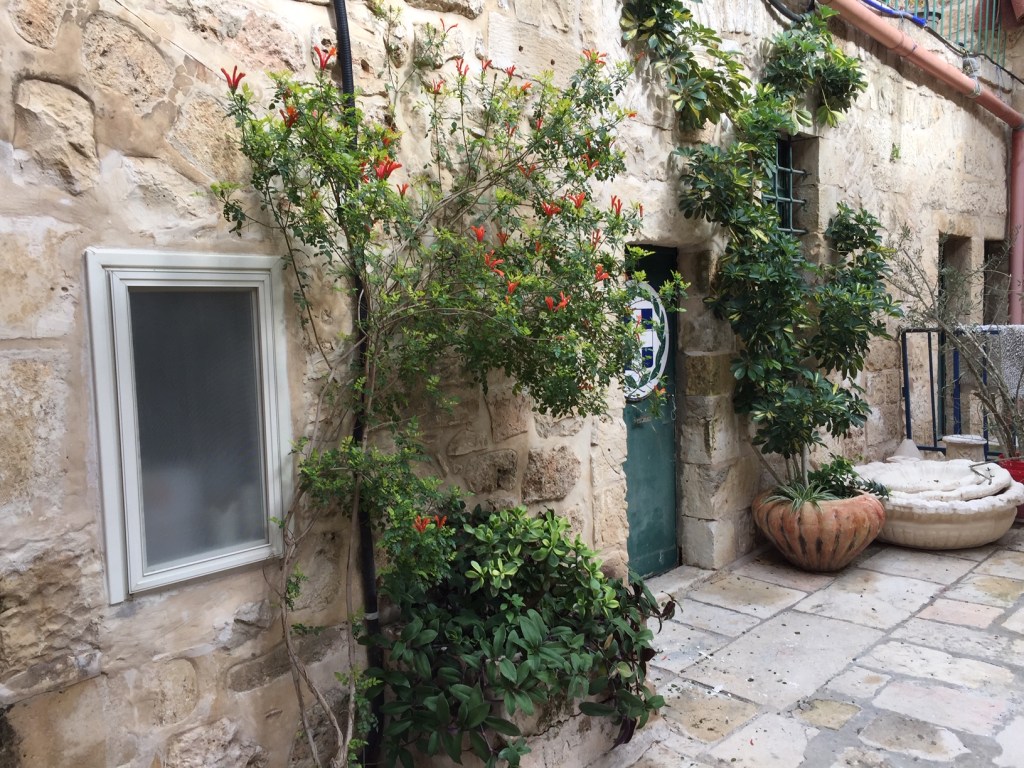
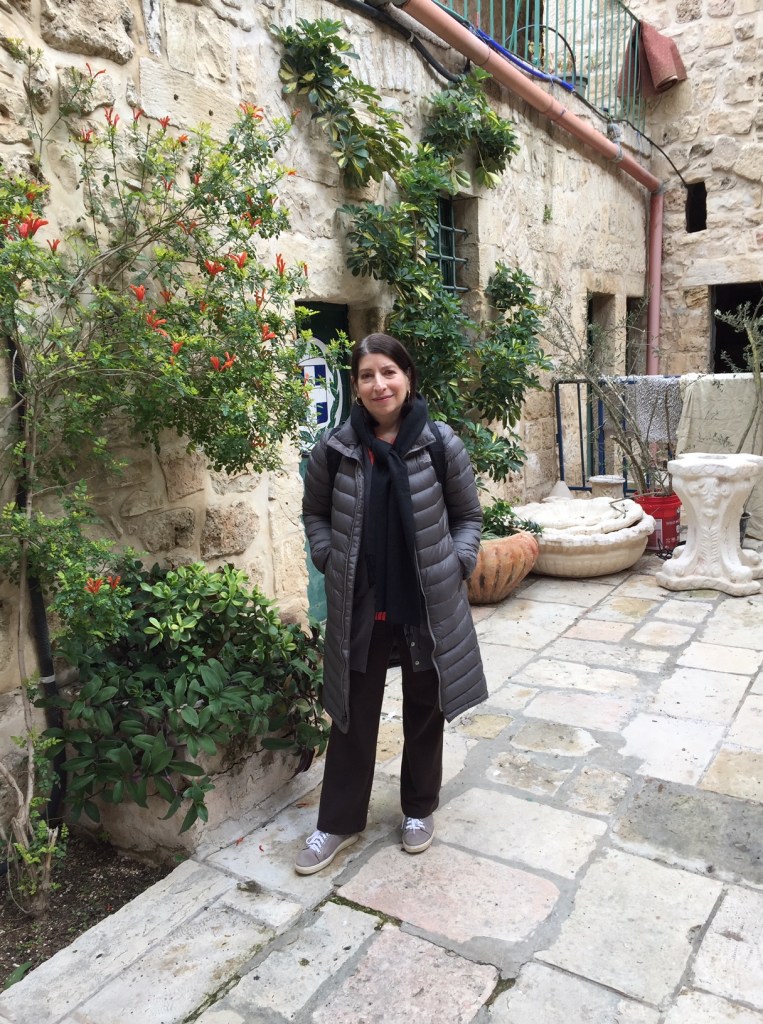
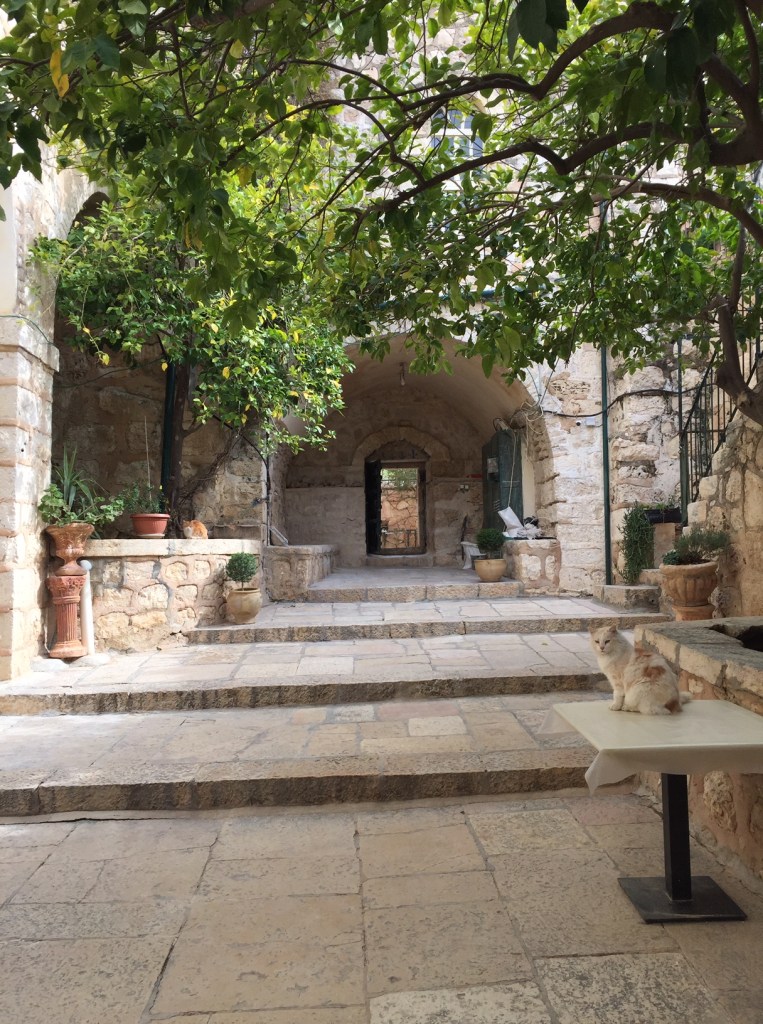
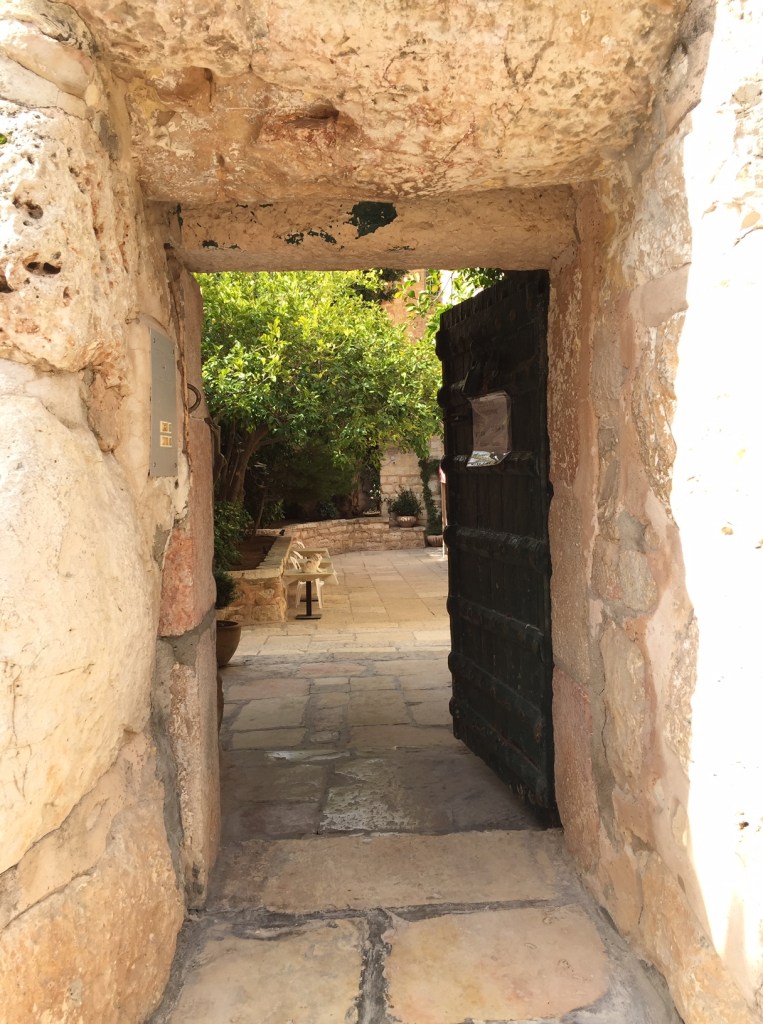
As you emerge from the sanctuary, this is what you see on your right. The little museum that is through the lower right hand door was not open. A monk in robes and tennis shoes was painting the railing when we first arrived, but by the time we emerged and I took this picture he was gone, alas.And this is what you see on your left.Even the bathroom door is picturesque (although the interior was somewhat less so).Portrait of a woman in front of a bathroom door.And this is what you see as you prepare to leave. Please note two pussycats — one foreground right, one middle ground left (orange, next to the flowerpot). These cats appeared well-kept and so I suppose they belong to the monks. It reminds me of the Samuel Barber song, “A Monk and His Cat”.A last look back into the monastery as we left its confines.
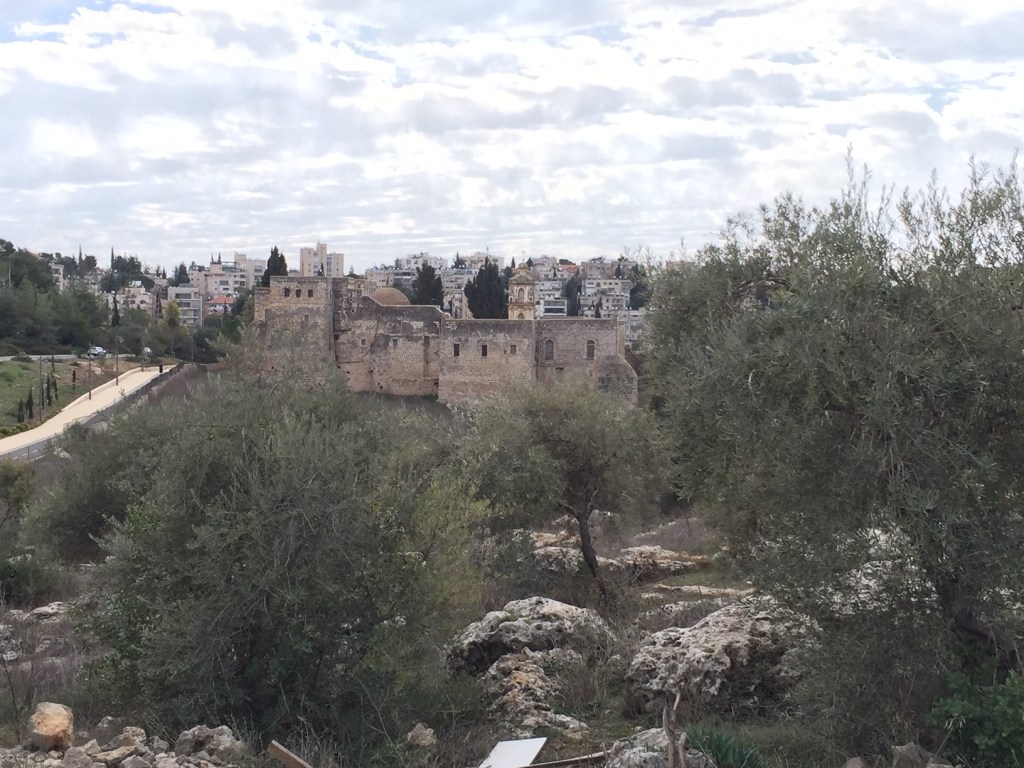
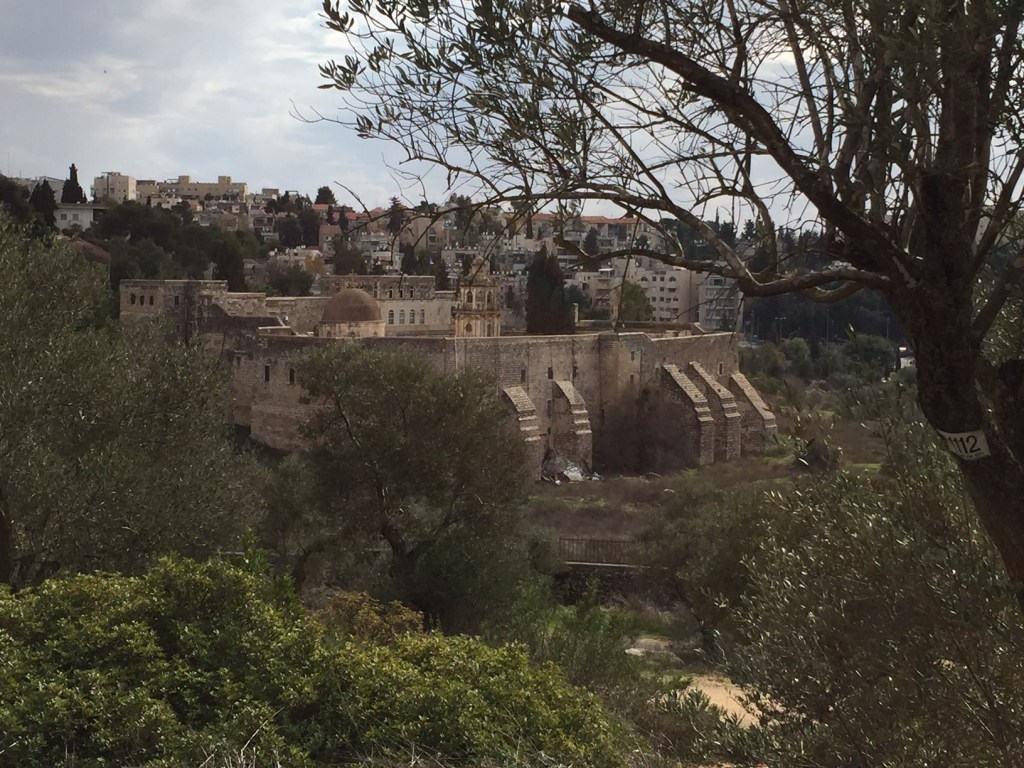
From the monastery it was short walk through a nice park to reach the Israel Museum. From the park there were good views of the monastery. It is really a very stern building from the exterior.
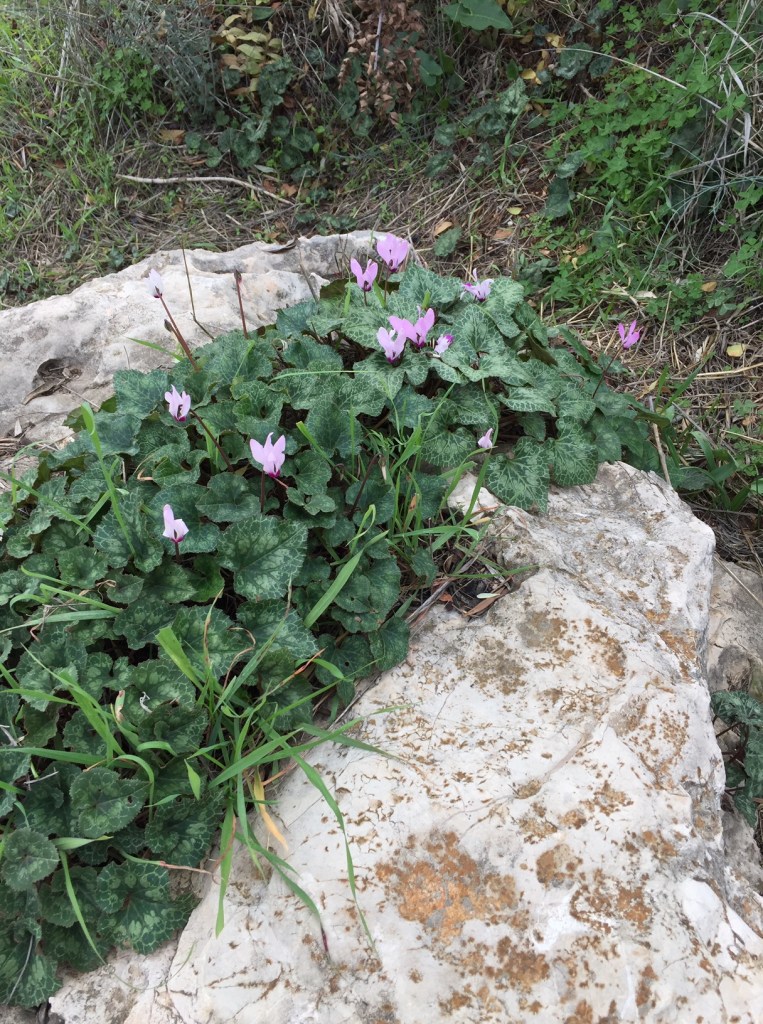
They were serious about their buttresses back in the eleventh century.Even in mid-January, the wild cyclamens were beginning to bloom.
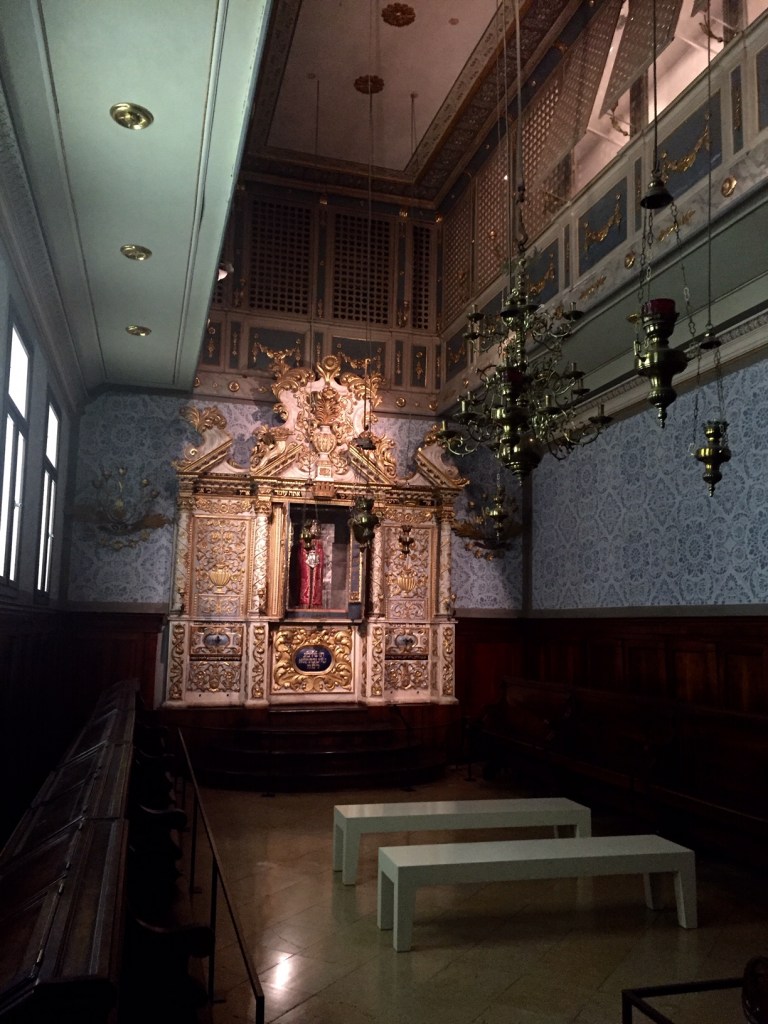
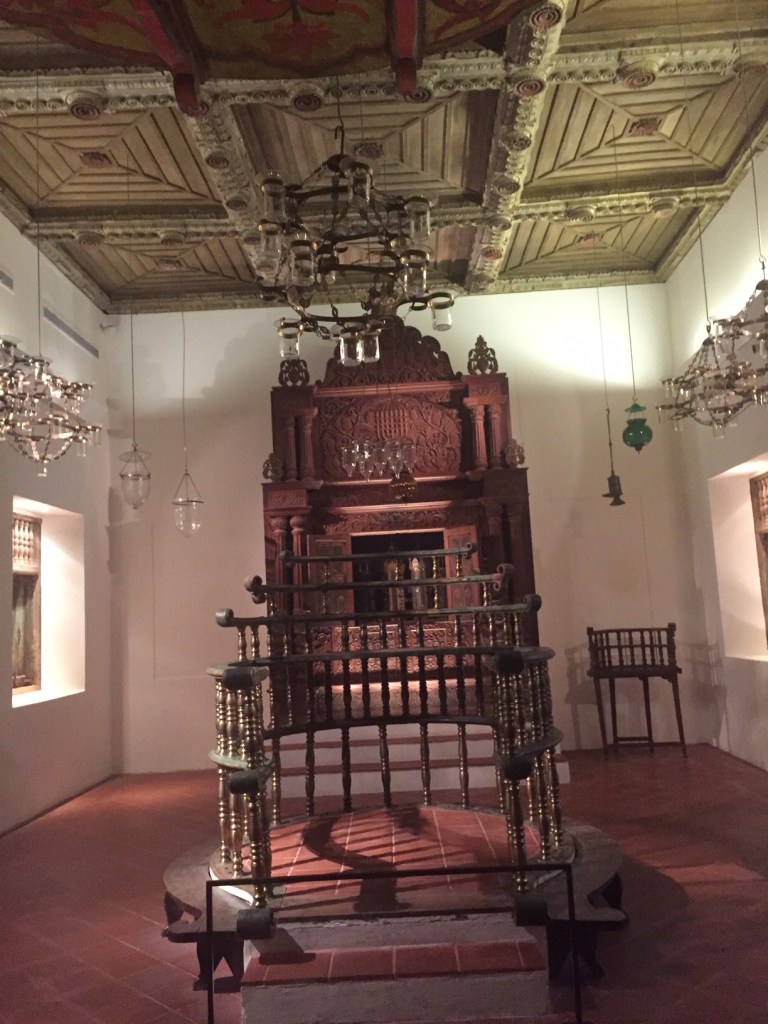
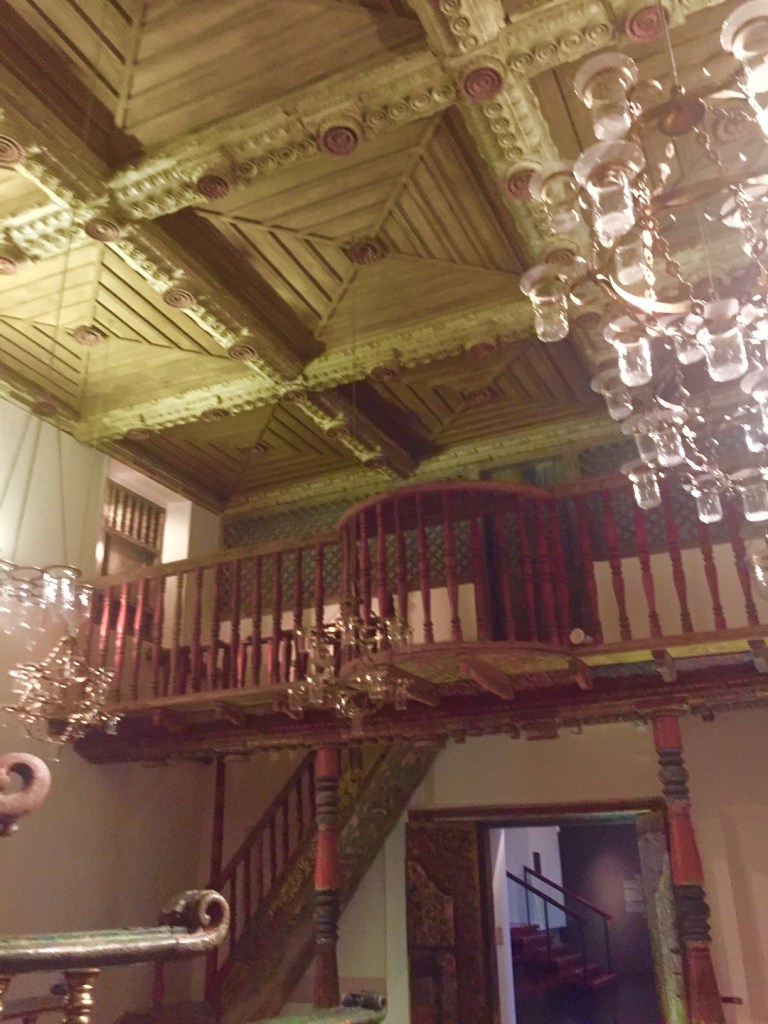
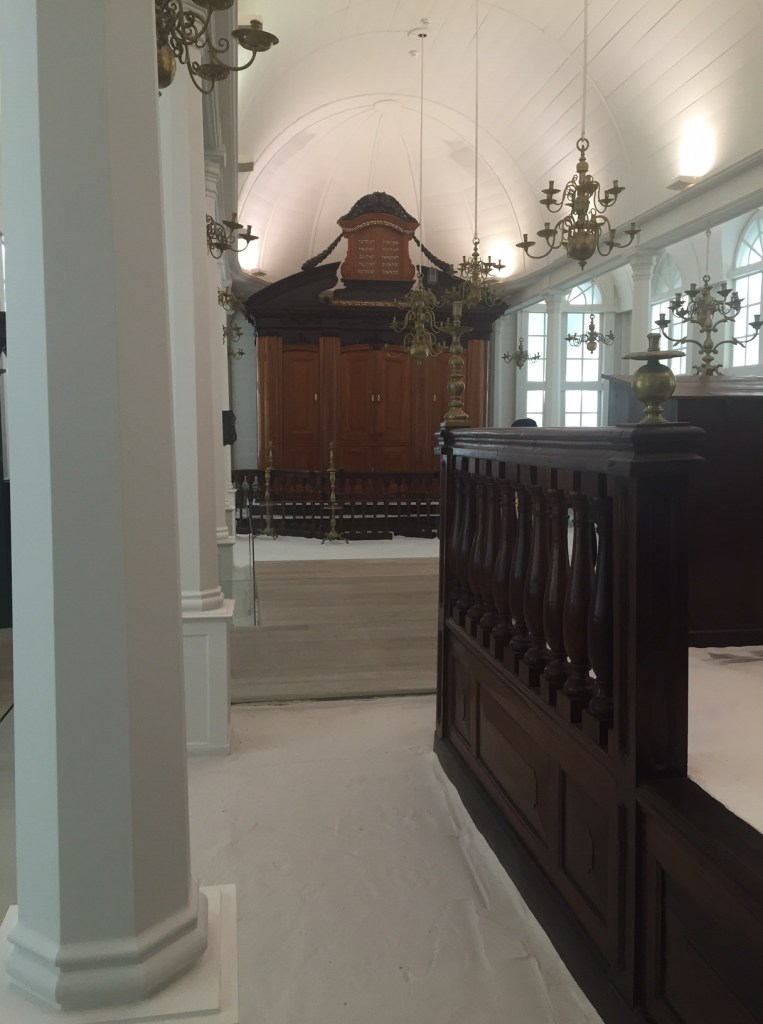
We spent a happy couple of hours in the museum’s Judaica collection, which includes all sorts of torah covers and crowns, havdalah spice boxes (for the end of Shabbat), wedding garments, burial garments, baby garments, illuminated manuscripts which put the lie to the notion that Jews don’t believe in representational art, chanukiot (menorahs for Chanukah), and the insides of three old synagogues plus the ceiling of one more. As the website of the museum informs us, “The synagogue from Vittorio Veneto, a small town in northern Italy, was built in 1700. Its interior is elegantly decorated in typical Italian Baroque style, reminiscent of a reception room in an aristocrat’s palace. The Kadavumbagam synagogue from the town of Cochin in southern India, built in the 16th century is a wooden structure, with an exquisitely carved and painted ceiling directly influenced by the decorations of mosques and Hindu temples. The Tzedek ve-Shalom synagogue from Suriname, northern South America, was built in the 18th century, and it tells the story of the Spanish-Portuguese Jews who came from Europe to the New World.” The thing I love most about this radiant synagogue is its white sand floor! The ceiling comes, as the website tells us, from “The wooden synagogue from Horb, southern Germany, [which]was built in the first half of the 18th century. Its walls and the ceiling were completely covered with paintings and inscriptions, thus being one of the rare testimonies of an old tradition of painted Synagogue common in Poland and Germany.”
I took no pictures at the museum, because I’ve been so many times before. However, here are a few that I took in 2015. For more wonderful pictures and information about the museum’s “Jewish Art and Life” galleries, you can look here: https://www.imj.org.il/en/wings/jewish-art-and-life
Italian synagogue c. 1700Indian synagogue from the 1700’sThe women sat behind the screen at the back of the balconySynagogue from Suriname with white sand floor
Deborah and I were quite tired out after all the looking and seeing we’d been doing, so we repaired to the museum restaurant and had a tasty lunch. Then we took a taxi back to my apartment. Deborah finished her packing as we awaited the arrival of Hagai in one car and Yochi and Yoni in the other, who were coming to take us all to Kiryat Ono (a suburb of Tel Aviv) where Avishai and his family live. I was sad to see Deborah go — we had had a lovely visit and seen many amazing sights together.
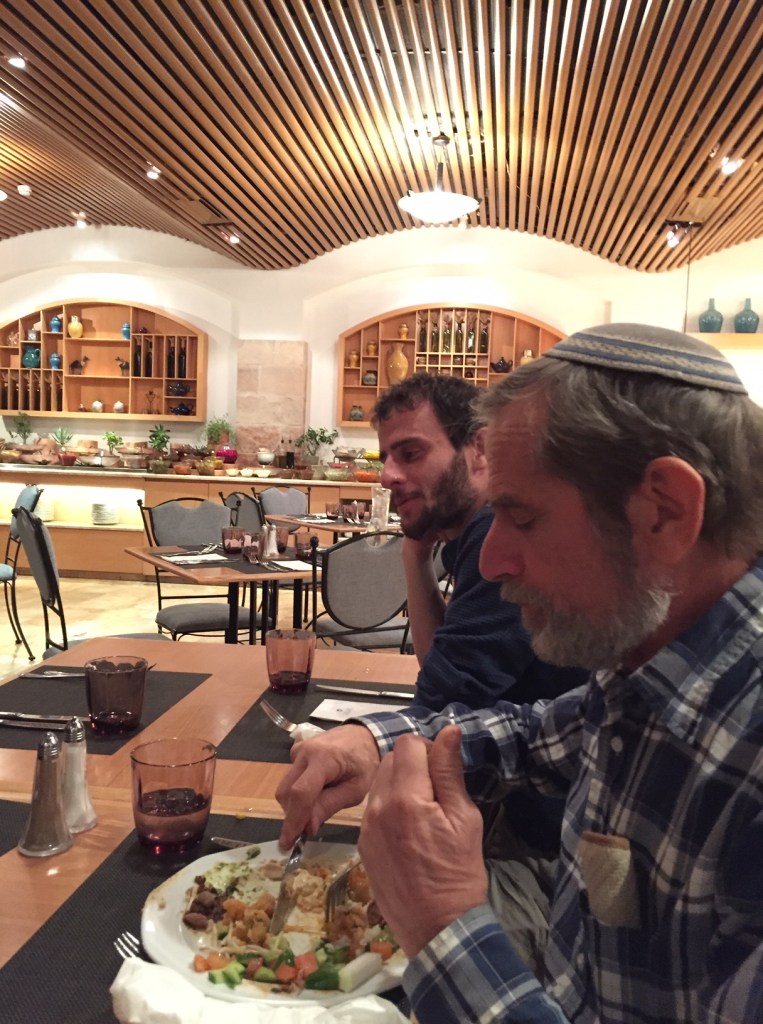
As dusk was falling, Deborah and Hagai and I drove north from Eilat, where we had crossed the border back into Israel from Jordan. It was mid-January, and it was full dark when we arrived in the courtyard outside the home of Yoni, Bob’s youngest son, and his wife Shoshana. After a few brief greetings we made our way quickly to the Ramon Inn, where we partook of their generous buffet dinner.
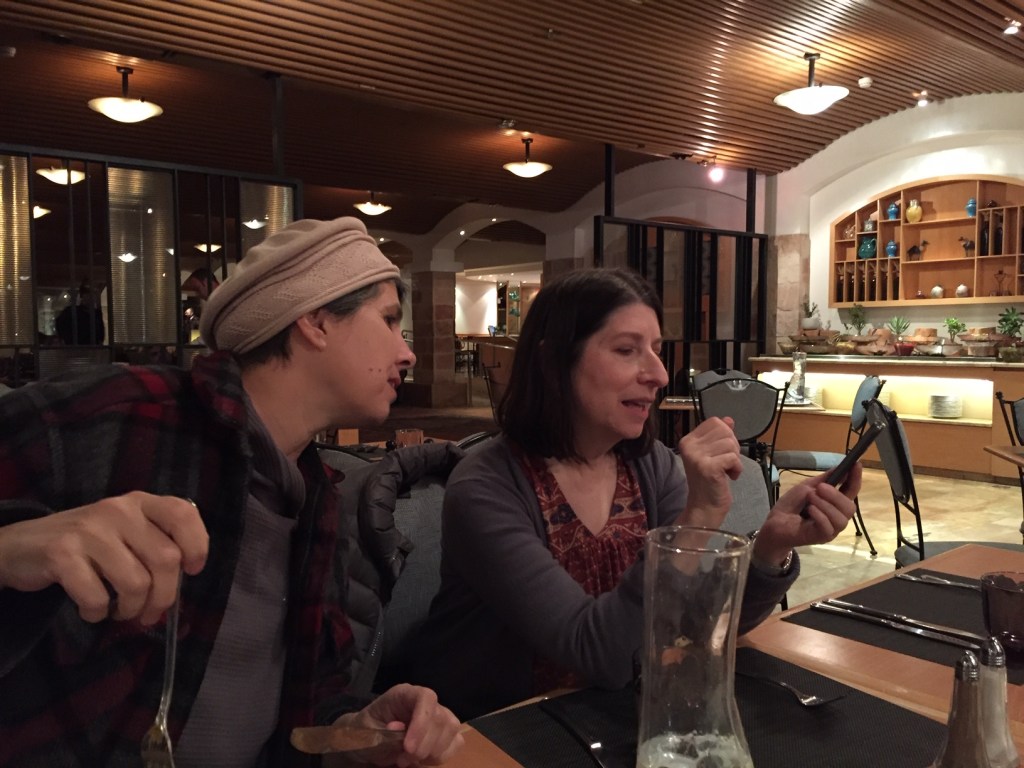
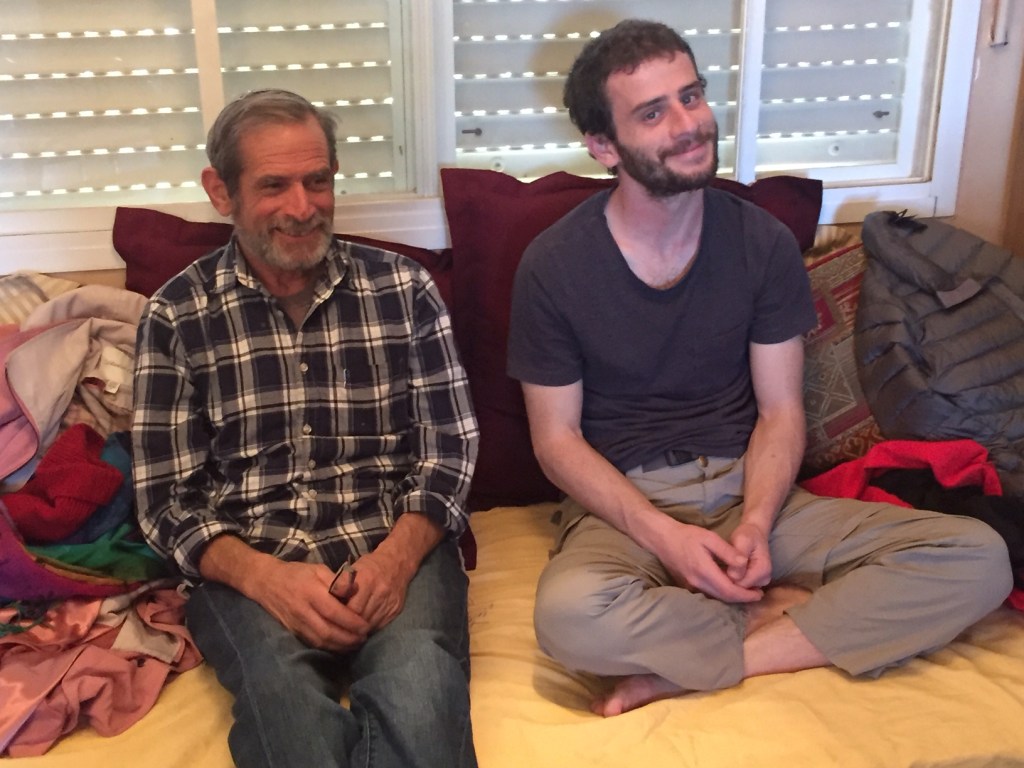
Bob’s youngest son, Yoni (foreground) and Yoni’s youngest son, HagaiShoshana and Deborah looking at pictures of Jordan on D.’s phone
Then we went back to Yoni and Shoshana’s cozy home, where the wood fire was burning merrily. The conversation, sadly but inevitably, turned to the death of my sister-in-law, Yoni and Deborah’s aunt, Phyllis. There were many details of the estate to think about, and all at long distance. Nonetheless, we were all glad to be together, I think.
Family resemblance…?Deborah, Shoshana, and Yoni look at photos of JordanThis one reminds me of a Renaissance painting — the Annunciation of the Photograph. Deborah’s hand looks suspiciously like God’s in “The Creation of Adam” by Michelangelo”…
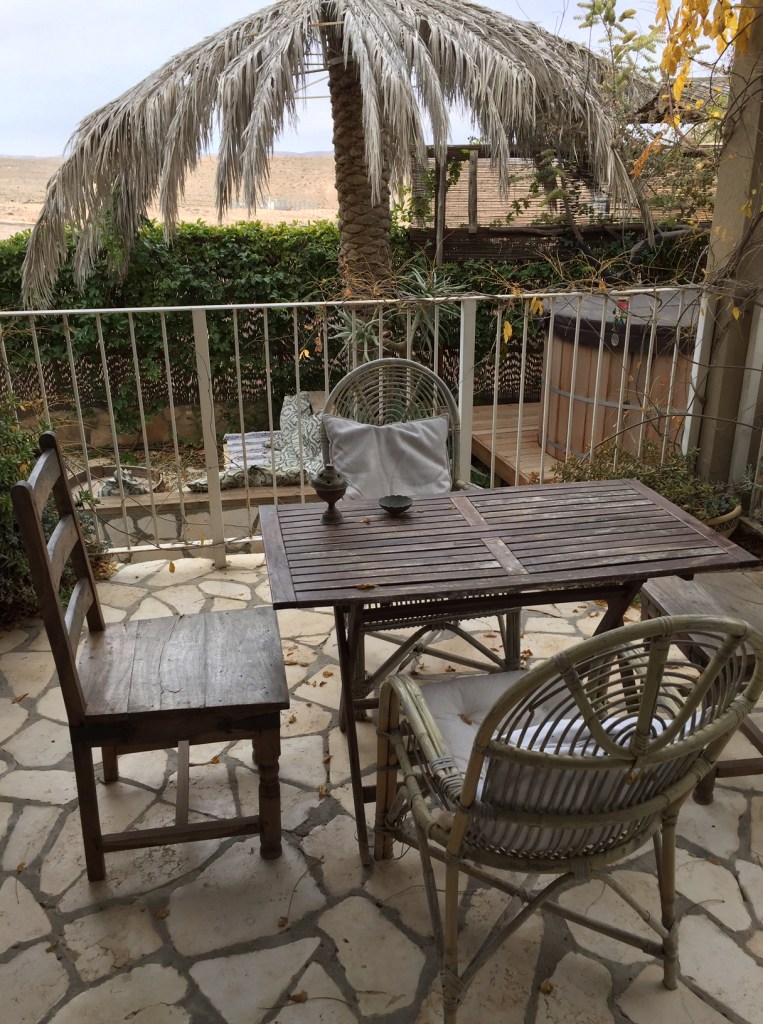
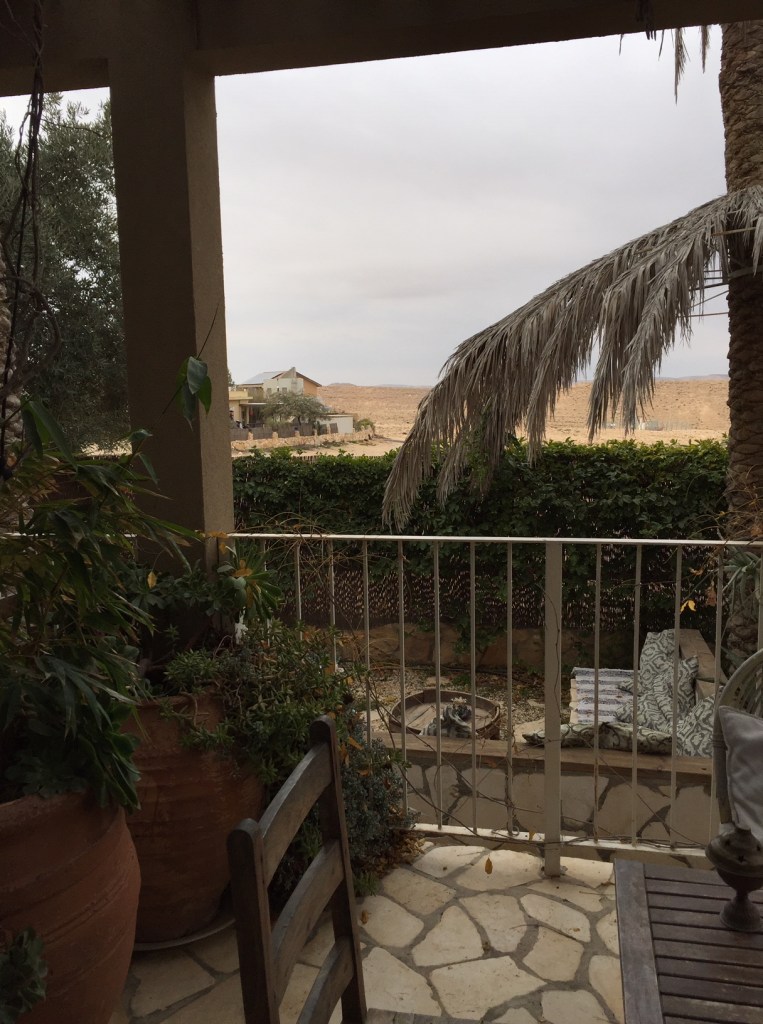
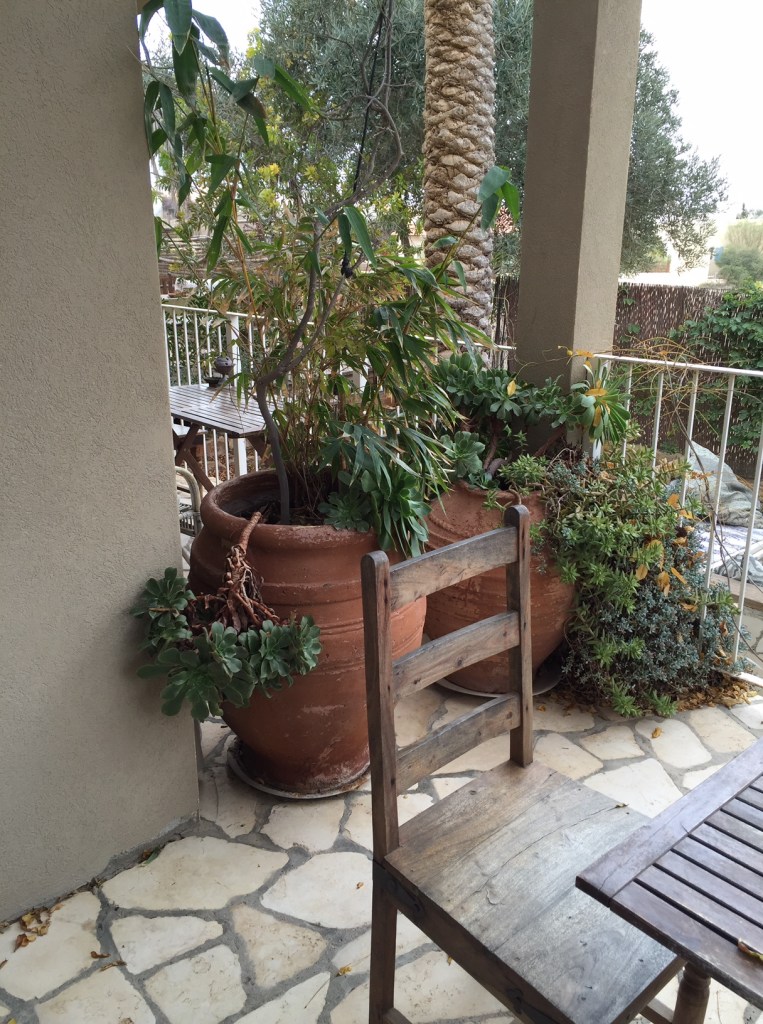
At last Deborah and I made our way to the bed and breakfast where we customarily stay in Mitzpeh Ramon, Bayit HaMidbar (Desert Home). I have stayed here a number of times — on my own, with Deborah, and with Ariel. It’s a comfortable place, set up so that if you wanted you could stay several days and cook for yourself. Deborah and I unfolded the sofa bed and made it up for her — she was kind enough to grant me the bed itself. I was asleep in no time, but she sat up late again, dealing with emails and phone calls related to the estate. I don’t have pictures of Bayit HaMidbar from this trip, but here are some from previous visits:
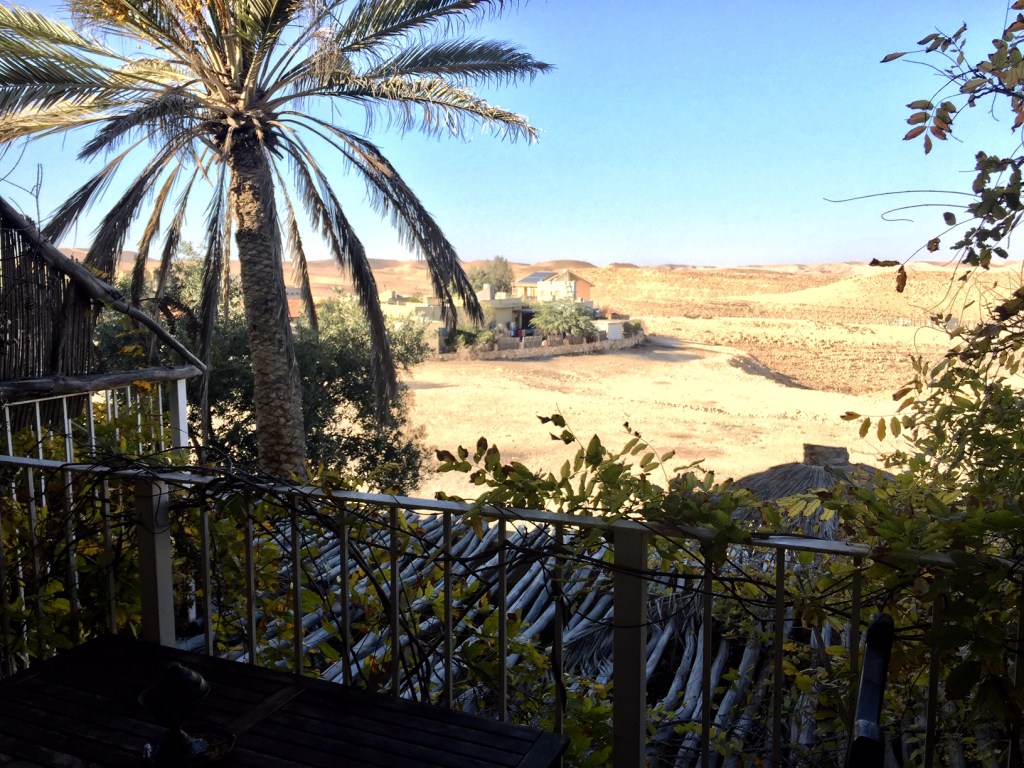
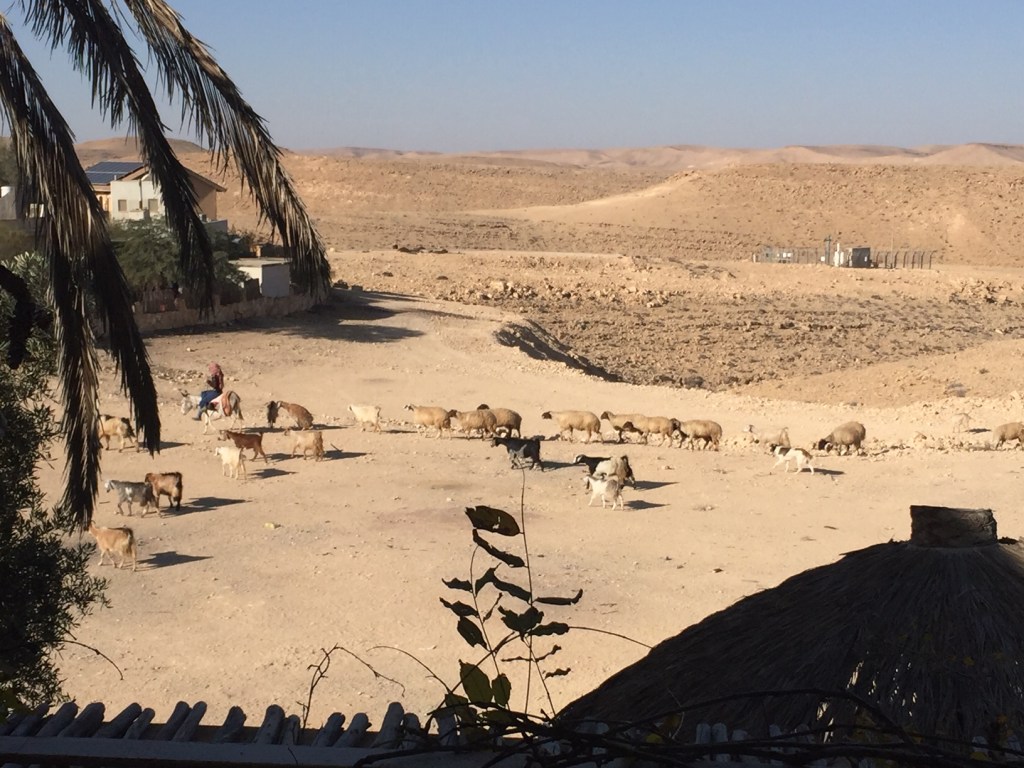
View from the upstairs balcony. We actually stayed in a first floor room this time.The last time I stayed here, a Bedouin girl road past in the morning with her flocks. They seemed to be looking for green plants growing where there is water outflow from the town. Yoni also reported that the bring the flocks into town and eat the municipal plantings. He was incensed, but I confess, this form of quiet guerilla warfare rather amuses me. In the evening, the girl rode past again — yaking on her cellphone.
In the morning we received the ample breakfast for which this place is known. They bring a huge tray of home-made jams, fresh exotic fruits, various salads, whole grain cereal flakes, halvah, labneh (like very thick Greek yoghurt with zatar — hyssop seasoning — and olive oil) and local cheeses. Then they bring a loaf of home-made warm whole wheat bread, and a carafe of orange juice. In the small fridge there are eggs to cook, and milk. Yoni and Shoshana can’t eat any of this because they are concerned about kashrut, but we invited Hagai to join us, as it is too much food for two people!
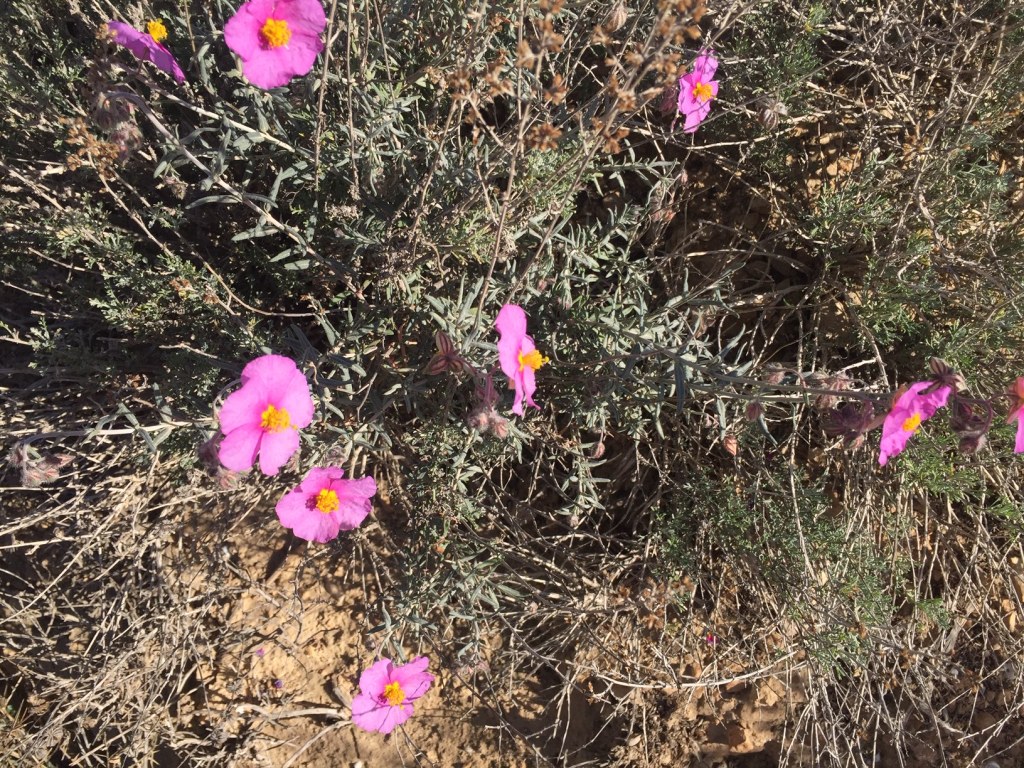
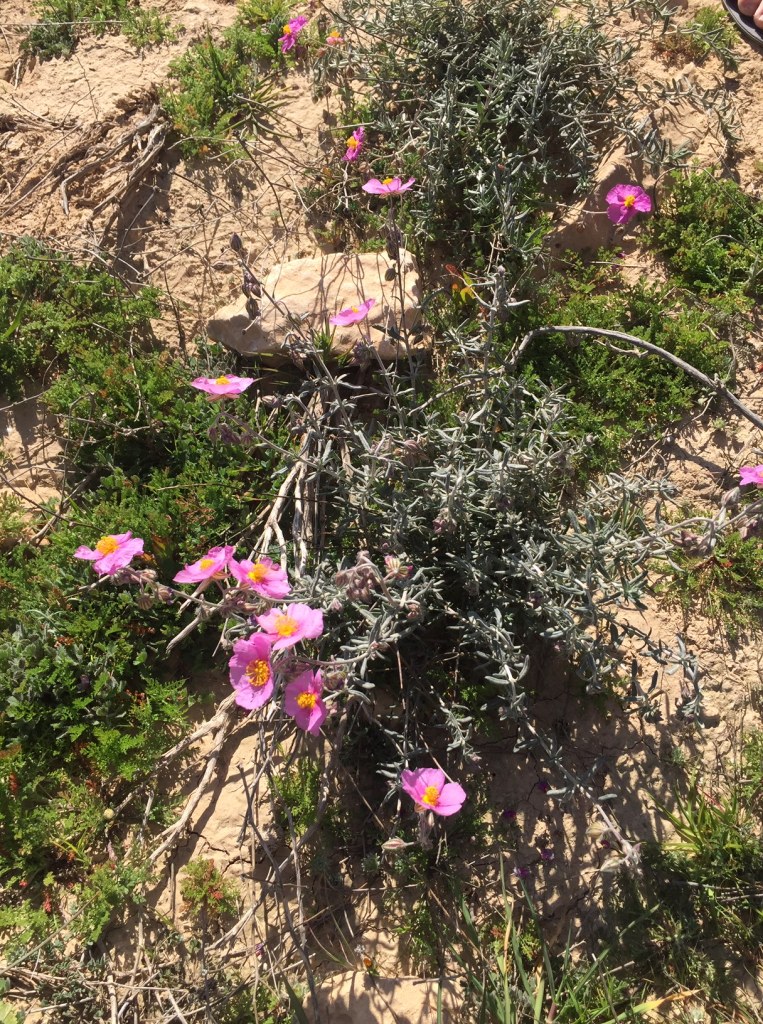
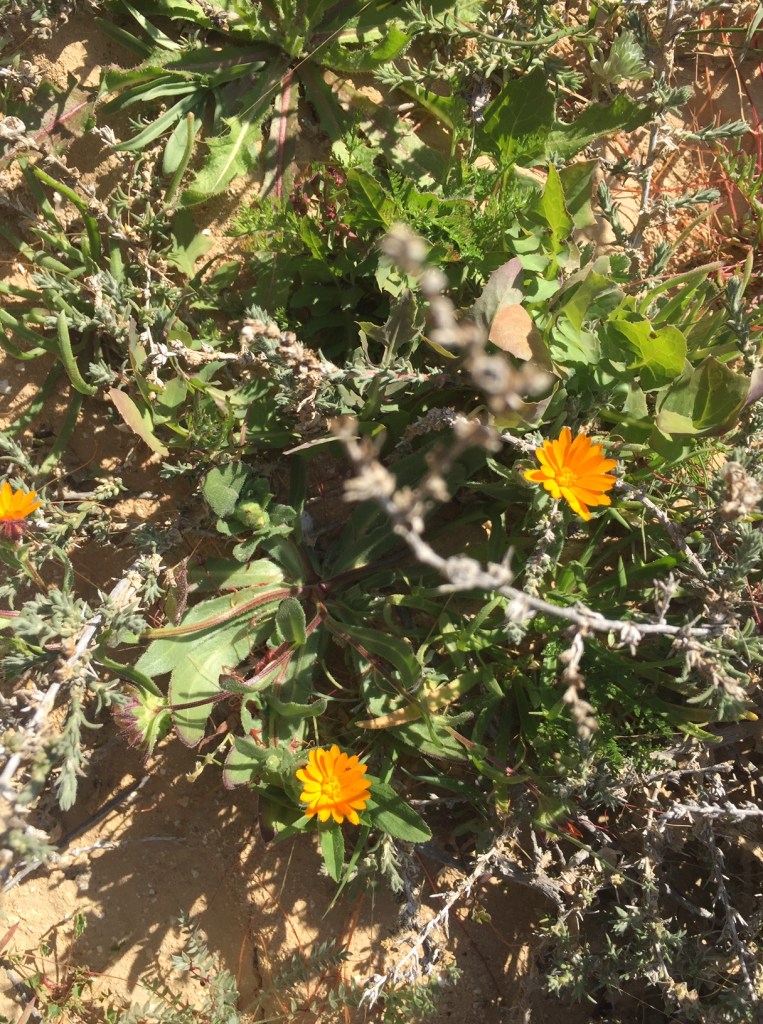
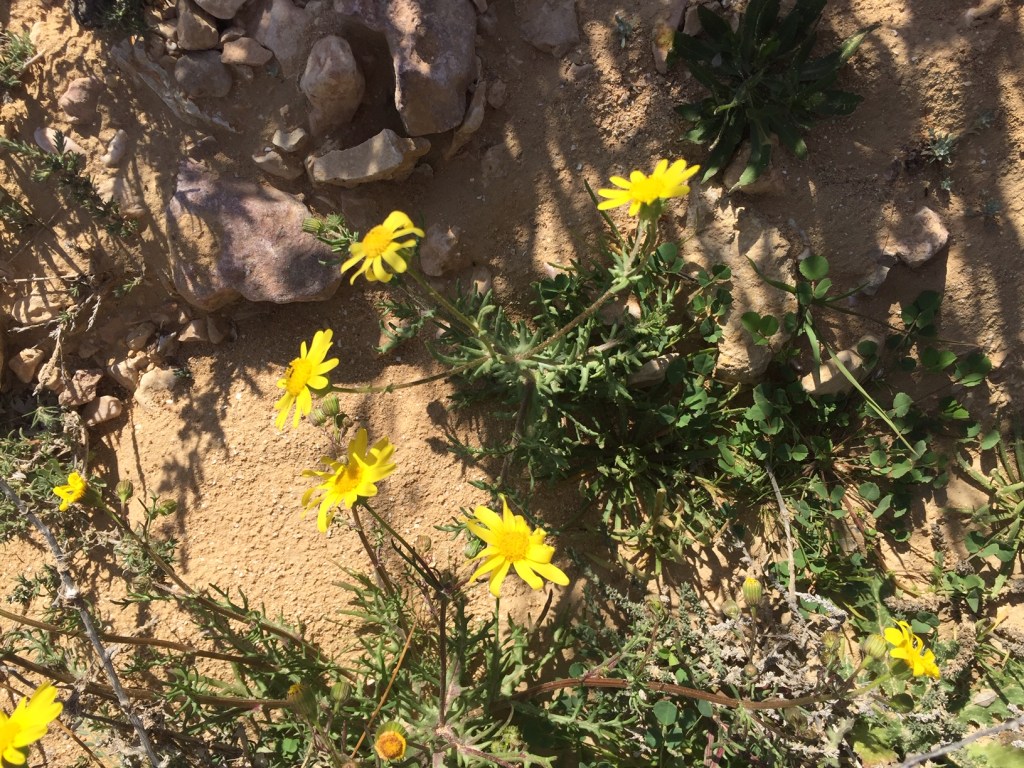
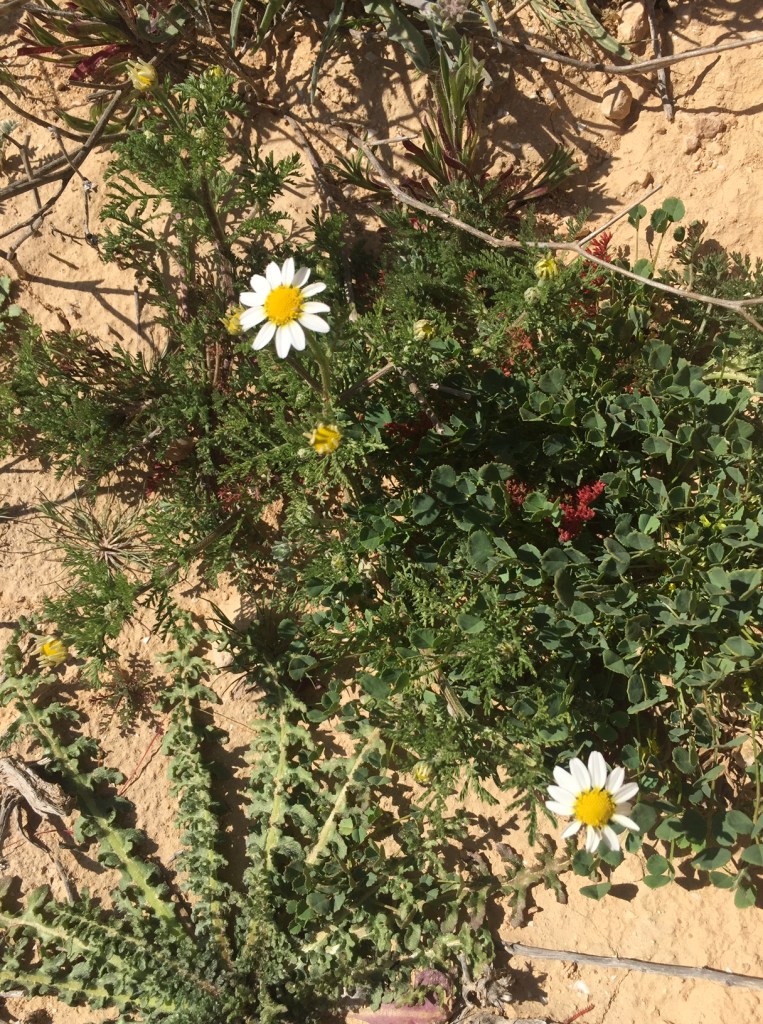
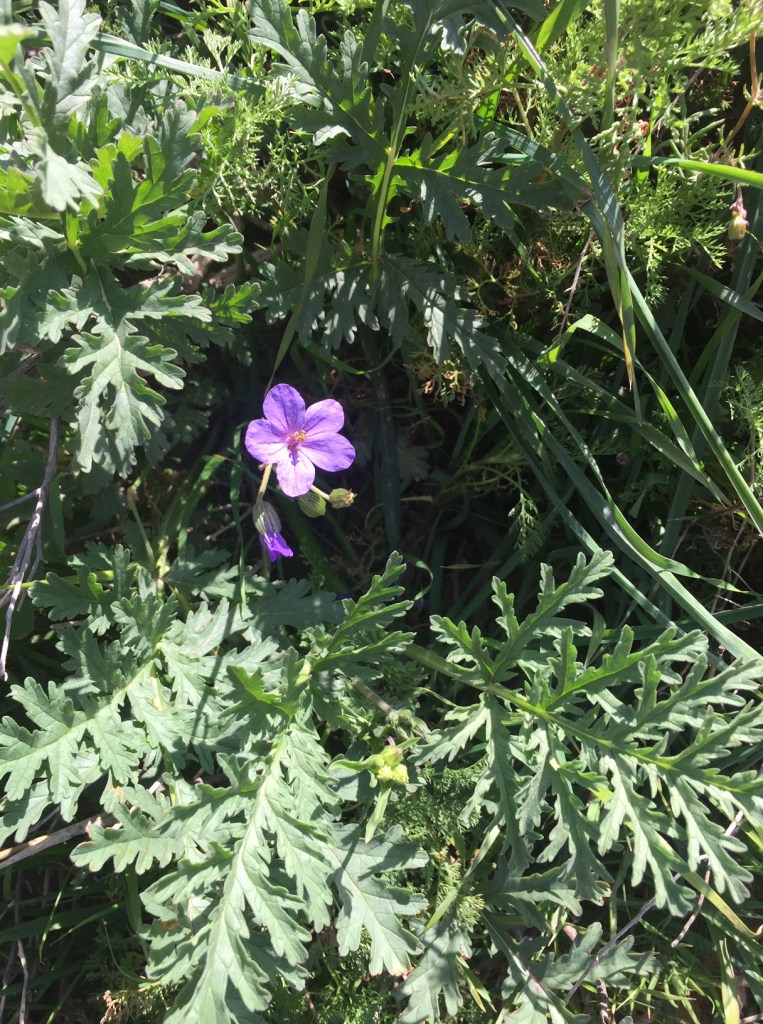
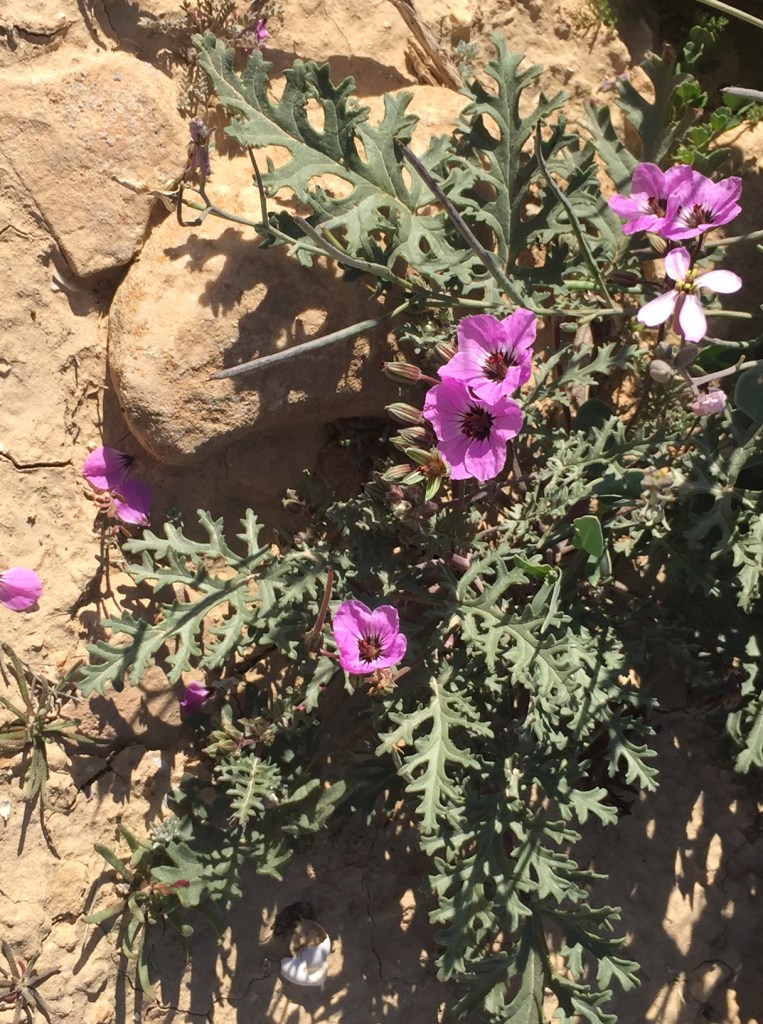
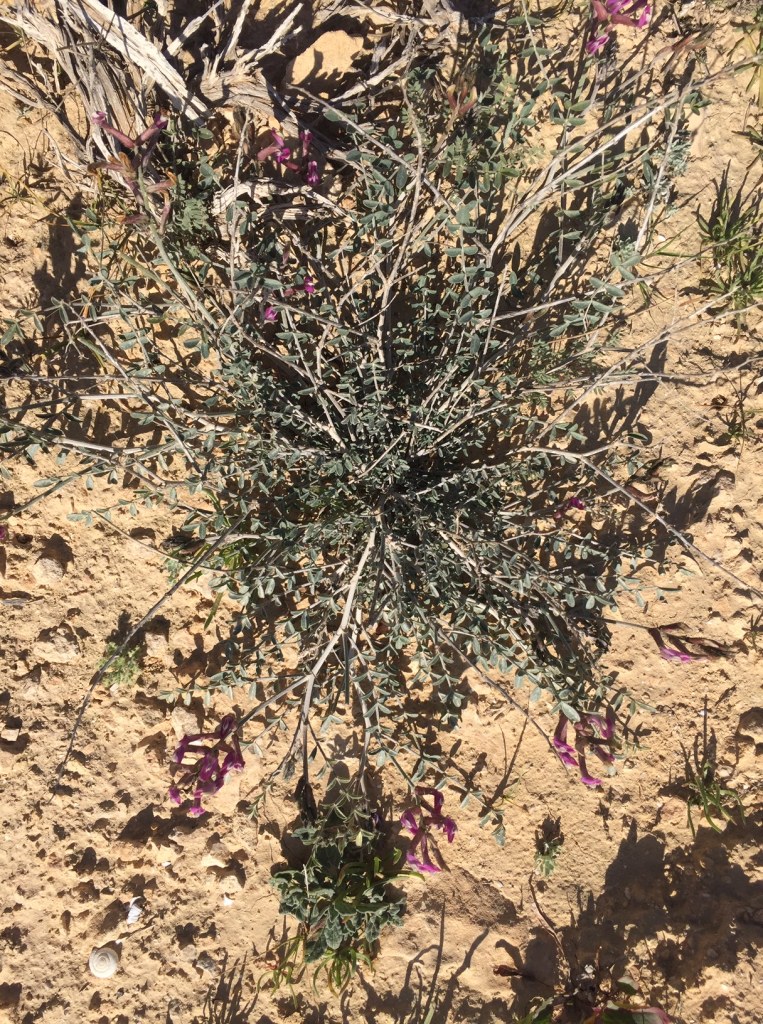
Our original plan had been to possibly go to Masada, but Shoshana and Yoni offered to take us out for a “Walk”, which turned out to be a long drive and a hike to the edge of the Machtesh — the canyon where Mitzpeh Ramon is located. On the way, we passed the plot where Yon and Shoshana are growing argan trees (https://en.wikipedia.org/wiki/Argania), but we didn’t stop, as they said the “farm” is not in great shape right now. We did stop by the side of the road to look for wild plants, are here is some of what we saw:
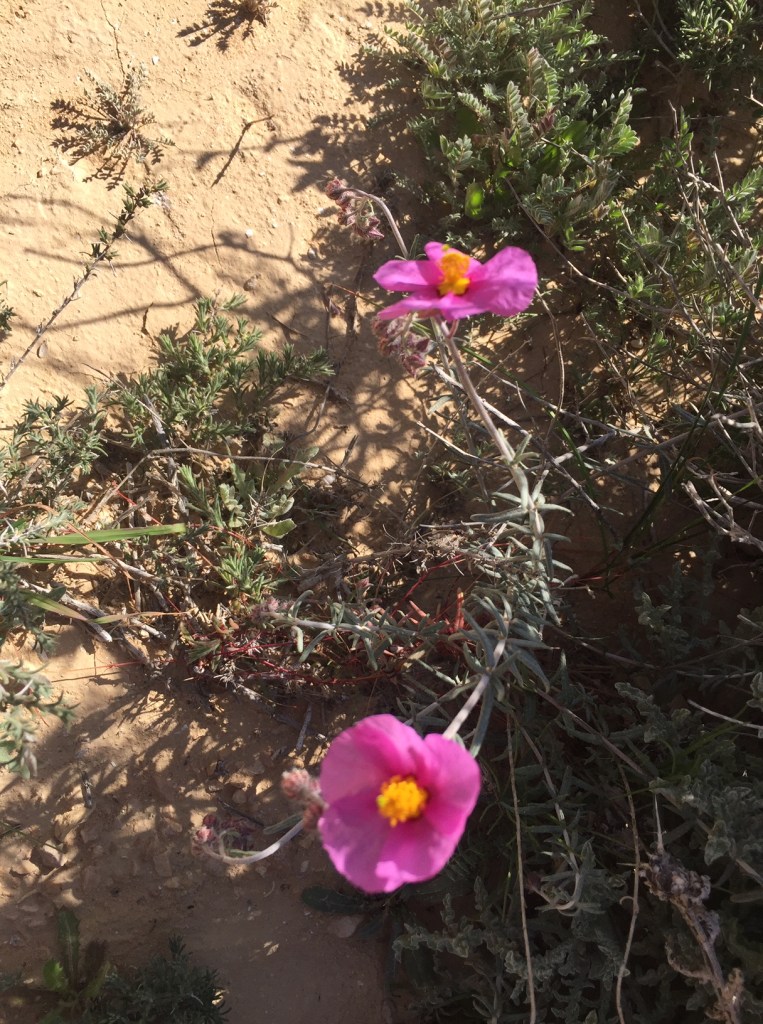
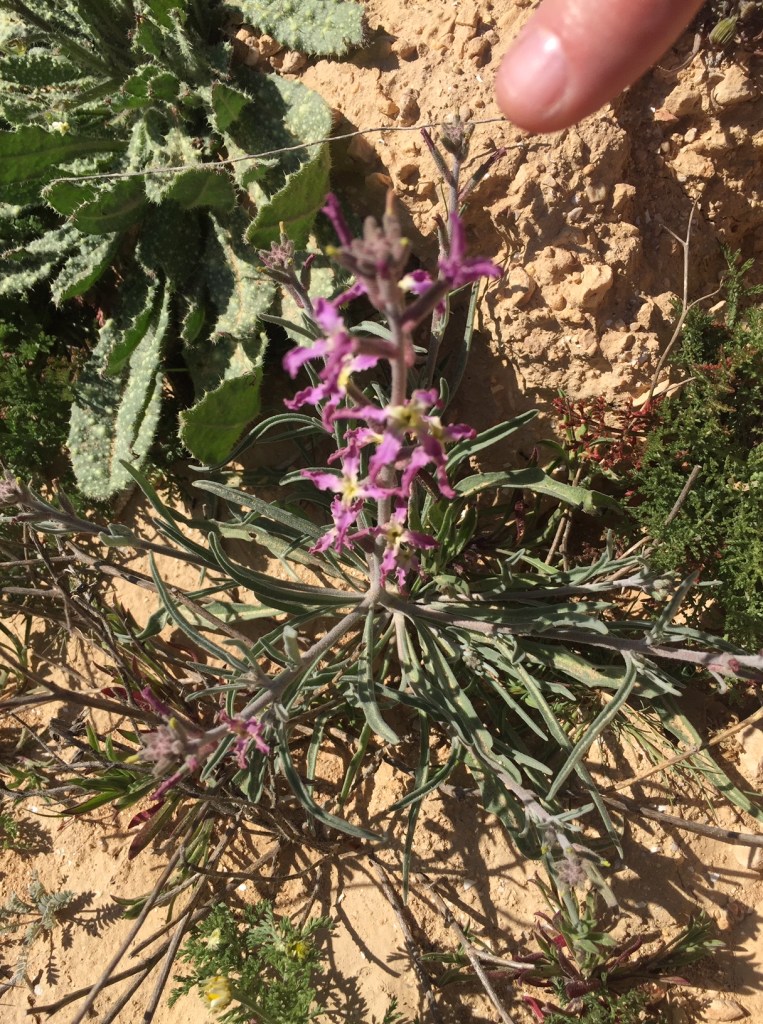
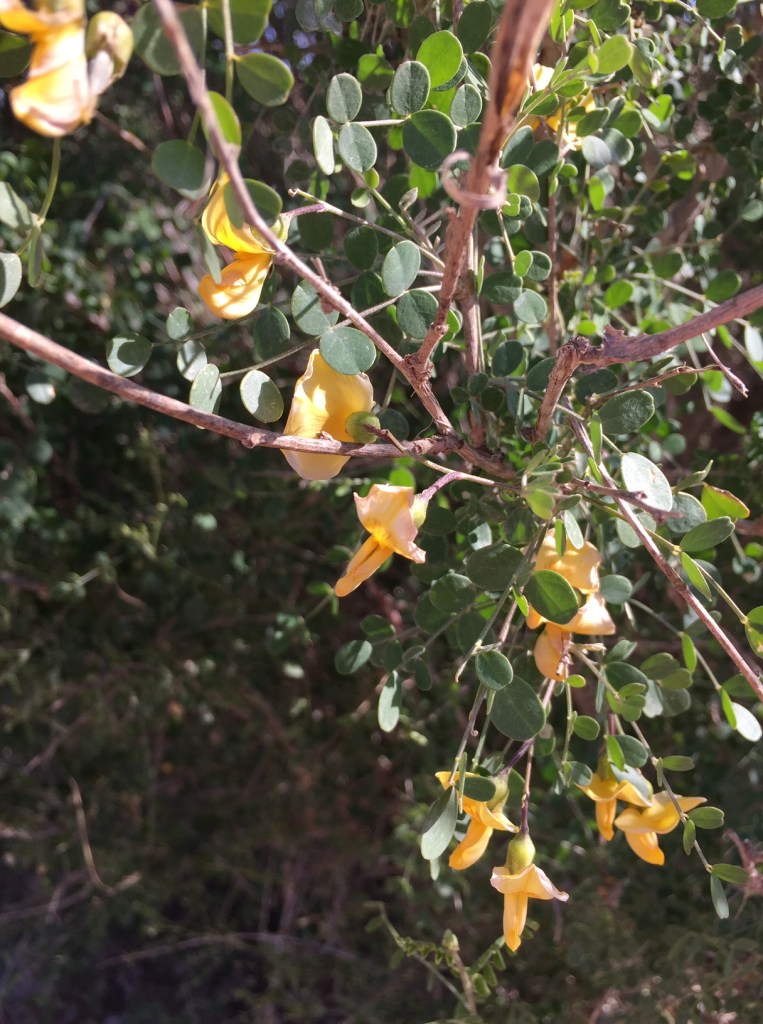
Desert SunroseThese are the flowers we saw growing in great abundance by the side of the road on the way down to Eilat.Tiny wild Calendula — this photo is about life sizeIsrael has a million different yellow compositae — I think this is Jaffa GroundselThe white flowers are ChamomileGreat Storksbill (an Erodium — a form of wild geranium)Hoary-leaved Heronsbill (an Erodium — a form of wild geranium) Astragalus (yes, like what you find in herbal mixtures for hormonal issues, etc.)I’ve pored over lists of Israeli wild flowers for an hour,but still can’t identify this one. I think it’s a bulb of some kind.Looking for plants with Shoshana is always fun. She is experimentally-minded — she takes things home and makes tinctures. Bladder-senna — a shrub
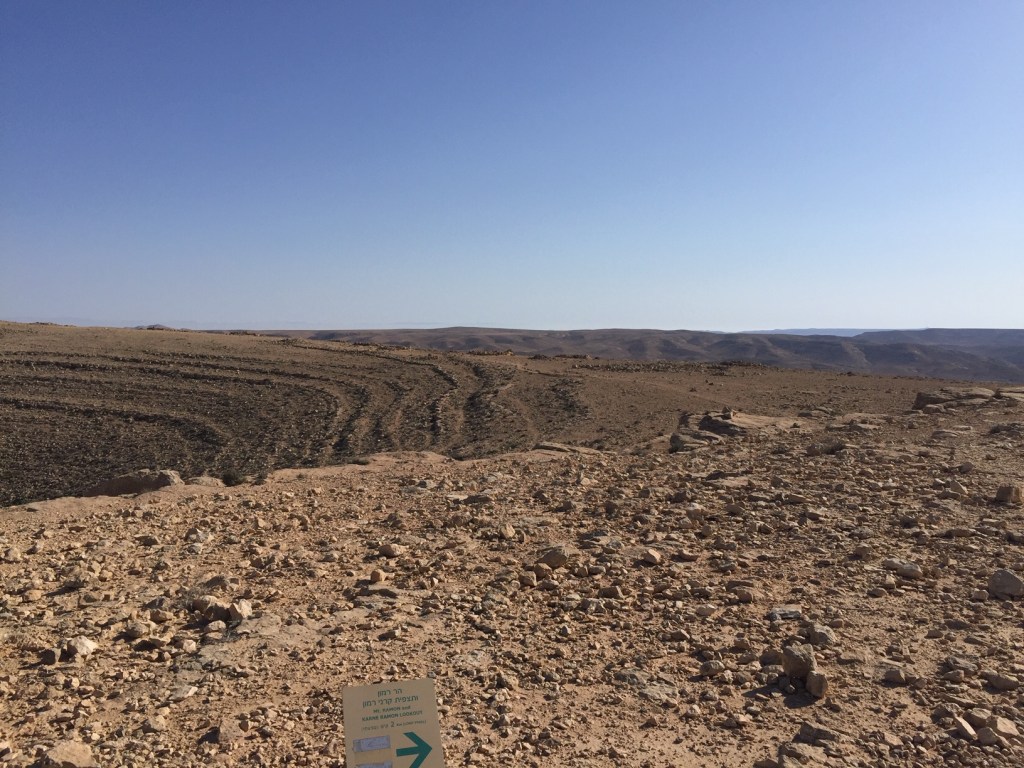
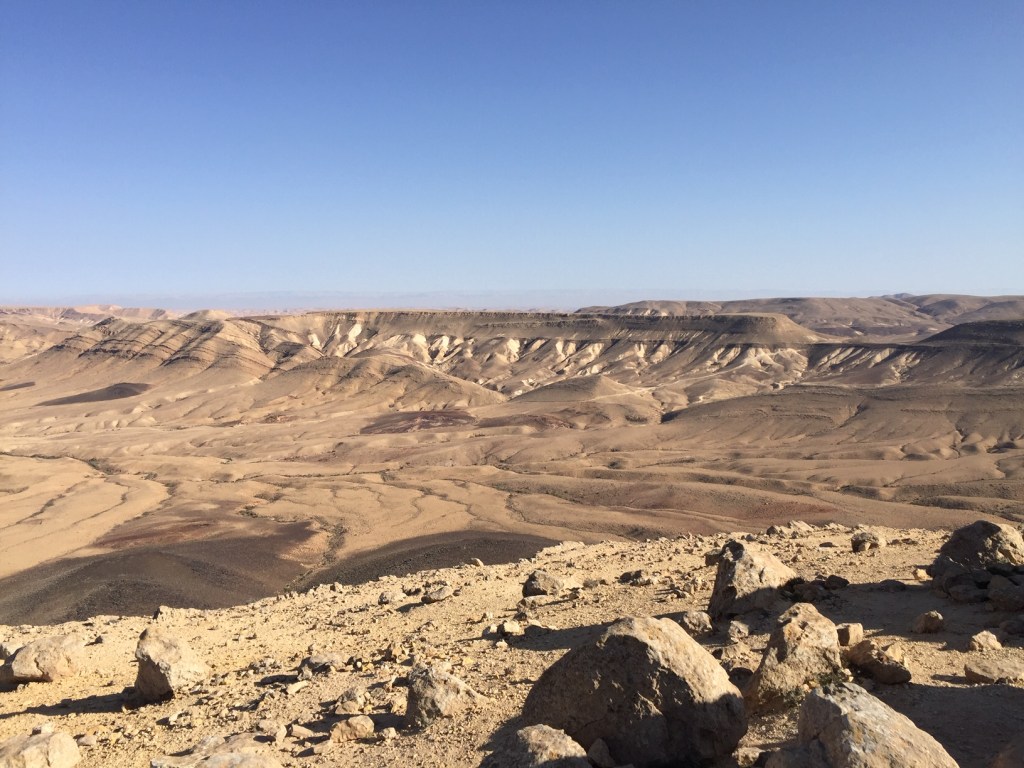
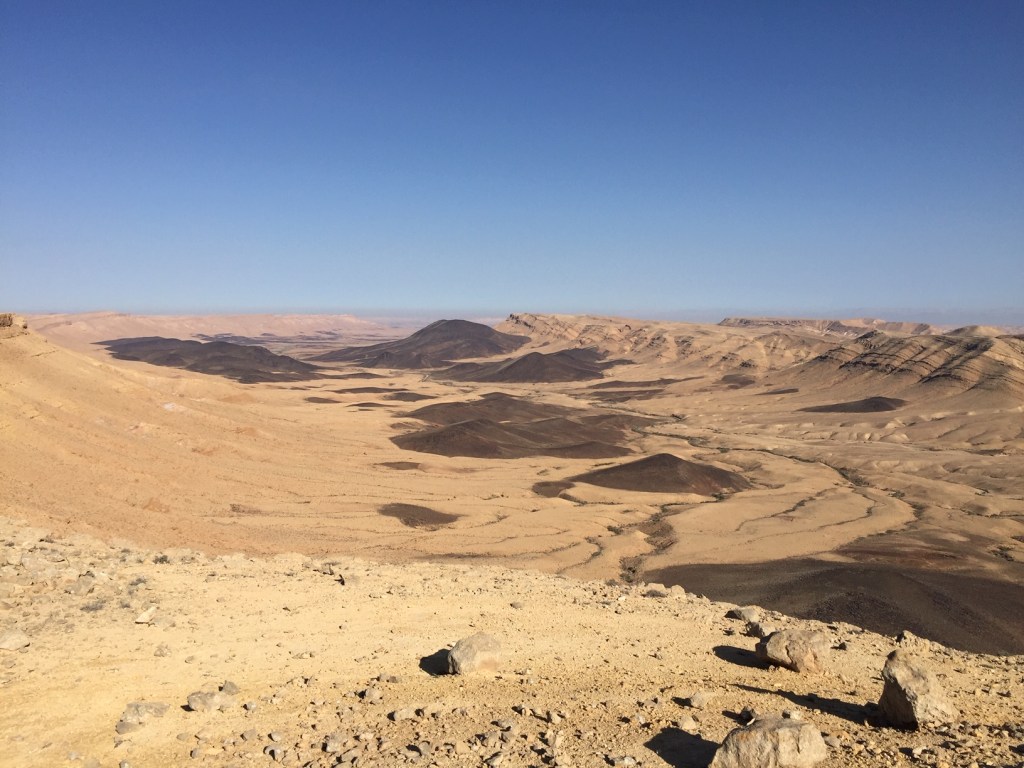
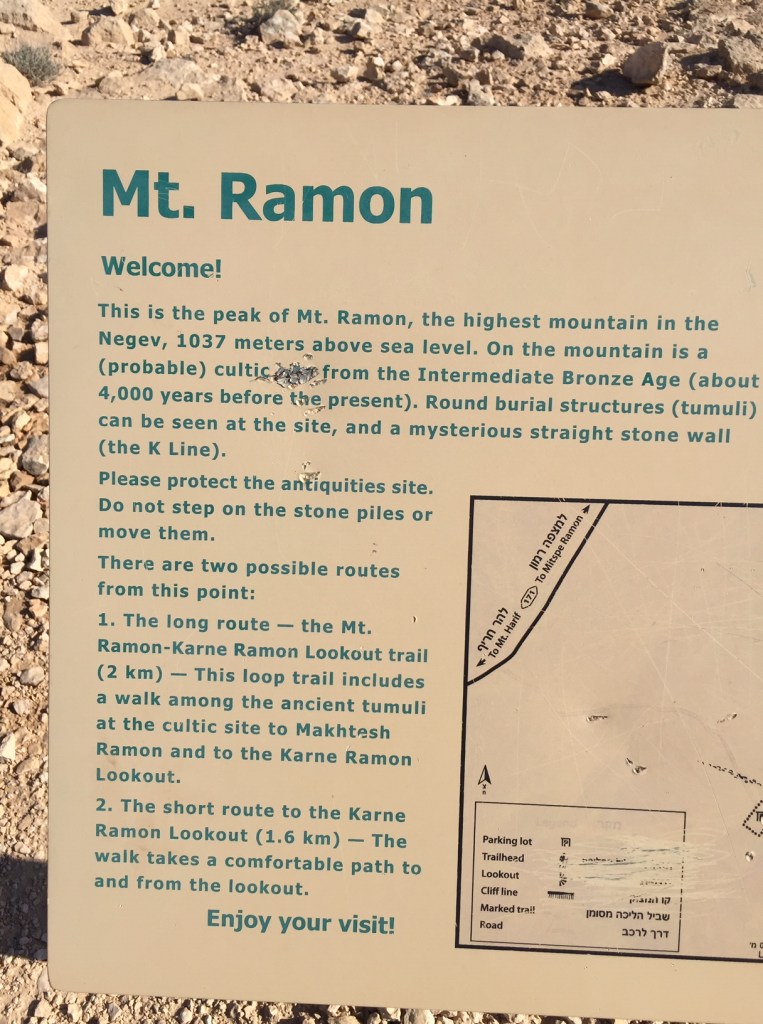
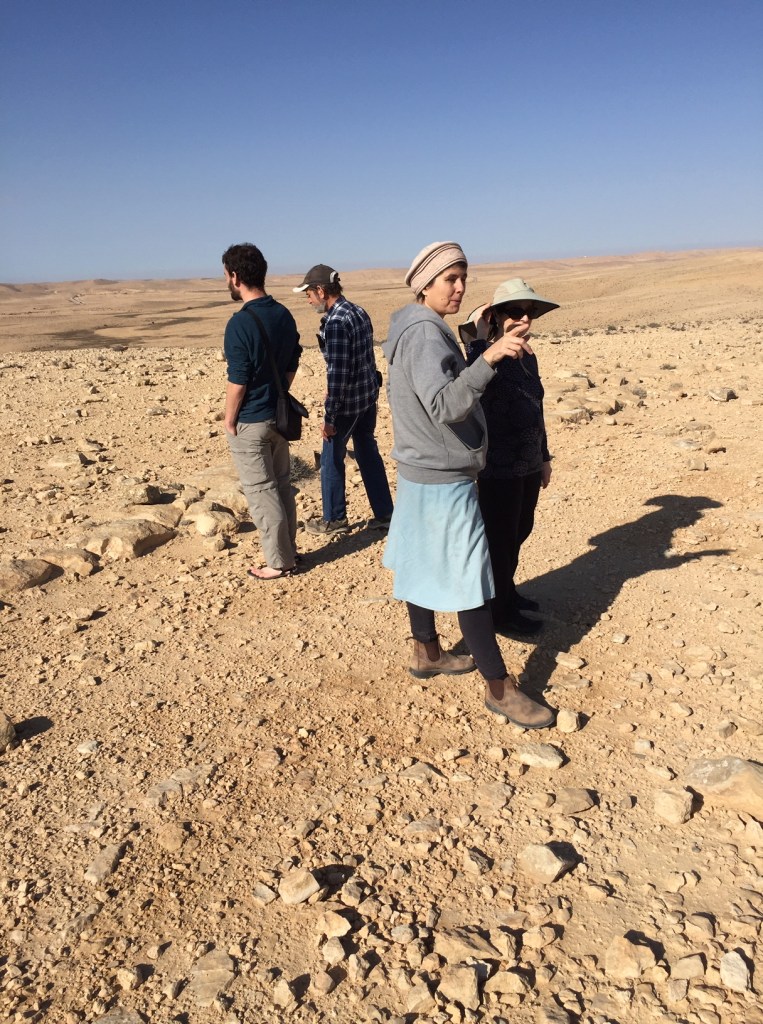
We drove onward, turning off the main road and bumping over a dirt road that is supposed to be usable by tourists — but I would be sorry for anyone who took anything other than a Jeep or Land Rover on this stony washed out trail! At the end of the road we parked and walk up to the lookout over the Mashtesh. We ate our lunch as we admired the view.
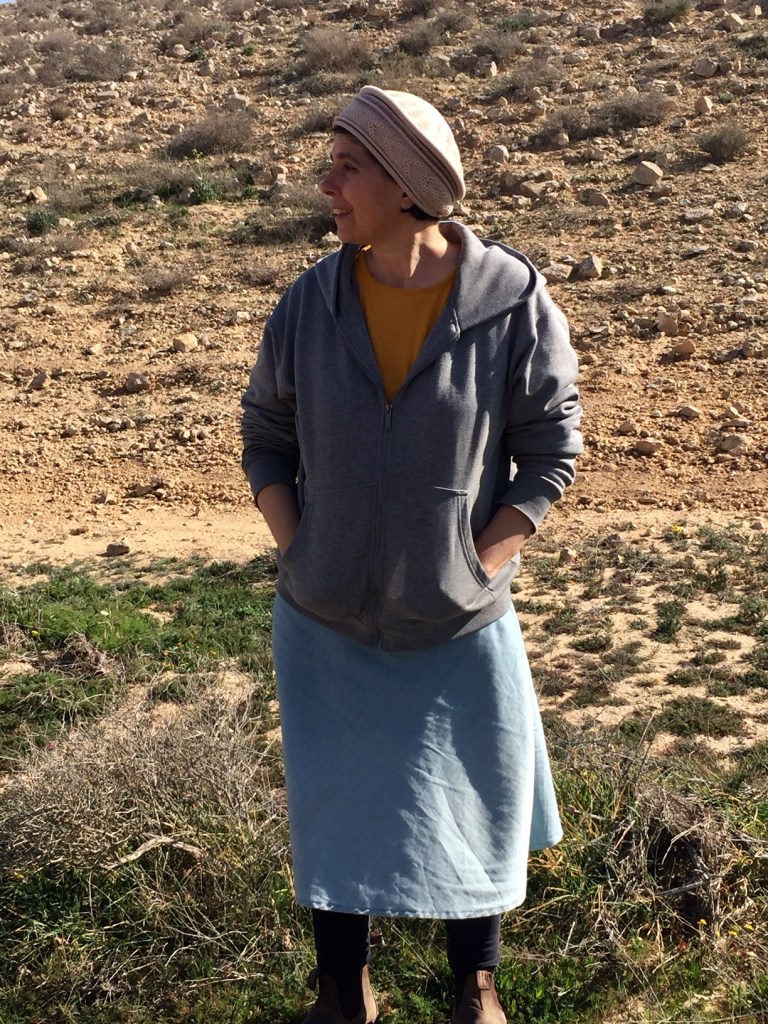
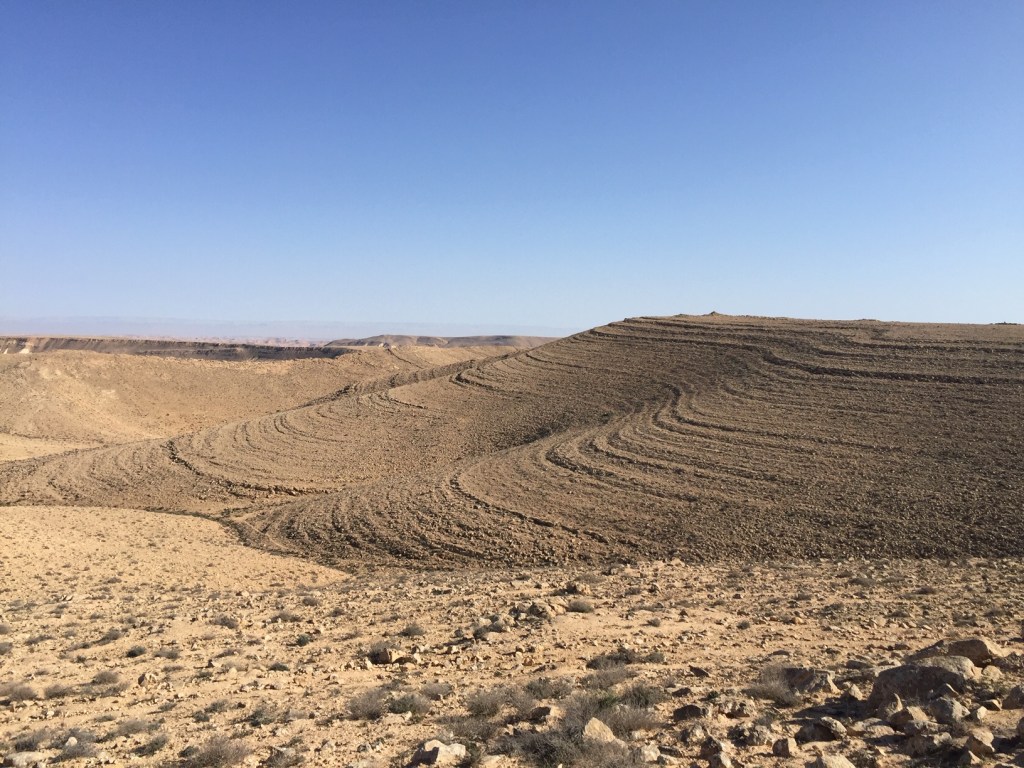
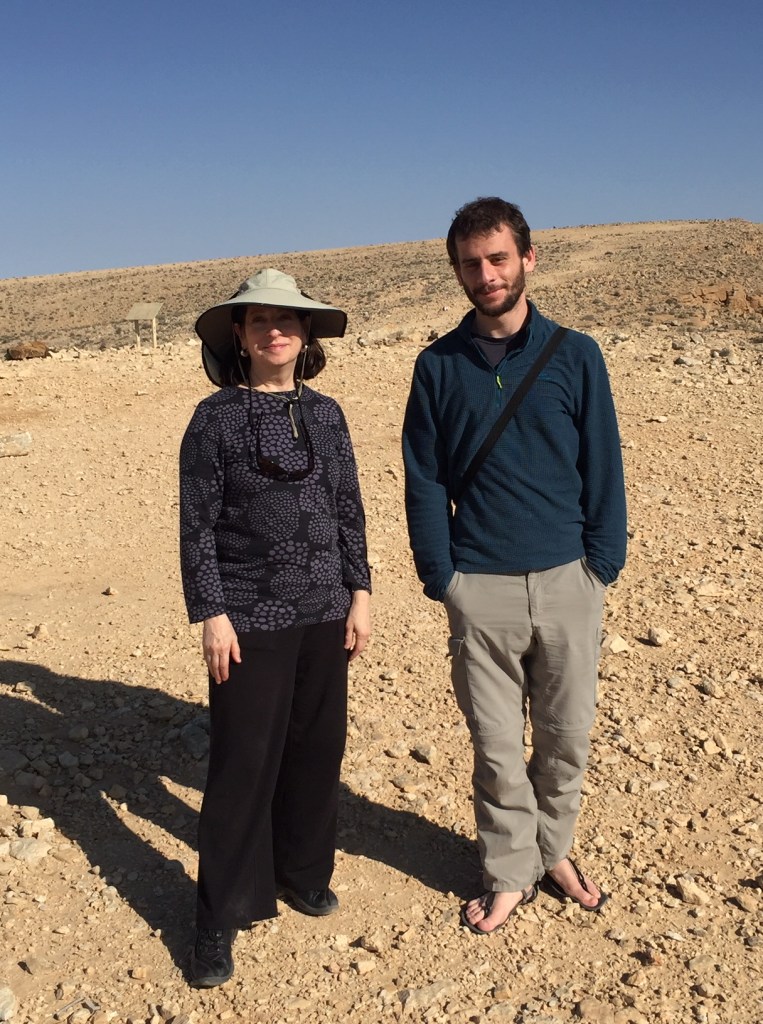
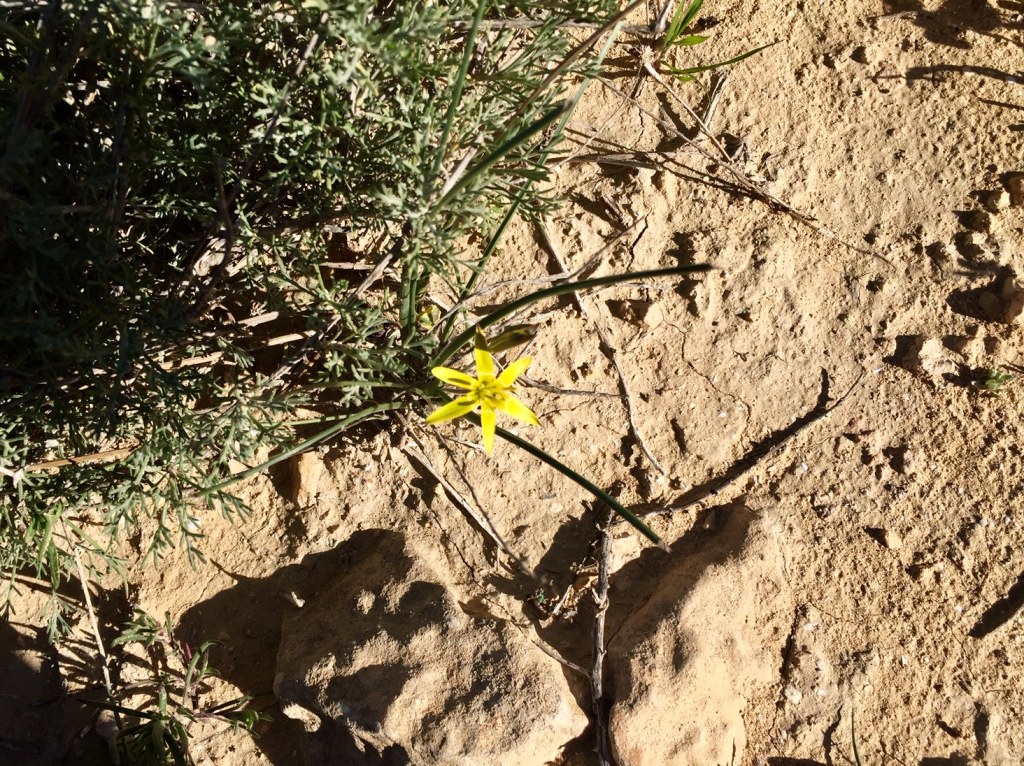
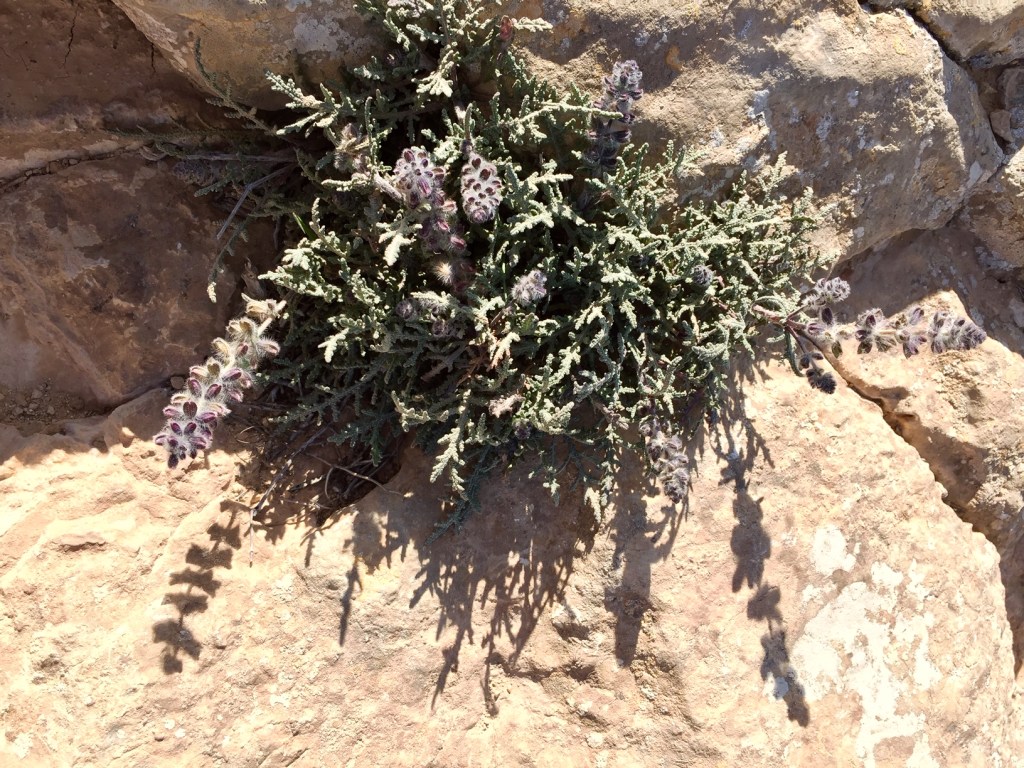
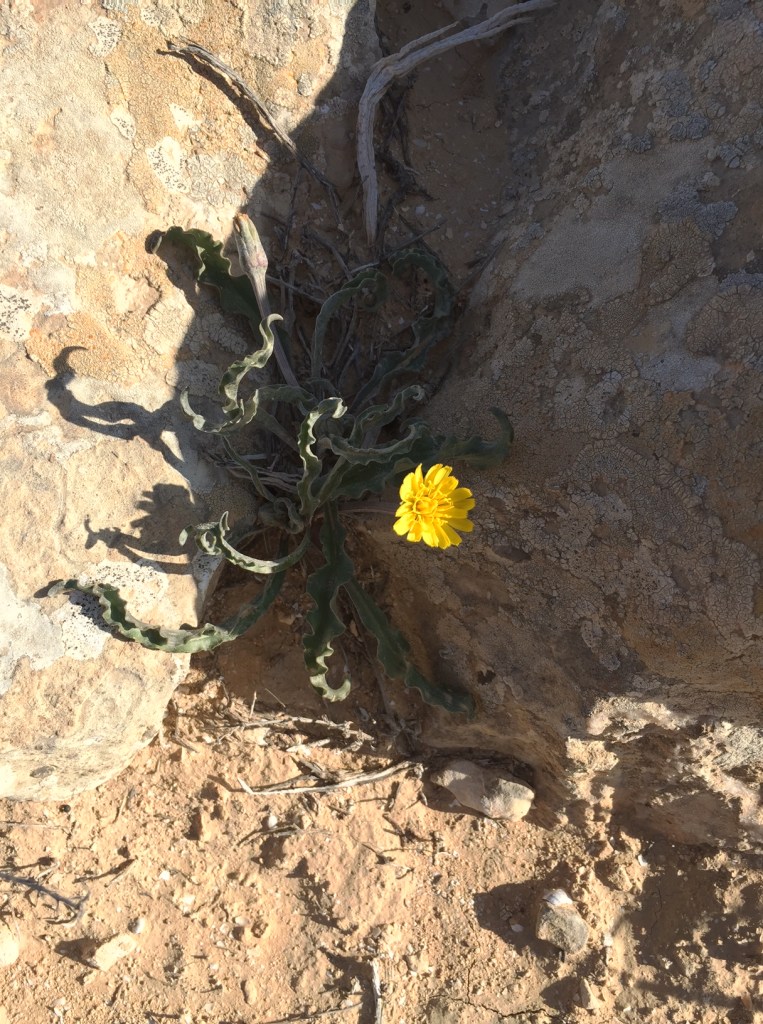
Compared to the colors of the Wadi Rum in Jordan, this is a less vivid landscape, but still full of visual interest. It’s a geologist’s dream — numerous geological periods are represented in the machtesh.The blackish hills are eruptions from volcanic actionDeboroh contrives to look stylish even in the desert.If you look down, even in the most seemingly barren setting, you find spring flowers. This is a bulb — Latin name Gagea (after a Professor Gage), sometimes known as Star of Bethlehem.This is Desert Sage. I love the fuzziness of many desert plants.I wasted another hour trying to track down the identity of this one. There are numerous yellow compositae in Israel, but I couldn’t locate this one. The leaves are so interesting.
The afternoon was wearing on toward evening when we finally left Yoni and Shoshana and set off back to Jerusalem. It had been a good visit, and a good trip all around.
Our new guide picked us up at 8:30 in the morning, and we set off on the drive to Wadi Rum. The new Ali (yes, same name) as not nearly as loquacious as his predecessor. However, when we commented on the snow, he talked for some time about how the village where we had stayed was snowed in many years ago, and tourists ended up staying with villagers and learning about their lives. The King (the previous one) even helicoptered in to check on the welfare of his subjects. This topic led Ali to tell us quite a bit about traditional agriculture in the region, traditional foods, and how the old systems have fallen away as young people choose to go off to university. Now, the villagers still do some farming from time to time, but with drought, they have little motivation to do so. Food is brought in from outside, life is more expensive, and no one is self-sufficient any more.
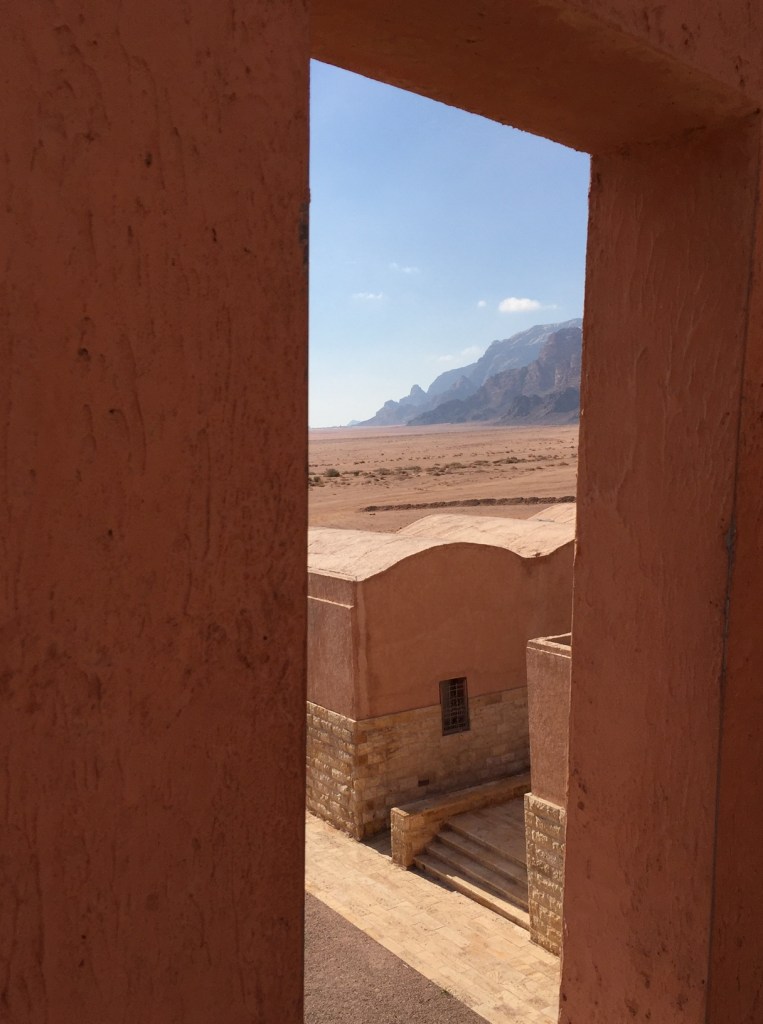
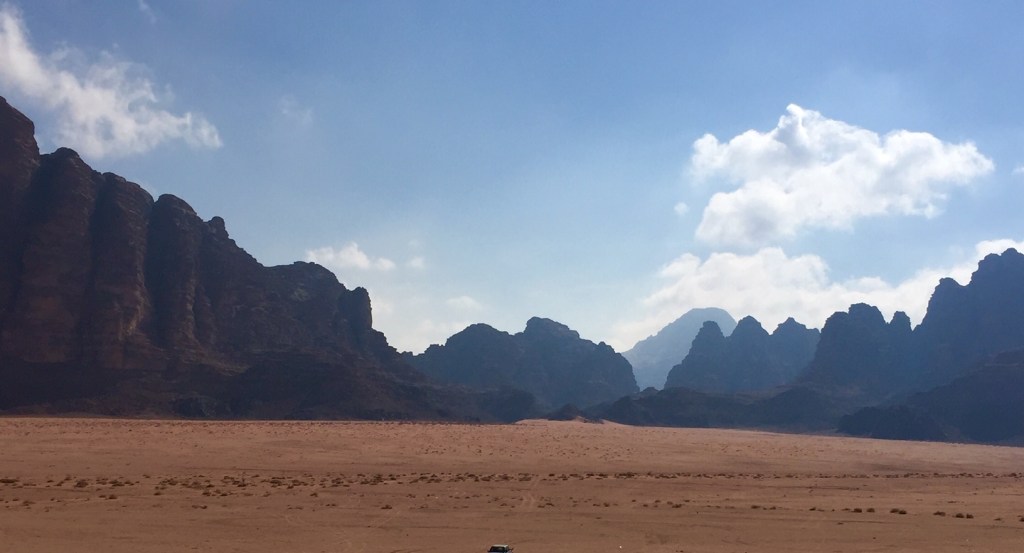
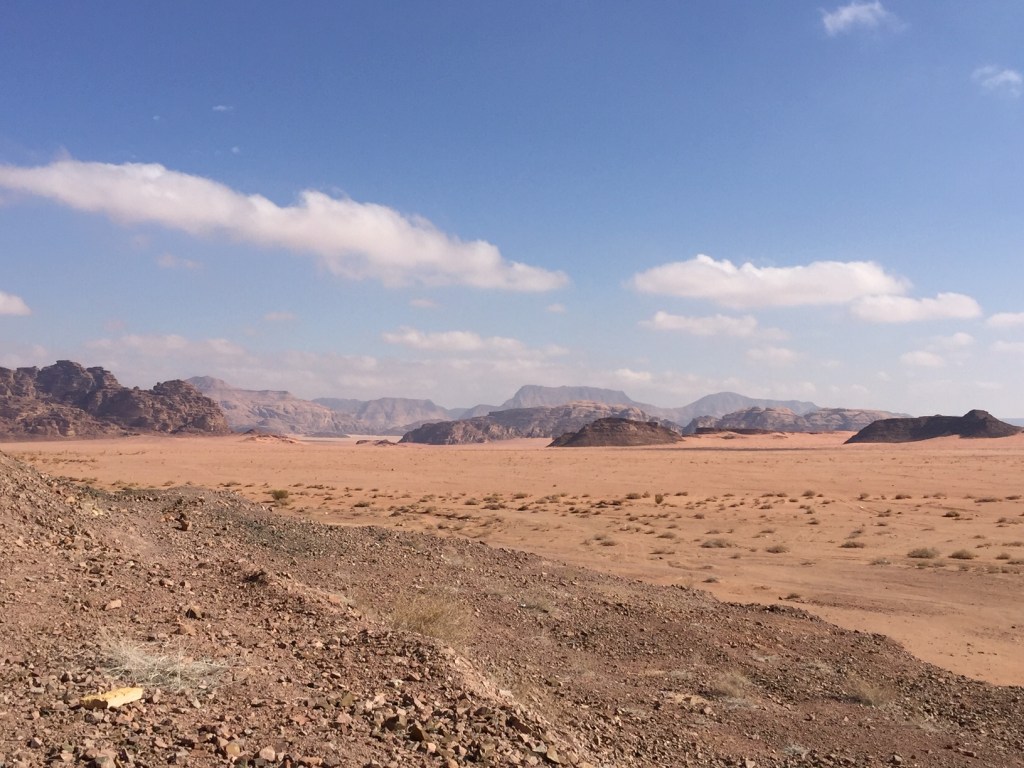
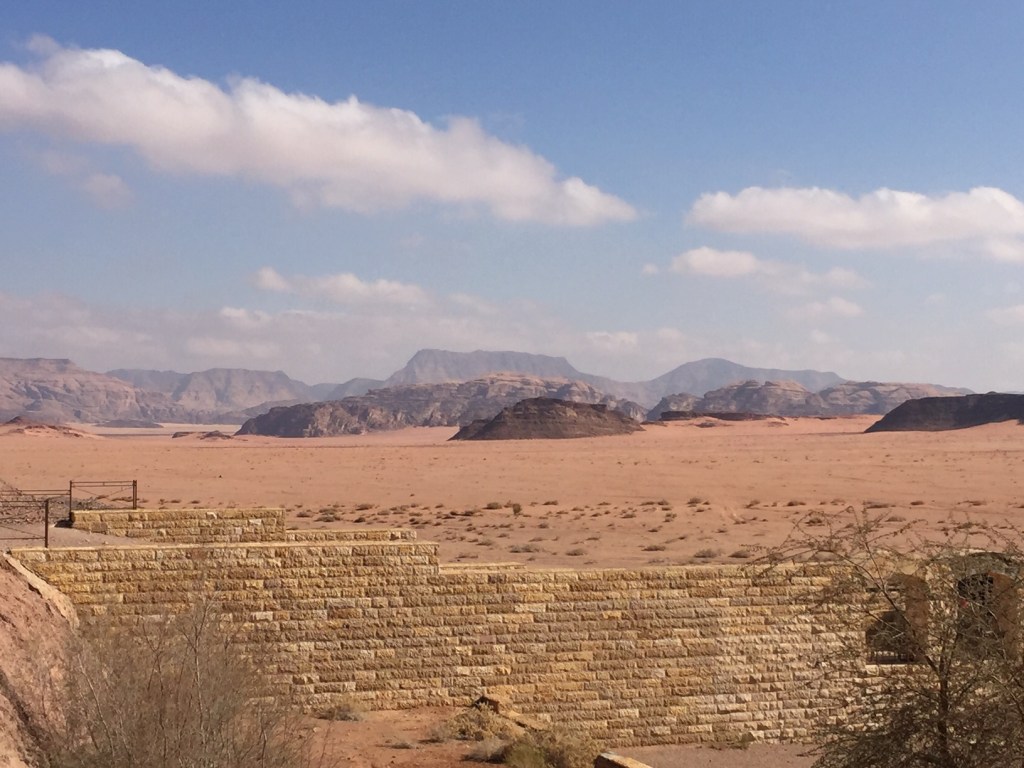
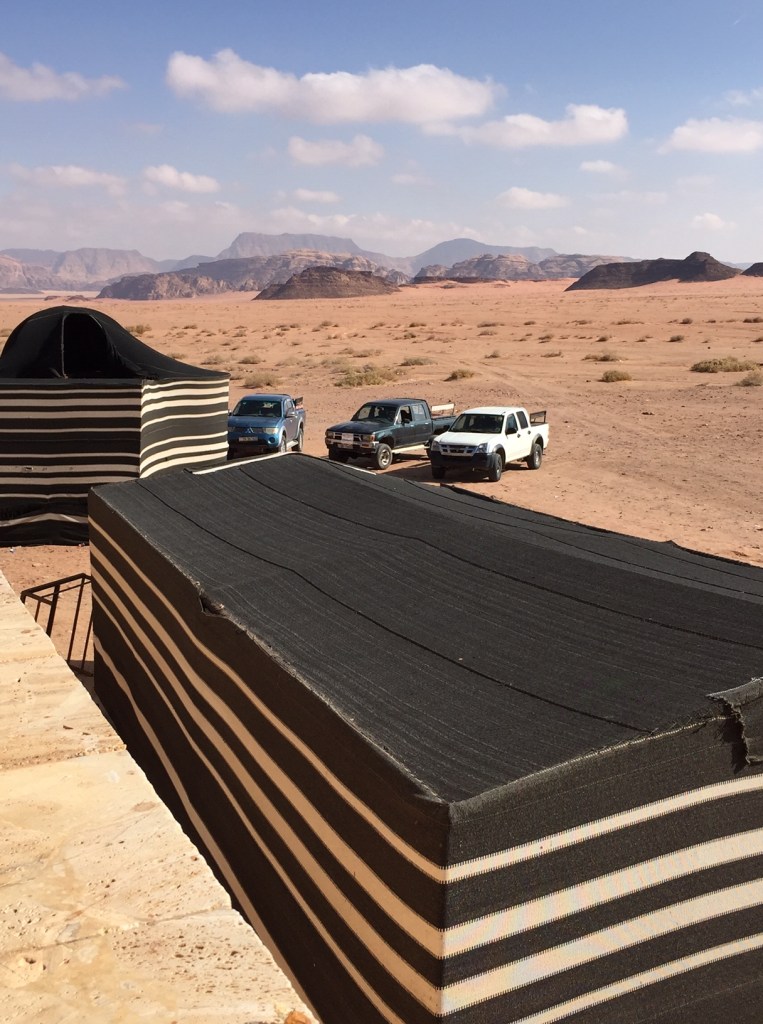
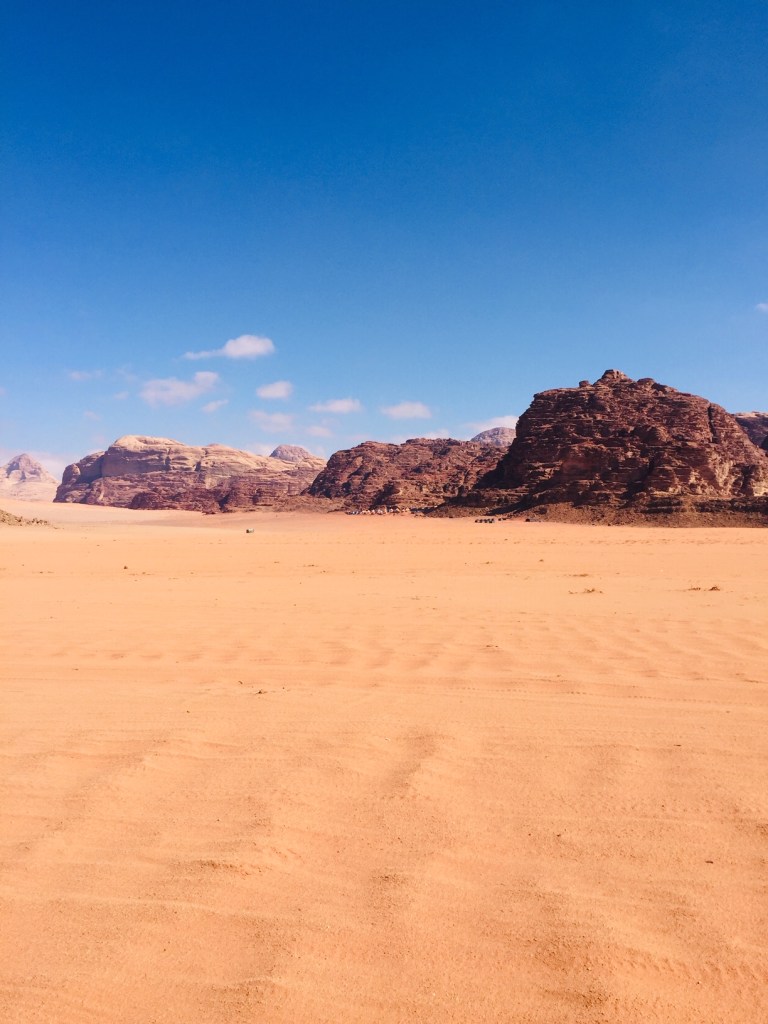
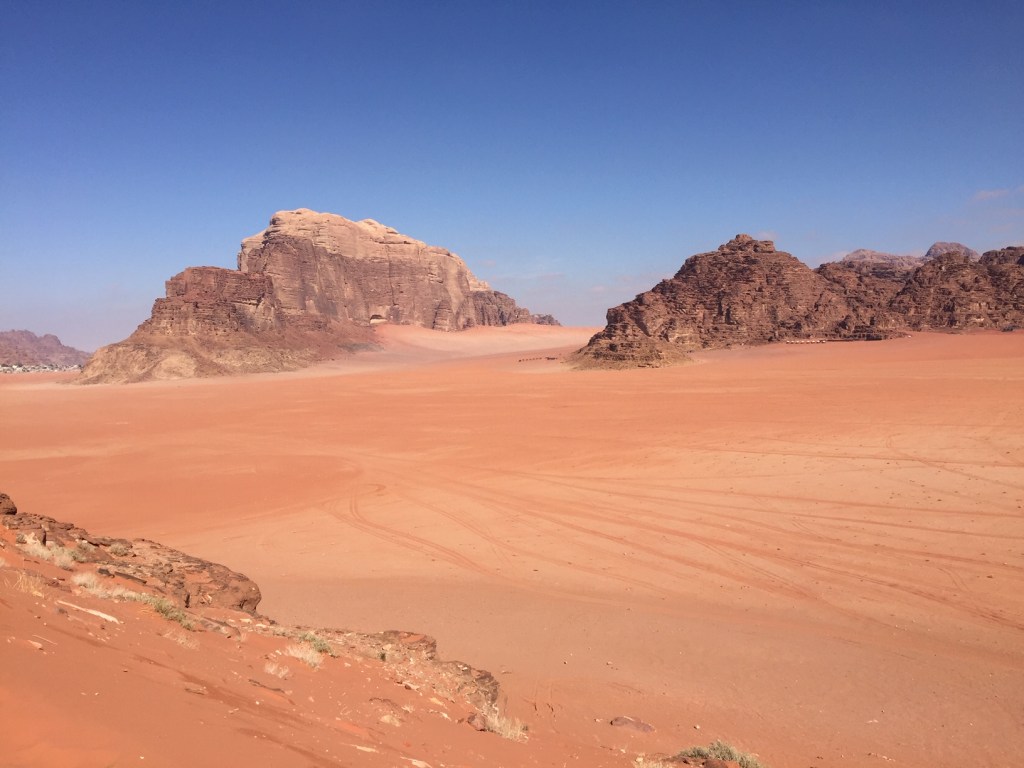
We retraced out journey of the day before, stopping once at a roadside gift and coffee shop where we bought some postcards. It was a long drive, but the views were spectacular — vast expanses of desert and mountains, with small towns huddling down among them. At last, we turned off the main highway and made our way to the Wadi Rum visitor center. While Ali paid our entrance fees, we walked up a small incline to get out first views of the Wadi Rum desert. This is what we saw:
Traditional Bedouin tents — and trucks for tourists to ride in the back of.
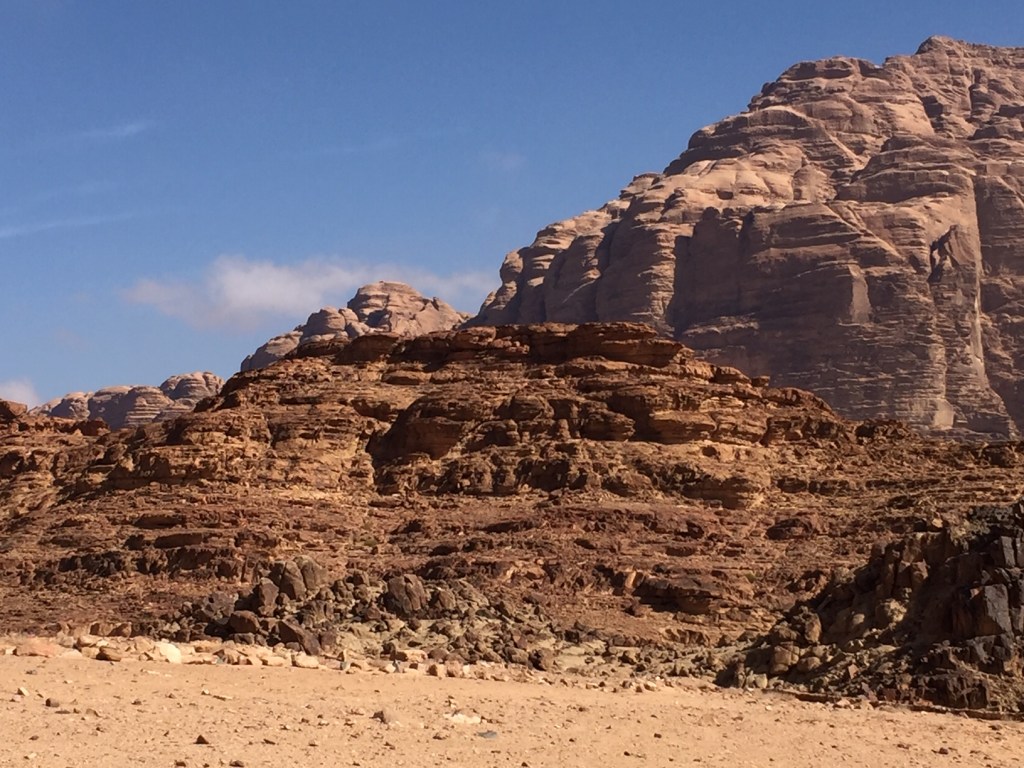
We set off into the desert. Ali explained that this area has become famous as a location for movie making. It began in the 1960s with “Lawrence of Arabia”. Indeed, several local landmarks are named after Lawrence, or after locations in the film — even though the film is supposed to take place in Saudi Arabia. More recent films made here include the last episode of “”Stars Wars”, “Transformers II”, “The Martian”, “Indiana Jones III”, and many others. Here’s a list: https://www.imdb.com/search/title/?locations=Wadi%20Rum,%20Jordan When I returned home to my apartment in Jerusalem, I watched some of these movies. I must say, I’ll never be able to watch a movie set on Mars again without thinking of Jordan!
Bedouin village
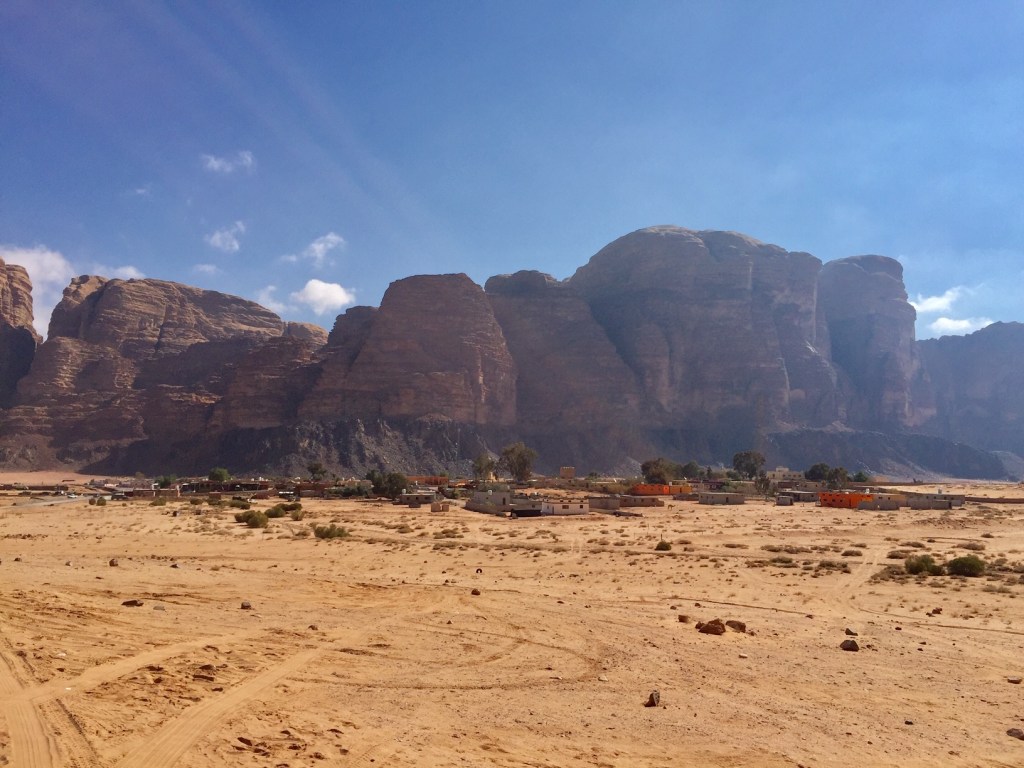
We passed through a small village. This is a place where the government settled the Bedouin, removing them from their nomadic lifestyle. It’s interesting to think about the critique that is made of the way the Israeli government has treated the Bedouin, and then ask oneself how the Jordanian government has dealt with the same issue. For an interesting paper on this topic, see here: https://halshs.archives-ouvertes.fr/halshs-01963959/file/Chatelard_Today_bedouins_Jordan.pdf This one is also quite interesting (although perhaps a bit of a puff piece): https://www.theturbantimes.com/2017/05/12/backbone-jordanian-culture-bedouins/ My sense is that because people want to paint Israel as oppressive, they talk about how the Bedouin are treated in Israel as if it were very different and more objectionable that how they are treated in Jordan — but in fact, it’s not clear to me that there’s a big difference. Semi-nomadic peoples are an inconvenience to modern life — and also, some of the semi-nomads themselves would prefer to opt into a more settled way of living if it brings them education, health care, and a higher standard of living. Although, of course, many would not!
I read in Wikipedia’s page about the Bedouin, In the 1950s and 1960s large numbers of Bedouin throughout Midwest Asia started to leave the traditional, nomadic life to settle in the cities of Midwest Asia, especially as host ranges have shrunk and populations have grown. For example, in Syria, the Bedouin way of life effectively ended during a severe drought from 1958 to 1961, which forced many Bedouin to abandon herding for standard jobs.[45][46] Similarly, governmental policies in Egypt, Israel, Jordan, Iraq, Tunisia, oil-producing Arab states of the Persian Gulf and Libya,[47][48] as well as a desire for improved standards of living, effectively led most Bedouin to become settled citizens of various nations, rather than stateless nomadic herders.
Governmental policies pressing the Bedouin have in some cases been executed in an attempt to provide service (schools, health care, law enforcement and so on—see Chatty 1986 for examples), but in others have been based on the desire to seize land traditionally roved and controlled by the Bedouin.
I would encourage you to read Wiki’s entries about Israel and Jordan in regard to the Bedouin. Then, of course, you can range further afield — it’s clear that the Wiki entry has been influenced by writers with various agendas. https://en.wikipedia.org/wiki/Negev_Bedouin
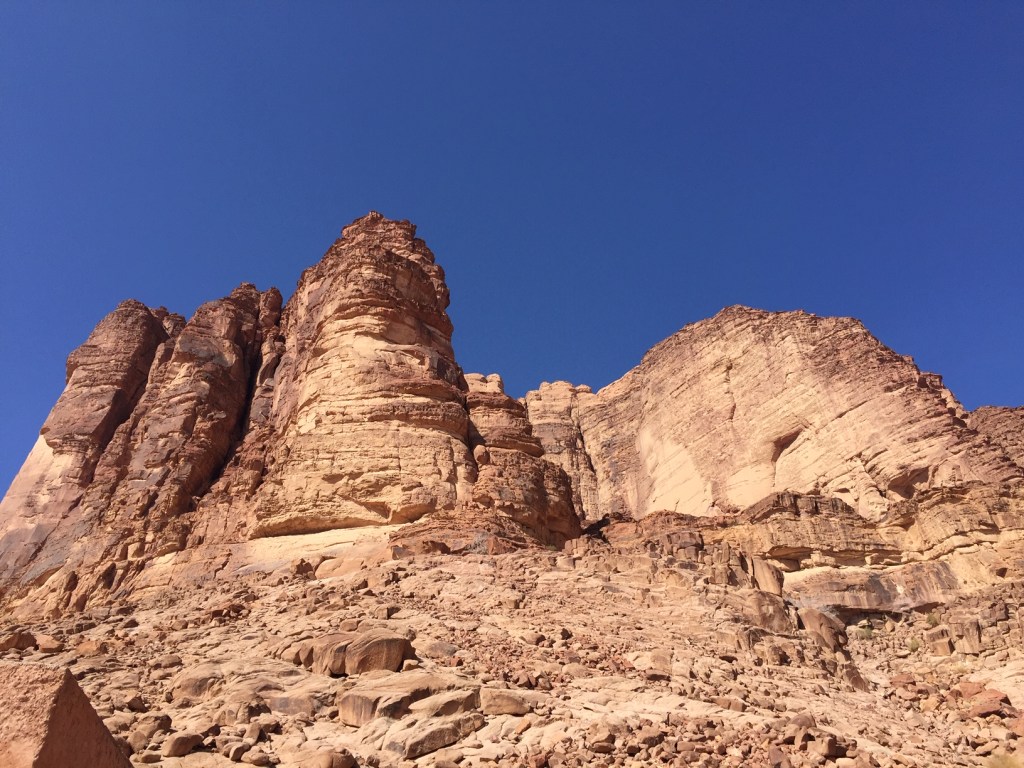
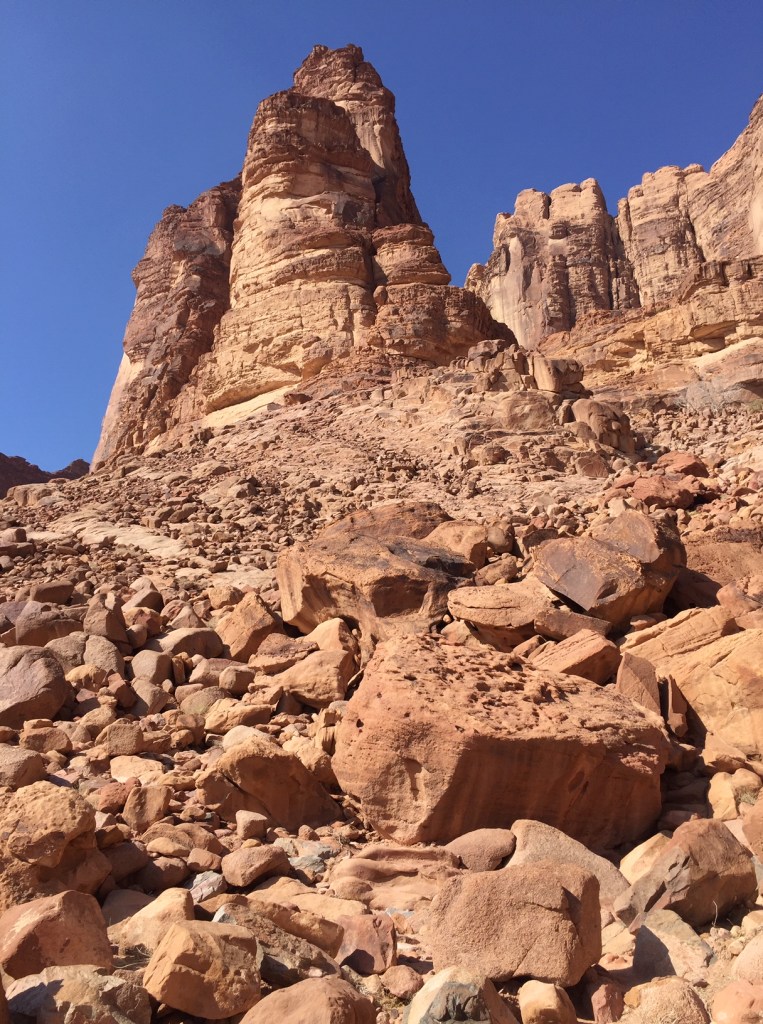
We stopped at a tiny outpost. Our guide pointed out that people do climbing on the rock faces here. He himself had climbed these rocks often, he said, when he was younger. We ascertained that he was my age — 56 — but he looked as though he might have been a decade or two older (although handsome in a rugged, weathered way). He wore desert camouflage, with he said was left from his days as a commando. “The Jordanians are a warrior people,” he said, proudly. “We have very few songs about love, our songs are all about war.” “Too bad!” said Hagai.
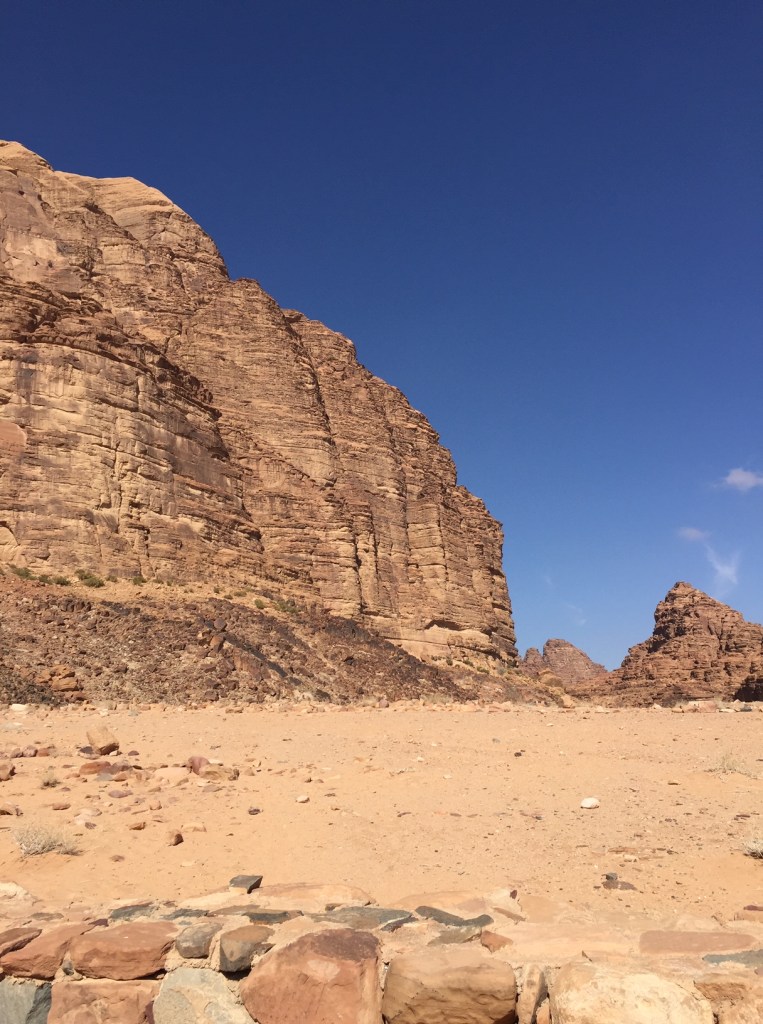
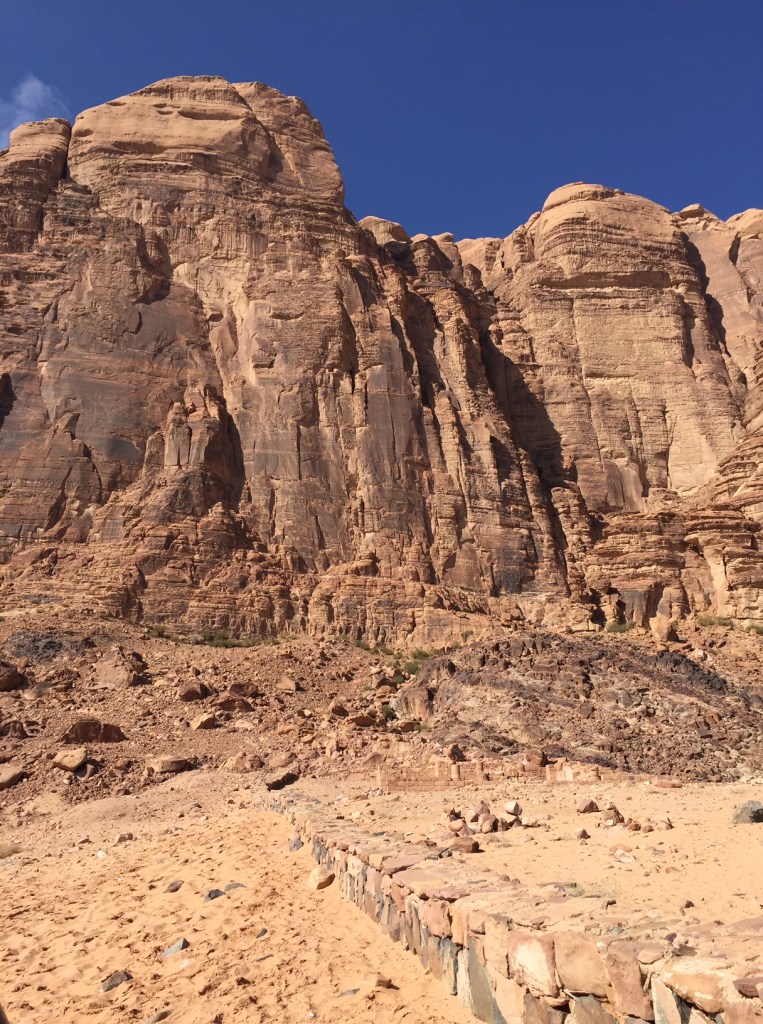
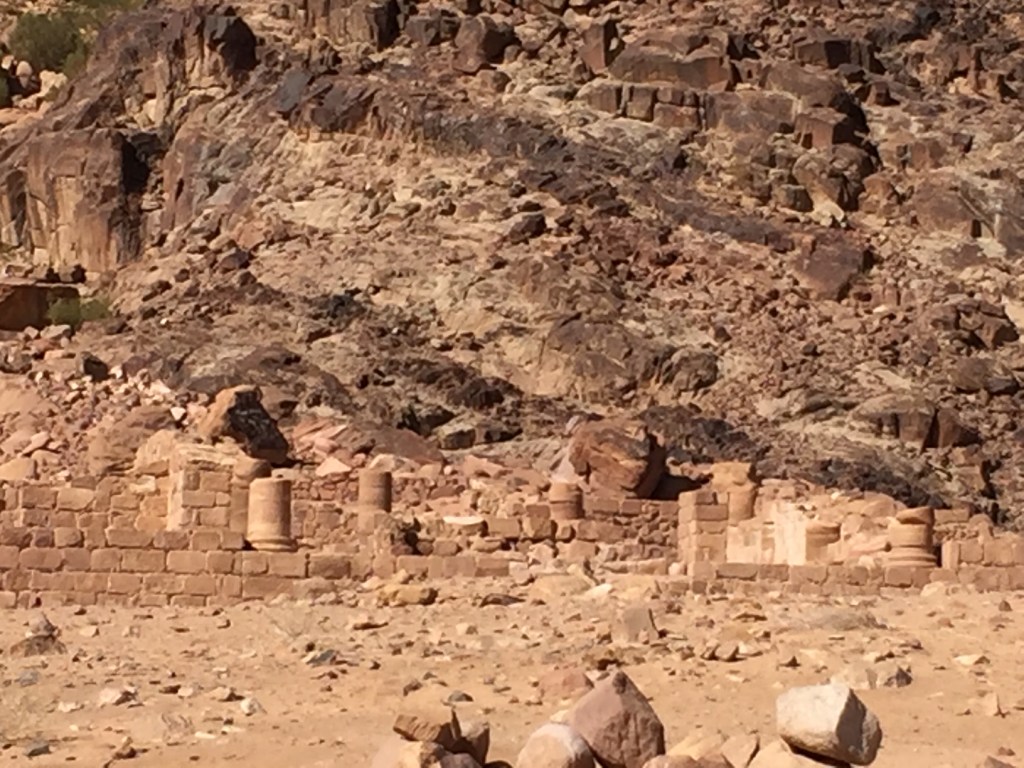
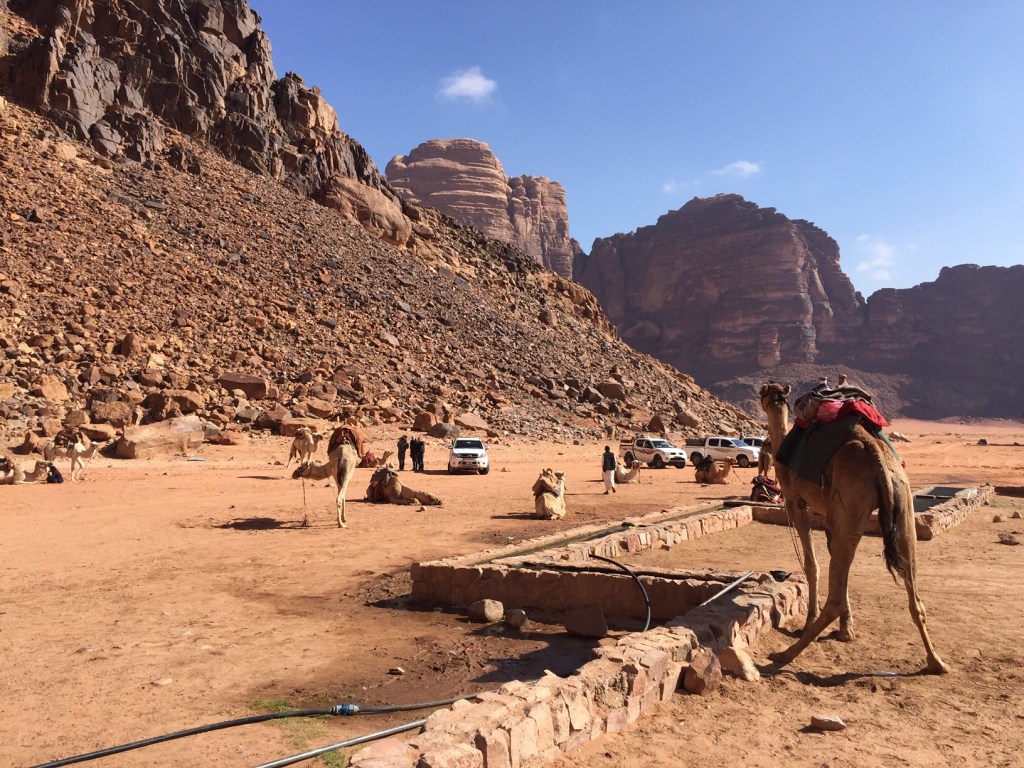
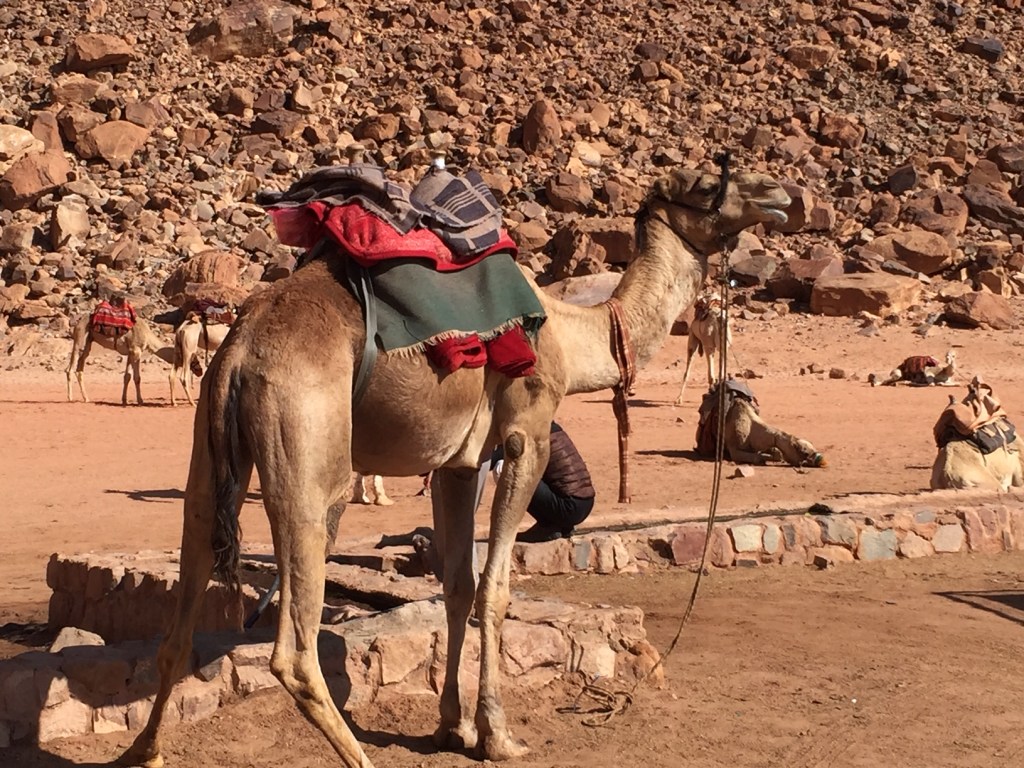
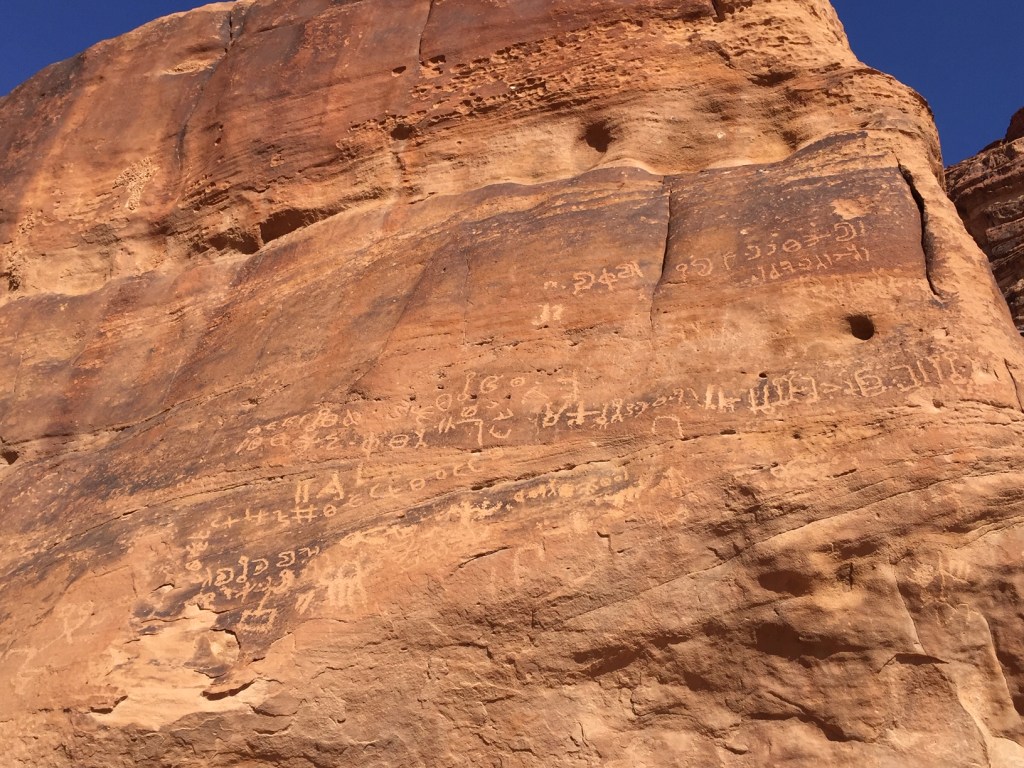
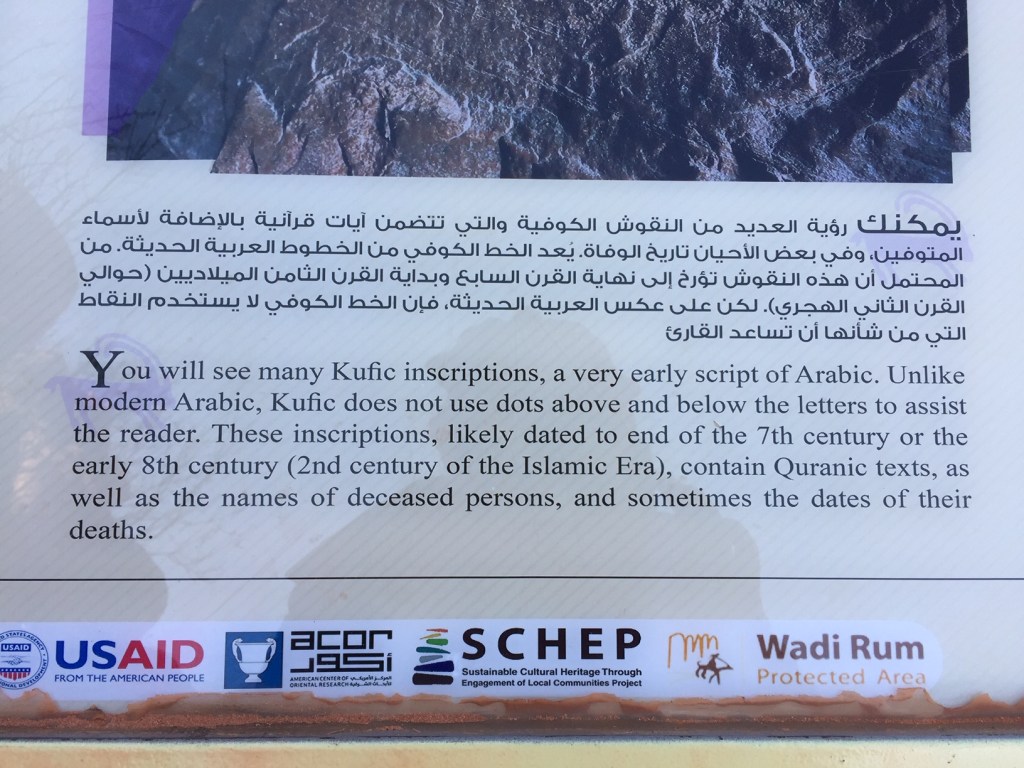
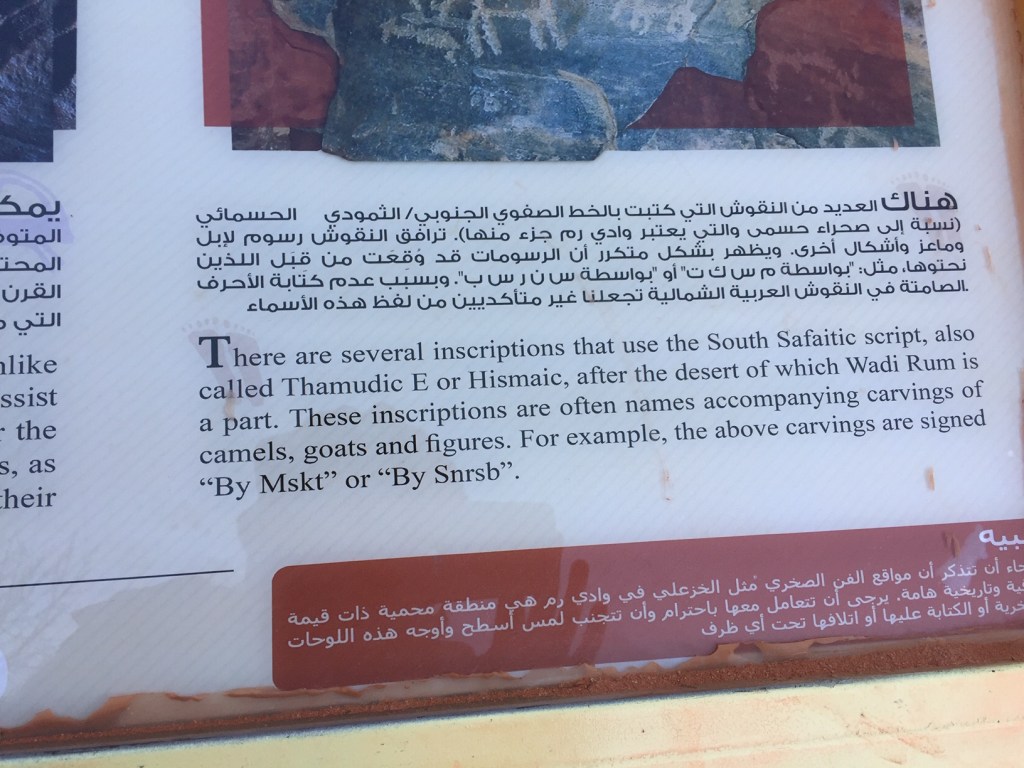
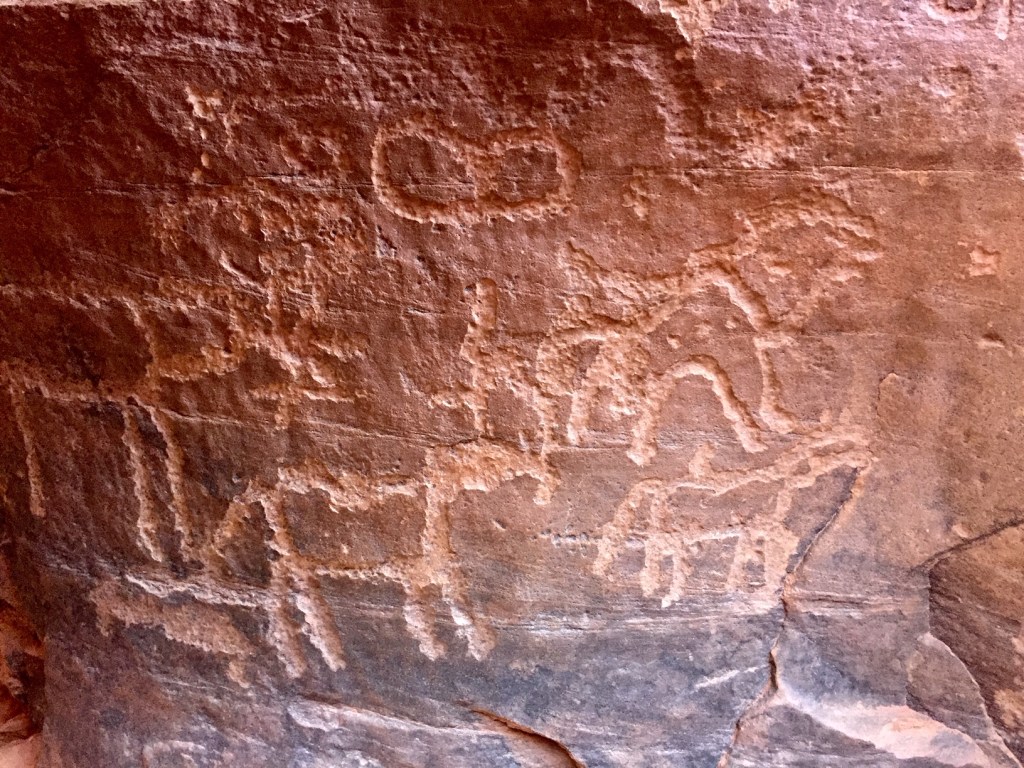
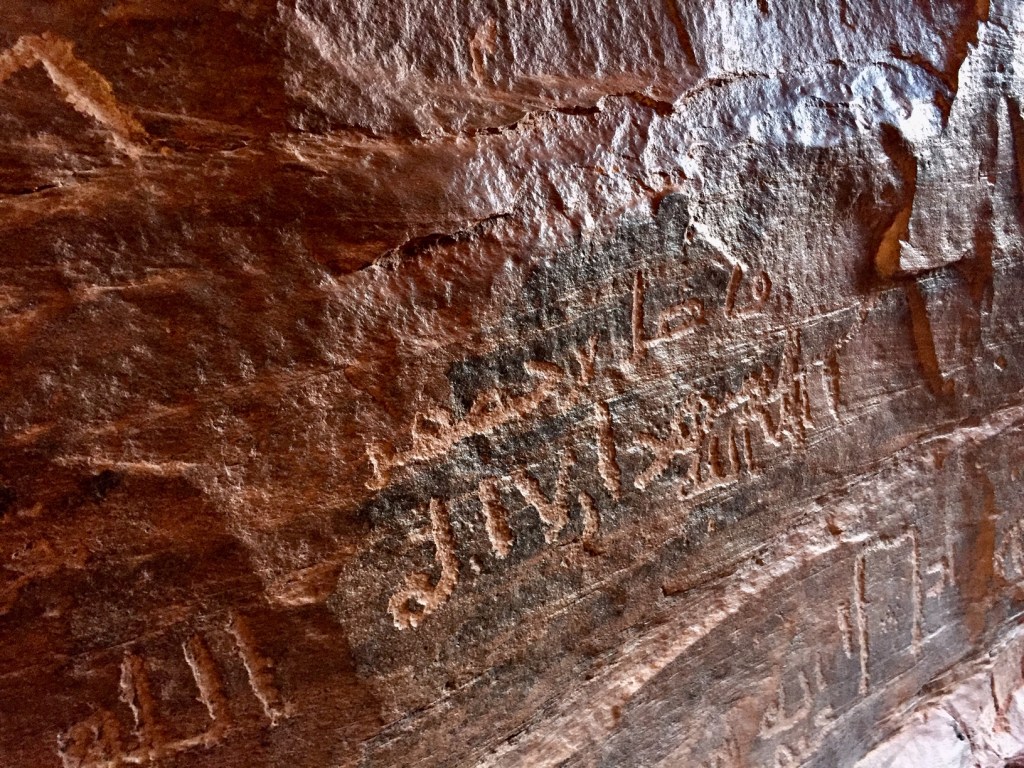
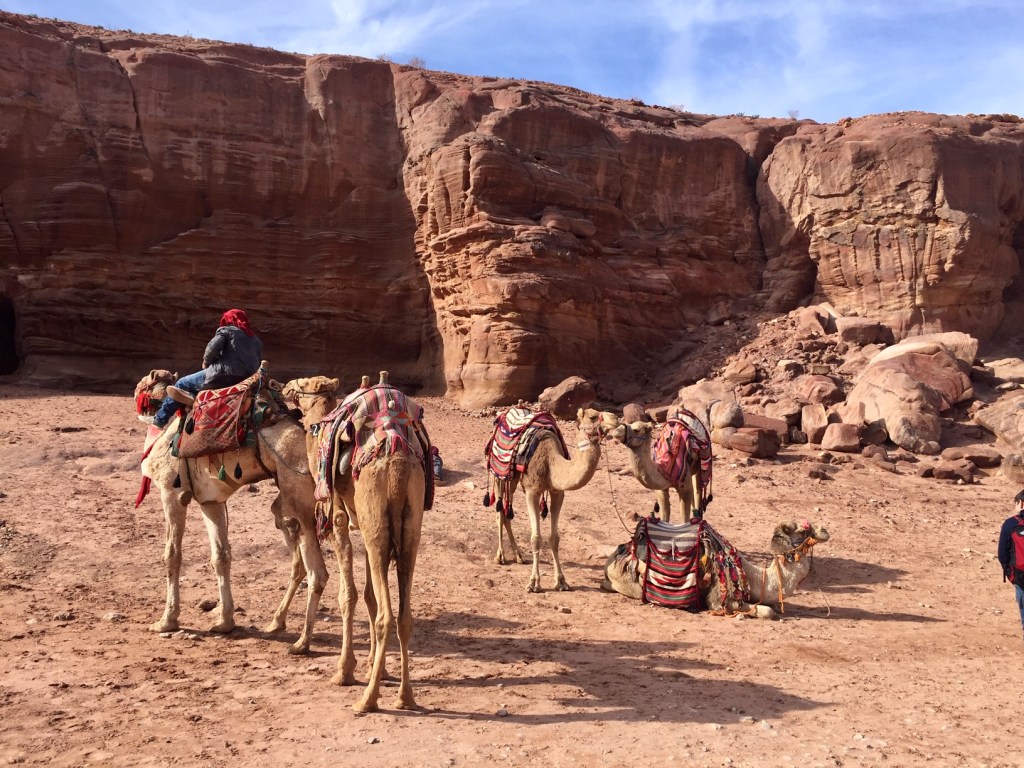
Ruins of an ancient temple, in front of the rock faces that people climb.Temple ruinsThe water running in this channel, from which the camels drink, comes from high up the mountainside, where a spring emerges. It is piped down to the camels in a long PVC pipe.The temptation to photograph camels is hard to resist. We had no inclination to ride them, however.Very ancient writing on the rock face.
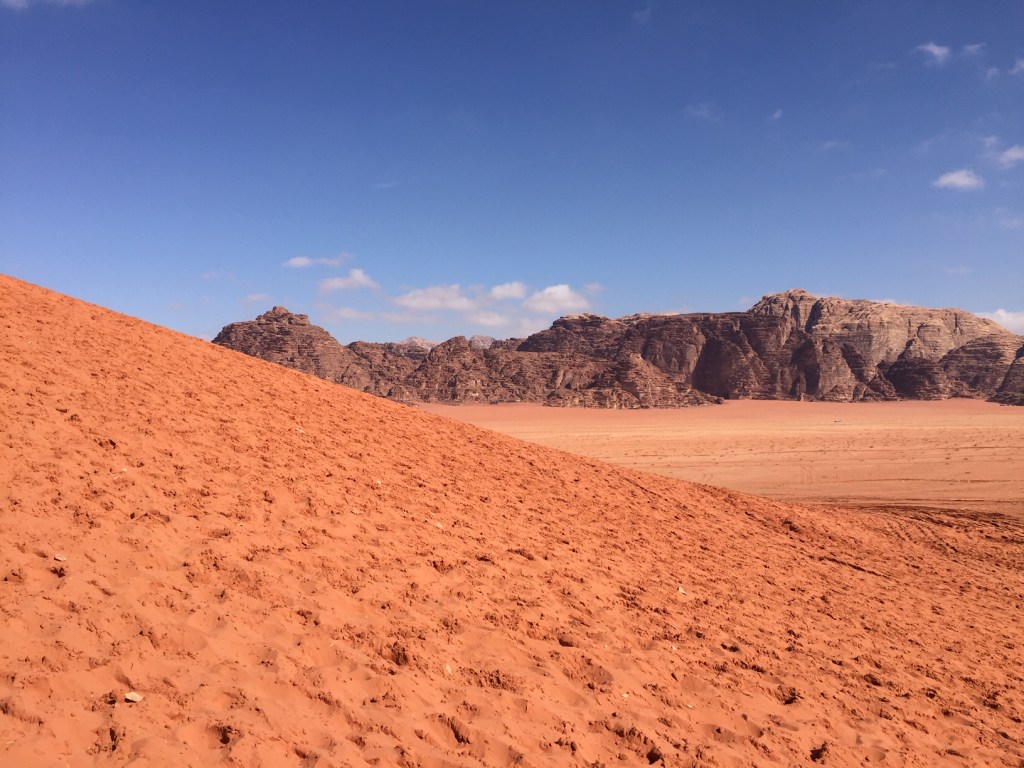
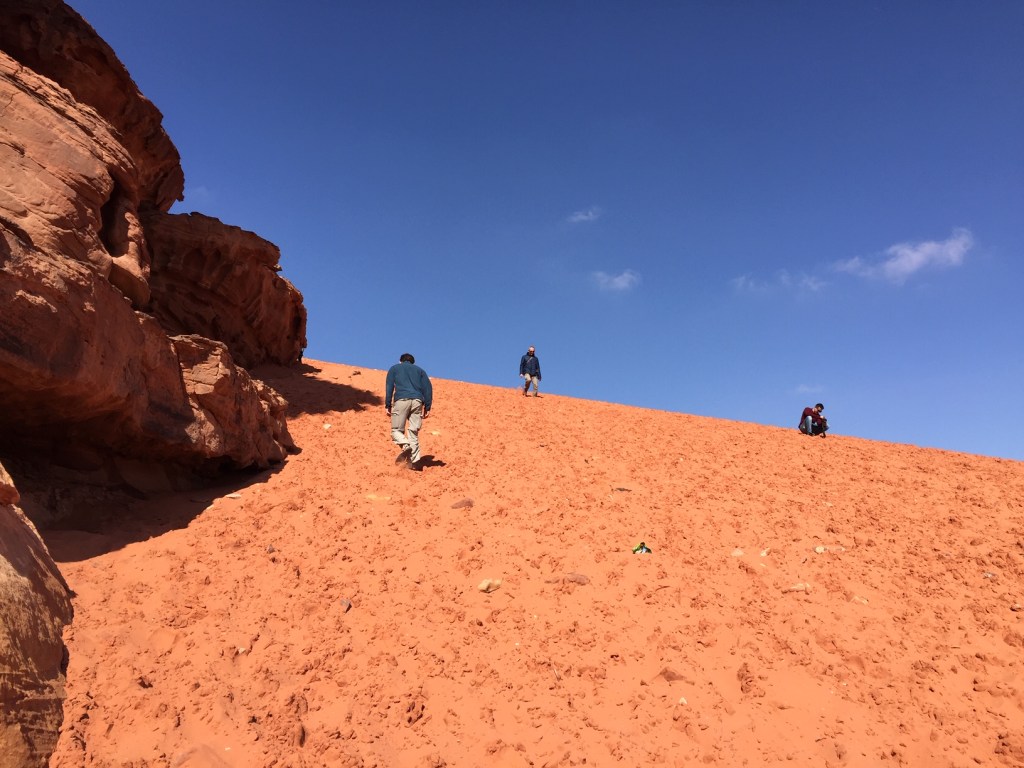
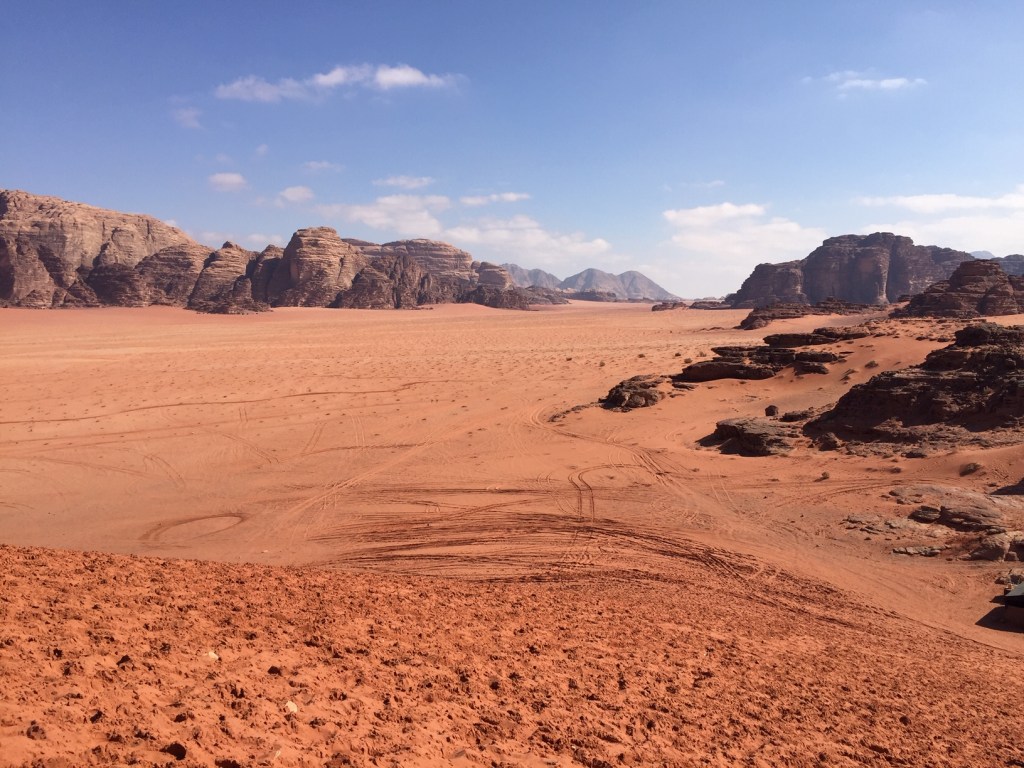
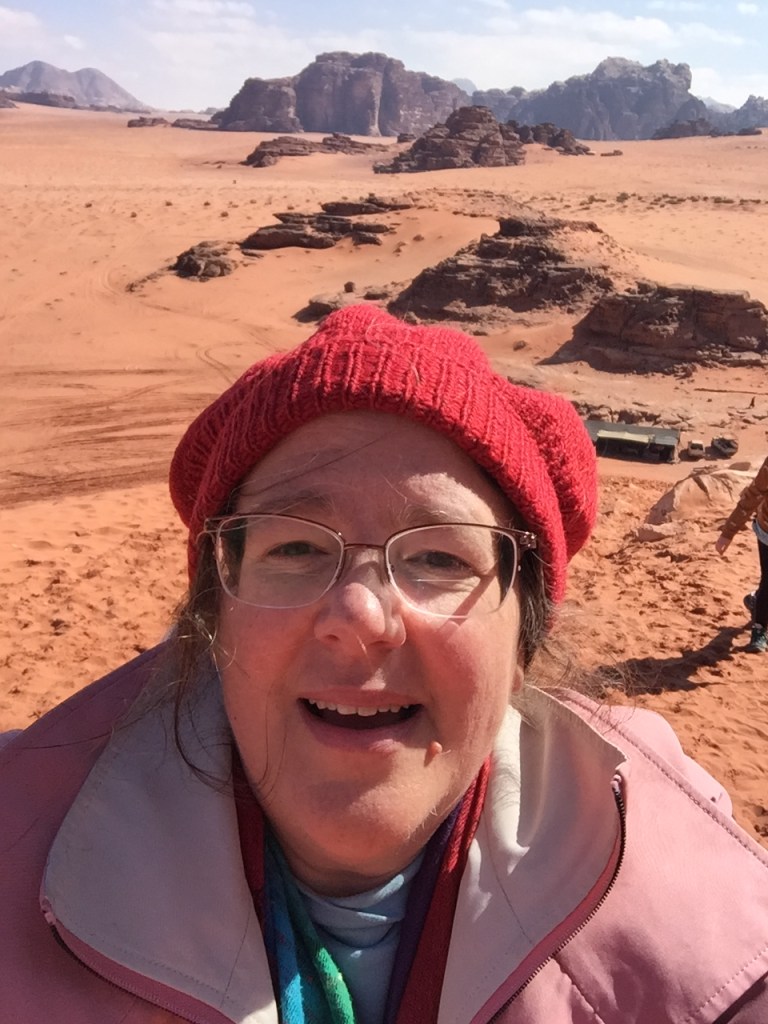
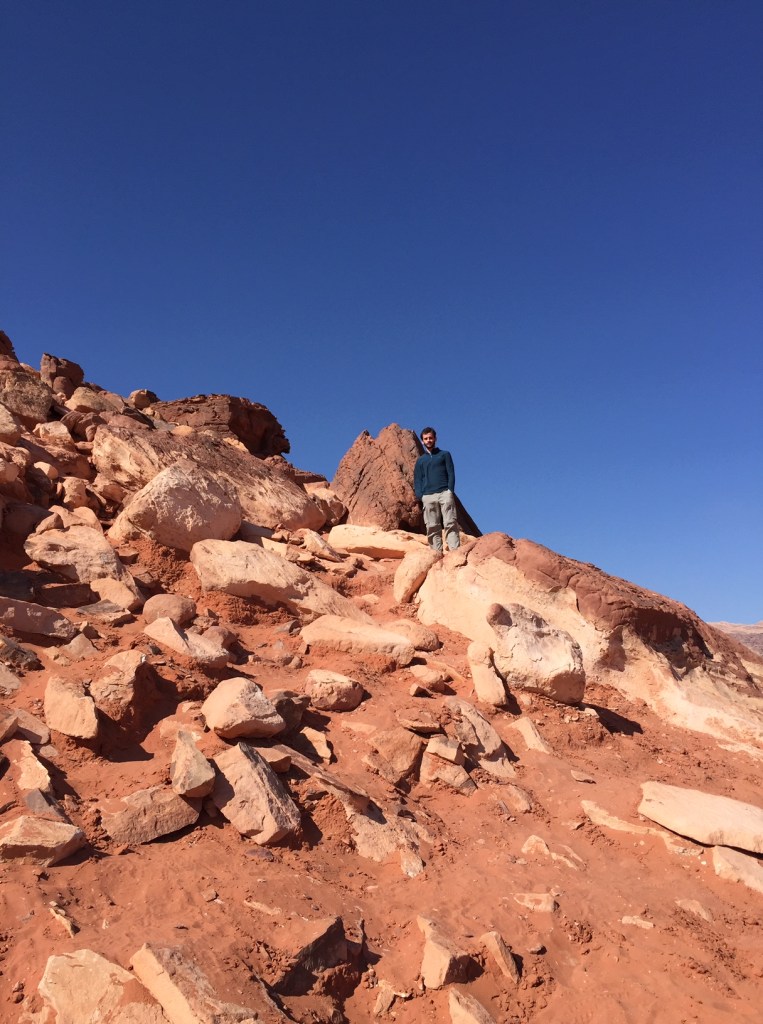
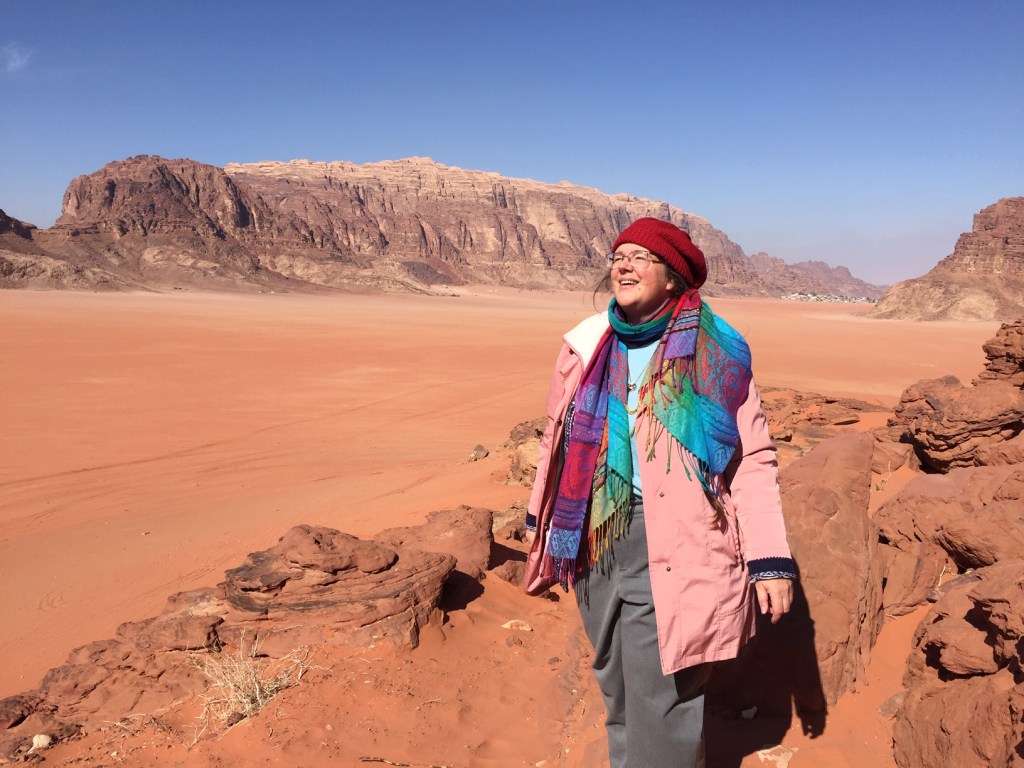
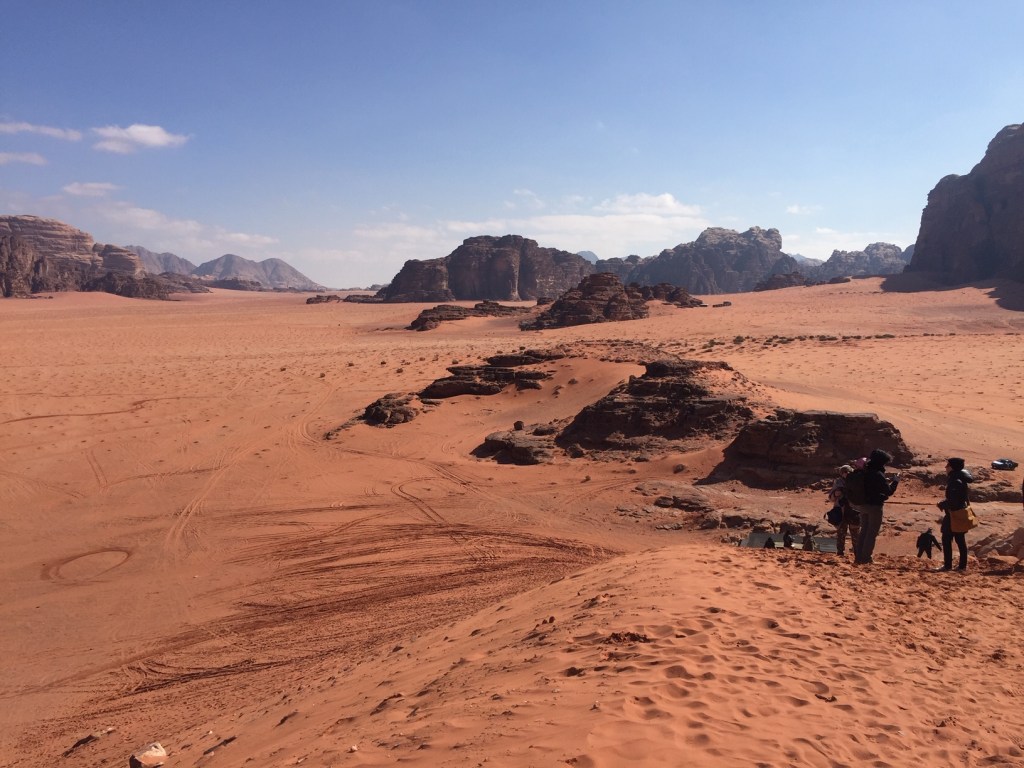
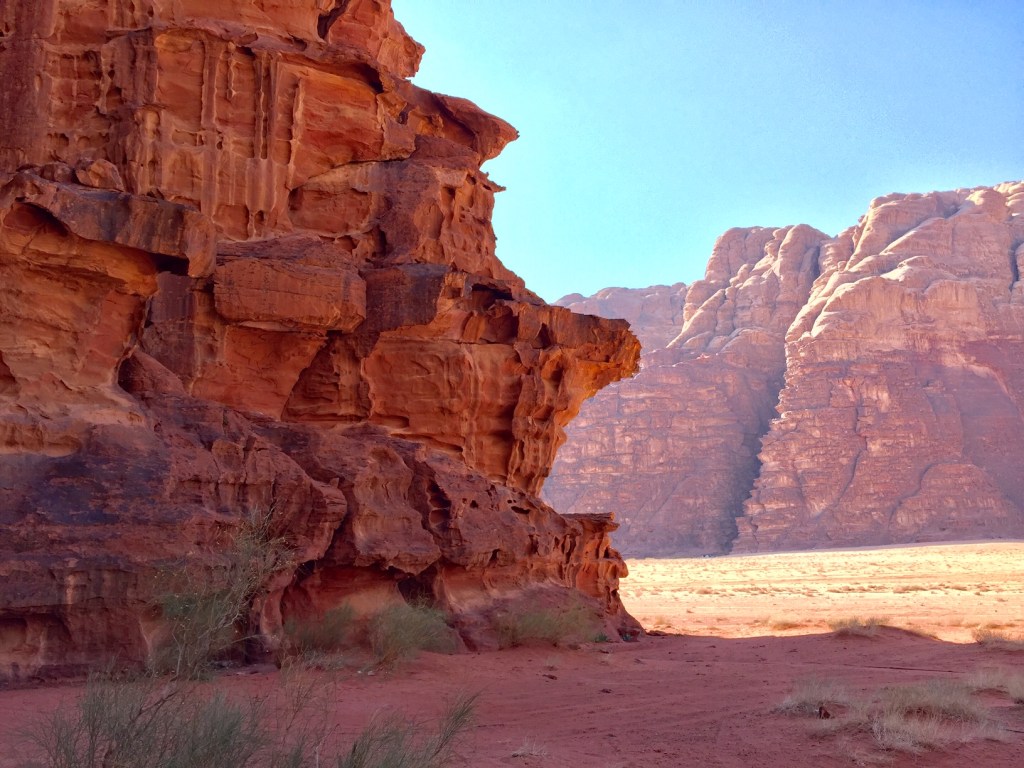
We drove on across the red sand. From time to time we could see encampments tucked against the foot of the towering rock formations — groups of twenty or thirty Bedouin tents, or in some cases more modern tent structures. These are tourist camps where people come to stay when they are on hiking trips or are in the desert to view the vivid stars at night. Film crews also camp in such places. Wadi Rum is now protected, though, and so a lot of the filming happens in other nearby desert areas. We stopped again, this time to climb a towering heap of red sand and get a view across the desert. Hagai went up like a mountain goat, and I slowly clambered after him. A group of Italian tourists was going up at the same time, exclaiming volubly in their native tongue.
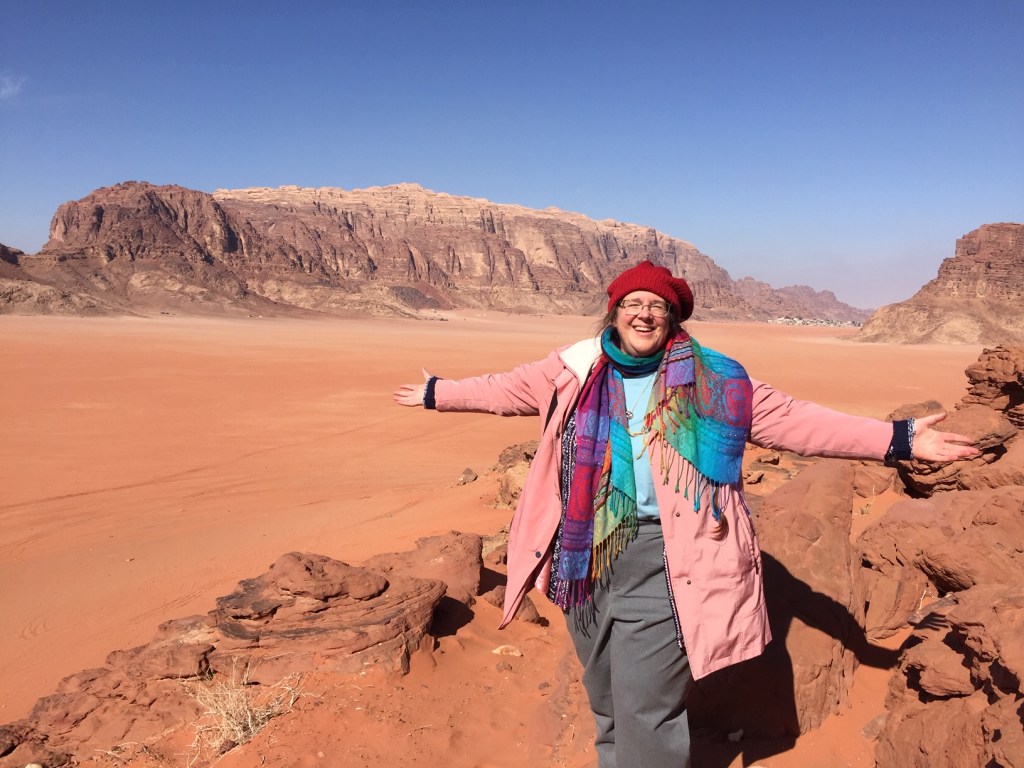
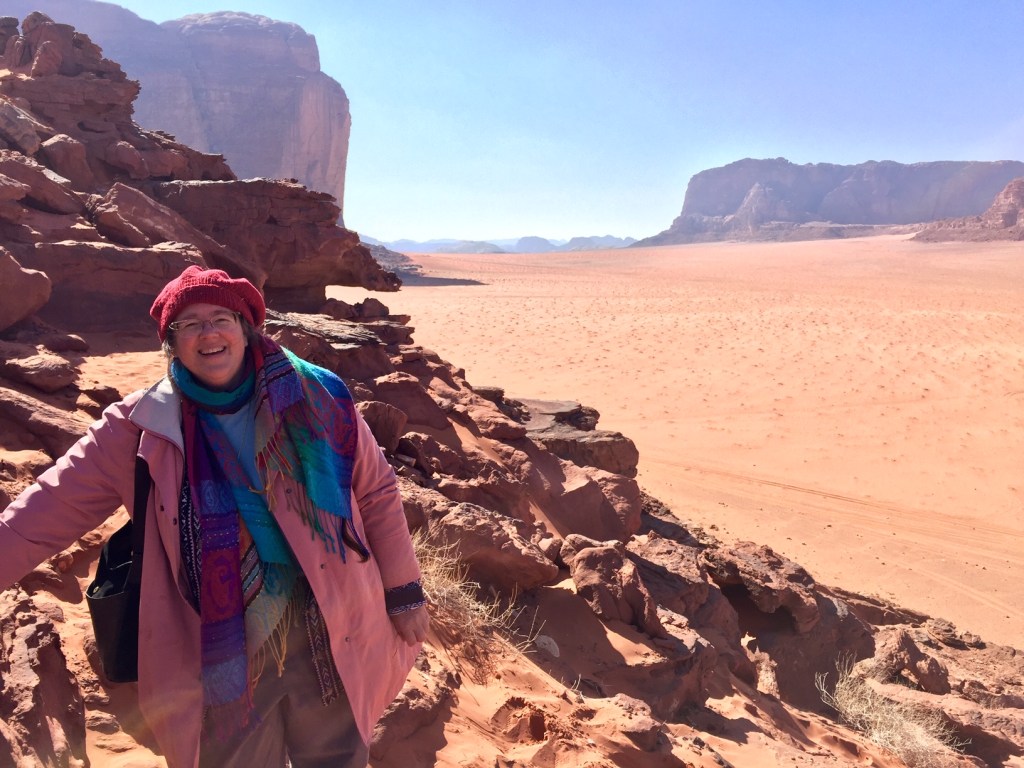
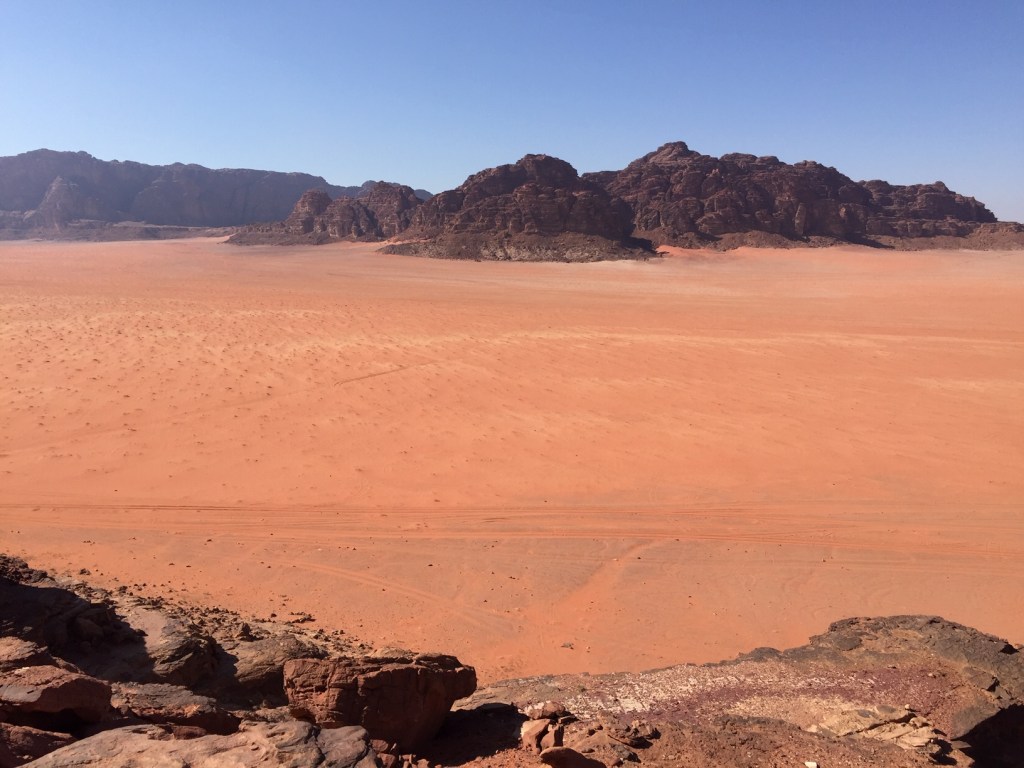
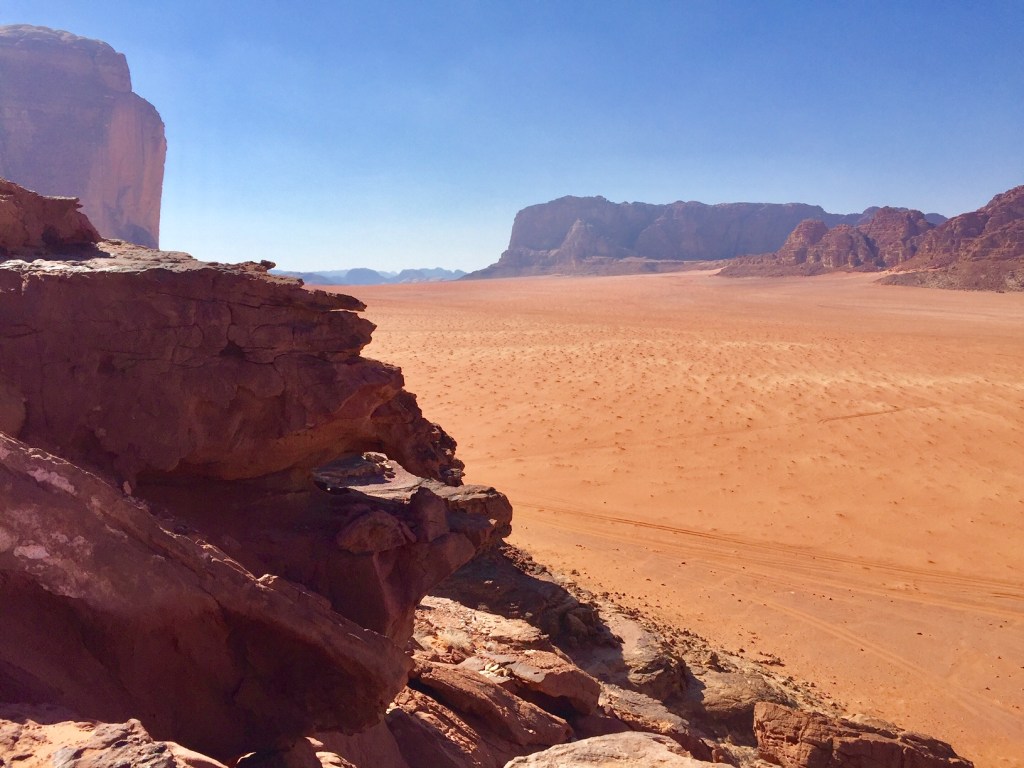
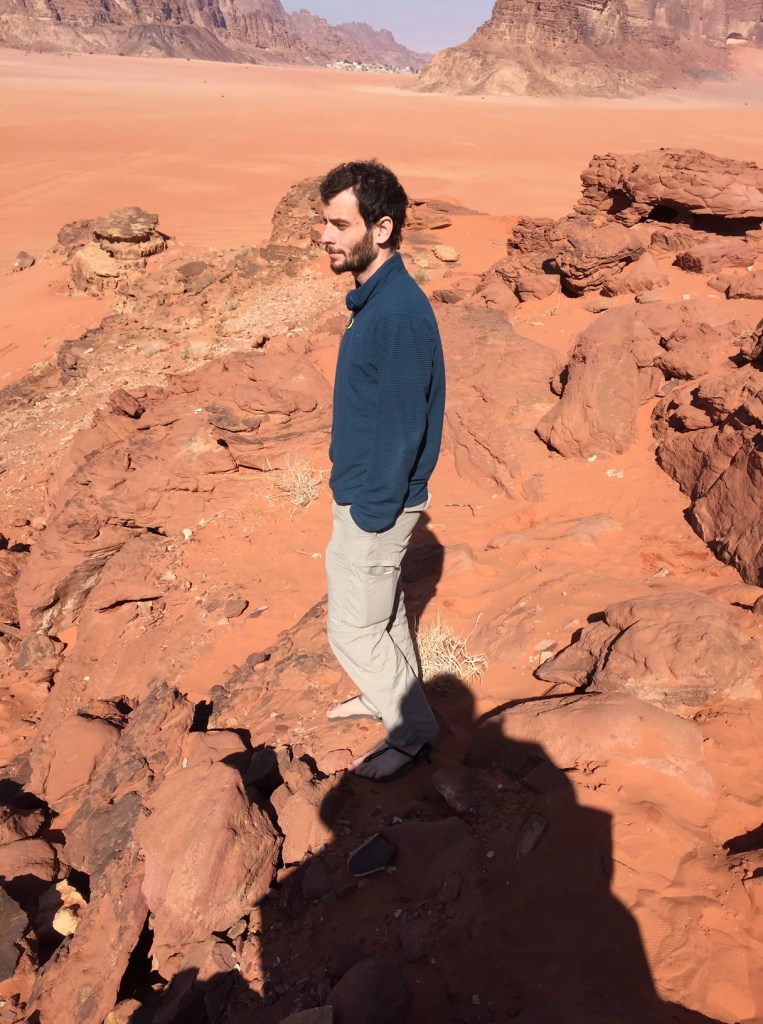
Tourist camps against the foot of the rocks.Well-trodden pile of sand, climbed by many tourists a day.Hagai goes up ahead of me. This photo gives you a clue how steep it was.Views on the way up…Astonishing natural rock formations.Looking back down at the gift shop at the foot of the sand pile…… and out to the desert beyond…Documenting that I had made it thus far!Hagai encouraged me to come up a bit further……and took my picture……monarch of all I surveyed!In both directions!The view was really spectacular — yes, the sand is this red.Hagai prefers to wear flip flops in all circumstances. Explain to me why such an attractive young man (smart, too) remains unattached! He claims it is because he is too picky.We climbed back down
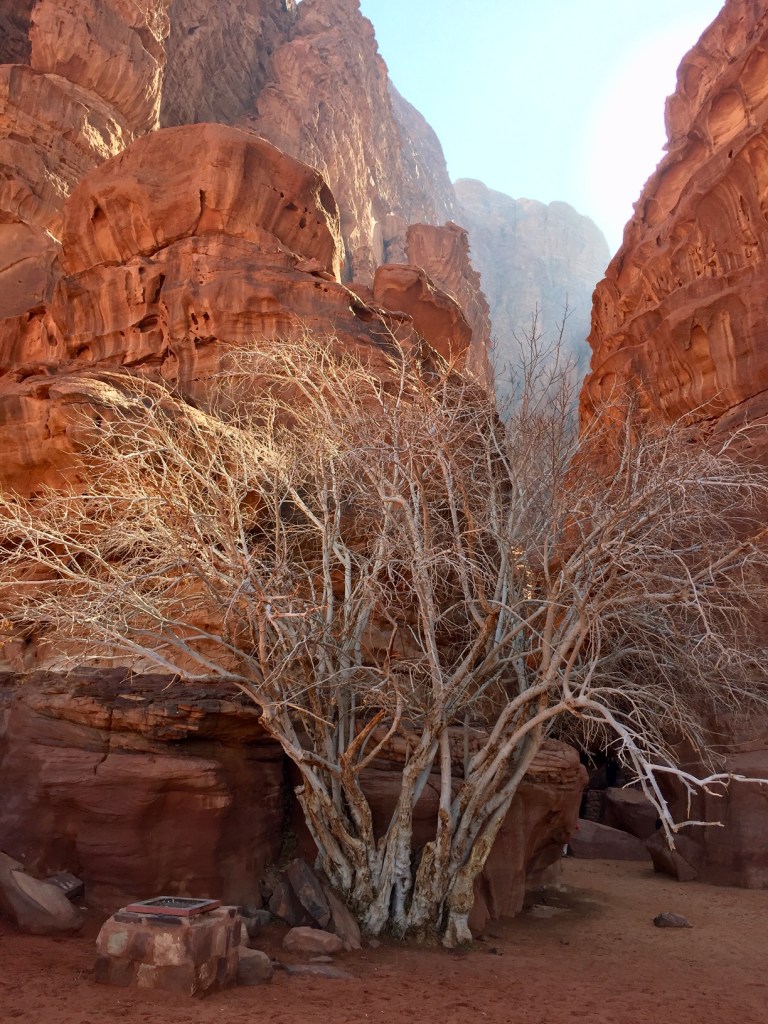
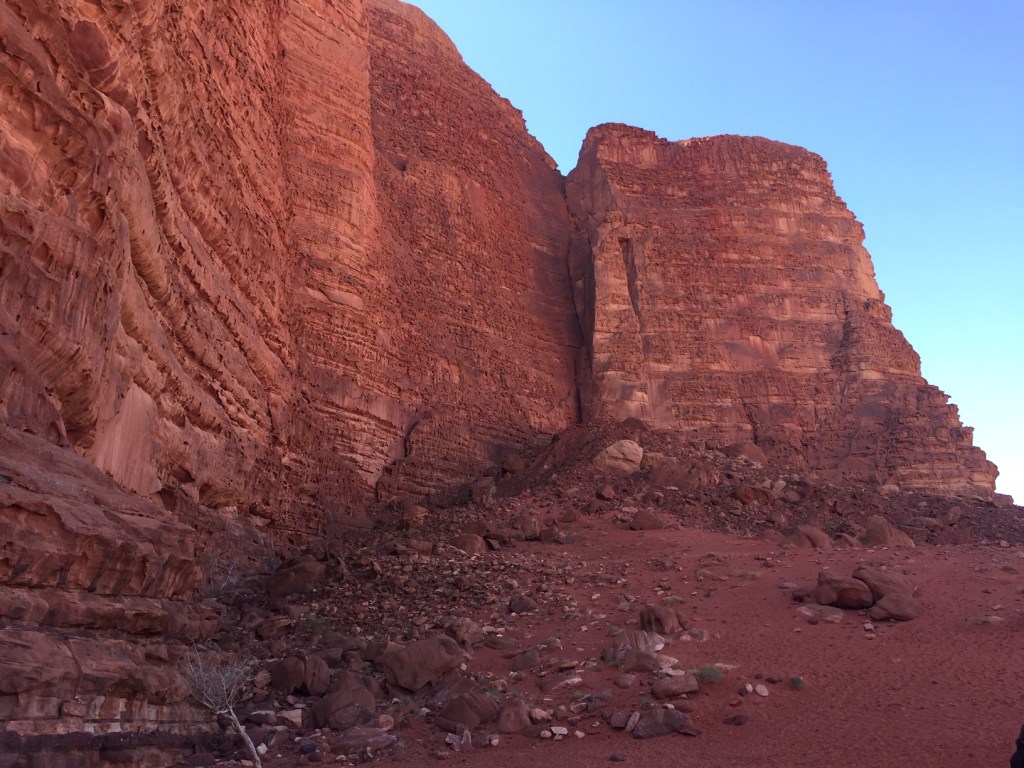
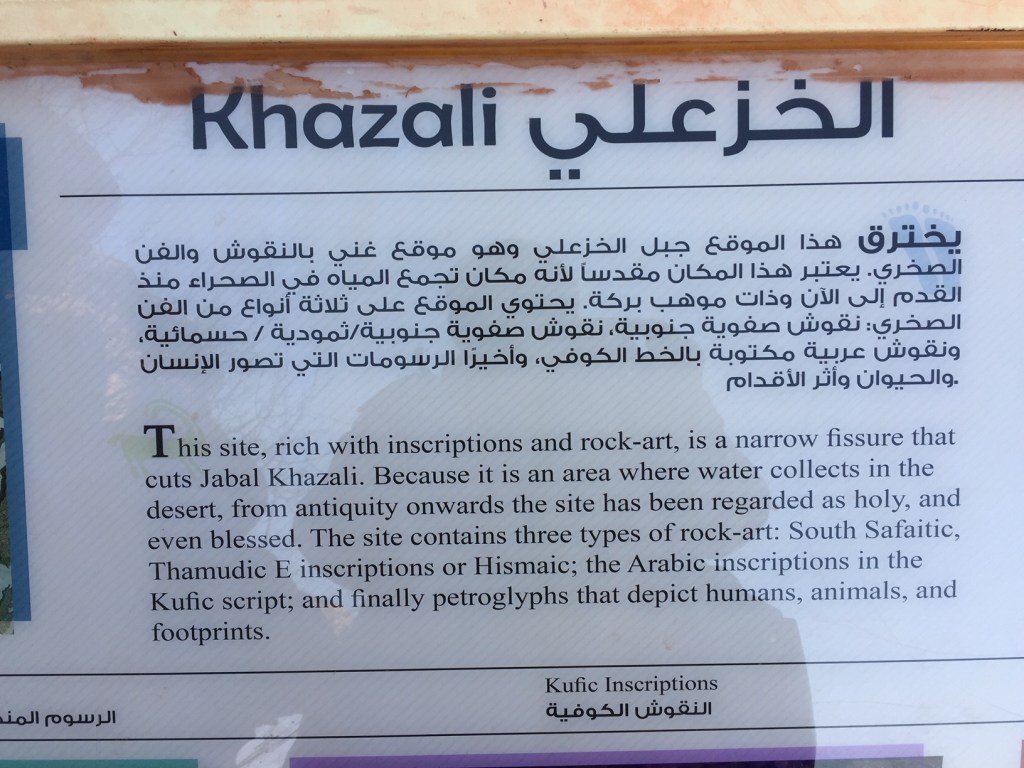
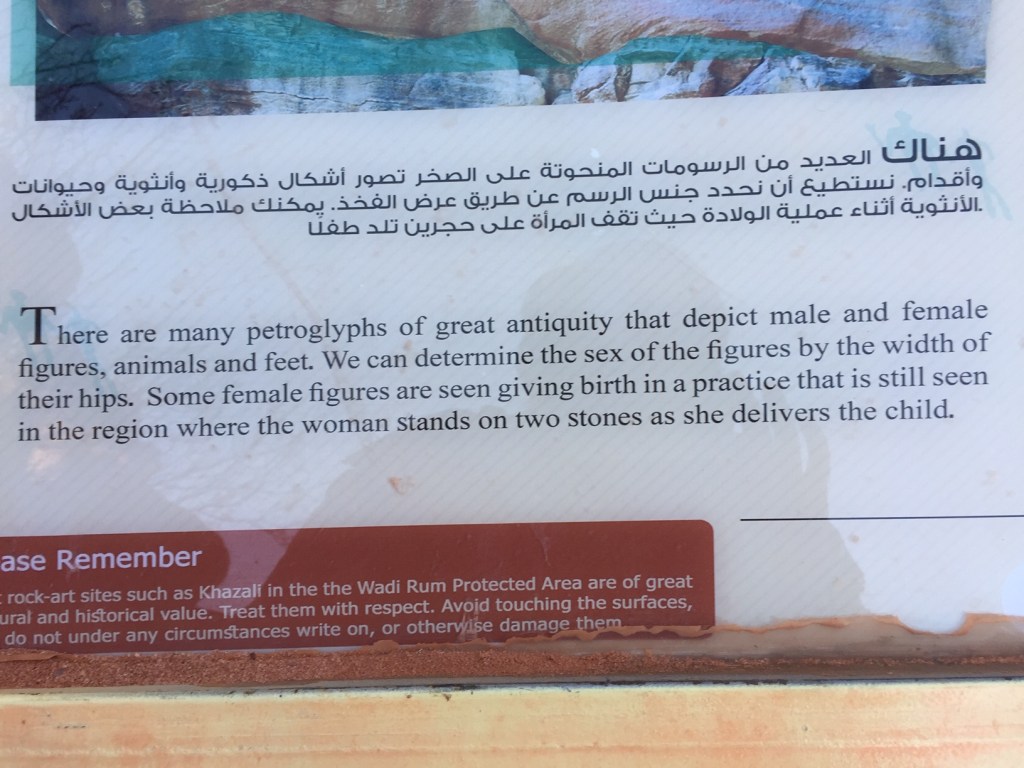
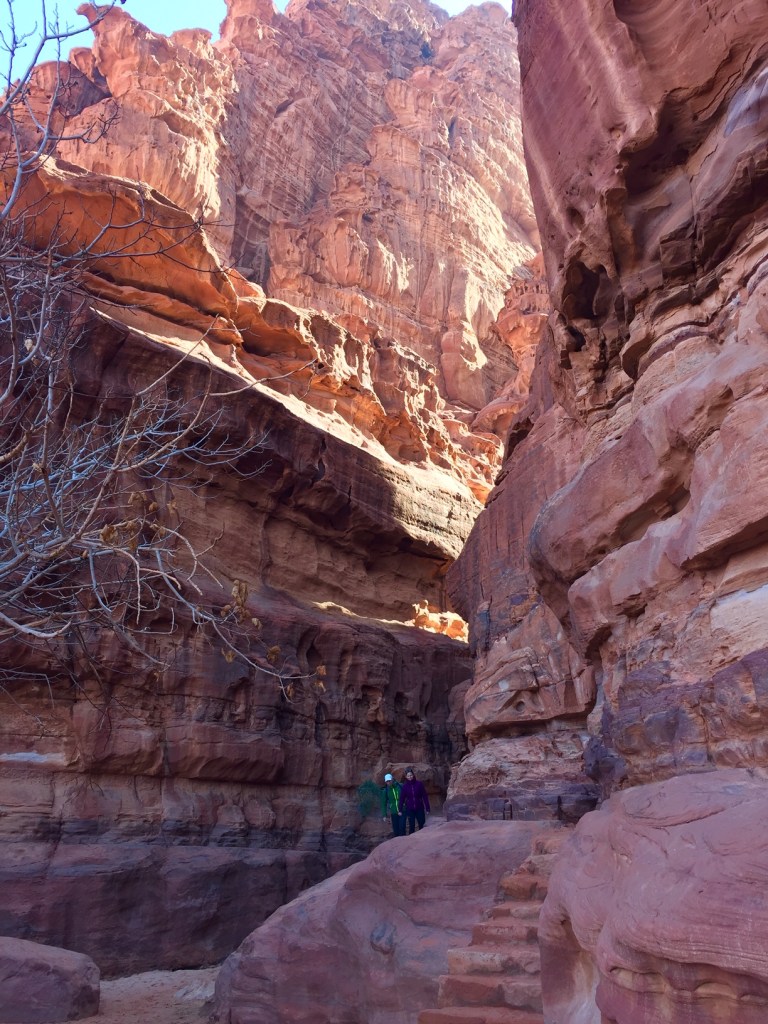
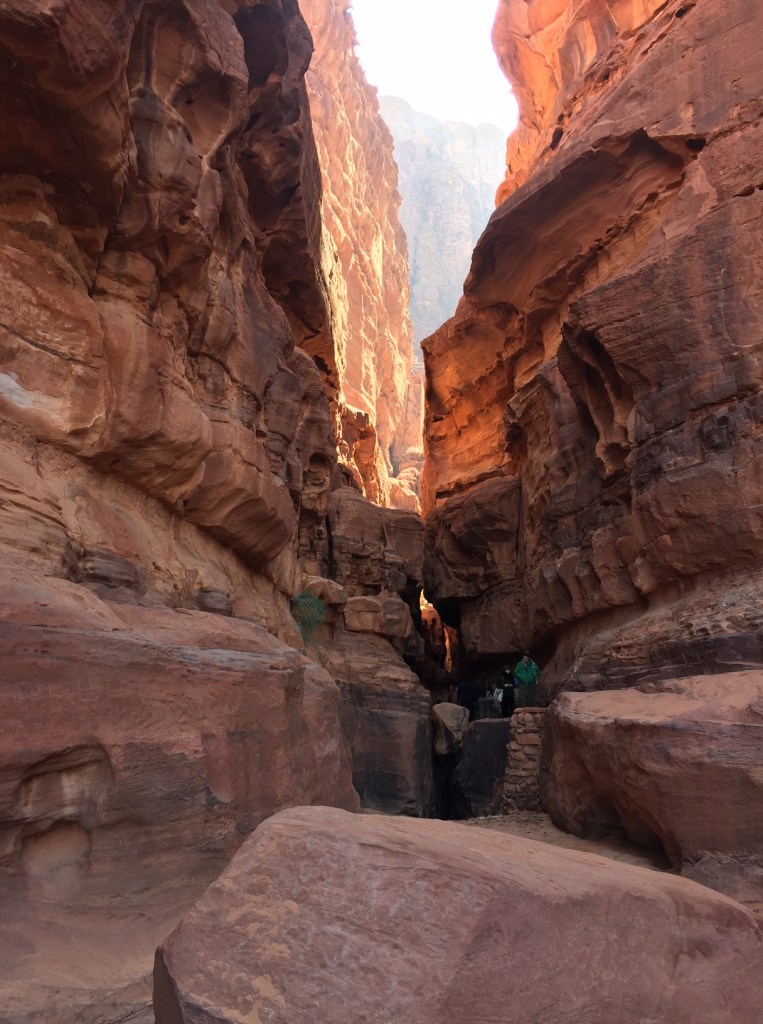
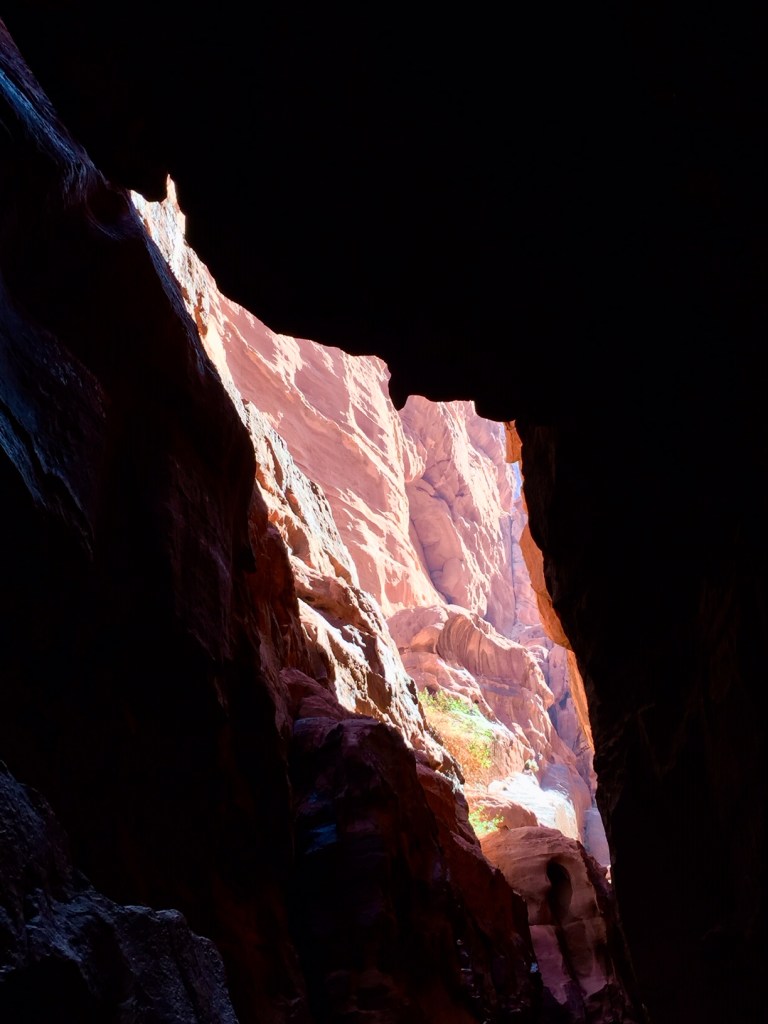
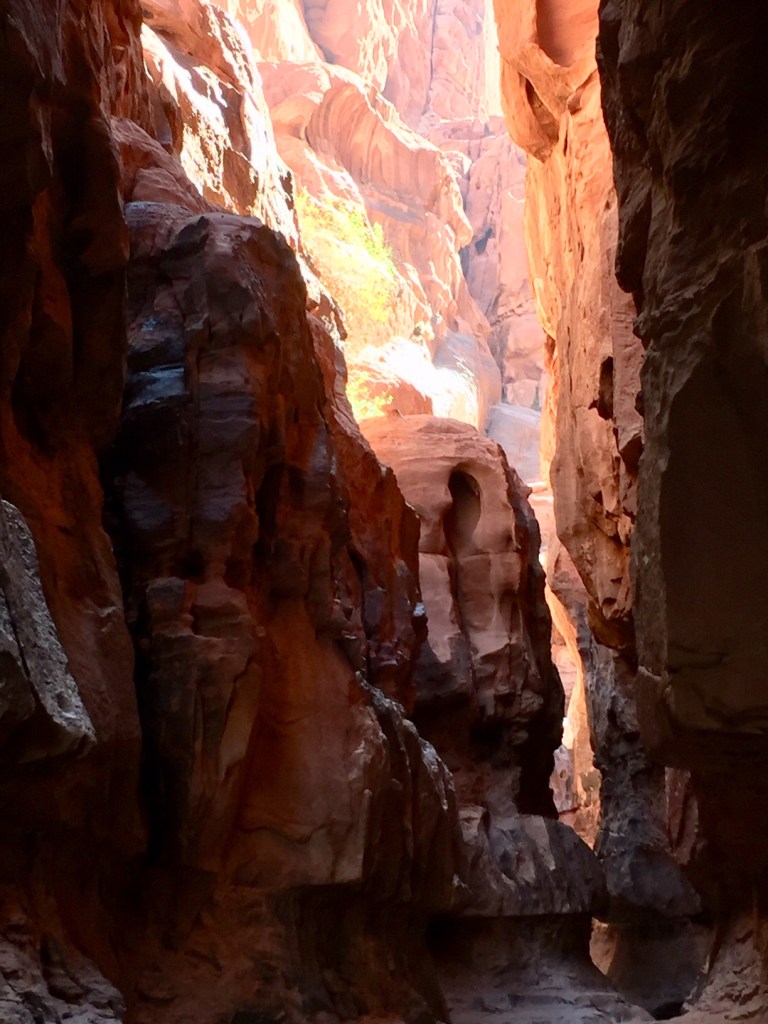
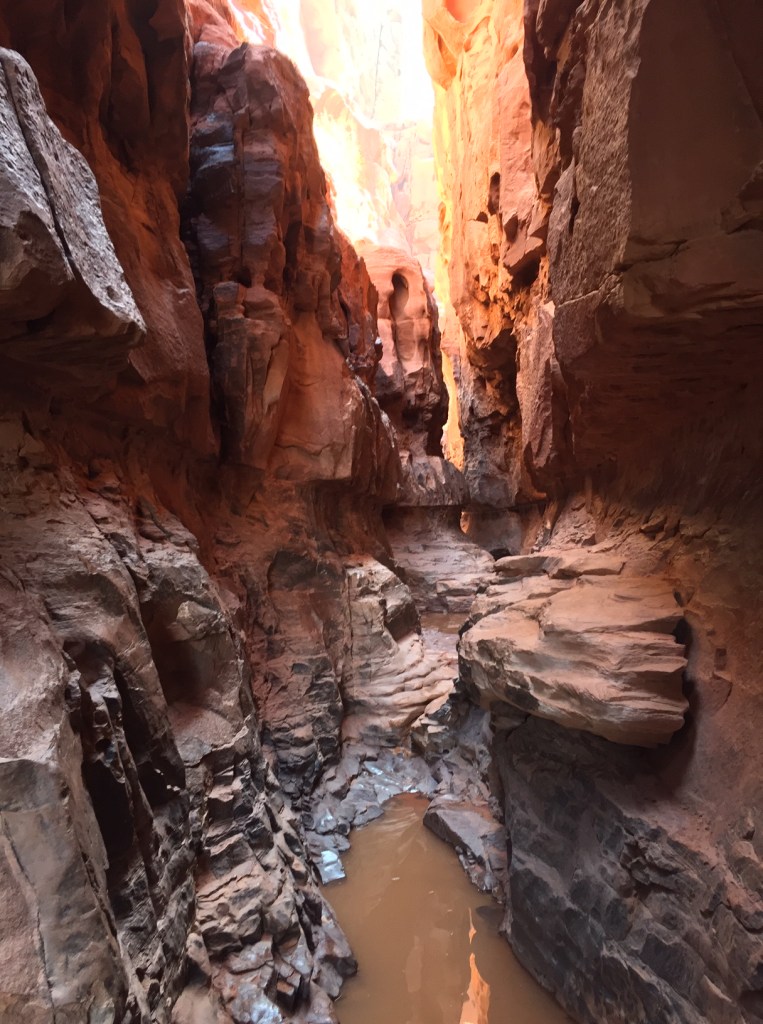
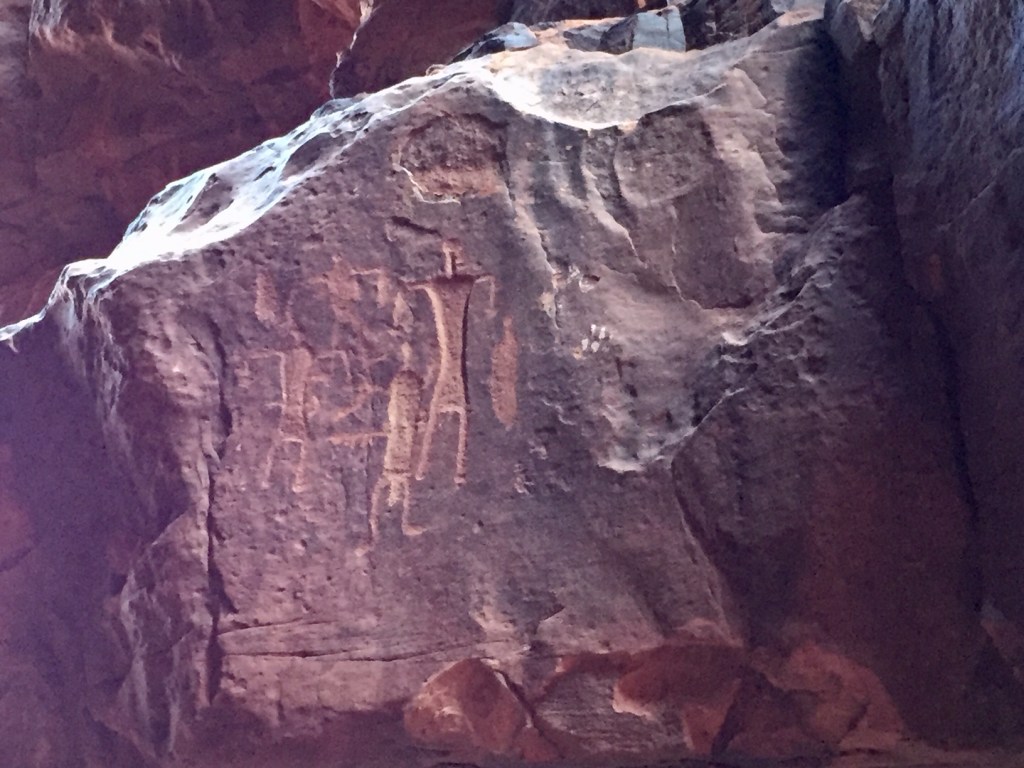
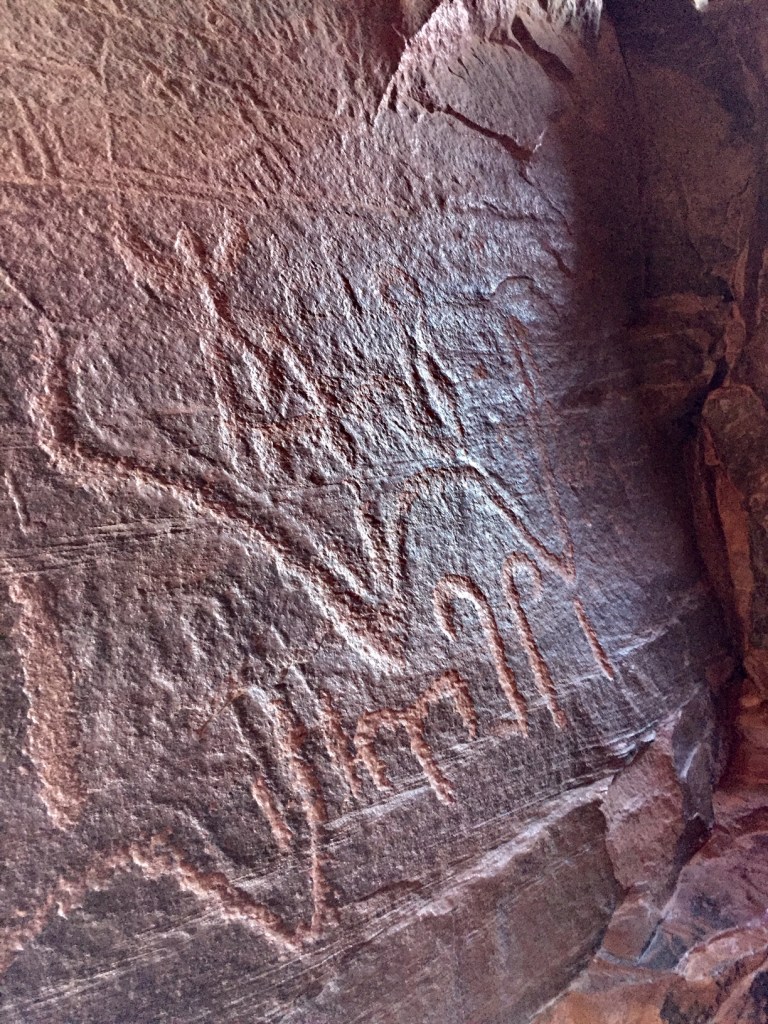
Our next stop was a narrow cleft in the rocks where there is ancient writing from three different civilizations.
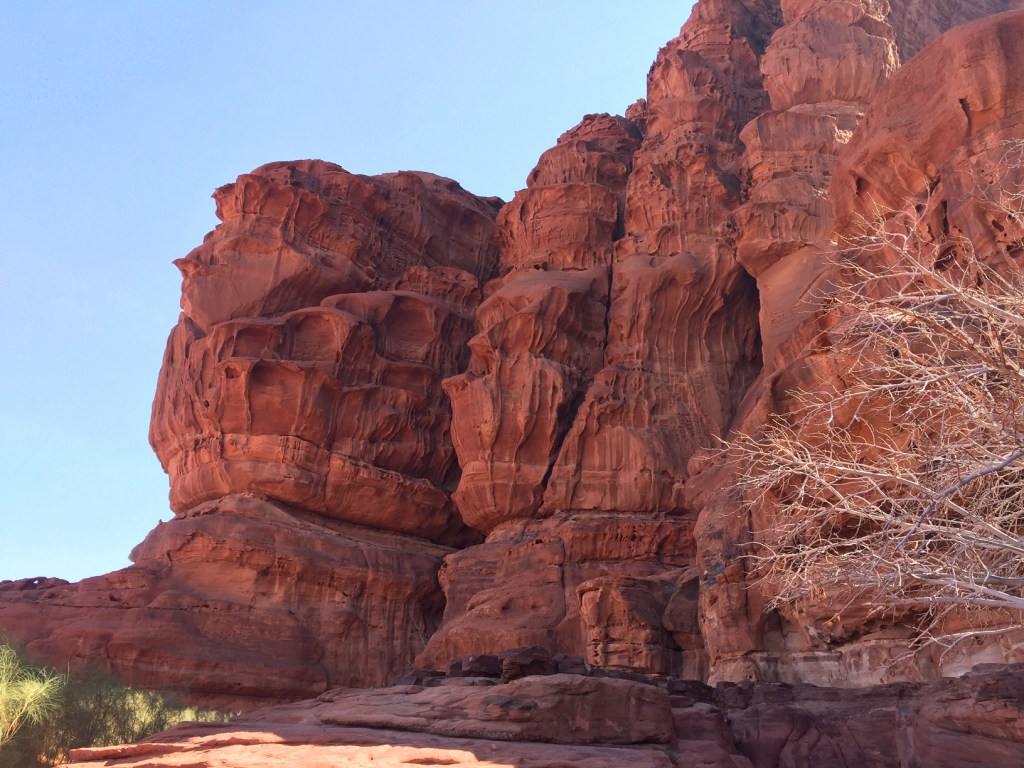
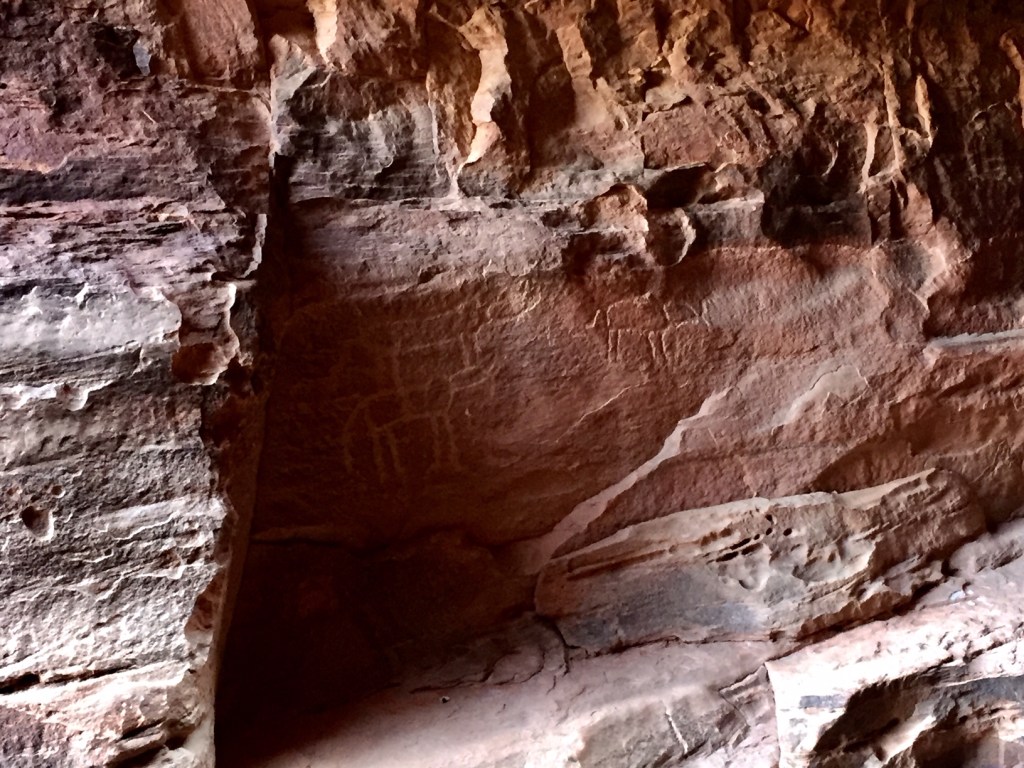
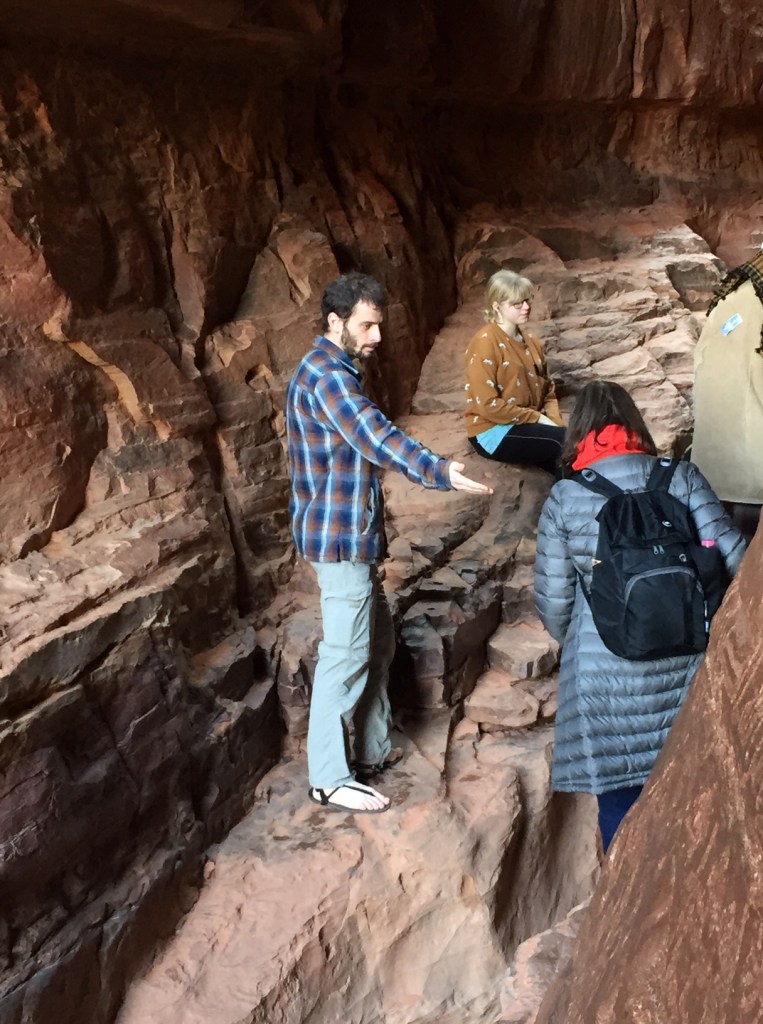
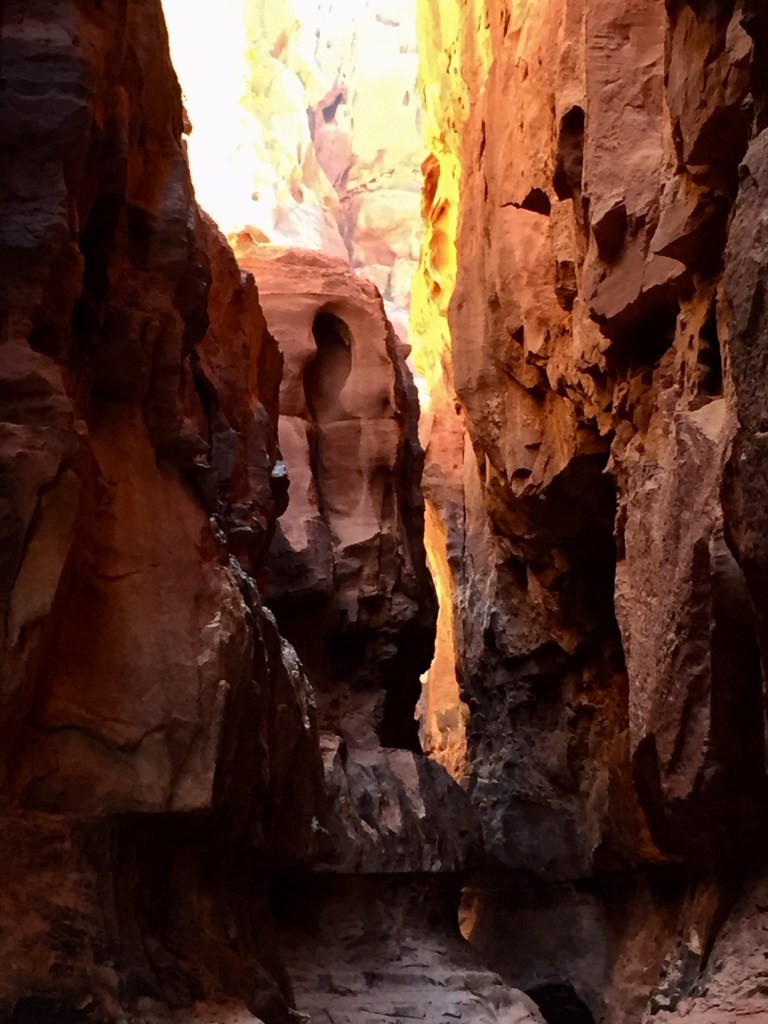
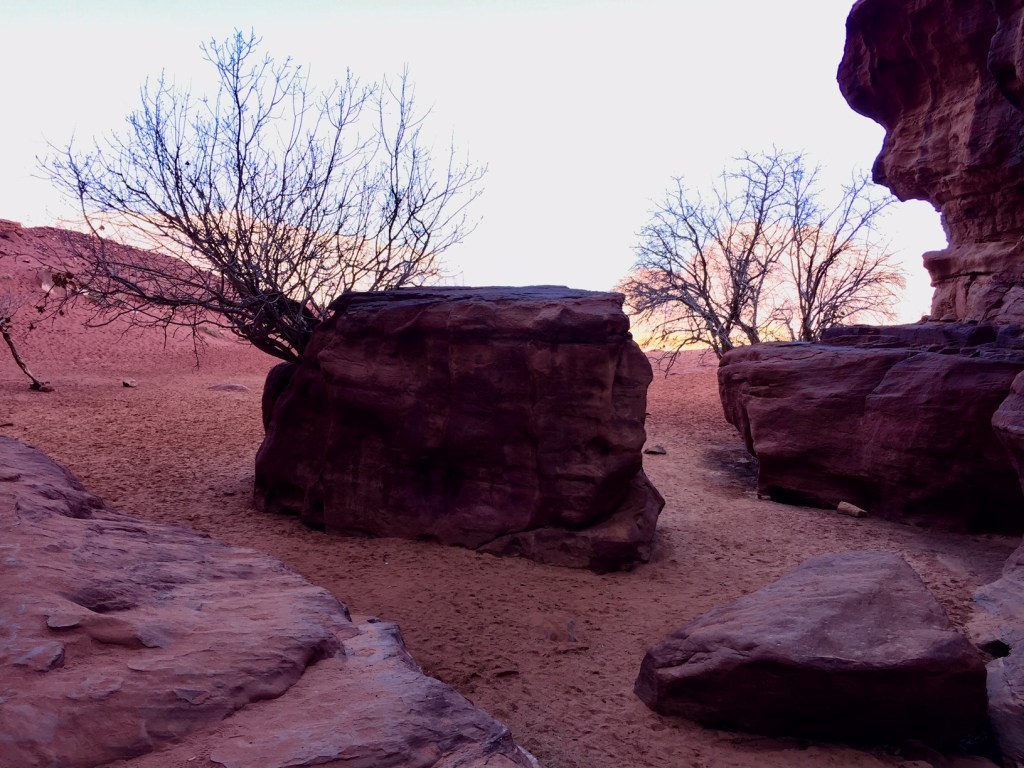
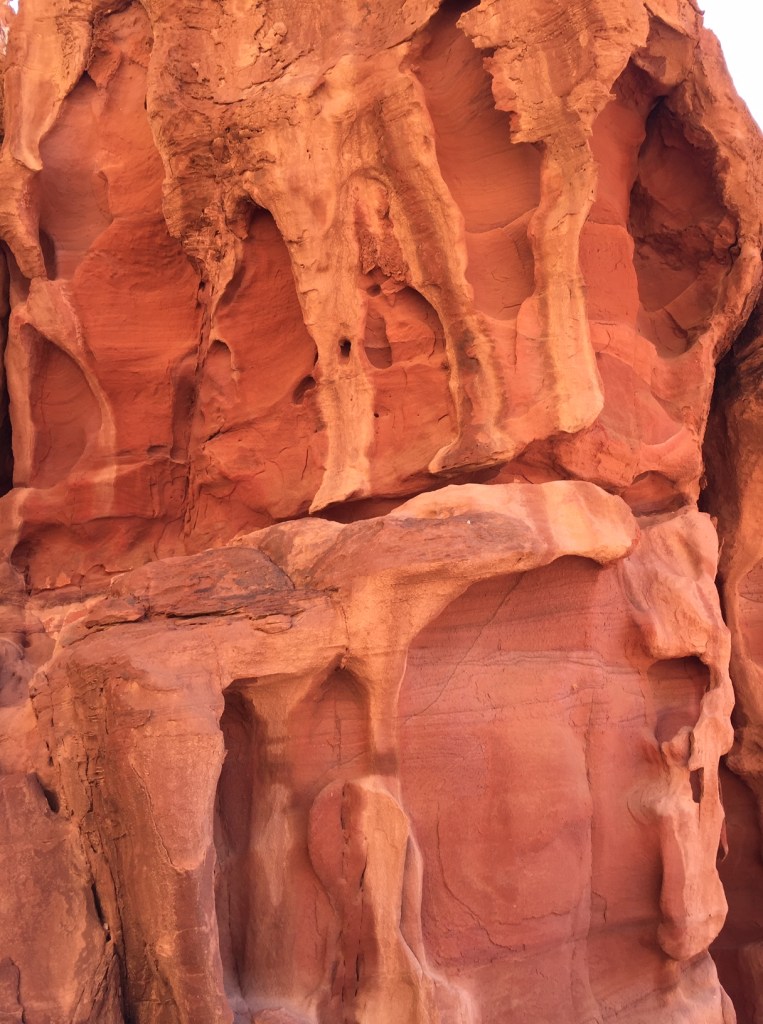
Ali informed us that he (and no doubt every other tour guide!) refers to this as “the melting chocolate mountain.”A dormant tree guards the cleft.To the right and the left, cliffs loom.You climb the steps cut into the rock, and walk along the narrow ledge into the canyon.PetroglyphsEver the gentleman, Hagai assists DeborahEver the skeptic, he wonders if all the writing in the rocks is really ancient, or whether it may have been “assisted” by modernsAncient Arabic scriptPhotographs can barely capture the sombre beauty of the place — the cool dampness of the cleft in the rocks, the glory of the sun beyond…We emerged to this……and this.
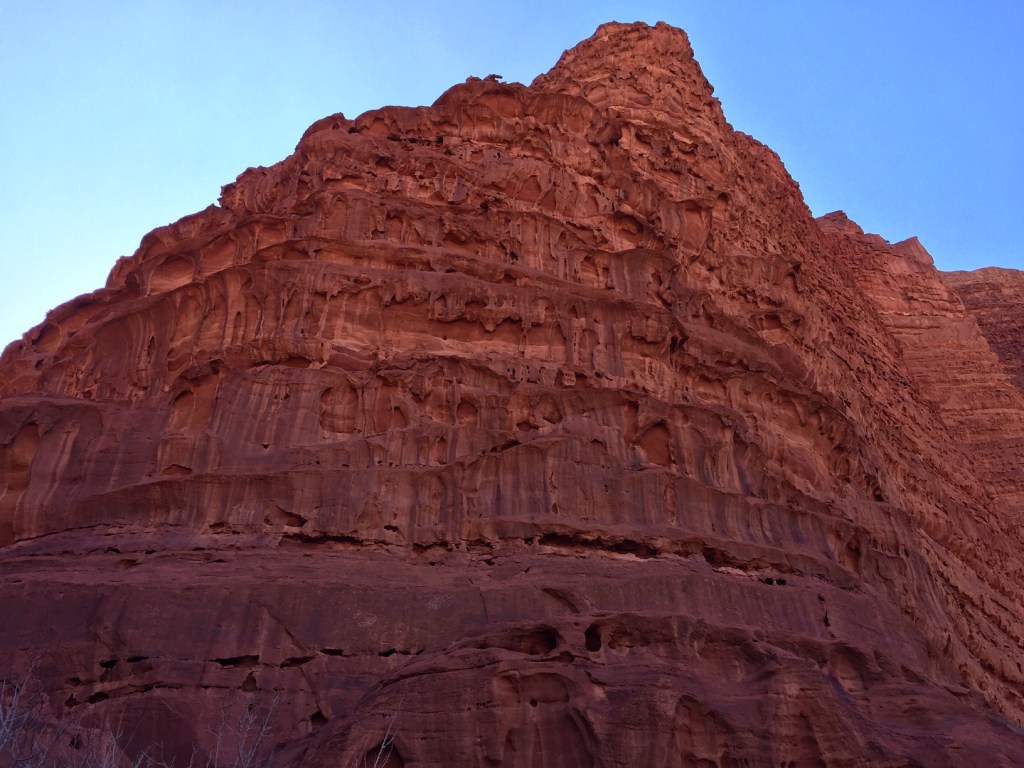
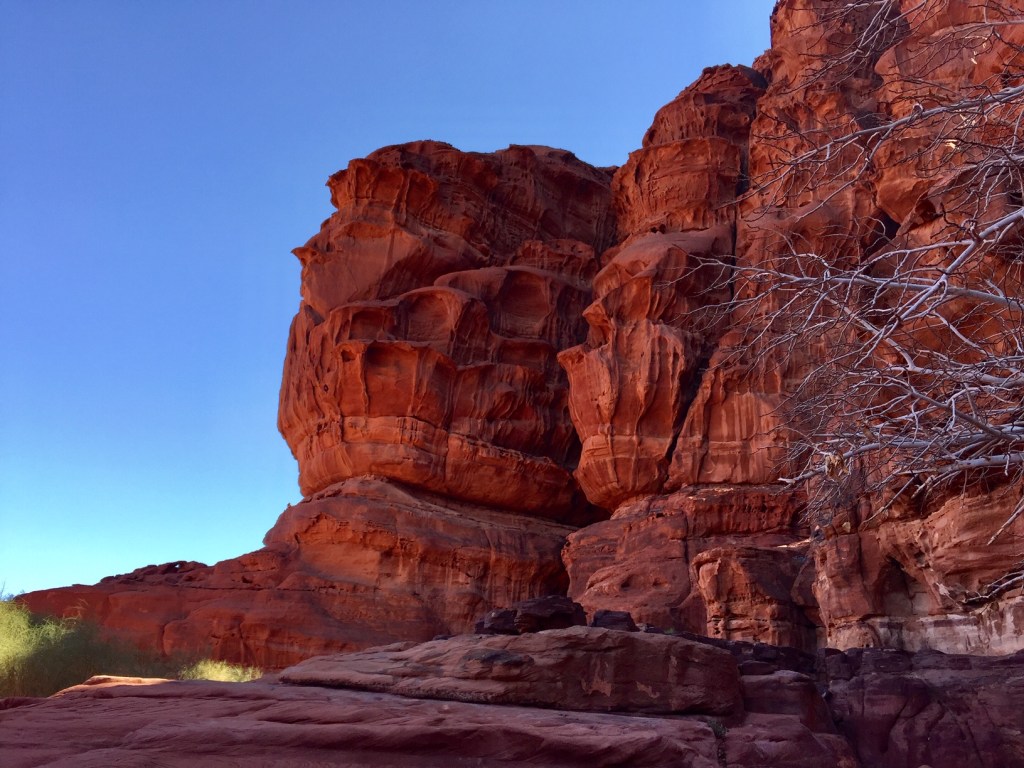
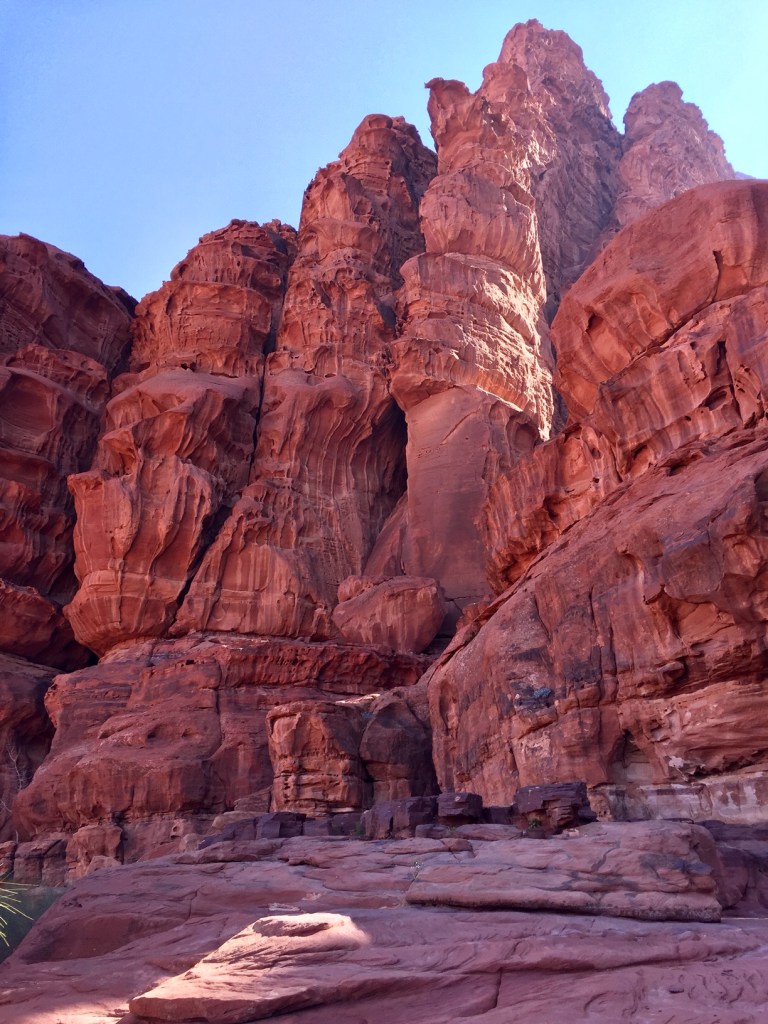
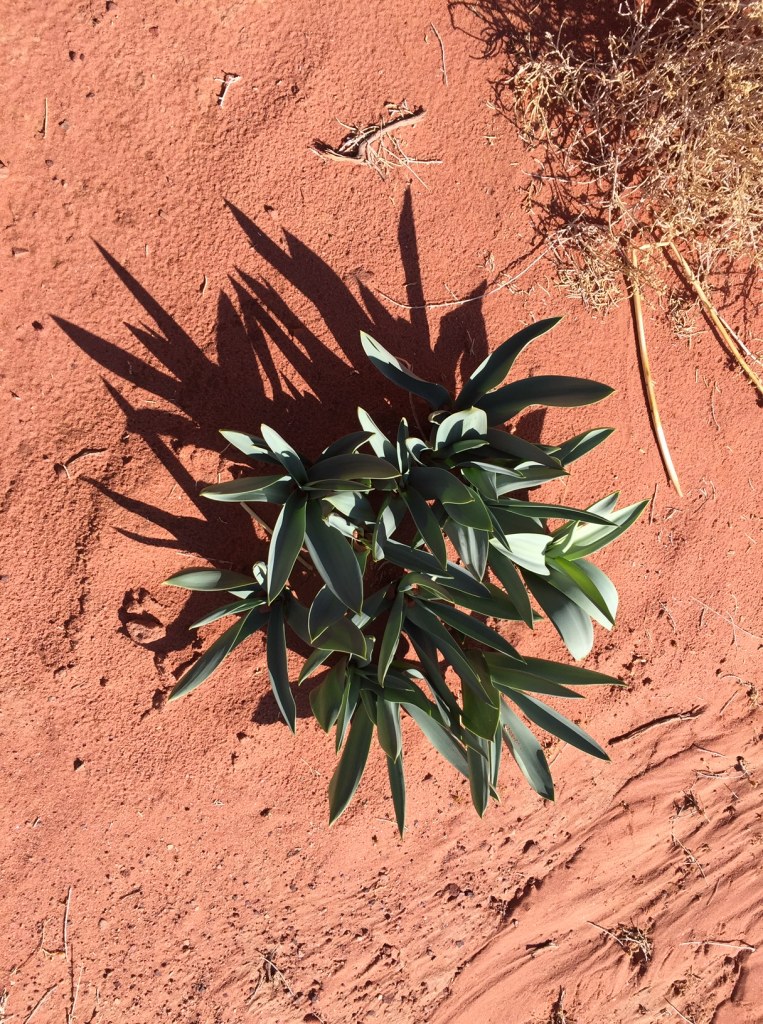
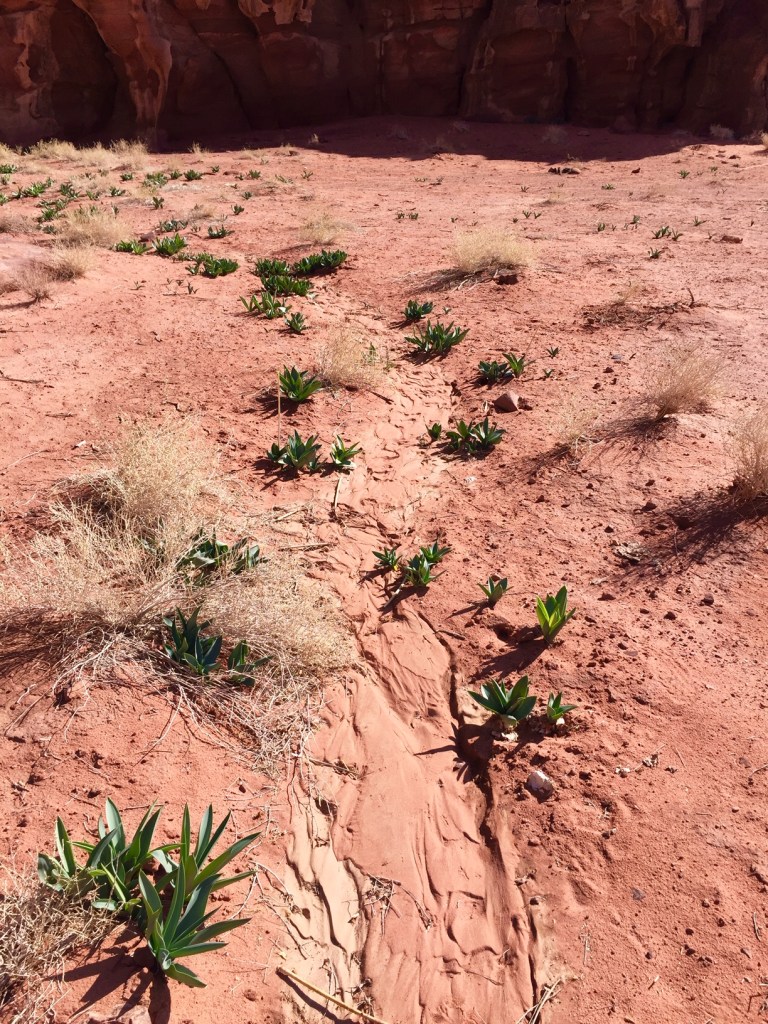
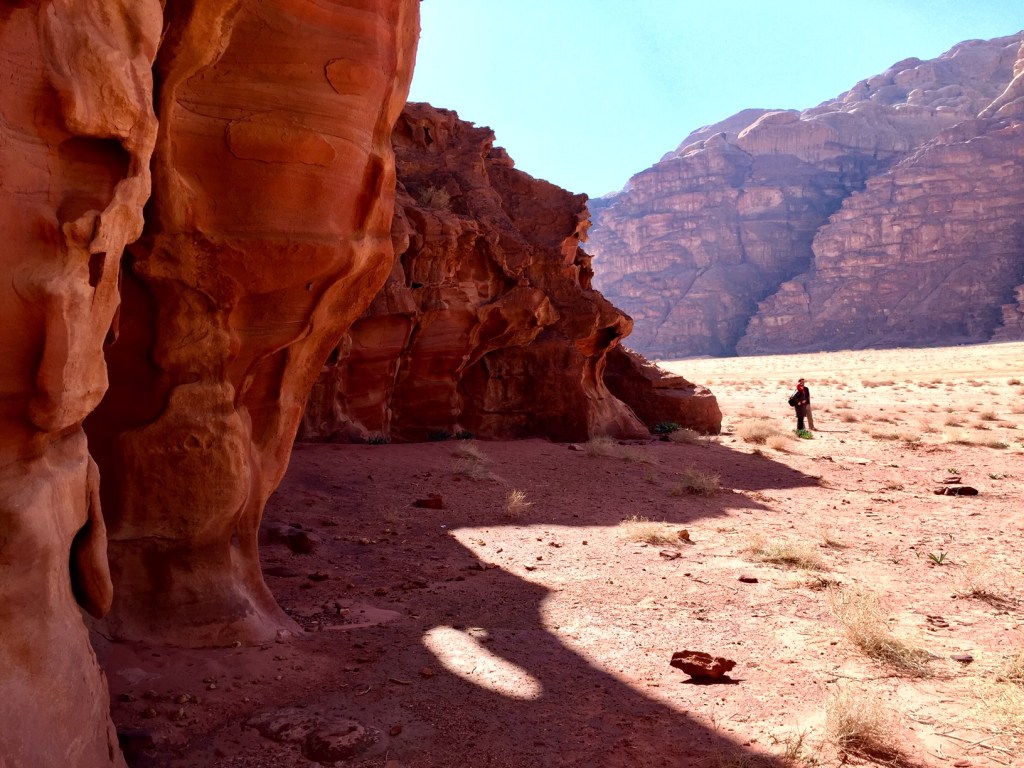
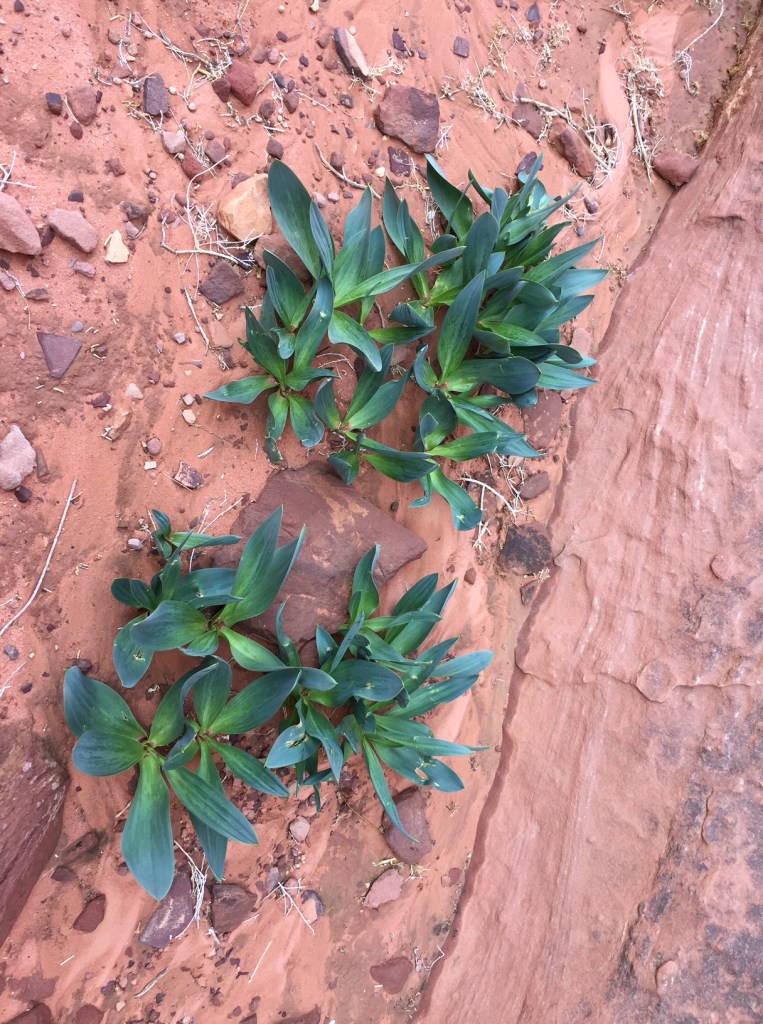
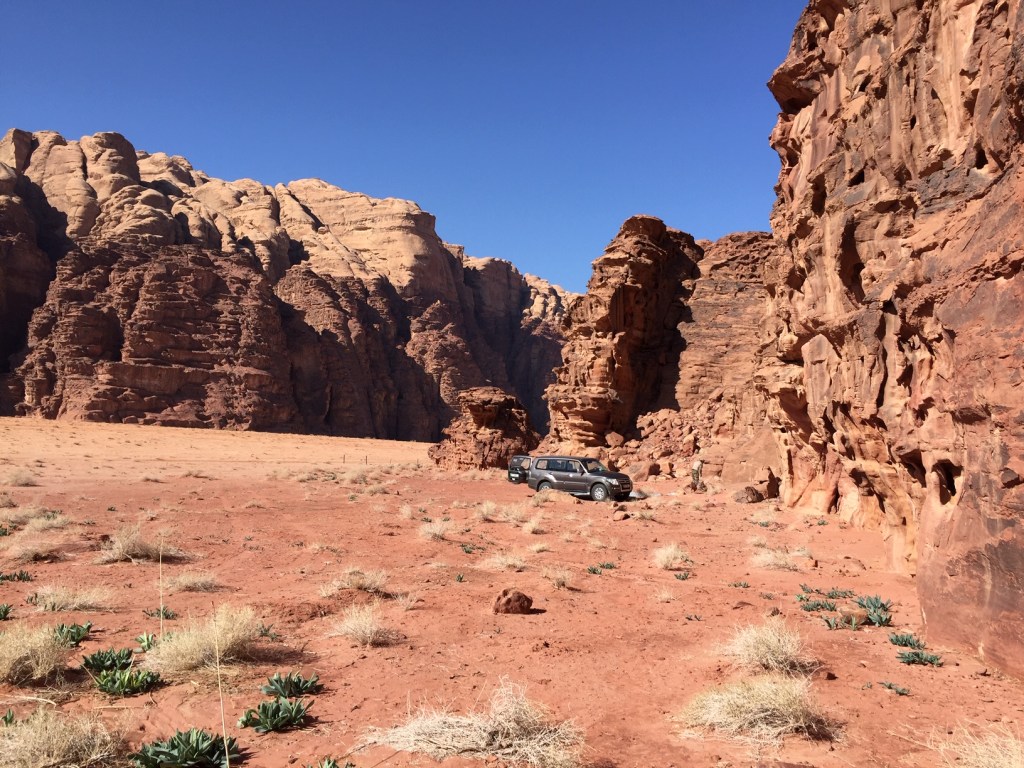
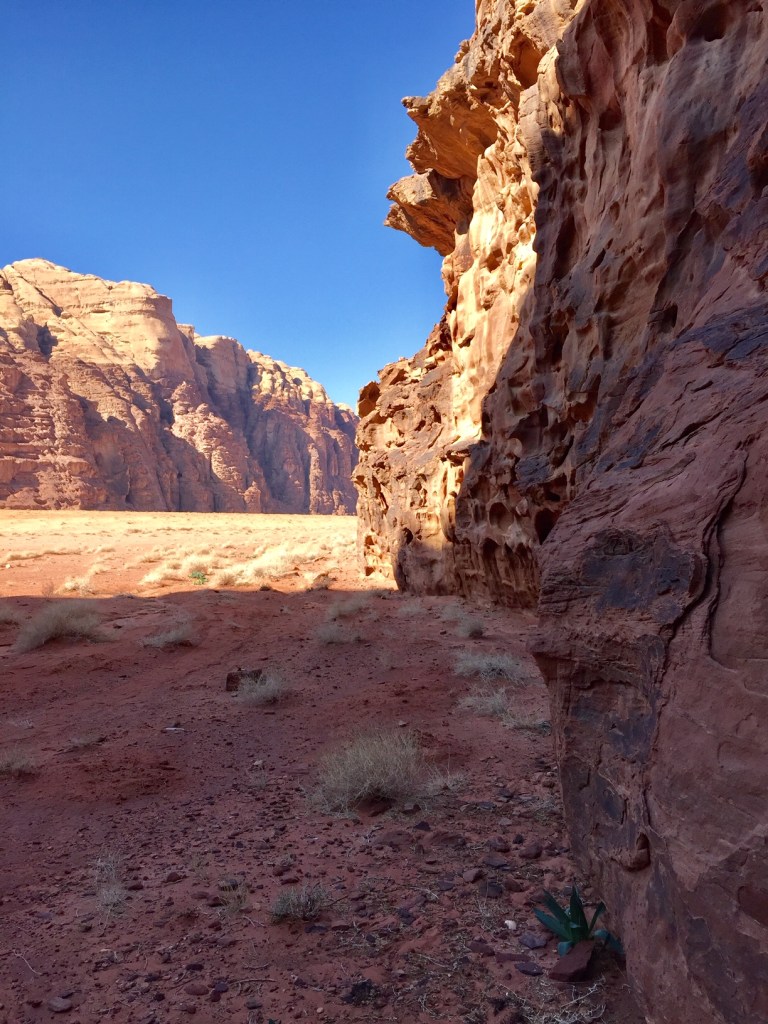
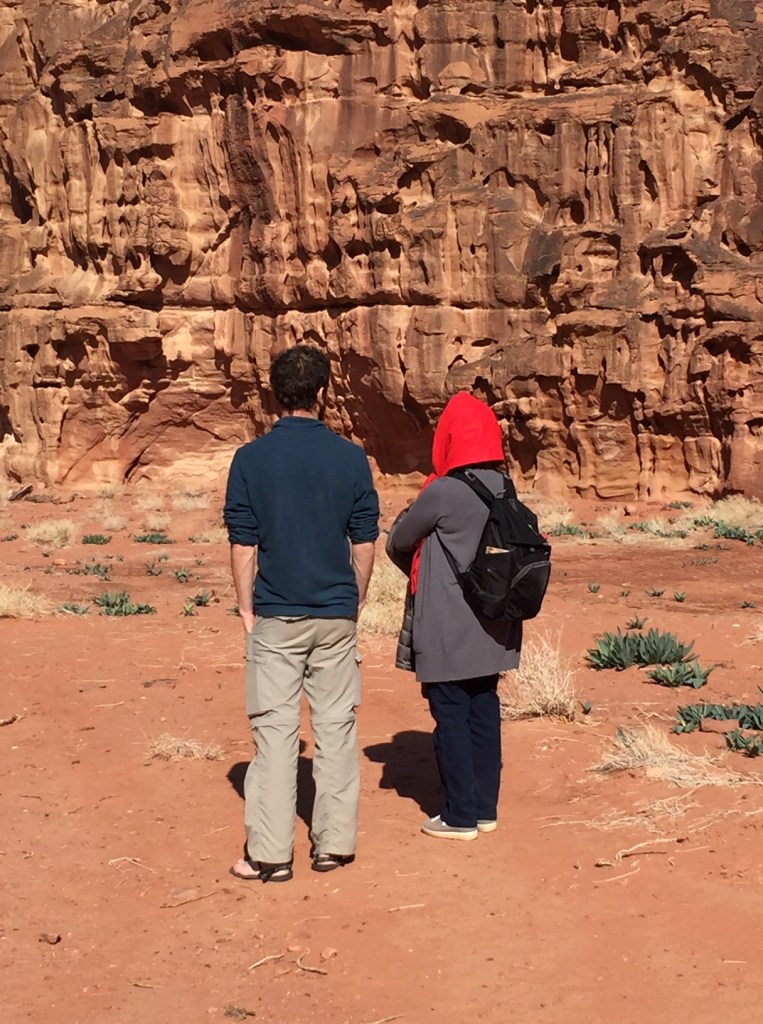
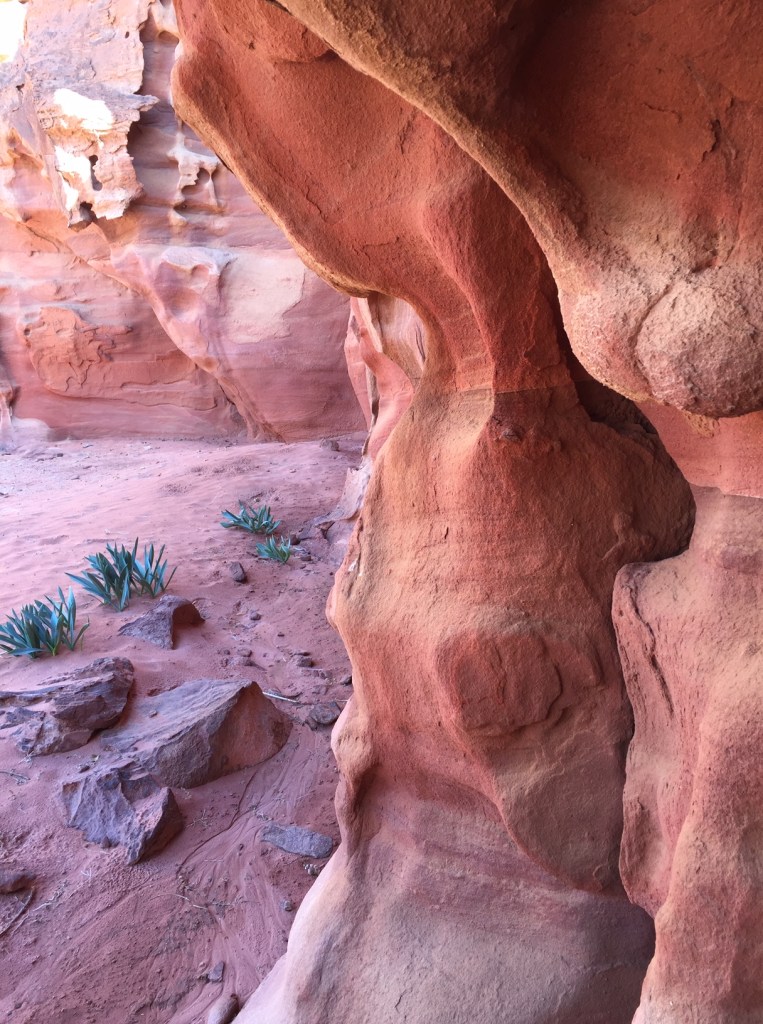
From here our guide drove us further out into the desert, stopping at last in a sunny spot against the rock. He shooed us away to “go about”, and set about making a fire to cook our lunch. I wondered if perhaps for a former commando and a mountaineer, cooking lunch for a bunch of tourists — and Jewish ones at that — might feel a big ignominious. We each wandered slowly across the sand. It was fairly warm in the sun, but chilly in the shadows. Rosettes of green leaves ere poking up out of the red sand. The silence was complete.
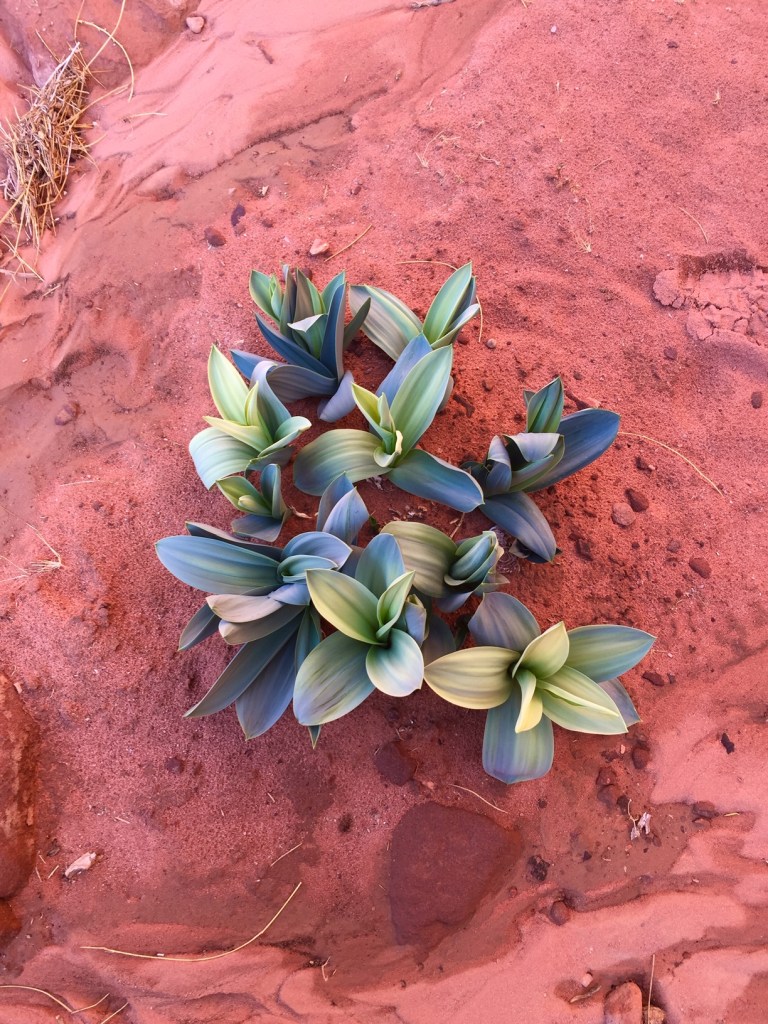
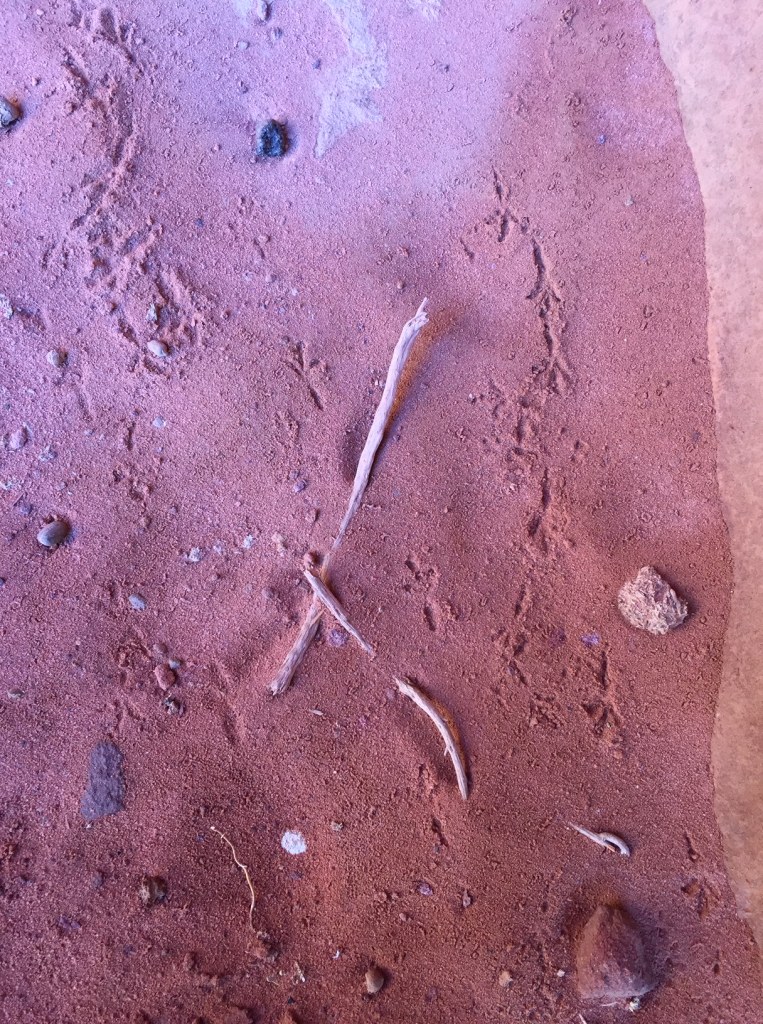
I was fascinated by the lively green against the red dust. I thought these were maybe tulips, but I found out otherwise.Ali and the Jeep. Notice the long dry stalks poking up from the rosettes of leaves. These are easily 2-3 feel tall.It’s worth noting, I guess, that this is not a pristine space. There is evidence of many tourists — in the crannies of rock you find all sorts of trash. In one spot I found a Bedouin tent that had fallen over.You can see the tire tracks. From time to time, a vehicle would pass.Exploring — and waiting for our meal.It was extremely easy to take beautiful pictures in this landscape.There is life in the desert! These are bird tracks.
At last our meal was ready. Ali had cooked chicken kebabs over an open fire that he made with bits of wood he gathered from the desert. (You could hardly imagine that there would be enough wood to start one fire, never mind the many fires for the many tourists — but somehow he foraged a sufficient bundle of twisty, knotted branches. A liberal anointing with lighter fluid no doubt aided the process!) The hot well-seasons chicken was served with pita and humus and a freshly prepared salad — the best one I’ve had in the Middle East so far, I think, thought the ingredients were the usual ones: cucumber, tomato, parsley, scallion, and a liberal dose of lemon juice. Over our meal, Ali told us something of his work guiding hiking trips in the mountains further north. He also explained that the leaves I had seen are not tulips. The flower is tall and white, he said, and emerged in the fall. The leave come now, without flowers. Later, I recalled that I had seen the flowers of this plant in Israel in the fall, and had indeed read a piece about it in my Hebrew book when I was studying with Dalit years ago. A little research led me to the conclusion that it is (per Wikipedia) Drimia maritima in the familyAsparagaceae, subfamily Scilloideae (formerly the family Hyacinthaceae). This species is known by several common names, including squill, sea squill, sea onion, and maritime squill. But apparently it not only grows on rocky coasts, but all over the Middle East and the Mediterranean area, well inland, surviving “in all but the driest deserts”.
After our lunch we bundled ourselves back into the Jeep, and took the long drive back to the Aqaba and the border with Israel. It was late afternoon when we arrived once again in Israel, and climbed back into Hagai’s car for the drive to Mitzpeh Ramon, where we would spend the night. It had been a truly wonderful and fulfilling trip. I never imagined that I would make it to Petra, and now, in addition to that extraordinary site, I had also seen the wild beauty of the Jordanian desert. If you ever have a chance to visit Jordan, I highly encourage you to do so. But of course, you must visit Israel first!
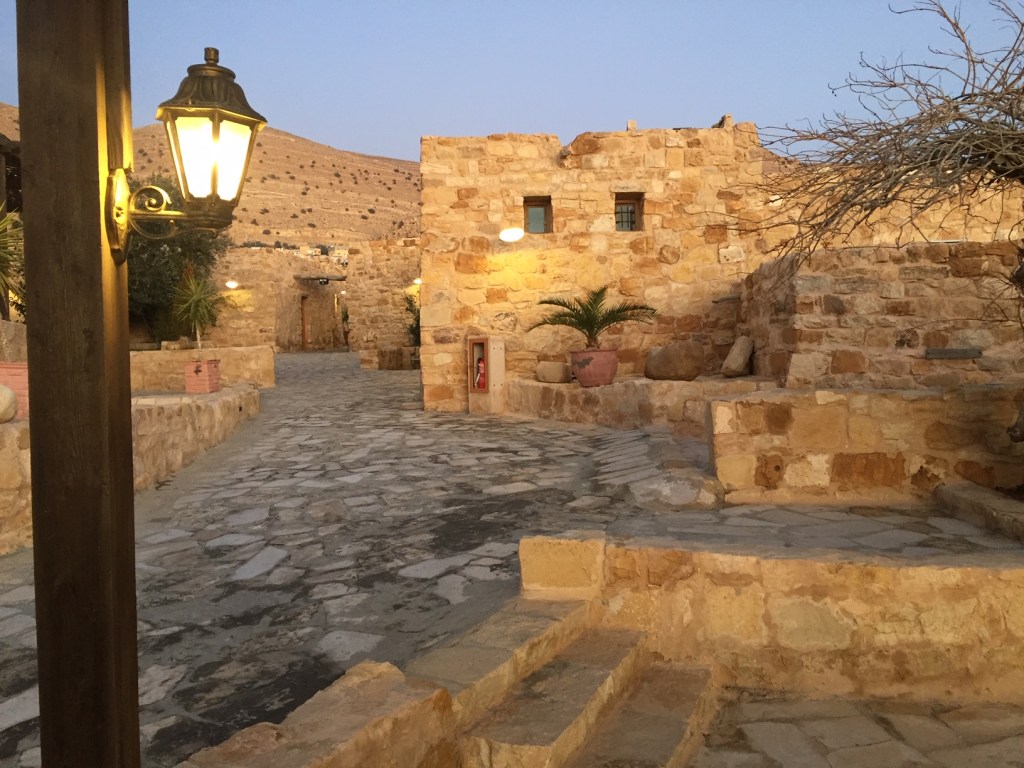
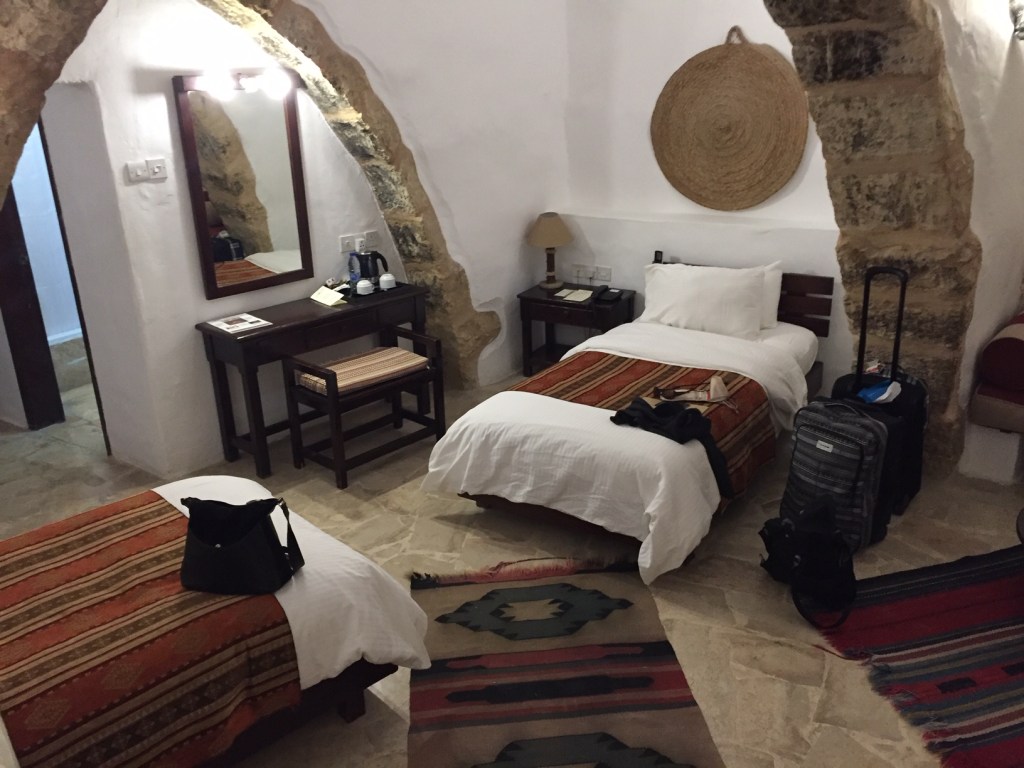
I am sharing these photos of our lovely hotel in Wadi Musa, just above Petra. I do not think our hosts were particularly happy to have us — I think because of Hagai being Israeli, most of all, and perhaps in general our being Jewish. Nonetheless, the room was charming and comfortable, the food was fine — again, large buffet spreads for dinner and breakfast — and apart from the chilly glare of the employees, we enjoyed a pleasant stay.
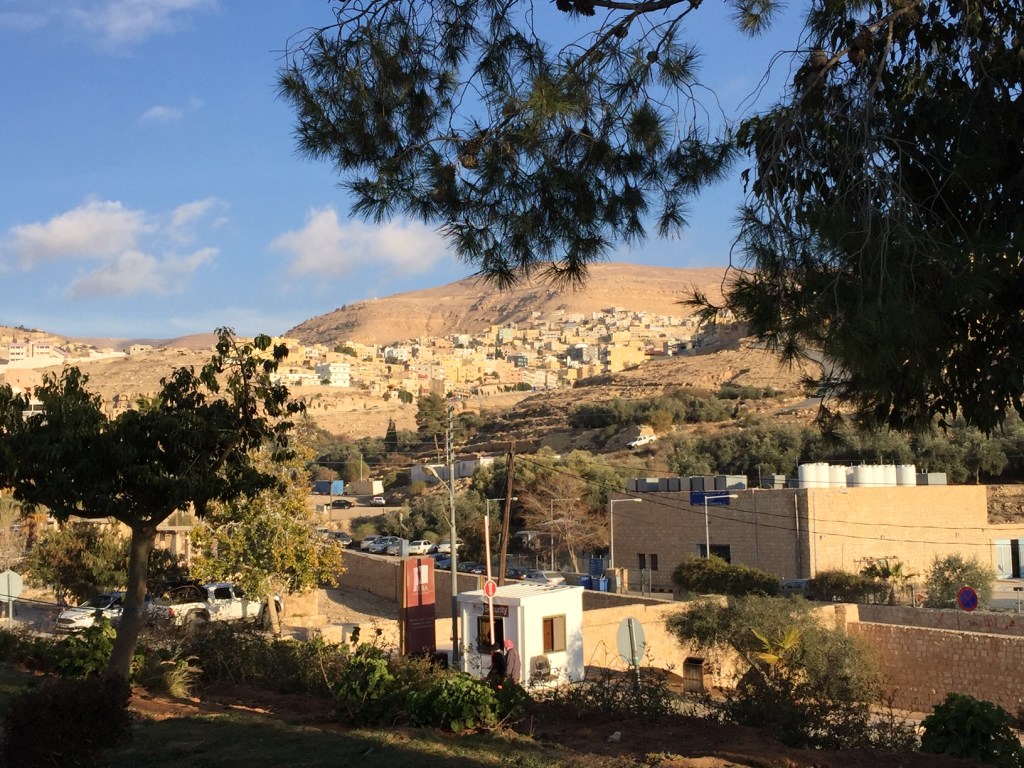
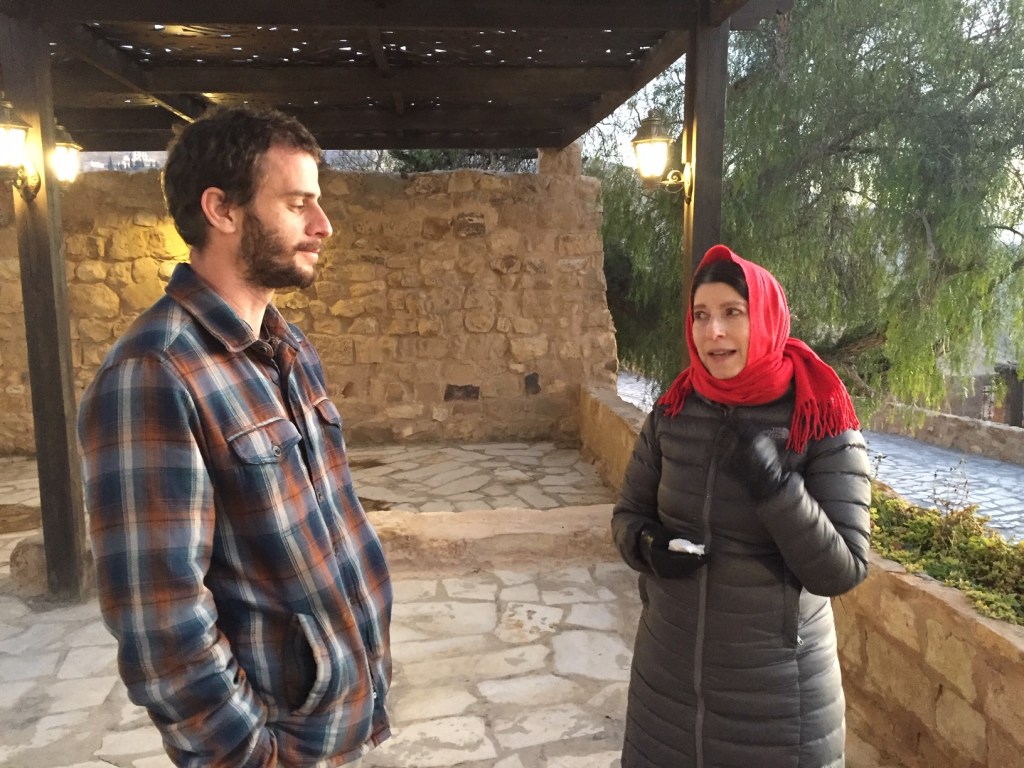
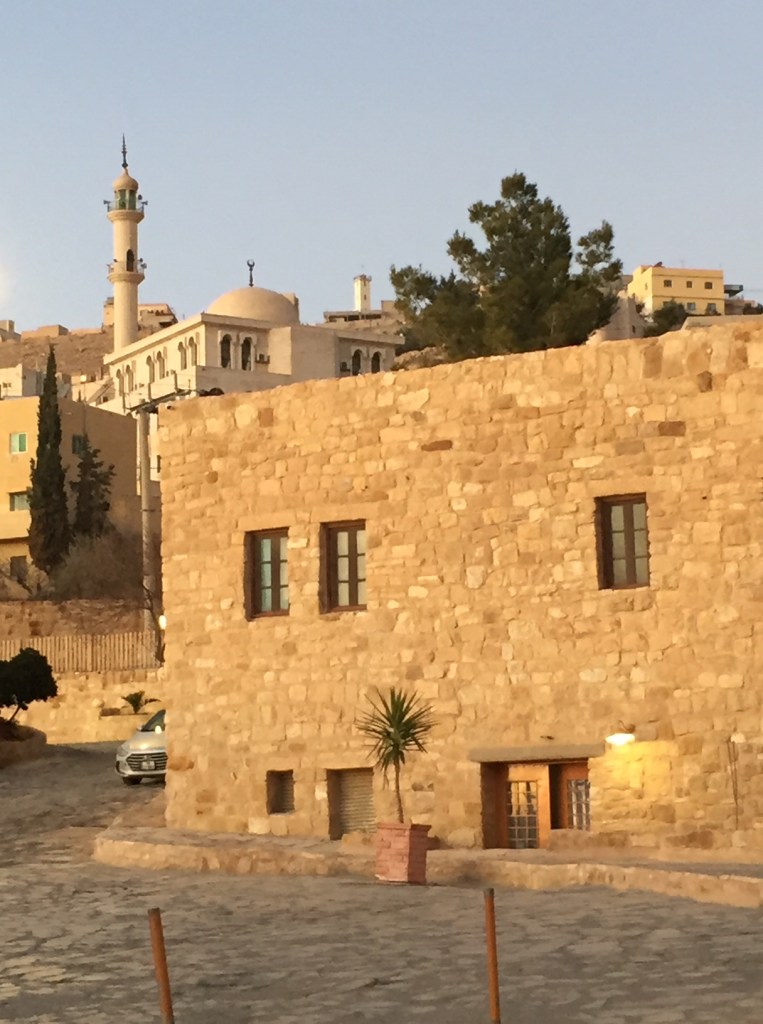
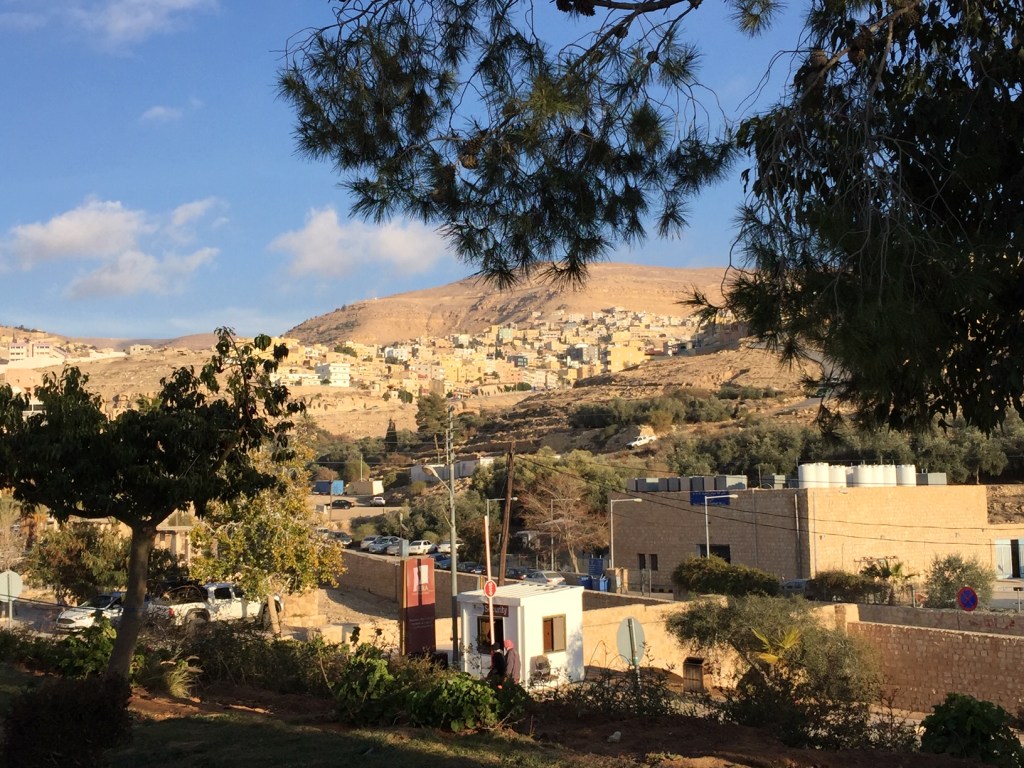
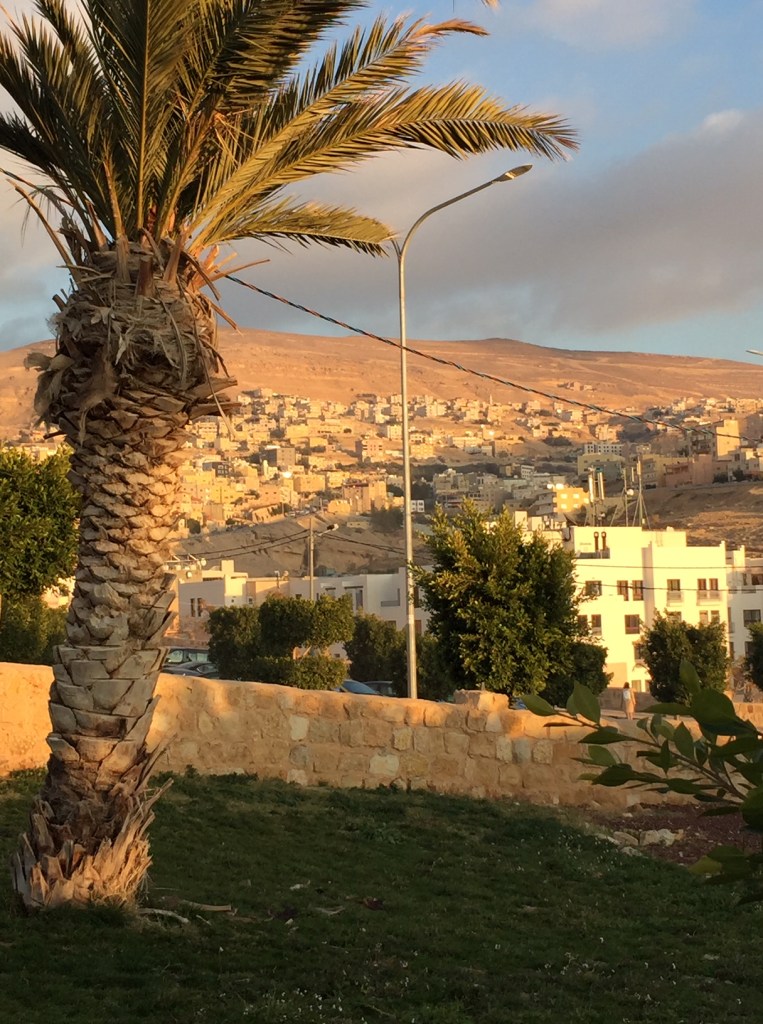
This is the village of Wadi Musa, looking up from belowOur hotel, the Hyatt Zaman, was designed to resemble a Jordanian village of 100 years ago, we were told — perhaps the village of someone’s dreams, very clean and neat. This is Deborah’s and my room. Hagai got his own palatial accommodations.We went for a short stroll around the hotel grounds before the sun fully set. It was quite cold! Personally, I think D. looks charming in this red scarf.Every Muslim village/town has many mosques. At night, the minarets are lit with kelly green neon. You can pick out which Israeli towns are Palestinian when you are driving at night by looking for the green light. Shortly after we began our stroll the muezzin began his call to prayer. You could hear other muezzins in town also — not all at once, they all seemed to be on slightly different time clocks — but the one at this mosque next to our hotel was a really superb singer and improviser. Since the call to prayer happens five times a day, we got a to hear him again ,and every time it was different and beautiful. Once, he was replaced by a young boy, a sweet soprano — perhaps his son or student?Looking away into the mountains.In the morning, this was the view from the yard in front of the hotel. Our next guide, also Ali, picked us up, and we set off for the Wadi Rum desert.
Our guide for the day, Ali, was voluble. Indeed, when he stopped lecturing us in English, he switched to lecturing the driver in Arabic. He announced that he would give us some background about Jordan as a country, and tell us a little bit about Aqaba, and would then let us have some quiet until we got closer to Petra.
Aqaba, he told us, is a growing city, despite being closed in by a ring of mountains. Tourism continues to grow in the area. The climate is pleasant. Some light industry is also beginning to happen here. King Abdullah (from whom, weirdly, I have only two degrees of separation — more on that in a bit) has a vacation home on the waterfront, not far from our hotel.
We left Aqaba and began our ascent into the mountains. As we had come south in Israel to get to Eilat, one of the two only entry points into Jordan for Israelis, we now crossed the mountain range that flanks the Jordan valley on the east and drove north on the other side of the mountains. The land quickly became bare and dry and empty. Here and there we passed small villages and tourist outposts. Sometimes we saw small farms, or farmers at the side of the road with boxes of tomatoes. Large trucks passed us continually, heading north to the big cities of Jordan.
After about an hour and a half we turned off the main highway onto a small winding road. Here we were surprised to see snow on the ground. Our guide explained that only a few days before the road to Petra had been closed, as there was a significant snowfall. This is not uncommon up in the mountains, he told us. We did stop so I don’t have photos, but an image that stays in my mind is a snow man someone had built, which was wearing Arab robes and keffiyeh.
After some time we stopped at a tourist shop. We were invited to use the bathrooms and get coffee if we wished. The shop was gloomy and cold, and its wares, like most of what we saw for sale in Jordan, gave the impression that they might have been made in China or India. Nonetheless, when I glanced at some scarves a young man informed me that they were made of “pure silk and camel wool”.
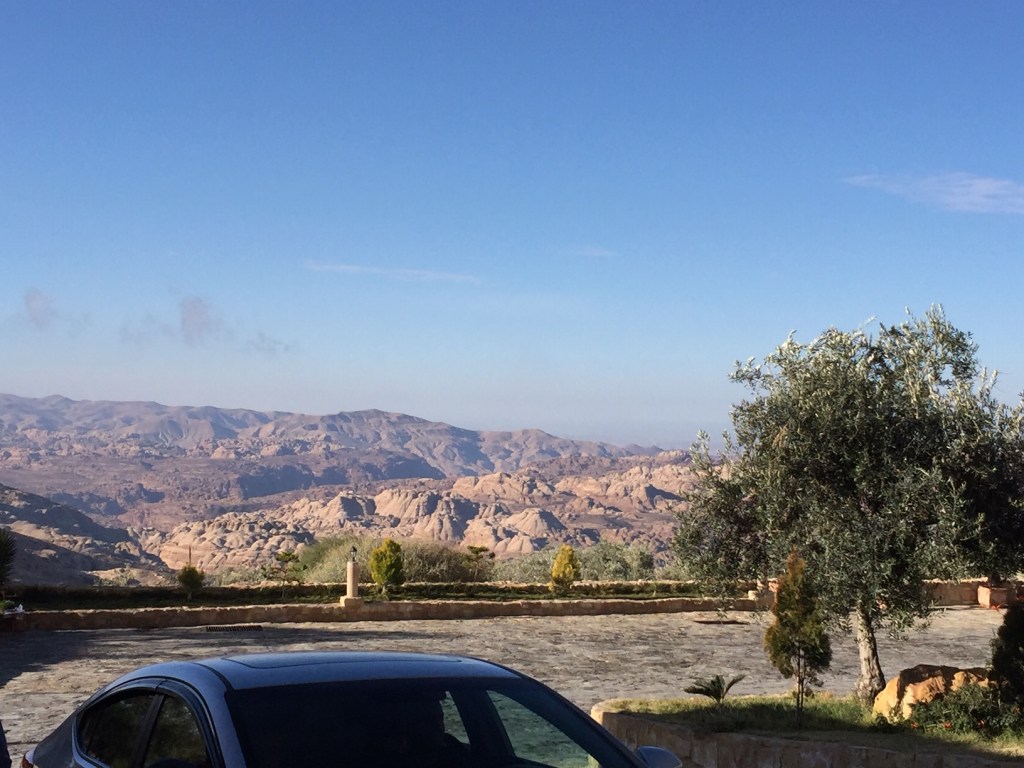
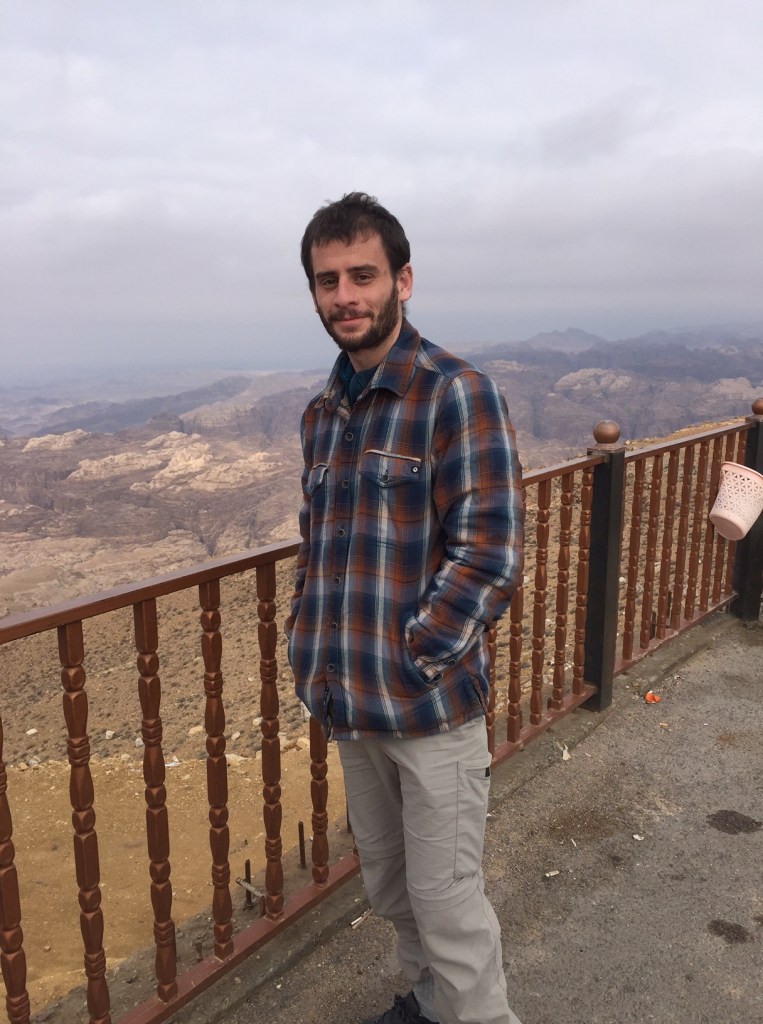
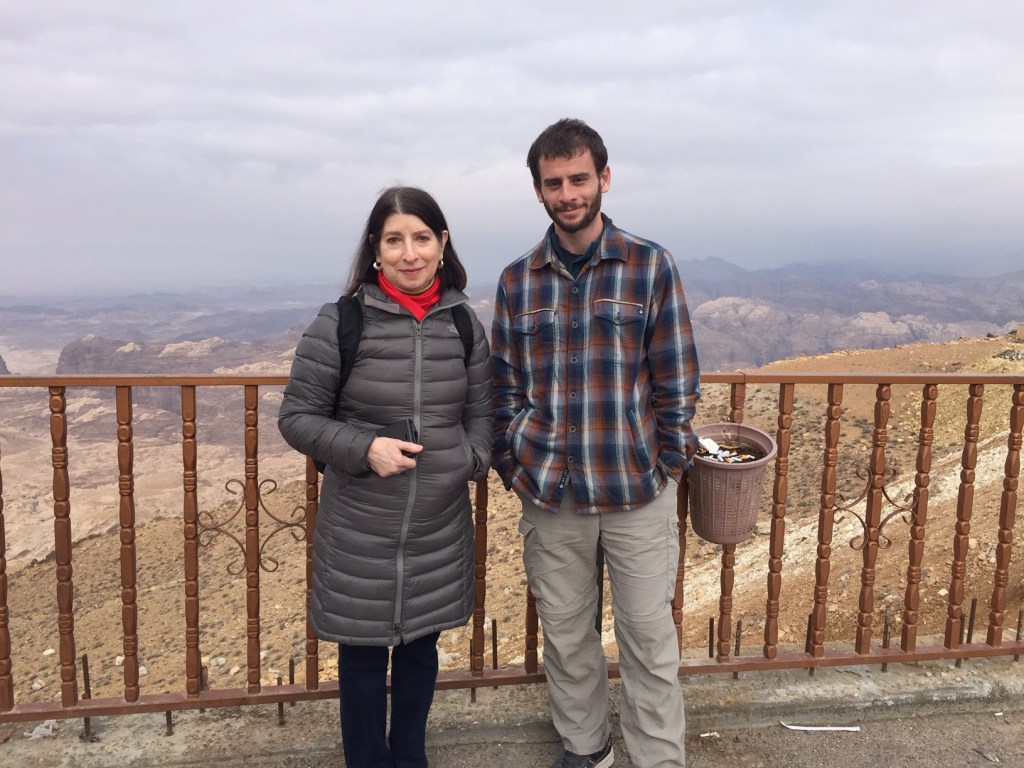
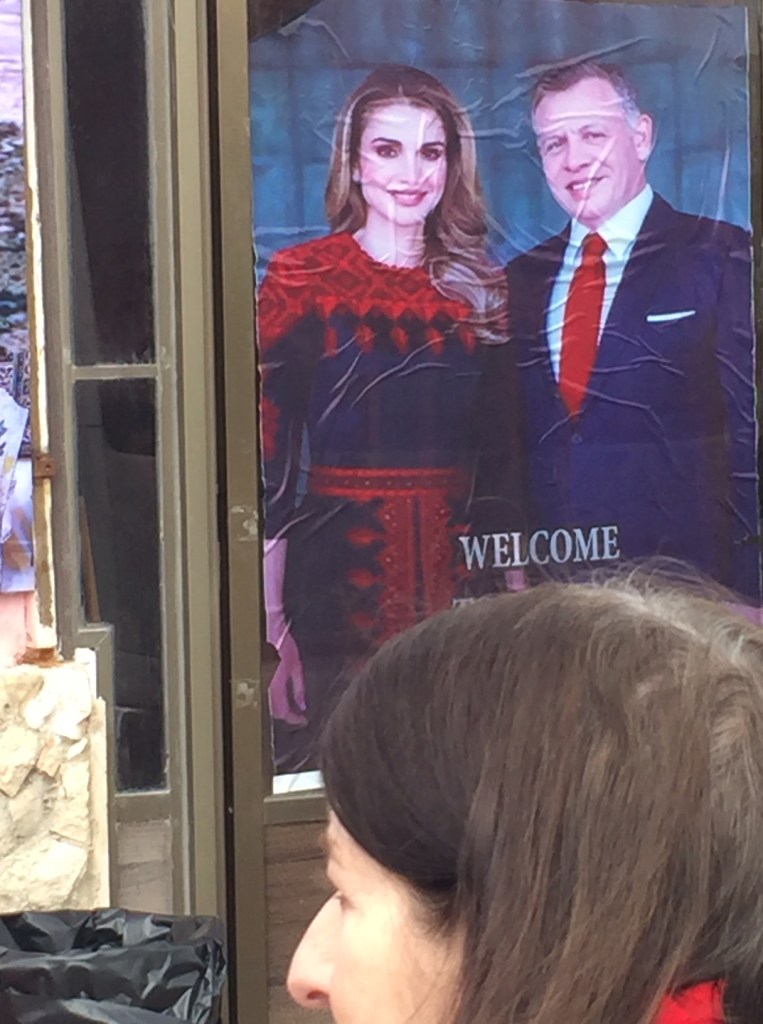
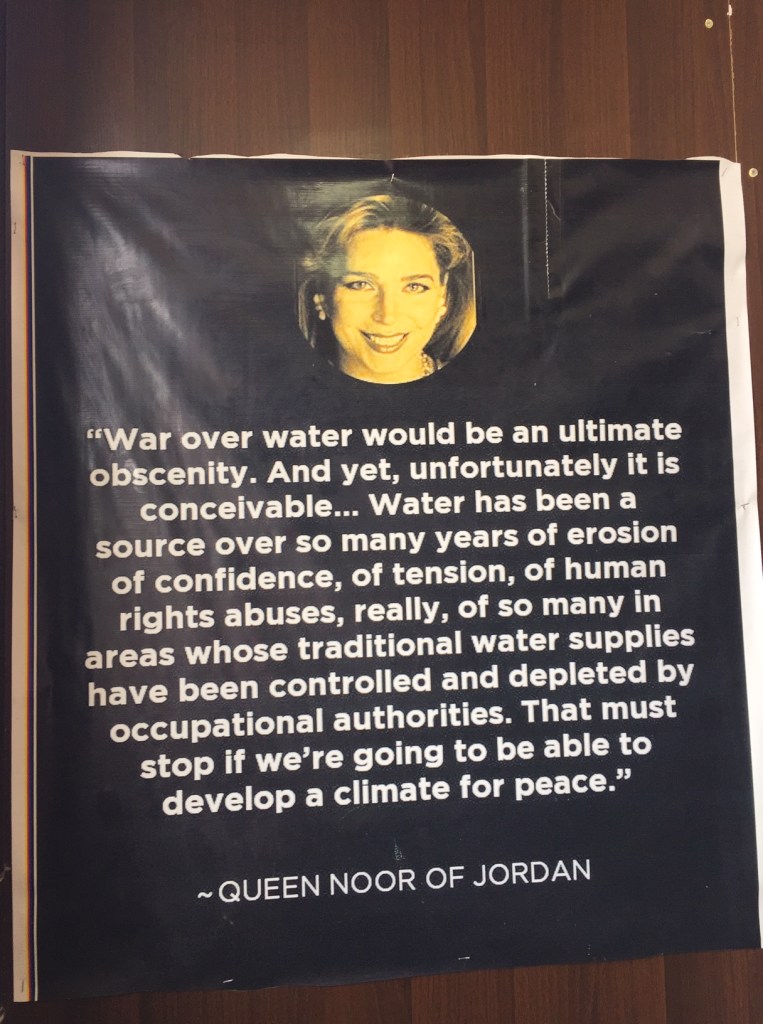
This is the view from the parking lot of the gift shop.From the roof of the little gift shop the desert appears even more vast.HagaiDeborah and HagaiOutside the shop, King Abdullah and Queen Rania welcome guestsInside the shop, the Queen Mother — Queen Noor, wife of the late King Hussein — tells us something important but also a bit pointed. Jordan and Israel have struggled over the rights to the Jordan river water for years. Fortunately, Israel now has desalinization plants working very successfully. Jordan does not, however, according to our guide, and has been suffering from a severe drought. They are tapping out their aquifers and running very low on water. Here is an extremely interesting article on water relations with Israel and Jordan — it’s long, but even if you skim it you will learn a lot: https://www.timesofisrael.com/sinking-israel-jordan-relations-leave-dead-sea-a-natural-wonder-low-and-dry/
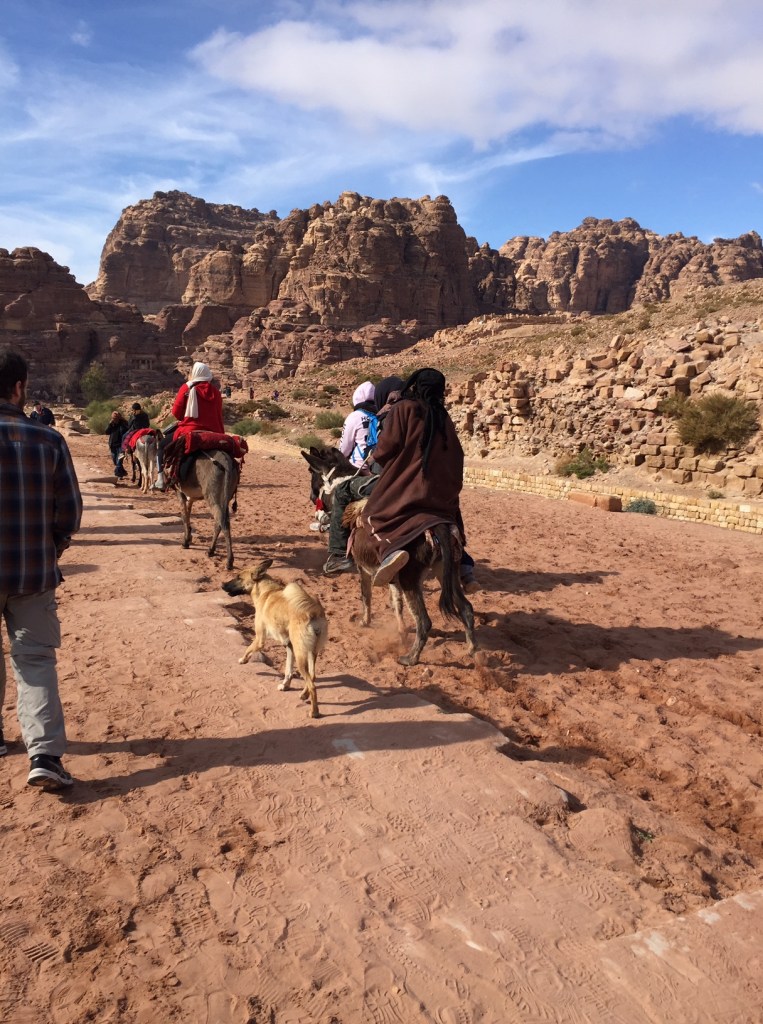
Ali purchased our tickets at the Visitor Center. He explained that he would guide us down, and then we would have lunch at the restaurant at the bottom of the site, and have the rest of the afternoon to wander the site, returning to the top of it in the late afternoon. He also told us that we could, if we wished, take either a horse, donkey, camel, or cart to ride back up — or to ride down, although he did not recommend the latter. I had been advised by the Israeli tour company not to take any such rides, which are expensive, jolting, and not kind to the animals.
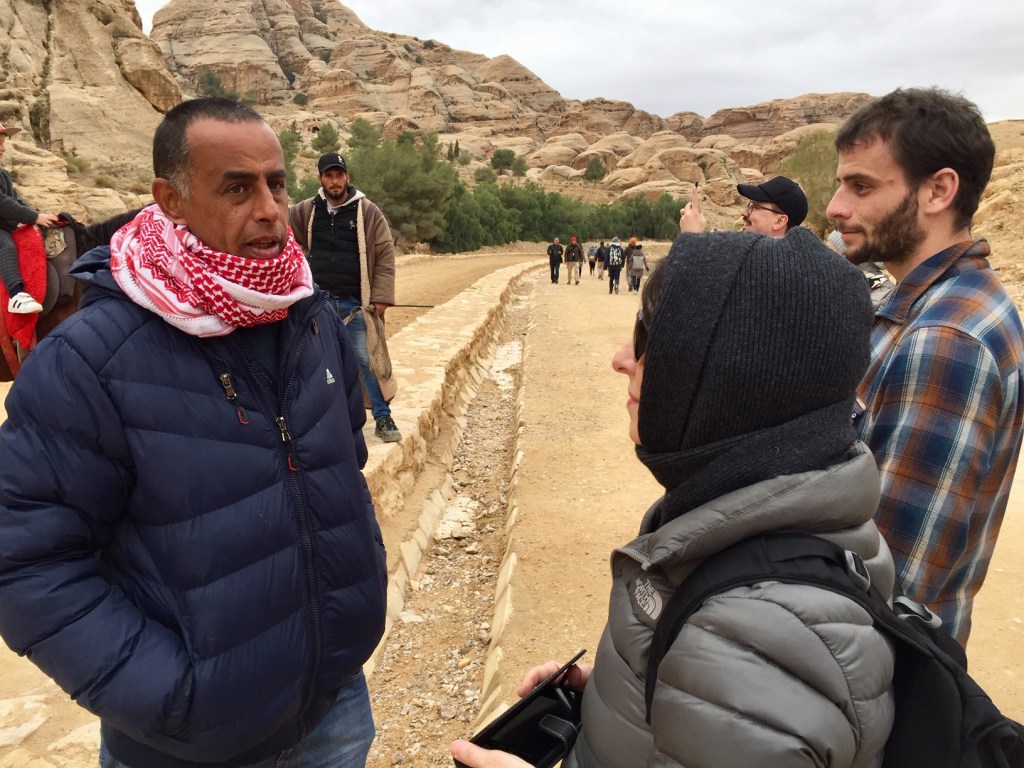
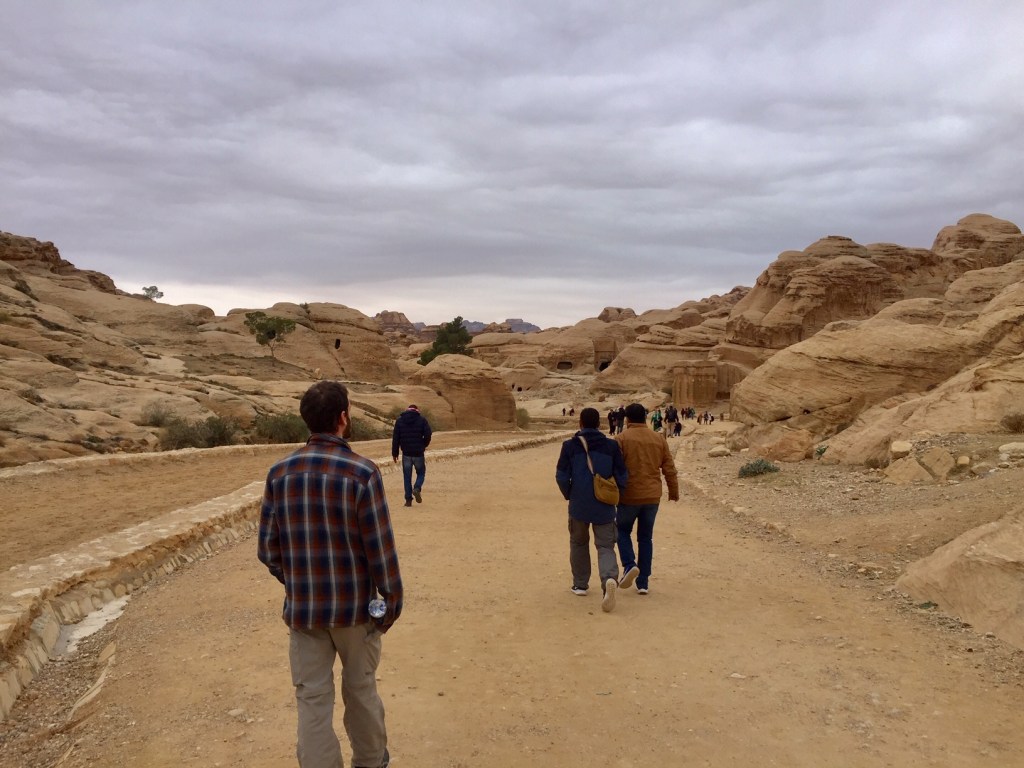
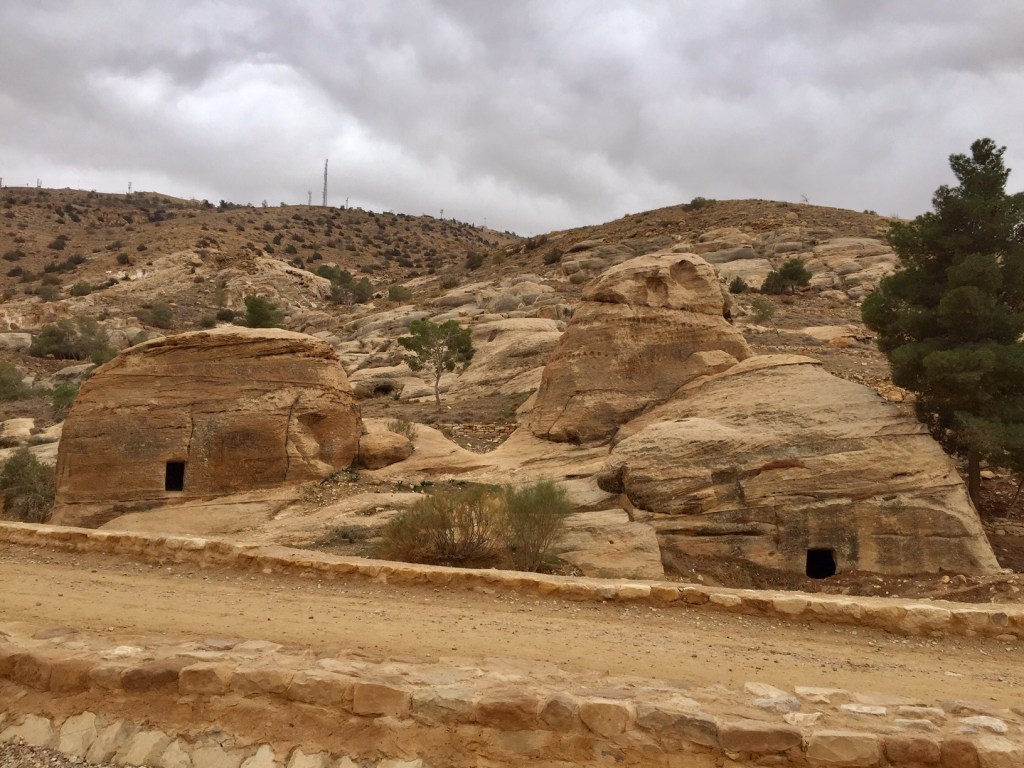
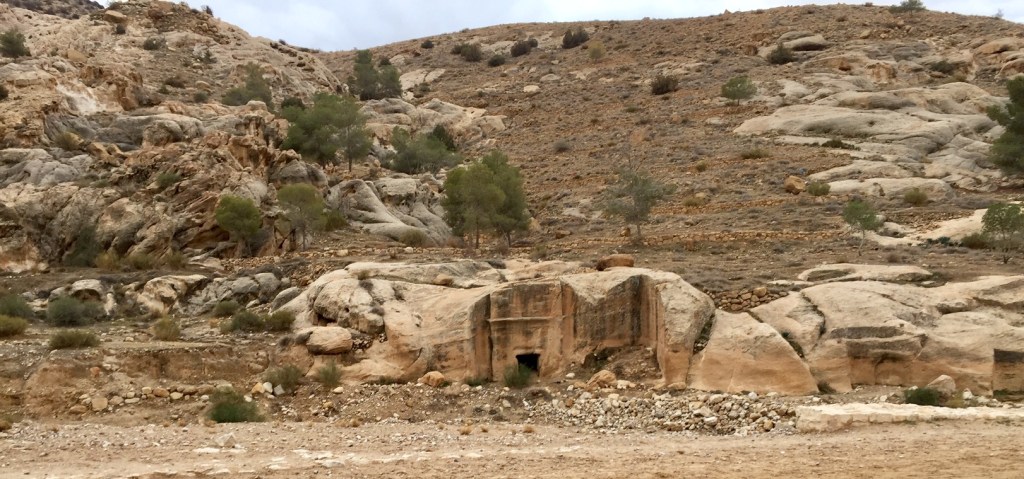
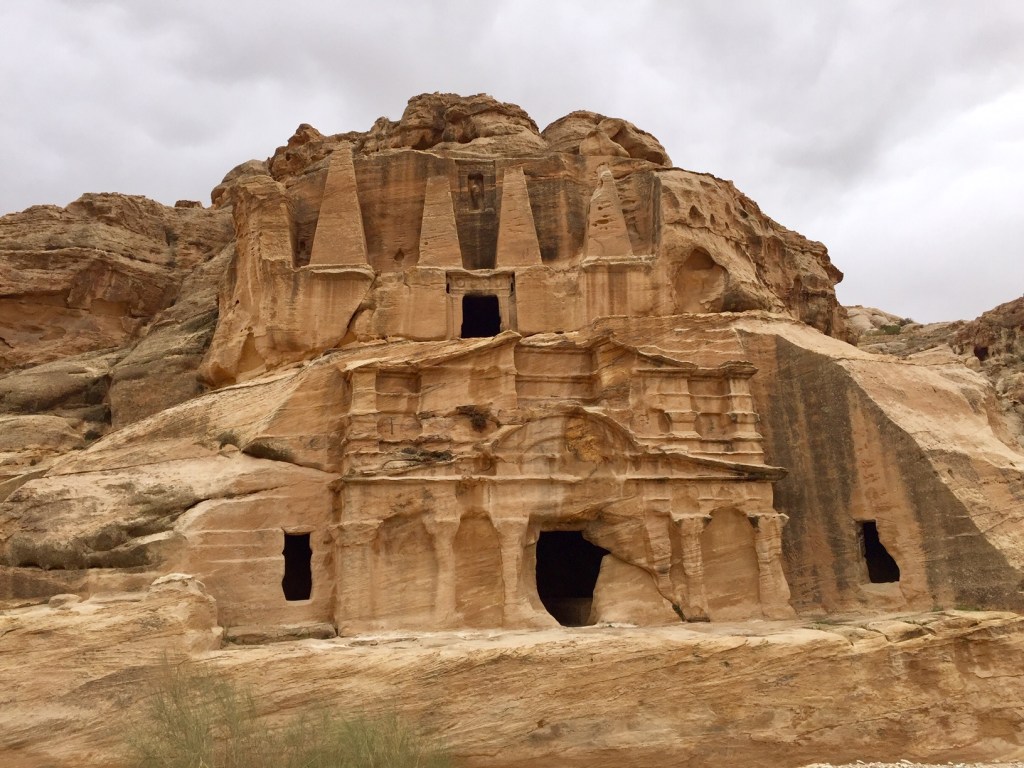
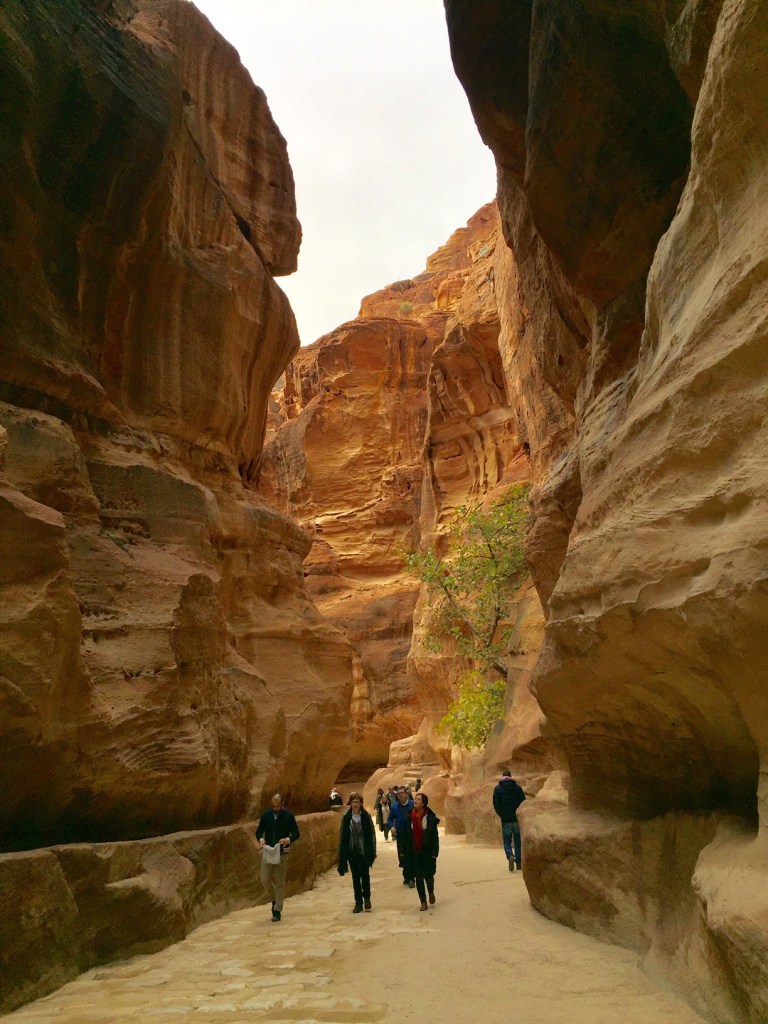
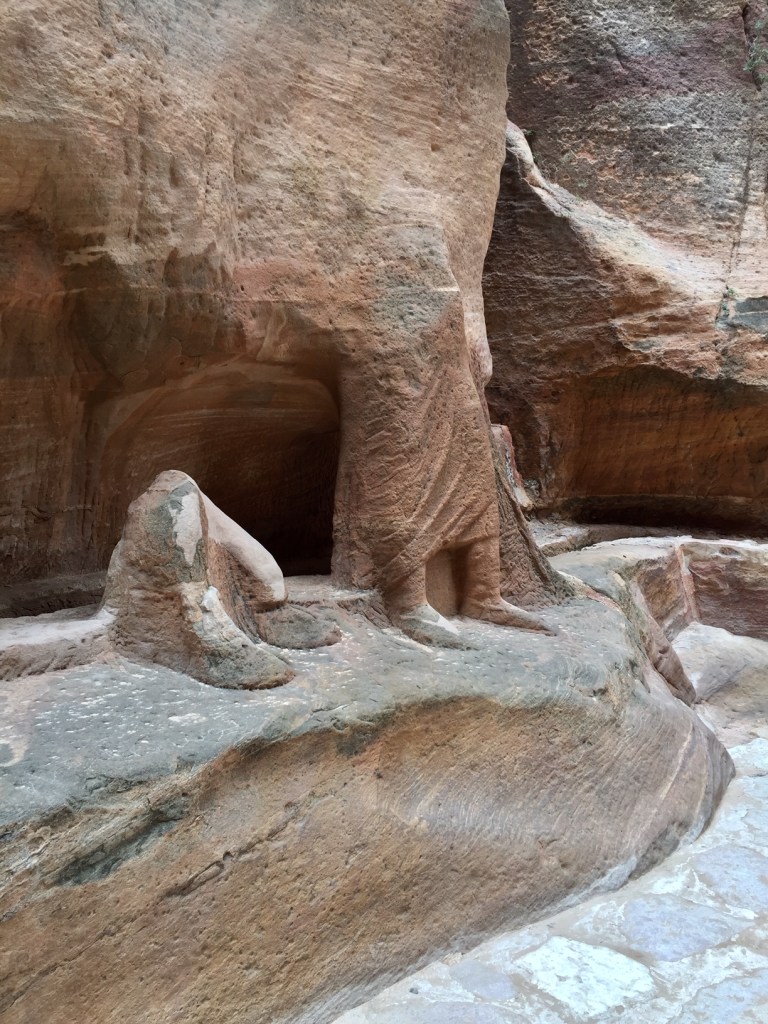
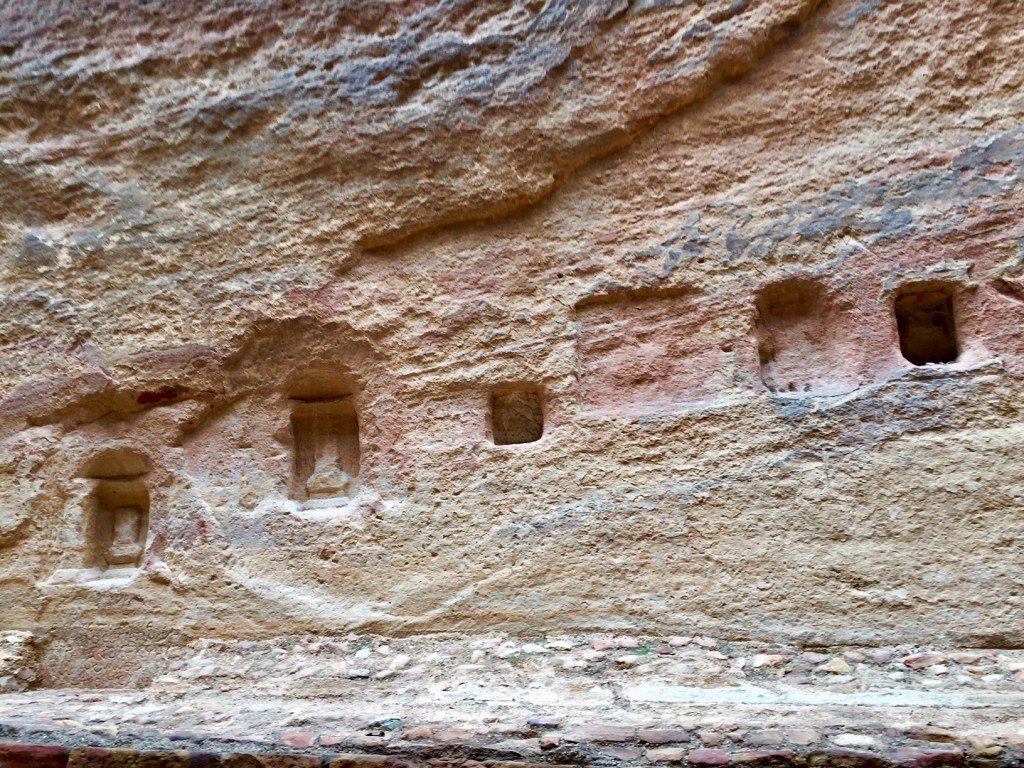
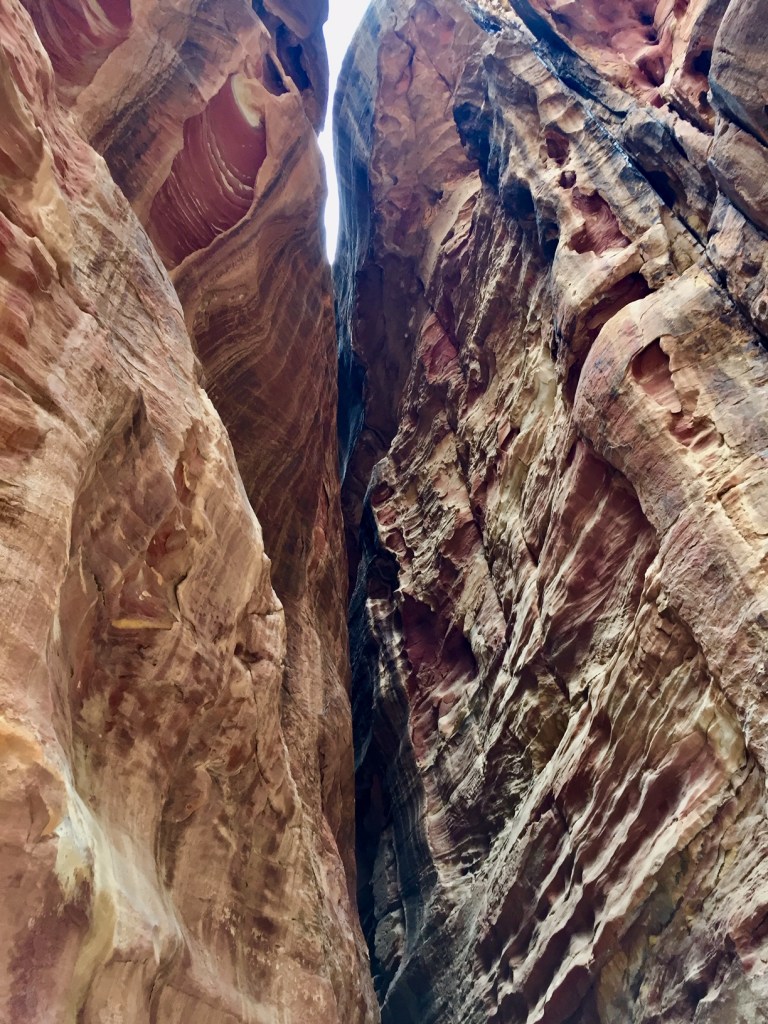
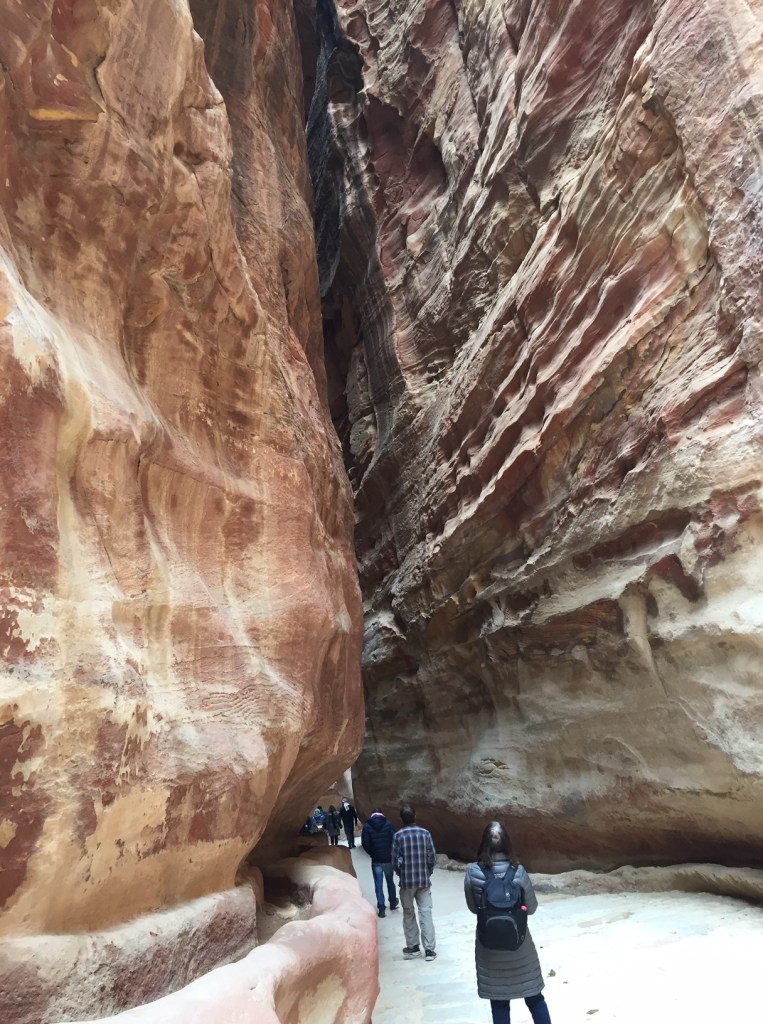
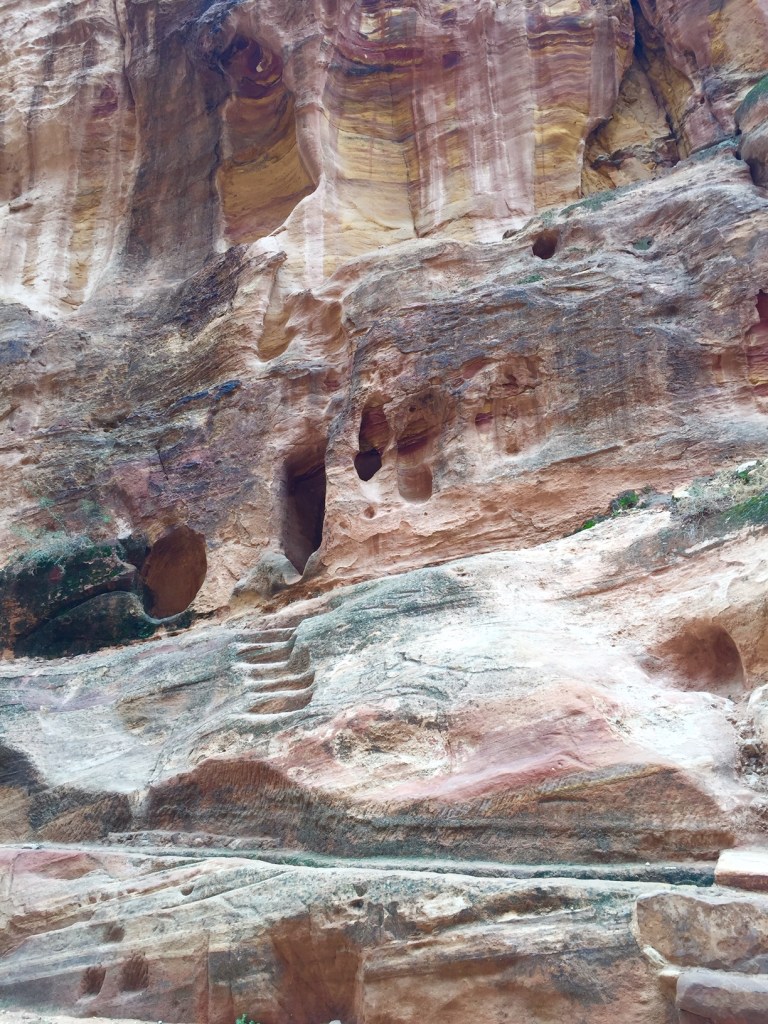
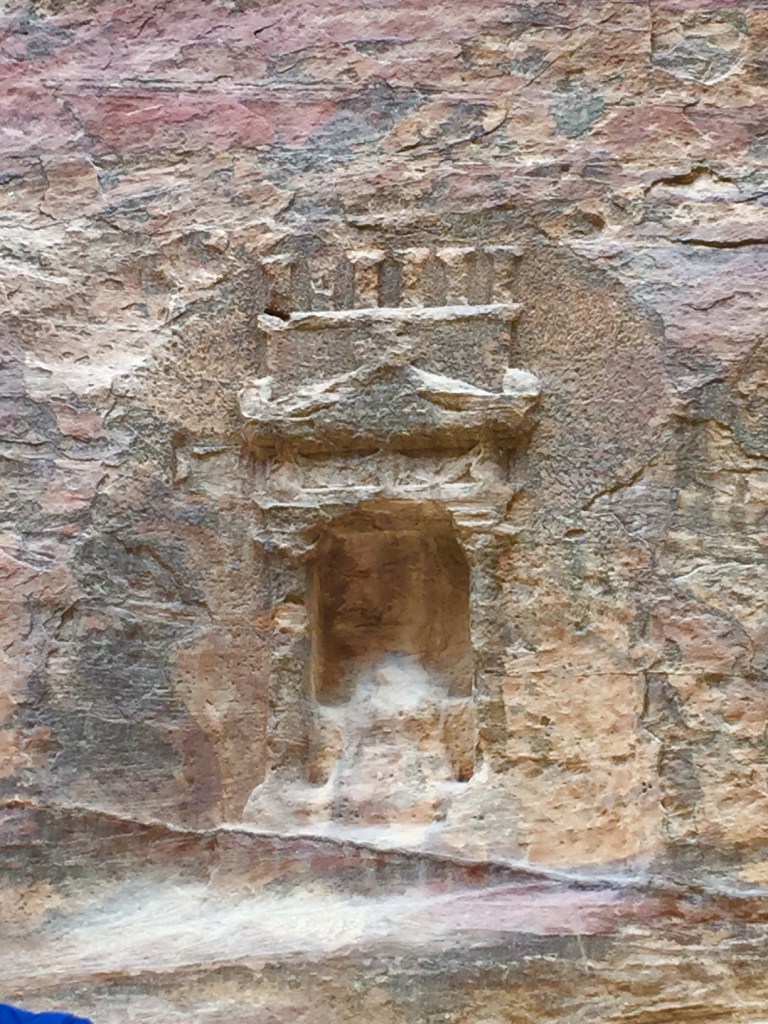
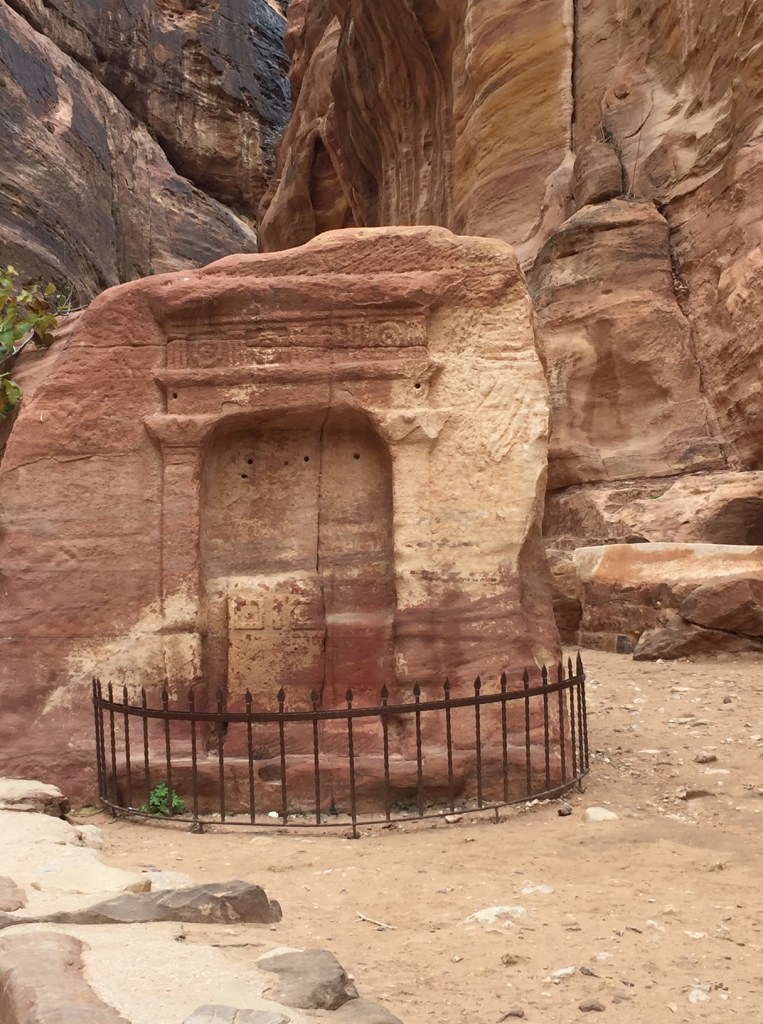
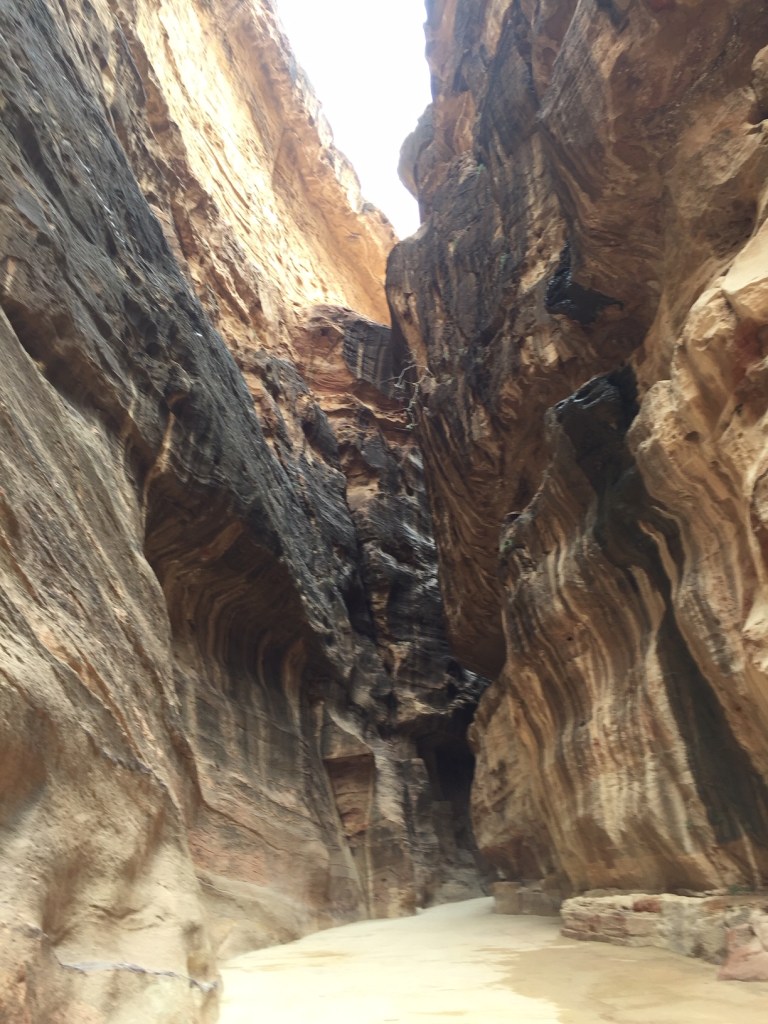
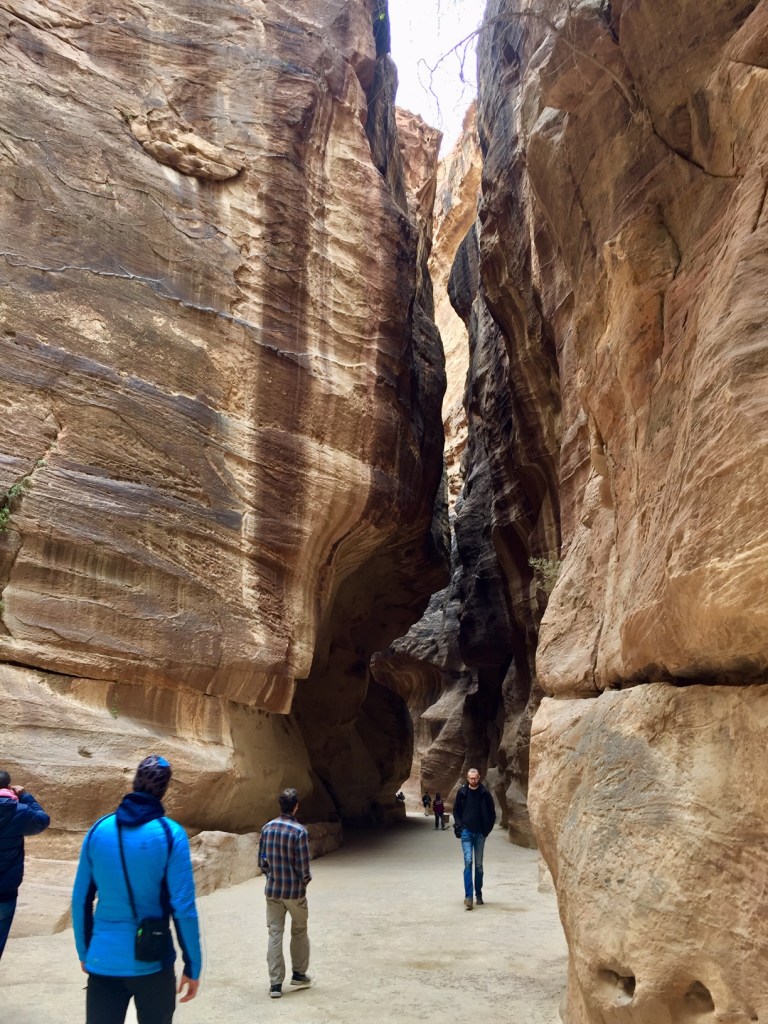
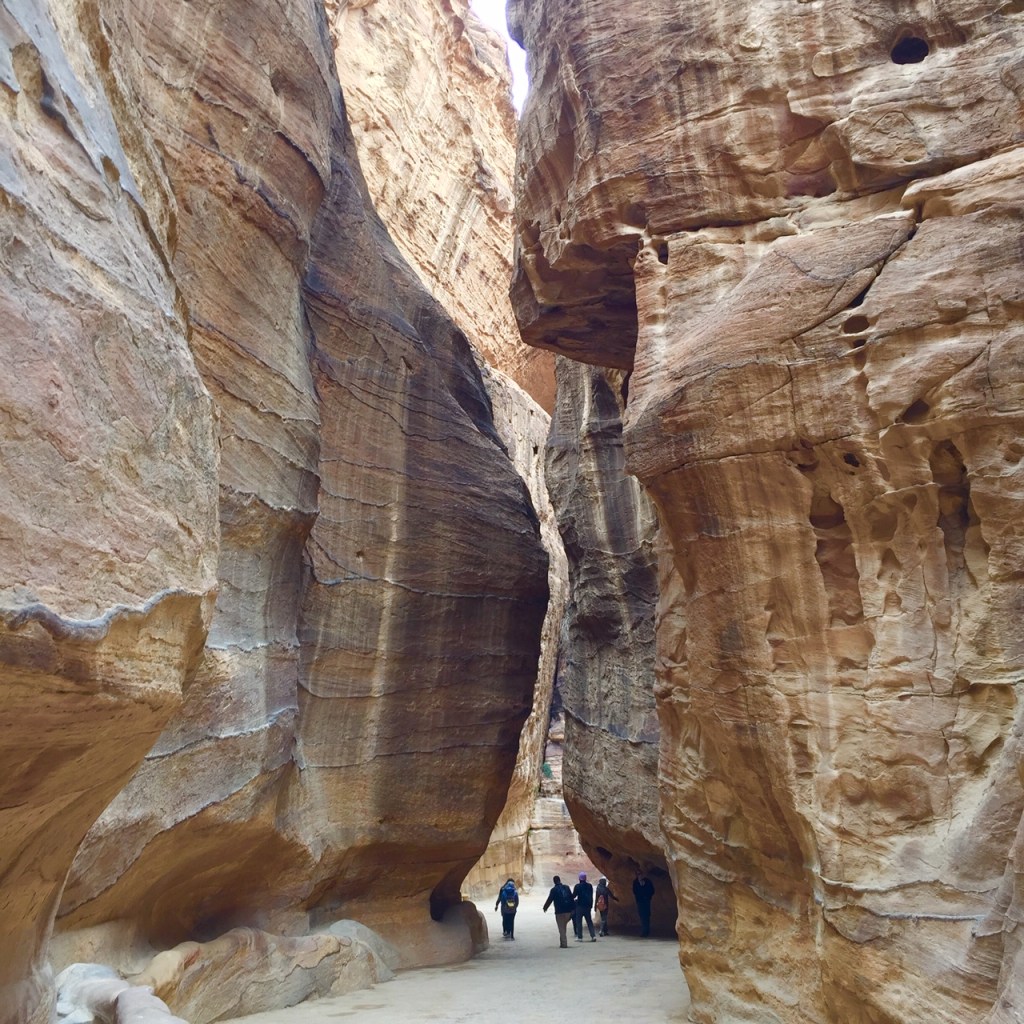
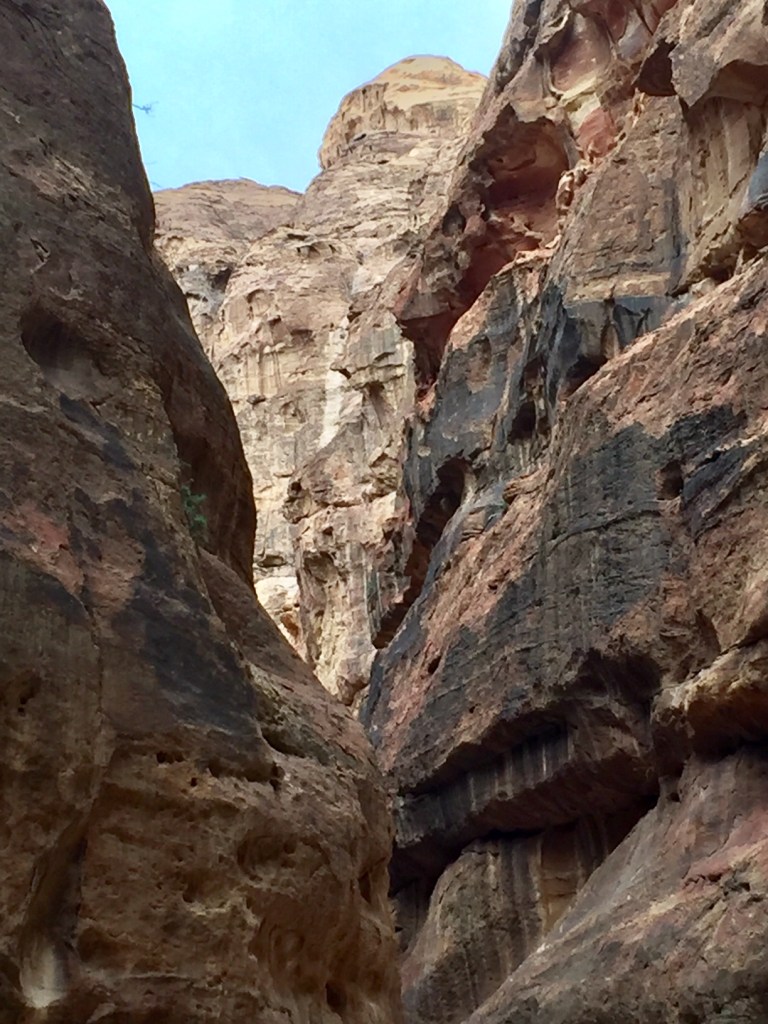
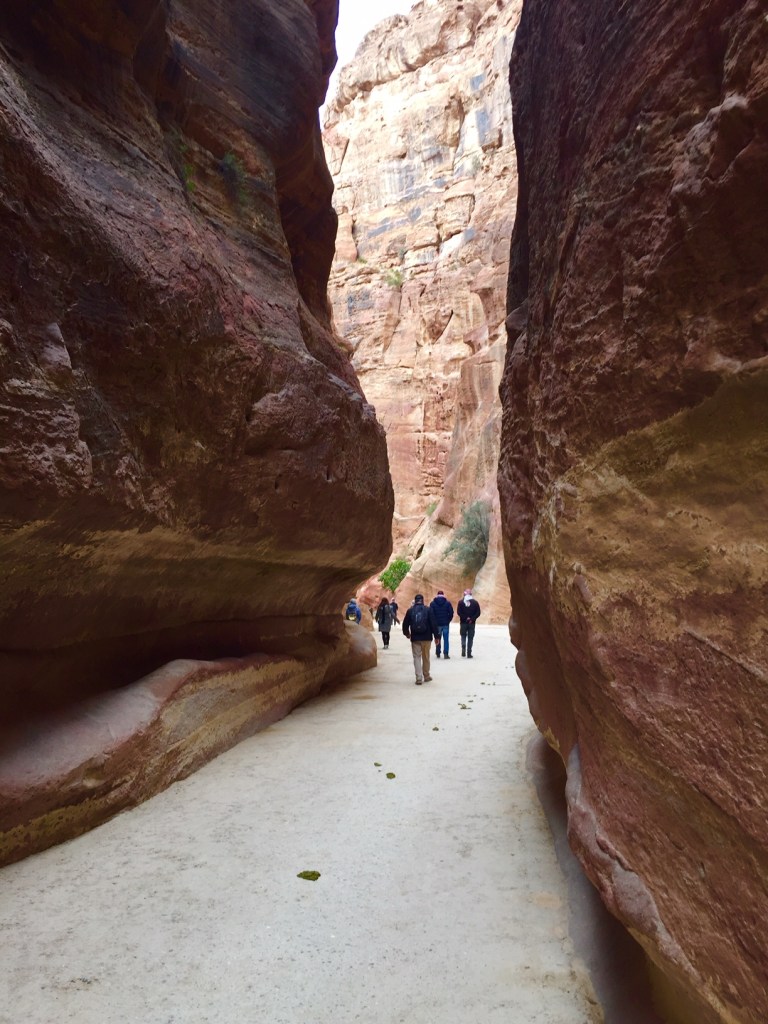
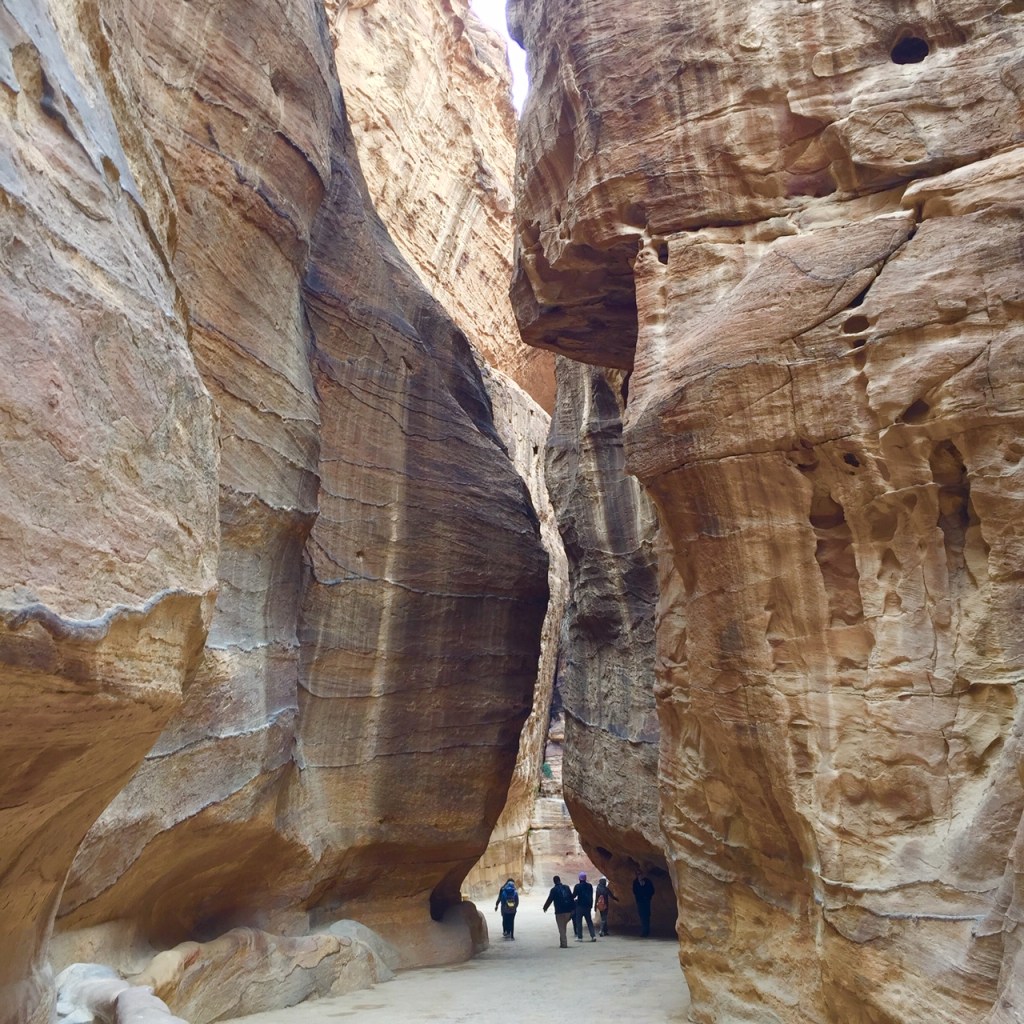
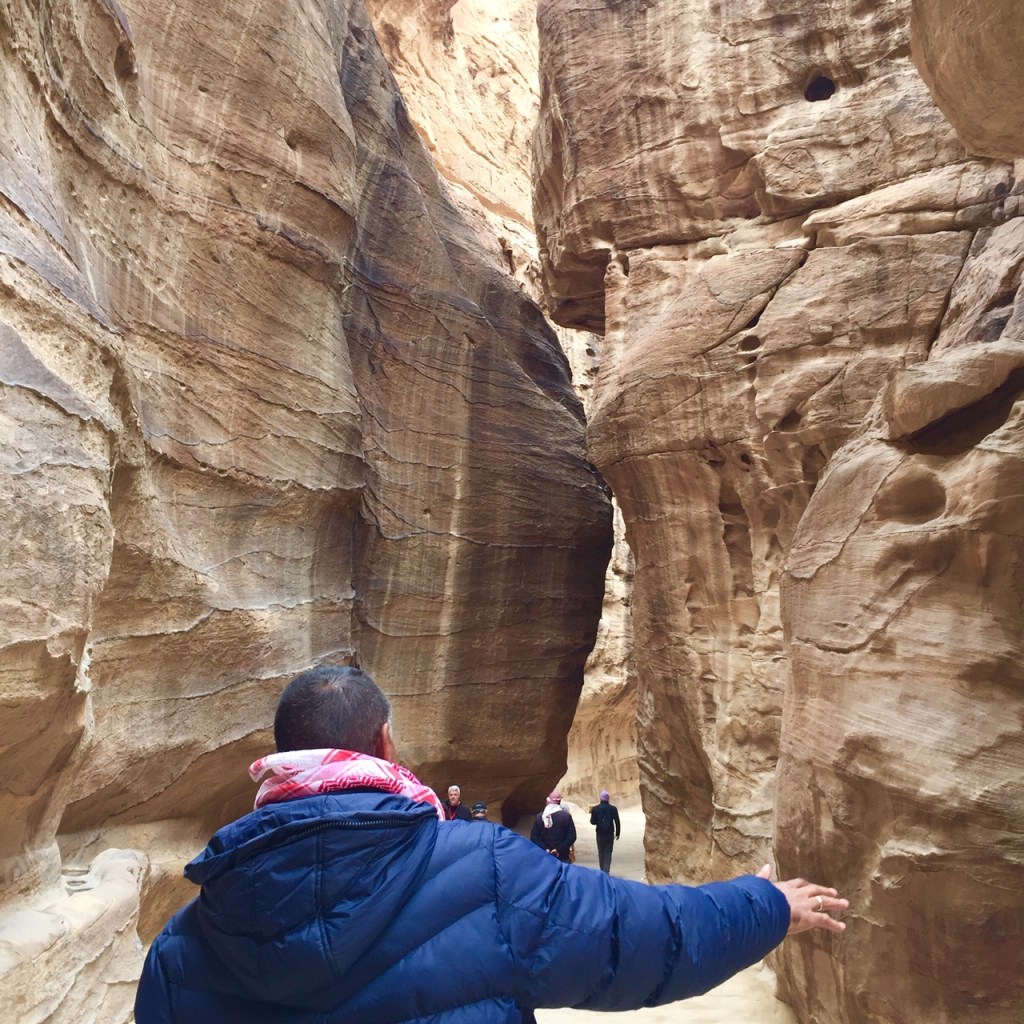
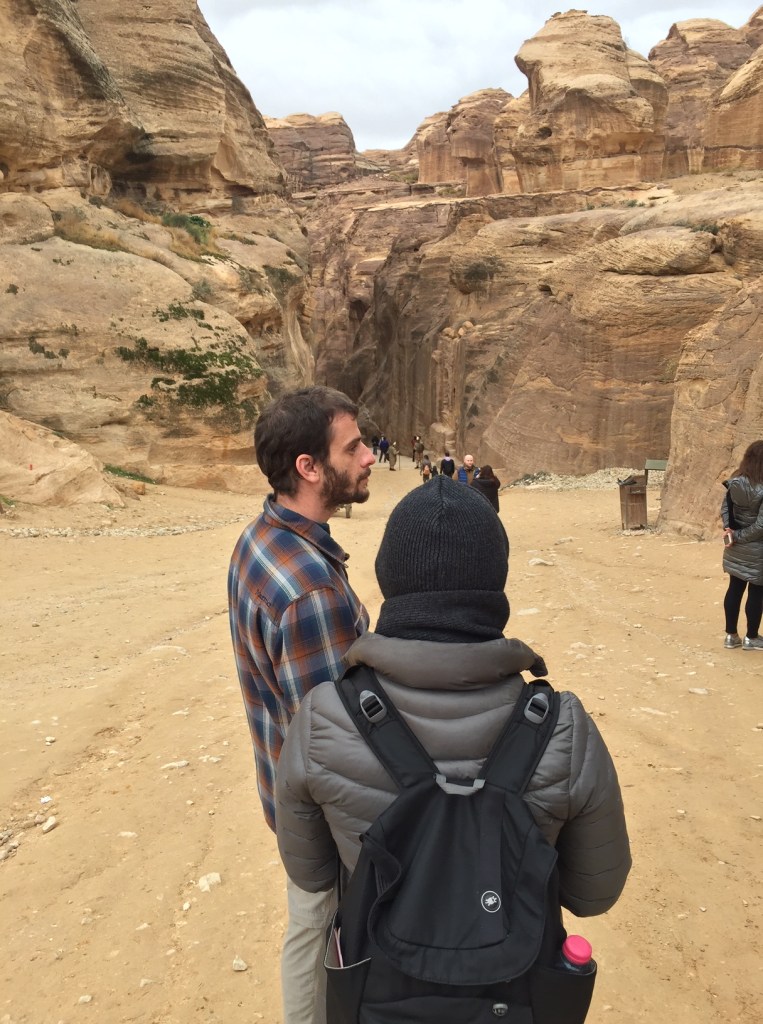
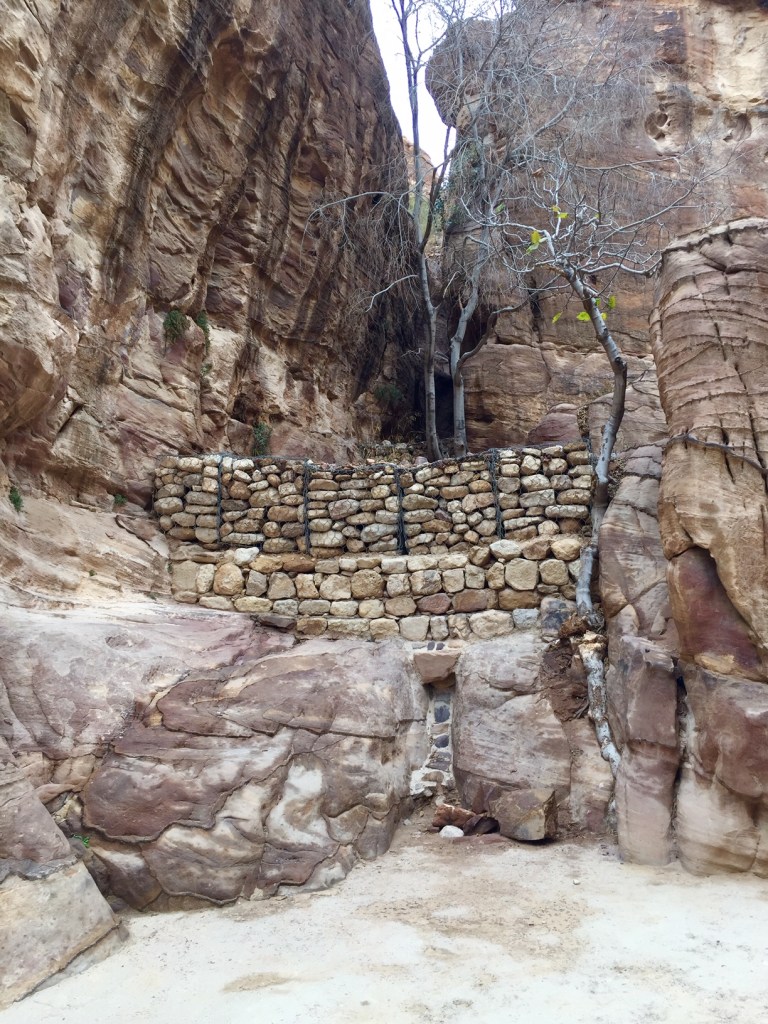
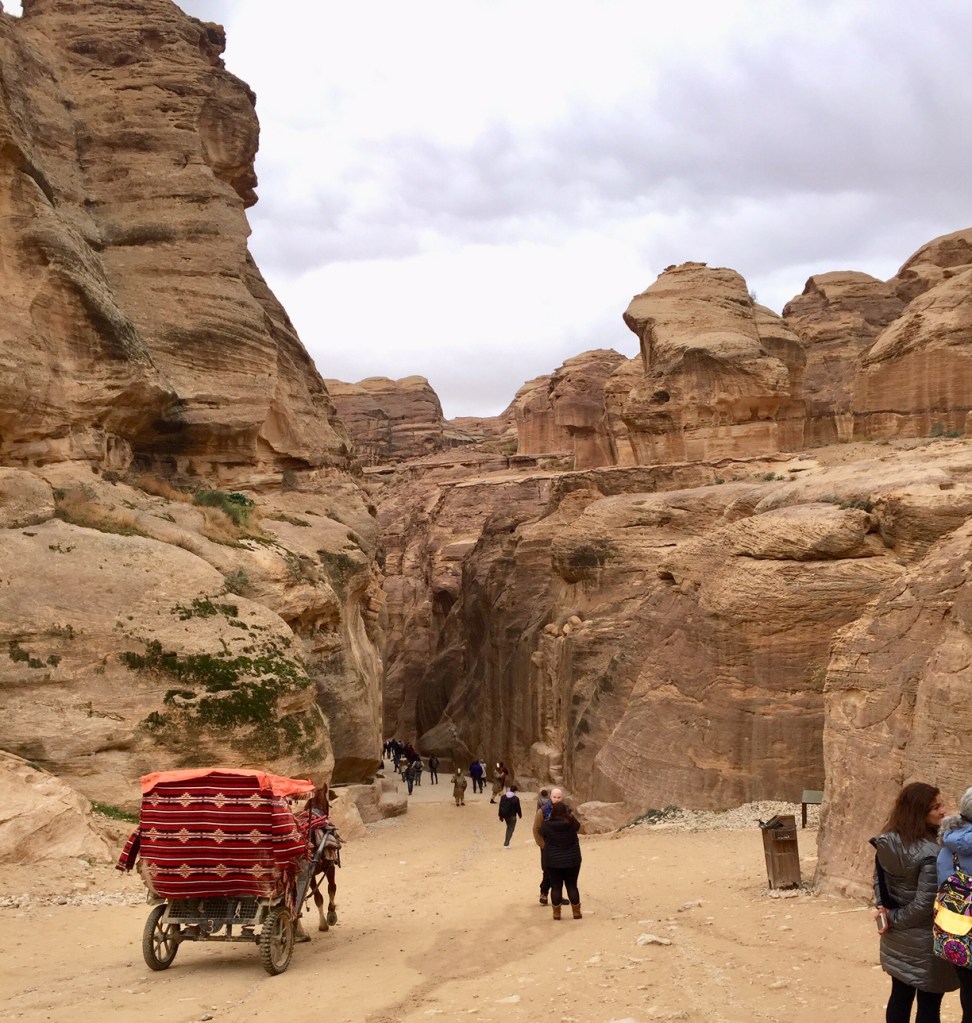
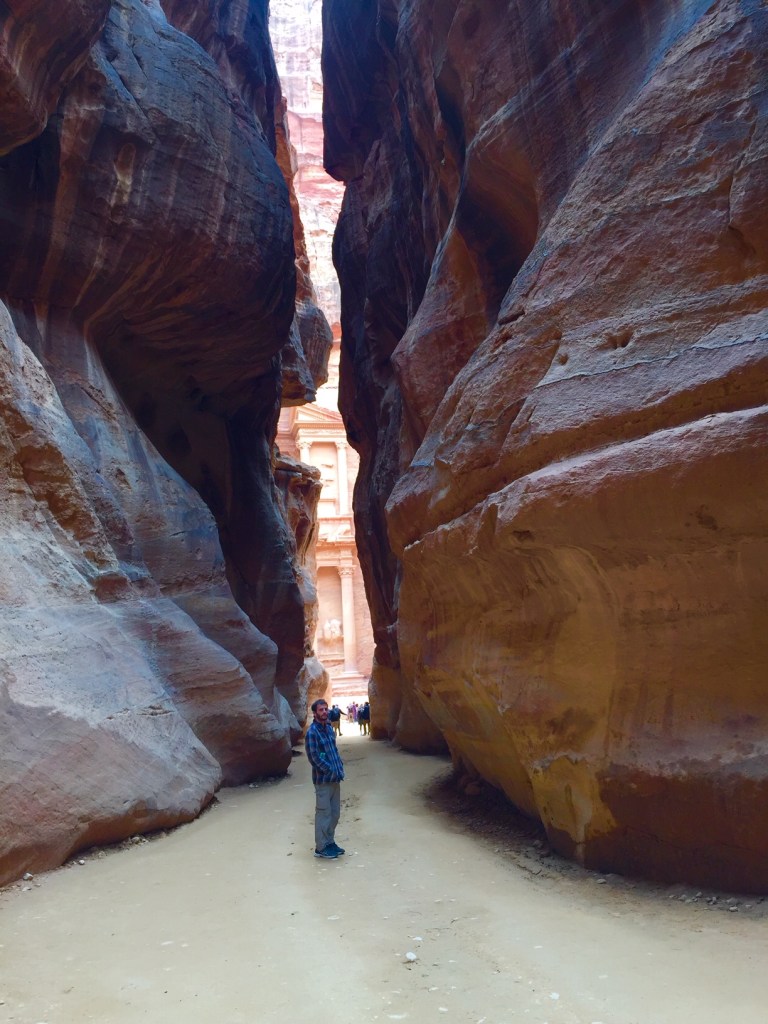
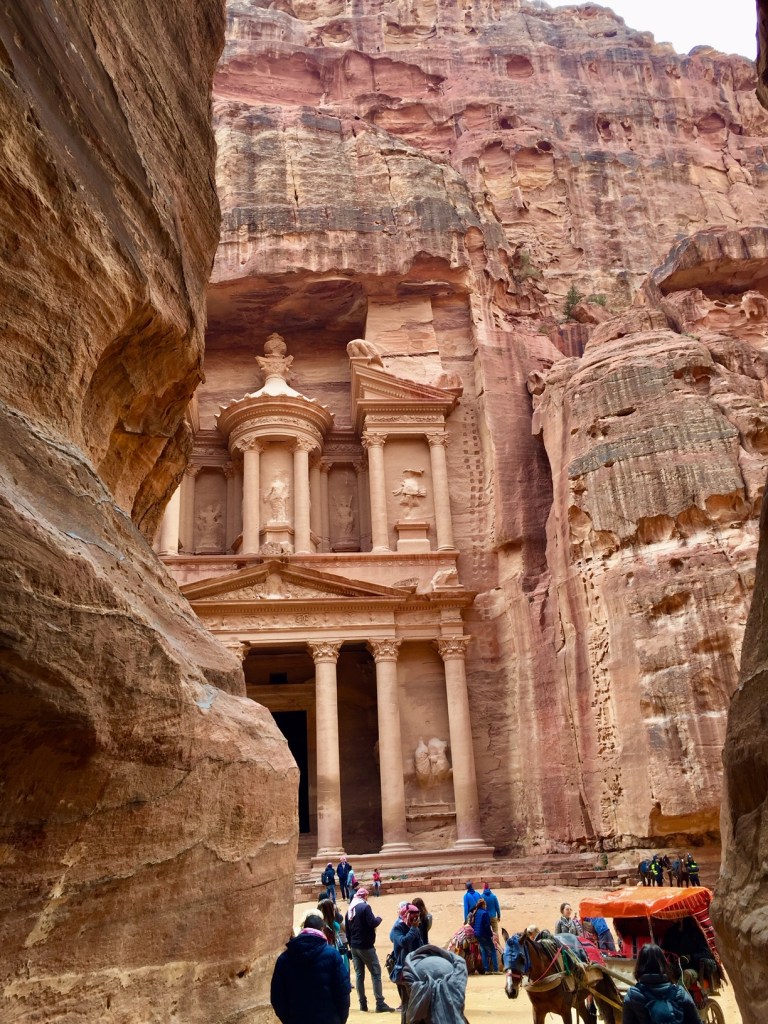
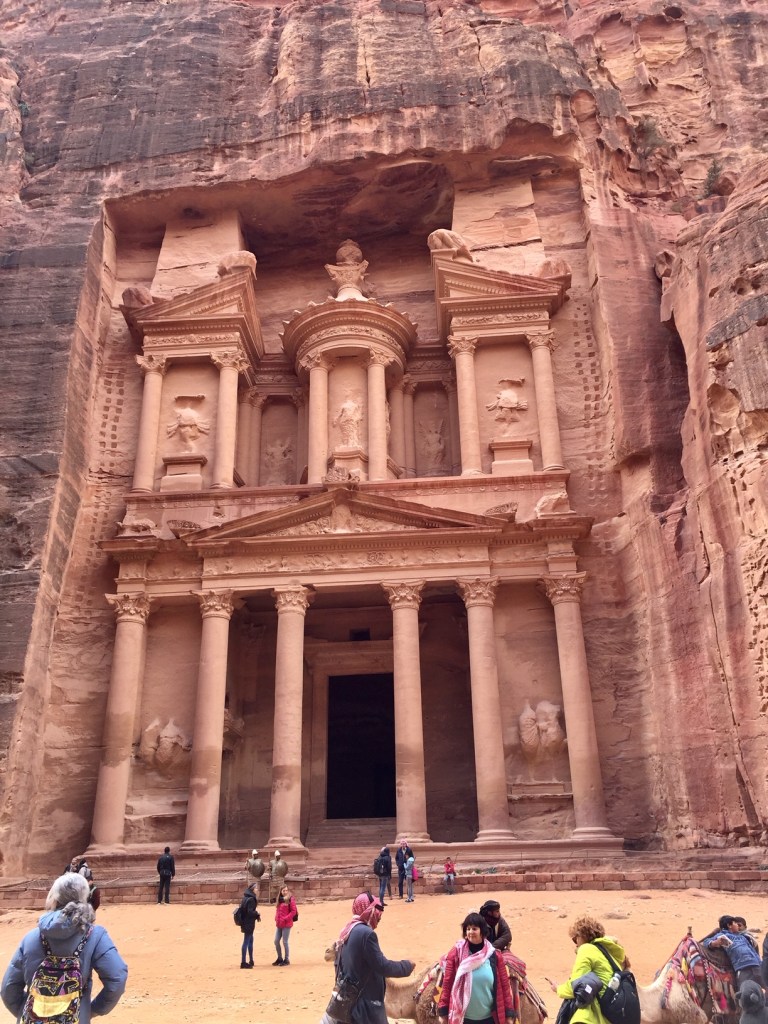
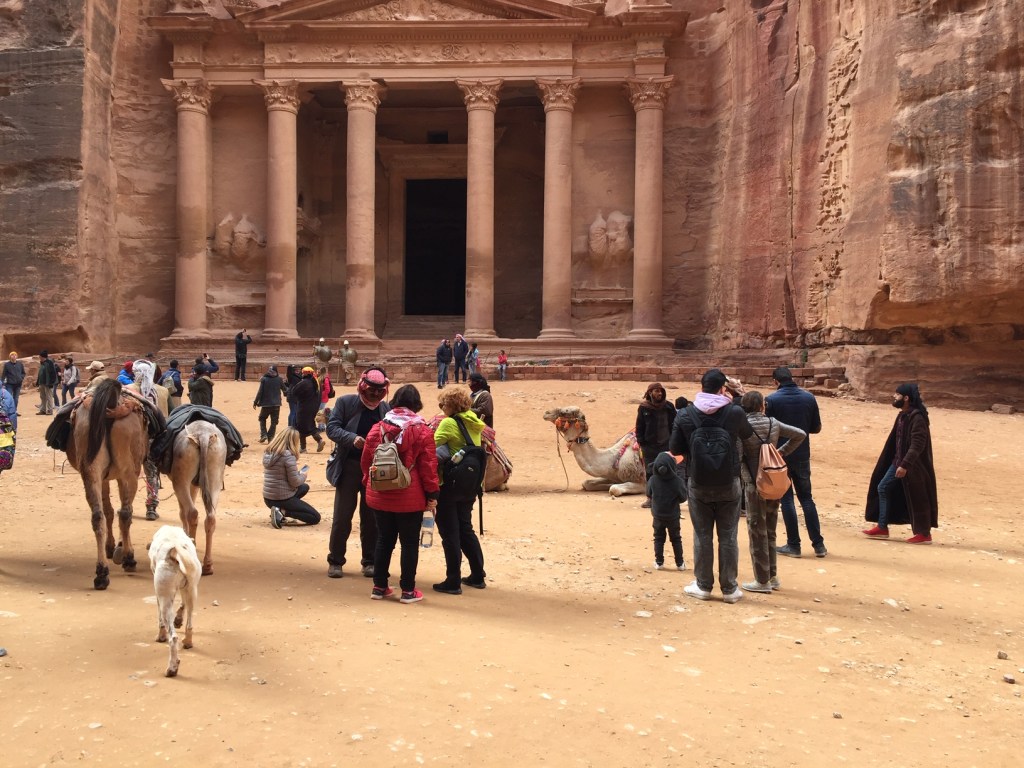
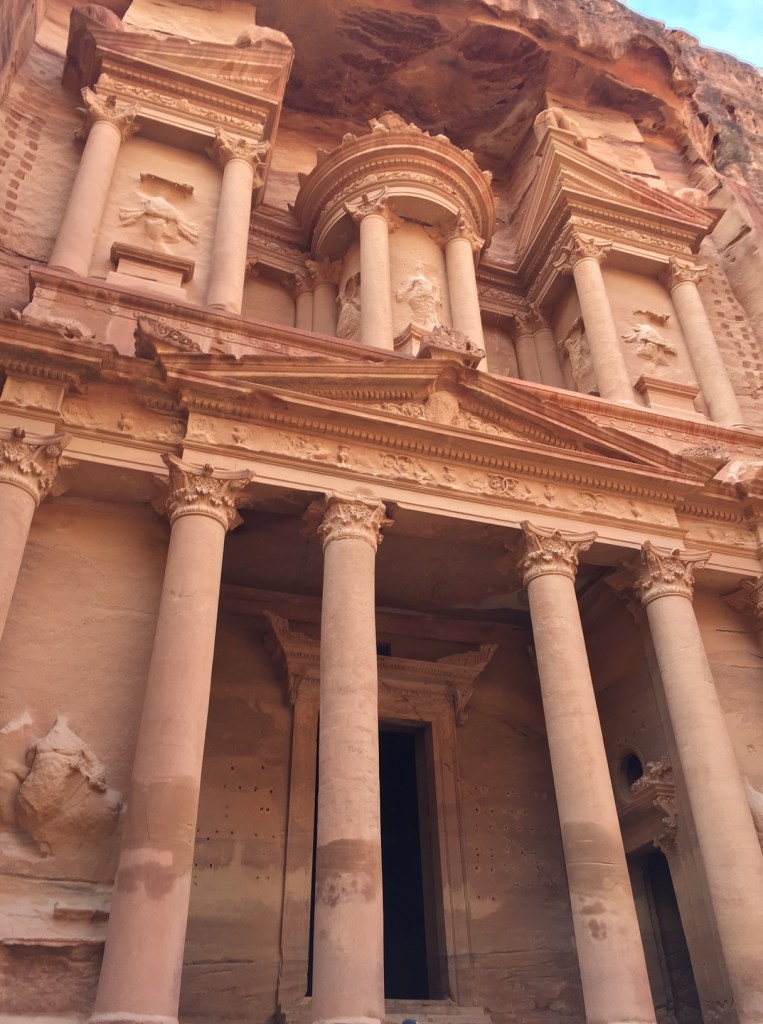
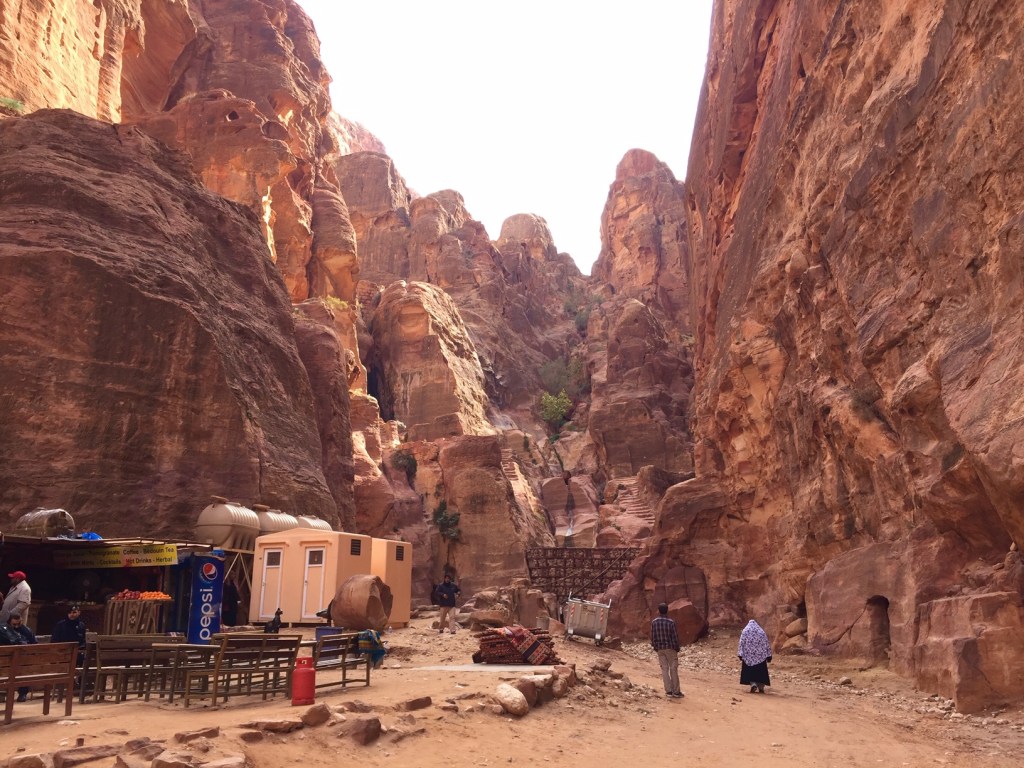
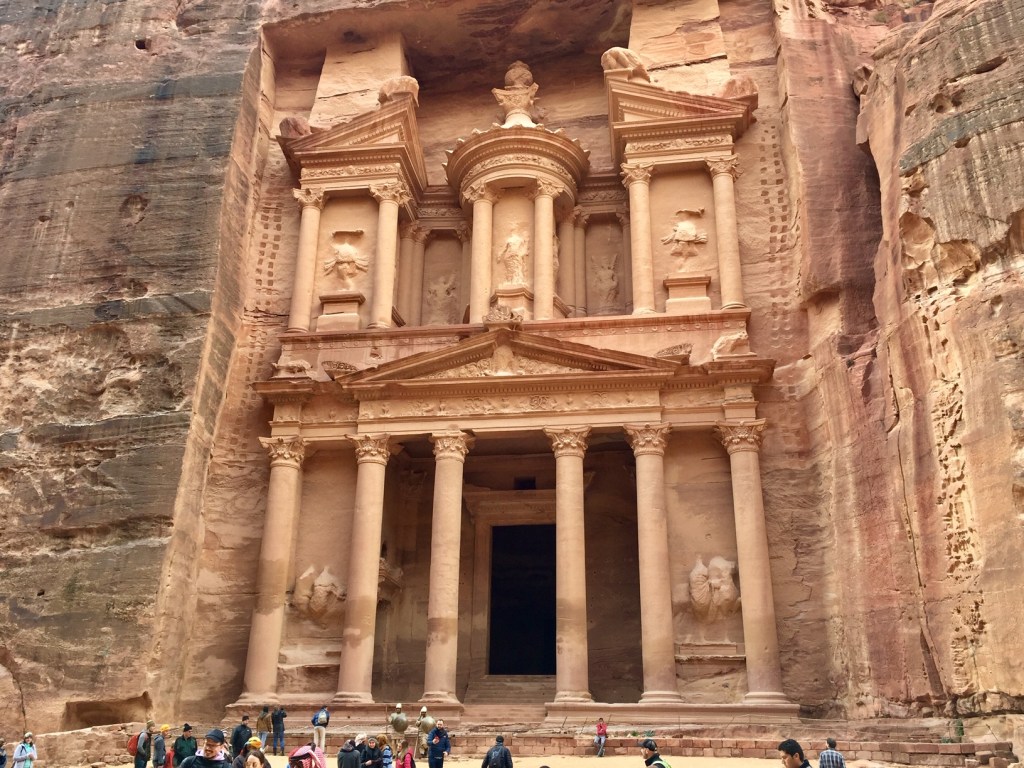
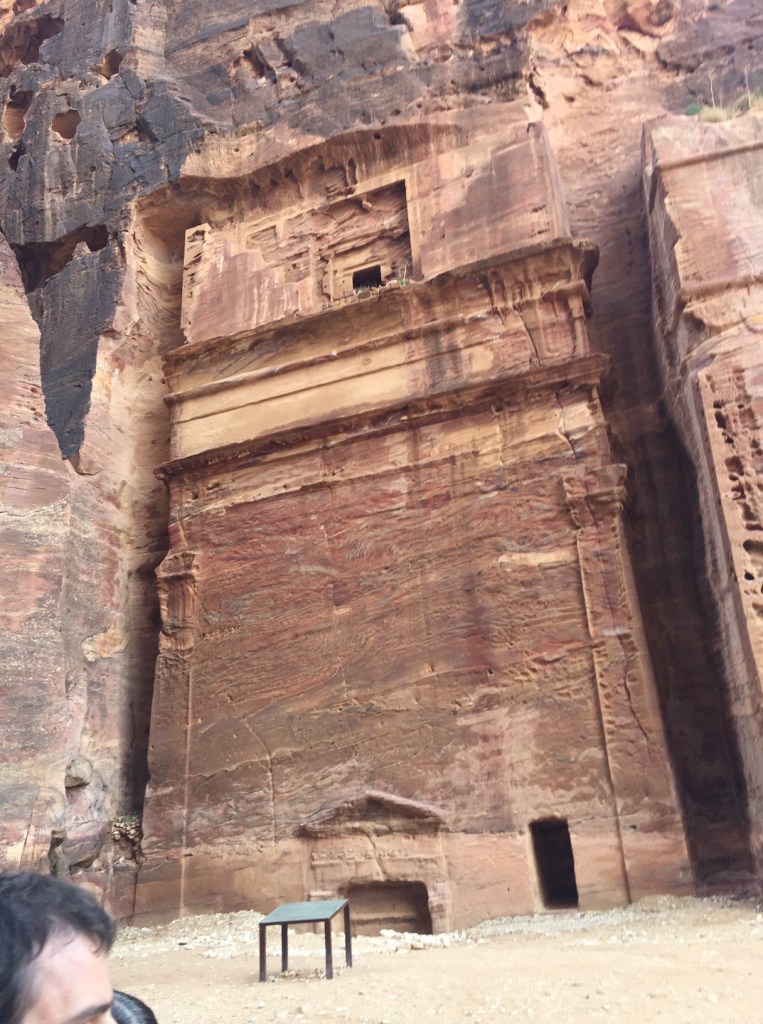
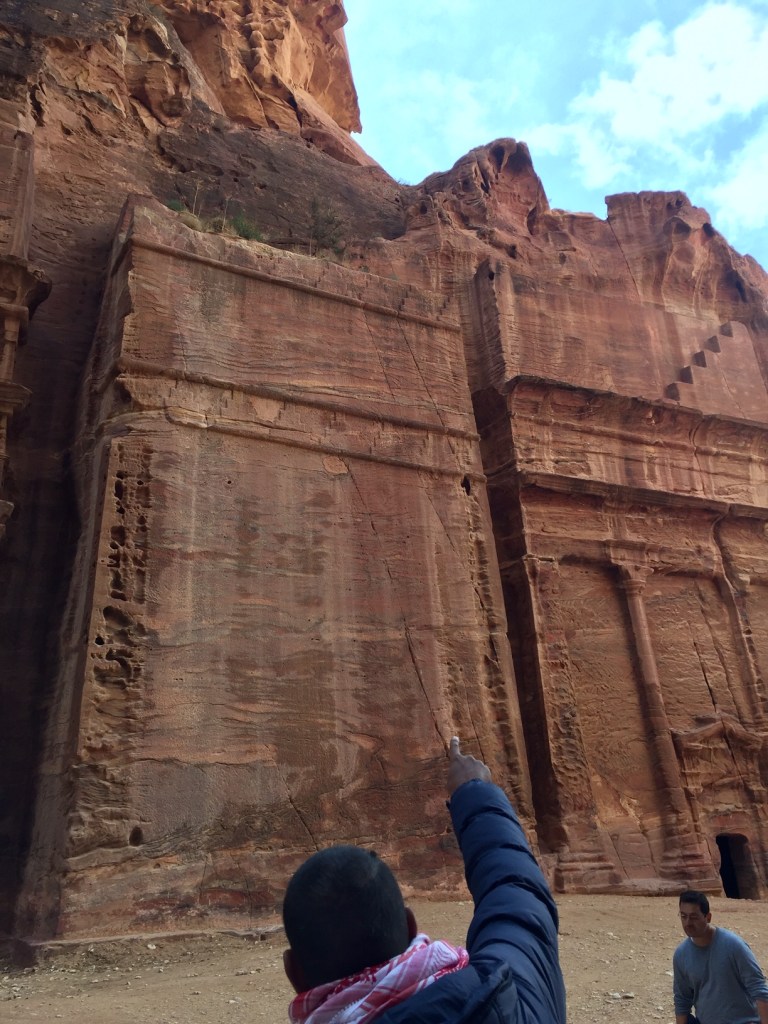
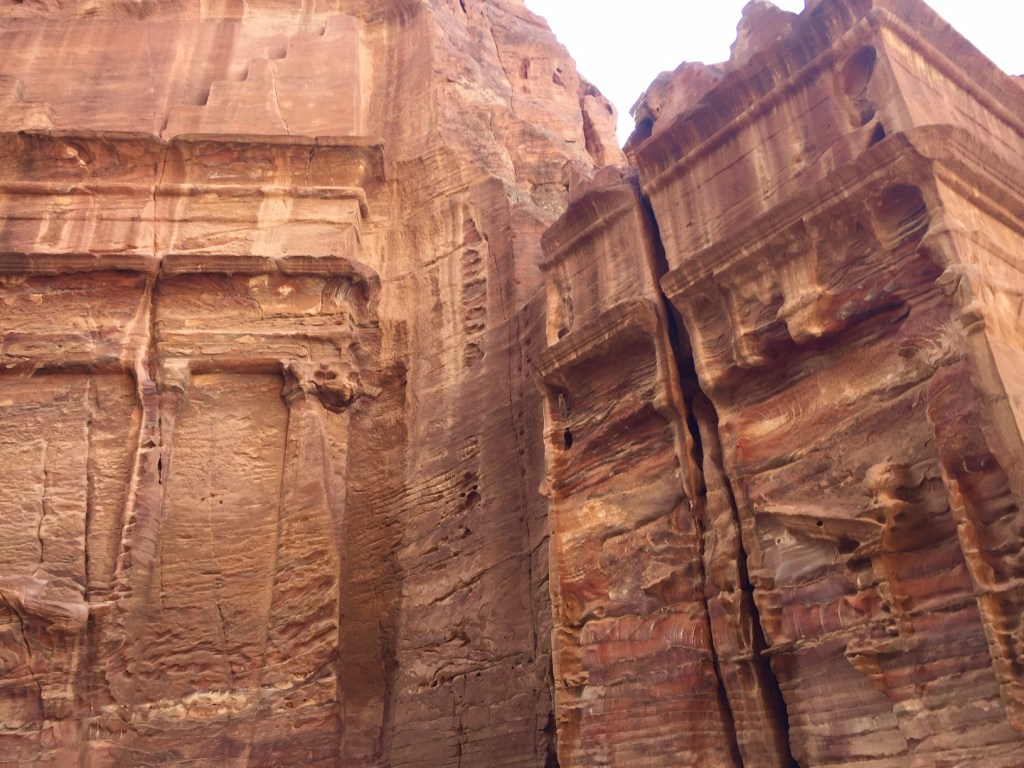
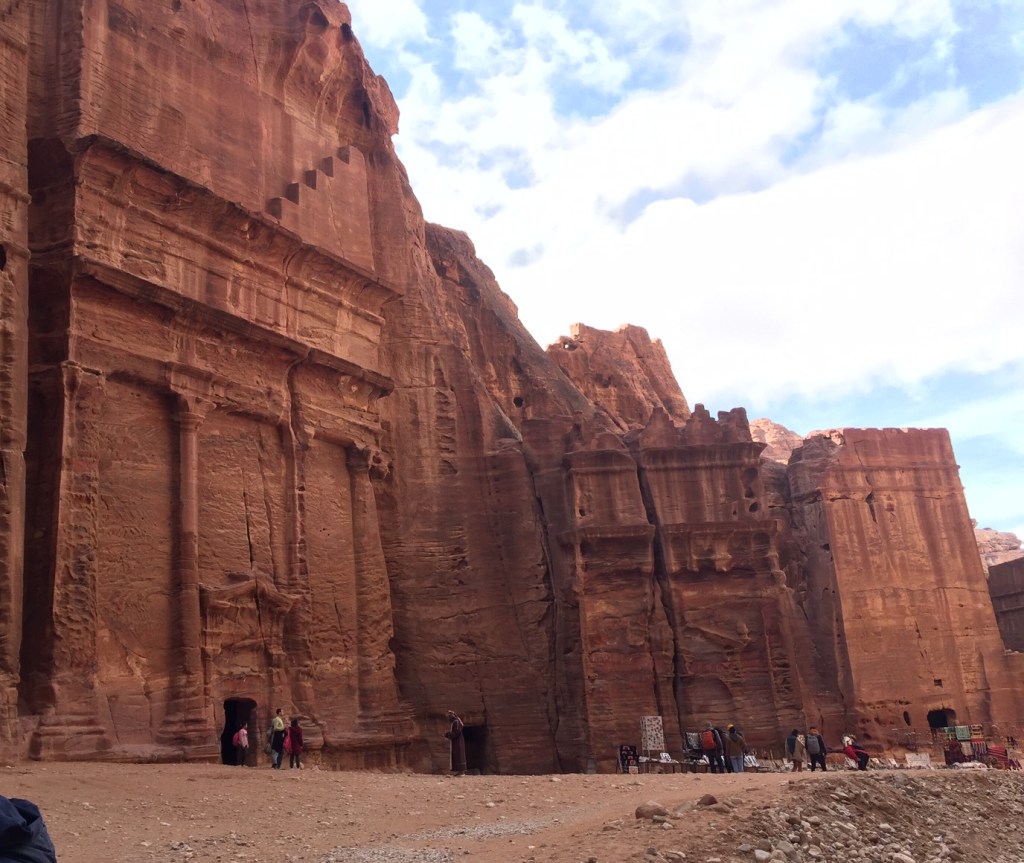
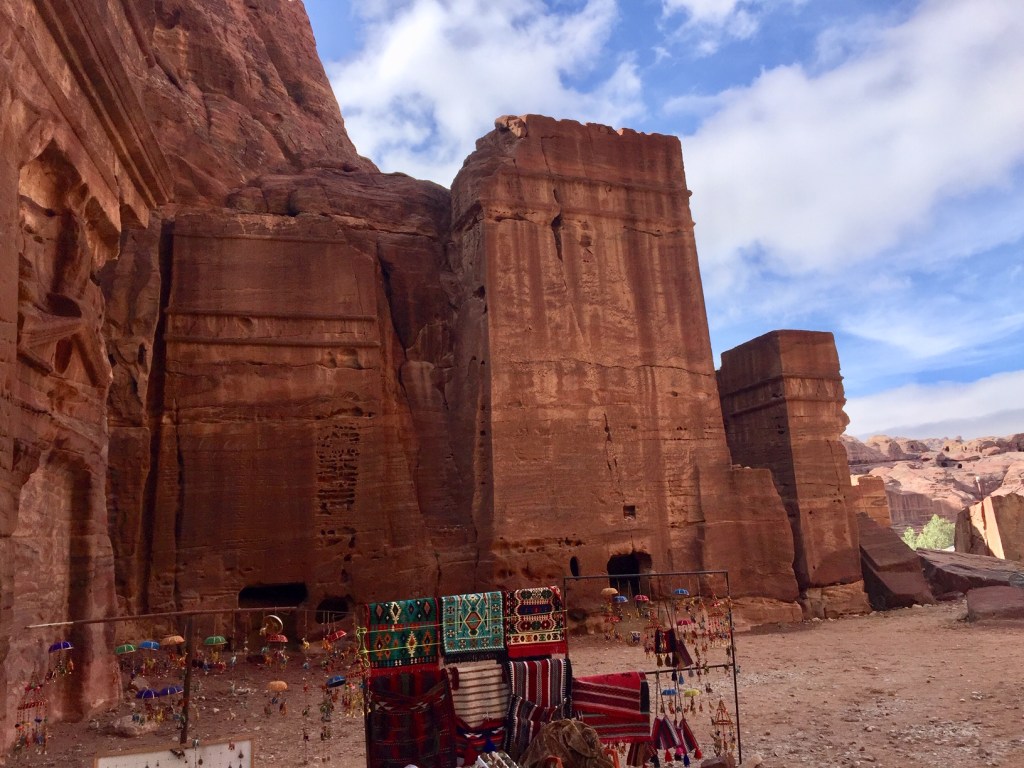
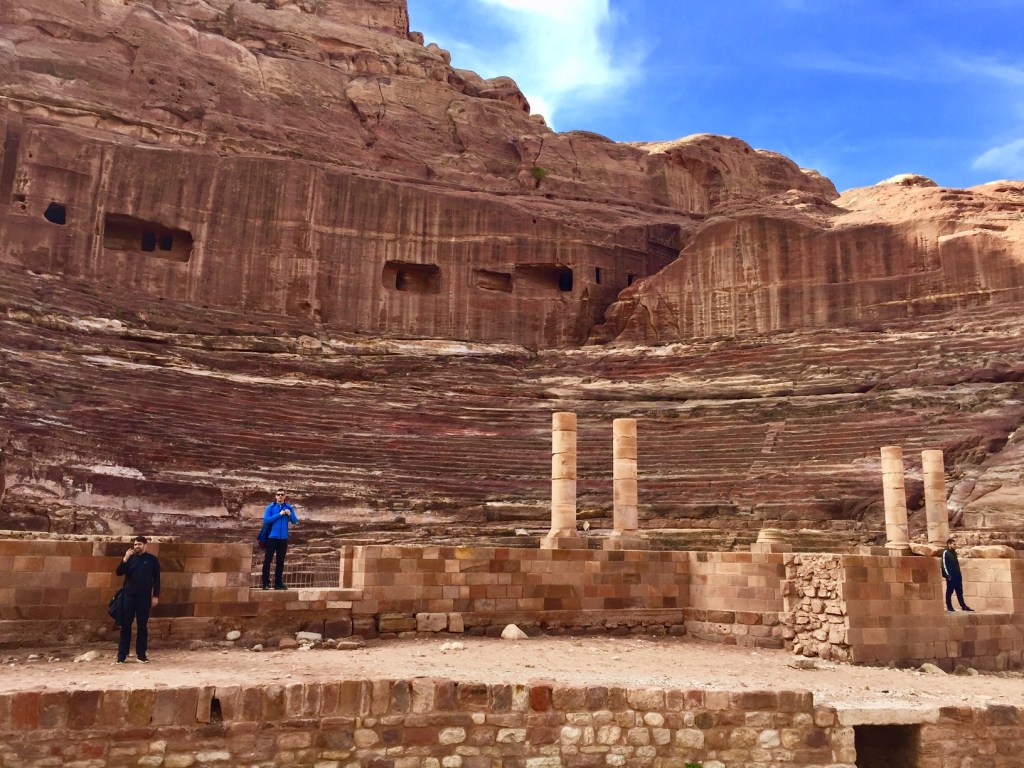
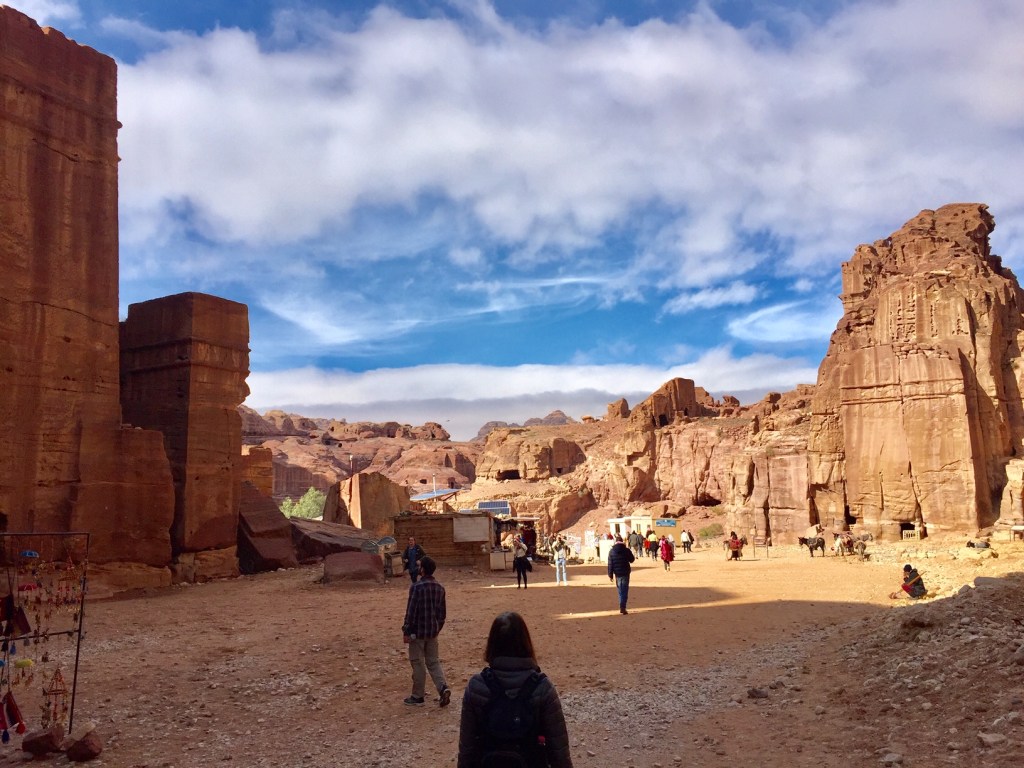
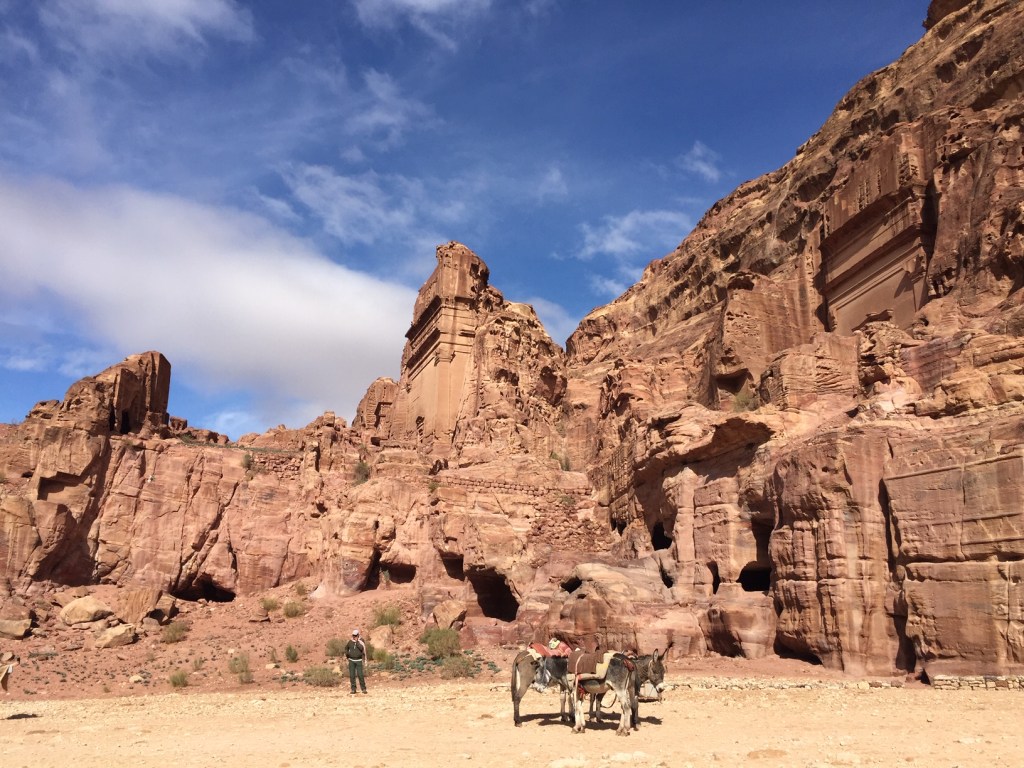
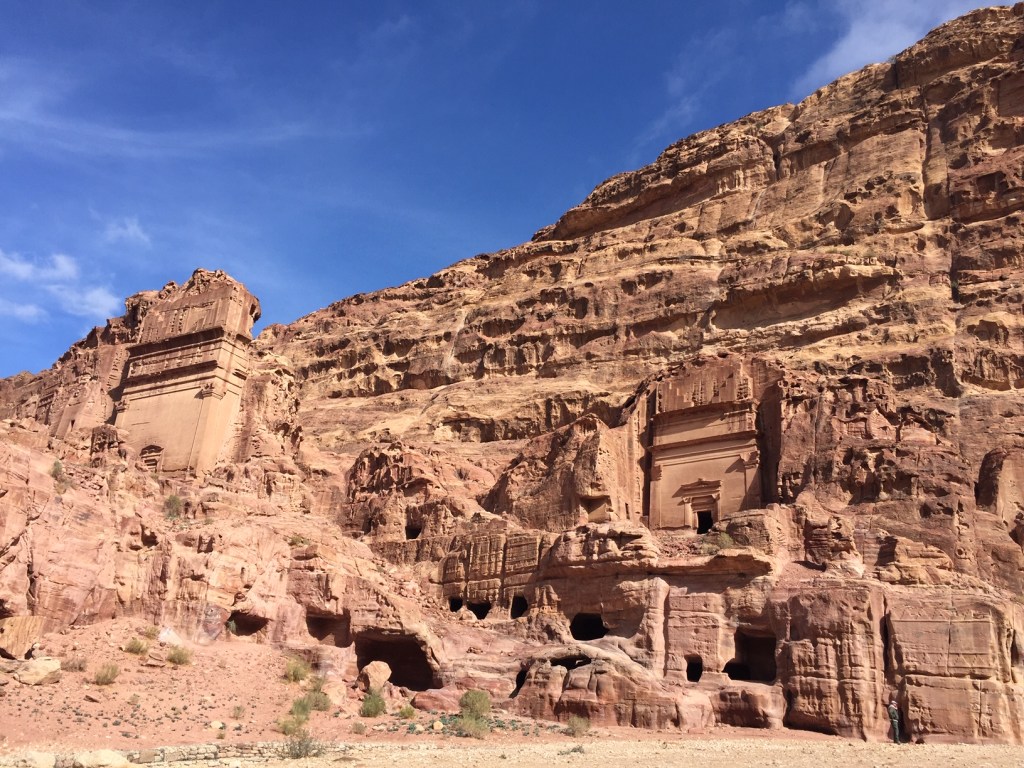
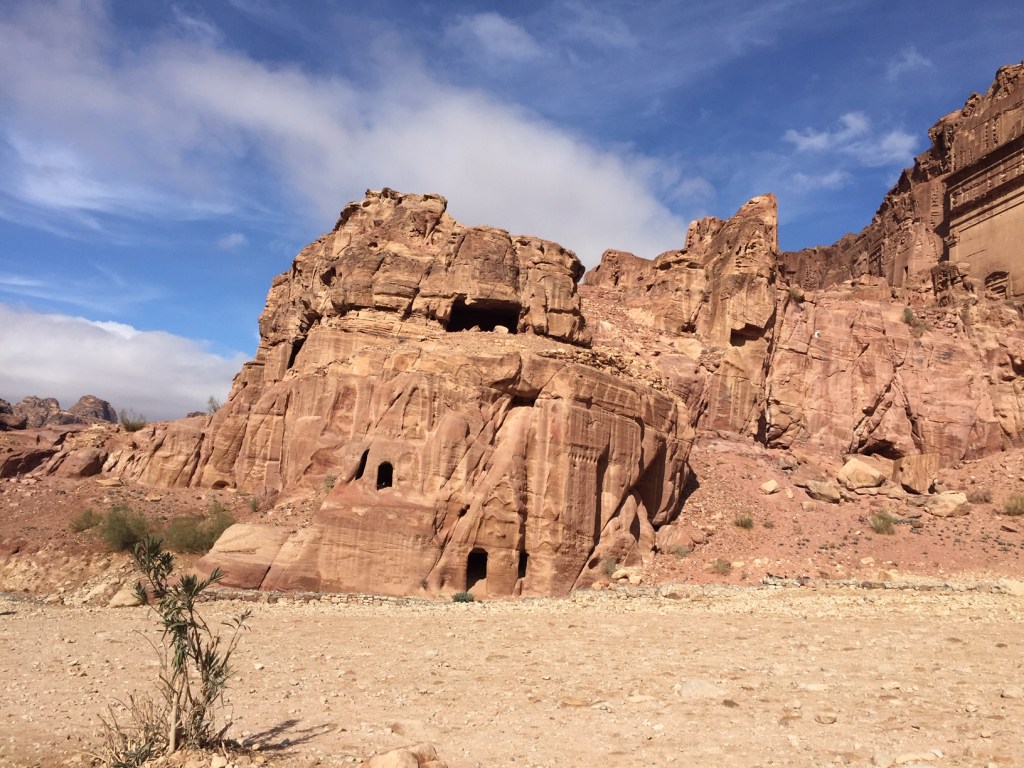
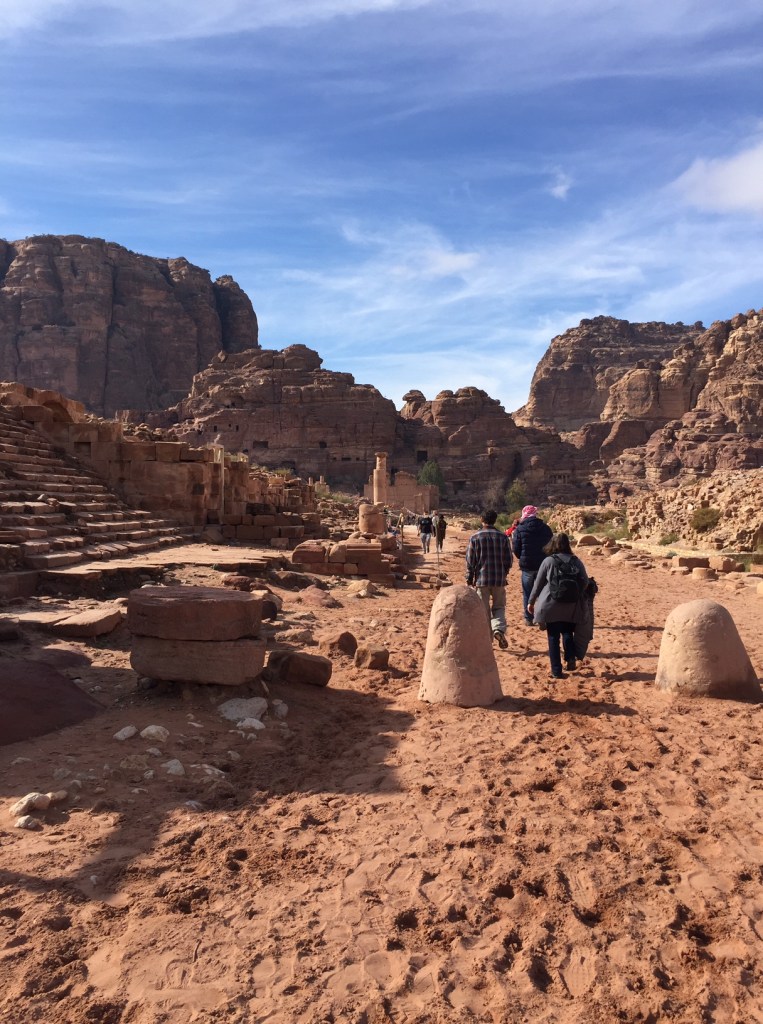
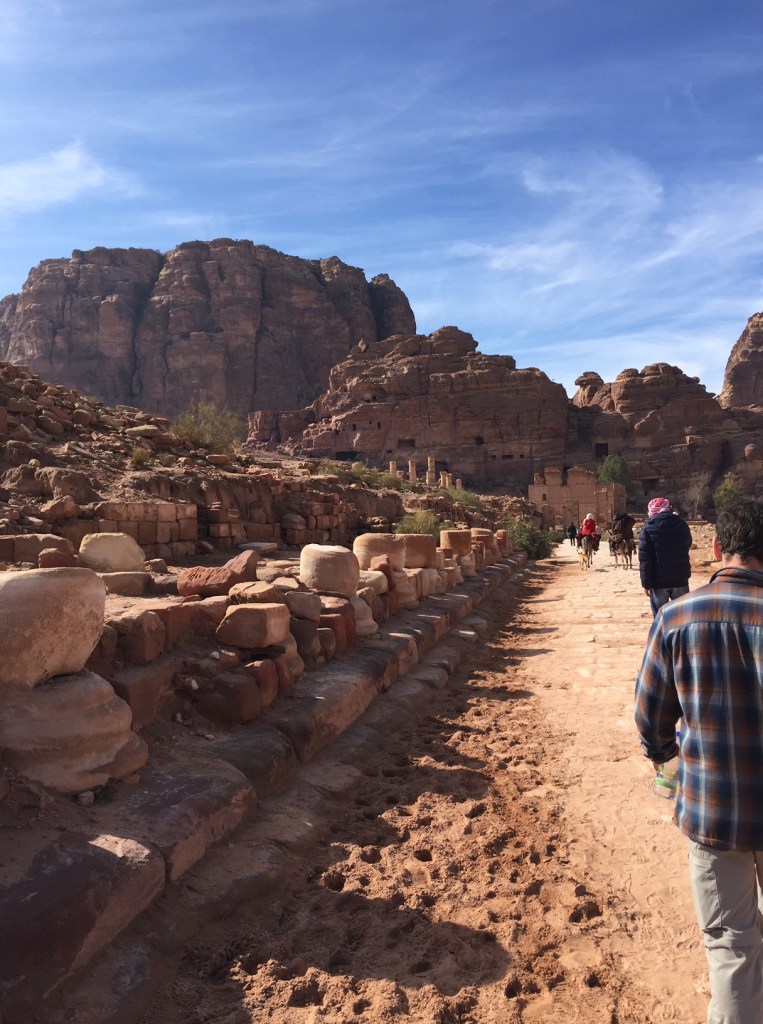
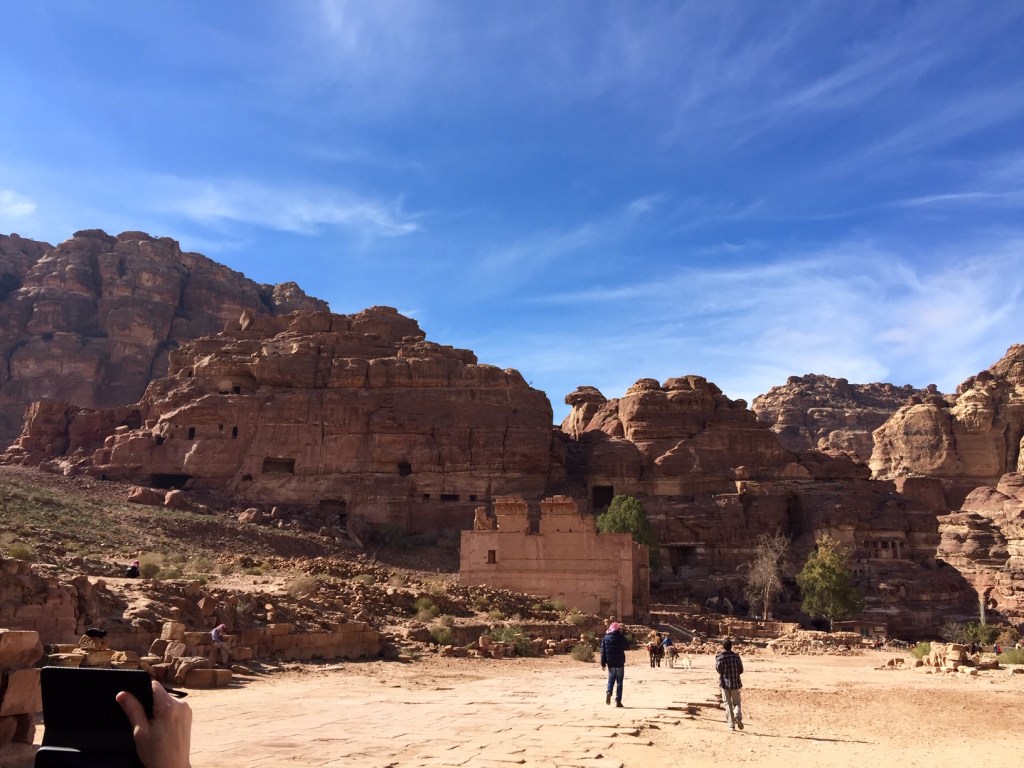
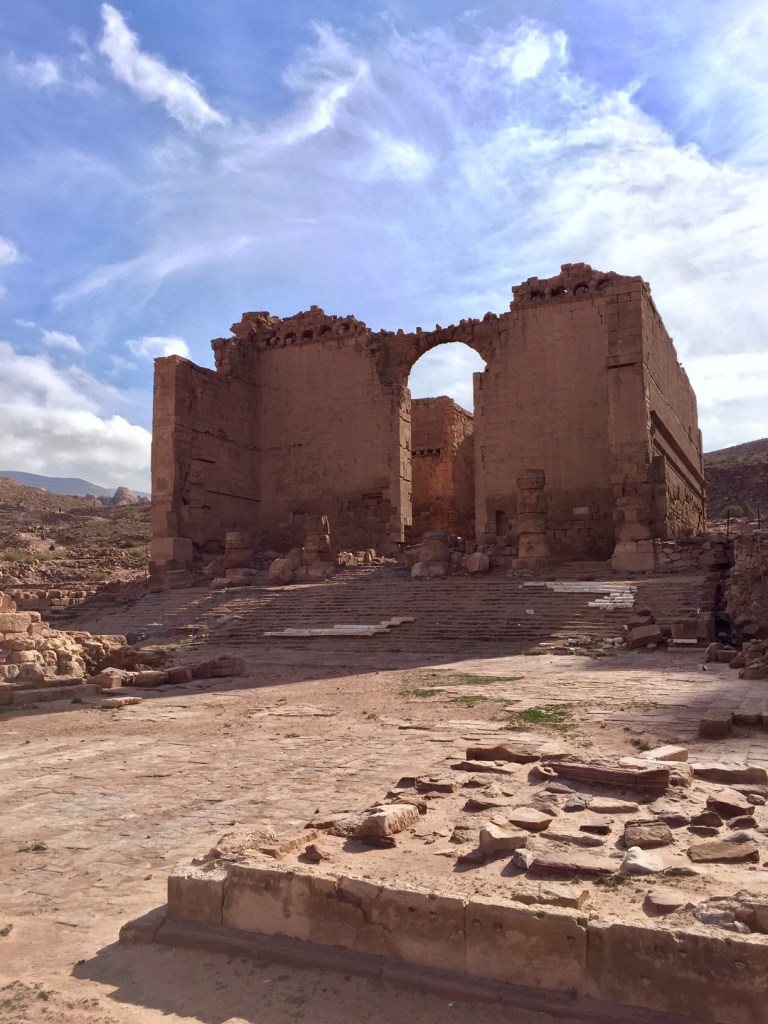
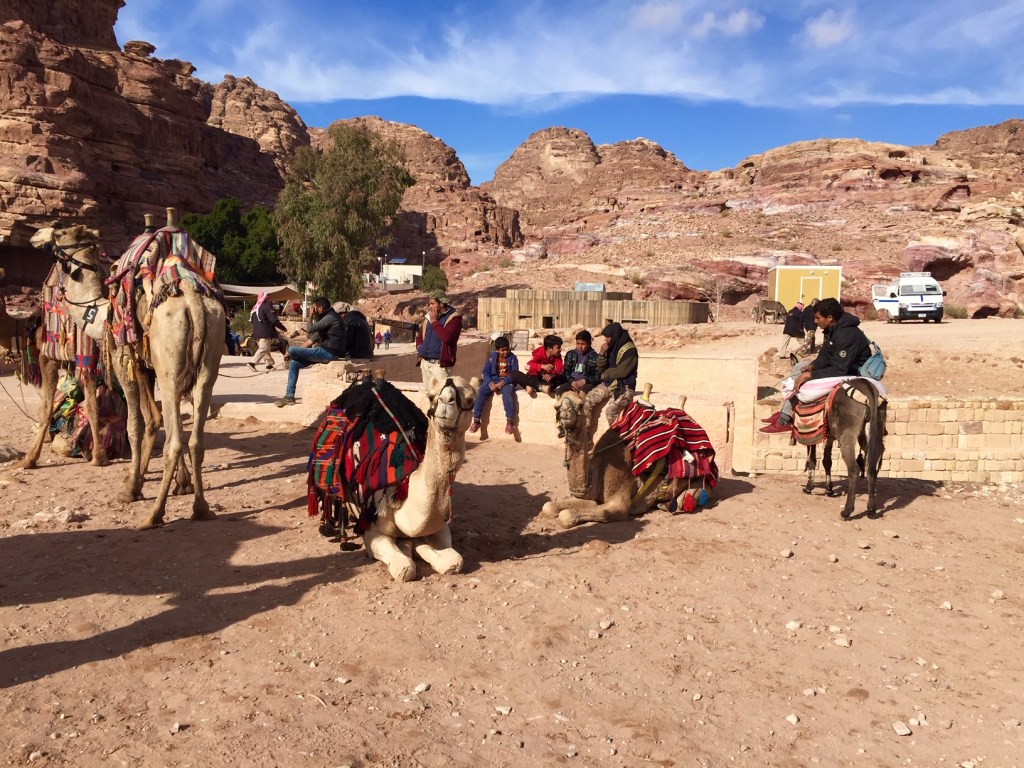
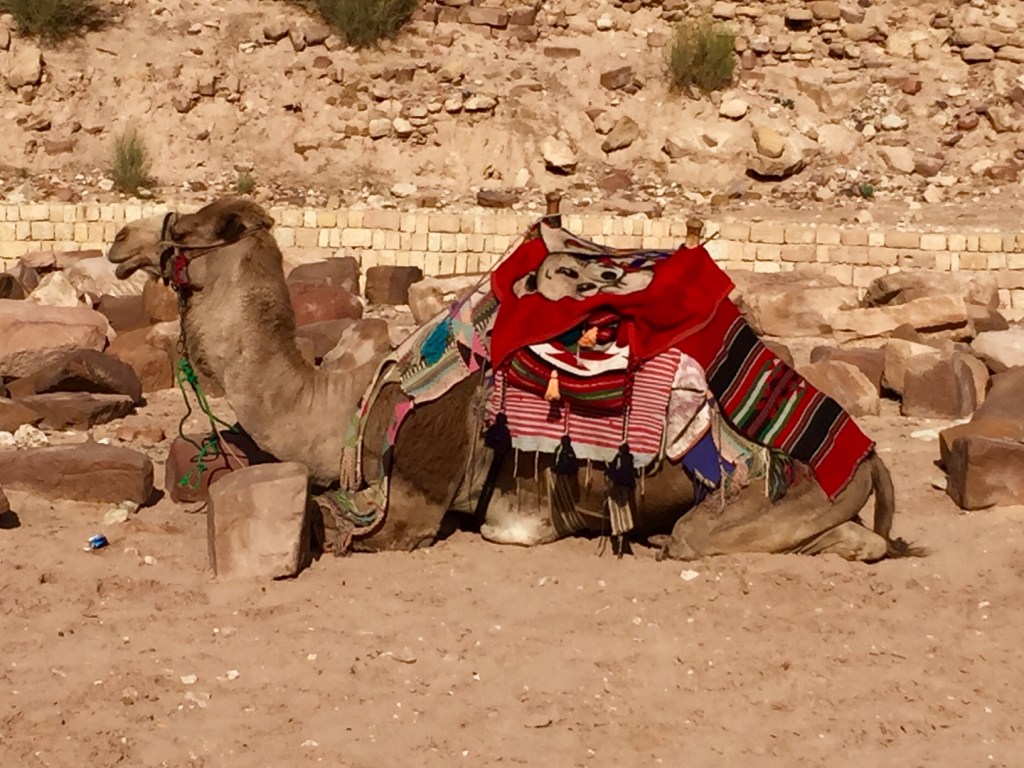
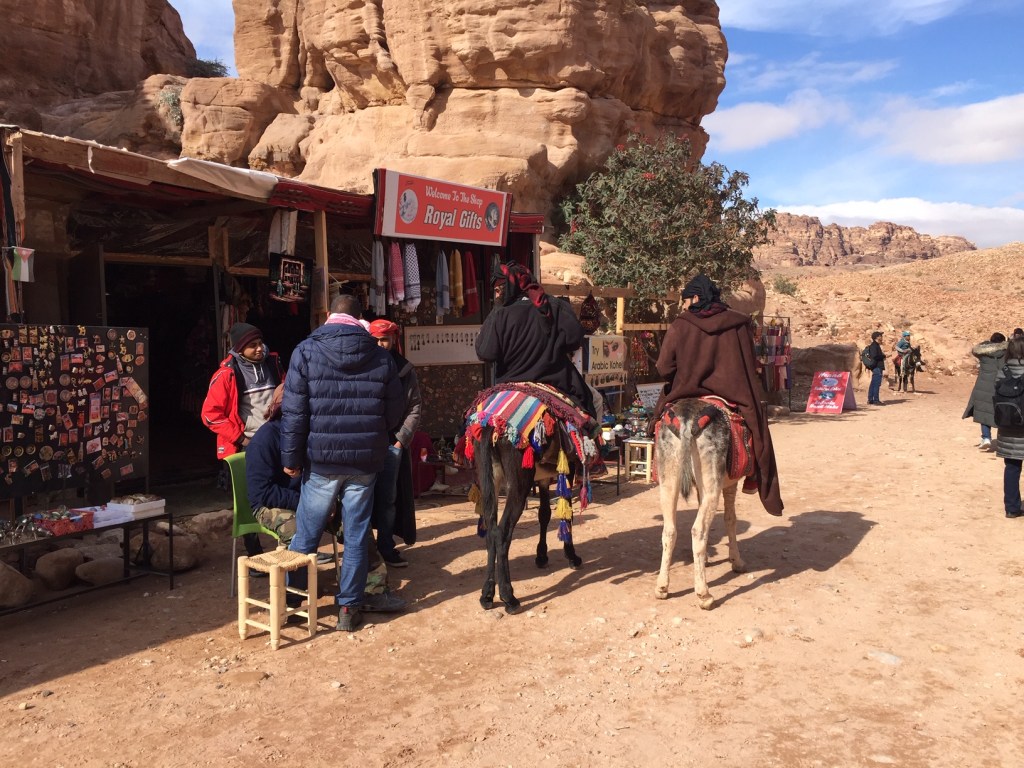
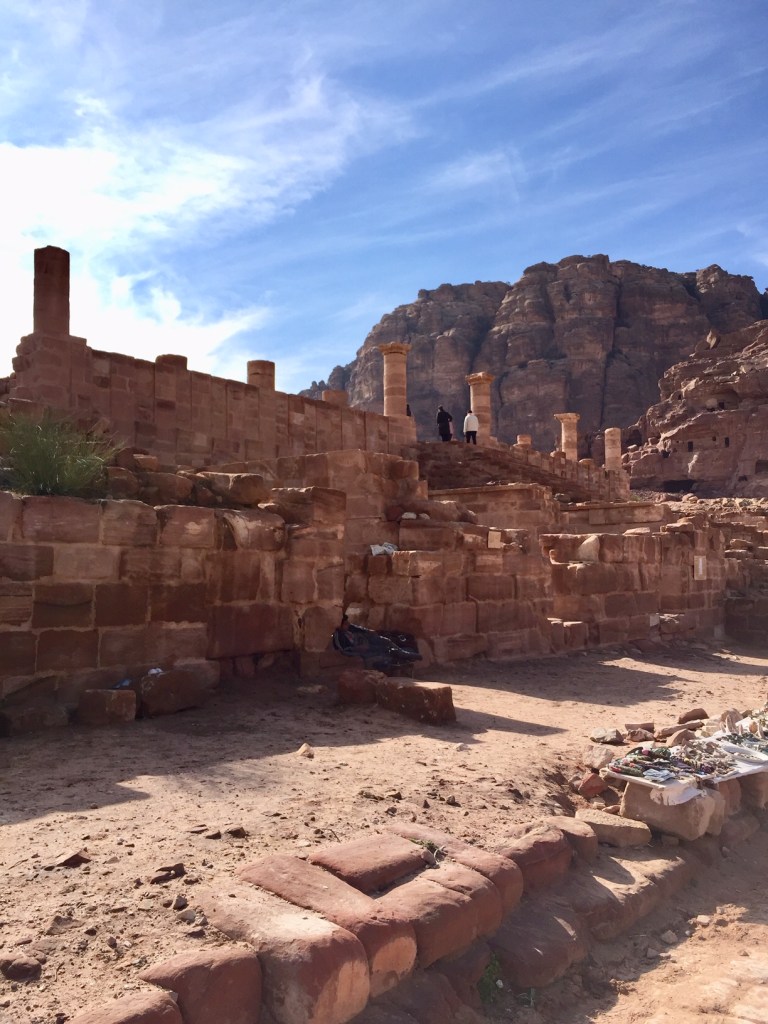
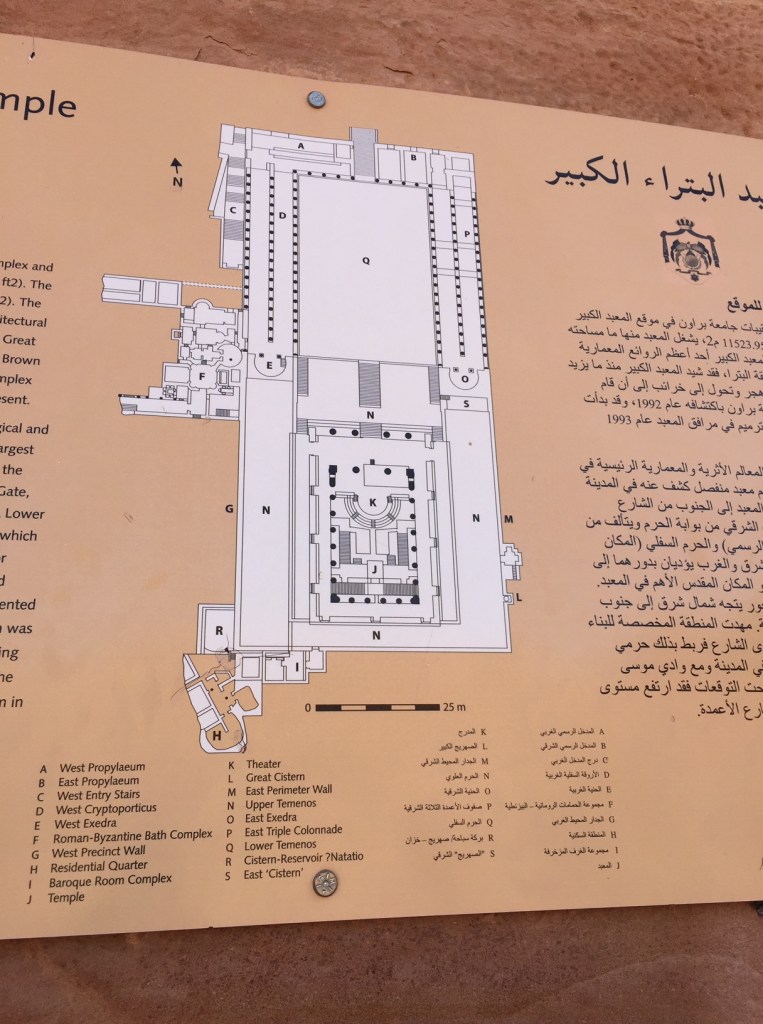
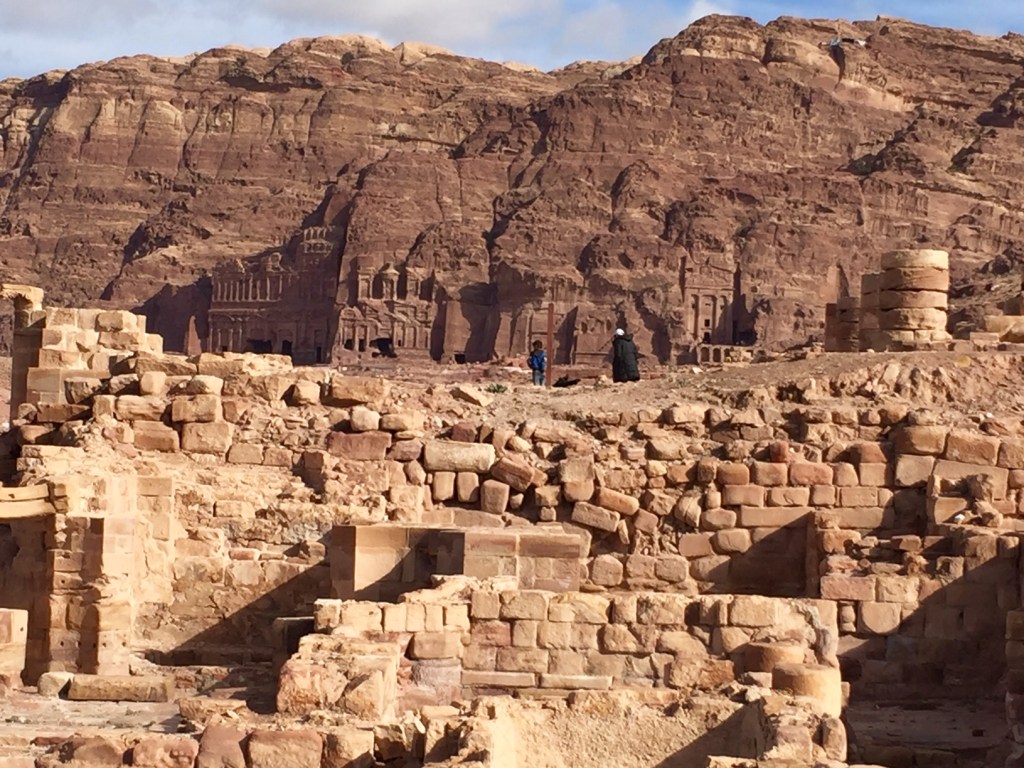
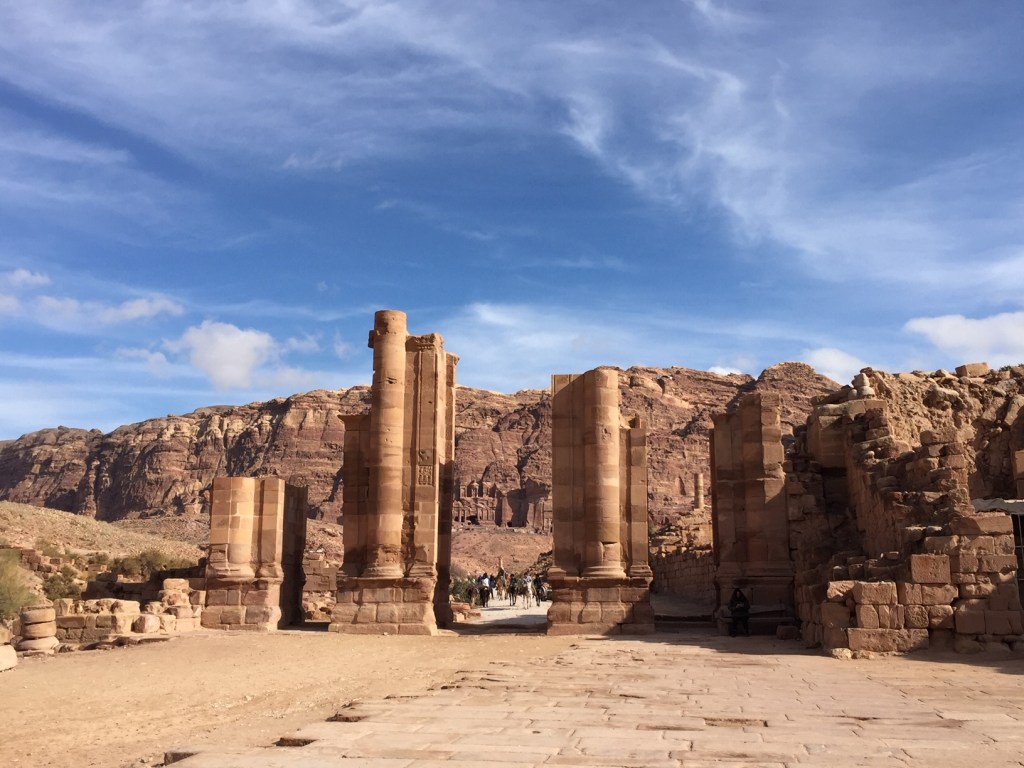
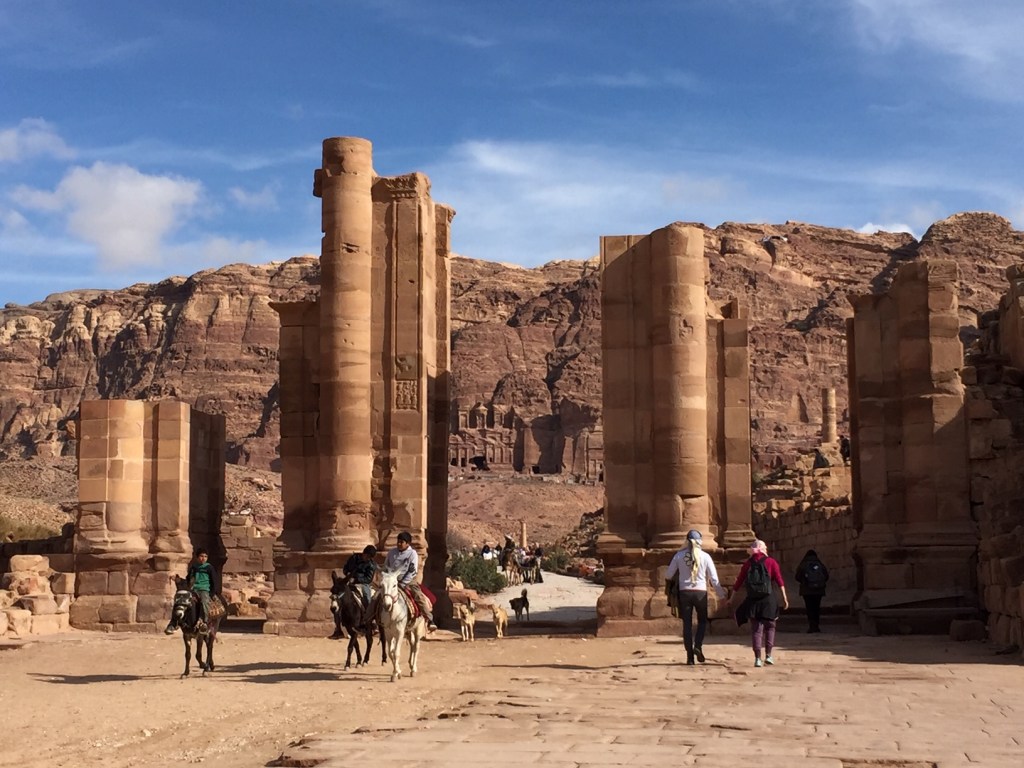
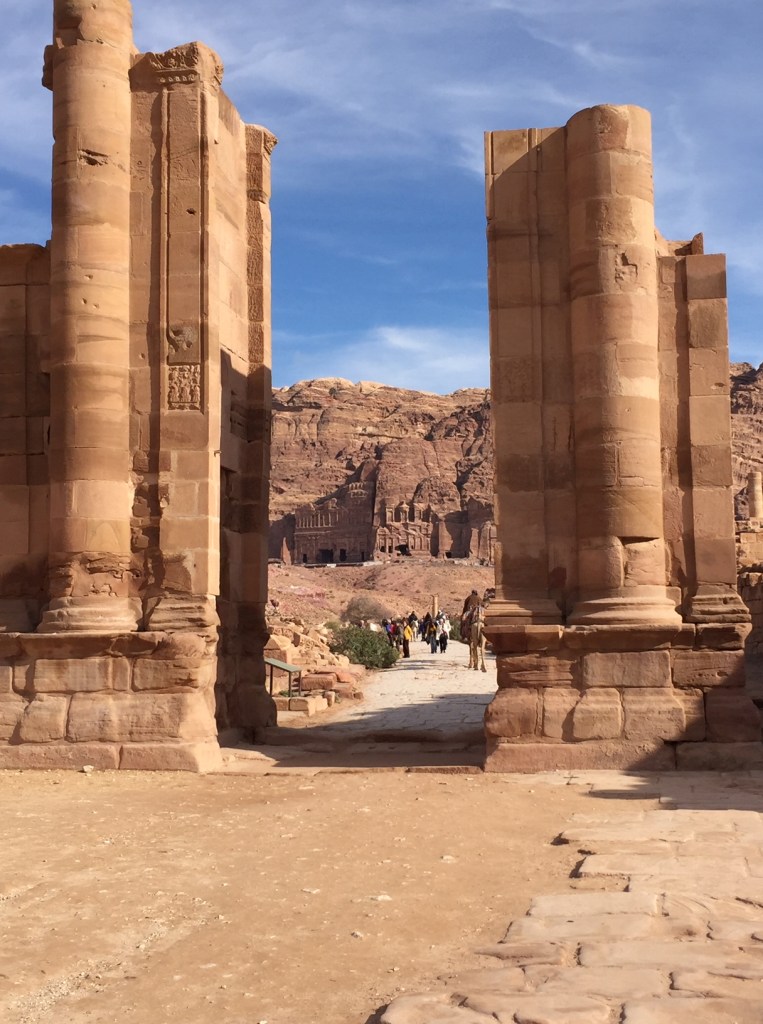
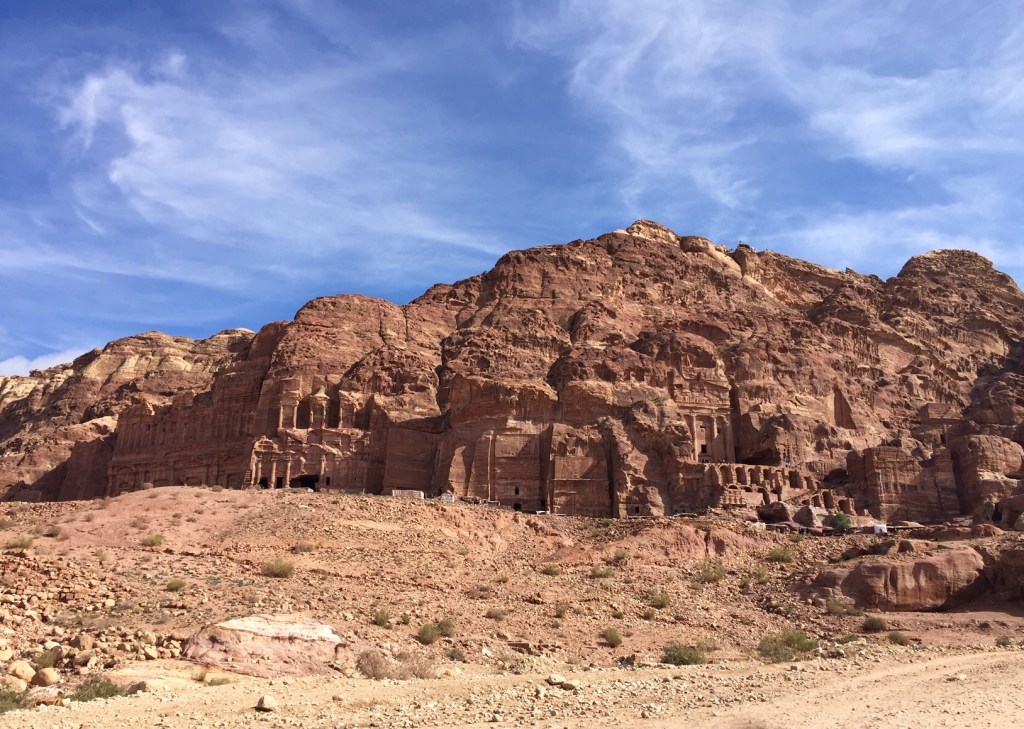
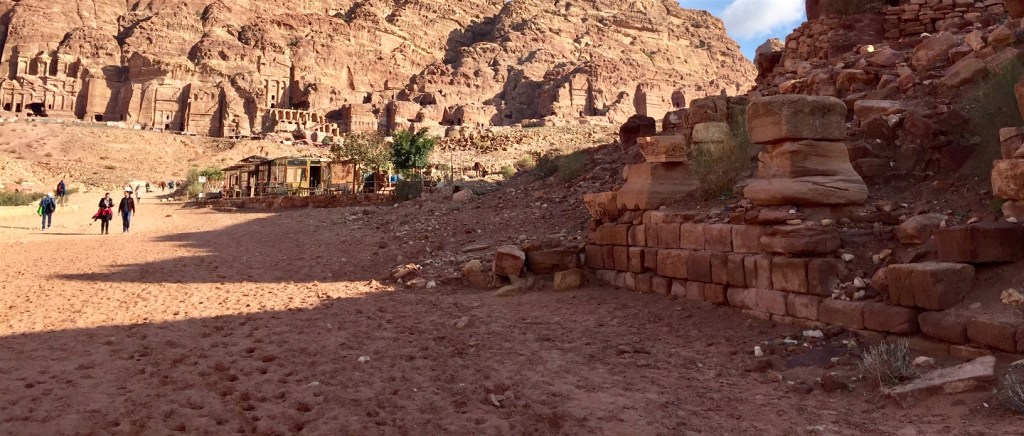
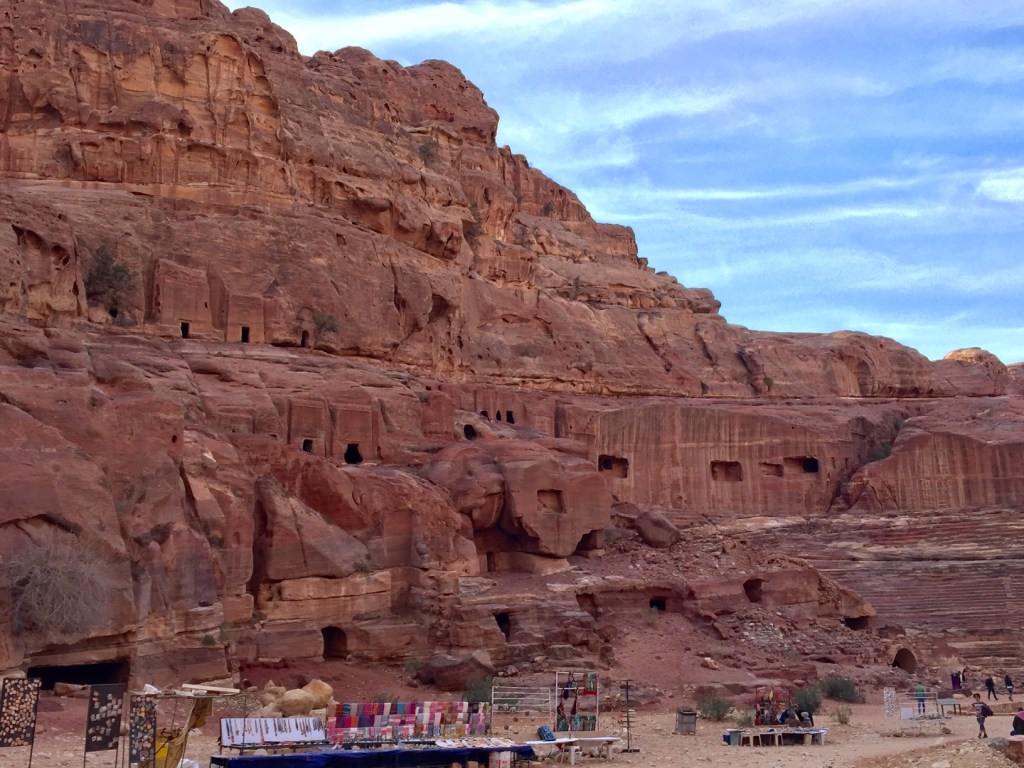
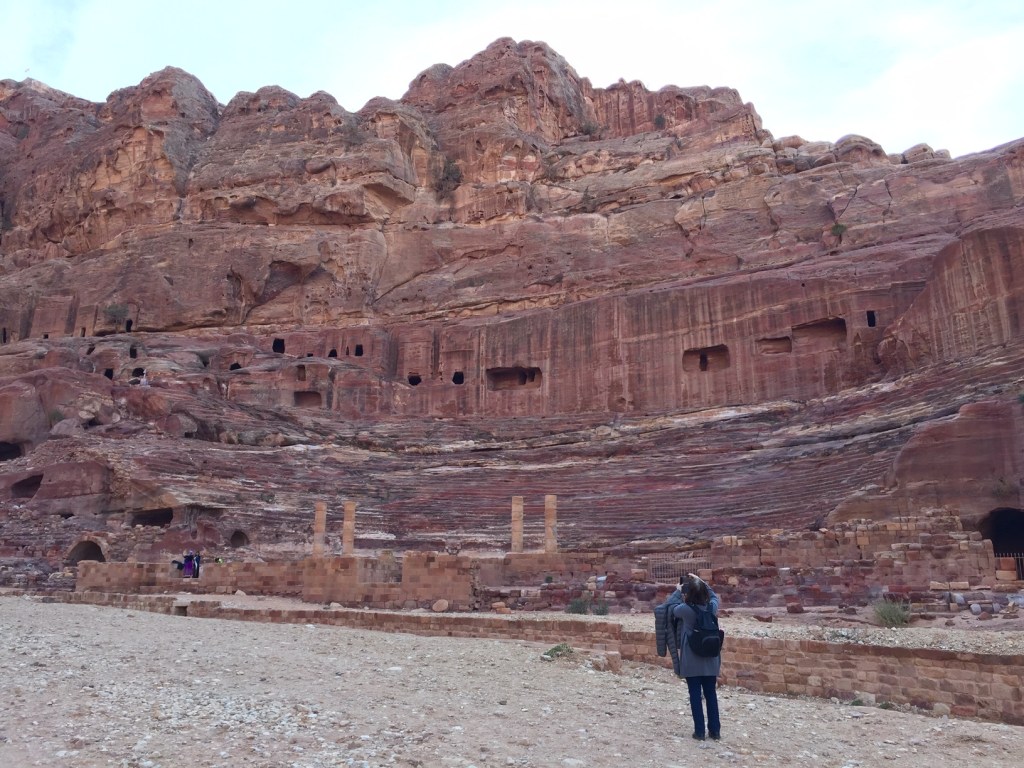
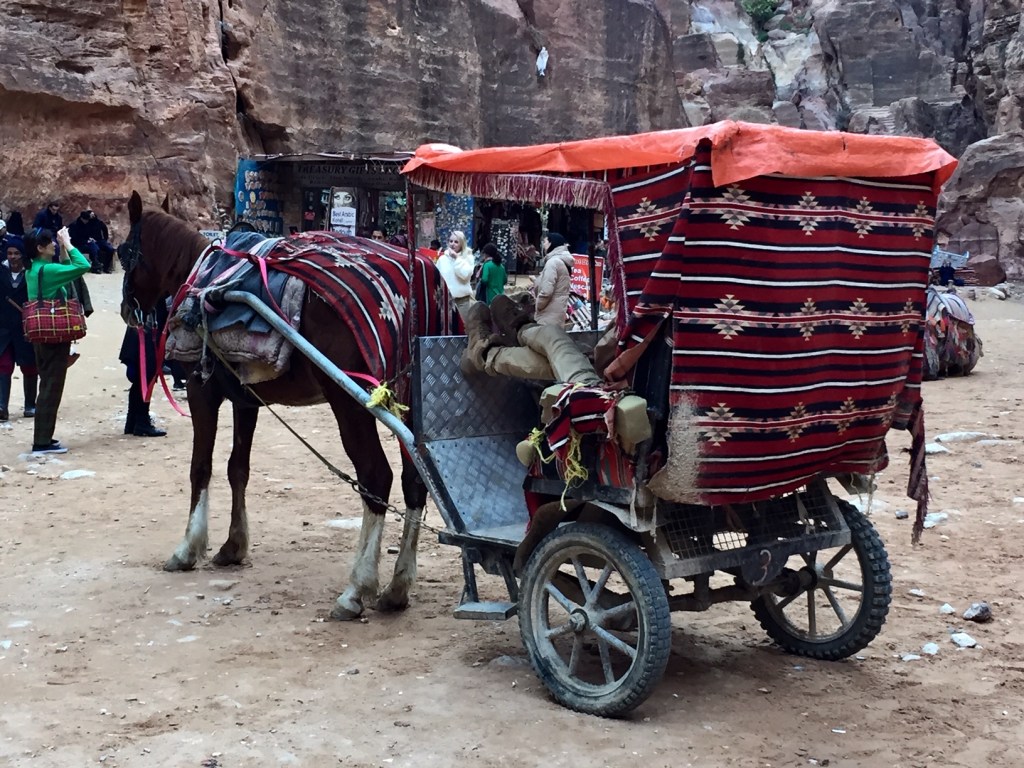
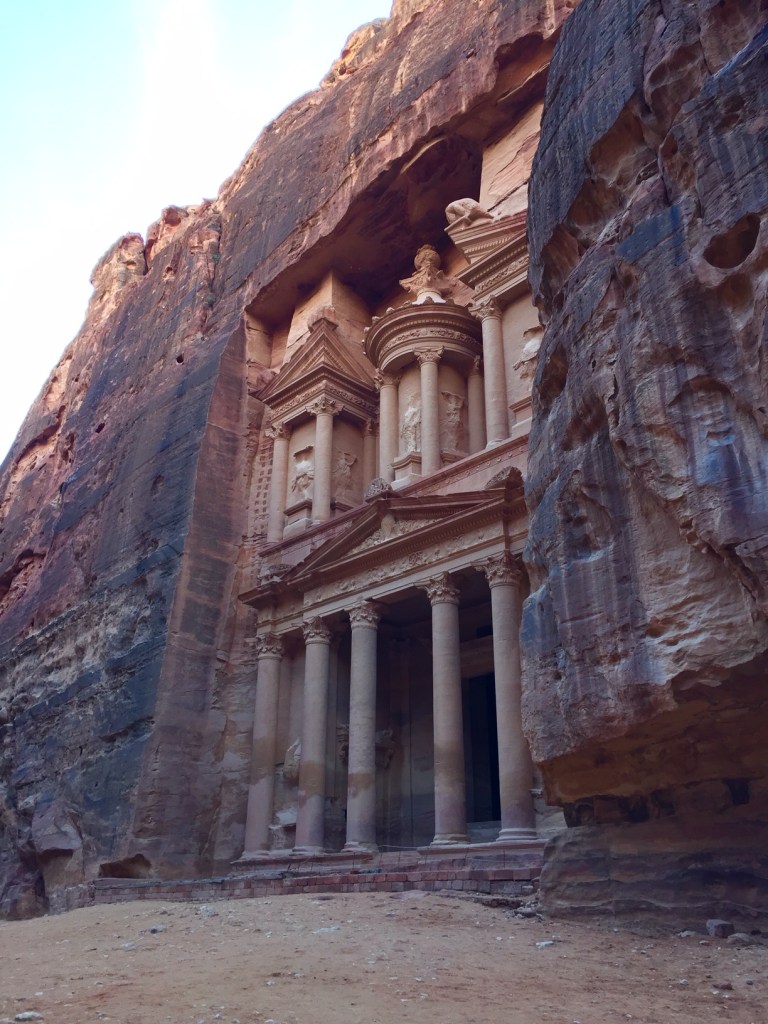
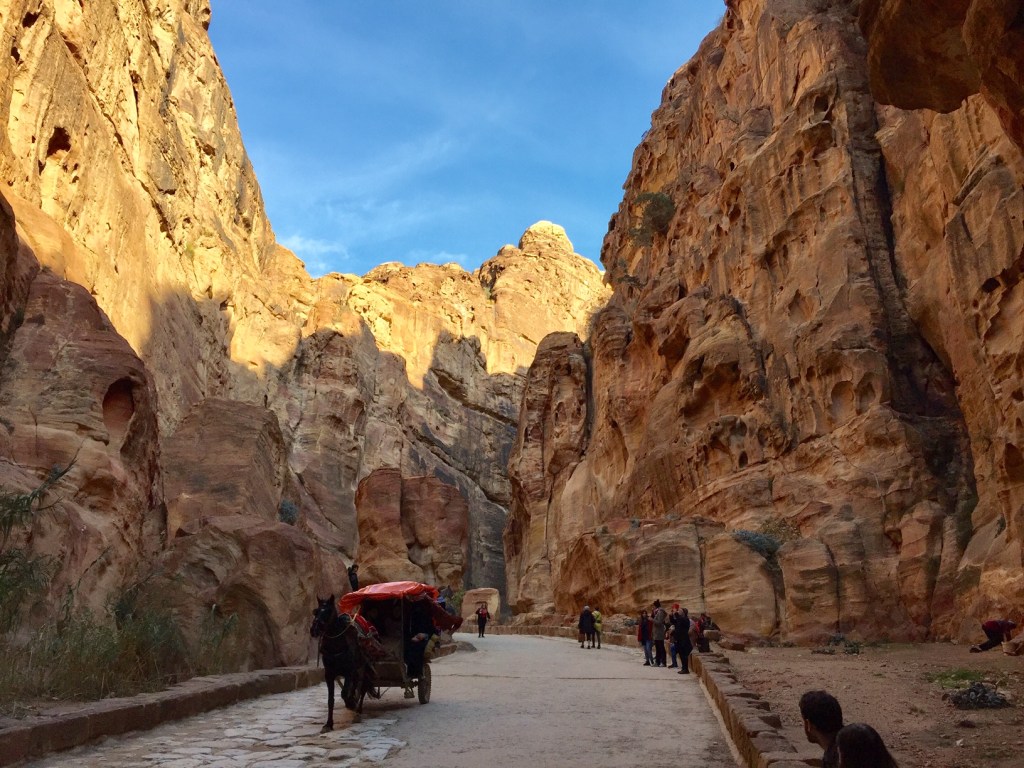
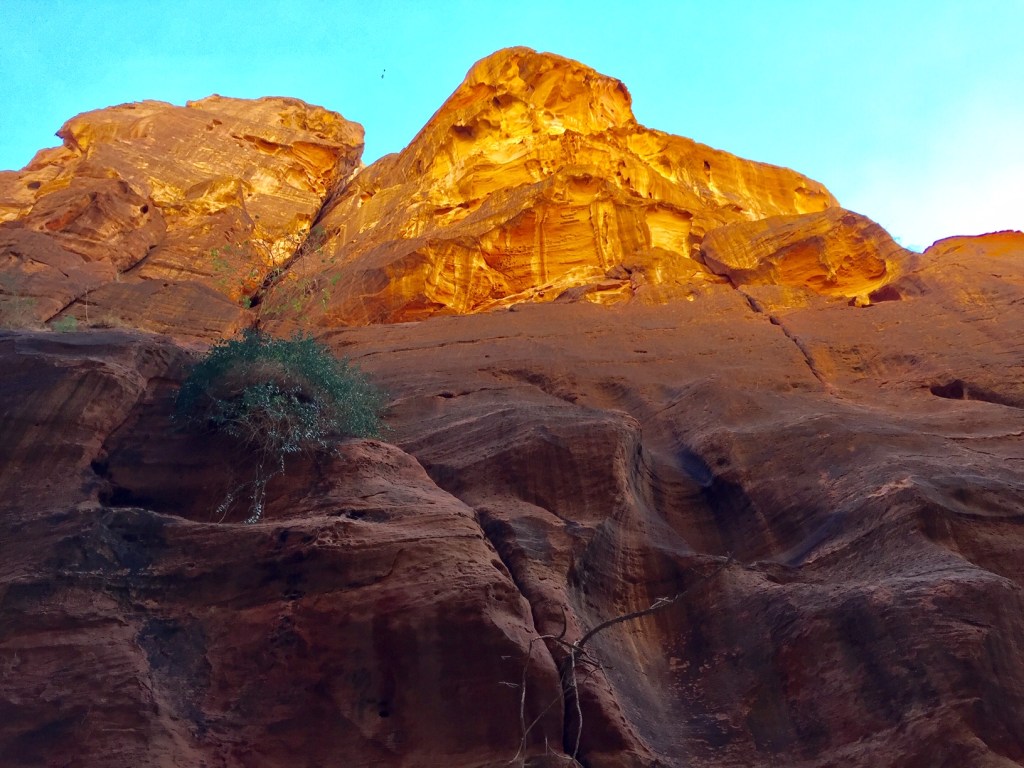
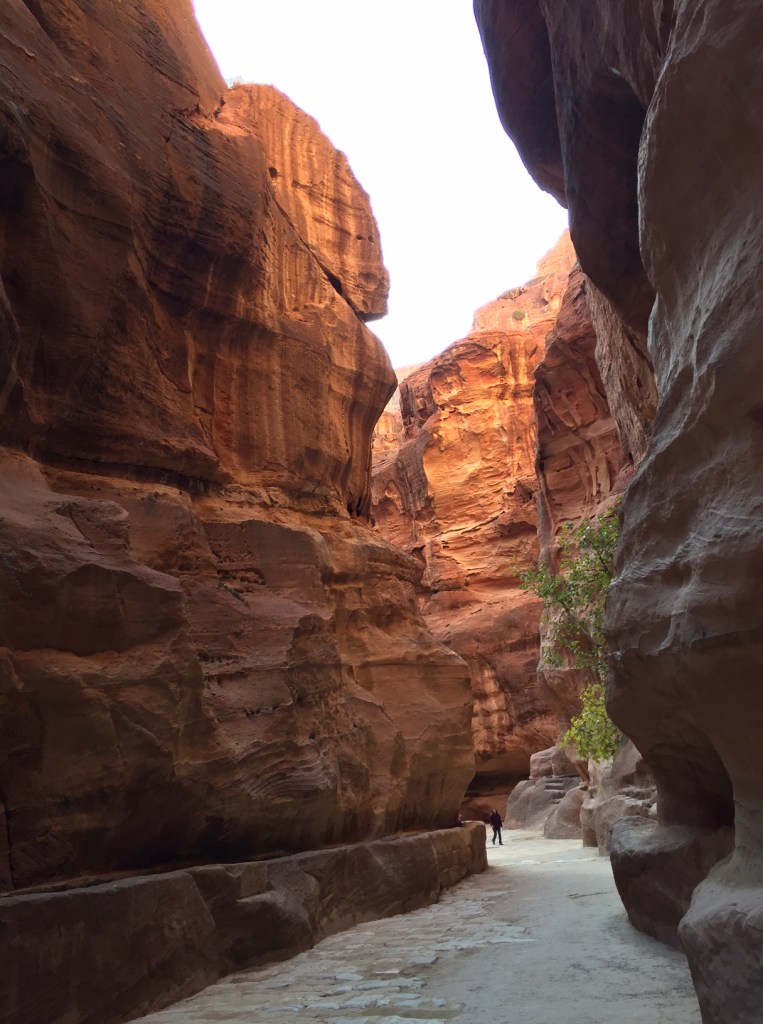
Our guide, Ali, at left. He does a tour six days a week, and seems to know and be on good terms with every camel driver and chotchke sellerTombs Carved from solid stoneDescending the canyonOnce, this was a sculpture of a man leading a caravan of camelsSome of these niches contain the remains of carved idolsOn the left, the remains of the incredible water system Most of the holes in the cliffs were carved as tombs — some served as homes. Later, Bedouin lived in these caves.It’s more than likely that the figures that used to fill the niches were destroyed by Muslims with an objection to art that depicts people. Our guide did not mention this possibility, however.If anything, the colors of the stone were richer than what the photos showIn addition to the carvings, the sandstone has amazing natural formationsDonkey carts and camels go dashing up and down the way — one has to keep one’s ears open and stand to the sideA modern attempt to keep water from flooding the canyonHorse cartWith great drama Ali had us move to one side, and then slowly step forward, until the greatest building of Petra, the tomb erroneously referred to as “The Treasury”, was little by little revealed. It was truly a dramatic moment.The stone figures – -standing or riding horses — are said to have worn away with time. The sandstone is soft, and the wind blows constantly, However, it’s possible they were destroyed by people with an aversion to “idols”.This building was carved out of solid stone. The Nabateans would first carve stairs in the stone up to the top, and then work their way downward, carving out the structure. It’s breathtaking to see and to think about. It is a tomb, not a temple, contrary to “Indiana Jones Part 3”.Look left from the “Treasury”…Then take it in again!You can see sand has washed down the valley and half-buried the door to this tomb.The stepped designs indicate that a different civilization from the one that built the “Treasury” built this imposing structure — I’m not sure, I think Ali said the AkkadiansWe were not good tourists. We didn’t buy souvenirs, or take our picture with the historical re-enactors in Roman armor. I did tell one small boy, who was manning a large souvenir stand by himself, that I would “maybe later” buy something. In Arab countries, “Maybe later” means “definitely yes”, as against in American where it means, “Not interested”. He was a beautiful boy, and it was a cold day to be trying to sell souvenirs to a sparse crowd of tourists. On the way back up the canyon later that day, I did bargain for and buy two useless souvenirs that were probably made in India or China.Amphitheater. The only one in existence to have been carved out of the stone, rather than laid of separate stones.I feel like this scene has probably not changed much since my great grand father was in the Middle East 115 years ago.The Bedouin who used to live in these caves now make their living offering donkey rides.At the bottom of the canyon is this fort, from a later era I think.And camel rides.Camels are really odd looking creatures!It had taken us a couple of hours to come down from the Visitor Center. Ali left us to explore on our own. Lunch at this small restaurant was included in our tour. It was the usual buffet style, and included some hot-out-of-the-oil falafel with sesame seeds — yum!After lunch we spent some time exploring this enormous Roman temple which archeology students from Brown University are the process of restoring.We began our ascent back up the valleyAs we climbed back up the hill I took many more pictures. The light had changed, and different perspectives were revealed. But I will spare you most of them!The amphitheater again — I think this one captures its vastness a little better.No thank you, we don’t want a carriage ride.A last look at the most iconic structure at PetraAfternoon light
When we reached the top of the canyon we had a little time left, so we went through the small but excellent museum. It had a perfect selection of artifacts from the various civilizations that once inhabited Petra. We were exhausted, but it was still worth seeing. It always astonishes me what can survive — glass, for instance, from many hundreds of years ago.
I couldn’t resist taking this fellow’s picture. He looks as tired as we felt.This is the village of Wadi Musa, where we stayed, viewed from above the museum.
It was late in the afternoon, and we were glad when our ride came to take us to the hotel. I’m tired just from sharing all this with you — so I’ll save the rest of my Jordan pictures for another couple of posts!
My trip to Jordan with Bob’s daughter Deborah and grandson Hagai already seems long ago! Is it really possible that a little over two weeks ago we were walking around Petra?
I took a lot of pictures on the trip, and so the next few posts will be largely pictorial, with some running commentary. We drove south — Hagai and I sharing the driving. We descended from the Jerusalem hills onto the flat agricultural land outside Tel Aviv and took the main highway southward. As Hagai remarked, the countryside turns from farmland to semi-desert sooner than you’d expect. Long before we reached our lunch stop in Mitzpeh Ramon, we were in the full-on Negev desert, stony as the moon.
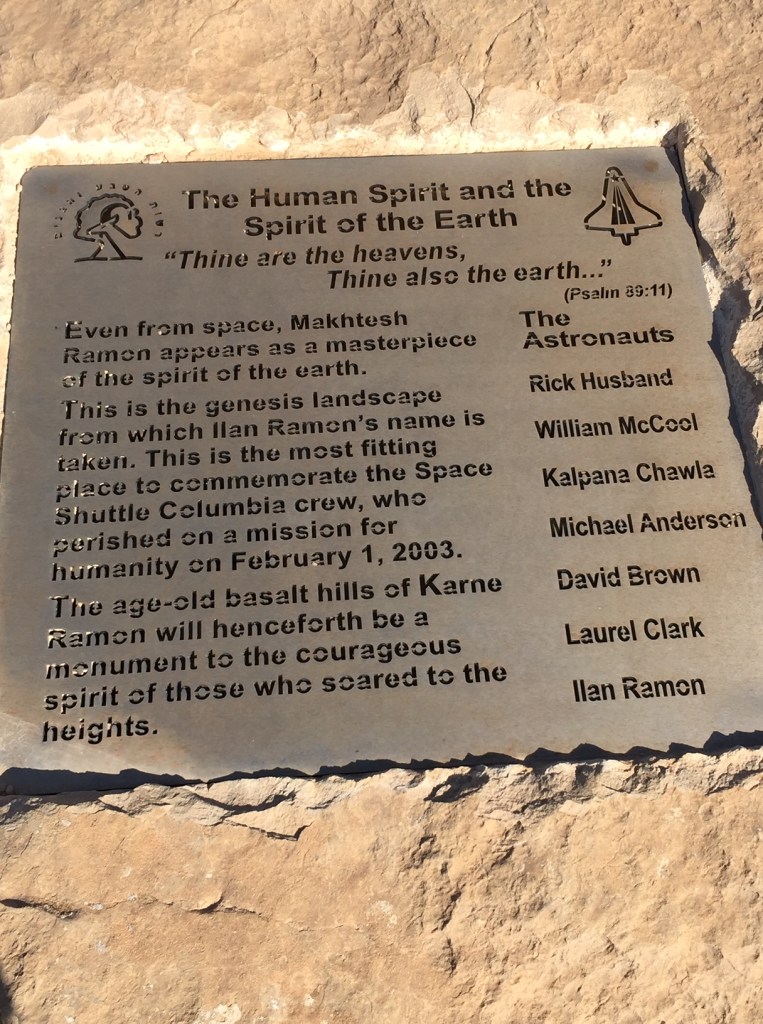
Bob’s son Yoni and his wife Shoshana live in the little town of Mitzpeh Ramon, on the edge of the Machtesh Ramon, the Ramon “Crater”. It is not a true crater, formed by an asteroid strike, but rather a kind of canyon scooped out by water over many centuries. I’ll say more when I recount our stop on the return journey — for now, I’ll just say it was nice to take a break, Shoshana fed us good food, and we were also glad to be able to visit together in the immediate aftermath of my sister-in-law’s death.
Back on the road again, we dove down into the Mashtesh, and on through the wild beauty of the desert. By the side of the road clumps of pinkish purple flowers bloomed –we didn’t have time to stop, but I think they were Pink Sunrose — Helianthemum. The soft lavender pink against the rusty orange colors of the desert in late afternoon was very beautiful.
We arrived at the border a little earlier than our guide. It was delightfully warm — we were suddenly overdressed (except Hagai who is perennially in flip-flops and a tee shirt.) We stood in the dusty dirt parking area watching crowds of Jordanian workers climbing off buses and vans and filing through the border crossing. I imagine they must mostly work in the hotels in Eilat, Israel’s southernmost city, on whose outskirts the crossing is located. It probably pays better to work in Eilat than in Aqaba, I’m guessing. It hadn’t occurred to me that people from Jordan work in Israel — it doesn’t go the other way, I’m sure!
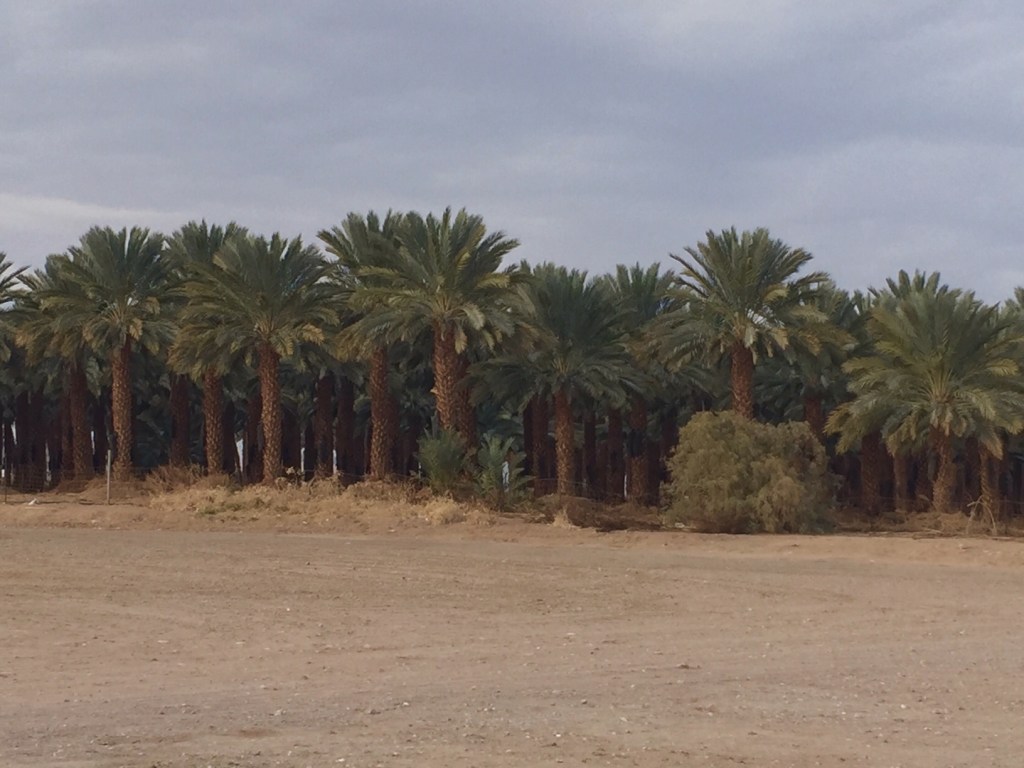
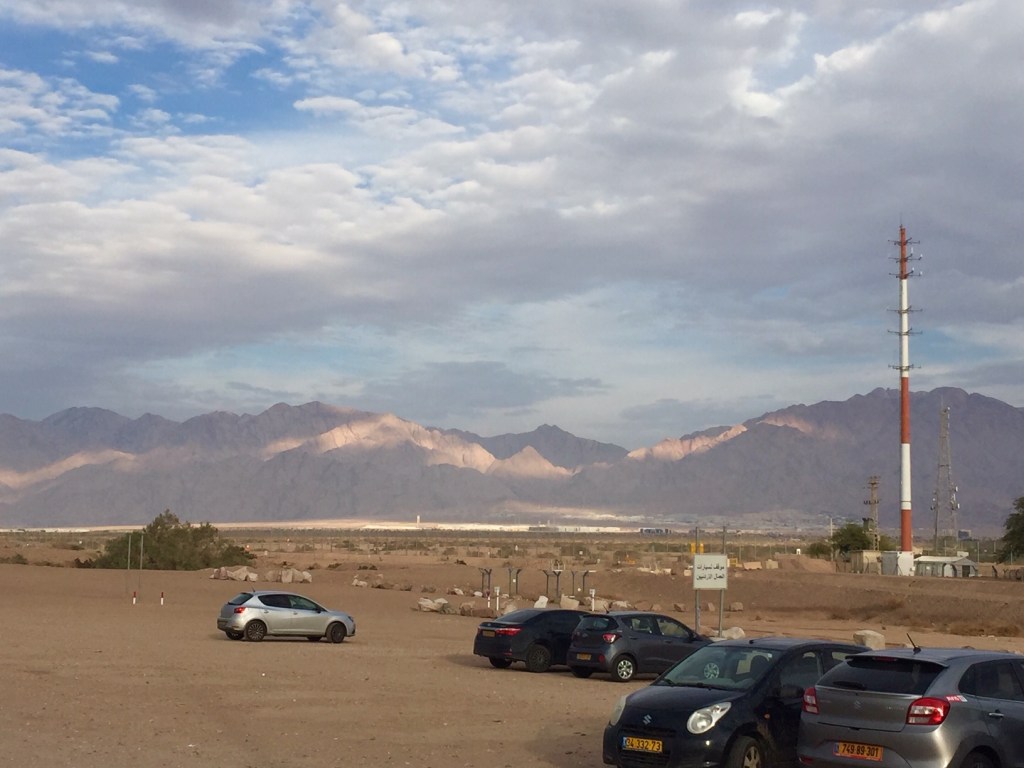
Looking one way from the parking lot we saw this — a grove of date palms.Looking the other way we saw this: Jordan.
A woman from the tour company met us, and got us started on the border crossing process. Then we were met by a young Jordanian man, who took us the rest of the way through. There were some questions about Hagai — relations are tense between Jordan and Israel at present, and so a young man from Israel is a subject of some suspicion. However, with our guide we wee able to get through the crossing fairly quickly. On the other side we were met by a driver who took us to our hotel in Aqaba, the Intercontinental.
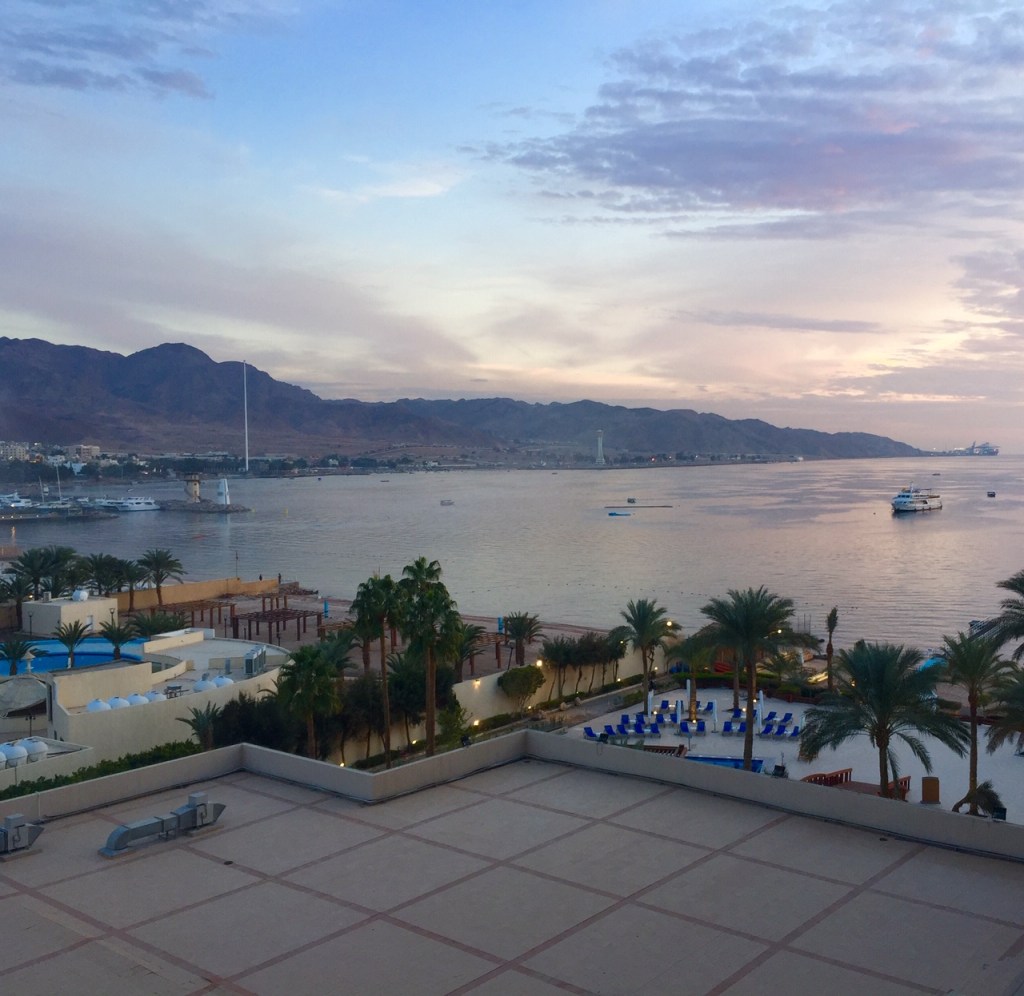
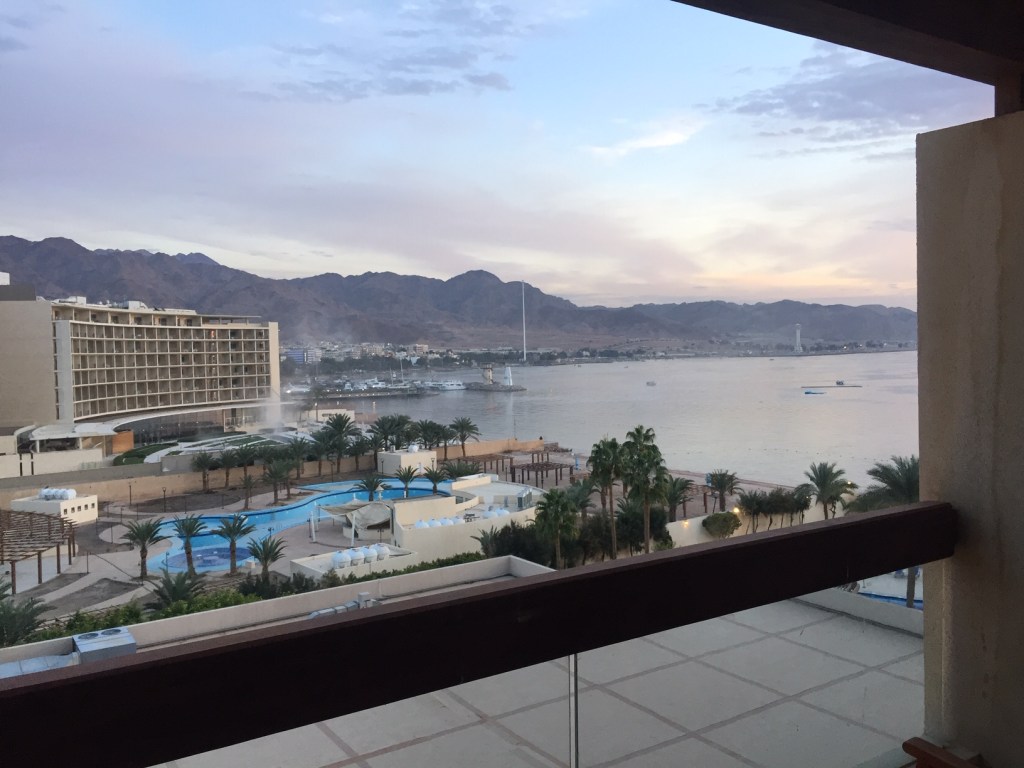
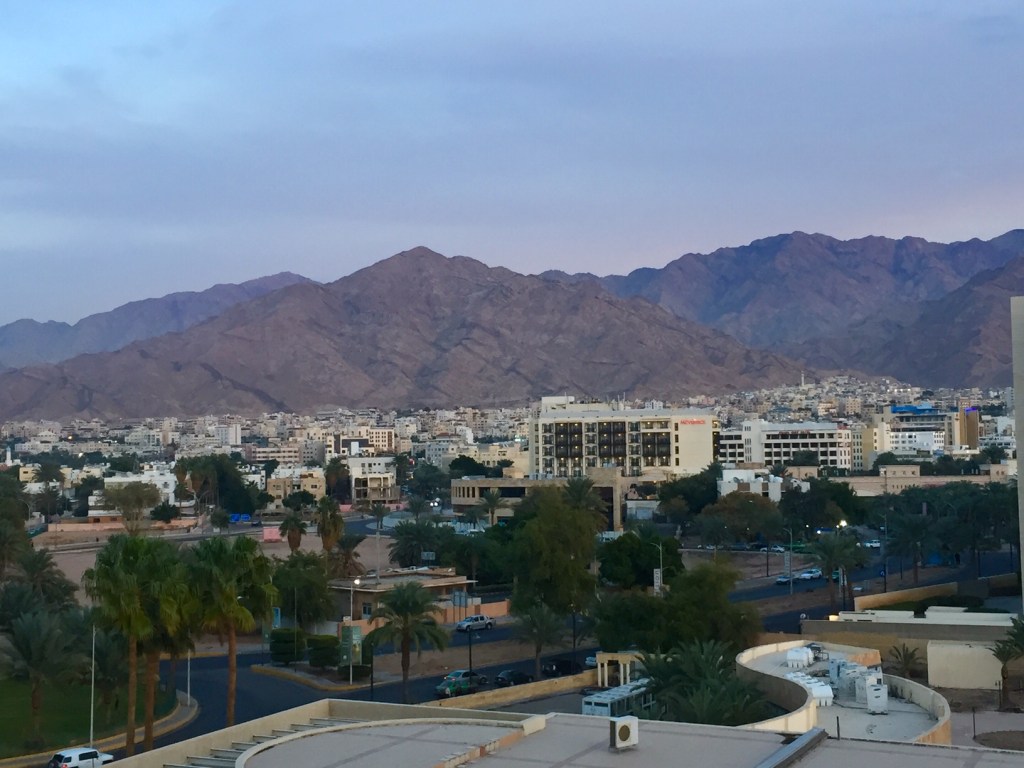
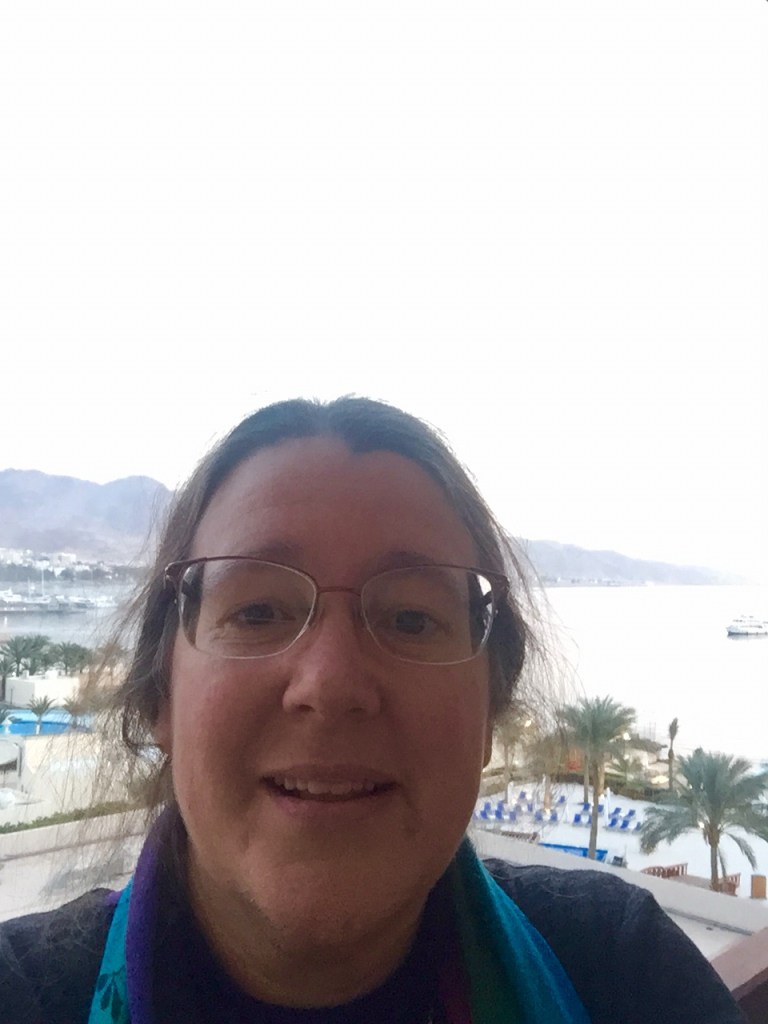
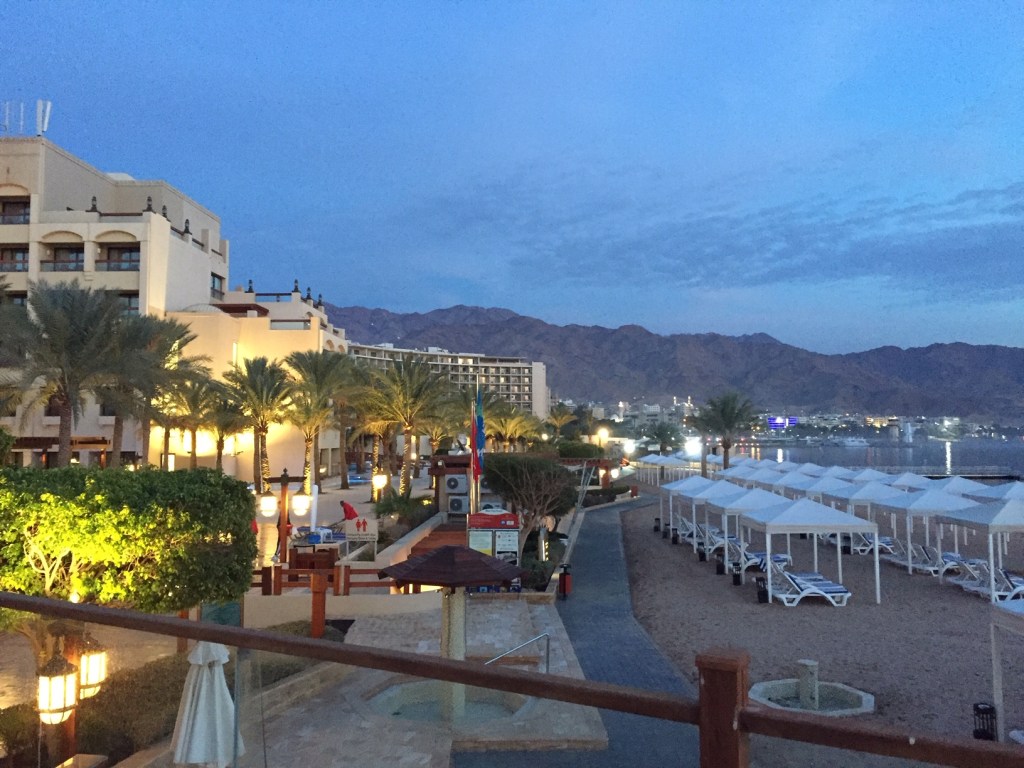
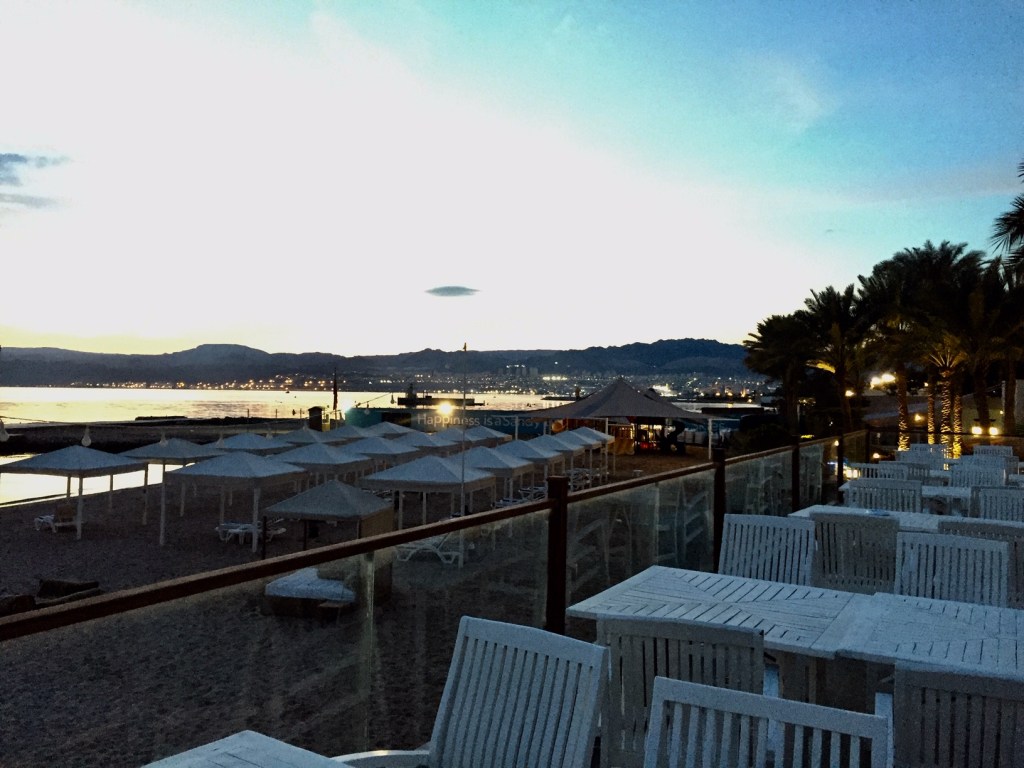
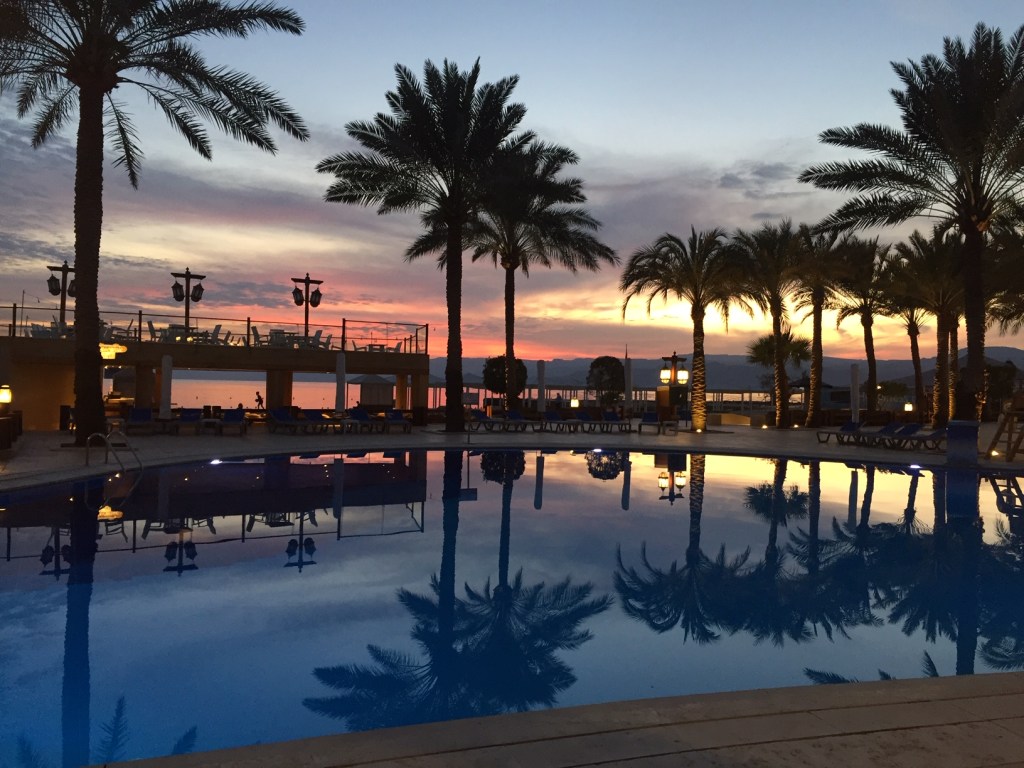
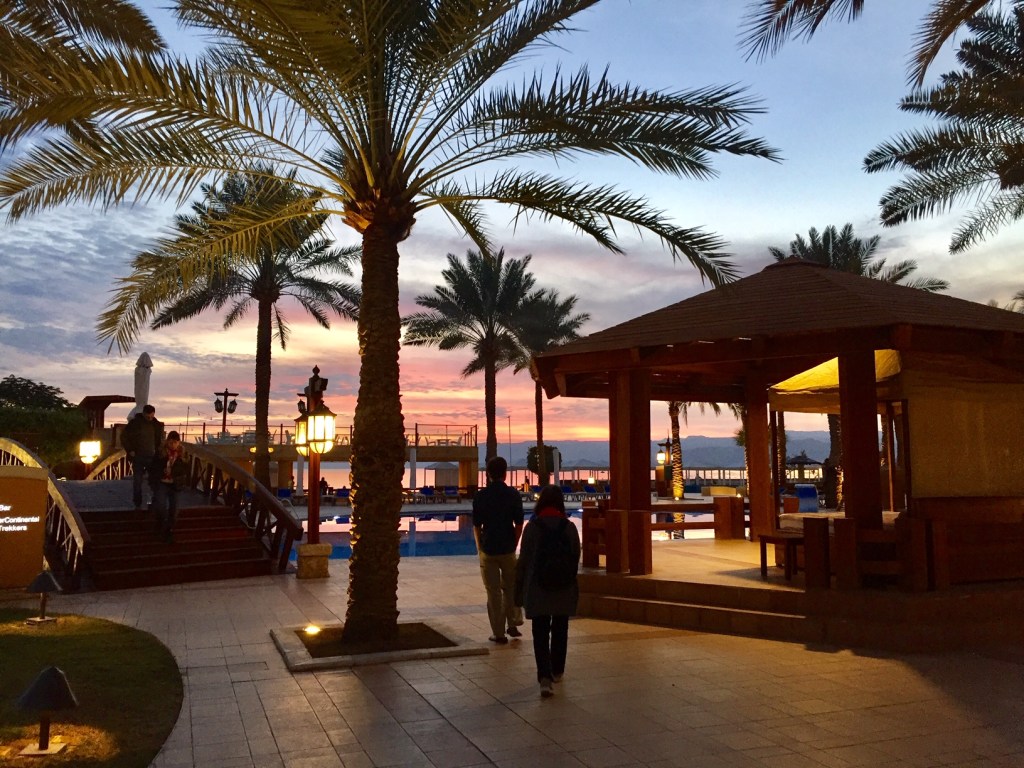
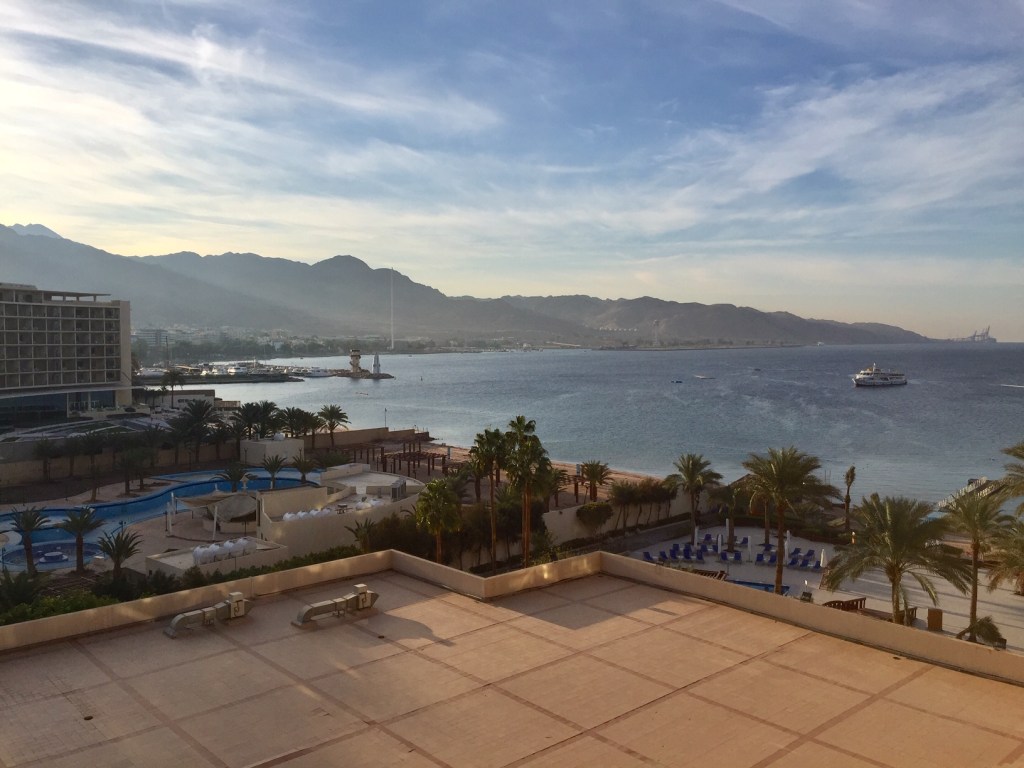
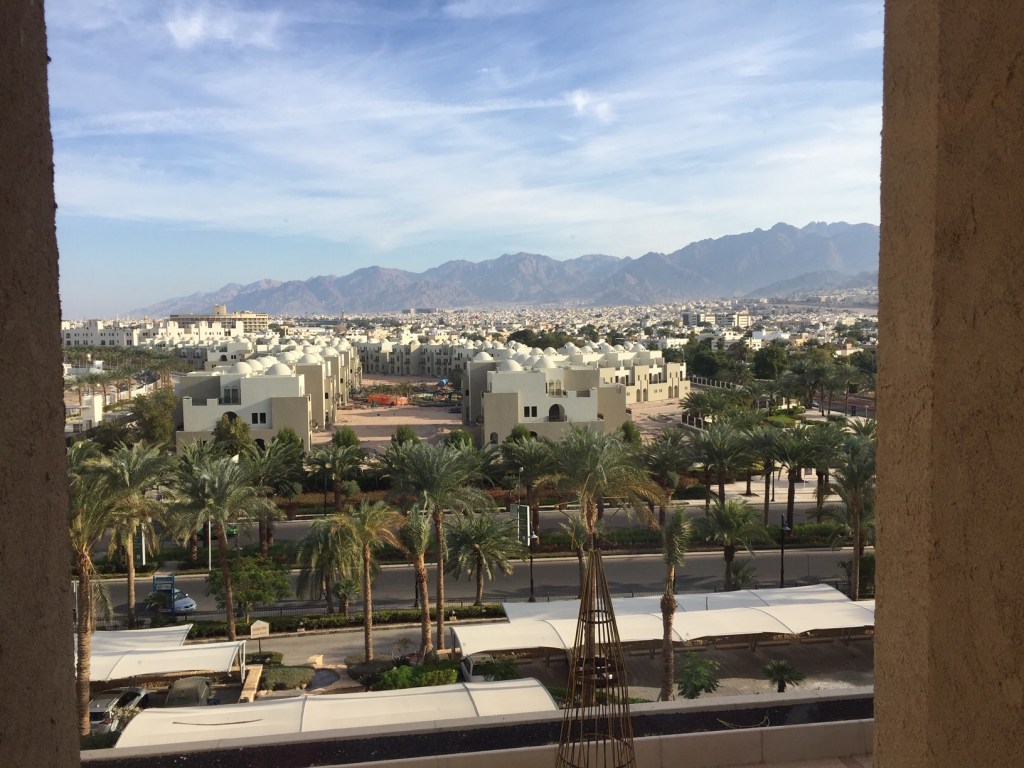
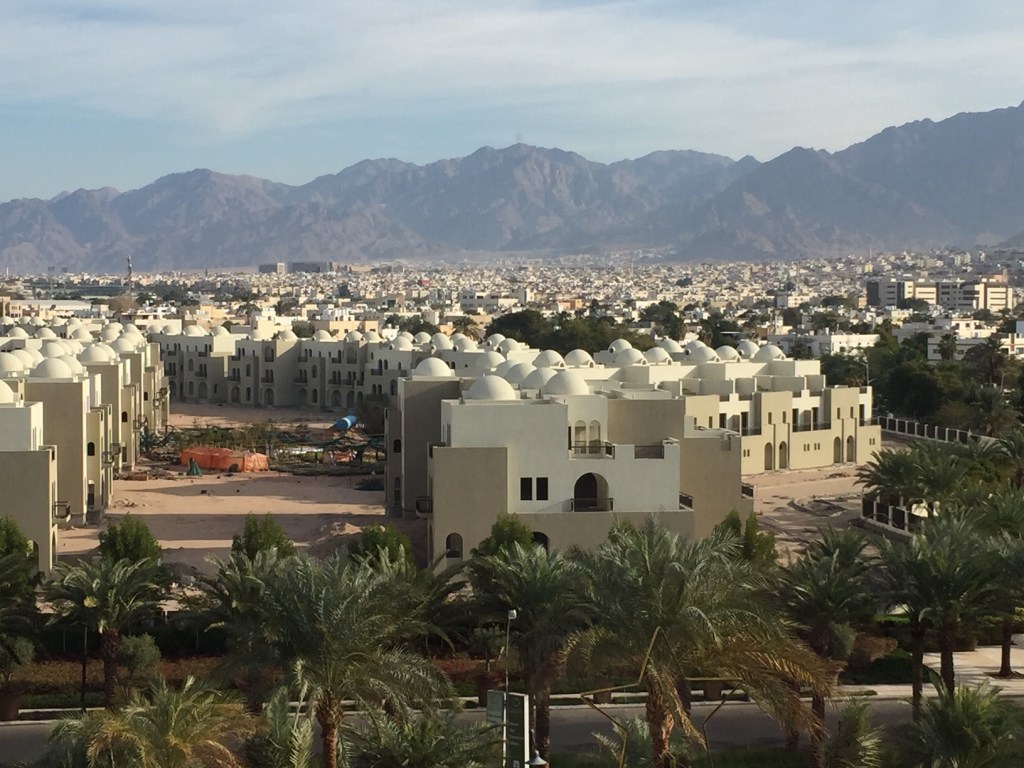
This is the view from the balcony of our fifth floor room. The water is the Red Sea, specifically the Gulf of Aqaba. We are facing south — the next country, not far away, is Saudi Arabia.The view form our balcony, looking to the left toward the mountains. Aqaba is a growing town, which supports not only tourism but Jordan’s only port. All products coming into Jordan by sea land here and are trucked north. Jordan, we learned, has no oil, so oil also is coming through the port of Aqaba.Yes, here I am in Jordan!On the beach in front of our hotel.
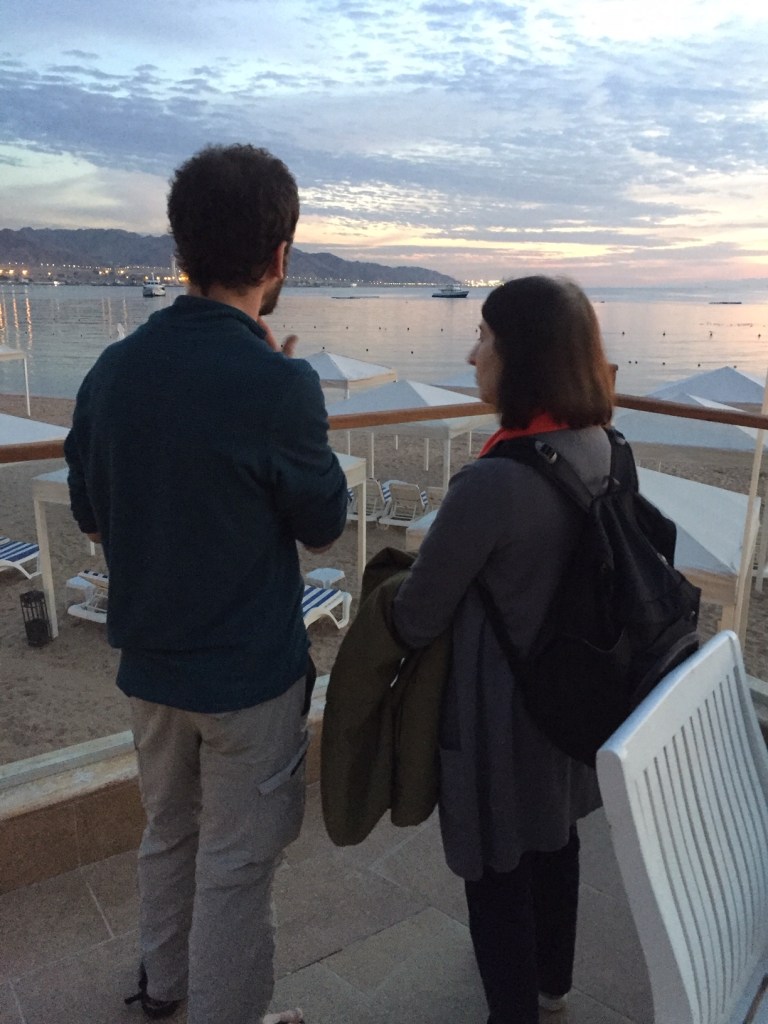
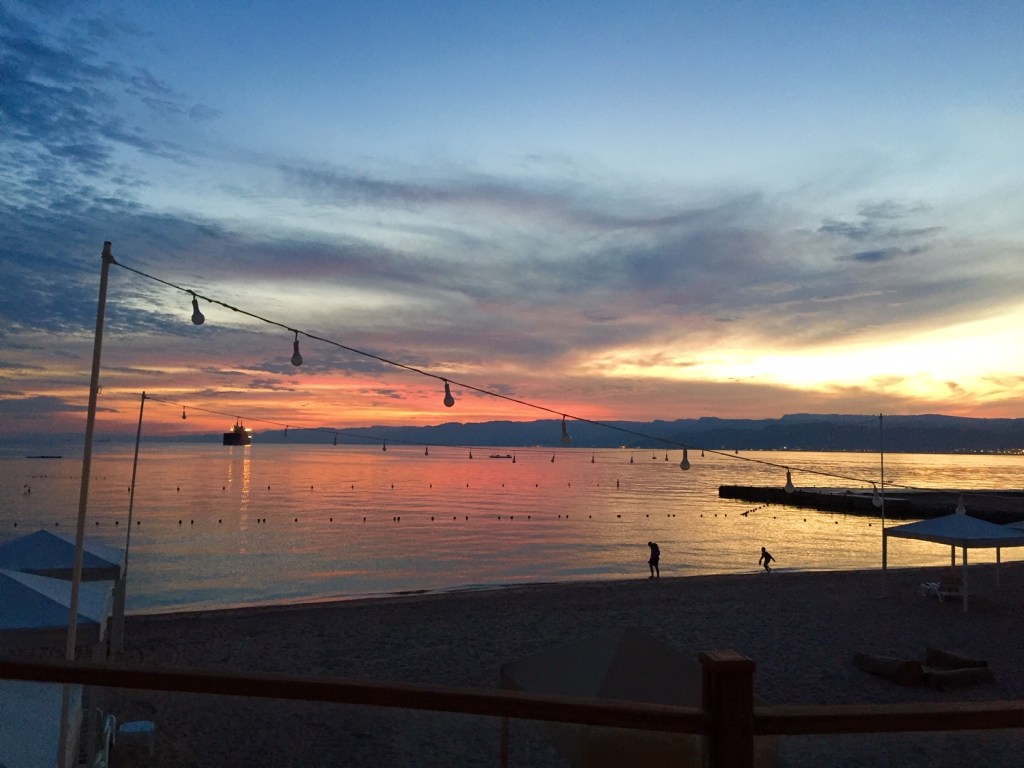
Hagai and Deborah take in the viewThere was a beautiful sunset. The far shore is Egypt. The lights in the distance are Eilat, in Israel.
We sat down by the outdoor bar and had a drink. Although there was hardly a soul there, there was music piped in to “entertain” us — truly horrible American pop music. Hagai was pained.
As it grew cooler and darker, the young man who was waiting on us–so enthusiastically: “Americans, I love Americans!”– apologetically informed us that the bar was closing. We trooped inside to the restaurant, where an extremely lavish buffet was awaiting us and the handful of other guests. We saw Europeans, Jordanians, and a group of men in white robes and red and white keffiyehs who were perhaps from Saudi Arabia. The food was beautifully displayed over many countertops and tables. There were numerous salatim, hot dishes, meat and fish being grilled on the spot, soups, and of course a huge spread of desserts. I wish I had though to take pictures! It was reasonably tasty as well.
Hagai slept the sleep of the young and innocent, while Debbie and I tossed and turned. But in the morning we rose early, partook of another extravagant buffet, and met our guide in the cavernous lobby of the hotel. And so we set off for Petra.
Morning view from our bedroom balcony.From the windows opposite the firth floor elevators, this view of Aqaba.
My husband Bob left me a wonderful family! His daughter, Deborah, who lives in New York, was the first person to come enjoy my wee guest room here in my apartment in Jerusalem. She was extraordinarily lucky — the winter weather held back its worst, and it was mostly sunny and even relatively warm while she was here. She arrived on a Friday morning, and Hagai — her nephew, my grandson — picked her up from the airport. He kindly stopped for me at the super, and even agreed to an additional stop on Rehov Emek Refaim at one of the natural foods stores. (I live within walking distance of four natural foods stores — but with my full agala it was delightful to have a car at my disposal.)
Deborah and I spent the first day chatting and preparing Shabbat dinner. I was chopping vegetables in the kitchen when we received a shocking phone call — news that my sister-in-law, Phyllis, had died suddenly at her home in Kalamazoo, Michigan. Among my family, Deborah and Phyllis were my closest supporters after Bob’s death. Their frequent phone calls were a life line for me during the hardest times, and contact with them both has continued to be an important part of my life. Deborah had just been out to see Phyllis, to help her think about her estate and prepare for the end of her life. She was nearly ninety one and had not been well — and yet, had continued her life with as much vigor as she could, visiting and hosting friends and getting out and about. Indeed, we learned that on the day she died, she had had breakfast with a friend, lunched with another, and was preparing to go out for dinner when she apparently keeled over of a fatal heart attack. As Deborah said, it was not entirely a surprise that she died –and yet, we were all surprised, as she sometimes seemed ageless and eternal.
Somehow, Deb and I pulled ourselves together to receive granddaughter Yochi and her husband Yoni and two year old Golan, grandson Hagai, and two of my friends from Pardes, for Shabbat dinner. It was a warm and friendly gathering, and yet Phyllis’s presence, for me at least, hovered around us, throwing a shadow behind our songs, our conversation, our meal, our blessings. Still we sang (in harmony, thanks to my grandson-in-law), we talked long and late of many things including Phyllis, we ate good roasted vegetables and baked chicken with Moroccan spices, and we sang our brachot and were glad for each other’s company.
On Shabbat day, Deborah and I attended no services and no meals, but slept in as late as we could, ate together, and took a long walk through the nearby neighborhoods. Deborah made and received phone calls about Phyllis. We packed for our journey ahead. My mind felt full of endings and beginnings, grief and anticipation. Life is a strange experience, but we are lucky to have our family and our friends to go through it with us…
Between the Chanukah break and the Winter break between semesters, Pardes offers a week called the Winter Learning Intensive. The theme of the Intensive this year was “The Many Faces of Me: Exploring Identity in a Post-Modern World”. I had intended to blog during that week, but our whirlwind round of classes and events was indeed so intensive that I couldn’t find a minute to write. Herewith, a brief reflection.
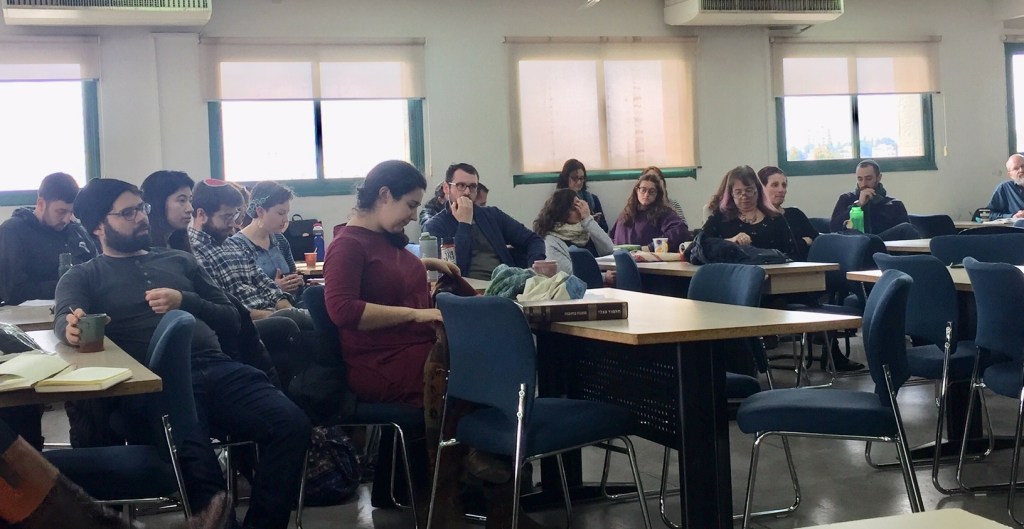
Regular Fall semester students gathered in the Beit Midrash for a “Critical Issues” talk. Many find knitting helps the learning process!
We began our week together in the Beit Midrash. The large room was very full, as a big contingent of new students had arrived just for the week: twice as many as in the picture above — every seat was filled. If you like vibrant Jewish learning, and are yearning to do it in Jerusalem, I highly recommend the Pardes Winter Intensive!
Our opening session was led by Rabbi Meesh Hammer-Kossoy. (For more about Meesh, see here: https://www.myjewishlearning.com/author/dr-meesh-hammer-kossoy/ ) She asked us to consider how our Jewish identities can be a bridge, rather than a wall, between ourselves and the world. What is identity and how is it formed? Is identity a problem or a solution? How do our collective and personal identities interweave? Meesh brought us radically different ideas from Kwame Anthony Appiah and Mark Moffett. Appiah believes that identity politics “set us against each other”, while Moffett believes it is dangerous not to form national identities, writing, “Cooperation and conflict are inseparable forms of sociation”. Ultimately, Meesh proposed that we see ourselves as both members of one universal identity — as human beings — and of multiple individual identities as well — as “children of our parents” as well as products of the choices we make in our lives. Her talk was an interesting way to set the tone for the week ahead.
My first class every morning as an in-depth look at the Book of Ruth with a teacher I had not worked with before, Tova Leah. She drew on a book by Yael Ziegler, Ruth: From Alienation to Monarchy, as well as traditional rabbinic sources. The class included an hour or more studying in chevruta (study pairs or trios) in the Beit Midrash. I enjoyed working with some of the new student, many of whom were closer to my own age than the average year student at Pardes. We did a close reading of Ruth in English and in Hebrew, using wonderful source sheets that Tova Leah had compiled for us. I look forward to bringing all the ideas from this class back to my teaching of the Book of Ruth at Shavuot in years to come.
In the later mornings and in the afternoons we had electives and sometimes whole-group activities. I took “Sexual Identity and Intersectionality” with Nechama, “The Search for Authenticity” with Yiscah, “Daughters of Egypt, Daughters of Tzelophechad: Women Leading from Personal to National Identity” with Judy Klitsner, “The Death and Rebirth of Rav: A Tale of Rabbinic Hazing” with Gila, and “Reclaiming our imperfect selves” with visiting teacher Miriam Stern.
Most electrifying of these were the class with Judy and the class with Gila. In one, I experienced the joy of studying Bible with an Orthodox feminist who is not afraid of either rabbinic or scholarly sources, and whose incisive mind brings new perspectives and exciting insights of familiar texts. (I am also reading Judy’s book, Subversive Sequels in the Bible — highly recommended!) In the other I discovered a completely different way of reading Talmud, from a modern literary criticism perspective. We read an astonishingly graphic story about the return of Rav (the leading figure of the Babylonian amora’im or writers of the Gemara ) to Babylon from Eretz Yisrael, and his “welcome” by his Babylonian counterpart Shmu’el. Gila suggested that the story is an example of what 20th century Russian philosopher and literary critic Mikhail Bakhtin called “grotesque realism”, in which “lower”, bodily things serve as metaphors for higher things. I’ll just say, this story, like many in the Talmud, seems to be fascinated with intestinal distress!
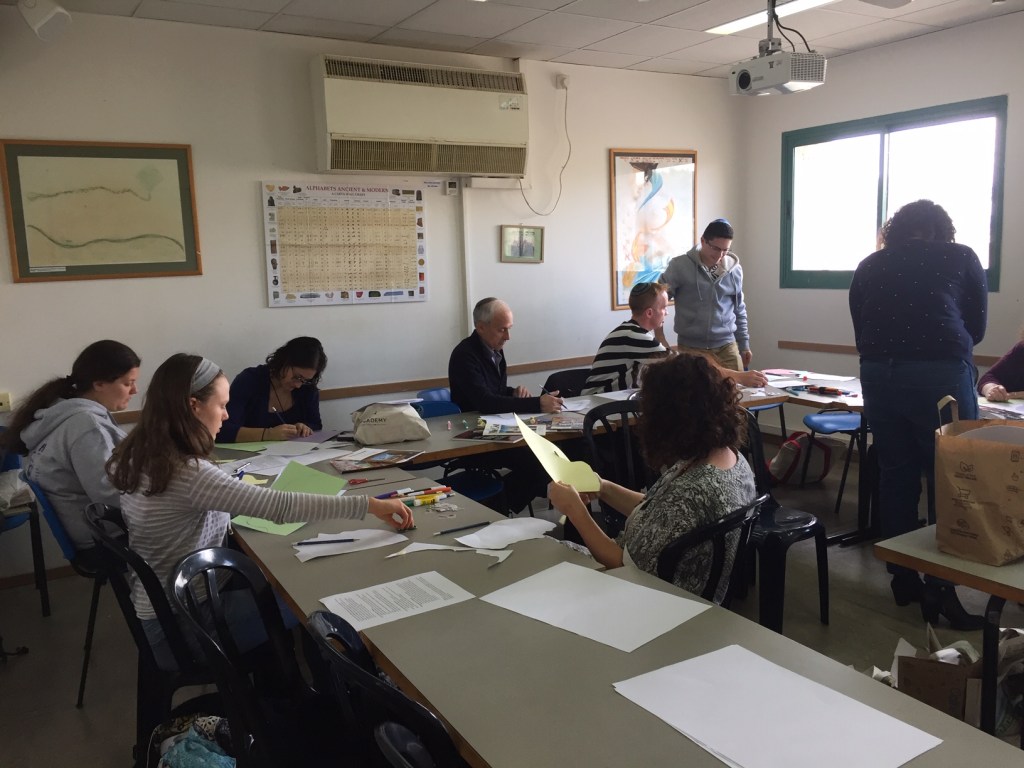
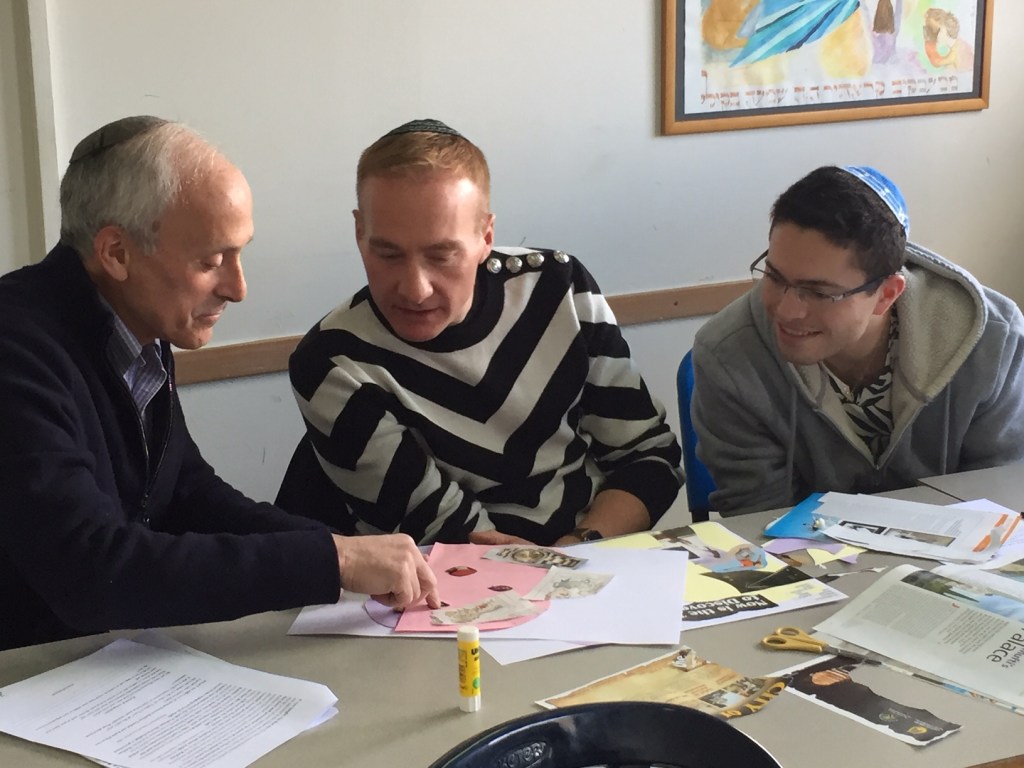
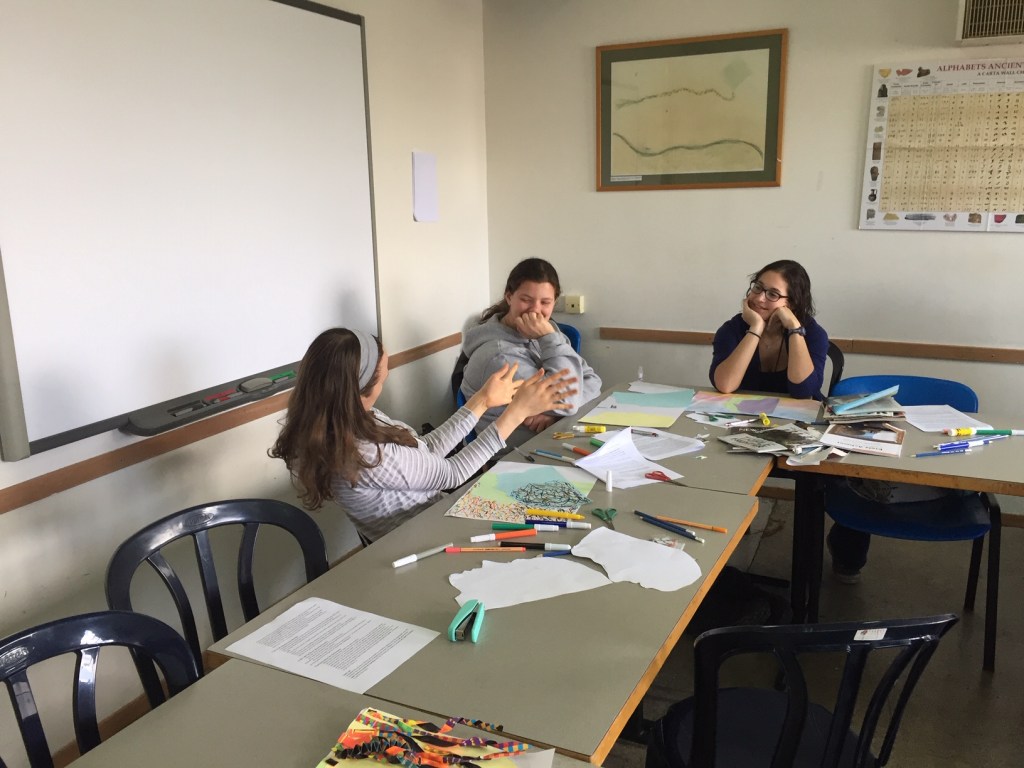
Art workshop on inner and outer identity As a facilitator I was asked to take photos My friend Sara on the right
Mid-week, I had the pleasure of being a teacher as well as a student. Regular students were invited to offer our own short classes. I taught on the topic of my Masters Thesis — applying the Alexander Technique to Jewish prayer. My brief workshop was well-attended, and I think some people took away new ideas about how to be conscious of their full “psycho-physical beings” while davenning. I also was one of several who facilitated a fun art workshop in which participants created two cut paper silhouettes of themselves and decorated them according to their perception of their inner and outer selves. I was only able to attend one of the other student taught classes, a presentation by a classmate who has worked for several international relief organizations. She provided a fascinating look at three Bible stories that involve the clash of cultures and the status of refugees, while giving us some insights into her own work.
The week concluded with a faculty panel on “Commitment, compromise, sacrifice: Living a Jewish Identity”, which sadly provided no deeper insights, and the usual Thursday community lunch. Then it was time to say goodbye to our new friends, and also to those students who were only with us for the Fall semester. I will miss some good friends very much — Anne Gaelle, a rabbinical student and former journalist from France who was one of my chevrutot; Golda, also from France, a student with a dry wit; and Eitan, a lovely young person from San Francisco whose gentle presence greatly enriched my life at Pardes.
But I was already preparing for my vacation, the arrival of my husband’s daughter Deborah, and a trip to Jordan…see my next post!
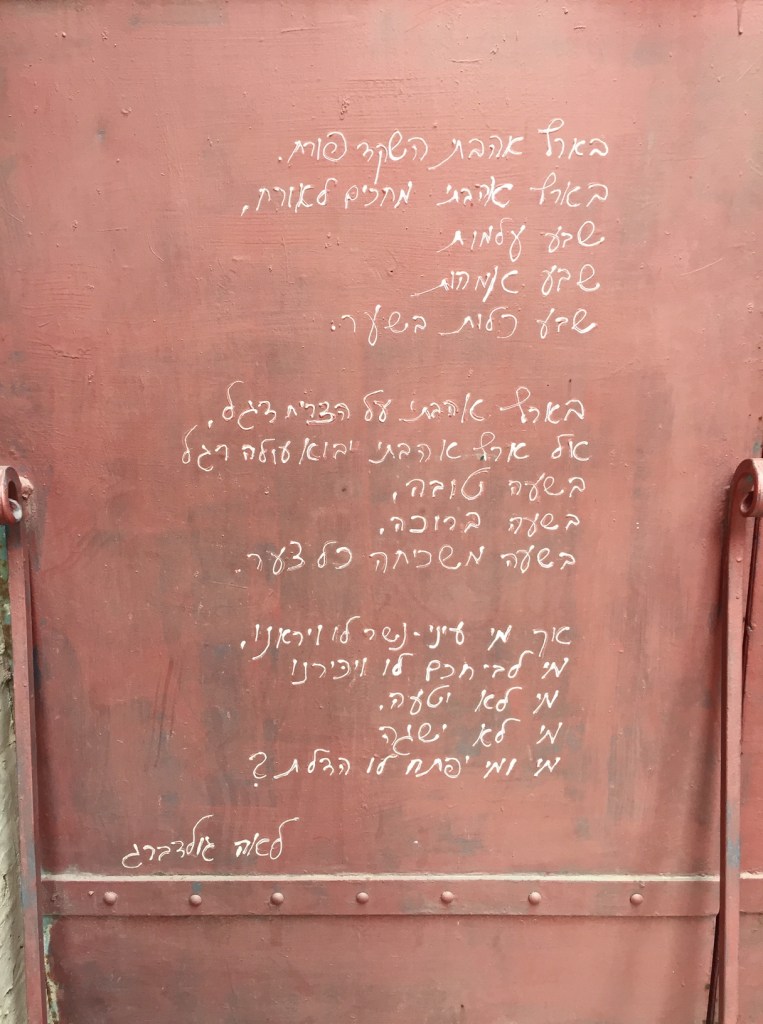
I have located a translation of this poem — which has also been set to music. I did start my own translation, but I was glad to find someone else’s, which is much more accurate! Here it is:
In my beloved country the almond is blooming. In my beloved country a guest is awaited by Seven maidens, Seven mothers, Seven brides at the gate.
In my beloved country there’s a flag on the turret. To my beloved country a pilgrim will come At a good hour, A blessed hour That causes all sorrow to be forgotten.
But who has eagle eyes and will see him? Who has a wise heart and will know him? Who won’t be mistaken, Who won’t err, Who will open the door for him?
Before I got a cold, I had a couple of days out and about. Here are photos from those days. The captions tell the story. Happily I am over the cold, and maybe will one of these days finally write that post about all the stuff I’ve been avoiding…in the meantime, enjoy.
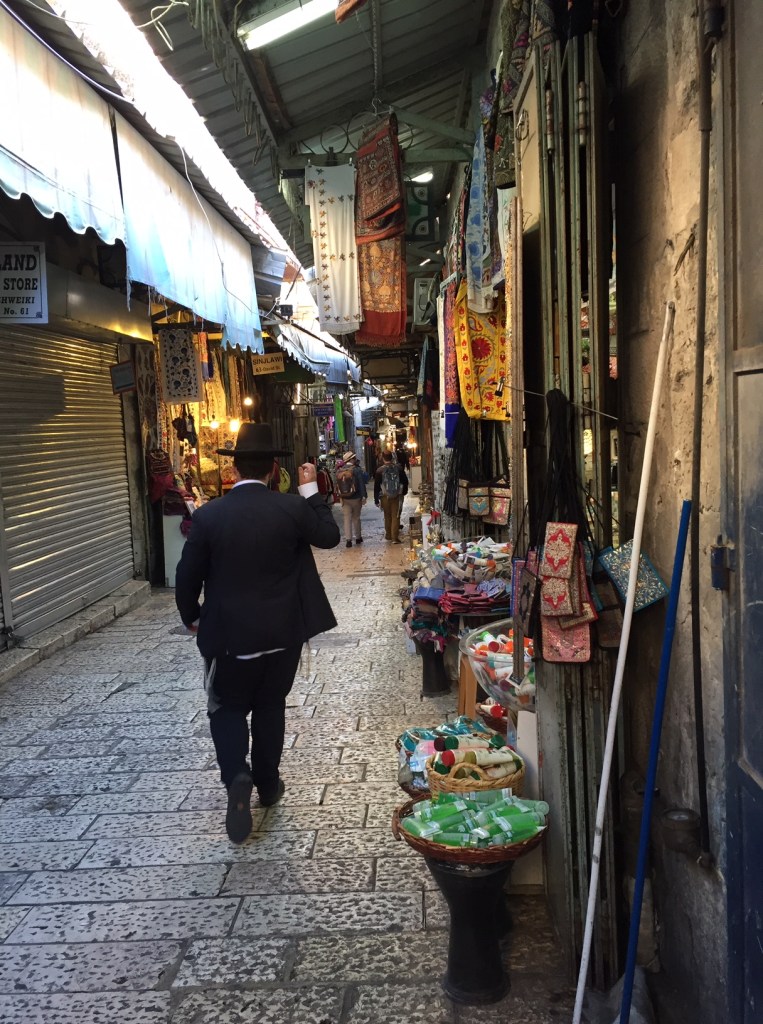
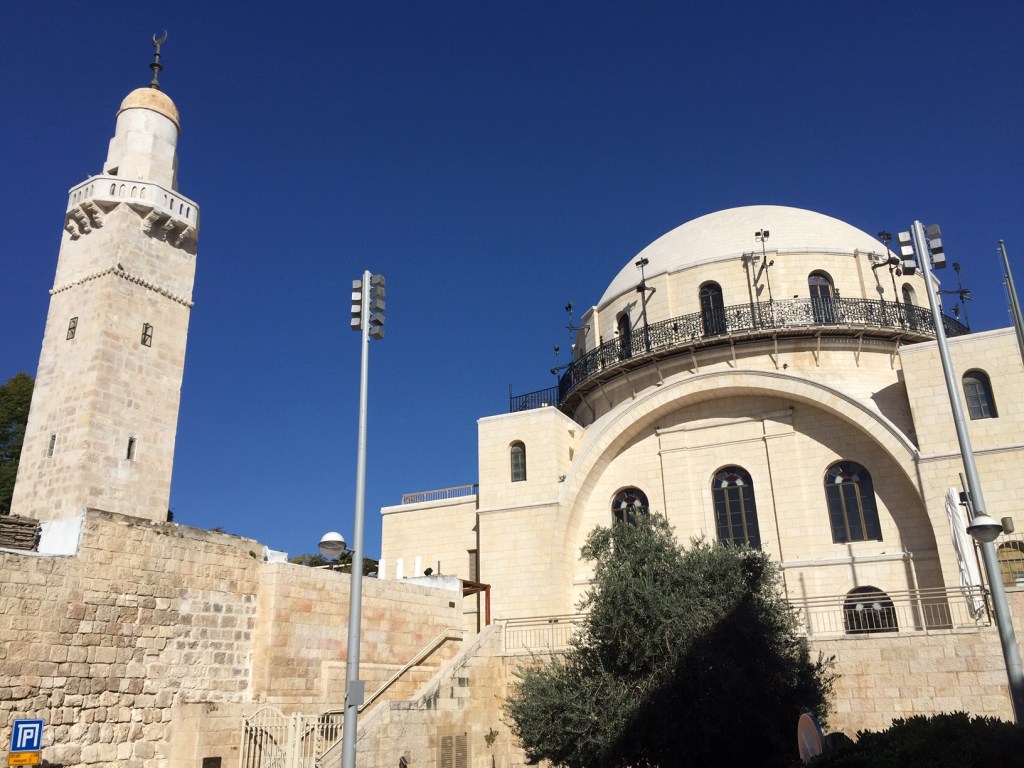
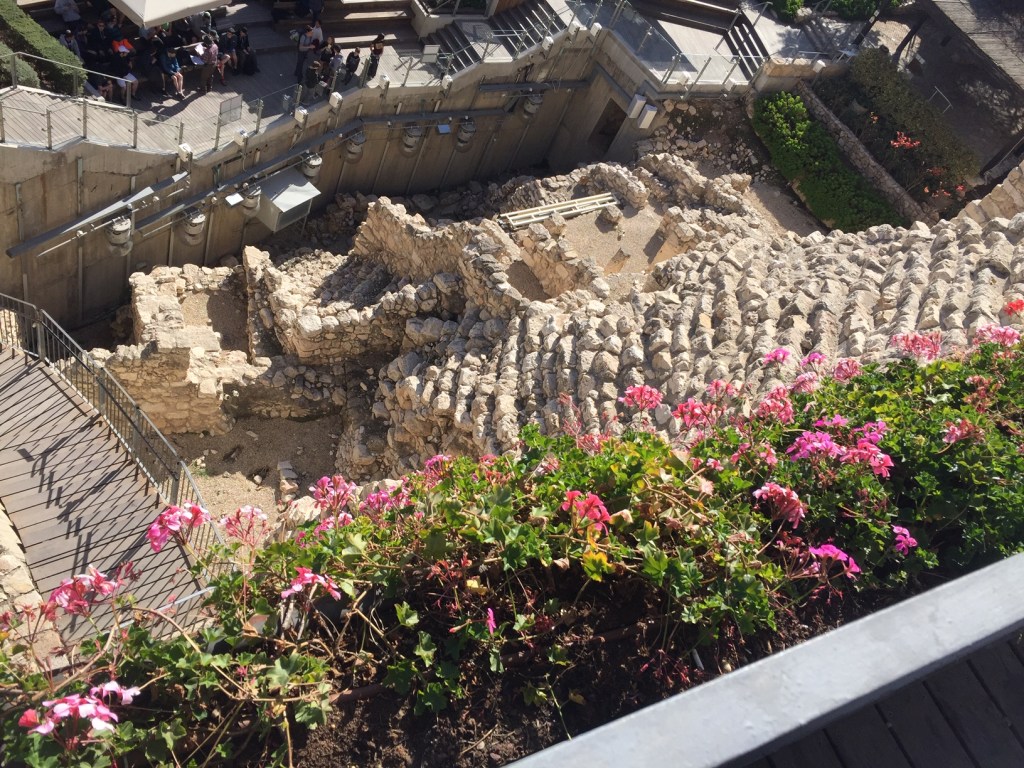
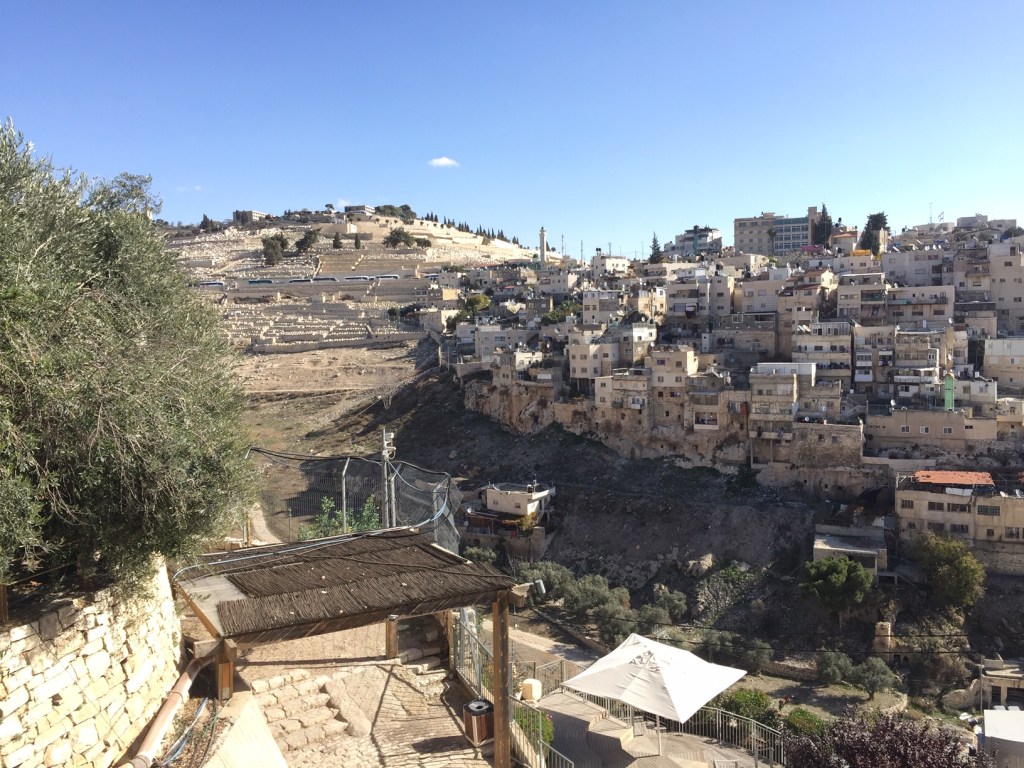
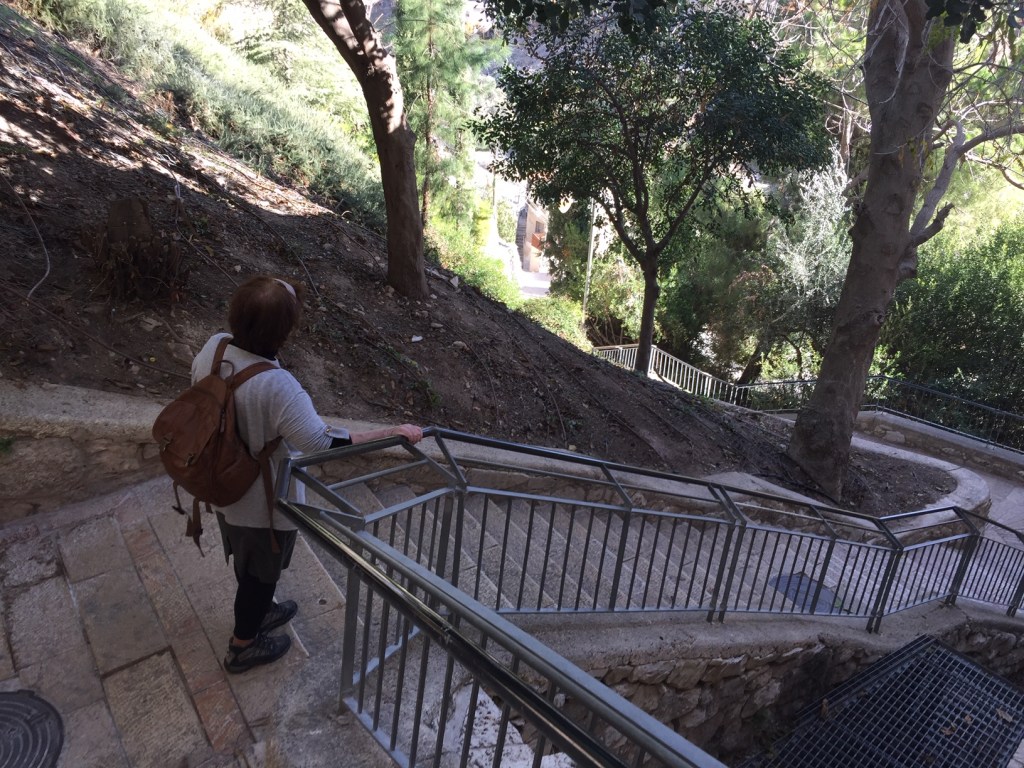
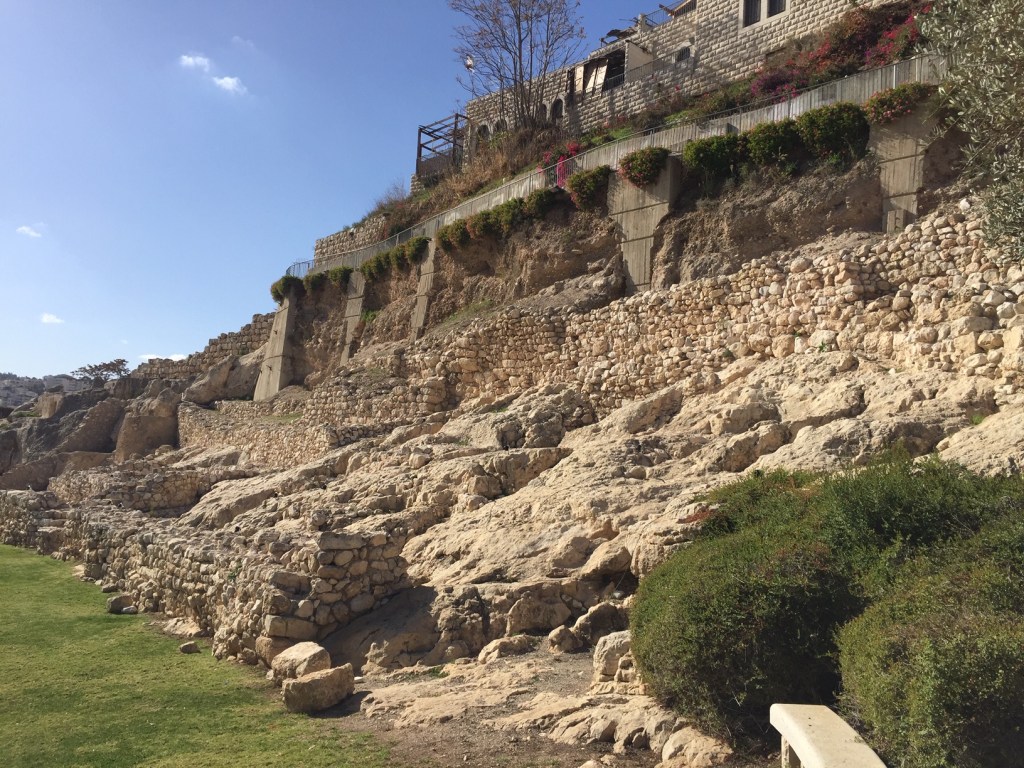
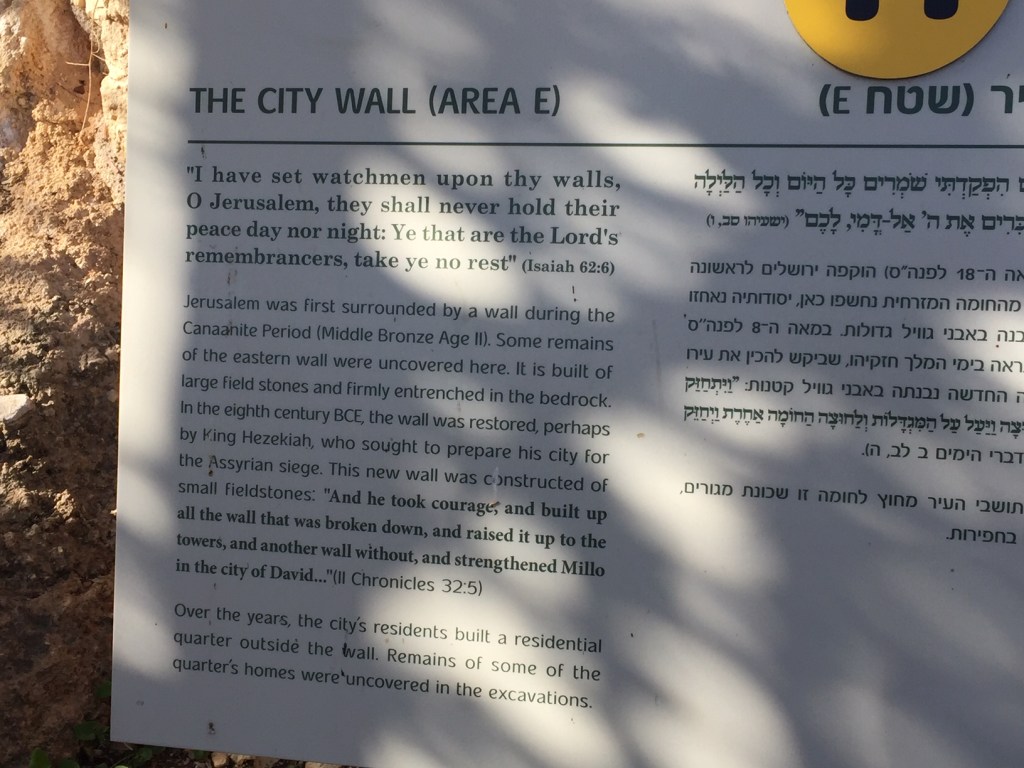
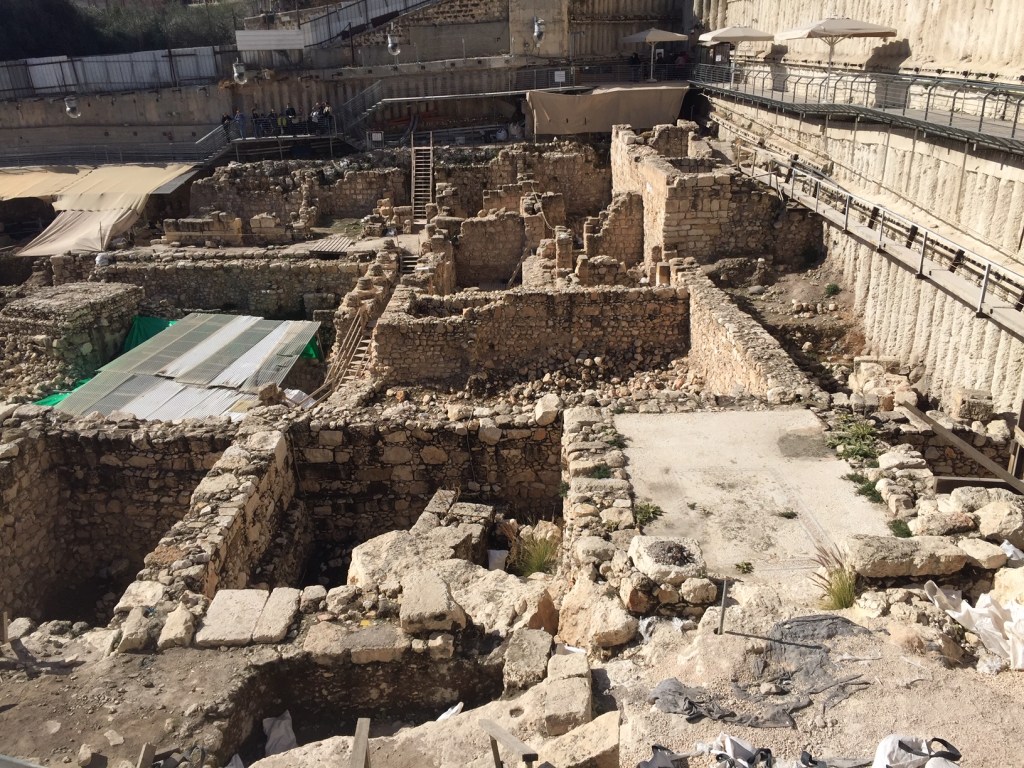
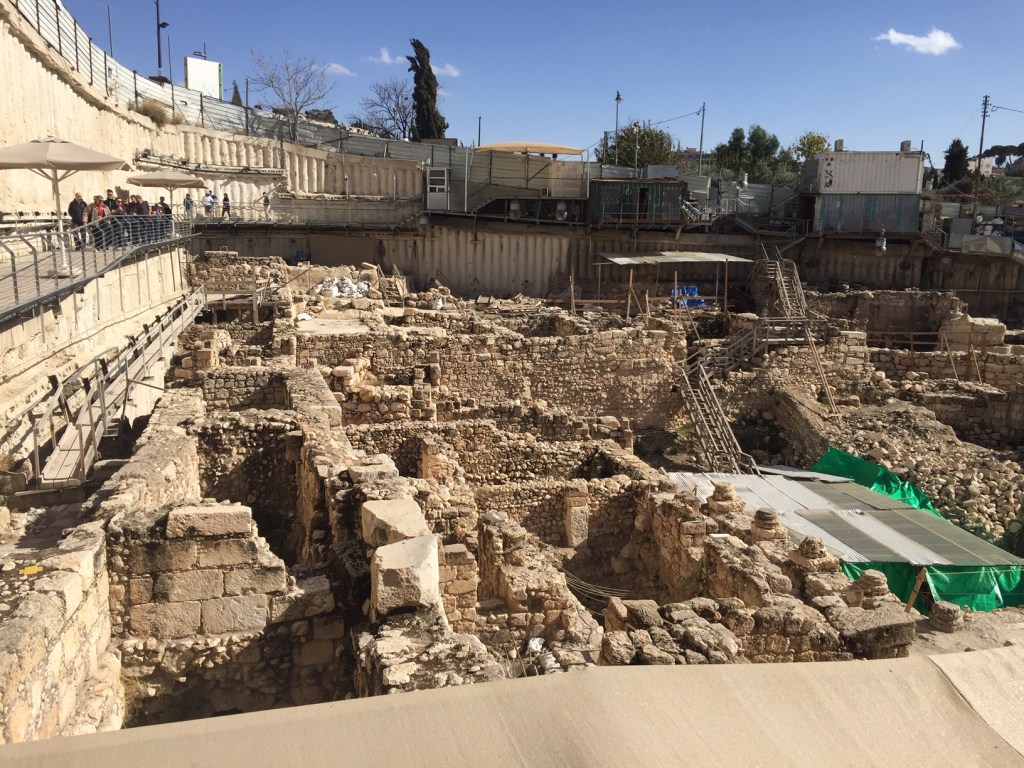
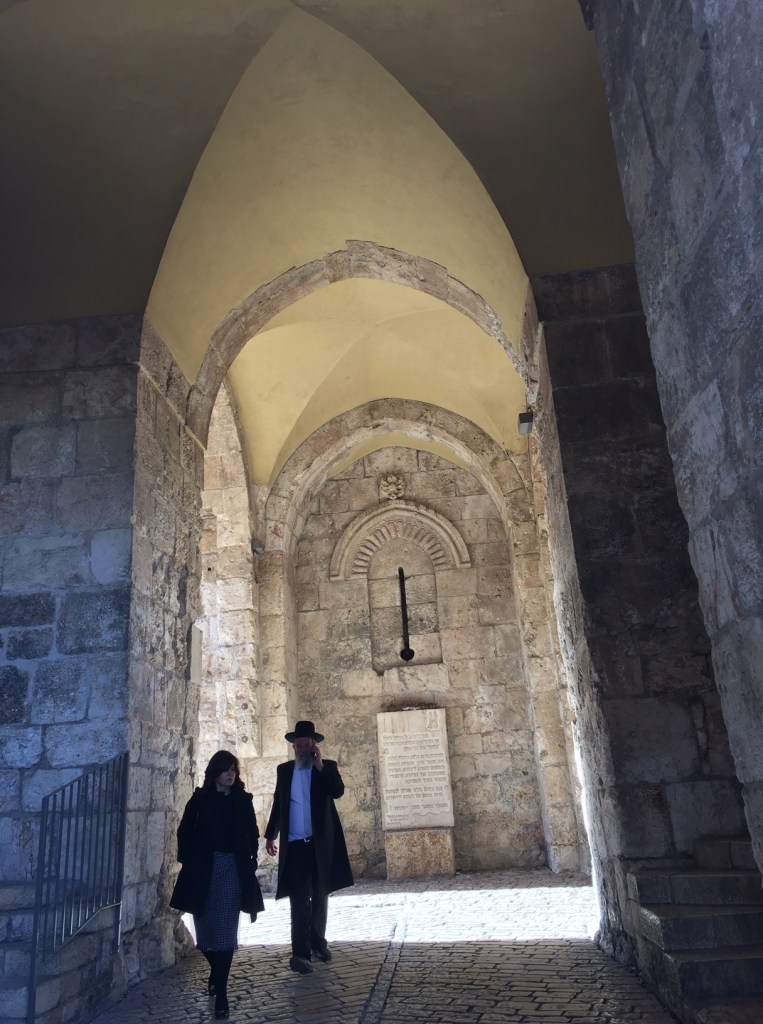
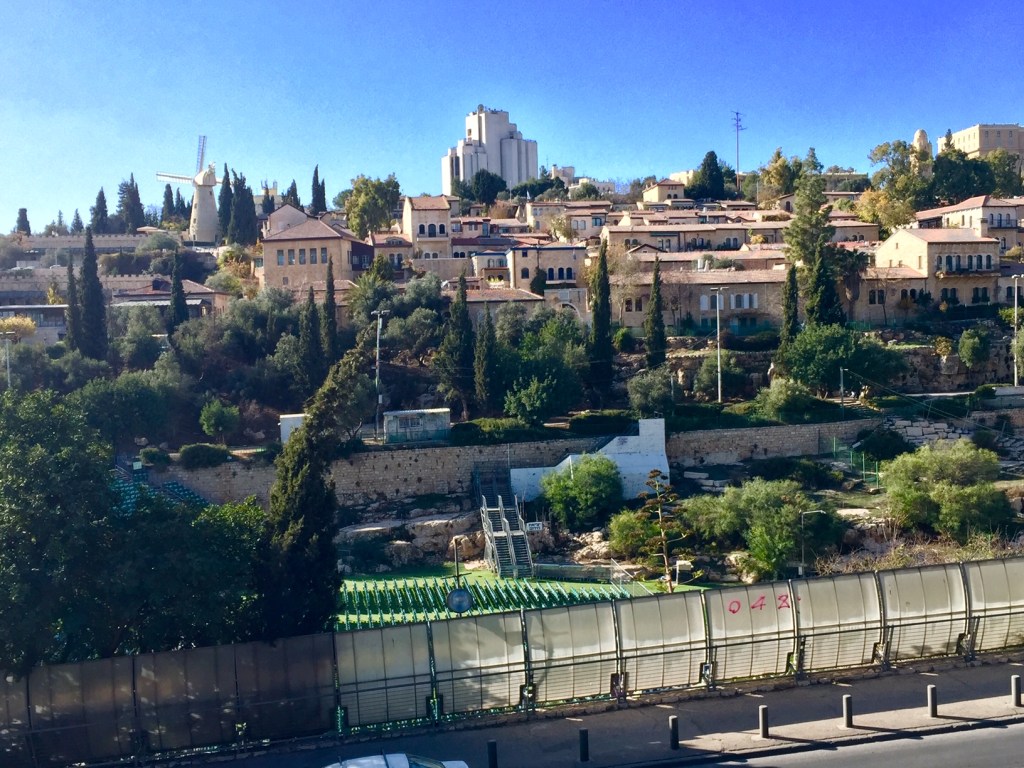
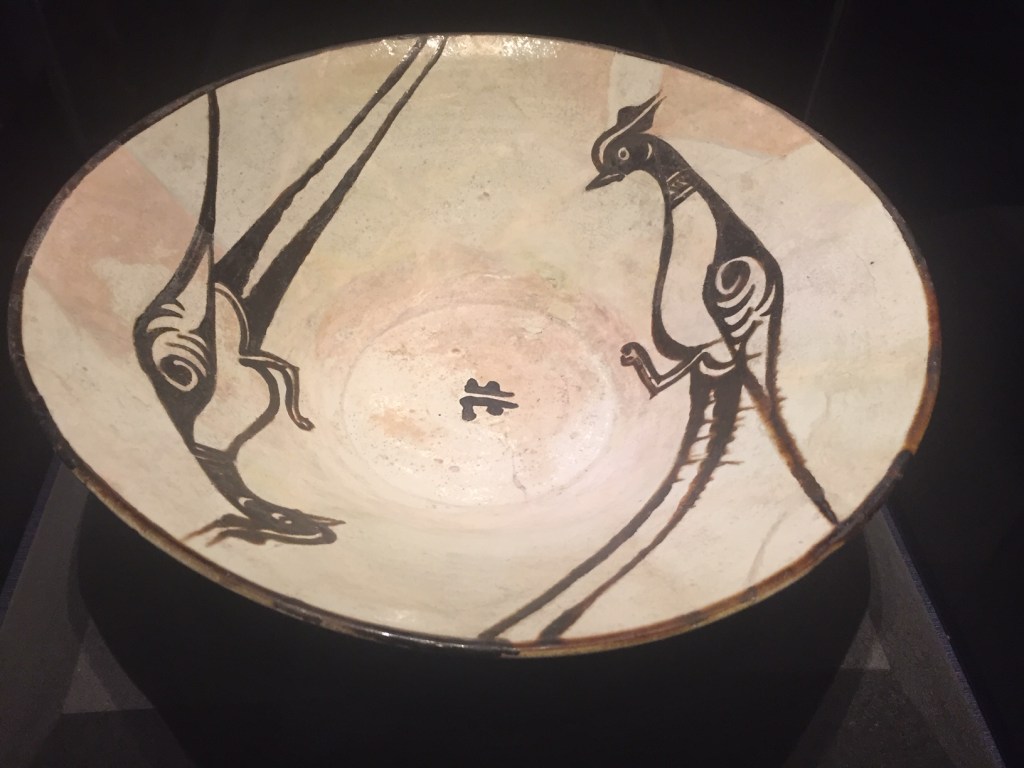
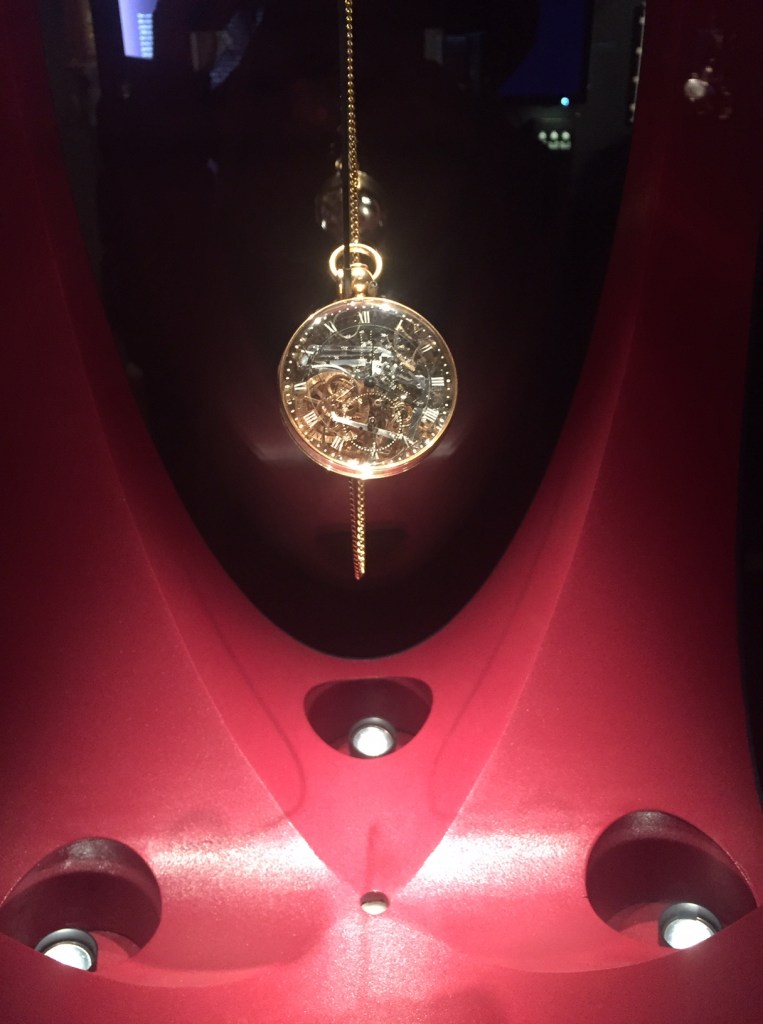
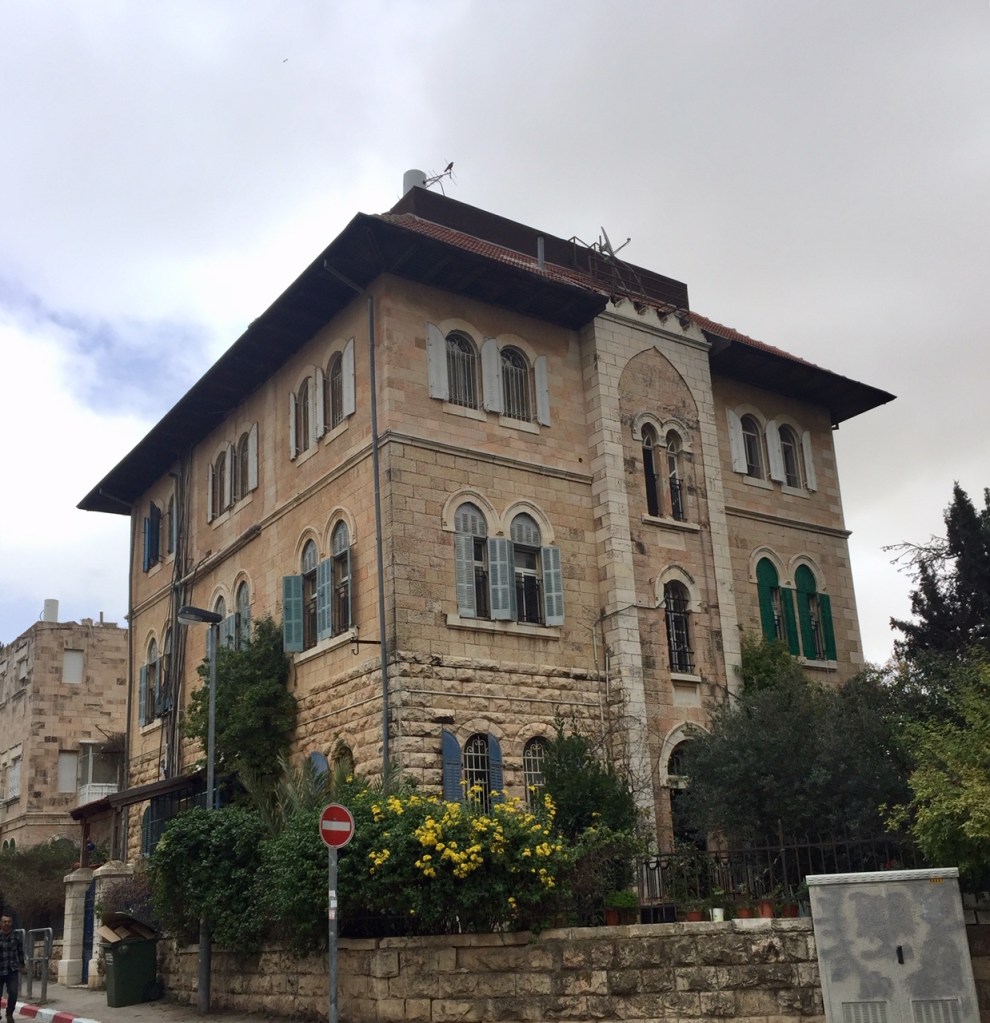
Walking through the market in the Jewish Quarter Old City — on my way to meet Laurie.The Hurva Synagogue, which was finished in 2010. To the left, Caliph Omar, a mosque not in use (since it’s in the Jewish Quarter). I met Laurie at a coffee shop here, and we walked down to the Western Wall and davenned. Then we bought tickets to the City of David excavations.City of David. A many-layered, complex, and much argued-about archeological dig below Har HaBayit (the Temple Mount). Here’s the official story: http://www.cityofdavid.org.il/en/about To the left the Mount of Olives. To the right, Silwan. The whole complex is on the side of the hill — here is Laurie, descending. This was a parking lot. It has revealed several layers of history — Islamic, Roman, Israelite.And here is an article that is reasonably balanced, on the complexity of the whole topic: https://www.nytimes.com/interactive/2019/03/30/opinion/sunday/jerusalem-city-of-david-israel-dig.htmlLaurie and I had lunch in the Old City. Then I used Googlemaps, with less than total success, to get us to the #13 bus. We left the Old City by the Zion Gate, having passed through the lanes next to the old Armenian Cemetery and the Church of the Dormition (see earlier posts of mine for photos of these sites from the top of the ramparts above).I’m afraid I dragged poor Laurie (and myself!) on a long walk — down into Geh Hinnom, up the other side through Mishkenot She’ananim (which you see here)…and when we got the bus finally, it turned out my Ravkav card was empty and she had to pay for me. This is my public apology!!!The next day I met some friends at the nearby Museum of Islamic Art. I loved this beautiful bowl! In the basement of the museum is a large collection of timepieces — mostly watches. This is the Marie Antoinette watch — the most valuable watch in the world. You can read more about this remarkable watch here: https://en.wikipedia.org/wiki/Marie_Antoinette_(watch) It was fun to see this exhibit with a fellow student who has worked in a clock museum. One of the beautiful villas in the German Colony. We were strolling toward Emek Refaim street and Sushi Rehavia restaurant, where I had some tasty Pad Thai.As I made my way home, I discovered this poem on the gate of a house near mine. It’s by Leah Goldberg. I had to look her up — here she is: https://en.wikipedia.org/wiki/Leah_Goldberg I haven’t been able to find a translation, so I’ve been working on my own — I’ll post it when I’m done! If you know Hebrew, enjoy!

 Nine months in Israel